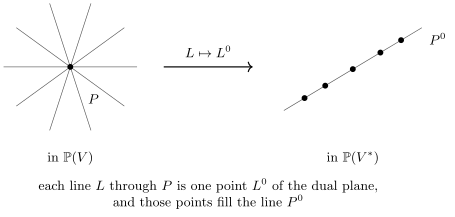
Two facts about the projective plane sit side by
side. Two distinct points lie on exactly one line; two
distinct lines meet in exactly one point. Read either
sentence aloud with “point” and “line” exchanged and you
get the other. This is not a coincidence and it is not a
philosophy: Chapter 5 already built the machine that
produces it. A hyperplane of is the set of
points killed by a linear functional, the functional is
determined by the hyperplane up to a scalar, and so the
hyperplanes of are themselves the
points of a projective space, namely . This section
turns that observation into an inclusion-reversing
dictionary between the projective subspaces of and those of , gets the
dimension bookkeeping right at both ends, and says
exactly how much of the “duality principle” we are
entitled to claim.
Throughout, is
an arbitrary field and is a finite-dimensional
vector space over
with , so that has dimension
(Definition 22.6.1). No
hypothesis on the characteristic is needed anywhere in
this section, and no analysis is used. We keep the two
extreme projective subspaces in play: , of dimension , and itself, of
dimension . The
correspondence below exchanges them, and it is precisely
at those two ends that a duality argument is easiest to
get wrong.
Projective
subspaces remember their subspaces
Everything rests on being able to move between a
projective subspace and the subspace
it came from.
That is the content of a short lemma, proved in Section
6 and recalled here because almost every proof below
uses it.
Lemma
22.8.1 (Passing Between and )
Let
be subspaces of .
- (a) if and only if . In
particular is injective, so a projective subspace
determines its subspace.
- (b) .
- (c) , where is the join, the
smallest projective subspace containing both (Proposition 22.6.5).
One consequence will be used repeatedly: if are
projective subspaces of the same finite dimension, then
. Indeed by (a)
and , so by Theorem 1.6.8.
The points
of the dual space are the hyperplanes
A hyperplane of is a projective
subspace of dimension , that is, for a hyperplane
of in the sense of Definition 5.5.2. In these are the
lines; in ,
the planes.
Now the hook. A hyperplane of is the kernel of a
nonzero functional (Theorem 5.5.3), and the
functional is determined by its kernel up to a scalar,
which is the injectivity half of the next proposition.
“A nonzero vector of , up to a nonzero
scalar” is exactly the description of a point of . So the
hyperplanes of are not merely a
set: they are the points of a projective space of their
own, of the same dimension.
The dual projective space is the space whose
points are the hyperplanes of the original.
Definition
22.8.1 (Dual Projective Space)
Let be a
finite-dimensional vector space over with . The
dual projective space of is the projective
space of the dual space (Definition 5.1.2). A point
of is a
class
with nonzero, and
exactly when for some .
Its dimension is , by Corollary 5.1.4: the
dual projective space has the same dimension as the
original. That is worth pausing on, because the
correspondence we are about to build reverses dimensions
inside a space of unchanged size.
Nonexample by minimal change. Take
. It is
a perfectly good element of , but is not a point of
— the
definition excludes the zero vector, as Definition 22.6.1 does.
And indeed , which is not a hyperplane: it has
codimension , not
(Definition 5.5.2). The
clause “nonzero” is exactly what keeps the following
bijection honest.
Proposition
22.8.2 (Points of the Dual Are
Hyperplanes)
Let . The map is a well-defined bijection from onto the set
of hyperplanes of .
Idea. Three checks. Well defined:
proportional functionals have the same kernel.
Surjective: a hyperplane has by the
annihilator count, so it is cut out by some nonzero
functional. Injective: two functionals with the same
kernel both lie
in the one-dimensional space , so they are
proportional. The counting does all the work.
Proof. Well defined. If
then
is a
hyperplane of by
Theorem 5.5.3, so is a
projective subspace of dimension , a hyperplane of . If , then
with , and if and
only if , so .
Surjective. Let be a hyperplane of
, so . By Theorem 5.2.2, , so there is a nonzero . Then
by Definition 5.2.1, and both
have dimension —
the second by Theorem 5.5.3 and Theorem 4.4.5 —
so
by Theorem 1.6.8.
Injective. Suppose with . Then ,
which has dimension as above. Two nonzero
vectors of a one-dimensional space are proportional, so
with , that is,
.
In coordinates this is completely concrete. Take
with
coordinates . By Theorem 5.1.1 every
functional is for a unique , and
this identification is a linear isomorphism . So a point of the dual plane is
a class , and the hyperplane it names is The equation is homogeneous, so it does not
matter which representative we substitute;
and scaling does not change
the solution set. Both scalings are exactly the ones the
projective spaces divide out.
Example
(A line and its point)
In ,
find the point of the dual plane naming the line through
and . Then find the
point where the lines and meet.
Solution. The line. Its
subspace is , of dimension
. By Theorem 5.2.2, ,
so one nonzero functional does it. We need and , whose
solutions are the multiples of .
Check: and . So the line is ,
named by the dual point .
The meet. Dually, we need with and
.
Subtracting, ; then . The solution space is spanned by , so the two
lines meet in the single point . Check: and .
The two computations are the same computation, run in
and in . That is the whole
of duality in one example.
Warning. There is no
canonical duality between and
itself. The rule “the point names
the line ” looks like a self-duality of , but it depends
on the coordinates. In the rule
assigns to
the line . Change coordinates by , , . The same
point is in
the new coordinates, and the same rule now assigns to it
the line , that is, . These are different lines: the point
lies on
the first, since , and not on the second, since . What is
canonical is the correspondence between and , not one
between and
itself. Identifying the two requires a choice — a basis,
or a nondegenerate form, which is how the pole and polar
of a conic will be built in Section 10 of this
chapter.
The
duality correspondence
We now extend from hyperplanes to
all projective subspaces. The right tool is the
annihilator, and we keep Chapter 5’s notation: for a
subspace , (Definition 5.2.1).
For a projective subspace of , define This is well defined because determines , by Lemma 22.8.1 (a).
Before the theorem, the dimension bookkeeping,
because it is the step where such a correspondence is
usually stated wrongly. Projective dimension is one less
than linear dimension. So from
we get Test it at both ends. If , so and
, the
formula gives , and indeed ,
so . If , with , the formula gives , and indeed , so . A
point ()
goes to a hyperplane (), and a hyperplane goes to a point,
agreeing with Proposition 22.8.2. The
formula is symmetric in the sense that is
its own inverse on .
Theorem
22.8.3 (The Duality Correspondence)
Let , and let be projective subspaces of , the empty set and
included.
Then:
- (a) ;
- (b) if and only
if ;
- (c) and ;
- (d) is a
bijection from the set of projective subspaces of onto the set of
projective subspaces of .
Idea. Every part is a Chapter 5
statement on annihilators, translated through Lemma 22.8.1, with the
dimension shifted by one at each end. The only part that
needs thought is the reverse implication in (b) and the
surjectivity in (d): both go up a level to and come back with
Corollary 5.3.4, which is
available because
is finite-dimensional.
Proof. Write and , which is
legitimate and unambiguous by Lemma 22.8.1 (a).
(a) By Theorem 5.2.2, . Hence
(b) If , then by Lemma 22.8.1 (a), so
by Theorem 5.2.3 (a), so
by the same lemma. Suppose
, so . Applying Theorem 5.2.3 (a) inside
gives . By Corollary 5.3.4, and
, so . Since is injective (Theorem 5.3.2), , and
.
(c) By Lemma 22.8.1 (c), , and by Theorem 5.2.3 (c).
Applying
and Lemma 22.8.1 (b), For the second identity, by Lemma 22.8.1 (b), and
by Theorem 5.2.3 (d), which
needs
finite-dimensional. Applying and part (c)
of the same lemma gives .
(d)
Injective. If then by Lemma 22.8.1 (a), so
by Corollary 5.3.5, so .
Surjective. Let be a
projective subspace of , where is a subspace of . Put a subspace of : it is the intersection
of the kernels over , each a
subspace by Theorem 2.2.1, and an
intersection of subspaces is a subspace by Theorem 1.2.2. Since
is surjective
(Theorem 5.3.2), . By Corollary 5.3.4, . Now and are subspaces of the
finite-dimensional space with the same
annihilator, so by Corollary 5.3.5 applied in
. Hence .
This proves the theorem.
Quick check. Let be a line in . What is , and what kind
of object is ?
What if is a
point?
Solution. Here and , so by Theorem 22.8.3 (a): is again a line,
this time in the dual space . Lines in
are self-dual
in dimension, which is one reason they are the
interesting objects there. If instead is a point, and : a plane in the dual space. Concretely, it is
the set of all planes of through that
point.
Dualizing
twice
Applying the correspondence twice lands in , not back in
. Chapter 5
already told us what to do: the evaluation map is a
canonical isomorphism , and it induces a projectivity.
Theorem
22.8.4 (Dualizing Twice Returns the
Original)
Let . The evaluation map
is an isomorphism (Theorem 5.3.2), so it
induces a projectivity (Definition 22.7.1). For
every projective subspace of , so that under the identification
given by we
have .
Moreover the inverse of the bijection of Theorem 22.8.3 (d) is
.
Proof. Write . By the
definition of the correspondence applied twice, , using Corollary 5.3.4. By Proposition 22.7.2, .
For the last statement, let be a projective
subspace of and put , a projective subspace of
by Proposition 22.7.2
applied to . Then , so by
the first part . Both and are projective
subspaces of , and Theorem 22.8.3 (d)
applied to the space says that the
correspondence there is injective, so .
Duality is also compatible with the maps of Section
07, which is what makes it more than a coordinate
trick.
Proposition
22.8.5 (Duality and Projectivities)
Let be an isomorphism of -dimensional spaces,
with dual map (Definition 5.4.1), which
is an isomorphism by Theorem 5.4.1 (d). Then
for every projective subspace of ,
Proof. Write , so by Proposition 22.7.2. For
,
the second step by Definition 5.4.1, and the
right-hand condition says .
Hence . Applying and Proposition 22.7.2 to the
isomorphism gives the
claim.
The
duality principle
We can now state precisely what “every theorem has a
dual” amounts to in this book.
Theorem
22.8.6 (The Duality Principle)
Let , and let be the correspondence of Theorem 22.8.3, from the
projective subspaces of the -dimensional space onto those of the
-dimensional space
. Let
be
projective subspaces of and let be an integer.
Then:
- (a) if and only
if ; and if and only if ;
- (b) if and only if
;
- (c) if and only
if ;
- (d) if and only
if ;
- (e) as runs over all
projective subspaces of , the subspace
runs exactly
once over all projective subspaces of .
Proof.
(a) The first
claim is Theorem 22.8.3 (b), and
the second follows by applying it in both directions, or
from injectivity in Theorem 22.8.3
(d).
(b) By Theorem 22.8.3 (a), . So gives ; conversely
gives , hence .
(c) is Theorem 22.8.3 (c). If , then by the equality clause of (a).
(d) The same
argument with the second identity of Theorem 22.8.3
(c).
(e) This is Theorem 22.8.3
(d).
How the principle is used, and what we have
not proved. Every clause of Theorem 22.8.6 is an “if
and only if”, and by (e) the correspondence is a
bijection between the two supplies of subspaces. So a
proved statement about whose hypotheses
and conclusion are built only from the
relations
and , the
operations and
, and the
dimensions of the subspaces involved, can be translated
clause by clause: reverse every inclusion, exchange
with , and replace every
dimension by
. The
translated statement then holds in ; and since
every -dimensional space
satisfies (Theorem 5.3.2), a
statement true in for
every is true in for every , because projectivities
preserve all of this structure (Proposition 22.7.2).
This is a recipe, carried out below on the statements
this chapter makes, and each carrying out is a proof. It
is not a theorem here. To make “for
every statement built only from …” itself a theorem, one
has to define a formal language of incidence statements
and induct on the way a statement is built, and this
book has set up no such language. So we claim the
principle only as a working method, and we prove each
dual statement we use.
Corollary
22.8.7 (Two Points, Two Lines)
Let ,
so that is a
projective plane.
- (a) Two distinct
points of
lie on exactly one line.
- (b) Two distinct
lines of
meet in exactly one point.
Idea. Prove (a) by hand: two
distinct points have independent representatives, so
their span is a plane in and a line in . Then get (b) from
(a) by the dictionary, in , which is a
projective plane of its own. Section 06 already proved
both statements directly from the dimension formula (Proposition 22.6.8, Corollary 22.6.7). The
point of doing (b) again this way is that duality
delivers it with no geometry at all: every step is a
clause of Theorem 22.8.6 with .
Proof.
(a) Let . The list is
independent: otherwise would be a
scalar multiple of , giving . So
has dimension ,
and by Lemma 22.8.1 (c), , a projective subspace of dimension
, that is, a line
containing both points. If is any line containing
and , then
because the join is the smallest such subspace, and both
have dimension ,
so by
the consequence noted after Lemma 22.8.1.
(b) Here . Let be lines of
. By Theorem 22.8.6 (b), , so and are points of
, and
they are distinct by the equality clause of Theorem 22.8.6 (a). The
space is
a projective plane, since by Corollary 5.1.4, so part
(a), applied in , says that
is a line, of dimension .
By Theorem 22.8.6 (d), . Hence , and Theorem 22.8.6 (b) read
backwards gives . A projective
subspace of dimension is a single point. This
proves that and
meet in exactly
one point.
The same bookkeeping shows that the dimension formula
of Theorem 22.6.6 is
self-dual: replacing each of , , , by minus itself and
exchanging
with turns
into which is the same equation after canceling
. A self-dual
theorem is one whose dual gives nothing new, and that is
a useful thing to be able to detect.
Warning. The dual of
“point” is not “line”; it is “hyperplane”, and which
dimension that is depends on . In the
projective plane, , and : points dualize to lines, which is why Corollary 22.8.7 looks
like a swap of the two words. In , , so points dualize
to planes () and lines
dualize to lines (). The correct dual of “two distinct points
lie on a unique line” in is “two distinct
planes meet in a unique line”, and that is true. The
careless dual, “two distinct lines meet in a point”, is
false in : the lines and have , so
they do not meet at all. Always compute ; never
translate by the words alone.
Pole and polar — the correspondence a conic sets up
between the points and the lines of a plane — is the one
piece of duality that needs a quadratic form rather than
only the annihilator. It is treated in Section 10 of
this chapter, where conics are, and nothing in this
section depends on it.
Exercises
A. Check your
understanding
Exercise
(A1)
- (a) Define the dual
projective space of , and say what its
dimension is.
- (b) Let be a plane in . Compute .
- (c) True or false,
with a reason: the duality correspondence of Theorem 22.8.3 is a
bijection from the points of to the points of
.
- (d) In , what is the dual
of the statement “three distinct points are
collinear”?
- (e) What are and ?
Solution.
(a) It is , the
projective space of the dual space (Definition 22.8.1). If
,
then as well, by Corollary 5.1.4.
(b) A plane has
dimension and
, so : a line in the dual space.
(c) False, twice
over. It is a bijection between all
projective subspaces of and all projective
subspaces of , and it sends
points of to
hyperplanes of , not to
points; and its target is , not (see the warning
after Example (A line and its point)).
(d) With , points dualize to
lines and a line dualizes to a point. “Three distinct
points lie on one line” becomes “three distinct lines
pass through one point”, that is, the three lines are
concurrent.
(e) , of
dimension ; and , of dimension .
B. Practice
Exercise
(B1: Lines and dual points)
Work in .
- (a) Find the dual
point of the line through and .
- (b) Find the point
where the lines and meet.
Solution.
(a) We need with and . From the
second, ; substituting, . Taking gives , so the line is and
the dual point is . Check: and . By Theorem 5.2.2 the solution
space is one-dimensional, so this is the only answer up
to scaling.
(b) Solve and
. The
second gives , and then . Taking , the meet is
. Check:
and
. The
solution space is one-dimensional, consistent with Corollary 22.8.7
(b).
Exercise
(B2: Dimension bookkeeping)
Let , so
.
For each of the following , give , and say which
of the two is larger.
- (a) a point.
- (b) a line.
- (c) of dimension .
- (d) a hyperplane.
- (e) .
Then determine whether there is any with .
Justify your answer.
Solution. By Theorem 22.8.3 (a), .
- (a) , ; the dual
is larger. (b)
and ; the dual is
larger. (c) and
; equal. (d) and ; the original is
larger. (e) and
; the dual is
larger.
For the last part, means , that
is, . So
the self-dual dimension in is , and part (c) is an
instance. In general forces , which
has a solution exactly when is odd.
Exercise
(B3: Dualize a statement)
For each statement about , write the dual
statement, using Theorem 22.8.6 with , and say whether
both are true.
- (a) A point and a
line not through it lie in exactly one plane.
- (b) Three planes
with no common line meet in at most one point.
Solution. With , the dimension rule
is :
points () and
planes ()
exchange, lines ()
stay lines, () and the whole space
() exchange. Joins
become meets.
(a) Dual: a
plane and a line not contained in it meet in exactly one
point. Both are true. For the original: if then
, so by Theorem 22.6.6 , a plane, and it is unique because any plane
containing both contains and has the same dimension. Dualizing
each clause by Theorem 22.8.6 gives the
dual statement, which is therefore also true; directly,
if the plane
does not contain ,
then has
dimension , so
.
(b) Dualize
clause by clause, as the warning after Corollary 22.8.7 insists.
The hypothesis “the three planes contain no common line”
reads: there is no with and . Writing , which are points by Theorem 22.8.6 (b), and
using (a) and (d) of that theorem, the hypothesis
becomes: there is no with and , that is, the three points are
not collinear. The conclusion “ has dimension at most ” becomes “ has
dimension at least ”. So the dual statement
is: three points not on a common line span a
projective subspace of dimension at least , that is, they
span a plane. Both are true: three noncollinear points
have independent representatives,
since a dependence would put all three in a subspace of
dimension at most
and hence on a common line, so their join has dimension
by Lemma 22.8.1 (c). The
original then follows by dualizing back.
C. Going deeper
Exercise
(C1: Counting in a finite projective plane)
Let be a prime
power and .
- (a) Show that a
projective space of dimension over has
points.
- (b) Deduce that
has as
many lines as points, and that every point lies on
exactly
lines.
Solution.
(a) Such a space
is with
. The
set has elements, and
two nonzero vectors give the same point exactly when
they differ by a scalar in , a
set of size .
So each point has exactly representatives, and the number of points
is .
(b) By Proposition 22.8.2 the
lines of are in
bijection with the points of , which
by Corollary 5.1.4 is again a
projective plane over . So by (a) with
both counts
are .
For the last claim, fix a point . The lines of containing
are, by the
remark after Theorem 22.8.3, exactly
the points of , and by Theorem 22.8.3 (a). So by
(a) with
there are of
them. As a check, count the incident pairs with in two ways: each
line is a projective space of dimension and so carries points, giving pairs, and the
other count gives as well.
Exercise
(C2: A form makes a self-duality)
Let be a
nondegenerate symmetric bilinear form on , with .
- (a) Show that , , is an
isomorphism, and deduce that it induces a projectivity
.
- (b) Hence define,
for a projective subspace of , a projective
subspace
of with
, and show that the assignment is an
inclusion-reversing bijection of the set of projective
subspaces of
with itself.
- (c) Give an example
over with in which for
some point , and
explain why this cannot happen if is positive
definite.
Solution.
(a) By Proposition 14.1.2, is nondegenerate
exactly when is an
isomorphism . A projectivity is induced by any
isomorphism (Definition 22.7.1), so
is
one.
(b) Define . This is a
projective subspace of by Proposition 22.7.2, of
the same dimension as , namely by Theorem 22.8.3 (a). Since
is
a bijection preserving inclusion (Proposition 22.7.2) and
is
an inclusion-reversing bijection onto the projective
subspaces of (Theorem 22.8.3 (b), (d)),
the composite is an inclusion-reversing bijection of the
projective subspaces of with
themselves.
(c) Take and , which is nondegenerate since
its matrix is
invertible. Let , so , and let . Then kills , so ,
that is, . If were positive
definite, then for every , so
no nonzero vector is annihilated by its own functional,
and is impossible for a point . The nonzero vectors
with are the isotropic ones of Definition 14.7.1, taken for
the quadratic form ; they are exactly the points lying on
their own duals.
Exercise
(C3: What the correspondence does to a chain)
Let and let be projective subspaces with for each
.
- (a) Prove that is again
such a chain, and identify .
- (b) Deduce that
carries the chains of this shape in bijectively to
those in , and that it
reverses their order.
Solution.
(a) By Theorem 22.8.6 (a),
gives , and the inclusion is strict: if
then by the
equality clause, contradicting strictness. By Theorem 22.8.6 (b), . As
runs from to
, the value runs from down to , taking each value
once. So writing gives and , a chain of the same shape
in .
(b) The
assignment is injective because is (Theorem 22.8.6 (e)),
applied term by term. It is surjective: given a chain
with in , set , which by
Theorem 22.8.4 is the
unique projective subspace of with . By
Theorem 22.8.6 (b), ; and if then , so , whence
by Theorem 22.8.6 (a). So
is a chain of
the required shape whose image is the given one, and the
order has been reversed.