Chapter 1 ended its discussion of complements with a
promise: a splitting should give a projection of onto along , and different
complements should give different projections. This
section keeps that promise. Projections are the
operators that are simplest in a well-chosen basis, and
computing their matrices there leads to a second topic:
the trace of an operator, a number attached to that no
choice of basis can change. We end with involutions,
which split a space into two pieces in the same way.
Projections
Suppose . By Definition 1.7.2,
every can be written as with and in
exactly one way. So the rule “”, keep the -piece and throw away
the -piece, is a
well-defined function . In , it sends to : the shadow of
a point on the floor when light falls straight down.
What property does such a map have that singles it
out? Apply it twice. The output already lies in
, and its
splitting is , so applying the rule again
returns .
Doing it twice is the same as doing it once. We take
this as the definition, because it can be checked
without knowing
and in
advance.
A projection is an operator that leaves alone
everything it has already produced.
Definition
4.5.1 (Projection)
Let be a
vector space over . An operator is a
projection if that is,
for every .
In words: is
the composite
(Definition 2.4.2), so
the condition says that fixes each of its own
outputs. Equivalently,
for every : if
, then , and conversely this for
is . No inner product and no notion of
angle is involved. The projections of this section are
often called oblique projections, to
distinguish them from the orthogonal projections met
later, in the chapters on inner product spaces.
Examples.
- Onto an axis. on . Then , so .
- A rank-one projection. on from Example (Making a matrix diagonal with a well-chosen basis).
We saw there that its matrix satisfies ; directly,
.
- Constant term. On , , the constant
polynomial with value . The constant
polynomial has
value at , so .
- Degenerate cases. The identity
and the zero
operator are projections, since and . They correspond
to keeping everything and keeping nothing.
Nonexample by minimal change. Change
the first example to on . Its image is still
the -axis and its
kernel is still the -axis. But when : does
not fix the vectors of its own image, since . So
having “the right image and kernel” is not enough; the
clause is
what forces to be
the identity on its image. Likewise the reflection is not a
projection: .
Here is the promised correspondence. It says that
projections and direct sum decompositions are two
descriptions of the same thing.
Theorem
4.5.1 (Projections and Direct Sums)
Let be a
vector space.
- (a) If is a
projection, then is the
identity on ,
and is zero on
.
- (b) Conversely,
suppose . Then there is exactly one
operator with for
all
and for all , namely
. It is a projection, with and . It is called
the projection onto along .
Idea. For (a), every vector splits
as “what keeps”
plus “what
removes”: . The first
piece is in the image by definition, and is exactly what
puts the second piece in the kernel. For (b), uniqueness
of the splitting makes the rule a function, and
uniqueness again makes it linear.
Proof.
(a) Let . Then
, where and
because
. Hence
.
If , then , as
shown after Definition 4.5.1,
and ; so . By
Theorem 1.7.4, .
We have also seen that fixes , and is zero on by
definition.
(b)
Existence. By Definition 1.7.2,
each
has exactly one splitting , so defines a function . It is linear: if
and , then and are splittings, because and are subspaces, so by
uniqueness and . For the
splitting is , so ; for
it
is , so .
Properties. Every value lies in , and every is ; so . Then
because fixes
; so . Finally is exactly when
, that is, when ; so .
Uniqueness. If is
identity on and
zero on , then
by
linearity, so .
So a projection is a direct sum
decomposition , recorded as an operator: is its image and its kernel. Given , the decomposition is
; given the decomposition, is the projection onto
along . The two constructions
undo each other, by the “exactly one” in (b).
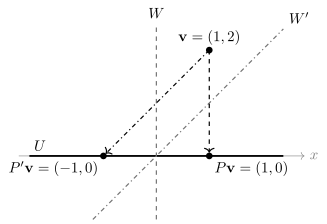
Now the promise from Chapter 1. There, the -axis in had many
complements, for instance the -axis and the line spanned by . Each gives a
projection onto the same line .
To project onto along a complement,
slide
parallel to that complement until it hits . Along the -axis,
gives (dashed arrow). Along ,
gives (dash-dotted arrow). In general and
, with standard matrices and .
Warning. “Projection onto
” is incomplete:
the direction “along ” matters. The
two operators above are both projections, both have
image , and they
are different: but . Since has infinitely many
complements in , it is the image of
infinitely many projections. A projection is determined
by its image and its kernel
together.
In finite dimension, the direct sum
hands us a basis in which is as simple as
possible.
Corollary
4.5.2 (The matrix of a projection)
Let be
finite-dimensional and a projection with . Let be a basis of and a basis of . Then is a
basis of , and
with
ones.
Proof. By Theorem 4.5.1
(a), , so the concatenated list is a basis of by Theorem 1.7.5 ((a)
(d)).
Since and ,
the columns of are
followed by zero columns (Definition 4.1.1).
Conversely, an operator whose matrix in some basis is
is a projection, since that matrix squares
to itself. With the change-of-basis square, this gives a
way to write down any projection in standard
coordinates.
Example
(Projecting onto a plane along a line)
In , let
and , so that by Example (A plane and a line in ).
Find the standard matrix of the projection onto along , and check that it
squares to itself.
Solution. Direct route. By
Example (A plane and a line in ),
splits as
with ,
and the first piece lies in . So Adapted basis. and lie in and are independent
(look at the first and third entries), so they form a
basis of the -dimensional plane . With , Corollary 4.5.2
gives , and by Theorem 4.2.3
with ,
whose columns are the vectors of . Multiplying out
gives the same matrix as the direct route.
Check. Let be the matrix found.
The first column of is applied to , which
is , the
first column of ;
the other columns work the same way by symmetry of the
entries. Also and , as a projection onto along must satisfy. The
division by needs
in the
field, which holds over .
Quick check. Is (acting on ) a projection? If
so, onto which line, and along which line?
Solution. , so yes. Its image is
spanned by its columns, , the -axis. Its kernel is
. By Theorem 4.5.1, it
is the projection onto the -axis along the line
.
The trace
of an operator
For a projection of rank , the diagonal matrix of
Corollary 4.5.2
has trace . But traces are defined for matrices,
and the same projection has many other matrices, such as
the
matrix of Example (Projecting onto a plane along a line),
whose trace is . The agreement is no accident. In Theorem 4.2.5 we
proved that similar matrices have the same trace, and by
Theorem 4.2.4 all
matrices of one operator are similar. So the trace
belongs to the operator.
The trace of an operator is the trace of its
matrix in any basis; the basis does not matter.
Definition
4.5.2 (Trace of an operator)
Let be a
finite-dimensional vector space over with , and let
. The
trace of is where
is any basis of . (For we set
.)
In words: to find , choose a basis, write down the matrix of
with that
same basis on input and output, and add
the diagonal entries.
Well-definedness. The definition
names a basis but claims the answer does not depend on
it. Let and
be bases of
. By Theorem 4.2.3,
with
invertible, so the two matrices are similar, and by Theorem 4.2.5
they have the same trace. Hence depends only on
.
Examples.
- Identity. In every basis, , so , where . Over this is ; over it is when is even.
- Differentiation. On with the
basis , has no -component, so every
diagonal entry of the matrix is and .
- A shift of the variable. On , let . In , , , , so
the matrix is and .
- The reflection. has
trace , whether
computed from or from (Example (The reflection in a mirror-adapted basis)).
Warning. The trace needs
the same basis on both sides. For an operator
, the
matrix with
is
square, but its trace depends on the bases. For on , with the standard basis
and , we get , of trace , while . Different
bases on input and output give equivalent matrices, not
similar ones, and equivalence does not preserve the
trace. For the same reason there is no trace of a map
between
different spaces.
The rules for the trace of a matrix carry over at
once.
Theorem
4.5.3 (Properties of the Trace of an
Operator)
Let be
finite-dimensional with , let and . Then
Proof. For all traces are
. Otherwise fix a
basis of . The map is linear by Theorem 4.1.4, so
and ; and by Theorem 4.1.2,
and likewise for . The first three
identities now follow from Theorem 0.9.6, since
may be
computed in .
The last was computed in the examples.
A first consequence: on a finite-dimensional space
of dimension
over a
field in which , such as , there are no
operators with , since the left side has trace and the right side has
trace .
Now the trace of a projection. Over it is simply the
rank, but the precise statement is an equation in the
field, and reading it as an equation of integers needs a
hypothesis.
Theorem
4.5.4 (Trace of a Projection)
Let be a
finite-dimensional vector space over and a
projection. Then If has
characteristic ,
or characteristic , then is determined by : it is the unique
integer with
and . In particular for
projections on real or complex spaces.
Proof. Let . If , both
sides are .
Otherwise, by Corollary 4.5.2
there is a basis with with ones, so by Definition 4.5.2.
For the second statement, let . Since and , it
remains to show uniqueness. Suppose for
integers . By Lemma 0.7.4, , and adding to both
sides gives . If , then by Definition 0.7.2 the
characteristic of
is nonzero and at most , which contradicts the hypothesis. Hence
. In and , is the number
.
The hypothesis cannot be dropped. Over , the identity of
is a
projection of rank , and its trace is , the same as
the trace of the zero projection, of rank . The equation
still holds there; what fails is recovering the integer
from the
field element .
Involutions
and reflections
A projection satisfies . The other simple
polynomial relation is : doing twice changes nothing.
Such an operator is called an
involution. Examples are the reflection
,
the transpose on , and on
functions . In Chapter 1 the last two produced direct
sums: symmetric plus skew-symmetric matrices (Example (Symmetric and skew-symmetric matrices)),
and even plus odd functions (Example (Even and odd functions)).
The next theorem explains both at once. For an
involution , write
These are subspaces, since
and (Theorem 2.2.1).
Theorem
4.5.5 (Involutions Split the Space)
Let be a field
of characteristic not , a vector space over
, and with . Then and the projection onto along is .
Idea. Copy the even/odd split:
.
Applying swaps
and , so the first
piece is fixed and the second changes sign. Both halves
of the argument divide by , which is where the
characteristic enters.
Proof. Since the characteristic is
not , in (Definition 0.7.2), so
exists. Let
, and
put and . Then , and by linearity and , So , ,
and . If , then , so and
. By Theorem 1.7.4, .
The operator is
linear by Theorem 2.4.1, sends
to , fixes (where ),
and kills
(where ). By the uniqueness in Theorem 4.5.1
(b), it is the projection onto along .
For the transpose, is the symmetric
and the
skew-symmetric matrices; for , they
are the even and odd functions; for the reflection , they
are the mirror line and the perpendicular line , and the adapted
basis is the one of Example (The reflection in a mirror-adapted basis).
In finite dimension, a basis of followed by a basis
of gives
, and so . In Chapter 9 the nonzero
vectors of
and will be
called eigenvectors with eigenvalues and .
Warning. In characteristic
an involution
need not split the space. Over , let
with . Then , since . But , so , and .
Exercises
A. Check your
understanding
Exercise
(A1)
- (a) Define a
projection , and state the correspondence between
projections and direct sum decompositions.
- (b) True or false: a
projection is determined by its image. Justify your
answer.
- (c) True or false:
an operator on
with the -axis and the -axis is a projection.
Justify your answer.
- (d) Explain why
does not
depend on the basis used to compute it.
- (e) True or false:
for every field
and every projection on a finite-dimensional
space over , the
integer can
be recovered from . Justify your answer.
- (f) Where does the
hypothesis “characteristic not ” enter the proof of Theorem 4.5.5?
Solution.
(a) is a projection if
(Definition 4.5.1).
By Theorem 4.5.1, a
projection gives , and each decomposition gives
exactly one projection with image and kernel .
(b) False. On
, and
are different projections with the same
image, the -axis.
A projection is determined by its image and its kernel
together.
(c) False. has
this image and kernel, but .
(d) Matrices of
in two bases are
similar by Theorem 4.2.3,
and similar matrices have equal traces by Theorem 4.2.5.
(e) False. Over
, on has rank and the zero operator
has rank , but
both have trace .
It is true when the characteristic is or larger than (Theorem 4.5.4).
(f) Twice: to
define , and to pass
from to . Both
need in
.
B. Practice
Exercise
(B1: A projection in )
Let and .
- (a) Show that .
- (b) Find the
standard matrix
of the projection
onto along .
- (c) Verify that
, and that
.
Solution.
(a) is the kernel of , which is nonzero; its image is then a
nonzero subspace of , hence all of (Theorem 1.6.8), so
by Theorem 2.3.1. If
,
then , so . By Theorem 1.7.4, ,
so by
Theorem 1.6.8, and
.
(b) Split with : the condition
gives . So Check: , and for the vectors , and .
(c) Row by row,
, and by Theorem 4.5.1
(b), in agreement with Theorem 4.5.4.
Exercise
(B2: The complementary projection)
Let
be a projection.
- (a) Prove that is a
projection.
- (b) Prove that
and .
- (c) Deduce that if
is the projection
onto along , then is the
projection onto
along .
Solution.
(a) By Theorem 2.4.2
(composition distributes over sums of maps), .
(b) () , so . () If ,
then . For the
kernel: means .
Such lies
in , and
conversely every satisfies , as
shown after Definition 4.5.1.
So .
(c) By Theorem 4.5.1
(b), and
. By (a)
and (b),
is a projection with image and kernel . By the uniqueness in
Theorem 4.5.1
(b), applied to , it is the projection onto along .
Exercise
(B3: Traces of operators on matrices)
- (a) Let , . Show that .
- (b) Fix , and let
, . Show that .
Hint: use the basis of matrix units .
Solution.
(a) Order the
basis of
in any way.
Since , the coordinate column of has a in the position of
and elsewhere. The diagonal
entry of the matrix in the column of is therefore
if , that
is , and otherwise. There are
basis vectors
, so by
Definition 4.5.2.
(Consistently with Theorem 4.5.5
over : symmetric
matrices have dimension ,
skew-symmetric ones , and the
difference is .)
(b) Use the basis
and write . The
product
has the -th column
of in column
and zeros
elsewhere, so . The diagonal
entry in the column of is the
coefficient of itself, which is
. Adding over
the four basis vectors, .
C. Going deeper
Exercise
(C1: When is a sum of projections a projection?)
Let have
characteristic not , and let be
projections.
- (a) Prove that is a projection if
and only if .
- (b) Show that (a)
fails over .
- (c) Suppose is finite-dimensional
over and is a projection.
Deduce that .
Hint: for in (a), use
the relation together with .
Solution.
- (a) By Theorem 2.4.2, .
If
, this
is .
If
,
then .
Multiplying on the left by and using gives ; multiplying
on the right by
gives .
Subtracting, , so . Then , and since in , . Hence also .
(b) Over , let with . Then
,
which is a projection, but . The
step from
to is the
one that fails.
(c) By Theorem 4.5.4
over , and Theorem 4.5.3,
Exercise
(C2: The trace is the only trace-like functional)
Let , and
let be linear with for all .
- (a) Using
and for , show that
whenever .
- (b) Show that for all .
- (c) Deduce that
for some ,
and conversely that every has the
property.
Solution. Recall that is if and otherwise, by Definition 0.9.9.
(a) Let . Then
and , because . By the hypothesis and linearity, .
(b)
and . Hence .
(c) Let . For
, linearity with (a) and (b) gives
Conversely, is linear and
by Theorem 0.9.6. So the
linear functionals with are exactly the multiples of the
trace.