Affine geometry knows about lines, parallels, and
ratios along a line, but not about length. Put the
standard inner product back on and a new question
appears: which maps of space leave every distance
unchanged? One might expect a large and unruly
collection, since the condition says nothing about
linearity, nothing about continuity, and nothing about
where the origin goes. The first theorem of this section
says otherwise. A map that preserves distances is forced
to be affine, with an orthogonal linear part — and it is
forced without assuming that it is surjective, which
most treatments quietly do. The rest of the section
turns that structure theorem into a complete list of the
motions of the plane and of space.
Throughout, the field is , the space is with the standard
inner product, and the distance between
and is . Matrices are bold, points of are bold vectors as
usual, and we write and the
reflections of Theorem 11.7.6 for
the elements of .
Distance
alone
Chapter 11 studied the linear maps
preserving distance: the isometries, which in are the orthogonal
matrices (Theorem 11.7.3).
But a translation with
also preserves every distance and is not linear, since
it moves the origin. So the linear theory misses exactly
what affine geometry was invented to supply, and the
right notion drops linearity from the hypotheses
altogether.
A Euclidean motion is a map of space that changes
no distance.
Definition
22.4.1 (Euclidean Motion)
A Euclidean motion of , or simply a
motion, is a map
such that No linearity, continuity, or surjectivity is
assumed.
In words: the only requirement is that the distance
between any two points equals the distance between their
images. The quantifier is for all
pairs, not for pairs at some special distance, and that
turns out to be exactly the right amount of
information.
Examples.
- Translations. satisfies ,
so it is a motion for every . It is linear
only when .
- Orthogonal maps. For , the map
is a motion: , the last equality by Theorem 11.7.3 (a)
applied to ,
which is an isometry by part (f) of that theorem.
- Compositions. If and are motions then so is
, since
. In particular is a motion for every and .
- The degenerate case is the
one-point space and its only motion is the identity; for
the motions
are , as the theorem below will confirm.
A nonexample by minimal change. Take
. It is linear, continuous, and
bijective, and it multiplies every distance by the same
factor . The one
clause of Definition 22.4.1 it
fails is the only one there is: as soon as . A
map that rescales all distances equally is a
similarity, not a motion, and this book
does not pursue them.
Why this definition, and why it is
enough. Nothing in it mentions the vector space
structure of ;
it is a statement about as a set with a
distance. The content of the next theorem is that the
vector space structure is recoverable anyway. That is
worth pausing on: distances alone remember which points
are midpoints, hence which maps are affine, hence all of
the linear algebra.
Theorem
22.4.1 (Every Motion Is Affine)
Let be a Euclidean motion. Then there are a
unique and a unique with
In particular is an affine map (Definition 22.1.3) whose
linear part
(Theorem 22.1.5) is the
isometry .
Idea. Three steps. ① Move the
origin out of the way: is a motion fixing , so it preserves
norms as well as distances. ② A map preserving both
norms and distances preserves inner products, because
the inner product is built from those two by
polarization: . ③ A map preserving inner products
is linear, and the way to see it is the reflex for
showing a vector is zero: pair the vector with itself.
Expanding the square turns it into a combination of
inner products, each of which has just been shown to
preserve, and the combination is the square of .
Proof. Step 1: reduce to a
motion fixing the origin. Put
and . For all , so is a
motion, and . Taking gives
for every : preserves norms.
Step 2: preserves inner
products. By Theorem 11.1.2 (c),
for real vectors , This is the polarization identity of Lemma 11.7.2 in the
form that uses the distance: the inner product is
determined by norms and distances alone. Applying it to
and then to , and
using Step 1 three times, So for all .
Step 3: is linear. Fix
and expand the squared norm of . For any three
vectors , repeated use of Theorem 11.1.2 (c)
gives Apply this with , ,
. Every term on the right is a norm
or an inner product of values of , and Steps 1 and 2
replace each by the corresponding quantity for ,
, . The result is
the same expression with , , , that
is, . Hence
and by Theorem 11.1.2 (a),
so For scalars, let and
expand in the same way: so . Therefore is linear.
Step 4: the matrix. Let be the matrix of in the standard basis,
so . By Step 2, preserves inner
products, so by Theorem 11.7.3 (b)
and (f), the standard basis being orthonormal. Then
.
Uniqueness. If for every , then gives
, and then for every gives . This proves
the theorem.
Corollary
22.4.2 (Motions Are Bijections)
Every Euclidean motion of is a bijection, and
is again a
motion. The linear part of is , where is the linear part of
.
Proof. Write by Theorem 22.4.1. Since
,
is invertible
with (Theorem 11.7.3
(g1)), so the map
satisfies and . Hence is a bijection with
inverse , which is
a motion by examples 2 and 3 after Definition 22.4.1, with
linear part .
Warning. The Euclidean norm
is doing real work. Step 2 is the only place
where the special shape of is used, and
for other norms the phenomenon fails. Here is a
distance-preserving map that is not affine, for a norm
of Chapter 16 and between spaces of different
dimensions. Give the norm of
Chapter 16 and consider , . For , Lemma 16.1.1 applied to the
absolute value as a norm on gives , so
So preserves
distances exactly, and it is visibly not affine: ,
,
and , yet is not the
midpoint of and , which is
. Replacing
by
any function that never changes by more than its input
does gives another one. What makes Theorem 22.4.1 true is
polarization, an identity special to the norms that come
from an inner product, and not any property shared by
all norms.
The determinant of the linear part now splits the
motions into two halves, exactly as it splits .
Definition
22.4.2 (Direct and Opposite Motions)
Let be a motion of . It is
direct, or orientation-preserving, if
, and
opposite, or orientation-reversing, if
. These
are the only possibilities: , and (Theorem 7.4.5), so
by Theorem 7.5.4.
Quick check. For which is the map a direct motion of ? Describe it for
and .
Solution. It is a motion with
linear part ,
and , so it is direct exactly when is even. For it is direct: , and
is the half-turn
about the point , which
is its unique fixed point, since forces . For it is opposite: it
is the point reflection in the point
,
which sends each point to the point diametrically
opposite it through that center.
The group
of motions
Write for
the set of Euclidean motions of and for the
translations. One proposition records how these fit
together, and every part of it is a line of
computation.
Proposition
22.4.3 (The Euclidean Group)
- (a) is a
group under composition.
- (b) The map sending a motion to its linear
part is a surjective group homomorphism.
- (c) , and is a group isomorphism .
- (d) For every motion
with linear part
and every , In particular a conjugate of a translation is
a translation.
Idea. Write everything in the form
. Composing two such maps multiplies
the matrices and moves the translation vectors through,
so the matrix is exactly the part that composes without
interference — which is what a homomorphism is. Part (d)
is one substitution, and it explains where the
translations sit: they are the motions that every other
motion pushes around among themselves.
Proof. By Theorem 22.4.1 every
motion is with , and
conversely every such map is a motion (examples 2 and 3
after Definition 22.4.1). Write
for
it. A direct computation gives the composition rule:
so
(a) By Corollary 22.4.2 every
motion is a bijection of , so is a
subset of the group of all bijections under
composition, which is a group by the argument of Example (Groups) for
: composition of
functions is associative by Theorem 0.4.2, the
identity map is a two-sided identity, and a bijection
has a two-sided inverse (Theorem 0.4.7), none
of which used finiteness. It contains , it
is closed under composition by and because (Proposition 11.7.4),
and it is closed under inverses by Corollary 22.4.2. By Definition 0.10.2 it
is a subgroup, hence a group.
(b) With , well defined by the uniqueness in Theorem 22.4.1, reads , so is a homomorphism
(Definition 0.10.3). It
is surjective because for every .
(c) if and only if , that is, ; so
. By with , , so is a homomorphism from ; it is
injective because forces
, and its
image is
by definition.
(d) By Corollary 22.4.2, where . Then which is .
This proves the proposition.
Warning. is
not the direct product of and .
Part (d) shows why: conjugating by a
rotation gives , not , so the two
subgroups do not commute with one
another. Concretely in , with and ,
the composite sends to , while sends to . A rotation
followed by a translation is not the same motion as the
translation followed by the rotation.
Motions of
the plane
Now the classification. Four kinds of map appear, and
each is built from a linear one by moving the origin to
a chosen point.
Definition
22.4.3 (Translation, Rotation, Reflection,
Glide Reflection)
Let .
- (a) The
translation by is .
- (b) The
rotation about by is .
- (c) Let be a line, ,
and let be the linear reflection fixing and
negating .
The reflection in is .
- (d) Let be
parallel to , that
is, . The glide
reflection with axis and vector is .
The reflection does not depend on
which point is used: replacing by
changes by , since .
All four maps are motions, being composites of
translations and orthogonal maps. Their linear parts are
, , , and , so the first two
are direct and the last two are opposite.
Theorem
22.4.4 (Classification of the Motions of the
Plane)
Let be a motion of . Then
exactly one of the following holds.
- (a) .
- (b) is a
translation with ; the vector is unique.
- (c) is a rotation about a
point by
an angle ; the point and the angle
are
unique.
- (d) is a reflection in a line ; the line is unique.
- (e) is a glide reflection
with axis and
vector ; the pair is
unique.
The five cases are told apart by the determinant of
and the
fixed-point set :
Idea. Split on , which Theorem 11.7.6
turns into “ is a
rotation ” or “ is a linear
reflection”.
For
with , the
matrix is
invertible, and solving is exactly finding a
fixed point; once there is one, moving the origin to it
makes linear.
For
there may be no fixed point, so instead split into its
components along the mirror and across it. The
across part is absorbed by sliding the
mirror halfway; the along part is what
is left over, and it is the glide.
Proof. Case . By Theorem 11.7.6 (a),
for a unique .
If
then and
,
which is case (a) when and
case (b) otherwise; the vector is ,
hence unique. Its fixed-point set is or .
If ,
then Were this we would have , hence
and ,
so by
the uniqueness in Theorem 11.7.6 (a),
a contradiction. So is invertible and there is a unique with , that is, with . For every , so is
the rotation about by : case (c). Its
fixed points satisfy , hence
, so and is determined by
; is determined
because is.
Case . By Theorem 11.7.6 (b),
fixes a line
pointwise and negates , where is
an orthonormal basis of . By Theorem 11.3.2
write Put and . The reflection in is , and
because , so and
If , then : case (d). Its fixed set is , since holds exactly when ; so is determined by .
If , then is the glide reflection
with axis and
vector ,
which is parallel to : case (e). For its
fixed set, compute the square of : using and . So
, and a fixed
point of would be
a fixed point of ; hence .
Uniqueness in case (e). Suppose also with
parallel to .
Picking gives ,
so comparing linear parts (unique by Theorem 22.4.1) gives
,
and hence
has direction and . Now sends to and to , so , and Comparing with and using the uniqueness of
the decomposition in Theorem 11.3.2,
. Finally , and a reflection determines its axis as
its fixed set, so .
Exactly one case holds. The table follows
from what was computed in each case, and it separates
the five: within the fixed sets , , a single point
are distinct, and within a line and
are
distinct. This proves the theorem.
So there are only four shapes of plane motion, and
the surprise is the fourth. A student asked to list them
usually produces translations, rotations, and
reflections, and stops; the glide reflection is the one
that has no fixed point and no visible center, and it is
forced on us by the two-line computation .
Example
(Naming a plane motion)
Classify the motion of with
Solution. The linear part.
The columns and have norm
and inner product , so by Theorem 11.7.3 (f),
and . So is opposite, and we are
in case (d) or (e) of Theorem 22.4.4.
The mirror direction. Solve :
the first row gives , that is , and the
second row gives , the same condition. So fixes with
, and negates with
: indeed .
Splitting . Since
, As , is a glide
reflection. Its axis is with , and its
vector is .
Checks. The point should go to ,
and indeed , which lies on . And should be the
translation by : , with , so .
The next example is the one that explains where
reflections sit in the group: they generate everything,
and two of them make a direct motion.
Example
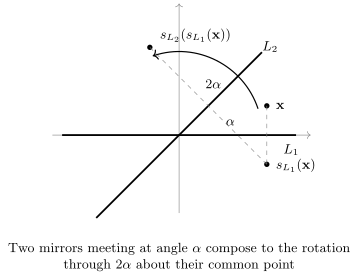
(Two mirrors)
- (a) Reflect in the
line and then in .
Identify the composite.
- (b) Reflect in and
then in . Identify the composite.
- (c) Prove the
general statements: two reflections in lines through a
common point meeting at angle
compose to
the rotation about by ; two reflections
in parallel lines compose to a translation by twice the
perpendicular vector between them.
Solution.
(a) The
reflection in the first coordinate axis is , and
the reflection in the line swaps the
coordinates, (each fixes its line
pointwise and negates the orthogonal complement, which
is the description in Theorem 11.7.6
(b)). Then The two lines meet at angle , and the composite
is the rotation by about
their common point .
(b) , and , since reflecting in the line fixes the first
coordinate and sends to . Composing, , the translation by — twice the
perpendicular vector from to .
(c) Let with unit vectors,
meeting at . Moving the
origin to
(that is, conjugating by ) we may
assume , because and the two
translations cancel in the middle of the composite. By
Theorem 11.7.6 (b)
the linear reflection in the line through at angle is , the matrix
with rows and . Writing , one
checks and , the second because changes the sign of
in both
off-diagonal entries. Hence, for lines at angles and with , a rotation about by ; conjugating back
gives the rotation about .
For parallel lines the linear part is
the same reflection for both, and . Therefore using . Since kills and
doubles ,
the vector is twice the
component of perpendicular to the lines. In (b),
and the translation was by .
Motions of
space
In the
same method works, with Corollary 12.6.2
supplying the normal form of the linear part. Two new
names are needed.
Definition
22.4.4 (Screw Motion, Rotatory
Reflection)
Let be a line in with , and
let be a plane.
- (a) A
rotation about the axis is a motion
with , and . It
fixes pointwise,
and by Corollary 12.6.2
it turns the plane
by a single angle , the angle of the
rotation. The requirement keeps the identity out: it is a
translation, and a translation should not also count as
a rotation about every line at once.
- (b) A screw
motion is ,
where is a
rotation about —
so its angle is again nonzero — and is
parallel to .
- (c) The
reflection in the plane is , with the linear map
fixing pointwise
and negating ; a
glide reflection is with
lying in .
- (d) A
rotatory reflection about the point is the
composite of a rotation about an axis by an angle with
the reflection in the plane perpendicular to that
axis. The two commute, and the composite is where is
in an orthonormal basis beginning with ; in particular
. The
case
gives
and the point reflection .
Theorem
22.4.5 (Classification of the Motions of
Space)
Let be a motion of .
- (a) If is direct, then is a translation
(possibly the identity), a rotation about an axis, or a
screw motion, according as , or and is orthogonal to
the line fixed by , or and it is
not.
- (b) If is opposite, then is a reflection in a
plane, a glide reflection, or a rotatory reflection
about a point.
In both parts the three cases are mutually exclusive,
and are told apart by
together with whether :
Idea. Corollary 12.6.2
gives an orthonormal basis in which is or
with . In
every case, split into its
component along and its
component in , and ask whether can absorb each
piece.
For a direct motion with , kills but is
invertible on ; so
the -part of is absorbed by
moving the axis, and the -part survives as
the glide along the axis. That is Chasles’s screw.
For an opposite motion the roles swap. When , is a plane reflection:
is
invertible on and kills
, so the -part of is absorbed by
sliding the mirror plane and the -part survives as the
glide. When ,
is invertible outright, so all of is absorbed and
has a fixed
point.
Proof. By Corollary 12.6.2
there are an orthonormal basis of and such
that, in that basis, is
when and
when . Put , a -invariant subspace on
which acts as
in the
basis , and write, by Theorem 11.3.2,
As in the proof of Theorem 22.4.4, , which is nonzero exactly when
, that is, when .
(a) Direct motions. Here .
If , then and , the identity when . Its
fixed set is
or .
If , then and the restriction of to has matrix , which
is invertible. Since ,
there is a unique with . Put and . Then fixes pointwise, because
, so is the rotation about
the axis . And
with
parallel to . So
is a rotation
about when , and a screw motion otherwise.
For the fixed sets, note that
for every ,
because and maps
into . Hence the
-component
of is . If
there is no fixed point; if the fixed points are the with , whose -component is the unique
above and
whose -component is
free, that is, the line .
(b) Opposite motions. Here .
If , then fixes pointwise and negates
: it
is the linear reflection in the plane . Put and . Since
we get , so the reflection in
is with
parallel to . So
is the reflection
in when , and a glide reflection otherwise. For
the fixed sets: for every , since kills , so the -component of is
.
If there is no fixed point; if the fixed points are the with , that is, with -component , which is the
plane .
If , then in the basis the matrix is , whose determinant is .
So is
invertible and there is a unique with , that is, .
Then for every , as in the plane
case, and is a
rotatory reflection about : in the basis
its linear part is ,
the rotation by about followed
by the reflection in , and these two commute.
The fixed set is , since is injective.
When ,
and ,
giving the point reflection .
Finally, exactly one case holds in each part. Among
the direct motions a translation has while a rotation
and a screw do not, and those two differ by having a
line of fixed points or none; among the opposite motions
the three fixed sets, a plane, the empty set, and a
single point, are pairwise different. This proves the
theorem.
Warning. From on, the list breaks
down. The proof rested entirely on Corollary 12.6.2,
which in turn rested on the arithmetic of Theorem 12.6.1. In
the matrix
has determinant and fixes no nonzero
vector, so a direct motion of need not have an
axis and need not be a screw. The right general
statement replaces “one axis and one angle” by the full
canonical form: a direct motion of
decomposes
the space into a flat, along which it translates, and a
list of mutually orthogonal planes, each turned by its
own angle. The word direct is needed
there: that description hides the block of Theorem 12.6.1,
which splits into rotations by only when is even, and an
opposite motion keeps one leftover direction and negates
it. The glide reflection of Theorem 22.4.5 (b) is the
smallest witness, with , ,
: it has no
rotation plane, yet it is not a pure translation. This
book proves the classification only for .
Example
(Naming a space motion)
Classify the motion of with
Solution. The linear part.
The columns of
are , an orthonormal list, so by Theorem 11.7.3 (f).
Expanding along the first row, , so is direct. By Theorem 12.6.4
(c), for some unit and . Its
trace is , so by
Theorem 12.6.5 (a)
the angle is given by , that is , and in
particular . The axis direction is fixed by : reading , the equation
says , so the axis direction is .
Splitting . With and , Since , Theorem 22.4.5 (a) says
is a
screw motion with glide vector .
The axis. We need perpendicular to
with
. Writing , the equations are , , , together
with . From the second, ; from the
first, ; the sum gives , so .
The axis is .
Checks. The rotation part should fix : ,
and . And applied three times
should be the translation by , since : Here is the all-ones matrix , so , as predicted.
Exercises
A. Check your
understanding
Exercise
(A1)
- (a) State Definition 22.4.1, and
say which of linearity, continuity, and surjectivity it
assumes.
- (b) True or false:
every motion of with a fixed point
is linear. Justify your answer.
- (c) Name the four
kinds of motion of and give the
fixed-point set of each.
- (d) True or false:
the composite of two opposite motions of is opposite.
Justify your answer.
- (e) A motion of
has exactly
one fixed point. What kind is it?
Solution.
(a) A motion is a
map with for all . It
assumes none of the three: Theorem 22.4.1 shows that
a motion is automatically affine, and Corollary 22.4.2 that it
is automatically a bijection.
(b) False as
stated, but only just: by Theorem 22.4.1, , and
gives , so , which is linear precisely
when can
be taken to be . For example the
half-turn of
about , , has a fixed point but sends to , so it
is not linear. What is true is that a motion fixing
is linear,
which is Steps 1 to 3 of Theorem 22.4.1.
(c) Translations
(fixed set if
the identity, otherwise ); rotations
about a point (one point); reflections in a line (that
line); glide reflections (). This is Theorem 22.4.4.
(d) False. By Proposition 22.4.3 (b)
the linear part of a composite is the product of the
linear parts, and is multiplicative
(Theorem 7.5.4), so
the composite has and is direct.
What composes is the parity, not the word “opposite”: Example (Two mirrors) is
the two-dimensional instance, where two reflections make
a rotation.
(e) A rotatory
reflection about that point, by Theorem 22.4.5: it is the
only kind whose fixed set is a single point. In
particular it is opposite.
B. Practice
Exercise
(B1: Classify three plane motions)
Classify each motion of , giving the center
and angle, the axis, or the axis and glide vector, as
appropriate.
- (a) , .
- (b) , .
- (c) , .
Solution.
(a) and , so is a rotation by . Its center solves
, that is and ; adding
gives , so
.
Check: . So is the rotation about
by .
(b) , and swaps the coordinates:
it is the reflection in , negating
. With
, and , so and . Since , is a glide reflection
with axis , where : the axis
is the line and the glide vector is . Check: , which is
on the axis.
(c) Same . Now , so and . Hence is a
reflection, in the line with . Check: , a fixed point, and ,
another one; the two lie on .
Exercise
(B2: A space motion)
Classify the motion of with giving the axis and the glide vector if there
is one.
Solution. The columns are , orthonormal, so ;
expanding along the first row, , so is
direct. The fixed vectors of satisfy free, , , hence : the axis
direction is , and is the quarter turn
about it.
Now and . Since , Theorem 22.4.5 (a) says
is a pure
rotation about an axis, with no glide. The axis
is where solves : gives and , so . The axis is . Check: , and .
Exercise
(B3: A motion is determined by few points)
Let and be motions of that agree on . Prove that .
Hint: consider and use Theorem 22.4.1.
Solution. By Corollary 22.4.2, is a motion, so
is a motion (example 3 after Definition 22.4.1). It
fixes and
each ,
since and agree there. By Theorem 22.4.1, with ; from we
get , and then for each , so agrees with on a basis and . Hence , and composing
with gives .
(The
points are affinely independent, and
the same argument works for any affinely independent
list of points,
which is the affine statement of §02.)
C. Going deeper
Exercise
(C1: Reflections generate the motions)
- (a) Prove that every
motion of is
a composite of at most reflections in affine hyperplanes, where the
reflection in the hyperplane is
with
the Householder reflection of Definition 11.8.1.
- (b) Deduce that a
translation of by is
a composite of exactly two such reflections, and
identify them.
Hint: for (a), first make the motion fix a point,
then quote Theorem 12.6.7.
Solution.
- (a) Write by Theorem 22.4.1. If , then
is a product of
at most
Householder reflections by Theorem 12.6.7,
and each of those is the reflection in the hyperplane
in the above sense, so
is a composite of
at most
reflections.
If , let be the reflection
in the hyperplane , that is, . Since (Proposition 11.8.2
(d)), this simplifies to , and then,
using (Proposition 11.8.2
(b)), so . Therefore a linear orthogonal map, which by Theorem 12.6.7 is
a product of at most Householder
reflections. Hence is a composite of
at most
reflections.
- (b) Let with
. It is not a single reflection, since
a reflection has a fixed point and has none.
Let be the
reflection in
and the
reflection in . By the computation in
(a), and , so So exactly two reflections suffice, in two
parallel hyperplanes perpendicular to and at distance
apart — the -dimensional form of Example (Two mirrors)
(b).
Exercise
(C2: Matching two congruent frames)
Let and be points of with for all , and suppose is a basis of .
- (a) Prove that there
is a motion of
with for every .
- (b) Prove that is unique, and give an
example with fewer points where it is not.
Hint: for (a), translate both lists so that , then compare the inner products of
the two lists.
Solution.
(a) Replacing
by
and by
changes no distance, and undoing the
two translations at the end changes a motion into a
motion; so assume . Put
and for . Taking in the hypothesis gives , and then for , by Theorem 11.1.2 (c),
So the two lists have the same inner products.
Since is a basis, Theorem 2.1.5 gives a
unique linear
with , and for , where both ends use Theorem 11.1.2 (c)
repeatedly to expand a squared norm of a sum. So is an isometry, and
is a motion with for and .
(b) If and are motions with for all , then is a
motion (Corollary 22.4.2) fixing
every .
Write by Theorem 22.4.1.
Subtracting from gives for , so fixes a basis and
; then and , so .
With fewer points the spanning hypothesis fails and
uniqueness goes with it. In , take the single
pair and . Both the identity and the reflection in
the first coordinate axis are motions carrying to , and they
differ at .
Here spans only a line.
Exercise
(C3: Motions of a finite set)
Let be a finite nonempty set and let be its symmetry group.
- (a) Prove that is a subgroup of , and
that every
fixes the centroid .
- (b) Deduce that
is isomorphic to
a subgroup of , and that contains no translation
other than the identity.
Solution.
- (a) The identity
lies in . If then ,
and with
a bijection (Corollary 22.4.2) gives
; so
is a subgroup by
Definition 0.10.2,
using Proposition 22.4.3 (a).
Let ,
with . Since restricts to a
bijection of the finite set , while on the other hand . Dividing by
gives .
- (b) Conjugating by
the translation gives an
injective homomorphism , , whose image consists of
motions fixing , hence of linear
ones by Theorem 22.4.1; those are
the orthogonal maps. So is isomorphic to a
subgroup of , namely
in the notation of Proposition 22.4.3. If
then by (a), so .
Geometrically: a finite figure cannot be carried onto
itself by a nontrivial translation, because a
translation would move its centroid.