Chapter 18 built the theory of convex sets and proved
its main theorems: that a compact convex set is the hull
of its extreme points, that a bounded polyhedron and a
polytope are the same thing, and that a feasible,
bounded linear program and its dual have the same
optimal value. This section proves none of that
again. It reads those theorems as statements
about the geometry of a solid with flat sides: what its
faces are, how they fit together, and what a linear
program looks like when the objective is a family of
parallel hyperplanes sliding across it. Everything here
is a corollary of Chapter 18 or a short argument on top
of it, and every citation points back there.
Throughout, the field is and the space is
with the dot
product, as in Chapter 18. A polyhedron is a set (Definition 18.9.2), with
whose rows we write , so that
is the list of inequalities . A vertex of is an extreme point of
it (Definition 18.8.1), and
is the set of them. We use Chapters 16 and
18’s topological words — closed, bounded, compact — only
inside the results we cite; nothing here develops them
further.
Faces, cut
by a supporting hyperplane
A cube has six square sides, twelve edges, and eight
corners, and each of them is the part of the cube
touched by a plane that has the whole cube on one side.
That is the picture to formalize. The tool is Chapter
18’s supporting hyperplane (Theorem 18.3.6): a
hyperplane through a point of a convex set with the set
in one of its closed half-spaces.
A face of a polyhedron is the part of it touched
by a hyperplane that does not cut into it.
Definition
22.3.1 (Face of a Polyhedron)
Let be a polyhedron. A face
of is a set of
the form for some and such that for every . A face
other than itself
is called proper.
Clause by clause. The pair must be
a valid inequality for : the whole polyhedron
lies in the closed half-space . The face is then what the boundary
hyperplane actually touches. Note that is allowed to be
.
Two faces come free. Taking and
makes the
inequality ,
valid everywhere, and : the whole polyhedron is a face of
itself. Taking and
makes the
inequality ,
again valid, and : the empty set is a
face. These two are the degenerate cases, and
they are kept because the theorems below are cleaner
with them than without.
Chapter 18 §08 already has a notion of face for an
arbitrary convex set, Definition 18.8.2: a
convex subset that swallows every segment of passing through it at
an inner point. The two agree here in one direction at
once.
Examples, in , with the triangle of Chapter 18 §09.
- , . The inequality is valid by the third row,
and the face is the slanted edge from to .
- , . Valid, since on . The face is the single
point : the
hyperplane
touches the triangle at one corner.
- , . Valid by the first row, and the face is the
vertical edge .
- , . Valid, but never attained: the face is .
A nonexample by minimal change. In
example 1 replace by . The set is still a segment inside , still convex, and
still a slice by a hyperplane. What fails is the one
clause the definition insists on: is
not valid for , since violates it.
The hyperplane cuts through the triangle instead of
resting against it, and the slice is not a face. It also
fails Definition 18.8.2: the
segment from
to passes
through at an
inner point but is not contained in the slice.
The reason faces are useful is that there are only
finitely many of them, and each is again a polyhedron
described by the same rows, some of
them turned into equations.
Proposition
22.3.1 (Faces Are Polyhedra, and There Are
Finitely Many)
Let with rows. For put Then:
- (a) every is a face of , and it is a
polyhedron;
- (b) every
nonempty face of equals for some ;
- (c) consequently
has at most nonempty faces, and
every face of is
a polyhedron.
Idea. For (a), add up the rows
indexed by : the
sum is at most on
, and a sum of
numbers each at most its bound hits the total bound only
if every one of them does. So one valid inequality
encodes all of at
once.
For (b), let
be a nonempty face and let collect the rows that
are tight at every point of . Certainly . For the
other inclusion we need a point of at which every row
outside is
slack; averaging finitely many points
of , one per slack
row, produces it. Then, given with
, step from
away from . The rows in
are equations
satisfied by both points, so they survive the step
exactly; the rows outside have room at , so they
survive a short step. But the step raises above
, which no
point of may
do.
Proof.
(a) Put and , with the empty sums and . For , so the inequality is valid. If and , then is a
sum of nonnegative numbers, so each is zero and ;
conversely every has . Hence is a face. It is a polyhedron because
each equation is the pair of inequalities and , so is cut out by
inequalities.
(b) Let be nonempty, with
on . Put Then by the definition of , and it remains to
prove .
First note that is convex: it is the
intersection of the convex set (Proposition 18.9.1) with
the solution set of a linear equation, which is convex
as the preimage of a point under (Proposition 18.1.1 (b));
an intersection of convex sets is convex by Proposition 18.1.1
(a).
Step 1: a point of with every row outside
slack.
For each
choose, by the definition of , a point with
. If let be any point
of . Otherwise let
be the
number of indices outside and let , which lies in by convexity. For each
, every
term of
is at most and
the term is
strictly less, so .
Step 2: the step away from . Let
and suppose, for a contradiction, that . For put . For
we have
, because , and , because ; hence
For put and ; both are minima
and maxima of finitely many numbers. Choose with , which is
possible (any
will do if ).
Then for , So . But since and . This contradicts
the validity of on . Hence and , so and .
- (c) There are subsets , so by (b) at most that
many nonempty faces. Each of them is a polyhedron by
(a), and the empty face is the polyhedron .
This proves the proposition.
The map is surjective onto the nonempty faces but
is very far from injective: adding to a row that is already
tight everywhere on changes nothing, and
adding two incompatible rows gives .
Warning. A row of the
system need not be a side of the solid. In
the
third row is implied by the first two, since on . It defines no face
except the empty one: . So a polyhedron with
rows can have far
fewer than sides,
and counting rows is not counting geometry. Conversely,
Definition 22.3.1 never
mentions the rows at all, which is why Proposition 22.3.1 has to
prove that the faces can be read off them.
Vertices,
edges, facets
A nonempty face is a nonempty convex
set, so it has a dimension: , as in Chapter 18 §01, and is
the flat of Proposition 18.1.4 — a
flat in the sense of Definition 22.2.1. The
graded vocabulary follows.
Definition
22.3.2 (Edge, Facet)
Let be a nonempty polyhedron. A face of of dimension is an
edge; a face of dimension is a
facet. A face of dimension is a single point, and
the next proposition shows that these are exactly the
vertices.
Proposition
22.3.2 (Three Descriptions of a Corner)
Let and . The
following are equivalent.
- (a) is a vertex of
, that is, an
extreme point.
- (b) is a face of
.
- (c) Among the rows
active at
there are
linearly independent ones, that is, is a basic
feasible point.
Idea.
- (a) and (c) are Theorem 18.9.2, already
proved. A one-point face is an extreme point by Proposition 18.8.4 (b).
For the remaining implication, take to be the active set:
if the active rows have rank , the system
has as its
only solution, so , and Proposition 22.3.1 makes
that a face.
Proof.
(a) (c) is Theorem 18.9.2.
(b) (a). Write
with
on . By Proposition 18.8.4 (b),
applied with and , .
(c) (b). Let
be
the active set and the matrix of active
rows, of rank by
hypothesis. Its null space is by Theorem 3.5.7, so
has at most one solution; since
is one, it
is the only one. Hence and
is a face by Proposition 22.3.1 (a).
This proves the equivalence.
So a corner of a polyhedron can be recognized three
ways: by convexity (it is not an average), by geometry
(a hyperplane touches there and nowhere
else), or by algebra (enough constraints are tight). The
three are used interchangeably from here on.
Bounded polyhedra are the ones with enough corners to
rebuild them. This is the bounded half of the
Minkowski–Weyl theorem, and it is the sentence this
whole section is arranged around.
Theorem
22.3.3 (A Bounded Polyhedron Is the Hull of Its
Vertices)
Let be a bounded polyhedron. Then is
finite and Conversely, every polytope is a bounded
polyhedron.
The same theorem applied to a face is what makes an
edge a segment between two corners — the statement that
lets one speak of walking along the edges of a
solid.
Proposition
22.3.4 (An Edge Joins Two Vertices)
Let be a bounded polyhedron and an edge of . Then
for two distinct vertices of
.
Idea. An edge is itself a bounded
polyhedron, so it is the hull of its own vertices; those
are vertices of
because a face passes extremeness upwards. Being -dimensional, it sits on
a line, and the hull of finitely many points of a line
is the segment between the outermost two.
Proof. By Proposition 22.3.1, is a polyhedron, and it
is bounded because . By Theorem 22.3.3, with
finite, and since it has a dimension. By the
remark after Definition 22.3.1, is a face of in the sense of Definition 18.8.2, so Lemma 18.8.3 gives : every vertex of is a vertex of .
Fix . By Proposition 18.1.4,
with , and , so for some .
Every point of
lies in ,
hence is for exactly one , the map being injective because .
Let be the parameters of the points of , a
nonempty finite list. A convex combination equals , and lies in
;
conversely each is for some . Hence,
writing for the segment of Chapter 18 §01,
If then
is a single point and , contrary to hypothesis; so ,
and both are vertices of . This proves the
proposition.
Two face
lattices, computed
Faces are ordered by inclusion, and the resulting
picture — which face lies in which — is the face
lattice of the polyhedron. It is the
combinatorial skeleton of the solid. Here it is in full
for the two standard examples.
Example
(The faces of a cube)
Let , described by the rows and . Find all faces of and their
dimensions.
Solution. By Proposition 22.3.1 (b)
every nonempty face is some . A set of rows says, for each
coordinate ,
either nothing, or , or , or both; the last makes . So the
nonempty faces are indexed by sign
vectors : Each is nonempty:
the point with where and elsewhere lies in it. Distinct sign vectors
give distinct faces, because exactly when
the coordinate
is constantly
on . So
has
exactly
nonempty faces, one for each sign vector, together with
.
Let and . Then is the flat , a coset of : it contains , and
conversely contains the
point with
for and for , together with
for every , whose
differences from span . By Proposition 18.1.4,
.
So the faces of dimension are the sign vectors
with exactly
zeros, and there are of
them. For :
vertices (), edges (), facets (), and the cube
itself, and . Every vertex is a sign vector in each coordinate,
matching what Example (The cube and the cross-polytope)
found by the rank test.
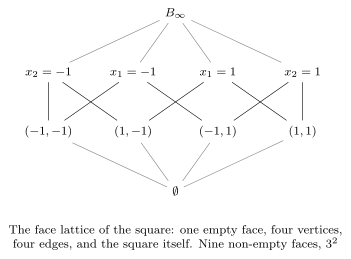
Here is the resulting lattice for the square ,
with at
the bottom and the square at the top, and a line drawn
when the lower face is contained in the upper one.
Example
(The faces of a simplex)
Let be the
standard simplex (Definition 18.1.2),
described by the
rows
together with and .
Find all faces of .
Solution. The last two rows are
tight at every point of , so including
them in changes
nothing. A face is therefore for determined by a set
of coordinates forced to zero: Write . If the
conditions and clash, so . If , then
consists of the
vectors supported in with ,
which by Theorem 18.1.3 is
exactly , a copy of .
Its dimension is , by the computation of after Proposition 18.1.4.
Distinct nonempty
give distinct faces, since
exactly for .
So the nonempty faces of are indexed by
the nonempty subsets , and there are of them: vertices, edges, and so
on up to
itself. For ,
the tetrahedron of dimension has nonempty faces.
The contrast is the point. The cube’s lattice is the
set of sign vectors; that of the simplex is the set of
nonempty subsets. A cube in dimension has vertices and facets; a simplex has
vertices and
facets. The
cube’s corners grow exponentially with , those of the simplex
only linearly.
Quick check. How many faces does a
triangle in
have, counting the empty face and the triangle
itself?
Solution. Eight: , three
vertices, three edges, and the triangle. Count directly
from Proposition 22.3.1 (b),
writing the triangle as the polyhedron cut out by its
three sides: is the
triangle, each single row gives one side, each pair of
rows gives the corner where those two sides meet, and
all three rows together give . That is nonempty faces,
plus . The
count matches Example (The faces of a simplex)
with , whose
nonempty faces are indexed by the nonempty subsets of
the three corners.
A linear
program, seen
Fix with . The level sets of the objective are parallel affine
hyperplanes, one for each , and they sweep
across as
grows,
moving in the direction . Maximizing
over a polyhedron
means pushing the sweeping hyperplane as far as it will
go while still touching . Two things can happen:
it escapes to infinity, and the program is unbounded; or
there is a last hyperplane that touches, and what it
touches is a face.
Proposition
22.3.5 (The Optimal Set Is a Face)
Let be a polyhedron, , and
suppose
attains a maximum on . Then the set of maximizers
is a nonempty face of . If is bounded, contains a
vertex of .
Proof. By the definition of a
maximum, for every , and is
nonempty. That is Definition 22.3.1
verbatim, so is a face.
Suppose is
bounded. Then is a bounded polyhedron by Proposition 22.3.1, and
nonempty, so by Theorem 22.3.3 (a
nonempty set is not the hull of the empty set). By the
remark after Definition 22.3.1 and Lemma 18.8.3, , so any
point of is a vertex of lying in .
The last sentence is Corollary 18.8.6 read
geometrically, and it says a little more than that
corollary: not only is some maximizer a vertex,
but the whole set of maximizers is a face — a
single vertex when the optimum is unique, and otherwise
an edge or a larger face, up to all of when . A
linear program with a nonunique optimum has a
positive-dimensional optimal face, and every point of it
is optimal.
An algorithm now suggests itself: start at a vertex,
and as long as some edge leaving it increases the
objective, walk along that edge to the vertex at its
other end (Proposition 22.3.4
guarantees there is one, when is bounded). That is
the idea of the simplex method,
sketched in Chapter 18 §09 after Corollary 18.9.3.
No algorithm is developed here or anywhere in
this book: Chapter 24 is where this book’s
algorithms live, and it treats the numerical linear
algebra of elimination, least squares, and eigenvalues,
not linear programming. What this section supplies is
the geometry an algorithm would exploit.
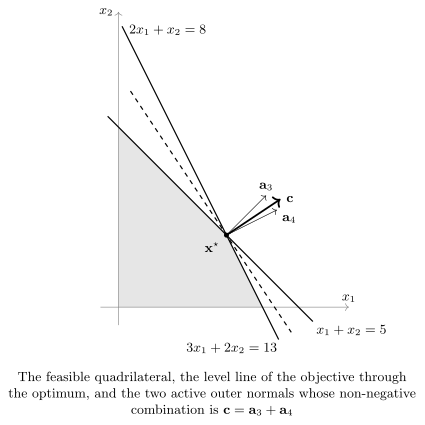
Example
(A linear program and its picture)
Maximize over Find the vertices, the optimum, the optimal
face, and the dual optimal solution.
Solution. Number the rows (1) , (2) , (3) , (4)
.
No two rows are multiples of each other, so each of the
pairs
gives one basic point, which we test against the other
two rows: For the last pair, subtracting (3) from (4)
gives ,
hence . By
Proposition 22.3.2 the
vertices are ,
, and . is bounded, since on
it, so by Theorem 22.3.3 it is the
quadrilateral .
The objective takes the value at , at , at , and at , so by Proposition 22.3.5 the
maximum is , at
, and the optimal face is . Since only one vertex achieves and the face is the
hull of its vertices, the optimal face is the single
point :
the optimum is unique.
The rows active at are (3)
and (4), with outer normals and
.
And so is a candidate for the dual. In the notation
of Definition 18.6.2, with
the rows and and , the
dual asks to minimize subject to , , . At both
constraints are equalities and the value is , which
matches. By Corollary 18.6.2 (a),
and are
both optimal, and no further checking is needed.
What the
dual variables are, geometrically
The example ended with an identity worth isolating:
the objective vector was a nonnegative
combination of the outer normals of the constraints
active at the optimum, and the coefficients were the
dual optimal solution. That is the geometric content of
duality, and Chapter 18 has already done all the
work.
Recall Chapter 18 §06’s pair of programs, with , , : The feasible region of (P) is the polyhedron
with the rows
and the rows . The outer normal of a row
is the vector on its left-hand side: for the -th constraint and for the sign
constraint on .
Proposition
22.3.6 (Dual Variables Are the Weights of the
Active Normals)
Let be an
optimal solution of (P). Then there are and
with and
such that where whenever , and whenever . That
is, is a
nonnegative combination of the outer normals of the
constraints active at ,
and the weights are an optimal solution of (D).
Idea. Strong duality hands over an
optimal
for (D); the slack is nonnegative
because is
dual feasible, and rearranging is the displayed
identity. Complementary slackness is exactly the
statement that the weights vanish on the inactive
constraints.
Proof. Since is
feasible, (P) is feasible, and for every feasible
, so (P) is
not unbounded. By Theorem 18.6.3 (b), (D)
is therefore feasible, and by Theorem 18.6.3 (a) both
programs have optimal solutions with equal optimal
values; let be an optimal
solution of (D). Then and
, so . Reading the -th coordinate of as , we get
, and hence Both and
are
optimal, so Theorem 18.6.5 applies:
its condition (i) says forces , which is the contrapositive of “ forces ”; its condition (ii) says forces
, that is . This proves the proposition.
So a dual optimal solution is a certificate
written in normals. The hyperplane supports the feasible
region at , by Theorem 18.6.1 and
equality of the optimal values, and Proposition 22.3.6 says
how its normal is assembled
from the normals of the facets meeting at .
Increasing
loosens the -th
constraint, and
bounds the gain: the dual feasible
region does
not mention at all, so stays dual
feasible when
is raised to , and Theorem 18.6.1 then caps
the objective of every point feasible for the loosened
program at , the old optimal value plus . That
is also the
exact rate of gain, its shadow
price in the economists’ phrase, says more, and
this book does not prove it; nothing here uses it, and
it can fail. Take , ,
, , and
, so
that (P) maximizes subject to written twice and
. Its
optimum is , and
is
dual feasible with ,
hence dual optimal by Corollary 18.6.2 (a);
but raising
leaves the second copy binding and the optimum at , a gain of against . The same pair
shows which half of complementary slackness is
available: Theorem 18.6.5 (i) says
forces
row tight, so a
constraint slack at the optimum has
, and that
is what Proposition 22.3.6
records. The converse is the trap — here while row is tight.
Polyhedra
without corners
Boundedness is doing real work in Theorem 22.3.3, and the
failures are worth seeing.
Example
(A slab, and a quadrant)
- (a) Find the faces
of the slab , and its
vertices.
- (b) Show that does not exist for the quadrant , although has a vertex.
Solution.
(a) has the two rows and . By Proposition 22.3.1 the
nonempty faces are among , ,
and . So there are three nonempty faces:
and two parallel
planes, of dimensions , , . There is no face of
dimension or
. In particular
has no
vertices: at any the active
rows are among , of rank at
most , so
Theorem 18.9.2 denies a
vertex. Hence , and Theorem 18.8.5 indeed
needs compactness. Note also that is attained, on the whole
face ,
which contains no vertex: the last sentence of Proposition 22.3.5 needs
boundedness too.
(b) The point
is a vertex
of : the two
active rows are independent, so Theorem 18.9.2 applies.
It is the only one, since at any other point of at most one row is
active. But for every and there, so the objective is unbounded above
and no maximum exists. A polyhedron can have corners and
still have no optimum.
Warning. “Vertex” and
“corner of the picture” can both be empty words for an
unbounded polyhedron. The slab above is a
perfectly ordinary convex solid, closed, with a genuine
boundary, and it has no vertices, no edges, and no
bounded face. Nothing in this section rebuilds it from
finitely many points, and nothing should: by Theorem 18.9.5 (a) a
polyhedron is a polytope exactly when it is bounded. The
general finite description of an unbounded polyhedron
needs directions as well as points — every nonempty
polyhedron is a polytope plus a finitely generated cone
— which Chapter 18 derives from Theorem 18.9.5 (b) in Exercise (C1: Unbounded polyhedra),
and which is not pursued here.
Exercises
A. Check your
understanding
Exercise
(A1)
- (a) State Definition 22.3.1, and
say which pair exhibits itself as a face and
which exhibits .
- (b) True or false: a
polyhedron given by inequalities in has exactly nonempty faces.
Justify your answer.
- (c) Give the three
equivalent descriptions of a vertex from Proposition 22.3.2.
- (d) True or false:
if a linear program over a bounded nonempty polyhedron
has two distinct optimal solutions, it has infinitely
many. Justify your answer.
- (e) How many faces
of dimension does
the cube
have?
Solution.
(a) A face of a
polyhedron is a
set for some with
valid on all of . The pair gives ; the pair gives .
(b) False; is only an upper
bound (Proposition 22.3.1 (c)).
The map need not be injective, and some may be empty. The
warning after that proposition has rows in and only four
nonempty faces: the polyhedron, two edges, and one
vertex.
(c) is a
vertex when: it is an extreme point of ; or is a face of
; or among the
rows active at there are linearly independent
ones.
(d) True. The
optimal set is a face (Proposition 22.3.5),
hence convex, so it contains the whole segment joining
the two optimal points, and a segment with distinct ends
has infinitely many points.
(e) By Example (The faces of a cube)
with , : .
B. Practice
Exercise
(B1: Vertices and faces of a region)
Let Find all vertices of , list all of its faces,
and maximize over .
Solution. Number the rows (1) , (2) , (3) , (4)
.
No two are multiples, so each of the six pairs gives a
basic point: For the last pair, twice (3) minus (4) gives
, so and . By Proposition 22.3.2 the
vertices are ,
, and , so is a quadrilateral, not
a pentagon; two of the six basic points are infeasible.
is bounded (, on it),
so by Theorem 22.3.3.
By Proposition 22.3.1 (b)
every nonempty face is some . The four singletons
give the four edges, computed directly: ; ; , where gives and gives , a segment from to ; and , which in the same way is the segment
from to . The six pairs give
, ,
, ,
and , the two infeasible
basic points; every with three or more rows
gives ,
since no point of
has three rows active. So has ten faces in all:
, four
vertices, four edges, and itself.
The objective takes the values , , , at , , , . By Proposition 22.3.5 the
maximum is ,
attained at
alone.
Solution. The optimum is .
The active rows there are (1), with outer normal ,
and (3), with outer normal . In
the notation of Definition 18.6.2 the
rows of are (3)
and (4) in that order, so the weight on is . Writing with : gives , so , and , so . Both are
nonnegative, as Proposition 22.3.6
requires. Row (4) is inactive at , so its
weight is ;
and , so the slack on the second sign constraint
is .
So has rows
and , with and
.
The dual solution read off is ,
which satisfies and so it is dual feasible, with value . Since the primal value at
is also , Corollary 18.6.2 (a)
confirms that both are optimal.
Exercise
(B3: Faces of the cross-polytope)
Let , the
cross-polytope of Example (The cube and the cross-polytope).
Determine the face for a single sign vector
, and its
dimension. How many facets does have?
Solution. For a single sign vector
, . Now , term by term, so equality
holds exactly when for every ; and on
, as Example (The cube and the cross-polytope)
records. So
forces and for every ; conversely those
conditions give . Writing with , we get using Theorem 18.1.3. This is
a copy of ,
of dimension
by the computation after Proposition 18.1.4.
Since
— it contains and every , and the
differences span , so Proposition 18.1.4 gives
— each is a
facet. Distinct give distinct
facets, since is recovered
from by the
signs of the vertices .
There are no others. Every nonempty face is for a set of sign vectors, by Proposition 22.3.1 (b),
and if both lie in then . A point of that
intersection has ,
so whenever
;
hence the intersection is , of dimension at most , since at least one
index is missing. So has exactly facets: in it has vertices and facets, exactly the
reverse of the cube.
C. Going deeper
Exercise
(C1: A face of a face)
Let be a
polyhedron and a
face of .
- (a) Prove that every
face of is a face
of .
- (b) Deduce that the
faces of
contained in a fixed face are exactly the faces
of .
Hint: for (a), use Proposition 22.3.1 to
write both and
the face of in
the form .
Solution.
(a) We may assume
the face of is nonempty, since
is a face
of . Fix a system
with and rows
, . By Proposition 22.3.1 (b),
for some
. By part (a) of
the same proposition, is cut out by the original rows together
with the rows for . By (b) applied to with
this system, for some set
of those rows;
since the rows with are tight everywhere on , including them in
changes nothing,
so we may take . Then which is a face of by Proposition 22.3.1
(a).
(b) By (a), every
face of is a face
of , and it is
contained in .
Conversely let be
a face of with
, say
with on . Then holds in particular on , and so is a
face of .
Exercise
(C2: The two notions of face agree for a
polyhedron)
Let and let be a
nonempty face in the sense of Definition 18.8.2: is convex, and whenever
with
and , both and lie in .
- (a) Let . Prove
that .
- (b) Deduce that
is a face in the
sense of Definition 22.3.1, so the
two notions agree for polyhedra.
Hint: for (a), Step 1 of the proof of Proposition 22.3.1
produces a point of at which every row
outside is slack;
use it as the midpoint of a short segment.
Solution.
- (a) by the
definition of .
For the reverse inclusion, note first that is convex, so Step 1 of
the proof of Proposition 22.3.1
applies verbatim and yields with
for every .
Let . If we are done, so assume
and put for
. Exactly
as in Step 2 of that proof, for and, for small enough , for ; so . Fix such a . Then a combination with positive coefficients
adding to : the
right side is .
Both and
lie in
and , so
the face property of Definition 18.8.2 forces
.
Hence and .
- (b) By Proposition 22.3.1 (a),
is a face in
the sense of Definition 22.3.1.
Together with the remark after Definition 22.3.1, which
gives the other direction for every face, the two
notions coincide on polyhedra.
They do not coincide for general convex sets, and one
round set shows it. Let ,
let , let , and put , so that and
. Since
is convex, Theorem 18.1.3 writes
every point of as
with and , whence the first inequality by Theorem 11.1.5.
Equality with forces , hence
dependent and ; so . Now
is a face of in the sense of Definition 18.8.2: if
with
and , then , and both inner
products are at most , so both equal and , with ; then
forces .
But no supporting hyperplane isolates . If on
with , then ,
since gives the face or ; testing the
inequality at the point
of gives ,
so equality holds in Theorem 11.1.5 and
, .
Then , so lies in the face
too, and the face is not .
Exercise
(C3: The optimal face has no better vertex outside
it)
Let be a nonempty bounded polyhedron, , and
let be
the optimal face of Proposition 22.3.5.
- (a) Prove that .
- (b) Deduce that the
optimal value of the program equals , a maximum
over a finite set, and that this finite maximum is
attained exactly at the vertices lying in .
Solution.
(a) is a nonempty
bounded polyhedron by Proposition 22.3.1, so Theorem 22.3.3 gives
. By the
remark after Definition 22.3.1, is a face of
in the sense of
Definition 18.8.2, so Lemma 18.8.3 gives .
Substituting proves (a).
(b) By Corollary 18.9.3, is
finite, and it is nonempty by Theorem 22.3.3 since
.
Write for the
optimal value. Every vertex lies in , so for ; and by (a) contains a
vertex, at which . So the finite maximum equals
. A
vertex
attains it exactly when , which is exactly the condition
defining the optimal face.