22.1  Affine Spaces and Affine Maps

Every space in this book so far has had a distinguished point: the zero vector. Geometry does not. A plane drawn on paper has no privileged spot, and none of the statements a geometer cares about — three points are collinear, two lines are parallel, this point is the midpoint of that segment — mentions one. This section builds the object that has all the structure of a vector space except the origin, and the maps between such objects. Everything in the rest of the chapter is written in this language.

22.1.1. A set with no zero in it

Chapter 3 already produced such an object without naming it. Let A∈Mm×n(F) and b∈Fm, and suppose Ax=b is consistent. By Theorem 3.1.3 the solution set is p+N, where N=nul(A) and p is any one solution. When b≠0 this set is not a subspace: it misses 0, and the sum of two solutions is not a solution. Yet it is not shapeless either. The difference of two solutions is a vector of N, and adding a vector of N to a solution gives a solution. So the solution set carries an action of N, and N records exactly how any two solutions differ.

That is the whole structure, and it deserves a name. The only operation is: subtract two points and get a vector; add a vector to a point and get a point. Adding two points is meaningless, and so is multiplying a point by a scalar.

An affine space is a set of points in which differences of points are vectors, and every vector moves every point to exactly one other.

Definition 22.1.1 (Affine Space)

Let V be a vector space over a field F. An affine space with direction space V is a nonempty set A, whose elements are called points, together with a map A×A→V,(P,Q)↦PQ→, such that:

  • (AS1) (Chasles’s relation) PQ→+QR→=PR→ for all P,Q,R∈A;
  • (AS2) for every P∈A, the map A→V, Q↦PQ→, is a bijection.

The dimension of A is dim⁡A:=dim⁡V. For P∈A and v∈V we write P+v for the unique point Q with PQ→=v, which exists and is unique by (AS2).

Read the two clauses. (AS1) says that traveling from P to Q and then from Q to R is traveling from P to R; it is the one law that makes the arrows behave like displacements. (AS2) says that from any fixed point P, every vector of V is the displacement to exactly one point: existence makes A big enough (the action is transitive), uniqueness makes it no bigger (the action is free). The set A is not a vector space and has no zero; V is a vector space and has one.
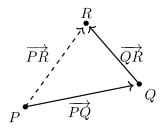
Diagram. Labels: P, Q, R, overrightarrow PQ, overrightarrow QR, overrightarrow PR

Two consequences are immediate and will be used constantly.

Lemma 22.1.1 (First consequences of Chasles)

Let A be an affine space with direction space V. For all P,Q∈A and u,w∈V:

  • (a) PP→=0, and QP→=−PQ→;
  • (b) P+0=P and (P+u)+w=P+(u+w);
  • (c) PQ→=0 if and only if P=Q.

Proof.

  • (a) Taking P=Q=R in (AS1) gives PP→+PP→=PP→, so PP→=0 by cancellation in the group (V,+) (Theorem 0.10.1). Taking R=P in (AS1) gives PQ→+QP→=PP→=0.

  • (b) P+0=P restates PP→=0. For the second identity, put Q=P+u and R=Q+w, so that PQ→=u and QR→=w. By (AS1), PR→=u+w, which says R=P+(u+w).

  • (c) (⇐) is (a). (⇒) If PQ→=0=PP→, then Q=P by the injectivity in (AS2).

The clauses in part (b) are the axioms of an action of the additive group of V on A, and the definition is often given that way instead. The two presentations carry the same information.

Proposition 22.1.2 (The two forms of the definition agree)

Let V be a vector space over F and A a nonempty set. Giving a map A×A→V satisfying (AS1) and (AS2) is the same as giving a map A×V→A, written (P,v)↦P+v, such that

  • (AC1) P+0=P for every P∈A;
  • (AC2) (P+u)+w=P+(u+w) for all P∈A and u,w∈V;
  • (AC3) for all P,Q∈A there is exactly one v∈V with P+v=Q.

The two constructions are inverse to each other.

Idea. There is nothing to find: in one direction the addition was already defined after Definition 22.1.1, in the other the vector PQ→ is the one whose uniqueness (AC3) asserts. The work is checking the axioms, and each check is one line.

Proof. Suppose first that (P,Q)↦PQ→ satisfies (AS1) and (AS2), and define P+v as after Definition 22.1.1. Then (AC1) and (AC2) are Lemma 22.1.1 (b), and (AC3) is (AS2), since P+v=Q says PQ→=v.

Conversely, suppose (P,v)↦P+v satisfies (AC1)–(AC3), and let PQ→ be the unique v with P+v=Q. For (AS1), put u=PQ→ and w=QR→; then by (AC2), P+(u+w)=(P+u)+w=Q+w=R, so PR→=u+w by the uniqueness in (AC3). For (AS2), fix P. The map Q↦PQ→ is surjective because v is the image of P+v, and injective because PQ→=PQ′→=v gives Q=P+v=Q′.

The two passages are inverse: starting from  ⋅ →, the constructed addition has P+v=Q exactly when PQ→=v, so the difference map it returns is the original one; and starting from an addition, the same equivalence returns it unchanged. This proves the proposition.

Remark. The converse half used only (AC2) and (AC3), and it could not have used more: (AC1) follows from the other two. Indeed (AC3) with Q=P gives exactly one v with P+v=P, and that v has P+(v+v)=(P+v)+v=P+v=P by (AC2), so v+v=v by the same uniqueness and v=0. We list (AC1) anyway, because that is how the axioms of a group action are usually written.

Now the examples. The first is the one every other example is modeled on.

Example (Four affine spaces)

Check each of the following against Definition 22.1.1, and say what its direction space and dimension are.

  • (a) A vector space V over F, with xy→:=y−x.
  • (b) A coset p+U of a subspace U of V (Definition 4.4.2), with the same difference map.
  • (c) The solution set of a consistent system Ax=b, A∈Mm×n(F).
  • (d) The set F22 of four points, with xy→=y−x.

Solution.

  • (a) Chasles reads (y−x)+(z−y)=z−x, which is true in any vector space. For fixed x, the map y↦y−x is a bijection V→V with inverse v↦x+v. Direction space V; dimension dim⁡V. Here the point x and the vector x are the same object, and only the language distinguishes them.

  • (b) The set p+U is nonempty (it contains p) and the difference of two of its elements is (p+u)−(p+w)=u−w∈U, so the map does land in U. Chasles is again the identity in (a). For fixed x∈p+U, the map y↦y−x is a bijection p+U→U: it is injective, and u∈U is the image of x+u, which lies in p+U because U is closed under addition. Direction space U; dimension dim⁡U. Over R these are exactly Chapter 18’s affine subspaces of V (Definition 18.1.5 (b)), with the same dimension.

  • (c) By Theorem 3.1.3 the solution set is p+nul(A) for any one solution p, so this is a special case of (b). Direction space nul(A); dimension nullity(A)=n−rankA by Theorem 3.5.7. Consistency is what makes the set nonempty, and Theorem 3.5.8 says when it holds.

  • (d) A special case of (a) with V=F22: four points, direction space F22, dimension 2. It is worth seeing because it is so small. Every pair of distinct points P≠Q has PQ→=QP→, since −1=1 in F2; the next section will call a coset of a one-dimensional subspace a line, and here each such coset has exactly two points. So every one of the (42)=6 pairs of distinct points is itself a line, and the six lines fall into three pairs with no point in common.

A nonexample, by minimal change. Delete one point from the plane: let A=R2∖{0}, with xy→=y−x. Chasles still holds, because it is an identity about subtraction. But (AS2) fails: for P=(1,0), no point Q of A has PQ→=(−1,0), since the only candidate is 0, which we removed. The map Q↦PQ→ is injective but not surjective. It is exactly the transitivity of the action that fails: the set has a hole.

Warning. A point is not a vector. In an affine space there is no zero point; and over a field in which 2≠0 and 3≠0 there is no sum P+Q of two points and no multiple 3P. The only legal expressions are PQ→∈V, P+v∈A, and the affine combinations defined below. If you find yourself writing P+Q, you have silently chosen an origin; the next subsection says what that costs.

22.1.2. Choosing an origin

An affine space looks like its direction space as soon as one point is nominated as the zero. This is the chapter’s first named move, and it is used in almost every proof that follows: to compute, pick an origin; to state a result, do not.

Proposition 22.1.3 (Choice of Origin)

Let A be an affine space with direction space V, and let O∈A. Then θO:A→V,θO(P)=OP→, is a bijection with θO(O)=0, and it carries the affine structure of A to that of V in Example (Four affine spaces) (a): PQ→=θO(Q)−θO(P)(P,Q∈A). If O′∈A is another point, then θO′(P)=θO(P)−θO(O′) for every P: the two identifications differ by a translation of V.

Proof. θO is a bijection by (AS2), and θO(O)=OO→=0 by Lemma 22.1.1 (a). By Chasles and the same lemma, θO(Q)−θO(P)=OQ→−OP→=OQ→+PO→=PQ→. For the last statement, apply this with P and O′ in place of Q and P: θO′(P)=O′P→=θO(P)−θO(O′).

So an n-dimensional affine space over F is a copy of Fn with the labels rubbed off. Choosing O writes the labels back on, and any two choices differ by a translation. We write An(F) for Fn regarded as an affine space over itself, and An when F=R; its points are written P=(p1,…,pn), in plain type, even though the same list of numbers written p would be a vector.

Warning. The identification is never canonical. Proposition 22.1.3 does not say that A “is” V; it says that each point of A gives one isomorphism, and there are as many as there are points. A statement proved after choosing O is a statement about A only if it does not depend on which O was chosen. Checking that independence is a real obligation, and the next subsection is nothing but that check, done once for all.

22.1.3. Affine combinations

Sums of points are forbidden, and yet the centroid 13(P1+P2+P3) of a triangle is a genuine point of the plane, independent of any coordinate system. Something with weights adding up to 1 survives the loss of the origin. Here is the computation that says which expressions survive.

Fix O∈A, points P1,…,Pk∈A and scalars t1,…,tk∈F with s:=t1+⋯+tk. Let O′∈A and w=OO′→. Since O′Pi→=O′O→+OPi→=OPi→−w,

∑i=1ktiO′Pi→=∑i=1ktiOPi→−sw,
(22.1.1)

and therefore, adding this vector to the point O′=O+w and using Lemma 22.1.1 (b), we get the companion identity for points.

O′+∑i=1ktiO′Pi→=(O+∑i=1ktiOPi→)+(1−s)w.
(22.1.2)

The vector on the left of Eq. 22.1.1 does not depend on the origin exactly when s=0; the point on the left of Eq. 22.1.2 does not depend on it exactly when s=1. Both cases are worth a name.

Weights adding to one make a point; weights adding to zero make a vector; nothing else means anything.

Definition 22.1.2 (Affine Combination)

Let A be an affine space with direction space V, let P1,…,Pk∈A with k≥1, and let t1,…,tk∈F.

  • (a) If t1+⋯+tk=1, the affine combination ∑itiPi is the point O+∑itiOPi→, for any O∈A.
  • (b) If t1+⋯+tk=0, the expression ∑itiPi denotes the vector ∑itiOPi→∈V, for any O∈A.

For no other value of t1+⋯+tk is ∑itiPi defined.

In words: the same symbol means a point when the weights add up to 1 and a vector when they add up to 0, and the type of the answer is read off from the weights. The simplest instance of (b) is k=2 with weights (−1,1): the vector Q−P is PQ→. The simplest instance of (a) is k=1 with t1=1, which is P1.

Proposition 22.1.4 (Affine combinations are exactly the origin-free ones)

With the notation of Definition 22.1.2, put s=t1+⋯+tk.

  • (a) If s=1, the point O+∑itiOPi→ is the same for every O∈A.
  • (b) If s=0, the vector ∑itiOPi→ is the same for every O∈A.
  • (c) Suppose dim⁡A≥1. If s≠1, there are points P1,…,Pk and origins O,O′ for which O+∑itiOPi→ and O′+∑itiO′Pi→ differ; and if s≠0, the same is true of the vectors ∑itiOPi→.

Proof.

  • (a) and (b) are Eq. 22.1.2 and Eq. 22.1.1 with 1−s=0 and s=0 respectively, since O′ was an arbitrary point of A.

  • (b) Since dim⁡A≥1, the direction space V contains some w≠0. Take any O∈A, put O′=O+w, and take P1=⋯=Pk=O, so that OPi→=0 for every i. Then Eq. 22.1.2 reads O′+∑itiO′Pi→=O+(1−s)w, which differs from O+∑itiOPi→=O when (1−s)w≠0, that is, when s≠1, by Lemma 22.1.1 (c). Likewise Eq. 22.1.1 reads ∑itiO′Pi→=−sw, which differs from ∑itiOPi→=0 when s≠0.

Taking A=V over R and O=0, part (a) becomes the ordinary vector expression ∑itixi with ∑iti=1, which is Chapter 18’s affine combination (Definition 18.1.5 (a)). So Definition 22.1.2 extends that notion from a real vector space to an affine space over any field, and adds the companion vector-valued case. Chapter 18’s affine hull affS and its description as a coset (Proposition 18.1.4) are the real case of the flats of the next section.

Quick check. Let f:R→R be f(x)=2x+3, which is not linear. Compute f(3⋅1−2⋅2) and 3f(1)−2f(2); then compute f(1+2) and f(1)+f(2). What do the two pairs show?

Solution. First pair: 3⋅1−2⋅2=−1 and f(−1)=1, while 3f(1)−2f(2)=3⋅5−2⋅7=1. They agree, and the weights 3 and −2 add up to 1. Second pair: f(3)=9, while f(1)+f(2)=5+7=12. They differ, and the weights 1 and 1 add up to 2. So f respects combinations whose weights add up to 1 and destroys the others: it is affine but not linear. That is the content of the next subsection.

22.1.4. Affine maps

Linear maps are the functions that respect the structure of a vector space. Affine maps should be the functions that respect the structure of an affine space, and by Definition 22.1.2 that structure is: which affine combinations equal which points. So there is only one reasonable definition.

An affine map is one that can be applied inside an affine combination.

Definition 22.1.3 (Affine Map)

Let A and B be affine spaces over the same field F, with direction spaces V and W. A map f:A→B is affine if f(∑i=1ktiPi)=∑i=1ktif(Pi) for every k≥1, all P1,…,Pk∈A and all t1,…,tk∈F with t1+⋯+tk=1.

Both sides are points, by Definition 22.1.2 (a) applied in A and in B. Nothing is asked about weights summing to anything else, and by the Quick check above nothing could be.

The definition quantifies over all k, which is awkward to verify. The next theorem replaces it by a single linear map, and is the result the rest of the chapter uses.

Theorem 22.1.5 (An Affine Map Is Linear Plus a Translation)

Let A,B be affine spaces over F with direction spaces V,W, and let f:A→B. The following are equivalent.

  • (a) f is affine.
  • (b) There is a linear map T:V→W with f(P)f(Q)→=T(PQ→) for all P,Q∈A.
  • (c) For some O∈A there is a linear map T:V→W with f(P)=f(O)+T(OP→) for all P∈A.

The map T in (b) and (c) is unique, is the same in both, and does not depend on O. It is called the linear part of f and written f→.

Idea. The cycle is (a) ⇒ (c) ⇒ (b) ⇒ (a). For (a) ⇒ (c) we must manufacture a linear map out of a condition about weights, so we need the two vector-space axioms written as affine combinations. They are O+(u+w)=(O+u)+(O+w)−O,O+λu=λ(O+u)+(1−λ)O, whose weights add up to 1−1+1=1 and λ+(1−λ)=1. Applying f to each is additivity and homogeneity of T.

Proof.

  • (a) ⇒ (c). Fix O∈A and define T:V→W by T(v)=f(O)f(O+v)→; this is a map because O+v is a well-defined point. Then f(O+v)=f(O)+T(v) by the definition of +  in B, so once T is shown to be linear, taking v=OP→ gives (c).

Additivity. Let u,w∈V. The three points O+u, O+w, O with weights 1,1,−1 have weight sum 1, and their affine combination, computed with origin O, is O+(u+w−0)=O+(u+w). Applying (a) and computing the right-hand side with origin f(O), f(O+u+w)=f(O+u)+f(O+w)−f(O)=f(O)+(T(u)+T(w)), so T(u+w)=T(u)+T(w).

Homogeneity. Let λ∈F. The two points O+u and O with weights λ and 1−λ have weight sum 1, and their affine combination with origin O is O+λu. Applying (a) and computing with origin f(O), f(O+λu)=λf(O+u)+(1−λ)f(O)=f(O)+λT(u), so T(λu)=λT(u). Hence T is linear.

  • (c) ⇒ (b). Let O and T be as in (c) and let P,Q∈A. Then f(P)=f(O)+T(OP→) and f(Q)=f(O)+T(OQ→), so by Proposition 22.1.3 applied in B with origin f(O), and then linearity of T, f(P)f(Q)→=T(OQ→)−T(OP→)=T(OQ→−OP→)=T(PQ→), the last equality by Proposition 22.1.3 in A.

  • (d) ⇒ (a). Let T be as in (b), let ∑iti=1, and put X=∑itiPi. Choose any O∈A, so that OX→=∑itiOPi→ by Definition 22.1.2. Applying (b) to the pairs (O,X) and (O,Pi), and then linearity, f(O)f(X)→=T(OX→)=∑itiT(OPi→)=∑itif(O)f(Pi)→. The right-hand side is, by Definition 22.1.2 computed in B with origin f(O), the displacement from f(O) to ∑itif(Pi). Hence f(X)=∑itif(Pi), which is (a).

Uniqueness. Suppose T and T′ both satisfy (b). Given v∈V, fix O and put Q=O+v; then T(v)=f(O)f(Q)→=T′(v). So T is determined by f, independently of any origin; and a T satisfying (c) for one O satisfies (b) by the implication above, hence is this same map. This proves the theorem.

So an affine map is one linear map plus one displacement, no more. In An(F)→Am(F) it is f(x)=Ax+b,A∈Mm×n(F), b∈Fm, with A the matrix of f→ in the standard bases and b=f(0).

Warning. Affine is weaker than linear, and the difference is exactly the origin. An affine map f:V→W between vector spaces is linear if and only if f(0)=0: if f(x)=T(x)+b then f(0)=b, and f is linear exactly when b=0. The translation τ(x)=x+b with b≠0 is affine with linear part idV and is not linear — Chapter 2 recorded it as Example (Translation), the standard nonexample of a linear map. Conversely x↦x2 on R fixes 0 and is not affine: it sends the affine combination 2⋅1+(−1)⋅0=1 to 1, while 2f(1)−f(0)=2.

An affine map is determined by very little, but not by too little. Here is the negative half; the positive half is the subject of the next section.

Example (Two points are not enough in the plane)

Let f,g:A2→A2 be g(x,y)=(x,y) and f(x,y)=(x+y, y). Both are affine, being linear. They agree at the two distinct points (0,0) and (1,0) — indeed at every point of the line y=0 — yet f(0,1)=(1,1)≠(0,1)=g(0,1). So two points, even distinct ones, do not determine an affine map of the plane. The count to remember is n+1: the next section proves that 3 suitably chosen points do determine an affine map of the plane, and that 2 never will.

22.1.5. The affine group, and the matrix that computes it

Affine maps compose, and the linear part is functorial. That single fact organizes every computation in the chapter.

Theorem 22.1.6 (Composition, Inverses, and the Affine Group)

Let A,B,C be affine spaces over F, and write V and W for the direction spaces of A and B.

  • (a) If f:A→B and g:B→C are affine, then g∘f is affine and g∘f→=g→∘f→.
  • (b) An affine f:A→B is bijective if and only if f→ is bijective, and then f−1 is affine with f−1→=(f→)−1.
  • (c) The bijective affine maps A→A form a group Aff(A) under composition, and f↦f→ is a surjective group homomorphism Aff(A)→GL(V) whose kernel is the set of translations τv:P↦P+v, v∈V.

Idea. Everything is read off from the identity f(P)f(Q)→=f→(PQ→) of Theorem 22.1.5 (b), which turns statements about points into statements about vectors. For (c), the kernel consists of the affine maps whose linear part is the identity, and such a map moves every point by the same vector.

Proof.

  • (a) For P,Q∈A, applying Theorem 22.1.5 (b) twice, g(f(P))g(f(Q))→=g→(f(P)f(Q)→)=g→(f→(PQ→)). Since g→∘f→ is linear (Theorem 2.4.2), condition (b) of that theorem holds for g∘f with this map, so g∘f is affine and, by the uniqueness clause, g∘f→=g→∘f→.

  • (b) (⇐) Suppose f→ is bijective. If f(P)=f(Q) then f→(PQ→)=f(P)f(Q)→=0, so PQ→=0 and P=Q by Lemma 22.1.1 (c); thus f is injective. For surjectivity, fix O∈A and let R∈B. As f→ is surjective, f(O)R→=f→(v) for some v∈V, and then f(O+v)=f(O)+f→(v)=R by part (c) of Theorem 22.1.5.

    (⇒) Suppose f is bijective and fix O∈A. If f→(v)=0, then f(O+v)=f(O)+0=f(O), so O+v=O and v=0; thus f→ is injective. Given w∈W, the point f(O)+w is f(P) for some P, and then w=f(O)f(P)→=f→(OP→); thus f→ is surjective.

    For the inverse, let R,S∈B and put P=f−1(R), Q=f−1(S). Then f→(PQ→)=RS→, so f−1(R)f−1(S)→=(f→)−1(RS→). Since (f→)−1 is linear (Theorem 2.5.1), f−1 is affine with the stated linear part.

  • (c) By (a) and (b), Aff(A) is closed under composition and inverses and contains idA, whose linear part is idV; composition of functions is associative, so it is a group (Definition 0.10.1). By (a) the map f↦f→ preserves composition, and by (b) it lands in GL(V); so it is a homomorphism (Definition 0.10.3). It is surjective: given T∈GL(V), fix O and set f(P)=O+T(OP→), which is affine with f→=T by Theorem 22.1.5 (c) and bijective by (b).

Its kernel is {f:f→=idV}. Each translation τv lies there, since τv(P)τv(Q)→=PQ→ by Chasles. Conversely suppose f→=idV, fix O and put v=Of(O)→. For any P, Chasles gives Pf(P)→=PO→+Of(O)→+f(O)f(P)→=PO→+v+OP→=v, so f(P)=P+v=τv(P). This proves the theorem.

In coordinates the homomorphism of (c) is visible in the shape of a matrix. Identify x∈Fn with the column (x1)∈Fn+1 — the points of An(F) become the vectors of Fn+1 whose last coordinate is 1.

Proposition 22.1.7 (The Block Matrix of an Affine Map)

Let f:An(F)→Am(F) be affine, f(x)=Ax+b with A∈Mm×n(F) the matrix of f→ and b=f(0). Put f^=(Ab0⊤1)∈M(m+1)×(n+1)(F). Then f^(x1)=(f(x)1) for every x∈Fn; and for affine f:An(F)→Am(F) and g:Am(F)→Ap(F) one has g∘f^=g^f^. For m=n, f is bijective if and only if A is invertible, and then f−1^=(f^)−1=(A−1−A−1b0⊤1).

Proof. Block multiplication (Theorem 8.1.1) gives (Ab0⊤1)(x1)=(Ax+b1), which is the first claim. Writing g(y)=Cy+d, the same rule gives (Cd0⊤1)(Ab0⊤1)=(CACb+d0⊤1), and (g∘f)(x)=C(Ax+b)+d=(CA)x+(Cb+d), so the two agree. For m=n: f is bijective exactly when f→ is, by Theorem 22.1.6 (b), and f→ is bijective exactly when its matrix A is invertible, by Theorem 4.1.5 (b). In that case x↦A−1x−A−1b is affine and is a two-sided inverse of f, and its block matrix is the one displayed, which is therefore (f^)−1 by the composition rule.

So composing affine maps is multiplying (n+1)×(n+1) matrices, and Aff(An(F)) is a group of such matrices. The last row (0⊤∣1) is what records “these are points, not vectors”; the projective sections later in this chapter read that row again, as the equation of the hyperplane at infinity, after the extra coordinate is moved from last place to first.

Example (Composing a shear and a quarter turn)

In A2 let f(x)=Ax+b and g(y)=Cy+d, where A=(1201),b=(1−1),C=(0−110),d=(20). Compute g∘f in block form, and find f−1.

Solution. The block matrices multiply as (0−12100001)(12101−1001)=(0−13121001), so (g∘f)(x,y)=(−y+3, x+2y+1). Check directly: f(x,y)=(x+2y+1, y−1), and applying g gives (−(y−1)+2, x+2y+1)=(3−y, x+2y+1), the same.

For the inverse, A−1=(1−201) and −A−1b=−(1−201)(1−1)=(−31), so f−1(x,y)=(x−2y−3, y+1). Check: f−1(f(x,y))=((x+2y+1)−2(y−1)−3, (y−1)+1)=(x,y).

Two things have been set up. Affine maps are linear maps that have forgotten where the origin is, and they are computed by one matrix of size one larger. The next section uses both to describe the subsets of an affine space that are themselves affine spaces.

22.1.6. Exercises

A. Check your understanding

Exercise (A1)
  • (a) State Chasles’s relation, and deduce QP→=−PQ→ from it.
  • (b) In an affine space over a field in which 2≠0 and 3≠0, which of P+Q, 3P, PQ→+RS→, P+QR→, 12P+12Q are defined? For each defined one, say whether it is a point or a vector.
  • (c) True or false, with a reason: a map f:R2→R2 with f(0)=0 is affine if and only if it is linear.
  • (d) An affine map f:A3→A3 has f→ of rank 2. Is f injective? Justify your answer.

Solution.

  • (a) PQ→+QR→=PR→ for all points P,Q,R. Taking R=P gives PQ→+QP→=PP→, and PP→=0 by Lemma 22.1.1 (a); hence QP→=−PQ→.

  • (b) P+Q and 3P are not defined: the weights add up to 2 and to 3, and under the hypotheses on F neither sum is 0 or 1, so Definition 22.1.2 gives these expressions no meaning; Proposition 22.1.4 (c) says why nothing could, since for dim⁡A≥1 no such expression is origin-free. PQ→+RS→ is a vector (a sum in V). P+QR→ is a point. 12P+12Q is a point, the midpoint, and 12 exists because 2≠0. (The hypotheses on F are needed: over F2 the weights of P+Q add up to 2=0, and Definition 22.1.2 (b) makes P+Q the vector OP→+OQ→=PQ→.)

  • (c) True. An affine map is f(x)=T(x)+b with T linear and b=f(0) (Theorem 22.1.5), so f(0)=0 forces b=0 and f=T. Conversely every linear map is affine, with f→=f, and sends 0 to 0.

  • (d) No. By Theorem 22.1.6 (b), f is bijective exactly when f→ is, and for an operator on a finite-dimensional space injective, surjective, and bijective agree (Theorem 2.5.7). Here rankf→=2<3, so f→ is not injective; taking v≠0 in kerf→ and any P, the points P and P+v have the same image, since f(P)f(P+v)→=f→(v)=0.

B. Practice

Exercise (B1: Determine which are affine)

Determine which of the following maps are affine. Justify your answer; for each affine one give its linear part, and for each other one name a failing affine combination.

  • (a) f:A2→A2, f(x,y)=(2x−y+1, 5).
  • (b) f:A2→A1, f(x,y)=xy.
  • (c) f:A1→A2, f(t)=(1−t, 2+3t).
  • (d) f:A2→A2, f(x,y)=(x+1, |y|).

Solution.

  • (a) Affine: f(x)=Ax+b with A=(2−100) and b=(1,5). Its linear part is x↦Ax, of rank 1.

  • (b) Not affine. Take the affine combination 2(1,1)−1⋅(0,0)=(2,2), with weights 2+(−1)=1. Then f(2,2)=4, while 2f(1,1)−f(0,0)=2.

  • (c) Affine: f(t)=At+b with A=(−13) and b=(1,2). Linear part t↦(−t,3t), of rank 1.

  • (d) Not affine. Take the affine combination 2(0,1)−1⋅(0,3)=(0,−1), with weights 2+(−1)=1. Then f(0,−1)=(1,1), while 2f(0,1)−f(0,3)=2(1,1)−(1,3)=(1,−1). The two differ, so f is not affine. (The first coordinate is affine in x; it is |y| that fails.)

Exercise (B2: Block matrices)

In A2, let r be the affine map with r^=(0−11100001) and let τ be the translation by (2,3).

  • (a) Write r and τ in the form x↦Ax+b.
  • (b) Compute τ∘r^ and r∘τ^, and say whether the two maps are equal.
  • (c) Find all fixed points of r.

Solution.

  • (a) r(x,y)=(−y+1, x), that is, Ar=(0−110), br=(1,0). And τ(x,y)=(x+2, y+3), with Aτ=I2, bτ=(2,3).

  • (b) By Proposition 22.1.7, τ∘r^=τ^r^ and r∘τ^=r^τ^: τ^r^=(0−13103001),r^τ^=(0−1−2102001). They differ, so τ∘r≠r∘τ. (The linear parts agree; the translation vectors do not, because r→ moves bτ.)

  • (c) r(x,y)=(x,y) reads −y+1=x and x=y, so x=y=12. The unique fixed point is (12,12). Equivalently, (I−Ar)x=br with I−Ar=(11−11) invertible.

Exercise (B3: The four-point plane)

Let A=F22 as in Example (Four affine spaces) (d), with points O=(0,0), P=(1,0), Q=(0,1), R=(1,1).

  • (a) Compute PQ→ and QP→, and explain why they are equal.
  • (b) How many affine combinations of the three points O,P,Q are there, and which points do they give? (A combination is counted by its list of weights.)
  • (c) How many bijective affine maps A→A are there?

Solution.

  • (a) PQ→=Q−P=(0,1)−(1,0)=(1,1) and QP→=P−Q=(1,1). They are equal because QP→=−PQ→ (Lemma 22.1.1 (a)) and −v=v for every v over F2.

  • (b) A weight list (t0,t1,t2)∈F23 with t0+t1+t2=1 has an odd number of ones, so it is one of (1,0,0),(0,1,0),(0,0,1),(1,1,1): four lists. The first three give O,P,Q, and (1,1,1) gives O+P+Q=(1,1)=R. So the four affine combinations give the four points, each exactly once.

  • (c) By Theorem 22.1.6 (c) an affine bijection is a translation composed with a linear one, and the number of pairs (T,v)∈GL(F22)×F22 is |GL2(F2)|⋅4. A matrix in GL2(F2) has a nonzero first column (3 choices) and a second column outside the span of the first (4−2=2 choices), so |GL2(F2)|=6 and there are 24 affine bijections. Since |A|=4, these are all 4!=24 permutations of the four points.

C. Going deeper

Exercise (C1: Fixed points)

Let f:An→An be affine, f(x)=Ax+b.

  • (a) Prove that f has a fixed point if and only if b∈col(I−A), and that the set of fixed points, when nonempty, is a coset of nul(I−A).
  • (b) Deduce that if 1 is not an eigenvalue of A, then f has exactly one fixed point.
  • (c) Give an affine map of A2 with no fixed point and linear part ≠id.

Solution.

  • (a) f(x)=x says Ax+b=x, that is, (I−A)x=b. This system is consistent exactly when b∈col(I−A) (Theorem 3.1.1), and then its solution set is p+nul(I−A) for any one solution p, by Theorem 3.1.3.

  • (b) If 1 is not an eigenvalue of A, then nul(I−A)={0}, so I−A is invertible (Theorem 3.4.4). Hence (I−A)x=b has the unique solution x=(I−A)−1b.

  • (c) Take A=(1002) and b=(1,0), so f(x,y)=(x+1, 2y). Then I−A=(000−1) and col(I−A)=span(e2), which does not contain b=e1; so there is no fixed point, by (a). And A≠I.

Exercise (C2: Affine maps on two points, over two fields)

Let f:A→B be a map of affine spaces over F that preserves affine combinations of two points, that is, f((1−t)P+tQ)=(1−t)f(P)+tf(Q) for all P,Q∈A and t∈F.

  • (a) Prove that if charF≠2, then f is affine. Hint: run the proof of Theorem 22.1.5, replacing the three-point combination by two two-point ones.
  • (b) Show that over F2 the hypothesis is empty, and give a nonaffine map F22→F2 satisfying it.

Solution.

  • (a) Fix O∈A and define T(v)=f(O)f(O+v)→ as in Theorem 22.1.5. Homogeneity is the hypothesis with P=O+v, Q=O: O+λv=λ(O+v)+(1−λ)O, so f(O+λv)=λf(O+v)+(1−λ)f(O)=f(O)+λT(v), giving T(λv)=λT(v).

    For additivity, let u,w∈V and let M=12(O+u)+12(O+w), which is legal since 2≠0 in F. With origin O, M=O+12(u+w). By the hypothesis, f(M)=12f(O+u)+12f(O+w), which with origin f(O) reads f(M)=f(O)+12(T(u)+T(w)). So T(12(u+w))=12(T(u)+T(w)). Applying homogeneity with λ=2 to the left-hand side gives T(u+w)=T(u)+T(w). Hence T is linear, and f(P)=f(O)+T(OP→) by construction, so f is affine by Theorem 22.1.5 (c).

  • (b) Over F2 the only scalars are t=0 and t=1, for which (1−t)P+tQ is P or Q; the required identity then reads f(P)=f(P) or f(Q)=f(Q). So every map satisfies the hypothesis. Take f:F22→F2 with f(0,0)=f(1,0)=f(0,1)=0 and f(1,1)=1. It is not affine: by Exercise (B3: The four-point plane) (b), (1,1) is the affine combination O+P+Q of the other three points with weights (1,1,1), so an affine f would have f(1,1)=f(O)+f(P)+f(Q)=0.
Exercise (C3: Conjugating a translation)

Let A be an affine space with direction space V, let f∈Aff(A) and let v∈V.

  • (a) Prove that f∘τv∘f−1=τf→(v).
  • (b) Hence prove that the translations form a subgroup of Aff(A) that is carried to itself by every conjugation, and that v↦τv is an isomorphism from (V,+) onto it.
  • (c) Deduce that if dim⁡A≥2, then Aff(A) is not abelian.

Solution.

  • (a) Both sides are affine maps A→A. By Theorem 22.1.6 (a) the linear part of the left-hand side is f→∘idV∘(f→)−1=idV, so by the kernel description in Theorem 22.1.6 (c) it is a translation τu for some u. To identify u, fix O∈A and put P=f−1(O). Then u=O(f∘τv∘f−1)(O)→=f(P)f(P+v)→=f→(v), using Theorem 22.1.5 (b) and P(P+v)→=v.

  • (b) The translations are the kernel of f↦f→ (Theorem 22.1.6 (c)), hence a subgroup by Theorem 0.10.3, and (a) says every conjugate of a translation is a translation. The map v↦τv satisfies τu∘τw=τu+w by Lemma 22.1.1 (b), so it is a homomorphism (V,+)→Aff(A); it is surjective onto the translations by definition, and injective because τv=id forces P+v=P, hence v=0.

  • (c) Since dim⁡V≥2, pick independent v,w∈V and T∈GL(V) with T(v)=w (extend {v,w} to a basis of V by Theorem 1.8.2, and map that basis to itself with v and w swapped, using Theorem 2.1.6; this T is invertible because T∘T fixes every basis vector and so is idV, by the uniqueness in that theorem). By Theorem 22.1.6 (c) there is f∈Aff(A) with f→=T. If Aff(A) were abelian then f∘τv∘f−1=τv, while (a) gives τT(v)=τw; by the injectivity in (b) that forces v=w, contradicting independence.

Found a typo or a mistake? Report it, or read this page’s source

The text of this book is licensed under CC BY-NC-SA 4.0.