13.7  Determinant Inequalities for Positive Matrices

Section 6 cut a Hermitian matrix into blocks and read a verdict off the corner: once the corner block is positive definite, the whole matrix is positive definite exactly when one smaller matrix, the Schur complement, is. The same cut carries a second piece of information, which that verdict threw away. The congruence behind it is a factorization, so it computes a determinant as well, and what the off-diagonal block does to that determinant goes one way only: it can push the determinant down, and never up.

That single observation, applied to a two-block partition, is Fischer’s inequality: the determinant of a positive matrix is at most the product of the determinants of its two diagonal blocks. Applied again and again, until every block is a single entry, it is Hadamard’s inequality: the determinant is at most the product of the diagonal entries. The second has a picture attached, and it is the reason the inequality is remembered — among all parallelepipeds with prescribed edge lengths, the rectangular one has the largest volume.

Throughout, F=R or F=C, and Fn carries the standard inner product. A Hermitian M∈Mk+l(F) is written in blocks as

M=(ABB∗C),A∈Mk(F),B∈Mk×l(F),C∈Ml(F),

with A and C Hermitian, as in Section 6.

13.7.1. Fischer’s inequality

When A≻O, the congruence of Theorem 13.6.1 turns M into A⊕(M/A), and taking determinants in it gives Theorem 8.3.2,

detM=detA⋅det(M/A).

If the Schur complement could be compared with C, that would bound detM by detAdetC — and it can be, because C is the Schur complement plus something positive:

C=(M/A)+B∗A−1B.

So what is needed is that adding a positive semidefinite matrix never decreases a determinant. That is the next lemma, and it is where the square root of Section 2 earns its keep.

Lemma 13.7.1 (Adding a positive matrix does not decrease the determinant)

Let P,Q∈Mn(F) with P≻O and Q⪰O. Then

det(P+Q)≥detP>0,

with equality if and only if Q=O.

Idea. Whiten: divide the problem by P on both sides, using the inverse of P1/2. The sum P+Q becomes I+K with K⪰O, and the determinant of I+K is ∏i(1+μi) over the eigenvalues μi≥0 of K. A product of numbers ≥1 is ≥1, and it equals 1 only when every factor does.

Proof. By Theorem 13.2.1 the matrix P1/2⪰O exists, and it is invertible because P is (Theorem 13.2.1 (c)). Write R=(P1/2)−1, which is Hermitian, being the inverse of a Hermitian matrix. Since P1/2R=I and (P1/2)2=P,

P1/2(I+RQR)P1/2=P+Q.

Put K=R∗QR=RQR, so that K⪰O by Proposition 13.1.2 (a). Taking determinants with Theorem 7.5.4, and using (detP1/2)2=detP,

det(P+Q)=detP⋅det(I+K).

Now K is Hermitian, so K=Udiag(μ1,…,μn)U∗ with U unitary, by Corollary 12.4.3 over C and Corollary 12.5.2 over R; and every μi≥0 by Theorem 13.1.4 (b). Then I+K=Udiag(1+μ1,…,1+μn)U∗, so

det(I+K)=∏i=1n(1+μi)≥1,

each factor being ≥1. Also detP>0, since the eigenvalues of P are positive (Theorem 13.1.5 (b)) and the determinant is their product. Hence det(P+Q)≥detP>0.

For the equality case, the product equals 1 exactly when every μi=0, that is when K=UOU∗=O, and then Q=P1/2KP1/2=O. Conversely Q=O gives equality. This proves the lemma.

Remark. Section 5 states this in its natural generality: the determinant is monotone for the Loewner order, so A⪰B⪰O implies detA≥detB. The special case proved here, in which the smaller of the two matrices is definite, is all this section and the next one need, and its proof is short enough to keep local.

Corollary 13.7.2 (Fischer’s Inequality)

Let M=(ABB∗C)∈Mk+l(F) with M⪰O, where A∈Mk(F) and C∈Ml(F). Then

detM≤detA⋅detC.

If M≻O, equality holds if and only if B=O.

Idea. Do the definite case first and reach the general case by a limit. For M≻O the Schur complement exists, the determinant splits as detAdet(M/A), and detC≥det(M/A) by Lemma 13.7.1 applied to C=(M/A)+B∗A−1B. For M⪰O, apply the definite case to M+tI and let t shrink to 0: both sides are polynomials in t.

Proof. Case 1: M≻O. By Theorem 13.6.1 (a), A≻O, and by (b), M/A≻O. By Theorem 8.3.2,

detM=detA⋅det(M/A).

The matrix A−1 is positive definite. Indeed the eigenvalues of A are positive (Theorem 13.1.5 (b)), so A is invertible (Theorem 9.2.6); the identity (A−1)∗=(A∗)−1=A−1 makes A−1 Hermitian; and Proposition 13.1.2 (b) with the invertible S=A−1 turns S∗AS=A−1AA−1=A−1 into A−1≻O. (This is Exercise (B3: The inverse of a positive definite matrix).) So Q:=B∗A−1B⪰O by Proposition 13.1.2 (a) with S=B. Since C=(M/A)+Q, Lemma 13.7.1 with P=M/A gives detC≥det(M/A), with equality if and only if Q=O. Multiplying by detA>0,

detM=detAdet(M/A)≤detAdetC,

with equality if and only if B∗A−1B=O.

It remains to see that B∗A−1B=O holds only for B=O. Let R=(A1/2)−1, a Hermitian matrix with R2=A−1, as in the proof of Lemma 13.7.1. Then B∗A−1B=(RB)∗(RB), whose (j,j) entry is the squared norm of the j-th column of RB. If the whole matrix is O, every column of RB is 0, so RB=O and B=A1/2(RB)=O. The converse is clear.

Case 2: M⪰O. For real t>0 the matrix M+tIk+l is Hermitian with v∗(M+tI)v=v∗Mv+t‖v‖2>0 for v≠0, so M+tI≻O. Its blocks are A+tIk, B, and C+tIl, so Case 1 gives

det(M+tI)≤det(A+tIk)⋅det(C+tIl)

for every t>0. A determinant is a polynomial in the entries (Theorem 7.4.3), and the entries here are polynomials in t, so both sides are polynomial, hence continuous, functions of t. Letting t decrease to 0 preserves the inequality, and at t=0 it reads detM≤detAdetC. This proves the corollary.

The inequality says that for a positive matrix the off-diagonal blocks are a liability: they can only shrink the determinant, and they cost nothing only when they are absent. Applying it repeatedly, to finer and finer partitions, gives the classical case in which every block is 1×1. That is the next result.

Quick check. What does Corollary 13.7.2 say for k=l=1, that is for M=(abb―c)⪰O?

Solution. It says ac−|b|2=detM≤det(a)det(c)=ac, that is |b|2≥0 — true for any b whatsoever, and with equality exactly when b=0. So in the smallest case the inequality carries no information beyond its equality condition. The content is in the blocks: for larger k and l the statement is no longer a triviality about one number, and its proof needs the whole of Lemma 13.7.1.

13.7.2. Hadamard’s inequality

Theorem 13.7.3 (Hadamard’s Inequality)
  • (a) Let A∈Mn(F) with A⪰O. Then detA≤a11a22⋯ann, with equality if and only if A is diagonal or some aii=0.
  • (b) Let B∈Mn(F) have columns b1,…,bn. Then |detB|≤‖b1‖‖b2‖⋯‖bn‖, with equality if and only if the columns are pairwise orthogonal or some column is 0.

Idea. Part (a) is Fischer’s inequality with k=1, applied again and again: peel off the first row and column, bound detA by a11detA′, and induct on the size. Part (b) is part (a) for the Gram matrix A=B∗B, whose diagonal entries are the squared lengths ‖bj‖2 and whose determinant is |detB|2. The equality conditions transfer along the same dictionary: A diagonal says the columns of B are orthogonal, and ajj=0 says bj=0.

Proof.

  • (a) Induct on n. For n=1 both sides are a11.

    Let n≥2 and split A with k=1:

    A=(a11b∗bA′),b∈Fn−1,A′∈Mn−1(F),

    so that A′ is the submatrix on rows and columns 2,…,n. By Theorem 13.6.1 (a), A′⪰O, and by Corollary 13.7.2,

    detA≤a11detA′≤a11(a22⋯ann),

    the second step being the inductive hypothesis applied to A′. This is the inequality.

    For equality, suppose first that some aii=0. Fix j≠i and put I={i,j}. By Theorem 13.1.4 ((a) ⇒ (e)) the principal minor on the rows and columns I is ≥0, so 0≤detAI,I=aiiajj−|aij|2=−|aij|2, forcing aij=0; and aji=aij―=0 because A is Hermitian. As j≠i was arbitrary, row i and column i of A are zero (which is Exercise (C3: The largest entry sits on the diagonal) (b)) and detA=0; the right-hand side is 0 too, so equality holds. If A is diagonal, both sides are the product of the diagonal entries. Conversely, suppose equality holds and every aii>0. Then detA=a11⋯ann>0, so A is invertible, and a positive semidefinite matrix with no zero eigenvalue is positive definite (Theorem 13.1.5 (b)). Both inequalities in the display are therefore equalities. The first is the equality case of Corollary 13.7.2 for the positive definite A, so b=0: the first row and column vanish off the diagonal. The second is the equality case of the inductive hypothesis for A′, whose diagonal entries are positive, so A′ is diagonal. Hence A is diagonal, and the induction is complete.

  • (b) Put A=B∗B, which is positive semidefinite by Theorem 13.1.4 (c). Its (j,j) entry is bj∗bj=‖bj‖2. By Theorem 7.5.4, and because det(B∗)=detB― — the star transposes, which does not change the determinant (Theorem 7.4.5), and conjugates every entry, which conjugates the determinant —

detA=detB―detB=|detB|2.

Part (a) now reads |detB|2≤‖b1‖2⋯‖bn‖2, and taking nonnegative square roots gives the inequality.

For equality, note that ajj=0 says bj=0, and that A is diagonal exactly when ⟨bj,bi⟩=aij=0 for all i≠j, that is, exactly when the columns are pairwise orthogonal. So the equality condition of (a) translates into the stated one. This proves the theorem.

Remark. Part (b) has a geometric reading, and it is the reason the inequality is remembered. Over R, |detB| is the volume of the parallelepiped with edges b1,…,bn (Definition 7.9.1), and the right-hand side is the volume of the box with the same edge lengths. So among all parallelepipeds with prescribed edge lengths, the rectangular one has the largest volume, and up to degenerate cases it is the only one. Tilting an edge costs volume.
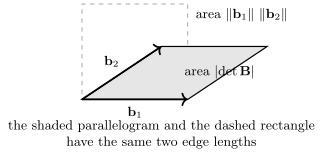
Diagram. Labels: cvec b_1, cvec b_2, area lvert det B rvert, area norm cvec b_1\,norm cvec b_2, the shaded parallelogram and the dashed rectangle\\ have the same two edge lengths
Example (Two Determinant Bounds)

Bound |detB| using Theorem 13.7.3 (b) for

B1=(111−1),B2=(210121012),

and compare each bound with the exact value.

Solution. For B1, both columns have norm 2, so the bound is 2. The determinant is −1−1=−2, so |detB1|=2 and the bound is attained. The equality case predicts this: ⟨(1,−1),(1,1)⟩=1−1=0, so the columns are orthogonal.

For B2, the columns have norms 5, 6, and 5, so the bound is 56≈12.25. Expanding along the first row, detB2=2(4−1)−1(2−0)=4. The bound holds and is far from sharp, as it must be, since ⟨(1,2,1),(2,1,0)⟩=4≠0 means the columns are not orthogonal.

Warning. Part (a) needs positivity; without it the inequality can fail in either direction. The symmetric matrix

A=(1111−1010−1)

has detA=3, while a11a22a33=1⋅(−1)⋅(−1)=1. So detA>∏iaii, and a diagonal entry of an indefinite matrix carries no information about the size of the determinant. Part (b), by contrast, has no hypothesis at all — but it bounds by column norms. For rows, apply the same result to B⊤, whose determinant is unchanged (Theorem 7.4.5).

13.7.3. Exercises

A. Check your understanding

Exercise (A1)
  • (a) State Corollary 13.7.2, including its hypothesis, and say when equality holds.
  • (b) State both forms of Theorem 13.7.3, and say what hypothesis each one needs.
  • (c) In the proof of Fischer’s inequality, which matrix plays the role of Q in Lemma 13.7.1, and which plays the role of P?
  • (d) True or false: if A⪰O and detA=a11a22⋯ann, then A is diagonal. Justify your answer.
  • (e) Theorem 13.7.3 (b) holds for every square B, with no positivity assumed anywhere. Where did the hypothesis go?

Solution.

  • (a) For M=(ABB∗C)⪰O with square diagonal blocks, detM≤detA⋅detC. The hypothesis is that the whole of M is positive semidefinite. When M≻O, equality holds exactly when B=O.

  • (b) For A⪰O, detA≤a11⋯ann, and the hypothesis is positive semidefiniteness. For any square B: |detB|≤‖b1‖⋯‖bn‖ over the columns, with no hypothesis.

  • (c) P=M/A and Q=B∗A−1B, so that P+Q=C.

  • (d) False. Equality also holds whenever some aii=0, and then A need not be diagonal: the matrix A=(110110000) is positive semidefinite, being N∗N for N the matrix with first row (1,1,0) and the rest zero, and both sides are 0. What Theorem 13.7.3 (a) says is that equality forces A to be diagonal or some diagonal entry to vanish, and the second alternative cannot be dropped.

  • (e) Into the Gram matrix. Part (b) is part (a) applied to A=B∗B, which is positive semidefinite whatever B is (Theorem 13.1.4 (c)). The positivity is not assumed because it is manufactured.

B. Practice

Exercise (B1: A bordered matrix)

Let

M=(211120102).

  • (a) Using the partition with k=1, compute M/A and decide whether M≻O.
  • (b) Hence compute detM, and check Fischer’s inequality for this partition.

Solution.

  • (a) Here A=(2)≻O, B=(11), and C=(2002). Then

    B∗A−1B=12(11)(11)=12(1111),M/A=(3/2−1/2−1/23/2).

    The leading principal minors of M/A are 3/2 and 9/4−1/4=2, both positive, so M/A≻O and M≻O by Theorem 13.6.1 (b).

  • (b) By Theorem 8.3.2, detM=2⋅2=4. Fischer’s inequality (Corollary 13.7.2) for this partition reads detM≤detAdetC=2⋅4=8, and indeed 4≤8. The inequality is strict, as it must be, since B≠O.
Exercise (B2: Hadamard bounds)
  • (a) Bound |detB| for B=(1234), and compare with the exact value.
  • (b) Let H=(111111−1−11−11−11−1−11). Compute H⊤H, and deduce |detH| without expanding the determinant.

Solution.

  • (a) The columns are (1,3) and (2,4), with norms 10 and 20, so the bound is 200=102≈14.14. The determinant is 4−6=−2, so |detB|=2. The bound is true and very weak, because the columns are far from orthogonal.

  • (b) Every column of H has norm 2, and any two distinct columns are orthogonal: each of the six pairs agrees in two positions and disagrees in the other two, so the dot product is 1+1−1−1=0. Hence H⊤H=4I4. Taking determinants with Theorem 7.5.4 and Theorem 7.4.5, (detH)2=44=256, so |detH|=16. This is exactly the Hadamard bound ‖h1‖⋯‖h4‖=24=16, as the equality case of Theorem 13.7.3 (b) predicts for orthogonal columns.

C. Going deeper

Exercise (C1: How large can a determinant be?)
  • (a) Let B∈Mn(F) have every entry of modulus at most 1. Prove that |detB|≤nn/2.
  • (b) Show that the bound is attained for n=1, n=2, and n=4.
  • (c) Let B∈M3(R) have every entry equal to 1 or −1. Prove that detB is a multiple of 4, and deduce that |detB|≤4. Hence the bound of (a) is not attained for n=3.

Hint for (c): normalize the first row and the first column, then subtract the first column from the other two.

Solution.

  • (a) Each column bj has n entries of modulus ≤1, so ‖bj‖2=∑i|bij|2≤n and ‖bj‖≤n. By Theorem 13.7.3 (b), |detB|≤(n)n=nn/2.

  • (b) For n=1, B=(1) gives 1=11/2. For n=2, B=(111−1) has |detB|=2=22/2. For n=4, the matrix H of Exercise (B2: Hadamard bounds) (b) has |detH|=16=44/2. In each case all entries have modulus 1 and the columns are orthogonal, which is exactly what is needed for equality both in ‖bj‖≤n and in Theorem 13.7.3 (b).

  • (c) Multiplying a row or a column by −1 multiplies detB by −1 (Theorem 7.5.1 (b) and (d)) and keeps all entries ±1, so we may assume that the first row and the first column both consist of 1s: first scale the three columns to make the first row (1,1,1), then scale rows 2 and 3 to make the first column (1,1,1), which leaves the first row alone. Subtracting column 1 from columns 2 and 3 leaves the determinant unchanged (Theorem 7.5.1 (c) and (d)) and gives a matrix whose first row is (1,0,0) and whose remaining entries are cij=bij−1 for i,j∈{2,3}; each lies in {0,−2}, since bij∈{1,−1}. Expanding along the first row (Theorem 7.6.1),

detB=c22c33−c23c32

with every cij∈{0,−2}. Each product lies in {0,4}, so detB∈{−4,0,4} and in particular |detB|≤4. Since 33/2=33≈5.196>4, the bound of (a) is not attained. The value 4 does occur, for instance for (1111−1111−1).

Found a typo or a mistake? Report it, or read this page’s source

The text of this book is licensed under CC BY-NC-SA 4.0.