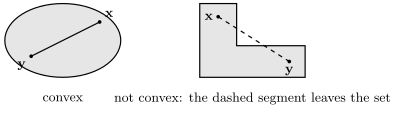
Convexity has turned up in this book four times
without being asked for: in the unit balls of Chapter
16, the positive semidefinite matrices of Chapter 13,
and the Ky Fan sums and the possible diagonals of
Chapter 17 (the chapter introduction lists the places).
Each time the property was checked by hand and set
aside. This section gives it a name, finds the smallest
convex set containing a given set, and fixes the words
closed and open that
the rest of the chapter needs.
The field is , throughout the
chapter. The definition below asks for a scalar
with , which
needs an order on the scalars; has none. A complex
space is treated as a real one by allowing only real
scalars. That is how the Hermitian matrices enter below:
they form a vector space over , and not over , since is not Hermitian when
is.
Unless a statement says otherwise, is a real vector space;
where a result needs a finite dimension, a norm, or an
inner product, it says so.
Segments,
and sets that contain them
Chapter 16 §01 checked the convexity of a unit ball
with one line: if and , then . The expression , with running over , keeps recurring,
so it deserves a name, and so does the property of
containing all of it.
Picture it first. At the expression is , at it is , and at it is the
midpoint. Writing it as shows the rest: we start at and travel the
fraction of the
way to . As
runs over , the point runs
along the straight segment from to , and nowhere
else.
A convex set is one that contains the whole
straight segment between any two of its points.
Definition
18.1.1 (Convex Set)
Let be a
vector space over . A subset
is
convex if, for all
and every real with , The set is
the segment joining and , written .
In words: pick any two points of , possibly equal; the
segment joining them must lie inside . The quantifier “for
all ” is what makes this a property of the
set rather than of a pair; one segment escaping is enough to make it
nonconvex. The restriction is the other half of the content,
and the end of this subsection shows what happens
without it. There is nothing to check for
well-definedness: a subset either has the property or it
does not.
Example
(The first convex sets)
Check each of the following against Definition 18.1.1.
- (a) The empty set,
and a single point .
- (b) A subspace of , and a coset of it (Definition 4.4.2).
- (c) A closed
half-space , where is a nonzero
linear functional on (Definition 5.1.1) and
.
- (d) A closed ball
of any norm
on , with center
and radius
.
- (e) The set of
positive semidefinite matrices (Definition 13.1.1) in
the real vector space of Hermitian matrices.
Solution.
(a) The empty set
has no two points, so the condition holds vacuously; for
, . These degenerate cases matter because
an intersection of convex sets, which we meet shortly,
is often empty or a single point, and the statements
below must allow for both.
(b) Let and with .
Then and because a subspace is
closed under linear combinations. Taking gives
the subspace itself. Here the restriction on was not used at all; we
return to this below.
(c) Let
and . By linearity, where the inequality multiplies the first
hypothesis by and
the second by . Multiplying an inequality by a number
preserves it only when the number is , so both and were used. In
every linear
functional is for some (Theorem 5.1.1), so the
closed half-spaces of are the sets with .
The same computation shows that the open
half-space is convex, and that the affine
hyperplane is convex.
(d) Let and . Since , (N3) and (N2) of Definition 16.1.1 give where homogeneity used and
. With and this is the closed unit ball of Definition 16.1.2, and the
computation is the one Chapter 16 §01 made
there.
(e) The Hermitian
matrices form a real vector space: a real linear
combination of Hermitian matrices is Hermitian. Let
and
. Then
is
Hermitian, and for every , since both inner products on the right are
by (P2) and
both coefficients are . So (P1) and (P2) hold, and .
The same computation with any in place of
and shows , so
the positive semidefinite matrices form a convex cone,
in the sense of §05. (This is what Exercise (C2: The cone of positive matrices)
(a) asks.)
The standard example of a convex set in coordinates
gets its own name, because the rest of this section
keeps returning to it.
Definition
18.1.2 (Standard Simplex)
For , the
standard simplex in is
is a point, is the segment
from to
, and is the triangle
with corners . It is convex: it is the
intersection of the closed half-spaces
with
the affine hyperplane , and each of these is
convex by Example (The first convex sets)
(c). (That an intersection of convex sets is convex is
the first item of Proposition 18.1.1
below; it is also immediate here, because a point that
lies in each set lies in their intersection.) An element
of is a
list of
weights: nonnegative, and adding up to
.
A nonexample by minimal change. Keep
the closed unit ball of but take only its
edge, the unit circle . Much survives: the circle is symmetric
under , bounded, and as round as the disc.
But the clause “for all ” fails
at , ,
: the
midpoint is , and . What was lost is exactly the inequality
that absorbed
the triangle inequality in Example (The first convex sets)
(d); with an equality there is nothing to absorb it.
Why this definition. Two variations
are worth trying.
- Let range
over all of . Then must contain the whole
line through any two of its points. The
subspaces and cosets of Example (The first convex sets)
meet this demand, which is why (b) never used ; the
half-spaces and balls do not. Exercise (C3: Sets that contain lines)
shows that, apart from , the sets
meeting it are exactly the cosets.
- Ask only for . A set containing the midpoint of
any two of its points is midpoint
convex, which is genuinely weaker: is midpoint convex,
yet it misses . Exercise (C1: Midpoint convexity)
shows that the gap disappears for closed sets, defined
at the end of this section.
The name is the everyday word: a convex lens has no
dents.
Warning. A union of convex
sets need not be convex. The two coordinate
axes in are
subspaces, hence convex, but their union contains and and not their
midpoint , which lies on neither axis. Even two
points fail: is a union of two convex
sets and misses . The
operation that does respect convexity is intersection
(Proposition 18.1.1), and
the convex replacement for a union is the hull of the
union, defined below.
Quick check. Is convex? Is convex?
Solution. The first is convex. It
is the set where both and , an intersection of two closed half-spaces,
and a point on a segment between two points of both
half-spaces lies in both by Example (The first convex sets)
(c). The second is not: and belong to it, since , but their
midpoint
does not, since is false. The two sets differ only in the
direction of the inequality, and the direction decides
everything; a convex function such as has a
convex region above its graph
(§10).
Here is a payoff. Chapter 17 §08 met a set of vectors
that it could describe exactly, but whose convexity it
proved only in an exercise. Everything needed to prove
it is now in place.
Example
(The vectors majorized by a fixed vector)
Let 𝛌. Prove that the set 𝛌 of vectors majorized by 𝛌 (Definition 17.8.1) is
convex, and deduce that the diagonals of the Hermitian
matrices with spectrum 𝛌 form a convex
set.
Solution. For and
,
write ,
the sum of the
largest entries.
Step 1: any entries add up to at
most . List
the entries at
a set of positions decreasingly
as . Since has entries ,
we get for each . Summing gives , with equality when holds the positions of
the largest
entries.
Step 2:
respects averages. Let and , and let hold the positions of
the largest
entries of . By Step 1, used once
with equality and twice as an inequality, where the inequality again needs and .
Step 3: convexity. Let 𝛌
and 𝛌, and put . For , Step 2 and
(M1) for both vectors give 𝛌𝛌𝛌. The
total of
is by (M2)
for both. So 𝛌, and the set is convex.
For the deduction, the Schur–Horn Theorem (Theorem 17.8.5) says
that the diagonals of the Hermitian matrices with
eigenvalues 𝛌 are
exactly the vectors 𝛌.
So the set of those diagonals is the set just shown to
be convex.
This is the statement of Exercise (C3: The possible diagonals form a convex set),
now with a proof in the text, and Step 2 is a first
glimpse of §10’s convex functions: satisfies because
it is a maximum of linear functions.
Operations
that preserve convexity
Checking the definition directly is rarely the
fastest route. Most convex sets are built from simpler
ones by a few operations, and the following proposition
lists those that preserve convexity. It needs one
construction. For subsets and a real , the Minkowski
sum and the scalar multiple
are A translate is the
Minkowski sum ; a coset (Definition 4.4.2)
is a translate of a subspace.
Proposition
18.1.1 (Operations Preserving Convexity)
Let and be real vector
spaces.
- (a) The intersection
of any family of convex subsets of
is convex.
- (b) If is
linear, is convex and is convex, then the image and the preimage
are convex.
- (c) If are
convex and , then , , and
every translate are convex.
Idea. Rewrite the point of the
segment so that convexity of the given sets applies:
linearity moves the weights through , and a Minkowski sum
regroups term by term.
Proof. Throughout, let .
(a) Let be a family of
convex sets and . For each
, both points
lie in , so
by convexity of . Hence the point
lies in every , that is, in the
intersection. (The intersection of the empty family is
by convention,
and is
convex.)
(b) Let with . By linearity, , and
by convexity; so the point lies in . For the preimage,
let . Then by convexity of , so .
(c) Let and
lie in . Rearranging, and the two brackets lie in and in by convexity. So the
point lies in . The scalar multiple is the image of under the linear map
, and is convex by (b). A translate
is convex because a single point is convex
(Example (The first convex sets)
(a)). This proves the proposition.
The proposition turns many checks into one line. The
solution set of a system of linear inequalities, where is the
-th row of and
means in every
entry, is an intersection of closed half-spaces (a zero
row gives or
), hence
convex by (a). This is the kind of set that the closing
remark of Chapter 3 §07 points to, where nonnegativity
and capacities are added to a flow problem, and §06 of
this chapter optimizes over it. The set of
density matrices is convex for the same reason: it is the
intersection of the positive semidefinite set of Example (The first convex sets)
(e) with the preimage of under the linear
map .
Convex
combinations and the convex hull
A convex set contains the segment between any two of
its points. Apply that twice: it contains , , and hence
every point of , and then every point on a segment
from such a point to . The points
reached are the averages of with nonnegative weights, and the
pattern deserves a name.
Definition
18.1.3 (Convex Combination)
Let be a real
vector space and , with . A convex
combination of is a vector that is, with every and .
It is a linear combination with two restrictions on
the coefficients, and each restriction has a job.
Dropping “” gives the affine combinations of the next
subsection; dropping “sum to ” as well gives all
linear combinations, and the span. A convex combination
of two points is a point of the segment joining them,
with as
the weights. The weights may be read as masses placed at
the points, and the combination is then their center of
mass. The case is included and is .
Lemma
18.1.2 (Convex Sets Contain Their Convex
Combinations)
Let be a
convex subset of a real vector space. Then every convex
combination of points of lies in .
Idea. Peel off the last point. A
convex combination of points is a combination
of two points, one of which is a convex combination of
the first
points, rescaled so that its weights again add up to
. Induction on
does the rest;
the only care needed is not to divide by zero while
rescaling.
Proof. We use induction on the
number of points.
For , the
combination is . Let , suppose the statement holds for points, and let
with and
.
Case 1: . Then the other weights are nonnegative
and add up to , so
all of them are ,
and .
Case 2: . Put and . The division is legal
because .
The coefficients are and add up to , so is a convex
combination of points of , and by the
inductive hypothesis. Then which lies in by Definition 18.1.1,
applied to the points and of with . This
completes the induction.
A set that is not convex can be enlarged to one that
is. We want the most economical enlargement: nothing
added that convexity does not force.
The convex hull of a set is the smallest convex
set containing it.
Definition
18.1.4 (Convex Hull)
Let be a
subset of a real vector space . The convex
hull of
is the intersection of all convex
subsets of that
contain :
The family being intersected is never empty, because
itself is convex
and contains . By
Proposition 18.1.1 (a),
is convex;
it contains ,
since each set in the family does; and it lies inside
every convex set containing , since it is the
intersection of all of them. So “smallest” in the slogan
is literal:
is a convex set containing and contained in every
other one. In particular,
exactly when is convex. This
description from outside is clean but gives no way to
decide whether a given point lies in the hull. The next
theorem gives the description from inside.
Theorem
18.1.3 (The Hull Is the Set of Convex
Combinations)
Let be a
subset of a real vector space . Then is the set of all
convex combinations of points of :
Idea. Call the right-hand side
. One inclusion is
Lemma 18.1.2 applied to
the convex set . For the other, is the smallest
convex set containing , so it suffices to show
that is
some convex set containing . An average of two
averages is again an average, of the combined list.
Proof. Let denote the right-hand
side.
The
set is
convex and contains . By Lemma 18.1.2 it contains
every convex combination of its own points, in
particular of points of . Hence .
Each
is
the convex combination , so . To see
that is convex,
let and be points of , with all , and let . Then a combination of the points of , with coefficients
and
adding up to . So , and
is convex. Since is contained in every convex set containing
, we get .
This proves .
A combination needs a point, so ; and, padding with zero weights and
merging repeated points, is the set of all with
; since , the standard simplex is
the hull of the standard basis.
The theorem does not say how many points a
combination needs. Every is allowed, and for an
infinite nothing
in it bounds .
That question is the business of §02.
Example
(Deciding membership in a triangle)
Let , , in . Decide whether
and lie in
.
Solution. By Theorem 18.1.3 and the
remark after it, a point lies in the hull
exactly when
for some . The two coordinates and the condition
give three linear equations in , with
coefficient matrix So each has exactly one
solution ,
and is in
the hull if and only if that solution has no negative
entry.
For ,
the solution is . Check: , and the
weights add up to . All three are , so lies in the
hull.
For ,
the solution is . Check: , and . The only solution has , so
no convex combination equals , and . The negative weight
even says where is: on the far
side of the line through and from .
Quick check. Is in the convex hull of in ?
Solution. Yes. Give each of the
four points weight : the weights are
and add up to
, and By Theorem 18.1.3, the
point lies in the hull. One convex combination is a
complete certificate of membership; proving
non-membership, as for above, needs an
argument about all combinations at once.
Affine
combinations and the affine hull
Dropping the sign condition from a convex combination
gives the other natural kind of average. It describes
the flat pieces of : lines, planes, and
their analogues, not necessarily through . Chapter 4 §04
already has these objects, as cosets of
subspaces, and the point of this subsection is to
connect them with combinations.
Definition
18.1.5 (Affine Combination, Affine Hull)
Let be a real
vector space.
- (a) An
affine combination of , , is a vector with real satisfying . No
sign condition is imposed.
- (b) An
affine subspace of is a coset of a
subspace (Definition 4.4.2).
Its dimension is .
- (c) The
affine hull of , written
, is the set of all affine combinations of
points of .
The dimension in (b) is well defined, because the
coset determines its subspace: . Indeed
each such difference is , and
each
is the difference . So a line in not through is an affine
subspace of dimension , and a single point
is one of dimension .
Proposition
18.1.4 (The Affine Hull Is a Coset)
Let be a
nonempty subset of a real vector space
, let , and put
. Then and is
contained in every affine subspace of that contains . In particular does not depend on the
choice of .
Idea. Since the weights add up to
, an affine
combination is plus a linear
combination of the differences ;
that identity, read in both directions, gives the
equality, and minimality follows because an affine
subspace through is plus a
subspace.
Proof. Let with and
.
Since the add
up to , , and therefore
An
element of is for some
and real , by Definition 1.3.2. It
equals a combination of points of whose coefficients add
up to , hence an
affine combination.
Now let be an affine subspace containing . Since , Lemma 4.4.3 (b)
gives . Each also lies
in ,
so . Thus
is a subspace containing every ,
and
by Theorem 1.3.1. Hence
.
Finally, is the
subspace determined by the coset , by
the remark after Definition 18.1.5, and
that coset does not mention . This proves
the proposition.
So the affine hull is to affine subspaces what the
span is to subspaces, and what the convex hull is to
convex sets: the smallest one containing . It also gives every
convex set a dimension. The dimension
of a nonempty convex set is . A segment in has dimension and a triangle
dimension . For
, take
in Proposition 18.1.4: each
has coordinates adding up to , so lies in the kernel
of , which has dimension by Theorem 2.3.1 (the map
is surjective onto ); and contains the vectors
(),
independent because the -th coordinate of is , so by Theorem 1.6.8. Hence
has
dimension ,
and it is flat inside : no ball of
positive radius fits inside it.
Closed and
open sets
The later sections take limits: §03 needs a nearest
point of a convex set to exist, and §02 needs the hull
of a compact set to be compact. Chapter 16 §02 used the
right notion in passing, inside Corollary 16.2.5; here it is
given a name, together with its partner.
Throughout this subsection, is a
finite-dimensional real vector space
with a norm . By Example (Inner products, weights, and a function space)
(a), an inner product space is a special case, with the
induced norm. A sequence
converges to , written ,
if . By Corollary 16.2.3 (a),
whether does not depend on which norm is used,
so neither does anything defined from it below.
A closed set keeps the limits of its sequences.
An open set is one that every sequence converging to one
of its points must eventually enter.
Definition
18.1.6 (Closed Set, Open Set)
Let be a
finite-dimensional real vector space with a norm, and
let .
- (a) is
closed if, whenever
is a
sequence of points of with
for some , the limit lies in .
- (b) is
open if, whenever
with , there is
an index such
that for every .
By Corollary 16.2.3 (a), both
properties are the same for every norm on . Closedness in (a) is
the notion used in Corollary 16.2.5.
In words: (a) demands that no convergent sequence
inside has its
limit outside, and (b) that every sequence converging to
a point of is
eventually inside . This is the sequential
form, matching the way Chapter 16’s introduction defines
continuity; it is the form taken as the definition, and
Proposition 18.1.6 (a)
gives the equivalent ball form, which §03 and §10
use.
Continuity will be needed for linear maps, and in
finite dimension it costs nothing.
Lemma
18.1.5 (Linear Maps Are Lipschitz)
Let and be finite-dimensional
real vector spaces with norms, and let be
linear. There is a constant such that In particular
implies ; and every linear functional ,
with as the
norm on , is
continuous.
Idea. In a basis, is at
most a constant times the -norm of the coordinates
of , and
norm equivalence trades that norm for the given one.
Proof. If , then
and works. Otherwise
let be a basis of , and write . The function is a norm on : it is the -norm of the coordinate
vector (Example (The -, -, and -norms on )), and the
coordinate map is linear (Theorem 1.5.2) and
injective, so (N1), (N2) and (N3) transfer. By Theorem 16.2.2 there is
with for every . By (N3) and
(N2) of Definition 16.1.1 in , with . Applying this to
and using gives the
inequality. If , then . The
statement about is the case .
This is Step 1 of Lemma 16.3.1, with a basis
of in place of
the standard basis of .
Proposition
18.1.6 (Closed and Open Sets: First
Facts)
Let be a
finite-dimensional real vector space with a norm.
- (a) A subset is open
if and only if for every there is a
real with
.
- (b) The intersection
of any family of closed sets is closed, and the union of
finitely many closed sets is closed.
- (c) For a linear
functional
on and , the sets , , and
are
closed. Every closed ball is closed, and every subspace
and every coset of a subspace is closed.
Idea. Each part unwinds the
definitions. For the converse in (a), radii build a sequence
breaking openness; for unions in (b), some set catches
infinitely many terms.
Proof.
- (a) Let , and take as in the hypothesis.
Since , there is with for , and then .
Suppose some has no such . Then for each the radius fails, so there
is with . Hence while no lies in , and is not open.
(b) Let be closed, and
with every . For each , the sequence lies
in , so
. Hence lies in the
intersection. For a union :
if with every in the union,
then some
contains
for infinitely many , because there are only
sets. Those terms
form a subsequence of points of converging to , so by
closedness of .
(c) Let
for every , and
. By Lemma 18.1.5, , and a nonstrict inequality
survives a limit, so .
The same argument handles , and is the
intersection of the two, closed by (b). For the ball,
let and .
By Lemma 16.1.1, , so is the limit of numbers , and is .
Finally let be
a subspace, with basis . By Theorem 1.6.5 extend
it to a basis of , and let , for , send a
vector to its coefficient on ; each is linear by Theorem 1.5.2. A
vector lies in
exactly when these coefficients all vanish, since the
basis expansion is unique (Theorem 1.5.1). So
, which is closed by the
previous paragraph and (b); when , , which is closed
because every limit lies in . A coset is closed
because with gives with , hence . This proves the
proposition.
By (b) and (c), the solution set of a system of linear inequalities
is closed as well as convex, and so is . An open ball
is open by (a): for in it, the
radius works, by the triangle
inequality.
Warning. “Closed” is not
the opposite of “open”, and it is not “closed under an
operation”. The interval is
neither:
stays inside and converges to , and
converges to
without ever entering it. At the other extreme, and are both closed and
open. And is
closed under addition and midpoints, yet not a closed
subset of : by
fact (A1) of Chapter 16’s introduction, is a limit of
rationals , and
.
Quick check. Is the open half-plane
closed? Is open in ?
Solution. Neither. The points lie in the
half-plane and converge to , which does not,
so the half-plane is not closed. For , take and ; no lies in , because its
coordinates add up to . So is not open,
which is the flatness of the simplex seen through
sequences. (It is closed, by (b) and (c) of Proposition 18.1.6.)
With convex sets, hulls, and closed sets in hand, the
question left open by Theorem 18.1.3 can be
asked precisely: how many points does a convex
combination need? The answer, in §02, depends only on
the dimension, and it is what makes the hull of a
compact set compact.
Exercises
A. Check your
understanding
Exercise
(A1)
- (a) State Definition 18.1.1 and Definition 18.1.3.
- (b) True or false:
the union of two convex sets is convex. Justify your
answer.
- (c) True or false:
the intersection of two convex sets is convex. Justify
your answer.
- (d) Explain why the
sphere is
not convex, naming the clause that
fails.
- (e) Describe and for
.
- (f) Give a subset of
that is neither
open nor closed, and one that is both.
Solution.
(a) A subset
of a real vector
space is convex if for all
and every . A convex combination of is with
every and
.
(b) False. The
two coordinate axes of are convex, and
their union contains
but not .
(c) True, by Proposition 18.1.1 (a):
a point of a segment between two points of both sets
lies in each set, by convexity of each.
(d) The clause
“for all ” fails for ,
, : both points lie on the sphere, and
the midpoint does
not.
(e) By Theorem 18.1.3, , the segment
from to
, which
is . By Definition 18.1.5, ,
the whole line .
(f) is neither (see
the warning above). is both: every limit
of real numbers lies in , so it is closed, and
every sequence lies in , so it is open; the
same holds for
vacuously.
B. Practice
Exercise
(B1: Determine which are convex)
Determine which of the following sets are convex.
Justify your answer.
- (a) .
- (b) .
- (c) .
- (d) .
Solution. Throughout, let .
(a) Convex. Let
and , and
put . Expanding, so .
(b) Not convex.
The points
and
satisfy , but
their midpoint has .
(c) Not convex.
and are symmetric with , but
has determinant
.
(d) Convex. It is
the affine hyperplane for the
linear functional , convex by Example (The first convex sets)
(c). It is also a coset of , convex by Example (The first convex sets)
(b).
Exercise
(B2: Membership in a hull)
Let , , in . Decide whether
and lie in . Justify your answer.
Solution. As in Example (Deciding membership in a triangle),
lies in
the hull exactly when the system , has a
solution with every . Its coefficient matrix has determinant (expand along the first column: ), so the solution is unique.
For : . Check:
, and . All weights are , so is in the
hull.
For : .
Check: , and . The unique solution has , so no convex
combination equals , and it is not in the hull.
C. Going deeper
Exercise
(C1: Midpoint convexity)
Let be a
finite-dimensional real vector space with a norm, and
let
be midpoint convex: whenever .
- (a) Prove by
induction on that
for all
and every dyadic with .
- (b) Prove that if
is also closed,
then is
convex.
- (c) Give a midpoint
convex subset of that is not convex,
and say which hypothesis of (b) it violates.
Hint for (b): approximate by (the floor exists and by the
completeness of , fact (A1) of Chapter
16’s introduction).
Solution.
(a) For , and the
point is
or .
Suppose the claim holds for , and let . If is even, and the
inductive hypothesis applies. If is odd, then
with , which
are dyadic of level and lie in . By the inductive
hypothesis , and
which lies in by midpoint
convexity.
(b) Let
and .
Put , a dyadic number in with
(the floor exists and by the completeness of , fact (A1) of Chapter
16’s introduction). By (a), . Then so , and closedness of
puts the limit in
. Hence is convex.
(c) . The
midpoint of two rationals is rational, but while for . The set is not closed: the rationals
converge to (the floor
exists and by the completeness of , fact (A1) of Chapter
16’s introduction).
Exercise
(C3: Sets that contain lines)
Let be a real
vector space and a nonempty set containing
for all
and every real .
- (a) Fix and put
. Prove that is a subspace of , so that is an
affine subspace.
- (b) Hence prove that
a nonempty is an affine subspace if and only if .
Hint for (a): for closure under addition, use a
midpoint and then a scaling.
Solution.
(a) . Scalars: let and . The point
lies in by
hypothesis, and it equals ; so
.
Sums: let and with .
The midpoint , so
, and by
the scalar step with , . By Theorem 1.2.1, is a subspace, and
by
the definition of .
(b) If ,
then is a coset
by Proposition 18.1.4.
If
is
an affine subspace, then by the minimality clause of Proposition 18.1.4, and
because each is the
affine combination . So .