Chapter 2 asked which linear maps are invertible. Now
that we can measure, we can ask a sharper question:
which linear maps leave the measurements alone? A map
that never changes a length never changes an angle
either, and the two facts turn out to be the same fact.
This section identifies these maps in five equivalent
ways, collects them into the orthogonal and unitary
groups, and classifies them completely in dimensions two
and three, where they are exactly the rotations and
reflections that the words suggest. At the end we drop
linearity from the hypothesis and get it back as a
conclusion.
As throughout the chapter, is or , inner products are
linear in the first slot, and spaces are
finite-dimensional unless stated otherwise.
Maps that
do not change length
Take the plane with its usual inner product and ask
which linear maps move the picture rigidly. Turning the
plane about the origin clearly does not change any
length. Flipping it across a line through the origin
does not either. Scaling by obviously does.
Shearing, , also does: it fixes but sends
to , of length . So “does not
change length” is a genuine restriction, and it is worth
a name.
An isometry is a linear map that every ruler
agrees with: the image of a vector is exactly as long as
the vector.
Definition
11.7.1 (Isometry)
Let and be inner product spaces
over . A linear
map
is an isometry if
In words: the condition is required for
every vector, not merely for the
vectors of a basis, and it compares a norm in with a norm in . The word comes from
iso (equal) and metron (measure). Some
authors reserve “isometry” for a bijective such map; we
do not, and Definition 11.7.2
below names the bijective case separately.
Two consequences are immediate. An isometry is
injective, since forces and hence (Theorem 2.2.3). And if
with ,
then by Theorem 11.1.2 (b),
so . We record the second observation, which the
classification below will use twice.
Proposition
11.7.1 (Eigenvalues of an Isometry Have Modulus
1)
Let
be an isometry of an inner product space over , and let be an
eigenvalue of .
Then . In particular, if then or .
Proof. Let
satisfy (Definition 9.2.1).
Then by Theorem 11.1.2 (b),
and , so dividing gives .
The only real numbers of modulus are .
Example
(Isometries and Near-Isometries)
Decide which of the following linear maps are
isometries, with the standard inner products.
- (a) ,
.
- (b)
for a permutation matrix (Definition 3.4.2).
- (c) ,
,
where .
- (d) ,
.
- (e) The orthogonal
projection onto
a subspace with
.
Solution.
(a) Yes: . Note that is not surjective, so
an isometry need not be invertible.
(b) Yes. A
permutation matrix has exactly one in each row and column,
so is
the list in a different order, and , the same sum reordered.
(c) Yes: .
(d) No: . One vector
is enough to refute.
(e) No: pick
with ,
which exists because (Theorem 11.3.2
(a)). Then (Theorem 11.3.3
(a)), so . A projection destroys
length by design.
Five ways
to say the same thing
The definition mentions only norms, but norms and
inner products determine each other. In one direction
this is Definition 11.1.3.
In the other it is the following identity, which
reconstructs the inner product from lengths alone; it is
the reason that preserving length automatically
preserves angle.
Lemma
11.7.2 (Polarization Identities)
Let be an
inner product space over and let .
- (a) If , then .
- (b) If , then .
Idea. Expand every norm squared
with (Theorem 11.1.2
(c)). In the real case the two expansions differ only in
the middle term, which survives doubled. In the complex
case the four terms are the same in all four
summands and are killed by ; what is
left is a sum in which the
parts reinforce and the
parts cancel.
Proof.
(a) By Theorem 11.1.2 (c),
, since over the inner product is
its own real part. Subtracting, .
(b) Write . Since , Theorem 11.1.2 (b)
and (c) give and where by conjugate-linearity
in the second slot. Multiply by and sum over . The first
two terms contribute , because . For
the remaining terms use : since . Dividing by gives the
identity.
Now the main theorem. It says that length, angle, the
adjoint, and orthonormal bases all detect the same class
of maps, and it is the reason isometries are easy to
work with: whichever of the five descriptions a problem
hands you, you may switch to whichever one you want.
Theorem
11.7.3 (Characterizations of Isometries)
Let and be finite-dimensional
inner product spaces over , and let . The
following are equivalent.
- (a) is an isometry: for every .
- (b) preserves inner
products: for all .
- (c) .
- (d) sends
every orthonormal list in to an orthonormal list
in .
- (e) sends
some orthonormal basis of to an orthonormal list
in .
- (f) For one
(equivalently every) pair of orthonormal bases of and of , the matrix , where and , satisfies
;
that is, the
columns of are
orthonormal vectors of .
If in addition , then (a)–(f) are further equivalent to
each of
- (g1) is invertible with
;
- (g2) .
Idea. Run the cycle (a) (b) (c) (a). The
first step is polarization: lengths are all we are
given, and Lemma 11.7.2
converts them into an inner product. The second is the
adjoint doing its job, , plus
nondegeneracy. The third is the same identity read
backwards with . Then (b) (d) (e) (b) is a
second, shorter cycle, and (c) (f) is Theorem 11.6.3. The
last two need a dimension count: makes injective, and in equal
dimensions injective means invertible.
Proof.
(a) (b). Suppose
for all . If , then by Lemma 11.7.2 (a)
applied in and
then in , and by
the linearity of ,
If , the same two lines work with Lemma 11.7.2 (b),
since .
(b) (c). For all
, Definition 11.6.1
gives , so for every . Taking makes its norm zero, so
for every .
(c) (a). ,
and norms are nonnegative, so .
(d) (d). Let
be orthonormal in , so . Then ,
which is exactly what it means for to be orthonormal (Definition 11.2.1).
(e) (e). is finite-dimensional,
so it has an orthonormal basis by Theorem 11.2.2, and
(d) applies to it.
(f) (b). Let
be an orthonormal basis of with orthonormal. Given ,
expand them in
as and . Expanding both slots and using
orthonormality twice, since in both double sums only the terms with
survive.
(g) (f). Fix
orthonormal bases and and put .
By Theorem 11.6.3,
, and by Theorem 4.1.2,
. Since a map is determined by its
matrix in fixed bases, if and
only if . The entry of is the standard
inner product of column with column , so this says the
columns are orthonormal. As (c) does not mention the
bases, the condition holds for one pair of orthonormal
bases if and only if it holds for every pair.
Now assume .
- (c) (g1). By (c)
and Theorem 2.2.3, is injective, so
by Theorem 2.3.1, and
is surjective.
Hence is
invertible, and multiplying on the
right by
gives .
(g1)
(g2). .
(g2)
(c).
makes surjective,
hence invertible by the equal dimensions and Theorem 2.3.1, and
multiplying on the left by gives , so . This
proves the theorem.
Condition (f) is the one to use on a concrete matrix:
check that the columns are orthonormal.
Condition (c) is the one to use in a proof. Condition
(e) is the cheapest to verify on an abstract map, since
one basis suffices, and (d) is what you get out
afterwards.
Warning. does not
give
when the dimensions differ. Let
be , with matrix . Then , so is an isometry; but
Ask identity on what? The composite
is the
orthogonal projection of onto , the -plane, and it is
the identity there and nowhere else. Only when is surjective can both
products be identities.
Quick check. Is the matrix of an
isometry of ?
If not, is some scalar multiple of it?
Solution. No: the first column has
norm ,
so the columns are not orthonormal and condition (f) of
Theorem 11.7.3
fails. The columns are, however, orthogonal, so dividing
by
normalizes both and is an
isometry.
Unitary
and orthogonal maps
Conditions (g1) and (g2) describe the case that
matters most, an isometry of a space with itself. It is
the case with a name.
Definition
11.7.2 (Unitary and Orthogonal)
Let be a
finite-dimensional inner product space over . An operator is
unitary if equivalently if is an invertible
isometry. When , such a is also called
orthogonal.
A matrix with is a
unitary matrix; a matrix with
is
an orthogonal matrix.
For a square matrix the one-sided
condition already forces , by part
(g2) of Theorem 11.7.3, or
directly by Theorem 3.4.5. The
warning above shows that squareness is not a
formality.
Definition
11.7.3 (The Unitary and Orthogonal
Groups)
For set
and ,
the special orthogonal group.
Proposition
11.7.4 (The Groups and Their
Determinants)
- (a) and are groups under
matrix multiplication, and .
- (b) If then
. If then or .
- (c) is a subgroup of
.
Proof.
(a) , so . If then
, so . Each
is
invertible with , and , so . Associativity is inherited from
matrix multiplication. The same three lines prove the
claim for ,
with
for a real matrix, which is also the last
assertion.
(b) The
determinant is the sum
of Definition 7.4.1, and
conjugation of complex numbers respects sums and
products, so . With Theorem 7.4.5 this
gives . Hence, by Theorem 7.5.4, For real the determinant is
real, and the real numbers of modulus are .
(c) , and is multiplicative
(Theorem 7.5.4), so
and
whenever .
Warning.
does not mean , and does not mean “rotation”. The matrix
has determinant , but it fixes no nonzero vector, so it is not
a rotation about an axis in any sense. Likewise has
determinant but
is not a reflection in a plane: a reflection fixes a
plane pointwise, and fixes only . The clean
classification below is a feature of dimensions and , not a general
theorem.
The
Frobenius norm and unitary factors
Section 1 made into an inner product space by
declaring the Frobenius inner product,
and observing that it is nothing but the standard inner
product of
after the entries are listed in a single column. Its
induced norm (Definition 11.1.3)
was named there but never given a symbol. This is the
place to give it one, because the single property that
makes it useful is a statement about unitary factors,
and unitary factors have only just arrived.
For , the Frobenius norm of
is The subscript is there because with no
subscript already means the norm of a vector,
and a matrix will later be asked to be both. Two remarks
on the formula. First, it treats as a list of numbers and forgets
that they are arranged in a rectangle: it is blind to
the difference between and . Second, it is computable
with no eigenvalues, no row reduction, and no choices:
add up squared
moduli.
The trace form of the same quantity is the one that
does the work.
Quick check. Why is ?
Solution. The entry of is , the squared
length of the -th
column. Summing over sweeps every entry of
exactly once, so
. Equivalently,
it is read off
the definition of the Frobenius inner product.
Now the property that makes this the right yardstick
whenever orthonormal bases are in play: unitary factors
are invisible to it.
Lemma
11.7.5 (Unitary Invariance of the Frobenius
Norm)
Let , let and let . Then In particular, if is square and is unitary then .
Proof. Using , then
and , For the right-hand factor, Theorem 0.9.6 (3) lets
the travel
around the trace, and : Both norms are nonnegative reals, so equality
of the squares gives equality of the norms. For the last
statement,
is unitary too, since ; apply the first equality to the left factor
and the
second to the right factor .
The consequence to keep in mind is this. If is an
operator on a finite-dimensional complex inner product
space and we compute
in an orthonormal basis , the answer does not
depend on which orthonormal basis we chose, because two
such matrices differ by a unitary similarity (Theorem 4.2.3).
So the Frobenius norm is a property of , not of our coordinates
— exactly like the trace and the determinant, and
unlike, say, the largest entry.
Rotations
and reflections of the plane
In dimension
the group
can be written down completely, and the two determinant
values split it into exactly the two families the words
suggest. For put
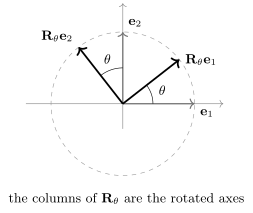
The first matrix rotates the plane by : its columns are
and
turned
through . The
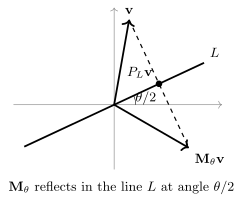
second is a reflection, and the picture says in which
mirror.
Theorem
11.7.6 (Classification of the Plane
Isometries)
Let .
- (a) If , then for a
unique .
- (b) If , then for a
unique . In this case , the
eigenvalues of
are and , and is the reflection in
the line : it fixes pointwise and negates
.
Consequently , and .
Idea. Condition (f) of Theorem 11.7.3 says
the two columns are orthonormal. A unit vector of is
for exactly one , and there are exactly two unit
vectors orthogonal to it. So there are only two
candidates once the first column is chosen, and the
determinant tells them apart. The geometric description
of is
then a two-line verification: guess the fixed vector
from the picture and check it.
Proof. Write . By Theorem 11.7.3 (f),
the columns are orthonormal: , , and . Since is a unit vector
of , there is
a unique with and . The vectors orthogonal to form a line,
spanned by ,
which is already a unit vector; so the unit vectors on
that line are , and . The two choices
give with determinants and . This proves (a) and the
first sentence of (b), and uniqueness of in both cases,
since is
already determined by the first column.
For the rest of (b), put and , two orthogonal unit
vectors. Writing and using the
subtraction formulas for cosine and sine, So is an orthonormal basis of
eigenvectors with eigenvalues and , and fixes both
of them, hence . Since , we have , because
and (Theorem 11.3.2
(c)), so fixes pointwise and negates
, which is
the description of a reflection. This proves the
theorem.
So is the
circle of rotations, and the other half of is the circle of
reflections. Multiplying two rotations adds the angles,
, so is abelian; Exercise (C3: Two reflections make a rotation)
shows what happens when two reflections are
multiplied.
Example
(Naming Two Plane Isometries)
Classify each of the following as a rotation or a
reflection, and give the angle or the mirror line.
- (a) .
- (b) .
Solution.
(a) The columns
and have norm
and inner product , so . Its determinant is , so
with and : rotation by .
(b) The columns
and
are
orthonormal, and , so with
and .
The mirror is , and rather than halve
the angle we find the fixed line directly:
reads , that is . So . Check: , and , as a reflection must
do to .
Rotations
of space
In dimension
the answer is the one physics assumes: every
orientation-preserving isometry of is a rotation about
a line. The proof is where Chapter 9 is needed, for one
reason only: to produce an eigenvector.
Theorem
11.7.7 (Every Element of SO(3) Is a
Rotation)
Let . Then there is a unit vector with
, and an orthonormal basis of in which for some . That is, fixes the
axis and
rotates the plane
by . Moreover
.
Idea. Three steps. ① Get a real
eigenvalue: the characteristic polynomial is real of
degree , and an
odd-degree real polynomial has a real root. ② That
eigenvalue is ,
since is an
isometry. ③ Split off the eigenline: its orthogonal
complement is invariant, the restriction there lies in
, and Theorem 11.7.6
finishes. If the eigenvalue was the restriction has
determinant , so
it is a reflection and supplies a eigenvector inside the
plane; feed that back into step ③.
Proof. Write , an isometry
of by Theorem 11.7.3.
Step 1: a real eigenvalue exists. By
Theorem 7.10.2, is
monic of degree ,
which is odd, so has a real root
by Corollary 6.5.9, and
is an
eigenvalue of by
Theorem 9.2.1. By Proposition 11.7.1,
or
. Fix a
unit eigenvector for , possible after
dividing by its norm.
Step 2: the orthogonal complement of an
invariant line is invariant.
Claim. If is a
subspace with , then .
Proof. is
injective, because is, so it is surjective
by Theorem 2.5.7 applied
on the finite-dimensional space . Let
and .
Write with . Then
, the middle
step by Theorem 11.7.3 (b)
and the last because . So
.
Step 3: reduce to the plane. Put
, which is -invariant. By the
claim, is -invariant, and by Theorem 11.3.2 (c).
Choose an orthonormal basis
of (Theorem 11.2.2);
then is an orthonormal basis
of , and in it
the first column because , and the two zeros in the
first row because have no -component.
This matrix is orthogonal, being the matrix of an
isometry in orthonormal bases (Theorem 11.7.3
(f)), so its second and third columns are orthonormal,
which says and ; and is the matrix of in the basis .
Expanding the determinant along the first column, and
using that similar matrices have equal determinants (Corollary 7.5.7, with
Theorem 4.2.4
(a)), , so .
Case . Then , so for some by Theorem 11.7.6 (a),
and and
are as required.
Case . Then , so by Theorem 11.7.6 (b)
the restriction is a reflection of
the plane and has
as an eigenvalue.
Let
be a unit eigenvector for , so . Now
rerun Steps 2 and 3 with in place of
. Because
was chosen
with , the eigenvalue this time is , so the rerun lands in
the previous case and cannot return here.
Finally, and
are matrices of the same operator, hence similar (Theorem 4.2.4
(a)), and similar matrices have equal traces (Theorem 4.2.5),
so . This proves the theorem.
The angle is determined by up to sign, since
reversing the order of
replaces by
; the trace
formula gives with
no computation at all. This settles as well: if
then
, so
is a rotation
composed with the antipodal map.
Example
(Axis and Angle of a Rotation)
Let .
Verify that and find its axis and angle.
Solution. Orthogonality.
The three columns are , and
.
Their squared norms are ,
and , and their pairwise inner products
are , and .
So the columns are orthonormal and by Theorem 11.7.3
(f).
Determinant. Expanding along the first row,
, so
and
.
Axis. Solve ,
that is : Adding row one to row two gives , so ; then row one
gives .
The axis is , and indeed .
Angle. , so and . The map is a rotation by about the line
through .
Quick check. A matrix has . What is its
angle, and what is ?
Solution. , so : a half-turn about the axis. Then is the rotation by
about the same
axis, which is . (In the basis of Theorem 11.7.7 the
matrix is , whose square is .)
Rigid
motions
We assumed linearity from the start. It is worth
knowing that we did not have to: for maps of that fix the
origin, preserving distance forces linearity.
Theorem
11.7.8 (Distance-Preserving Maps Are
Affine)
Let be any function, not assumed linear, with
- (a) If ,
then is linear
and orthogonal.
- (b) In general,
for a unique and a
unique .
Idea. Setting turns
the hypothesis into “preserves norms”, and expanding the
squared distance then turns it into “preserves inner
products” without any polarization at all. Once inner
products are preserved, sends the standard
basis to an orthonormal basis, and Theorem 11.2.1
writes
as an explicit linear expression in the coordinates of
. Part (b)
is part (a) applied to .
Proof.
(a) Assume .
Taking gives for all . Expanding both
sides of the hypothesis with Theorem 11.1.2 (c),
and the four outer terms cancel in pairs,
leaving Put . By , ,
so is an orthonormal list of vectors in , hence an
orthonormal basis (it is independent by Theorem 11.1.4 and
has
elements). Now let be arbitrary. By Theorem 11.2.1
applied to the basis , and then by , The right-hand side is linear in , so is linear; and it
preserves norms, so it is an isometry, hence orthogonal
by Definition 11.7.2,
since it maps
to .
(b) Put and . Then preserves distances,
since the translation cancels, and ;
by (a), is
orthogonal, say with , and
. For uniqueness, evaluating at recovers , and then determines . This proves the
theorem.
So the rigid motions of are exactly the
maps “rotate or reflect, then translate”, and the linear
ones are exactly the orthogonal maps. That is the sense
in which
is the symmetry group of Euclidean geometry, and it is
why the same group reappears whenever a problem has a
distance in it.
Exercises
A. Check your
understanding
Exercise
(A1)
- (a) Define an
isometry , and state two conditions equivalent to
it.
- (b) What must be
checked about a square matrix to decide whether it
is unitary? State the check in terms of its
columns.
- (c) True or false:
every isometry is invertible. Justify your answer.
- (d) True or false:
if for
,
then fixes a
nonzero vector. Justify your answer.
- (e) Give the two
families of matrices making up , and say how the
determinant distinguishes them.
- (f) An operator
on a complex
inner product space is unitary. Why must every
eigenvalue of lie
on the unit circle?
Solution.
(a) for every (Definition 11.7.1).
Equivalent: for all ; and
(Theorem 11.7.3).
(b) That its
columns are orthonormal in , that is (Theorem 11.7.3
(f)). For a square matrix this already gives .
(c) False. ,
, is an isometry and is not surjective (Example (Isometries and Near-Isometries)
(a)). An isometry is always injective, and it is
invertible exactly when .
(d) False for
even : has
determinant and
fixes only . It is true for
odd , though not
by the argument of Theorem 11.7.7,
which uses the classification
of a 2-dimensional complement. The general reason is a
count: the nonreal eigenvalues of a real come in conjugate
pairs with for an isometry, so
they contribute
to the determinant and an even number to the count. With
odd, an odd
number of eigenvalues are real, each , and their product
is ; an
odd number of factors with product cannot all be , so is an eigenvalue and
some nonzero vector is fixed.
(e) The rotations
, with
determinant , and
the reflections , with
determinant (Theorem 11.7.6).
(f) A unitary
operator is an isometry, so Proposition 11.7.1
applies: .
B. Practice
Exercise
(B1: Determine which are unitary)
Determine which of the following matrices are
orthogonal or unitary. Justify your answer; for those
that are not, name the failing condition.
- (a) over .
- (b) over .
- (c) over .
- (d) over .
Solution.
(a) Orthogonal,
as computed in Example (Axis and Angle of a Rotation):
the three columns are orthonormal.
(b) Unitary. The
columns are and
, of norm , and their inner product is So . (It is unitary but not orthogonal, since
it is not real.)
(c) Not
orthogonal. The second column has norm , so the
columns are not orthonormal. Equivalently, the map
stretches .
(d) Not
orthogonal. Both columns are unit vectors, and , but their
inner product is . Unit columns are not
enough; they must also be orthogonal. (Its determinant
is , neither nor , which confirms it by
Proposition 11.7.4.)
Exercise
(B2: Name the plane isometry)
Each of the following lies in . Decide whether
it is a rotation or a reflection, and give the angle of
rotation or the mirror line.
- (a) .
- (b) .
- (c) .
Solution.
(a) Determinant
, so a
reflection. reads , so the mirror is , the line . Check: .
(b) Determinant
, so a rotation . Comparing
with ,
and , so : a
clockwise half of a right angle.
(c) Determinant
, so a reflection.
reads , that is , so . Check: .
Exercise
(B3: Permutations are orthogonal)
Let and let
be its permutation matrix (Definition 3.4.2),
whose -th column
is .
- (a) Prove that .
- (b) Deduce that
, and identify the sign.
- (c) Show that .
Solution.
(a) Column of is , by
Definition 3.4.2.
So each column is a unit vector, and for the columns
and
are
distinct standard basis vectors, because is injective,
hence orthogonal. By Theorem 11.7.3 (f),
.
(b) By Proposition 11.7.4
(b), . The sign is : permuting
the columns of
by
multiplies the determinant by (Theorem 7.2.1), and
.
(c) holds because is
orthogonal, by (a). For the second equality,
exactly when , so exactly when , that is
when ; and that is the defining
condition for .
C. Going deeper
Exercise
(C1: Determinant as a homomorphism)
- (a) Prove that is a surjective group homomorphism with
kernel , and
deduce that exactly half of has determinant
, in the sense
that is
the disjoint union of and one coset
.
- (b) Prove that is a surjective
group homomorphism.
- (c) Describe and completely.
Solution.
(a) is multiplicative
(Theorem 7.5.4) and
takes only the values on (Proposition 11.7.4
(b)), so it is a homomorphism into . It is
surjective: , and is orthogonal,
since its columns are , with . Its
kernel is by definition. If then , so
;
and no matrix has both determinants, so the union is
disjoint.
(b)
Multiplicativity again, and
on by Proposition 11.7.4
(b). For surjectivity, given with , the
matrix has orthonormal columns, hence lies in , and its
determinant is
(Theorem 7.4.6).
(c) A matrix satisfies exactly
when . So is the unit
circle of and
. Consistently, is
trivial.
Exercise
(C2: Linearity is a hypothesis, not a
consequence)
- (a) Let be
,
where carries
. Show that
for every , that
is not linear
over , and that
does not preserve
the inner product. Which step of Theorem 11.7.3
fails?
- (b) Let be a
complex inner product space and let
satisfy for every . Prove
that .
- (c) Show that (b)
fails over by
exhibiting a nonzero with for all .
Hint for (b): apply the hypothesis to and to .
Solution.
(a) . But unless , so is not -linear. And , while . The
proof of (a) (b) in Theorem 11.7.3 uses
, which is exactly what
does not
satisfy.
(b) Let .
Applying the hypothesis to and
expanding both slots, Applying it to , and
using , and , Multiplying by gives Adding (1) and (2), , so for all . Taking
gives , so for every , that is .
(c) Let be the rotation , that is . Then for every , and . The complex
proof breaks down because the second equation is
unavailable: there is no to substitute.
Exercise
(C3: Two reflections make a rotation)
Let and let be the reflections of Theorem 11.7.6, in
the lines and at angles and .
- (a) Prove that .
- (b) Deduce that the
composite of the reflections in two lines through the
origin is the rotation by twice the
angle from the second line to the first, and that every
rotation of the plane is a product of two
reflections.
- (c) Deduce that
is not
abelian, by computing .
Solution.
(a) Multiplying
out, where and , by the subtraction formulas. The
top-right entry is , as
displayed. So .
(b) The angle
from to
is , and (a) says the composite is the
rotation by , twice that. Conversely, given , choose and ; then , a product of two
reflections.
(c) By (a) with
the roles exchanged, . These two
agree only when ,
that is when is a multiple of . Taking and gives , so is not
abelian.