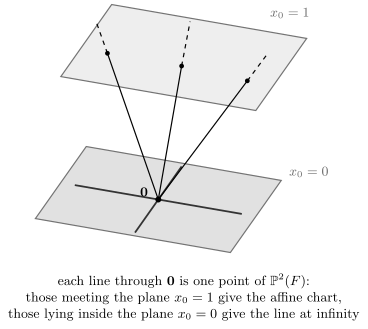
The affine geometry of the first two sections has one
flaw, and it is visible in the statement of Theorem 22.2.4: the
formula for the dimension of a join has two cases,
because two flats may fail to meet. This section builds
a geometry in which that never happens. The construction
is entirely linear — a projective space is the set of
lines through the origin of a vector space — and the
payoff is a dimension formula with no exceptional case
at all. Everything here works over an arbitrary field
, and neither
analysis nor topology enters.
Two lines
that do not meet
In the affine plane , take A point in both would satisfy , so .
Both are flats of dimension with the same direction
space ,
and their join is the whole plane. So Theorem 22.2.4 (c) is in
its second case: , with the extra
paid for by the
failure to meet, and there is nothing to substitute for
,
because the empty set has no dimension.
The two lines do have something in common: a
direction. They are going the same way, and the natural
thing to say is that they meet “at infinity”. The whole
of this section is the work of turning that phrase into
mathematics without losing linearity. The repair, in one
sentence: stop working with points of a vector space
and start working with its lines through the
origin.
The
projective space of a vector space
Let be a
vector space over . On
define This is an equivalence relation (Definition 0.5.2): it
is reflexive with ; symmetric, because with gives ; and transitive, because
and
give with , a field
having no zero divisors. Note that had to be
removed: it is equivalent only to itself, and keeping it
would put a single extra point into every picture with
no geometric job.
A point of projective space is a line through the
origin, with the origin itself thrown away.
Definition
22.6.1 (Projective Space)
Let be a
finite-dimensional vector space over a field with . The
projective space of is the quotient set (Definition 0.5.5)
whose elements are called
points. The point determined by is
written .
The dimension of is so that has dimension . We write
for projective -space over . A projective
space of dimension is a projective
line, and one of dimension a projective
plane.
Two clauses need comment. The shift by one in the
dimension is not a decoration: it is what makes a
projective line behave like a line and a projective
plane like a plane, as Theorem 22.6.2 is about
to confirm. And the convention looks
like a dodge, but it is forced by the same shift — the
empty set is and
— and it will do real work in Theorem 22.6.6.
Proposition
22.6.1 (Points Are Lines Through the
Origin)
Let be a
finite-dimensional vector space over . The map is a bijection from onto the set of
-dimensional
subspaces of .
Proof. Well defined. If
then with , so because each of is a
scalar multiple of the other. Also , so
has
dimension .
Injective. If with , then for some , and since .
Hence .
Surjective. A -dimensional subspace
has a basis with ,
and then it is , the
image of . This proves
the proposition.
So a point of is a line
through the origin of , and a “line” of the
projective plane will turn out to be a plane through the
origin of .
Every statement below can be read twice: once about
and once
about subspaces of .
Definition
22.6.2 (Homogeneous Coordinates)
Let be nonzero. The
homogeneous coordinates of the point
are written the colons recording that only the ratios are
determined: for every , and not all of are
zero.
Coordinates run from . In we index the
entries and the standard basis from , writing and , and every projective section of
this chapter does the same. Subscripts start at everywhere else in the
book; the exception pays for itself here, because it
keeps the of
equal to
the dimension while the coordinates number .
Examples.
- has exactly one point, , since every nonzero
scalar is a nonzero multiple of . Its dimension is , as a single point
should have.
-
consists of the points for , all distinct, together with the single point
. Indeed if
then
, and if then and .
- has three points. The three
lines through the origin of are , , , matching Proposition 22.6.1.
- The degenerate case . It is worth keeping, because
intersections produce it.
Nonexample by minimal change. Over
, replace the
relation by when with . This is
still an equivalence relation, but the quotient is not
: every
projective point splits into
the two classes of and . The clause
that fails is the one allowing every
nonzero ,
and what is lost is precisely the identification of a
line with itself traversed backwards.
Warning. A single
homogeneous coordinate means nothing. The
expression “” is not a statement about a point of , since and the
second coordinate changed. Only two kinds of statement
survive scaling: a ratio such as where , and the
vanishing or nonvanishing of a
homogeneous expression, such as or .
Whenever a formula below names a coordinate, check that
it survives replacing by .
The affine
chart, and where the missing points live
Here is the theorem that makes the construction worth
doing: projective space is an affine space plus a
smaller projective space.
Theorem
22.6.2 (The Standard Affine Chart)
Let and
let Then:
- (a) both conditions
are independent of the representative, and , a disjoint union;
- (b) the map ,
, is a bijection, with
inverse ;
- (c) with
, so has dimension
, and is a bijection .
is the
standard affine chart and the
hyperplane at infinity.
Idea. Scaling multiplies by a nonzero number,
so it cannot create or destroy a zero there: that single
observation makes both halves well defined. On the half
where we
may normalize to , and once the remaining
coordinates are no longer ambiguous, which is why the
affine points come back one for one. On the other half
carries no
information at all, so it may be deleted, and what is
left is one dimension smaller.
Proof.
(a) If with then , and a
product of two elements of a field is zero only if one
of them is, so exactly when . Hence both defining conditions depend only
on the point. Every point satisfies exactly one of them,
so the union is disjoint and exhausts .
(b) Well
defined: , and its zeroth entry
is , so
.
Injective: if then for some ; comparing
zeroth entries gives , hence .
Surjective: let , so
and exists. Then
, so . The displayed formula for the inverse
is exactly this computation, and it is independent of
the representative because replacing by
multiplies numerator and denominator of each ratio by
.
- (c) is a subspace of , being the kernel
of the linear functional , and
by the
Rank-Nullity Theorem (Theorem 2.3.1), the
functional being nonzero and hence surjective onto (Proposition 5.1.2). A
nonzero
has exactly
when , so and
by Definition 22.6.1. The
stated map is well defined, because deleting the zeroth
coordinate turns into
times the
deletion and cannot produce from a nonzero
with ; it is injective
and surjective because inserting a zeroth coordinate
inverts it. This
proves the theorem.
For the
statement reads: the projective plane is the
affine plane together with a projective line.
Writing it out, every point of is exactly one
of the first family being the affine plane
through , and
the last two being the line at infinity ,
which has points when is finite. The label
is chosen
deliberately: the next proposition shows is the point
where all affine lines of slope meet.
Proposition
22.6.3 (Completing an Affine Line)
Let be not both zero, let , and let a flat of dimension in by Theorem 22.2.10, the
single row being nonzero, with direction space . Let
and . Then:
- (a) is a projective
line;
- (b) , so contains a faithful copy of ;
- (c) is
the single point ;
- (d) two such lines
have the
same direction space if and only if and meet in the same
point.
Proof.
(a) is linear and
nonzero, since and
are not both zero. So is surjective
onto (Proposition 5.1.2) and
by Theorem 2.3.1. Hence
has dimension .
(b) A point of
is by Theorem 22.6.2 (b), and
. This vanishes exactly when
.
Since is
homogeneous of degree , the vanishing does not
depend on the representative.
(c) A point of
has and with . The
solution set of that single nontrivial equation in is , of
dimension , so
there is exactly one such projective point, namely .
(d) By (c) the
point in question is , which by Proposition 22.6.1
determines and is determined by , the
direction space of . This proves the
proposition.
Now return to the hook. The lines and
have and respectively , so Subtracting the two equations gives , and then with . So
exactly one point, and it lies on the line at
infinity. By Proposition 22.6.3 (c)
that point is for both lines,
which is their common direction read as a
point. Two parallel lines meet at their shared
direction, and nowhere else.
Quick check. In , which point
of the line at infinity do all the
vertical affine lines pass through, and
which point do all lines of slope pass through?
Solution. A vertical line has , so
by Proposition 22.6.3 (c)
its point at infinity is . A line , that is
,
has and point at infinity . So the
points of are for each slope
, plus
for the
vertical direction: one point per direction, and the
vertical direction is no longer a special case.
Definition
22.6.3 (Projective Subspace)
Let be a
finite-dimensional vector space over . A projective
subspace of is a subset of the
form for a subspace of . Its
dimension is . A projective
subspace of dimension is a
point, of dimension a
line, of dimension a
plane, and of dimension a
hyperplane.
The dimension is only well defined if can be recovered from
. It can, and
the reason is worth isolating.
Lemma
22.6.4 (A Projective Subspace Remembers Its
Subspace)
Let and be subspaces of . Then
if and only if ; in particular forces
.
Proof. Immediate
from the definition.
Suppose and let . If then
.
Otherwise , so
for some , that is with ; hence
,
being a subspace.
So .
For the last claim, apply the equivalence in both
directions and use that is
antisymmetric. This proves the lemma.
Proposition
22.6.5 (Meet and Join)
Let
and be
projective subspaces of . Then:
- (a) ,
so an intersection of projective subspaces is a
projective subspace;
- (b) among all
projective subspaces containing there is a
smallest one, namely .
We write and call it the join of
and .
Proof.
(a) Let . By
Lemma 22.6.4 applied to
, we
have exactly when . Hence
exactly when and , that is
, which says .
(b) and
,
so
contains
by Lemma 22.6.4. Conversely,
if for a subspace , then the same lemma
gives
and ,
hence because is the smallest subspace containing both (Theorem 1.7.1), and
so . This proves the proposition.
Idea. There is nothing to invent.
Write and as and , apply Chapter 1’s
dimension formula to and , and subtract four times. The only
thing that needs watching is the bookkeeping of those
four ’s, and the
reason the formula has no second case is that two of
them cancel against the other two even when —
which is precisely the situation the affine version
could not handle.
Proof. By Definition 22.6.3 write
and
; the
subspaces and
are uniquely
determined by Lemma 22.6.4. By Proposition 22.6.5, and
. Hence, using Definition 22.6.3 four
times and Theorem 1.7.3 once,
The middle step is Theorem 1.7.3, which
holds for all subspaces with no hypothesis
beyond finite dimension. In particular when
the second term on the first line is , and the
computation is unaffected. This proves the theorem.
Compare the two formulas side by side. For flats
of an affine
space, Theorem 22.2.4 (c) gives
where are the direction spaces. Two cases, and in
the second the intersection has dropped out of the
formula entirely, replaced by an intersection of
direction spaces and an apologetic . Eq. 22.6.1 has one case
and needs no directions. That is the whole reason for
building projective space, and everything the rest of
this chapter does with it rests on this one line.
Corollary
22.6.7 (Two Lines in a Projective Plane
Meet)
Let be a
projective plane, that is with . Then any two distinct lines of meet in exactly one
point.
Proof. Let and be distinct
lines, so and by Lemma 22.6.4. Then contains properly: otherwise
, and
two subspaces of the same dimension with one inside the
other are equal (Theorem 1.6.8
applied inside ),
contradicting . So , and ,
whence and .
By Theorem 22.6.6, and a projective subspace of dimension is with , which by Proposition 22.6.1 is a
single point. This proves the corollary.
Proposition
22.6.8 (Two Points Determine a Line)
Let be a
projective space of dimension at least . Any two distinct
points of
lie on exactly one line.
Proof. Let . Then and are linearly
independent: a dependence relation with would give with , hence
. So has dimension and is a line
containing both points.
If is any
line containing both, then
by Lemma 22.6.4, so ; and , so
by Theorem 1.6.8. This
proves the proposition.
The two statements just proved are each other’s
mirror images: “two distinct points lie on a unique
line” and “two distinct lines meet in a unique point”.
Section 8 will show that this mirroring is not a
coincidence.
Counting
points
Over a finite field the whole space can be counted,
and the count is a useful check on the constructions
above.
Proposition
22.6.9 (The Number of Points of a Finite
Projective Space)
Let be a
finite field with
elements and let . Then More generally a projective subspace of
dimension has
points.
Idea. Count the nonzero vectors and
divide by the size of one equivalence class. Every class
has the same size, , because scaling a fixed nonzero vector by
distinct scalars gives distinct vectors. The alternative
count, chart by chart, gives the geometric sum directly,
and the two agreeing is a check on Theorem 22.6.2.
Proof. A vector of is a list of
entries, each
chosen from
independently, so there are of them and nonzero
ones.
Fix . Its equivalence class is , and the map is injective there: if then , and
forces . So every class has exactly elements.
The classes partition (Theorem 0.5.2), so the
number of classes is . That
this equals follows from the middle terms canceling in pairs. For a
projective subspace of dimension , the space has dimension , hence elements, since a
choice of basis puts it in bijection with (Corollary 2.5.5); the
same argument applies. This proves the proposition.
The geometric sum is Theorem 22.6.2 in
disguise: the chart contributes points and the
hyperplane at infinity contributes ,
so , and unwinding that
recursion from
gives .
Example
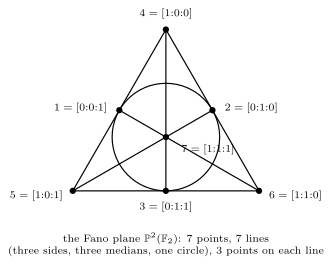
(The Fano plane)
Describe completely:
its points, its lines, how many points lie on each line,
and how many lines pass through each point. Verify Corollary 22.6.7 and Proposition 22.6.8 by
direct count.
Solution. By Proposition 22.6.9 there
are
points. Since , each point has a
unique nonzero representative, so the
points are simply the seven nonzero vectors of . Number the point
by
:
A line is with , and by Proposition 22.6.9 it has
points. Since for any two distinct nonzero ,
the lines are exactly the triples of nonzero vectors. There
are seven: Each is the kernel of one of the seven nonzero
linear functionals on , and different
functionals have different kernels here because a
functional is determined up to a nonzero scalar by its
kernel — if with , then and both vanish on and so lie in the
annihilator
(Definition 5.2.1), which
has dimension by Theorem 5.2.2 — and the
only nonzero scalar here is . So there are exactly
seven lines.
Incidences. Each of the seven labels appears
in exactly three of the seven displayed triples, so
every point lies on exactly lines. The total is
consistent: counting incident pairs (point, line through
it) by lines gives , and counting them by points gives as
well.
The two theorems. There are pairs
of points, and each of the lines contains pairs,
for pairs in
total; since no pair can be covered twice without two
lines sharing two points — which Proposition 22.6.8
forbids — each pair is covered exactly once. Dually
there are pairs of lines, and each of the points lies on lines and so accounts
for of those pairs, again in total; no pair of
lines is accounted for twice, since two points on both
lines would again contradict Proposition 22.6.8. So
every pair of lines meets in exactly one point, as Corollary 22.6.7
says.
In the picture the “midpoint” of two marked points
really is their sum: , and likewise all round. The
circle is the line , which under Theorem 22.6.2 is the
line at infinity, so the picture also shows as the four
affine points of together with the
three directions .
Warning. A drawing of a
finite projective plane is a mnemonic, not a
picture. The seven points of the Fano plane are
not points of the Euclidean plane, and the “circle” is a
line, not a curve. The only content of the drawing is
the incidence data: which triples of the seven labels
form a line. Any picture with the same seven triples is
the same object, and no metric statement about the
drawing means anything.
Exercises
A. Check your
understanding
Exercise
(A1)
- (a) State Definition 22.6.1, and
say why is
removed before taking the quotient.
- (b) What is when ? What is the
dimension of a hyperplane of that projective space, and
of what subspace of is it the image?
- (c) Decide whether
in , and whether
in .
Justify your answers.
- (d) True or false:
the condition defines a subset of . Justify your
answer.
- (e) How many points
does
have?
Solution.
(a) with
when for some nonzero , and .
The vector
is removed because its class is alone, so it
would contribute one point whose span is the zero subspace and not a
line, and Proposition 22.6.1 would
fail.
(b) . A
hyperplane has dimension and is for a subspace
of with .
(c) Yes: and
in . Yes again: and
in .
(d) False. The
expression is not homogeneous: satisfies it but
, which
represents the same point, does not. Only the vanishing
of a homogeneous expression is a condition on
points.
(e) , by Proposition 22.6.9.
B. Practice
Exercise
(B1: Meeting at infinity)
In ,
complete each pair of affine lines and find their
intersection point, saying in each case whether it lies
in the chart or
at infinity.
- (a) and .
- (b) and .
- (c) and .
Solution.
(a) Writing them
as
and ,
Proposition 22.6.3 gives
and . Subtracting, , so and : the point
, at
infinity. This agrees with part (c) of that proposition,
since gives .
(b) Here and . Adding, , so ; then .
Taking
gives ,
which lies in
and corresponds to the affine point . Check: and .
(c)
and . Subtracting, , so and then , forcing : the point
, at
infinity, the vertical direction.
Exercise
(B2: Joins and meets)
In , let
be a plane and
a plane.
- (a) What are the
possible values of ? Justify each.
- (b) Show that two
planes in
always meet.
- (c) Give an example
in of two
planes that do not meet.
Solution. Throughout, and with
inside a space of dimension (for ).
(a) By Theorem 22.6.6, . Now contains , so , and
it is contained in , so .
Hence , and all three occur: when ; when has dimension
, for instance
, ; and
for , .
(b) The
computation in (a) shows , so .
(c) In take
and
. Then
, so , and
indeed Theorem 22.6.6 gives
, that is , the
whole space.
Exercise
(B3: A projective plane over three elements)
Let .
- (a) How many points
does
have, and how many lines?
- (b) How many points
lie on each line, and how many lines pass through each
point?
- (c) List the four
points of the line .
Solution.
(a) By Proposition 22.6.9, . A line is with , equivalently
the kernel of a nonzero functional on , and two nonzero
functionals have the same kernel exactly when they are
proportional (Corollary 5.6.6 applied to
the
matrices, or directly: a kernel of dimension determines the
functional up to scale). So the lines correspond to the
points of , of
which there are again .
(b) Each line has
points. For the lines through a fixed point : they are the
with and , and every such is
for one of the vectors , while two choices
give the same
exactly when , a set of vectors. So
each point lies on lines. (Consistently, the incident pairs
number counted by lines and counted by
points.)
(c) The points
with are
with
, that is the points of : , , and . Four points, as
(b) requires.
C. Going deeper
Exercise
(C1: Other charts)
Work in
and fix . Let .
- (a) Prove that is well defined and
in bijection with .
- (b) Prove that .
- (c) For and , describe the
point of that
is missing from , and the point of
missing from
. Conclude that
the “point at infinity” is not a property of a point,
but of a chart.
Solution.
(a) Both parts
repeat Theorem 22.6.2 with the
index replaced by
. Scaling
multiplies by a
nonzero scalar, so the condition is independent
of the representative. The bijection is with the in position ; it is injective
because comparing the -th entries of two
proportional representatives forces the scalar to be
, and surjective
because when .
(b) A point is
with
, so some coordinate is nonzero, and then
.
(c) . The chart omits exactly , and the chart
omits exactly . Both omitted
points are perfectly ordinary points of ; each is at
infinity for one chart and in the affine part of the
other. So “at infinity” describes a relation between a
point and a chosen chart, not the point itself.
Exercise
(C2: Counting subspaces)
Let be a
finite field with
elements.
- (a) Prove that the
number of lines in equals the
number of points, namely . Hint: a line is the kernel of a
nonzero functional.
- (b) Deduce that
every point of lies on exactly
lines.
- (c) How many points
does a hyperplane of have, and how
many points of lie outside
it?
Solution.
(a) A line of
is with , and by Lemma 5.6.1 such a is the kernel of a
nonzero functional on , since
(Theorem 5.2.2) and is the common kernel of
its annihilator. Two nonzero functionals have the same
kernel exactly when they are proportional: if , then and both lie in the
-dimensional space
, so one is a
scalar multiple of the other, and the scalar is nonzero.
So lines correspond to points of , and has dimension
(Corollary 5.1.4); by Proposition 22.6.9 there
are of
them.
(b) Count
incident pairs (point, line through it) in two ways.
Each line has
points by Proposition 22.6.9, so
the count is . By
symmetry among the points — or
simply dividing — each point lies on lines, provided every point lies on the
same number. That last point needs an argument. The
lines through a fixed are the with and , and every such is
for some , of which there are . Two choices
give the same exactly when , a set of vectors. So the
number of such is
, independently of .
(c) A hyperplane
is with
, so it
has points. Subtracting from
leaves points
outside, in agreement with Theorem 22.6.2, whose
chart is
exactly the complement of a hyperplane and is in
bijection with .
Exercise
(C3: Where the affine formula goes wrong)
Let and be flats of .
- (a) Give two lines
in that do
not meet and are not parallel, and compute from Theorem 22.2.4.
- (b) Complete both
lines to projective lines in by the recipe of
Theorem 22.6.2, that is
by adding the points with to the projective
subspace each spans, and verify Eq. 22.6.1 for the
completed pair.
- (c) Explain in one
sentence why the projective formula could not have an
exceptional case, given Proposition 22.6.5.
Solution.
(a) Take and . A common point would need
third coordinate
and , so .
Their direction spaces are and
,
which are different, so they are not parallel and . The second case of Theorem 22.2.4 (c) gives
, the whole of .
(b) Under of Theorem 22.6.2, becomes , whose
points together with form with ; and becomes , giving
with . Now :
a vector of has
third and fourth entries , while a vector
of has third
entry and fourth
entry , so both
and vanish. Hence of
dimension , and
has dimension
, so
.
Then , as Eq. 22.6.1 requires. The
two projective lines still do not meet, which is
correct: Corollary 22.6.7 is about
a projective plane, and these lines do
not lie in one.
(c) Because by Proposition 22.6.5 both
the meet and the join of projective subspaces are again
projective subspaces, coming from and , and the
vector-space formula Theorem 1.7.3 holds
for those with no hypothesis whatever, the empty
intersection being simply the case .