A basis lets us write every vector in coordinates,
but finding those coordinates costs work: in Definition 1.5.2 the
scalars come from solving a linear system. In an
inner product space one kind of basis makes that cost
disappear. If the basis vectors are mutually orthogonal
unit vectors, then the -th coordinate of is just ,
one inner product, computed without reference to the
others. This section defines such bases, shows that
every finite-dimensional inner product space has one,
and gives the algorithm that produces them.
Orthonormal lists
The standard basis of has two features
beyond being a basis: distinct vectors are orthogonal,
and each has length . The two conditions can
be packed into a single formula using the Kronecker
delta ,
which is when
and otherwise.
An orthonormal list is a list of unit vectors
that are pairwise perpendicular.
Definition
11.2.1 (Orthonormal List)
Let be an
inner product space. A list of vectors of is
orthonormal if that is, if whenever (orthogonal) and for
every
(normalized).
In words: the single equation carries two conditions at once,
because the case says the vectors are orthogonal and the case
says .
The list must be ordered, as every list
in this book is, but nothing in the definition depends
on the order. Note that no vector of an orthonormal list
is , since
; so by Theorem 11.1.4,
every orthonormal list is linearly
independent. That single sentence is why
orthonormality is so useful: independence, which
normally takes an argument, comes for free.
Definition
11.2.2 (Orthonormal Basis)
An orthonormal basis of an inner
product space is
an orthonormal list that is a basis of .
Examples.
- The standard basis. In with the standard
inner product, by inspection. This is the model,
and the notation is
deliberately reused for orthonormal vectors in a general
space.
- A rotated basis of . The list
is
orthonormal: the inner product of the two vectors is
, and each has norm . Geometrically it is the standard basis
turned through .
- A basis of . The
columns of form an orthonormal list: each
has norm , and the three pairwise inner products
are , and , all . Being independent and
of length , it is a basis (Theorem 1.6.4
(a)).
- Matrix units. In with
the Frobenius inner product, the matrix units satisfy if and
otherwise, since only one entry of each is nonzero. So
the standard basis of is orthonormal.
- The Lagrange basis. On with the
node inner product of the previous section,
the Lagrange polynomials of
Definition 6.6.1
vanish at every node but their own, where they take the
value ; that is,
. Hence :
the Lagrange basis is an orthonormal basis for this
inner product. An interpolation formula and an
orthonormal expansion turn out to be the same
statement.
- The degenerate case. The empty list
is orthonormal, vacuously, and it is an orthonormal
basis of . This is not a joke: it is the
base case of every induction below.
Nonexample by minimal change. In
, the list
is orthogonal, and it is a basis. It is
not orthonormal, because . The failure is only in the normalization,
and it is repaired by dividing each vector by its norm,
which changes neither the spans nor the orthogonality
(Theorem 11.1.2
(b)). Scaling is always available; orthogonality is the
real content.
Coordinates in an orthonormal basis
Here is the payoff promised in the opening.
Theorem
11.2.1 (Coordinates, Inner Products, and Norms
in an Orthonormal Basis)
Let be an orthonormal basis of an inner
product space ,
and let . Then:
- (a) ;
- (b) ;
- (c) (Parseval’s identity
for a finite orthonormal basis).
Idea. For (a) we already know that
for unique scalars ; the only question is
what they are. Pair both sides with :
orthonormality kills every term except the -th, and that one
survives with coefficient . Parts (b) and (c) then
follow by expanding, since the coordinates are now
known.
Proof.
(a) Since is a basis, Theorem 1.5.1 gives
scalars with . Fix . Pairing with and using
(IP1), by Definition 11.2.1.
So for every , which is (a).
(b) Write and
by (a).
Expanding the first slot with (IP1) and the second with
Theorem 11.1.1 (b),
Only the terms with survive, and there
. This is (b).
(c) Take in
(b): the -th term
becomes by
Theorem 0.6.2 (c), and
the left side is .
Read (b) again: in the coordinates supplied by an
orthonormal basis, every inner product
becomes the standard inner product of . So an orthonormal
basis does not merely simplify coordinates; it turns an
abstract inner product space into with the dot product.
We record that as a corollary below, and use it
repeatedly: to make an abstract statement
concrete, fix an orthonormal basis.
Example
(Reading Off Coordinates)
Let , , , the orthonormal basis of
found above.
Write in this basis, and check Parseval’s
identity.
Solution. By Theorem 11.2.1 (a),
the coordinates are so . No
system was solved. Checking directly, . For Parseval,
, and indeed .
Quick check. With the same , find the coordinates of and
verify Parseval’s identity.
Solution. , , . Then , as Parseval requires.
The
Gram–Schmidt process
Everything so far assumed that an orthonormal basis
was handed to us. Does one always exist? The answer is
yes in finite dimension, and the proof is an algorithm
that we will use constantly.
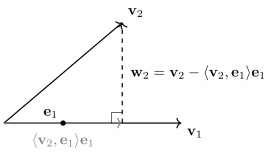
The idea comes from a picture in . Given independent
, normalize to get . The vector
is
generally not perpendicular to ; but its
“shadow” on the line through is the
multiple ,
and subtracting the shadow leaves a vector perpendicular
to .
Normalize it. Then repeat with , subtracting
its shadows on both and .
Project, subtract, normalize. The right angle at the
foot is the only thing that has to be checked, and one
line of algebra checks it.
Theorem
11.2.2 (Gram–Schmidt Process)
Let be an
inner product space and let be a linearly
independent list in . Define recursively
Then every is nonzero, so
the recursion is defined, and:
- (a) is an orthonormal list;
- (b) for every ;
- (c) if is already orthonormal for some
, then
for .
In particular, every finite-dimensional inner product
space has an orthonormal basis.
Idea. Induction on . Hypothesis: is orthonormal and spans . Two things need care. First, :
if it were , then would lie in
, contradicting independence.
That is the only place independence is used, and it is
used exactly there. Second, for : pair and watch the sum collapse.
Proof. We prove by induction on
that ,
that is orthonormal, and that .
Base case . The empty sum is , so ,
which is nonzero because a list containing is dependent.
Then has norm by Theorem 11.1.2 (b),
and since each vector is a
nonzero multiple of the other.
Induction step. Let and suppose
the claim holds for . Put .
First, . If ,
then , so would be a
linear combination of the earlier , making dependent, contrary to hypothesis.
Hence and is defined,
with .
Next, for every . By (IP1) and
the induction hypothesis , and is a scalar
multiple of , so as well. Together with the induction
hypothesis, is orthonormal, which is
(a).
For (b), is a linear
combination of and , hence lies in by the induction hypothesis; so
. Conversely , and
the earlier lie there by
the induction hypothesis. The two spans are equal,
completing the induction.
For (c), suppose is orthonormal and that
for all ,
where . Then
for , so
and , giving .
Induction on
proves (c).
Finally, let
be finite-dimensional. If , the empty list is an
orthonormal basis. Otherwise take any basis of and apply the process:
by (a) the output is orthonormal, and by (b) it spans
, so it is an orthonormal
basis.
Two remarks on the formulas. The vector subtracted
from is
exactly the expansion of in the
orthonormal basis of , which by Theorem 11.2.1 (a)
is the best available “copy of inside ”; the next section will
call it the orthogonal projection of onto . And the subtraction is
the same move that produced the vector in the proof of
Theorem 11.1.5.
Project, then subtract is one move used
twice.
Corollary
11.2.3 (Extending an Orthonormal List)
Let be a
finite-dimensional inner product space and let be an orthonormal list in . Then there are vectors
such that is an orthonormal basis of .
Proof. The list is linearly independent by Theorem 11.1.4,
since its vectors are orthogonal and nonzero. By Theorem 1.6.5 there
are making a basis of
. Apply Theorem 11.2.2 to
that basis. By part (c) the first output vectors are
unchanged, and by (a) and (b) the
whole output is an orthonormal basis of .
Two worked
examples
Example
(Gram–Schmidt in )
Apply the Gram–Schmidt process of Theorem 11.2.2 to
, , in
with the dot
product.
Solution. Step 1. ,
so .
Step 2. , so Then , and .
Step 3. and , so Then and .
Check. The three vectors have norm , and , , . The span
condition is visible too: is a multiple
of , and
is a
combination of and .
The next example runs the same three steps in a
function space, where no picture is available and only
the algebra is left.
Example
(Gram–Schmidt on )
Apply the Gram–Schmidt process of Theorem 11.2.2 to
in
with
Solution. Step 1. , so .
Step 2. ,
since the integrand is odd. So , and , giving .
Step 3. and , again by
oddness. Hence Its squared norm is so .
The monic polynomials produced along the way are
, , and . These
are, up to scaling, the first three Legendre
polynomials; the usual normalization takes
, fixed by the
convention rather than by the norm. Section 10 of this
chapter takes up such families in general.
Notice how much work the oddness of the integrand
did: two of the three inner products were before any computation.
Symmetry of the weight is worth looking for.
Warning. Gram–Schmidt
depends on the order of the list. Run the
process on in : it returns . Run it on
, the
same two vectors in the other order: it returns . Both outputs are
orthonormal bases of , and they are
different. An orthonormal basis is never unique (for
one
can always replace by ); the process
returns an orthonormal basis adapted to
the given order, not the orthonormal
basis.
Quick check. Run Gram–Schmidt on
in
, and then on
.
Do you get the same list?
Solution. First order: ;
, so and .
Output .
Second order: ; , so and . Output . Not the same
list, and not even the same set of lines.
Warning. The classical
process is numerically fragile. Computed with
rounding, the vectors drift out of orthogonality, and the drift
grows with and
with how nearly dependent the input list is. Nothing
above is wrong — the fault is in the arithmetic, not the
mathematics — but in practice one uses a rearranged
version or reflections instead. Section 8 of this
chapter gives the reflection-based method, and Chapter
24 explains why it is the stable one.
All inner
product spaces of the same dimension look alike
Corollary
11.2.4 (Classification of Finite-Dimensional
Inner Product Spaces)
Let be an
inner product space over with . Then there is
an isomorphism with where the right-hand inner product is that of
and the left-hand
one is the standard inner product of . An isomorphism with
this property is an isometric
isomorphism, so every -dimensional inner
product space over is isometrically
isomorphic to .
Proof. By Theorem 11.2.2,
has an
orthonormal basis . Let be the
coordinate map , an isomorphism by Corollary 2.5.5. By Theorem 11.2.1 (a),
the -th entry of
is .
Hence the standard inner product of and in is ,
which equals
by Theorem 11.2.1
(b).
So dimension is a complete invariant of
finite-dimensional inner product spaces over a fixed
field: there is nothing to classify. This should be
compared with Theorem 2.5.4, which
said the same for vector spaces; adding an inner product
adds no new invariant. What becomes interesting is the
interaction of the inner product with a given operator,
and that is the subject of Chapter 12. Isometries in
general are the subject of Section 7 of this
chapter.
Gram
matrices
Given a list of vectors, all of its inner products
can be collected into one matrix, and that matrix turns
out to answer questions about the list.
Definition
11.2.3 (Gram Matrix)
Let be a list in an inner product space
over . Its Gram
matrix is with entries
The order of the subscripts looks backwards and is
chosen on purpose: it makes act on coefficient
vectors the right way round, as part (b) below shows.
For a real list the distinction disappears, since then
.
For example, the Gram matrix of in is , with the squared norms on the
diagonal.
Over the
order of the subscripts becomes visible. For and
in , the
off-diagonal entries are so , which is Hermitian but not
symmetric. Part (b) below says ; with
both sides are ,
since . Writing instead would
transpose and
leave that identity reading .
Theorem
11.2.5 (Properties of the Gram Matrix)
Let be a list in an inner product space
over , with Gram matrix . Then:
- (a) is
Hermitian, , and its
diagonal entries are the real numbers ;
- (b) for every ;
- (c) is invertible if and
only if is linearly independent;
- (d) is a real number
with ,
and
exactly when the list is linearly independent.
Idea. Part (b) is the whole
theorem: the quadratic expression is
a squared length, so it vanishes only for the
coefficient vectors of genuine dependence relations.
That identifies with the set of
dependence relations and gives (c) at once. For (d), fix
an orthonormal basis of the span and write for a
coordinate matrix ; a determinant of that
shape is a squared modulus.
Proof.
(a) By (IP2),
.
The diagonal entries are , real and by Theorem 11.1.1
(a).
(b) Write . Expanding by (IP1) and Theorem 11.1.1 (b),
and the right-hand side is exactly the entry
of the
matrix .
(c) We show . If , then for each , by (IP1), so
. Conversely, if ,
then , so by (b) and hence by Theorem 11.1.2 (a).
Now is
invertible if and only if
forces (Theorem 3.4.4, (a)
(b)), which by the displayed equality of sets says
exactly that the only dependence relation among the
is the
trivial one.
(d) Let , let , and let be an orthonormal basis of , which exists by Theorem 11.2.2. Let
have as its -th column the
coordinate vector of , so that . By Theorem 11.2.1 (b),
so .
If the list is dependent, then is singular by (c) and
. If it
is independent, then and
is square. By Theorem 7.4.5, , and , because by the Leibniz formula (Theorem 7.4.3) the
determinant is a sum of products of entries and
conjugation preserves sums and products (Theorem 0.6.2). Hence,
by Theorem 7.5.4, This is real and , and it is because is the matrix of an
isomorphism onto its coordinates, hence invertible with
(Theorem 7.5.2).
Over , with
and the
dot product, part (d) is the statement Chapter 7 reached
from Cauchy–Binet: Corollary 7.7.3 says
that for a real , with equality exactly
when the rows of
are dependent. Taking the rows of to be makes the Gram matrix,
so that corollary is the special case of (d) in which
the ambient space is . The pointer left
there is now paid: a Gram matrix is exactly a matrix of
pairwise inner products, and its determinant is
nonnegative for that reason.
Example
(Deciding Independence with a Gram Matrix)
Decide whether is independent in , using its Gram
matrix.
Solution. The pairwise dot products
give and expanding along the first row, . By Theorem 11.2.5 (d)
the list is dependent. Indeed for
, and Theorem 11.2.5 (c)
says this is a dependence relation: .
Two features of this method are worth noting. It
never needs coordinates in the ambient space, so it
works verbatim for polynomials and functions, where
writing the vectors as columns is not an option. And the
answer comes with a witness: a null vector of is a dependence
relation, ready to read off.
Exercises
A. Check your
understanding
Exercise
(A1)
- (a) Define an
orthonormal list, using the Kronecker delta, and say
what an orthonormal basis is.
- (b) Why is every
orthonormal list linearly independent? Name the result
used.
- (c) Write down the
coordinates of in an
orthonormal basis , and state Parseval’s
identity.
- (d) True or false:
the Gram–Schmidt process (Theorem 11.2.2)
applied to a list and to the same list in reverse order
produces the same orthonormal list. Justify your
answer.
- (e) State the
criterion for linear independence in terms of the Gram
matrix.
- (f) True or false:
every -dimensional
real inner product space is isometrically isomorphic to
with the dot
product. Justify your answer.
Solution.
(a) A list with for all (Definition 11.2.1);
an orthonormal basis is such a list that is also a basis
(Definition 11.2.2).
(b) Its vectors
are pairwise orthogonal and nonzero (each has norm ), so Theorem 11.1.4
applies.
(c) , and
(Theorem 11.2.1).
(d) False. On
the
process returns , while on
it
returns .
(e) The list is
independent if and only if its Gram matrix is
invertible, if and only if (Theorem 11.2.5 (c),
(d)).
(f) True. By Corollary 11.2.4,
the coordinate map with respect to any orthonormal basis
is an isometric isomorphism onto .
B. Practice
Exercise
(B1: Gram–Schmidt with numbers)
Apply the Gram–Schmidt process of Theorem 11.2.2 to
each list, with the dot product.
- (a) in .
- (b) in .
Solution.
(a) , so
. Next , so with , giving . Finally and , so with , giving .
(b) . Then , so with and . Finally and , so with and .
Exercise
(B2: Gram–Schmidt on polynomials)
In with , apply the Gram–Schmidt process
of Theorem 11.2.2 to
.
Compare the monic outputs with those of Example (Gram–Schmidt on )
and explain the difference.
Solution. , so . Then
, so
and giving . Next and so . Its squared norm is so .
The monic outputs are , , ,
whereas on
they were , , .
Orthogonality is a property of the inner product, not of
the polynomials: changing the interval changes which
polynomials are orthogonal. These are the shifted
Legendre polynomials, and the substitution carries
one family to the other.
Exercise
(B3: Coordinates without solving a system)
Let , , in .
- (a) Write in
this basis.
- (b) Compute in two
ways, and state which theorem says the answers
agree.
- (c) Compute
for from the coordinates of and , using Example (Reading Off Coordinates)
for .
Solution.
(a) , , . So .
(b) Directly,
. From the coordinates, . They agree
by Theorem 11.2.1
(c).
(c) The
coordinates of are by Example (Reading Off Coordinates),
so by Theorem 11.2.1 (b),
Directly, .
Exercise
(B4: Gram matrices)
For each list, write down the Gram matrix and use it
to decide whether the list is independent.
- (a) in with the dot
product.
- (b) in with the standard
inner product.
- (c) in
with
.
Solution.
(a) , and expanding along the first
row, . By
Theorem 11.2.5 (d)
the list is independent.
(b) and , so by Theorem 11.2.5 (a).
Then and the list is independent; in fact it is
orthogonal, so Theorem 11.1.4
already gives the answer.
(c) These are the
monic outputs of Example (Gram–Schmidt on ),
so they are pairwise orthogonal, and . Its determinant is , so the
list is independent. A Gram matrix is diagonal exactly
when the list is orthogonal.
C. Going deeper
Exercise
(C1: The Gram matrix determines the list)
Let be a list in an inner product space
and a list in an inner product space
, both over , with the
same Gram matrix: for all .
- (a) Prove that if and only if , for every .
- (b) Deduce that
there is an isomorphism , well
defined by for every .
- (c) Prove that is an isometric
isomorphism, that is, for all
in the domain.
Solution.
(a) Let be the common Gram
matrix. By Theorem 11.2.5 (b),
. By
Theorem 11.1.2 (a),
one side is if
and only if the other is, and a norm is only at the zero
vector.
(b) Every element
of is for
some .
Define . This
is well defined: if , then
, so by (a), that is . It is linear because the formula
is linear in , it is
surjective onto by construction, and it is
injective: if , then , so by (a).
(c) Let and . Expanding by (IP1) and Theorem 11.1.1 (b),
and the same computation in gives .
The two sums are equal term by term, since the Gram
matrices agree.
Exercise
(C2: Gram–Schmidt on a dependent list)
Let be a list in an inner product
space, not assumed independent, and run
the recursion of Theorem 11.2.2.
- (a) Let be the smallest index
with . Prove
that the recursion is defined up to and that
, so the step fails.
- (b) Repair the
process: show that if, whenever , we
discard
and continue with , the
output is an orthonormal basis of .
- (c) Run the repaired
process on in .
Solution.
(a) The list
is independent, since a
dependence among its members would, by Theorem 1.4.1, put
some
with in
the span of its predecessors, contradicting the
minimality of . So
Theorem 11.2.2
applies to it and produces with . Since , Theorem 11.2.1 (a)
applied inside
gives ,
which is precisely the vector subtracted, so .
Dividing by is
impossible.
(b) Let be the vectors that the repaired
process outputs. The proof of Theorem 11.2.2
shows, unchanged, that after processing the accumulated list is orthonormal
and spans : the only step that used
independence was the claim ,
and in the repaired process a step with
discards a that lies in
the span already built, so the span does not change.
Taking , the
output is an orthonormal list spanning , hence an orthonormal basis of
it.
(c) . For :
, so , and
is
discarded. For : , so , with and . The output is an
orthonormal basis of the plane spanned by the three
given vectors.