Two theorems from the drawing board, both of them
older than coordinates. Both speak only of points,
lines, and incidence: no lengths, no angles, nothing a
projective transformation could disturb. Both are proved
here by one algebraic move, the one that makes
projective arguments short — choosing, out of the whole
line of vectors that represents a point, the single
vector that makes the hypothesis into an equation.
Perspective from a point, perspective from a line
Draw a triangle on a sheet of glass and let a lamp
cast its shadow on the floor. The two triangles that
result have their corresponding vertices joined by three
lines through the lamp. That is the first of the two
relations below. The second is what the same picture
looks like when you attend to the sides instead of the
vertices: corresponding sides, extended, meet the ground
in three points, and those three points lie on one
line.
Both relations need the words “the line through two
points”, and there is exactly one: distinct points and of have independent
representatives and lie on the unique line ,
by Proposition 22.6.8. We
write for it,
and we use that description of it, as ,
in every proof below.
Definition
22.9.1 (Triangles, and the Two
Perspectives)
Let ,
so that is a
projective plane (Definition 22.6.3). A
triangle in is an ordered
triple of
noncollinear points, called its
vertices; its sides
are the three lines , , .
Let and
be
triangles with , and . They are:
- (a)
perspective from a point if some point
lies on
all three of the lines , , ; such an is a
center;
- (b)
perspective from a line if the three
pairs of corresponding sides ,
,
consist of distinct lines and the three
intersection points are collinear; a line through all three is an
axis.
In (b) each intersection is a single point: two
distinct lines in a projective plane
meet in exactly one point (Corollary 22.6.7). That
is why the clause “distinct in each pair” is part of the
definition and not an afterthought; without it the
phrase “the point ” names nothing.
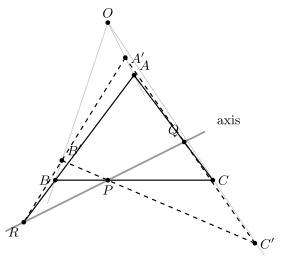
The picture shows both relations at once: the three
gray rays make the triangles perspective from , and the three marked
points , ,
lie on the thick line. Desargues’s theorem says that
this coincidence is no coincidence.
Warning. Two corresponding
sides may be the same line, and then part (b) is not
even a statement. Take a line , four distinct
points on it and a point on it, and any . Fix
representatives of and of and put , a point of the line other than and ; it does not lie on
, since and the two
meet only at (Corollary 22.6.7). The
triples and
are triangles, the six vertices are distinct, and the
three lines , , all pass through
. But ,
so “the point ” does not exist. Exercise (C3: Why the side hypothesis is there)
writes this out in coordinates. The hypothesis that
rules it out is the one in the theorem below: no vertex
of either triangle lies on a side of the other.
Choosing
the representatives
A point of is a whole line of
vectors, and every proof has to pick one vector per
point. The pick is free, and freedom used well is the
whole art. Here the hypothesis is three collinearities,
and each of them becomes a clean equation as soon as the
two representatives involved are scaled against each
other.
Lemma
22.9.1 (Scaling Three Collinear Points)
Let be a -dimensional subspace
and let be three distinct
points of the line . Let be any nonzero
vector representing . Then there are vectors
representing and
representing
with
Idea. Two distinct points of a line
give a basis of ,
so the third is a combination of them. Both coefficients
are nonzero, precisely because the third point is
neither of the first two; and scaling the two
representatives by the right amounts turns that
combination into a sum with coefficients and .
Proof. Pick any nonzero representing
. Since , the pair is
independent, and it lies in with , so it is a
basis of . As
,
a representative of can be written
Here : otherwise with , giving . And : otherwise
with , giving . Both are
excluded because the three points are distinct.
Put and , which is legitimate
since and
are nonzero
scalars, so still represents
and still
represents .
Then This proves the lemma.
It is Lemma 22.7.4 for , with the one
common scalar spent on fixing first. The lemma
is used three times in a row, always with the
same . That is the
point: is
chosen once and never rescaled again, while each pair
, ,
is scaled to match it.
Quick check. In the lemma, which
conclusions survive if we drop the hypothesis ? And if we
drop ?
Solution. Neither survives. If
we may
take , so ; and the conclusion fails, because every
representative of is a multiple
of , so
would lie in , forcing
or , and both are impossible. If we may take
, so , and would say that two representatives of
the same point
differ by ;
subtracting, would be a
multiple of , making , again excluded.
Each of the two scalars is guarded by exactly one of the two
hypotheses.
Desargues’s theorem
The forward half of Desargues’s theorem needs less
than the full configuration, and stating it with its
minimal hypotheses is what makes it reusable: the
converse will apply it to a different
pair of triangles built from the same picture.
Lemma
22.9.2 (Perspective from a Point Gives an
Axis)
Let .
Let and
be
triangles in
with ,
, , and
suppose:
- (i) some point , distinct from
all six vertices, lies on each of , , ;
- (ii) ,
and .
Then the three points , ,
are collinear.
Idea. Fix one representative of . By Lemma 22.9.1 the three
collinearities can be written as , , for suitable representatives. Subtract
two of them and cancels: . One vector,
lying in
and in
at once, so its point lies on both and . The three
such vectors add to , so they span at
most a plane; the triangles being genuine keeps them
from collapsing to a line, so they span exactly a plane,
and a plane of is
a line of .
Proof. Fix a nonzero representing
. The points are
distinct, by (i) and by , and they are collinear, since and with
. So Lemma 22.9.1 gives
representatives of and of with . The same lemma, with the
same , gives and .
Subtracting, . Now
, since would
give ,
contradicting that is a triangle.
Since and , the point lies
on ; since , it lies on
as
well. By (ii) these two lines are distinct, so by Corollary 22.6.7 they
meet in exactly one point, and therefore The same argument, with the letters advanced
cyclically, gives and .
Let . The three vectors sum to , so and . Moreover
: if
for some , then , so
would lie on
, contradicting
that is a
triangle; and for the same reason as
before. So
is a line, and it contains all three points. This proves
the lemma.
Now the configuration of Definition 22.9.1, with
the one extra hypothesis that kept the warning above at
bay.
Theorem
22.9.3 (Desargues’s Theorem)
Let
and let and
be
triangles in
such that
- (i) the six vertices
are distinct, and
- (ii) no vertex of
either triangle lies on a side of the other.
Then the two triangles are perspective from a point
if and only if they are perspective from a line.
Idea. ① The hypotheses (i) and (ii)
are exactly what is needed to feed Lemma 22.9.2: (ii) forces
corresponding sides apart, and — less obviously — it
also forces a center to miss all six vertices, because a
center sitting on a vertex would drag a vertex of one
triangle onto a side of the other. ② For the converse
there is no second theorem to prove: the same lemma is
applied to the auxiliary triangles and , which are
perspective from
because the axis passes through . Their corresponding
sides meet in , in , and in ; collinearity of those
three puts on the line , which is
concurrency.
Proof. Throughout, (ii) is used in
the form: none of lies on , or , and none of
lies on , or .
First, the three pairs of corresponding sides are
distinct. If then , contrary
to (ii); the other two pairs are the same argument with
the letters advanced.
Suppose lies on
, , . We check that
is none of the
six vertices. If , then ; since , the line through and is , and it contains , so , contrary
to (ii). If ,
then
gives
in the same way, and if then gives ; both
contradict (ii). If , then ; since , the
line through them is , and it
contains , so
,
contrary to (ii). If then gives , and if then gives
;
both contradict (ii). So Lemma 22.9.2 applies, and
its conclusion is that the two triangles are perspective
from a line.
Suppose the three points are collinear. We apply Lemma 22.9.2 to the
triangles and , with center , and verify its
hypotheses one at a time.
The points
and are not
vertices. If then , and if then ; both
contradict (ii). Likewise and .
Both triples are triangles. Suppose were
collinear. Since and , the line is ; so , whence
,
contrary to (ii). The triple is handled
the same way.
Corresponding vertices are distinct. and by (i).
If , that
point lies on
and on ; these
two lines are distinct (else would be
collinear) and both contain , so by Corollary 22.6.7 they
meet only at ,
giving and
hence , contrary to (ii).
The center
is none of the six vertices . If then ; if then ; if then ; if then . All four
contradict (ii). If , then this point lies on and on , two distinct lines
through , so , already excluded;
if , the same
argument with
and gives , also excluded.
lies on
the three joins. It lies on and on by
definition. Since , the line is defined, and it
contains because
are
collinear.
Corresponding sides of the two auxiliary
triangles are distinct. If , this
one line contains
and , hence equals
, and then , contrary
to (ii). Next, and give ,
and with give ;
these are distinct, since would make
collinear. Finally and , distinct for the same reason.
By Lemma 22.9.2 the three
points are collinear, the last two evaluations being
Corollary 22.6.7 applied
to two distinct lines with an evident common point.
Since
by (i), the line through and is , and collinearity
puts on it. So
lies on , on , and on : the triangles
are perspective from the point . This proves the
theorem.
Two routes to Desargues’s theorem are standard. One
embeds the plane in , moves one triangle
off the plane, and uses that two distinct planes of
meet in a
line; Exercise (C1: Desargues in space)
carries that route out. The proof above is the other,
purely two-dimensional route, and the step that decides
whether it works is the scaling of Lemma 22.9.1 — one
representative fixed first,
every other representative matched to it afterwards.
Example
(Desargues with exact coordinates)
In
take
and the triangle , , , and on the three lines through take Verify the hypotheses, scale the
representatives as in the proof, and find the axis.
Solution. Each primed point does
lie on the corresponding line: , , and . Both triples are triangles, since
is a basis and The six vertices are distinct. No vertex of
either lies on a side of the other: the sides of are the coordinate
lines ,
, , and each
primed point has all three coordinates nonzero; in the
other direction the primed sides are and no coefficient in any of them is zero, so
none of satisfies any of the
three equations.
Now scale. With the relation has , , so the lemma takes and ;
similarly ,
and , .
Each check is one subtraction: The three intersection points are therefore
and indeed . A linear form vanishing on the first
two is , and it vanishes on the third as well, so
the axis is the line .
Pappus’s
theorem
Desargues’s theorem uses two triangles. Pappus’s uses
two lines, with three points on each, and concludes that
three points built by cross-joining them lie on a line.
Nothing is assumed about the two triples beyond being
distinct and avoiding the one point the two lines
share.
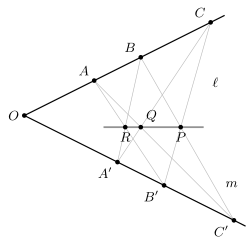
The six thin lines are the cross-joins; they meet in
pairs at , and , and the theorem says
those three points always lie on one line, the thick
one.
Theorem
22.9.4 (Pappus’s Theorem)
Let ,
let and be
distinct lines of and let be their common point.
Let be
three distinct points of , none equal to , and let be
three distinct points of , none equal to . Then the three points
exist and are collinear.
Idea. Coordinates, in the one basis
the data offers: the common point and one direction along
each line. Every point of the configuration then costs a
single parameter, each cross-join is a system, and
the three answers come out as explicit vectors. What
finishes the proof is not a determinant but an identity
visible on the page: the vector for is the sum of the
vectors for and
.
Proof. Write and with .
Since we
have (Lemma 22.6.4), and two
distinct subspaces of the same dimension satisfy , so
strictly
contains and has
dimension . By the dimension formula Theorem 1.7.3, . Thus for a nonzero , and is the
unique common point of and .
Choose and . Then is a
basis of and
is a basis of , and is a basis of : it has three members
and spans . Every point of other than is represented by a
vector with , hence, after dividing by , by exactly one vector
of the form ; and likewise on . So there are scalars
with where are distinct and
are distinct, because the representatives above are
uniquely determined by the points.
The three intersections exist. The lines
and are defined,
since
and : a
point of other
than is not a
point of , as
. They are distinct: if , this
line would contain and , two distinct points of
, hence be
; then , contradicting . So
is a single point (Corollary 22.6.7), and
the same argument gives and .
Computing . A vector in has the form and a vector in has the form . A nonzero vector lying in both
must have and , the
triple
being a basis, and then Taking and solves it.
The resulting vector is the same read in either span: in
the first the coefficient of is , and in the second it is
as well. So
lies on both lines, and it is nonzero since
. The two
lines being distinct, Corollary 22.6.7 makes
their
unique common point: . Advancing the letters, and with
The finish. Comparing the three displayed
vectors coordinate by coordinate in the basis , So
has dimension at most , and it has dimension
at least since
. Any subspace of dimension or is contained in some
-dimensional
subspace of , and then is a line
containing , and . This proves the
theorem.
The hypotheses did exactly three jobs, and it is
worth saying which. That gave the
basis. That none of the six points is let every one of them
be written as or with
the leading coefficient ; a point equal to has no such
representative, and the parametrization would break
down. That
are distinct and are distinct made the six
cross-joins exist and the three vectors nonzero. Nothing
else was needed — in particular the six points may
interleave along their two lines in any order, and no
further nondegeneracy hypothesis is required.
Example
(Pappus with exact coordinates)
In
let and , and take Find ,
, and the line through
them.
Solution. Here ,
, ,
and the parameters are , ,
, , , . The formulas
of the proof give so , , , and as it must be. A linear form vanishing
at and is , and
, so all three lie on the line .
As a check on the formulas, compute directly: is spanned by
and , so it is ; is spanned by
and , so it is . Their
common point is .
What the
two theorems measure
Both theorems have been proved here inside for a vector space
over a field
, and the proofs
used the field only through its arithmetic. It is worth
recording what happens if either assumption is loosened,
because the answers are among the most quoted facts in
the subject — and because this book has built neither
the tools to prove them nor the language to state them
carefully.
Exercises
A. Check your
understanding
Exercise
(A1)
- (a) Define
“perspective from a point” and “perspective from a line”
for two triangles in a projective plane.
- (b) In Lemma 22.9.1, which
hypothesis makes and which makes ?
- (c) State Theorem 22.9.3, with both
of its hypotheses on the configuration.
- (d) True or false,
with a reason: in Theorem 22.9.4 the six
points are required to be pairwise distinct.
- (e) Name the one
place in the proof of Theorem 22.9.4 where the
hypothesis is used.
Solution.
(a) Definition 22.9.1:
perspective from a point means some point lies on all
three lines , , ; perspective from
a line means the three pairs of corresponding sides are
pairs of distinct lines and their three intersection
points are collinear.
(b) The
hypothesis makes , and makes .
(c) Two triangles
whose six vertices are distinct and with no vertex of
either lying on a side of the other are perspective from
a point if and only if they are perspective from a
line.
(d) True, though
it is stated in two pieces: are required
distinct and are required distinct, and no point of
can equal a point of , since
. So all six are distinct.
(e) In the first
paragraph, to get and hence the basis . If then and there is no such basis.
B. Practice
Exercise
(B1: A Desargues configuration)
In
let ,
, , , and Check that each primed point lies on the
corresponding line through , scale the
representatives as in Lemma 22.9.2, and compute
the axis.
Solution. , and similarly and . In each case and , so Lemma 22.9.1 takes ,
, and likewise ,
, , .
Each difference
is , as
required.
Hence and the three vectors sum to . A linear form
vanishing at the first two is , which
also vanishes at the third, so the axis is .
(Both triples are triangles, since .)
Exercise
(B2: A Pappus configuration)
In
let and , and take Compute , , and the line through
them, and verify .
Solution. With ,
, the
parameters are , ,
and , , . By the
formulas in the proof of Theorem 22.9.4, Then , so . The points are , , . A linear
form vanishing at
and is , and , so the
three lie on .
Exercise
(B3: Concurrency from collinearity)
In
let ,
, and Verify the hypotheses of Theorem 22.9.3, then
decide whether , , are concurrent by
computing the three points ,
, and testing them for
collinearity. Do not compute the three
lines ,
, .
Solution. Both triples are
triangles:
is a basis, and the determinant of the matrix with rows
, , equals . The six vertices
are distinct. No vertex of lies on a side of
,
and conversely: the sides of are the three
coordinate lines and every primed point has all
coordinates nonzero, while , , , none of which is satisfied by , or .
Now , and a point of with satisfies , so . Cyclically, and . The three vectors
sum to , so
they are dependent and the points are collinear, on
. By the half of Theorem 22.9.3 the three
lines ,
, are therefore
concurrent.
C. Going deeper
Exercise
(C1: Desargues in space)
Let ,
so .
Let and
be
triangles spanning distinct planes
and of , with the six
vertices distinct, and suppose a point lies on each of , , .
- (a) Prove that , , , lie in one plane
of , and
deduce that the lines and meet.
- (b) Prove that is a
line.
- (c) Deduce that the
three points , , lie
on that line, and so are collinear.
Hint: for (a), all four points lie on lines
through ; for (b),
use the dimension formula for subspaces.
Solution.
(a) Since and all six vertices lie in , the
point is none of
them; and , because the six are distinct. Let represent . The points are distinct
and collinear, so Lemma 22.9.1 gives
representatives with , and the same gives . All four of then lie in , of dimension at most , so the four points lie
in the projective subspace , of dimension at
most — a plane or
less. Subtracting, , a
vector that is nonzero because and that lies in
; so
lies on both and
, and
the two lines meet.
(b) and
with and , inside a -dimensional . Then , so by Theorem 1.7.3, , and is a line.
(c) First, :
otherwise and
would both
lie in ,
hence so would the line and the point
on it,
contradicting . Two distinct lines have at most
one common point, since two distinct points determine
their line (Proposition 22.6.8), and
by (a) these two lines do meet; so is a
single point. It lies on and on , hence in , which
is the line of (b). The same holds for the other two
points. Three points on one line are collinear.
Exercise
(C2: Pappus over the two smallest fields)
- (a) Prove that the
hypotheses of Theorem 22.9.4 cannot be
satisfied when .
- (b) Over , take , , , , as in the proof
of Theorem 22.9.4 and the
parameters , , . Compute and exhibit a line containing all
three points.
- (c) Explain why the
choice of parameters in (b) is the only one available
over , up to
renaming the points.
Solution.
(a) A line of
is
with , and
has vectors
falling into points (Proposition 22.6.9). For
a line has
points, so has
only two, and three distinct points of , none equal to , do not exist.
(b) With , , the formulas
give all read in and in the basis
.
So ,
, , and every
one of them satisfies . That linear form defines a line, and
the three points lie on it. As a check, in .
(c) A line of
has
points,
so has exactly three, namely the ones with
parameters ;
the same on . The
three points must therefore be those three in some order,
and likewise . Renaming amounts to permuting the
parameters, which permutes , , and changes nothing
about their collinearity.
Exercise
(C3: Why the side hypothesis is there)
In
let and let .
- (a) Prove that and
are triangles with six distinct vertices, and that lies on each of , , .
- (b) Prove that the
two triangles are not perspective from
a line, in the strict sense of Definition 22.9.1.
- (c) Say which clause
of hypothesis (ii) of Theorem 22.9.3 fails
here.
Solution.
(a)
is a basis, so is a triangle,
and so is
one too. The six coordinate vectors are pairwise
nonproportional, so the vertices are distinct. Now all have
last coordinate ,
hence lie on the line , and so are collinear; the same for . Finally
, so lies on the line
through and .
(b) The line
is , since and span its
underlying plane. The line is spanned
by and
, an
independent pair inside the same plane, so as well. The pair
therefore does not consist of distinct lines, and clause
(b) of Definition 22.9.1 fails
at its first requirement: there is no point “” to
speak of, the intersection being a whole line.
(c) The clause
that no vertex of one triangle lies on a side of the
other. Here lies on , and so do and .