The Jordan form of Section 3 exists only when splits, and over
that often
fails: a rotation of the plane has no real eigenvalue at
all. But a real matrix is also a complex matrix, and its
complex eigenvalues come in conjugate pairs (Theorem 9.2.5). This
section turns a complex Jordan basis into a
real one by pairing each chain with its
conjugate; the price for a conjugate pair is a
rotation-scaling block instead of a scalar, and the
result is the best real matrix there is. The second half
rearranges the same data in another way, the Weyr form,
which is the form to reach for when a second operator
commutes with the first.
A block
for a conjugate pair
The obstruction is visible in the smallest case. The
rotation has , so
has no real
eigenvalue and no real eigenvector (Example (A Rotation Has No Invariant Lines)).
Every real matrix similar to therefore has no real
eigenvalue either, so it cannot be triangular: whatever
basis of we
choose, the matrix of keeps two off-diagonal
entries. So is
already as simple as it will ever get over , and the honest thing
to do is to promote it to a building block.
More generally, for
with ,
consider This matrix carries the conjugate pair as
its complex eigenvalues, has trace and determinant , and is a scaled
rotation: it stretches by and
turns by the argument of . It is the real
substitute for the block , and it costs
one extra dimension.
A real Jordan block is a Jordan block with the
scalar
replaced by the rotation-scaling matrix it needs over , and the
superdiagonal
replaced by .
Definition
10.4.1 (Rotation-Scaling Block, Real Jordan
Block)
Let with and . The rotation-scaling block
of the conjugate pair
is For an integer , the real Jordan block
of size for the
pair is the matrix , partitioned into blocks of size
, with
in every diagonal block, in every
superdiagonal block, and the zero
matrix elsewhere: A real Jordan matrix is a
direct sum of ordinary Jordan blocks with and real
Jordan blocks with and
.
In words: is built
exactly like (Definition 10.3.1),
but every entry of is replaced
by a
block — the diagonal by , the
superdiagonal by
, and each
by the zero matrix.
It has size , not
. The last clause
matters: , so the pair
offers two candidate blocks of each size, and a real
Jordan matrix is required to use the member with , which makes
a
rotation through a positive angle. Without that
normalization the uniqueness below would fail, since
and
are similar over .
Examples.
- Size one. . For this is the
rotation above;
for it is .
- Size two. For , Its characteristic polynomial is , by Theorem 7.8.4 applied
to the block upper triangular shape.
- A real Jordan matrix mixing the two
kinds. has characteristic
polynomial .
Nonexample by minimal change. Change
the sign of the lower-left entry: is still real, still has
trace , and looks
just as harmless. But it is symmetric, its
characteristic polynomial is , and its
eigenvalues
are real; for it is the
coordinate swap, which is diagonalizable over . The clause that
fails is that the two off-diagonal entries must have
opposite signs; that is what makes the
eigenvalues nonreal.
Why this definition. Two conventions
are being fixed, and both are only conventions. First,
the sign of :
replacing by
amounts to changing the
sign of every second basis vector, so the two choices
give similar matrices. Second, the ones: a real Jordan
block could be written with below the diagonal
instead, giving the transpose. What is
not a convention is the size: a
conjugate pair cannot be carried by a real block,
because a real matrix has a real eigenvalue.
The following computation is the whole idea of the
section, and we will use it twice: once to see what
is
over , and once
to build the real basis.
Lemma
10.4.1 (Realifying a Conjugate Pair of
Chains)
Let , let with
and
, and let
be a Jordan chain of for in , so that Write with , and put . Then:
- (a) and for ;
- (b) is a Jordan chain of for ;
- (c) the vectors span, over , the same subspace of
as the vectors ,
and one of the two lists is linearly independent over
if and only if
the other is;
- (d) if the vectors are linearly independent
over , then
is invariant under , and the matrix of
in the
ordered basis is
.
Idea. For (a), write the chain
relation as and compare
real and imaginary parts; since is real, acts on the two parts
separately, and the only mixing comes from multiplying
by . The
minus sign in is chosen so that the
answer comes out with the signs of rather
than its transpose. Part (c) is bookkeeping:
and are obtained from each other
by an invertible matrix of scalars. Part (d) just reads off
the columns from (a).
Proof.
(a) Every is
uniquely with , by Definition 0.6.1
applied entry by entry; so
are well defined. The chain relation says for . Expanding
both sides with and , where we used and, on the left, that has real entries, so
with . Comparing real parts gives the first
identity, and comparing imaginary parts gives , that is, the
second.
(b) Conjugating
the identity entry by entry
and using that
is real, and for every (Theorem 0.6.2 (a),
(b)). Hence for and , which is the
chain condition for . (That follows from .)
(c) Since and , we have So each vector of either list is a -combination of the
other list, and the two spans agree (Theorem 1.4.2). The
passage from to
is given, for each separately, by the
matrix of
determinant , which is invertible; so the change of lists
is an invertible linear substitution of the
coefficients, and a nontrivial vanishing combination of
one list yields one of the other. Hence one list is
independent if and only if the other is.
(d) By (a), every
and
every
lies in , so is -invariant (Lemma 9.1.1). Order
the basis as and
read off the columns (Definition 4.1.1).
By (a), the column of has entry
at , at , at , and elsewhere; the column
of has
at , at , at , and elsewhere. Grouping the
basis into the consecutive pairs ,
the block is
,
the block
is , and all
other blocks are zero. That is (Definition 10.4.1).
Applying the lemma to the block itself tells us what
a real Jordan block looks like over .
Corollary
10.4.2 (A Real Jordan Block Splits into Two
Complex Ones)
Let and . Then, as matrices over , In particular , the
polynomial , and is the
same polynomial.
Proof. Put and let be the standard basis
of in this
order. Reading the columns of gives
exactly the identities of Lemma 10.4.1 (a).
Put , so that . Combining the two
real identities, since . So is a Jordan chain of for , and by (b) so is
for . By (c), the
vectors are
independent over , because the standard
basis is; being
independent vectors in , they form a
basis (Theorem 1.6.4 (a)).
On the span of one chain, has matrix by Lemma 10.2.2 (b),
so has matrix
there, the matrix of a sum of
operators being the sum of their matrices (Theorem 4.1.4, Definition 10.3.1);
likewise on the
span of the conjugate chain. By Theorem 9.1.5 the
matrix of in
the combined basis is . Hence over (Theorem 4.2.4).
The characteristic polynomial of is (Theorem 7.4.6), and
similar matrices have the same characteristic polynomial
(Theorem 7.10.3), so
. For the minimal
polynomial, by Corollary 10.3.2
(c), a single Jordan block being a Jordan form of itself
with one block, of size ; so by Proposition 9.5.6 and
Theorem 9.5.5, the
factors being powers of distinct irreducibles.
Quick check. What are the complex
eigenvalues of , with their algebraic and geometric
multiplicities?
Solution. By Corollary 10.4.2,
over . So the eigenvalues
are , each
with
(the total size of its blocks) and (the
number of its blocks), by Corollary 10.3.2
(a), (b).
Two facts about real matrices are needed before the
theorem. The first is that a real matrix has the same
kernel over as
over , in the
sense that a real basis of the one is a complex basis of
the other. Once one knows that is the
complexification of inside (Definition 1.9.2, Example (The Complexification of Is
)), this
is Theorem 1.9.3. It is
worth proving directly, because the identification is
itself part of what has to be checked, and because the
statement is used both to find the real chains and to
compare ranks.
Lemma
10.4.3 (Real and Complex Null Spaces of a Real
Matrix)
Let , let be its null space over , and let be its null space
over . Then:
- (a) for with : if and only if and ;
- (b) every basis of
over is a basis of over ; in particular and is the same computed over and over .
Proof.
(a) Since is real, with . By the uniqueness of real and imaginary
parts (Definition 0.6.1),
if and only if and
.
(b) Let be a basis of over . Spanning.
Let . By (a), ,
so and with ; hence
. Independence. Let
with . Separating real and imaginary parts, which
is legitimate because the are real,
gives and ; independence over
forces every
. So
is a basis of and . The rank statement follows from Theorem 3.5.7 over
each field.
Now the theorem. Read it as the Jordan form with one
amendment: a conjugate pair of complex blocks of size
is replaced by a
single real block of size .
Every real matrix is similar, over the reals, to
a direct sum of Jordan blocks for its real eigenvalues
and real Jordan blocks for its conjugate pairs, and that
matrix is unique up to the order of its blocks.
Idea. Work over , then come home. ①
Split over all complex eigenvalues (Theorem 10.1.3). ②
For a real eigenvalue, the generalized
eigenspace is the complexification of a real subspace,
by Lemma 10.4.3, and
Section 2’s structure theorem runs over on that real
subspace: nothing complex is needed. ③ For a
pair, choose the chains in freely, and
take their conjugates in — no
choice there. ④ Replace each conjugate pair of chains by
its real and imaginary parts; Lemma 10.4.1 says
the new matrix is , and a
count shows the real vectors collected are exactly in number and
independent. Uniqueness is the uniqueness of the complex
Jordan form, since by Corollary 10.4.2 a
real Jordan matrix has a known complex Jordan form.
Proof. Since has degree , it splits over (Corollary 6.5.5), and
its nonreal roots come in conjugate pairs with equal
multiplicities (Theorem 9.2.5 (a)); so
the list of eigenvalues has the displayed shape. Write
for the
algebraic multiplicity of in , so and By Theorem 10.1.3
applied to
over , with and (Corollary 10.1.2
(a)).
Step 1. Real eigenvalues, handled entirely
over .
Fix a real eigenvalue . The matrix is
real, so by Lemma 10.4.3 its
real null space has a real basis which is a -basis of ; in particular
. The subspace is -invariant, since for (Theorem 6.7.4 (b)),
and satisfies , so is nilpotent (Definition 10.2.1).
By Theorem 10.2.3
there is a basis of the
real space , a concatenation of
Jordan chains of , with .
Since and , adding
the matrices (Theorem 4.1.4)
blockwise (Theorem 8.1.4 (a),
Definition 10.3.1)
gives a direct sum of ordinary Jordan blocks.
Moreover ,
viewed in , is
a Jordan basis of for over : the chain relations
are the same equations, and is a -basis of by Lemma 10.4.3
(b).
Step 2. Conjugate pairs, chosen on one
side. Fix and write ,
,
. By Theorem 10.1.3
(d), is nilpotent, so Theorem 10.2.3
provides chains whose concatenation is a -basis of ; as in Step 1 these are
Jordan chains of
for , of
lengths summing to .
Claim: conjugating gives a Jordan basis of . Indeed,
conjugation maps
onto : if
, then by the
computation in Lemma 10.4.1 (b),
and conjugating twice returns . If is a -basis of , then spans — any has
, say , whence — and it has
entries, so it is a basis (Theorem 1.6.4 (b)).
Applying this to the concatenated chains, and using Lemma 10.4.1 (b)
chain by chain, the conjugated chains form a Jordan
basis of
consisting of chains for of the same
lengths .
Step 3. Realify each pair of conjugate
chains. Keep fixed and let be one of the chains of Step 2,
with , . By Lemma 10.4.1 (c),
the real vectors
have the same
-span as the
chain vectors
. Do this for each of the
chains attached
to , and
for each .
Step 4. The collected real vectors form a
basis of . Let be the list obtained
by writing, one after another: the real Jordan bases
of Step 1, and then, for each and each chain of Step
2, the block of
real vectors of Step 3. Its length is by , since the chain
lengths for sum to . Its -span contains a -basis of each (Step 1)
and, for each ,
all the vectors and (Step
3), which together form a -basis of by Step 2. So the
-span of is all of , and has exactly entries, so is a -basis of (Theorem 1.6.4 (b)).
In particular
is linearly independent over , hence over , and being a list of
independent
vectors in it
is a basis of
(Theorem 1.6.4
(a)).
Step 5. The matrix. Each segment of
spans an -invariant real
subspace: the spaces by Step 1, and
the spaces of Lemma 10.4.1 (d)
by Step 3 and the independence just proved. Their direct
sum is , since
is a basis. By
Theorem 9.1.5, is
block diagonal with the matrices of the restrictions as
diagonal blocks, which are ’s by Step 1
and ’s by Lemma 10.4.1 (d).
Taking to be the
real matrix whose columns are the vectors of gives (Theorem 4.2.4),
which proves (a).
- (b) Let be any
real Jordan matrix similar to over , and regard the
similarity over . By Corollary 10.4.2
and Theorem 8.1.4,
replacing each block of by produces a Jordan matrix
similar to ,
hence to , over
. By Theorem 10.3.1
(b), for every and the number of blocks with in that Jordan
matrix equals , computed
over . For a
real , the
blocks of
the Jordan matrix are exactly the blocks of , since the replaced
blocks contribute only nonreal eigenvalues; and the
ranks over
agree with the ranks over by Lemma 10.4.3 (b),
applied to the real matrix . For
with , the blocks of the
Jordan matrix come one each from the blocks of : a block of
with
contributes and
,
and because and both have
positive imaginary part (Definition 10.4.1).
In both cases the count is determined by , so any two real
Jordan matrices similar to have the same blocks
up to order.
So over the
dream of Chapter 2 comes true in the amended form:
every real square matrix is similar over to a matrix that is
block diagonal with blocks and ,
and the only new feature is the
rotation-scaling block. Counting: a real eigenvalue
contributes
to the size
and blocks;
a pair contributes to the size
and real
blocks. For an operator on a real vector space
the same
statement holds, applied to for any
basis of : the theorem produces a
real Jordan matrix similar to it, hence equal to for
another basis
of (Theorem 4.2.4).
The complexification of Definition 1.9.2 is
where the complex chains live; for it is (Example (The Complexification of Is
)), which
is the case written out above.
Warning. A real Jordan
matrix is not triangular, and the real form is not
obtained by “ignoring” the imaginary parts. The
real Jordan form of a matrix with a nonreal eigenvalue
cannot be triangular, since a
triangular real matrix has its diagonal entries as
eigenvalues, all real (Theorem 9.7.4). Nor is
a
diagonal matrix in disguise: it has no real eigenvector.
And the real basis is not the real part of the complex
one: each complex chain vector contributes
two real vectors,
and ,
and dropping either of them destroys the invariance.
Example
(The Real Jordan Form of a Matrix)
Let Find the real Jordan form of (Theorem 10.4.4)
and an invertible with in that
form.
Solution. The eigenvalues.
has roots , so over the eigenvalues are
and
, each with . There is
no real eigenvalue, so the real Jordan form consists of
real blocks only, with
sizes summing to
.
A chain for . Put , so that Solve using rows , , and in that order. Row
gives ; row
gives .
Substituting the first into the second, and writing
, , using . Row
reads , which becomes so .
Row is then
automatic: with we get , and row gives . So Hence there is exactly one -block over (Corollary 10.3.2
(b)), of size , and the real Jordan form is . For the
basis we need the chain: take
and solve . Try , so that only columns and of are used. Row then reads and row reads , so
is the only candidate of this shape. Rows and confirm it: which are the third and fourth entries of
. So
is a Jordan chain of for .
Normalizing the chain. If
is a chain, so is for any , since the chain
relations are linear. Taking clears the
denominators of the realification: Now read off with
real, as Lemma 10.4.1
requires:
The answer. With , is
lower triangular with ones on the diagonal, so (Theorem 7.4.6) and
is
invertible.
The check, column by column. Writing for the columns of , the identity
says read off the four columns of ; these are
exactly the identities of Lemma 10.4.1 (a)
with . Two
of them in full: adding columns and of ; and the third column of . The remaining two are
the same kind of one-line computation.
Cross-checks. and . Over , Corollary 10.4.2
gives the complex Jordan form , whose characteristic polynomial is
.
The Jordan form of a nilpotent operator is the Young
diagram of Section 2 read by rows: one
row per chain, one block per row. The same diagram can
be read by columns, and the columns are
the jumps of the kernel chain (Definition 10.2.3
and the discussion after Theorem 10.2.4).
Reordering a Jordan basis accordingly costs nothing and
gives a second normal form, the Weyr form. It carries
exactly the same information — a partition for each
eigenvalue — but it wears it differently, and for one
purpose it is strictly better: the matrices that commute
with a Weyr matrix are block upper triangular, which is
false for the Jordan form.
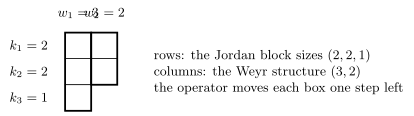
Here is the diagram for the partition of , whose dual partition
is :
The basis is the same; only its order changes.
Instead of listing chain by chain, list the first column
(a basis of the kernel), then the second column, and so
on. Since the operator moves each box one step to the
left, it maps the -th group of basis
vectors into the -th, injectively,
and the matrix becomes block upper triangular with a
very rigid pattern of ones.
In words: the diagonal blocks are scalar, of the
sizes given by the partition, and the only other nonzero
blocks sit immediately to the right of
the diagonal ones, each being an identity matrix stacked
on top of a zero block — so has full
column rank , which is
possible exactly because . The matrix is upper triangular,
with
repeated times on
the diagonal.
Examples.
- One column. If , then : a
scalar matrix. This is the diagonalizable case.
- All parts equal to . If ,
then : a single Jordan block. So Jordan
blocks are the basic Weyr matrices of the thinnest
possible structure.
- The structure with .
Here and
with the block in the upper right corner. As we
will see, this is the Weyr form of , the diagram drawn above.
Nonexample by minimal change. Put
the identity block in the lower part of
instead:
with structure and , compare
Both are nilpotent of rank , and indeed (Corollary 10.2.5):
the shape is not an extra invariant, and the two
matrices represent the same operator in different bases.
But only is a
Weyr matrix. The clause that fails for is that the block
must be
an identity matrix stacked on top of a
zero block, not below it. The ordering is a
normalization, and it is the one the commutant property
below is proved with: there the block is canceled on
the left, which uses that its columns are the
first standard basis
vectors, in order. Concretely, every matrix commuting
with turns out
to be upper triangular, while the commutant of contains the
matrix unit .
The existence and uniqueness of the form are now a
repackaging of Section 3.
Idea. Both parts come from one
observation: a Weyr basis is a Jordan basis in a
different order. Arrange the -chains of a
Jordan basis as the rows of the Young diagram, sorted by
decreasing length, and read the diagram column
by column. The operator moves
each box one step to the left, so it carries the -th column into the
-th, matching
the -th box of one
with the -th box
of the other — which is exactly the block . For uniqueness, count the boxes:
the first columns
of the diagram are a basis of ,
so the column lengths are the jumps of the kernel
chain.
Proof. A Weyr
matrix is upper triangular, so if has a Weyr form then
is
triangularizable and splits (Definition 9.7.1, Theorem 9.7.2).
Suppose splits,
and let be
an eigenvalue. By Theorem 10.3.1
there is a Jordan basis; fix its part inside , a
concatenation of Jordan chains of of
lengths summing to (Theorem 10.2.3,
after reindexing so that the lengths decrease). Write
for the -th chain in the order
of Definition 10.2.2,
so that Put and, for , let , the length of the
-th column of the
Young diagram; then is the dual partition of
(Definition 10.2.3),
a partition of . Because the
decrease, . Let be the -th column, and let
be the
list written one after another: a reordering
of the chosen basis of , hence a
basis of it.
Read the columns of .
For , . For , , and
is
the -th entry of
, which
exists because . In the block partition of by the groups
, this says: the block is ; the
block sends
the -th basis
vector of group
to the -th of
group for , so it
is ; and every other block is
. That is the
basic Weyr matrix with eigenvalue and structure
(Definition 10.4.2).
Writing the lists for the
distinct eigenvalues one after another and using (Theorem 10.1.3)
with Theorem 9.1.5, the
resulting basis
makes a
direct sum of basic Weyr matrices, one per
eigenvalue.
- (b) Let be a Weyr form of
with one basic
block per eigenvalue, and fix with basic block
of structure and size . Let be a basis with ,
and name the basis vectors inside the -block , where
indexes the
groups and the entries within a group. The blocks of
Definition 10.4.2
say precisely that while on the span of the basis
vectors belonging to the other basic blocks the operator
is invertible:
is -invariant and the
matrix of is ,
where is a
direct sum of basic Weyr matrices with eigenvalues , hence
upper triangular with all diagonal entries , so
of nonzero determinant (Theorem 7.4.6, Theorem 7.5.2). Hence
kills for and sends for . Write with
; both summands are -invariant, so , and the second
summand is because
is
invertible. Inside the displayed action
gives for , the spanning vectors being members of the
basis and hence
independent; and for . Subtracting consecutive values gives as claimed, a number depending only on
and . By Corollary 10.3.2
(d) this is also for the -block sizes of the Jordan form,
that is, the dual partition. Since the structures are
determined, so is up to the order in
which its basic blocks are listed.
Existence and uniqueness are thus free; what makes
the form worth the trouble is the next property. Here
is
called block upper triangular for a
partition , taken as both the row and the column
partition (Definition 8.1.1),
when every block with is zero; for
this is the
shape of Chapter 8.
Proposition
10.4.6 (The Commutant of a Basic Weyr Matrix Is
Block Triangular)
Let be a basic Weyr matrix with eigenvalue
and Weyr
structure , and let satisfy . Then is block upper
triangular for the partition :
its blocks
vanish for .
Idea. Write both products
blockwise. Because has only one nonzero
block in each block row, each block equation is short:
, where . Every has full column
rank, so it can be canceled on the left. Now sweep the
block columns from left to right: the first block column
forces
for , and
each new column is forced by the previous one.
Proof. Put
and for , so that has blocks and all
other blocks zero (Definition 10.4.2).
Since
commutes with everything, is equivalent to . Comparing
the blocks
with Theorem 8.1.1, and
reading an undefined symbol as , Each
is injective as a map ,
so
forces for
every matrix
with
rows.
We prove for by induction on .
Case . Let . Taking the indices in , the right-hand
side involves , which is
undefined and therefore read as . So ,
and
makes one
of the listed blocks; injectivity gives .
Induction step. Let and assume
whenever and . Let . Taking the indices in , Here and , so by the induction hypothesis, and the
right-hand side is . Again , so
injectivity of gives . This
completes the induction and the proof.
Quick check. An operator on a -dimensional complex
space has one eigenvalue , with Jordan
block sizes . What is the Weyr structure of its Weyr
form, and what is ?
Solution. The Weyr structure is the
dual partition: , , , so , a partition of
as it must be. By
Theorem 10.4.5
(b), . (Equivalently,
, by Corollary 10.3.2
(d).)
Exercises
A. Check your
understanding
Solution.
(a) and ;
the real Jordan block has size
(Definition 10.4.1).
(b) Every is
similar, by a real invertible matrix,
to a direct sum of blocks for the real
eigenvalues and
for
the conjugate pairs , and that matrix is unique up to
the order of the blocks (Theorem 10.4.4).
(c) False. A
triangular real matrix has real eigenvalues (Theorem 9.7.4), and
similar matrices have the same characteristic polynomial
(Theorem 7.10.3); so a
real matrix with a nonreal eigenvalue, such as the
rotation by a right angle, is similar to no real
triangular matrix.
(d) The real
eigenvalue has
, so its
blocks are
or . The pair has , so its real
blocks are (size ) or . That gives four possible real Jordan
forms, of total size in each case.
(e) The Weyr
structure of is the partition
with , that is, the dual
partition of the -block sizes of
the Jordan form (Theorem 10.4.5).
(f) has one -block of size , so the Weyr structure
is and the
Weyr form is itself. For the block sizes are
, the dual
partition is ,
and the Weyr form is .
B. Practice
Solution.
(a) , so the
eigenvalues are and the real Jordan form is . For
,
, and the first row gives ; take . Then
with and
,
so Check: and , which are the two
columns of as Lemma 10.4.1 (a)
predicts with .
(b) , with roots ; the real Jordan
form is . For , the
second row of gives ; take
. Then and , so
Check: and .
Solution.
(a) Block sizes
, a
partition of .
Dual partition: , , . So the Weyr form is the basic Weyr matrix
with
and structure , with the block and the block above the diagonal. As a check,
and .
(b) For : sizes , dual . For : sizes , dual . The Weyr form is the
direct sum of the basic blocks,
(c) Sizes , dual , . The basic Weyr
matrix with and structure is which is with its basis reordered as
.
Solution.
(a) The real
eigenvalue has
, giving
the block . The pair has , giving . So the real Jordan form is , the only
possibility.
(b) has roots
, so the
form is , again the only
possibility.
(c) All
eigenvalues are real, so the real Jordan form is an
ordinary Jordan form: the -block sizes form a
partition of ,
giving ,
, or .
(d) No. A
diagonalizable is similar over to a diagonal real
matrix, whose characteristic polynomial splits over
(Theorem 7.4.6); but
has no real
root. In fact whenever has a nonreal
eigenvalue its real Jordan form contains a block , which
is not diagonal.
C. Going deeper
Solution.
(a) With , , , , By Exercise (C1: Companion matrices)
(b), ,
and by Exercise (B3: Companion matrices)
(d), as
well.
(b) Over , ,
so . By Corollary 10.3.2
(c), the exponent
of in is the largest
size of an -block;
the sizes form a partition of with largest part , so there is one block
. Likewise
one block .
The complex Jordan form is .
(c) By Theorem 10.4.4,
the real Jordan form has no ordinary Jordan blocks
(there is no real eigenvalue) and one real block per
complex -block, of
the same size parameter. So it is (Consistently, Corollary 10.4.2
turns back
into over .)
(d) ,
and both matrices have characteristic polynomial : for by (a), and for by Corollary 10.4.2.
Their minimal polynomials agree too, both being .
Solution.
(a) . Write . Then has first row equal
to the third row of and other rows zero,
while has
third column equal to the first column of and other columns
zero. Equating, So the commutant is of dimension . The lower-left block is ,
so every such is
block upper triangular for , as Proposition 10.4.6
asserts.
(b) . Now has first row equal
to the second row of and other rows zero,
while has
second column equal to the first column of and other columns
zero. Equating gives , , , and , so the commutant is also of dimension . Take , which commutes with (it is the case , ). Its only nonzero
entry sits in position , below the
diagonal, so
is not upper triangular. The partition it violates is
, the Weyr
partition of this operator: the lower-left block of is . So the
conclusion of Proposition 10.4.6
genuinely fails for the Jordan form, while (a) confirms
it for the Weyr form (Theorem 10.4.5) of
the same operator.
(c) Both have
dimension . They
must agree, because and are similar (both are
nilpotent with and , so Corollary 10.2.5
applies): if , then is a bijection from the commutant
of to that of
, and it is
linear and invertible, hence preserves
dimension.