Every finite-dimensional space has a basis, and
usually a great many of them. This section proves that
they all have the same length, so that the length is a
property of the space and not of the basis we happened
to pick. That number is the dimension. The key step is
the Steinitz Exchange Theorem, the most important proof
of the chapter. With it we build the everyday tools of
dimension counting: size bounds, “count instead of
check”, extension of independent lists to bases, and
dimensions of subspaces.
How big is
a vector space?
We would like to say that a plane is smaller than
space, and that and are, in
some sense, the same size. The naive measure is the
number of elements. It fails at once: , , and are all
infinite sets, and counting elements cannot tell them
apart.
A better measure counts how many vectors it
takes to build everything, without waste, which
is the length of a basis. The standard bases give This matches intuition: a matrix and a polynomial are
both described by four free numbers.
But there is a gap. A space has many bases. We
counted the standard basis of ; the basis also
has length 2, but what guarantees that no basis of has length 3? If
some space had bases of two different lengths, “the
length of a basis” would be meaningless. So before we
can define anything, we need the following.
Goal. Any two bases of a
finite-dimensional vector space have the same
length.
A basis is independent and spanning,
and the goal follows from a single inequality about the
two properties separately: an independent list is
never longer than a spanning list. Granting this,
take two bases
and . Since
is independent
and spans,
is not longer
than . Swapping
the roles, is
not longer than . So they have the
same length. Everything rests on the inequality.
The
Steinitz Exchange Theorem
Why should an independent list be no longer than a
spanning list? In the spanning list
has length 2, and three vectors in
the plane always satisfy a linear relation, but “the
plane is two-dimensional” is what we are trying to
define, so we cannot use it. The idea is instead to feed
the independent vectors into the spanning list one at a
time, pushing out one spanning vector each time, while
keeping the list spanning. If the independent vectors
outnumbered the spanning ones, we would run out of
vectors to push out.
Theorem
1.6.1 (Steinitz Exchange Theorem)
Let be a
vector space over . Suppose that is a linearly
independent list in and that is a list that
spans . Then
- (a) , and
- (b) after
renumbering suitably, the list spans .
In words: an independent list is at most as long as a
spanning list, and the independent vectors can
replace of the spanning vectors
without losing the spanning property. “Renumbering”
means listing the ’s in a different
order; which ’s get replaced
depends on the ’s.
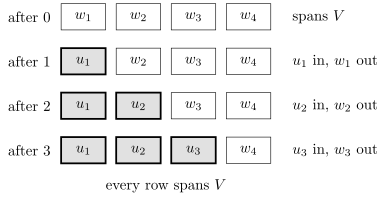
Idea. Picture a row of slots holding ; the row spans . We push into the row
and push one out, then , and so on,
keeping the row spanning after every exchange. Here is
the picture for , ,
with the ’s
numbered in the order they leave.
Which
may leave? Write the incoming as a
combination of the current row. Any with a
nonzero coefficient can be solved for,
so it lies in the span of the other entries together
with , and
removing it costs nothing. Such a must exist:
otherwise would be a
combination of alone, which independence
forbids. In particular, while ’s remain to be
inserted, a remains to be
removed, and that is why .
Step roadmap. Induction on the number of exchanges, with the
invariant
: , and after
renumbering the ’s, the list
spans .
Step 1 is the base case . Step
2 writes in the
current list. Step 3 is the Claim that
some remaining has a nonzero
coefficient. Step 4 exchanges that
for and checks
the span.
Proof. We prove for by
induction on . The
case is the
theorem.
Step 1 (base case). For the list in is , which spans by hypothesis, and
. So holds.
Step 2. Let and
suppose holds.
Renumber the ’s as allows, so that
spans .
Since , the
vector exists,
and . Hence there are scalars with (If , the list contains no ’s and the second
group of terms is empty.)
Step 3.
Claim. We have , and for some with .
Proof. Suppose not. Then either
, so that
there are no ’s at
all, or
and . In both cases reads . Therefore is a linear relation among in which the coefficient of is . This
contradicts the linear independence of . Hence there is at least one in , so , and some
with is
nonzero.
Step 4. Renumber among themselves so that . This only
changes the order of entries of , so still spans (the span of a list
does not depend on the order of its entries), and still holds with
the coefficients renumbered in the same way. Put Since , the scalar exists, and
solving for
gives The right side is a combination of the entries
of , so
. By Theorem 1.3.5,
inserting into does not change
the span: The list on the right contains every entry of
, so its span is
a subspace containing all entries of , and hence contains
by
Theorem 1.3.1.
Therefore . Together with from the Claim, this is .
By induction, holds: , and after
renumbering the ’s, spans . This proves the
theorem.
Part (a) is the inequality our goal needed. Part (b),
the exchange itself, is a bonus that we will spend later
in this section, to extend independent lists to
bases.
Warning. The that leaves must
have a nonzero coefficient; an
arbitrary
will not do. In , take the spanning
list and the
independent vector . Exchanging for gives , which
spans. Exchanging for , whose
coefficient is ,
gives , which does not reach .
The theorem already settles questions that would
otherwise need a computation.
Quick check. Can the four
polynomials ,
, , be linearly
independent in ?
Solution. No. The list spans and has
length , so by Theorem 1.6.1 every
independent list there has length at most . Indeed .
Dimension
The goal of the section is now one line away.
Theorem
1.6.2 (Basis Theorem)
Let be a
finite-dimensional vector space. Then has a basis, and any
two bases of have
the same length.
Proof. By Corollary 1.5.5,
has a basis. Let
and be bases of . The first is linearly
independent and the second spans , so by Theorem 1.6.1.
Swapping the roles of the two bases gives . Hence .
We started from a question: how big is a vector
space? The Basis Theorem says that one number, the
length of a basis, answers it without depending on any
choice. So we give that number a name.
The dimension of a space is the number of vectors
in any basis: how many independent directions the space
has.
Definition
1.6.1 (Dimension)
Let be a
finite-dimensional vector space over . The
dimension of over , written or simply , is the length of
any basis of .
In words: pick a basis of , any basis at all, and
count its vectors. The dimension is defined only for
finite-dimensional spaces (Definition 1.3.4); a
space spanned by no finite list is infinite-dimensional,
and we do not assign it a number here. The subscript
records the field
of scalars, which, as we will see, matters.
Well-definedness. Two things could
go wrong with “the length of any basis”: there might be
no basis to count, or different bases might give
different counts. The first is ruled out by Corollary 1.5.5 and
the second by Theorem 1.6.2. That
is exactly what the word any in the
definition needs.
Example
(Dimensions of the Running Examples)
Find the dimension of each space.
- (a) , , and
.
- (b) The zero space
.
- (c) over , and over .
- (d) , the symmetric real
matrices.
- (e) over (Example ( over )).
Solution. In each case we exhibit
one basis and count it.
(a) The standard
bases of Example (Standard Bases)
have lengths ,
, and . So , , and .
(b) The empty
list is a basis of (Example (Three More Bases)),
so .
(c) Over , the list is a basis of : every equals , and forces
. So . Over
, the list is a basis (Example (Three More Bases)),
so .
(d) A symmetric
matrix has the form , and this combination is the zero
matrix only when . So is a basis of , as in Exercise (B3: Symmetric Matrices),
and .
(e) Every element
is with , so spans. Let with . If , then ,
contradicting Theorem 0.2.3. So
, and then
. Hence is a basis,
and .
The zero space in (b) is the degenerate case: it has
dimension because
its basis is empty, not because it has no elements. It
has one element, .
Nonexample by minimal change. Remove
the degree bound from . The space
is not spanned
by any finite list (Theorem 1.3.3), so
it has no finite basis and no dimension in the sense of
Definition 1.6.1.
The hypothesis “finite-dimensional” in the Basis Theorem
is exactly what fails.
Why this definition. Why a basis,
and not some other list? Spanning lists can be made as
long as we like by repeating vectors, and independent
lists can be made as short as we like by deleting
vectors, so neither length alone is an invariant. A
basis sits exactly where the two meet: it is the longest
possible independent list and the shortest possible
spanning list, as we prove next. And why not count
elements? Over
every nonzero space is infinite, so the count says
nothing. Over a finite field the count does carry
information, but it is determined by the dimension; see
Exercise (C3: Counting Elements over a Finite Field).
Warning. The dimension of is ,
not . The basis has
one vector for each exponent , and the
constant is easy
to forget. For instance .
Warning. Dimension depends on the
field. The set
has dimension
over but
dimension over
, because over
the scalar
is no longer
available and
must be counted as a separate basis vector. When more
than one field is in sight, write .
Quick check. What are
and ? Which of them equals ?
Solution. and . Both equal .
Size
bounds
The first payoff turns the Exchange Theorem into
statements about the number .
Theorem
1.6.3 (Size Bounds)
Let be a
vector space over
with .
- (a) Every linearly
independent list in has length at most
. Hence every list
in of length
greater than is linearly
dependent.
- (b) Every list that
spans has length
at least . Hence
no list of length less than spans .
Proof. Let be a basis of ; it has length .
(a) Let be an independent
list of length . Since spans , Theorem 1.6.1 gives
. The
second sentence is the contrapositive.
(b) Let be a list of length
that spans
. Since is independent, Theorem 1.6.1 gives
. The
second sentence is the contrapositive.
So in a space of dimension , This settles many questions with no
computation. The four vectors , , , in are dependent,
because .
Three matrices never span , because .
Count
instead of check
To show a list is a basis we normally check two
things, independence and spanning. When the length of
the list equals the dimension, one check is enough. This
is one of the most used facts in the book.
Theorem
1.6.4 (Count Instead of Check)
Let be a
vector space with , and let be a list in
of length exactly
.
- (a) If is linearly
independent, then is a basis of .
- (b) If spans , then is a basis of .
Idea. For (a), the exchange part of
Theorem 1.6.1 does
the work: we can push all vectors of into a basis of
length , and then
no old vectors are left, so alone spans. For (b),
sift : the
result is a basis, so it has length , so nothing was
discarded.
Proof.
(a) Let be a basis of ; in particular it spans
. Since is independent of
length , Theorem 1.6.1 (b)
with says
that, after renumbering the ’s, the list
spans . This list
contains no ’s: it is . So is independent and
spans , and it is
a basis.
(b) By Theorem 1.5.4, contains a sub-list
that is a basis of . By Theorem 1.6.2, that
sub-list has length . The only sub-list of length of a list of length
is the list
itself. Hence
is a basis.
The theorem lets us choose the easier check, and
independence is almost always easier: it is a single
equation equal to , while spanning
asks us to solve for an arbitrary vector.
Example
(A Basis by Counting)
Show that is a basis of .
Solution. By Example (Dimensions of the Running Examples),
, and the list has length . So by Theorem 1.6.4 (a) it
suffices to check independence. Let Expanding, the left side is . Comparing coefficients with the zero
polynomial: ;
then
gives ; then
gives
. Hence the
list is independent, with elements, and therefore
it is a basis.
We never had to show that every polynomial of degree
at most 2 is a combination of . The
dimension count did it for us.
Extending
to a basis
Sifting finds a basis inside a
spanning list. The opposite direction starts from an
independent list and grows it into a basis. This is the
tool behind every dimension formula later in the book:
start from a basis of the smallest space, then
extend.
Theorem
1.6.5 (Basis Extension Theorem)
Let be a
finite-dimensional vector space with , and let be a linearly independent list in
. Then , and there are
vectors such that is a basis of . Moreover, the ’s can be chosen
from any given basis of .
Proof. Let be a basis of . It spans , so by Theorem 1.6.1, , and after
renumbering the ’s the list spans . This list has length
, so it is a basis by Theorem 1.6.4 (b).
Take for .
Alternatively, sift the list . It spans , and sifting keeps
every :
the sub-list is independent (Exercise (B3: Sub-Lists)),
so by Lemma 1.5.3. Sifting
has the advantage of telling us which
’s to
add.
Example
(Extending an Independent List)
Extend the list to a basis of .
Solution. The list is independent:
forces . By Theorem 1.6.5, one
vector from the standard basis will do, so we try . Let Then , so from the second entry, so from the first.
Hence the extended list is independent, with elements,
and therefore a basis by Theorem 1.6.4
(a).
The extension is far from unique. The same
computation with gives , and with gives ; both force . So any one
of completes this list to a basis.
Largest
independent lists and smallest spanning lists
We claimed that a basis is where independence and
spanning meet. Here is the precise statement. It does
not need finite dimension, and it is the form of “basis”
that generalizes to infinite-dimensional spaces later in
this chapter.
Call an independent list in maximal
independent if for every the longer
list is dependent. Call a
spanning list minimal spanning if
deleting any one of its entries gives a
list that does not span .
Theorem
1.6.6 (Maximal Independent and Minimal Spanning
Lists)
Let be a
vector space and a list in .
- (a) is a basis of if and only if is maximal
independent.
- (b) is a basis of if and only if is minimal
spanning.
Proof.
- (a) Let be a basis and . Then
, so is dependent by Lemma 1.5.3. Hence
is maximal
independent.
Let
be maximal
independent and . The list is dependent while is independent, so
by Lemma 1.5.3. Hence
spans , and is a basis.
- (b) Let be a basis, and
suppose that deleting gives a list
that still spans .
Then for some scalars, so , a linear relation
with the coefficient . This contradicts independence. Hence is minimal
spanning.
Let
be minimal
spanning. By Theorem 1.5.4, some
sub-list of is a basis of . Suppose . Then omits some entry , so every
entry of is an
entry of the list obtained by
deleting . By Theorem 1.3.1, contains
, so
spans
, contradicting
minimality. Hence , and is a basis.
“Maximal” means “cannot be enlarged”, which is
different from “longest possible”. In a
finite-dimensional space the two agree: by Theorem 1.6.3 a
longest independent list has length , and by Theorem 1.6.4 every
independent list of that length is a basis.
Dimensions
of subspaces
A subspace should be no bigger than the space
containing it. Proving this needs care, because of a
tempting circular argument.
Theorem
1.6.7 (Dimension of a Subspace)
Let be a
finite-dimensional vector space and a subspace of . Then is finite-dimensional,
and .
Idea. The tempting proof is: “take
a basis of ; it is
independent in ,
so its length is at most ”. But we do not
yet know that
has a basis. Corollary 1.5.5
needs a finite spanning list of , and that is exactly
what we are trying to prove. So we build from below
instead. Independent lists inside are independent in
, so their lengths
are bounded by . Take one of the largest possible length. If
it did not span ,
we could append a vector of outside its span and
get a longer one.
Proof. Let . Independence
of a list depends only on its vectors and the operations
of , which shares, so every
independent list in is an independent list
in , and has
length at most by
Theorem 1.6.3. The
empty list is independent in . Hence the set of
lengths of independent lists in is a nonempty set of
integers in , and it has a largest element . Choose an
independent list in of this length.
We claim . Since is a subspace
containing every , Theorem 1.3.1 gives
. Conversely, let , and
suppose . By Lemma 1.5.3, is an independent list in of length , contradicting the
maximality of .
Hence .
Therefore spans , so is finite-dimensional
(Definition 1.3.4),
and the list is a basis of . Hence .
When the dimensions are equal, there is no room
left.
Theorem
1.6.8 (Equal Dimension Forces Equality)
Let be a
finite-dimensional vector space and a subspace of . If , then
.
Proof. Let ;
is
finite-dimensional by Theorem 1.6.7. Let
be a basis of (Corollary 1.5.5). It
is an independent list in of length , so it is a
basis of by Theorem 1.6.4 (a).
Hence , where the
inclusion is Theorem 1.3.1 (3)
applied to the subspace . Since also , we get
.
This is the dimension version of “count instead of
check”: to prove two subspaces are equal, prove
one inclusion and compare dimensions.
It is usually much less work than proving both
inclusions.
Quick check. Let be a subspace of that
contains , , and . Must ?
Warning. Both hypotheses of Theorem 1.6.8
matter. Containment is needed: the -plane and the -plane in both have dimension
2, but neither contains the other, and they are
different. Without finite dimension it fails too. In
, the subspace
of polynomials
with constant coefficient has the basis-like list
,
which matches one for one; yet . Later in this
chapter we make this precise for infinite-dimensional
spaces.
Exercises
A. Check your
understanding
Exercise
(A1)
- (a) State the
Steinitz Exchange Theorem.
- (b) True or false:
. Justify your answer.
- (c) True or false:
in a vector space of dimension , every spanning list of
length is a
basis. Justify your answer.
- (d) True or false:
contains a
linearly independent list of length . Justify your
answer.
- (e) True or false:
if and are subspaces of with , then
. Justify your
answer.
- (f) What are and ?
Solution.
(a) See Theorem 1.6.1: if
is independent and spans , then , and after
renumbering the ’s, spans .
(b) False. The
basis has length , so .
(c) True, by Theorem 1.6.4
(b).
(d) False. , and by
Theorem 1.6.3 (a)
every list of length is dependent.
(e) False. The
subspaces and both have dimension , but lies in the
first and not in the second. Theorem 1.6.8 needs
one subspace to be contained in the other.
(f) , with
basis . Over , the list is a basis: every
with equals , and this is only if and , that is,
.
So .
B. Practice
Exercise
(B1: Dimension and a Basis of a Subspace)
Find a basis and the dimension of each subspace.
- (a) .
- (b) .
- (c) .
Solution.
(a) A vector lies
in exactly when
and
, that is,
when it equals So spans . It is independent:
forces . Hence it is a
basis, and .
(b) Write . The
condition says , so All eight matrices on the right have trace
, so the list of
the six
with ,
followed by and , spans . For independence,
let . The entry with of the left side
is , the
entry is
, and the entry
is ; all must be . Hence the list is a
basis, and .
(c) Let . Then and . Adding and subtracting, exactly when
and
.
Hence
exactly when So spans . It is independent:
has -coefficient and -coefficient , so . Hence it is a
basis, and .
Exercise
(B2: Extending to a Basis of )
Show that is linearly independent, and
extend it to a basis of using vectors from
the standard basis.
Solution. Let
and . If ,
then , so
the list is independent. By Theorem 1.6.5, two
standard basis vectors complete it; we sift
to find which.
- : keep. , since a multiple of has third
entry : keep.
- : if
, then and , but then . So : keep.
- : discard.
- , since : discard.
- :
every combination of has fourth entry : keep.
The sifted list is independent by Theorem 1.5.4. It
has
entries, so it is a basis of by Theorem 1.6.4
(a).
Exercise
(B3: Count Instead of Check)
Show that is a basis of . Hence
find the coordinate vector of with respect to this
basis.
Solution. Let . Expanding, . Comparing
coefficients, , then , then . So the list is independent, with
elements, and it is a basis by Theorem 1.6.4
(a).
Writing , Hence the coordinate vector of is .
C. Going deeper
Exercise
(C1: Symmetric and Skew-Symmetric Matrices)
Let . For
a field , let
and be the subspaces of
symmetric and of skew-symmetric matrices in (Definition 0.9.11):
and .
- (a) For , prove that .
- (b) For , prove that .
- (c) For , show that
, and find
its dimension. Which step of (b) fails?
Solution.
(a) Consider the
list consisting
of for
and
for . Each is symmetric. If is
symmetric, then , so because both sides have in entry and in entry
. So spans . If , then
for the
entry of the
left side is , so every
coefficient is .
Hence is a
basis, of length .
(b) If , then
comparing diagonal entries gives , so
, and
because
in . Off the diagonal,
.
Hence Each is skew-symmetric, so these matrices
span , and as in
(a) the entry with of a combination is its coefficient, so they
are independent. There are pairs
, so .
(c) In , , so for every matrix
, and the
conditions and coincide. Hence over , which has
dimension by the argument of (a), which works over
any field. The step of (b) that fails is “ implies ”, which
divides by .
For example, over , although its
diagonal entries are not .
Exercise
(C2: A complex space viewed over the reals)
Let be a
vector space over with .
Restricting the scalars to real numbers makes a vector space over
. Prove that
.
Hint: start from a basis over , and consider the
vectors .
Solution. Let be a basis of over . We show that is a basis of
over .
Spanning. Let . Then
with . Write with
.
By the distributive and associative axioms of scalar
multiplication, . Hence , a
real combination of .
Independence. Let with . Reading
the same axioms backwards, . Since is independent over , every , so .
Hence is a
basis over of
length , and
.
Exercise
(C3: Counting Elements over a Finite Field)
Let be a
prime.
- (a) Let be a vector space over
with . Prove that
has exactly elements.
- (b) Deduce that no
vector space over has exactly elements.
- (c) Let be a finite field that
contains ,
with the same addition and multiplication. Explain why
is a
finite-dimensional vector space over , and deduce that
has elements for some
integer .
Hint: for (a), use coordinates.
Solution.
(a) Let be a basis of , of length . By Theorem 1.5.2, is a bijection from to : every column is
the coordinate vector of exactly one vector. So has as many elements as
. A column
in is a
choice of
entries, each from the elements of , so there are columns. Hence has elements.
(b) A vector
space over
with finitely many elements is spanned by the finite
list of all its elements, so it is finite-dimensional,
of some dimension . By (a) it has elements. Since is not a power of , no such space has
elements.
(c) Define scalar
multiplication by the multiplication of . The vector space
axioms are then instances of the field axioms of : addition in is commutative and
associative with zero and negatives, multiplication is
associative, , and multiplication distributes over
addition. So is a
vector space over . It is spanned by
the finite list of all its elements, so it is
finite-dimensional; let . By (a), has elements. Since contains , it is not the
zero space, so .