Chapter 0 stated the Fundamental Theorem of Algebra
(Theorem 0.6.7) and
promised a proof. Everything algebraic that the proof
needs is now in place: division, the Factor Theorem,
multiplicities, and the polar form of complex numbers
with De Moivre’s formula. What algebra alone cannot
supply is a property of the real numbers that goes
beyond the field axioms, and some such property must
enter, because
is a field too and there has no root. We use completeness, in the
form of the extreme value theorem. This section isolates
the analytic input in two clearly labeled facts, proves
everything else in full, and then draws the consequences
for real polynomials: conjugate pairs, irreducible
factors of degree at most , and real roots of
odd-degree polynomials.
The goal
and the plan
Here is the theorem we want, in the language of this
chapter. A polynomial of degree is exactly the expression with
of Theorem 0.6.7.
Theorem
6.5.1 (Fundamental Theorem of Algebra)
Every nonconstant polynomial has a root
in .
We prove it after three lemmas. The proof is a
minimum argument, and it runs in three steps.
① Growth. Far from the origin, is
large, because the leading term outweighs all the
others. We will prove this with an explicit radius.
② A minimum exists. On a large
closed disc, the continuous function attains a smallest value. By ①, nothing
outside the disc does better, so this is the smallest
value of on all of .
③ A nonzero value is never the
minimum. If , we can move from a little in a
well-chosen direction and make strictly
smaller. This is d’Alembert’s lemma, and it is pure
algebra of .
Putting ② and ③ together, the minimum value must be
, and the point
where it is attained is a root.
Steps ① and ③ are proved from scratch. Step ② is
where analysis enters, and we say exactly how.
Step 1:
growth
We use three small facts about the modulus
repeatedly. For and : The first follows from Theorem 0.6.2 (d) by
induction on , and
the second from Theorem 0.6.4 by
induction on . For
the third, apply the triangle inequality to and
use .
The leading term wins as soon as exceeds a
radius computed from the coefficients.
Lemma
6.5.2 (Growth of a Polynomial)
Let with and . Put Then for every with , In particular, for every real , we have
whenever and .
Idea. Compare the leading term with
the rest. When , every lower power is at
most , so the rest is at most ,
while the leading term is . The rest is at most half the leading
term once , which is how
was found.
Proof. Let .
Since , we have for . By the
triangle inequality (Theorem 0.6.4), Since , we have . By the reverse triangle
inequality, Since and , , which gives the
second inequality. Finally, if also , then . This proves the lemma.
For example, for we get and , so whenever
. The radius is far from optimal, and it does
not need to be. We only need some
radius beyond which is large.
Step 2: the
minimum is attained
Lemma
6.5.3 (The Minimum of Is
Attained)
Let . Then there is with for every .
Idea. Use (A2) on a disc so big
that outside it, exceeds . The
disc contains , so
its minimum is at most , and
the points outside cannot compete. Lemma 6.5.2 tells us
how big “so big” is.
Proof. If is constant, every
works. Suppose
with and , and let be the radius of Lemma 6.5.2. Put
and By (A1), is continuous on , so by (A2) there is
with
for every .
Now let , so . Then ,
and because . By Lemma 6.5.2, . Since , . Hence for , and for . This proves the lemma.
Step 3:
d’Alembert’s lemma
It remains to show that a nonzero value of is never
the smallest one. Near , write , where
and
is the first
nonconstant term that is actually present. For small
, the term dominates the
later ones, so we choose the direction of to make point from straight toward .
Lemma
6.5.4 (d’Alembert’s Lemma)
Let
be nonconstant, and let with . Then there is with .
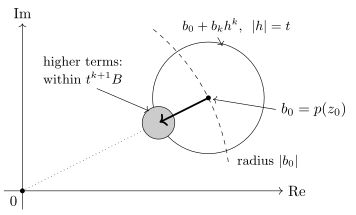
Idea. Picture the values in the plane.
As runs over
a small circle , the term runs times around the circle
of radius centered at . One point
of that circle lies on the segment from to , at distance from . Reaching it needs a
-th root of a unit
complex number, which De Moivre supplies. The higher
terms move the value by at most a multiple of , a blur much
smaller than the gain when
is small.
The dashed arc is part of the circle of radius about
, the old value of
.
The solid circle shows where goes for
. The arrow is the chosen direction, and the
shaded disc is the uncertainty caused by the higher
terms. The whole shaded disc lies strictly inside the
dashed circle, which is the inequality .
Proof. Let .
Step 1: re-center at . By Theorem 6.4.7 (a),
is a basis of , so for some .
Evaluating at
gives . The coefficient of on the right is , since has degree
and is monic; so
is the leading
coefficient of ,
and . By
Theorem 0.8.5, for
every ,
Since and , there is a smallest with . Then , and
Step 2: choose the direction. Since
and
, the
number
is nonzero. Write it in polar form, with , and put
.
Then , and by Theorem 0.6.6. Using
and
(Theorem 0.6.2 (d)),
Hence, for every real ,
Step 3: choose the size. Put (so if ), and where the last entry is omitted if . Then , and has three
properties.
(i) . Indeed, if , then ; otherwise , and .
(ii) . This is trivial if , and follows from
otherwise.
(iii) for every
, since
.
Step 4: estimate. Let . By Step 2
and (i), the number is real
and lies in ,
so By the triangle inequality (Theorem 0.6.4), and
(iii), Combining these with , the triangle
inequality, and (ii), where the last step uses and . Since , this proves the lemma.
Every hypothesis did a job. Nonconstant gave the
index . The
condition let us divide by and fix
a direction toward . And the field supplied the -th root , the one step that has
no analogue over .
Example
(One Step Downhill)
Let and . Follow the proof of Lemma 6.5.4 to find
with .
Solution. Here and the
expansion at is
itself: ,
, , . The first
nonzero with
is , so and .
Direction: , so and .
Indeed
points from
toward .
Size: . So , and
The proof guarantees , and
since . The direction matters: along the real
axis, , because
there points away from .
The proof
of the theorem
The three steps now combine into a proof of Theorem 6.5.1.
Proof. Let be
nonconstant. By Lemma 6.5.3 there is
with
for every . Suppose, for a
contradiction, that . By Lemma 6.5.4 there is
with , contradicting the choice of
. Hence , and is a root of .
This proves Chapter 0’s Theorem 0.6.7: a
polynomial with and is a nonconstant element of , and we have just
shown that it has a root.
Quick check. The polynomial
has no real root, yet the function on has a minimum, at
. Which step
of the argument breaks if we try to run it over ?
Solution. Growth and the attained
minimum both hold on : the minimum value is
. The step that fails is d’Alembert’s lemma.
At we have
, , , so we need a
direction with
. There
is no such real ,
and indeed for every real . Over , works and
for .
Warning. The theorem is an
existence theorem. It says a root exists; it
does not say how to find one, and the proof does not
produce one. There is no formula for the roots of a
general polynomial of degree or more built from the
coefficients by and -th roots (a theorem
from Galois theory, which we do not prove). Numerical
root-finding algorithms approximate roots; that is a
different subject, and the Fundamental Theorem of
Algebra is not one of those algorithms.
Complex
polynomials split
Combining the theorem with the root count of the
previous section gives the form in which it is used
most.
Corollary
6.5.5 (Complex Polynomials Split)
- (a) Every nonzero
splits
over : if and has leading coefficient
, then for some . In particular the
multiplicities of the roots of add up to .
- (b) The irreducible
polynomials in are exactly the
polynomials of degree .
Proof.
(a) By Theorem 6.4.3, , where are the
distinct roots of
in and has no root
in . By Theorem 6.5.1, is constant, and because . So splits over , and the
multiplicities add up to by the same theorem.
Comparing leading coefficients (Theorem 0.8.3), the
constant is .
(b) A polynomial
of degree is
irreducible, since a factorization into two nonconstant
factors would have degree at least . Conversely, let be
irreducible. It is nonconstant (Definition 6.3.1), so
by (a) it has a factor , say . Since is irreducible and
is not
constant, is a
nonzero constant, and .
So in ,
unique factorization (Theorem 6.3.5) is
completely explicit: the monic irreducible factors are
the , and the
exponent of
is the multiplicity of . In Chapter 9 this is
what gives every operator on a nonzero
finite-dimensional complex vector space an eigenvalue.
(That fact also has a proof using only linear algebra,
and one can run the logic in the other direction; we
will not need it.)
Example
(Factoring
over and over
)
Factor into irreducible polynomials in and in .
Solution. Roots. We solve
as in Example (Roots of Unity).
Write with ; by Theorem 0.6.6, .
Comparing polar forms, , so , and for an integer . The values give four
distinct roots
Over . Four distinct
roots, each of multiplicity at least , and , so by Theorem 6.4.3 each
multiplicity is
and the leading coefficient being . The factors are
irreducible by Corollary 6.5.5
(b).
Over . Pair each root
with its conjugate. For any , by Theorem 0.6.2 (c).
With , , and , Check: the product is . Each quadratic has nonreal roots only, hence
no real root, so it is irreducible over by Theorem 6.3.1. Note
that has no
real root but is reducible over .
Real
polynomials
A real polynomial is also a complex polynomial, so
the theorem applies to it; the roots it provides may be
nonreal. They are not scattered arbitrarily. Chapter 0
observed that nonreal roots of a real polynomial come in
conjugate pairs; we now show that the pairs also share
their multiplicity. For write , the polynomial with conjugated
coefficients.
Theorem
6.5.6 (Conjugate Roots Have Equal
Multiplicity)
Let
be nonzero, regarded as an element of , and let . Then . In particular is a root of if and only if is, and
Idea. Conjugation respects sums and
products of complex numbers, so applying it to all
coefficients respects sums and products of polynomials.
A real polynomial is unchanged by it. So conjugating a
factorization gives a factorization , and the cofactor test
transfers.
Proof. Let and
be in , and
. By Theorem 0.6.2 (a) and
(b), the coefficient of in is , which is
the coefficient of in . So
. By the same parts, .
Since has real
coefficients, . Hence , and if and only if
.
Let . By Lemma 6.4.1, with and . Conjugating,
and using , By Lemma 6.4.1 again,
. This proves the theorem.
For instance, a real polynomial with as a root of
multiplicity also
has as a root
of multiplicity ,
so by Theorem 6.4.3 its
degree is at least . Now the irreducible
real polynomials can be listed.
Corollary
6.5.7 (Irreducible Real Polynomials)
The irreducible polynomials in are exactly the
polynomials of degree , and the polynomials of
degree with no
real root. In particular, every irreducible polynomial
in has
degree or .
Idea. An irreducible real has a complex root
by the theorem.
If is real, is a real factor
and is linear. If
not, is
another root, and is a real
quadratic dividing . The only subtle point
is that it divides in and not merely in
; uniqueness
of division settles that.
Proof. A polynomial
of degree is
irreducible, since a product of two nonconstant
polynomials has degree at least (Theorem 0.8.3). A
polynomial of degree with no real root is
irreducible by Theorem 6.3.1.
Let be
irreducible. It is nonconstant, so by Theorem 6.5.1 it has a
root .
Case 1: . By Lemma 3.7.1 in
, with . Since is irreducible and
is not
constant, is a
nonzero constant, so .
Case 2: . Then , and
is also a
root by Theorem 6.5.6.
Applying Corollary 6.1.4 in
to the two
distinct roots gives for some . Put ,
which lies in . Divide in (Theorem 6.1.1): with and
. This
is also a division with remainder in , and so is . By the
uniqueness in Theorem 6.1.1 over
, and . So
in . Since is irreducible and
is not constant,
is a nonzero
constant, and . Finally, has no real root,
because a real root would give a factor
and with
,
contradicting irreducibility. This proves the
corollary.
Unique factorization in now takes a
concrete form.
Corollary
6.5.8 (Factorization over )
Every nonconstant can be written as where is the leading coefficient of ,
(not necessarily distinct), and are monic quadratics with no real root.
Then , and
is the sum of the multiplicities of the real roots of
. The
factorization is unique up to the order of the
factors.
Proof. By Theorem 6.3.5, with
monic irreducible, unique up to order. By Corollary 6.5.7 each
is either with or a monic
quadratic with no real root; list the first kind as
and the second as . Then
by
Theorem 0.8.3. For a
real number , each
has
multiplicity at
, and has multiplicity
or according as or not; by Theorem 6.4.2,
is the number of indices with . Adding over the
real roots of
gives .
The last consequence is one that calculus proves with
the intermediate value theorem. Here it falls out of
counting degrees.
Corollary
6.5.9 (Odd Degree Forces a Real Root)
Every of odd degree has a root in .
Proof. By Corollary 6.5.8, . Since
is odd,
is odd, so , and is a real root of
.
Exercises
A. Check your
understanding
Exercise
(A1)
- (a) State the
Fundamental Theorem of Algebra, and list the two facts
from analysis used in its proof in this section.
- (b) True or false:
every polynomial in of degree has a real root.
Justify your answer.
- (c) True or false:
if has
as a root of
multiplicity ,
then .
Justify your answer.
- (d) True or false:
every polynomial in of degree has a real root.
Justify your answer.
- (e) True or false:
every irreducible polynomial in has degree at
most . Justify
your answer.
- (f) In the proof of
d’Alembert’s lemma (Lemma 6.5.4), which
property of is
used that
lacks?
Solution.
- (a) Every
nonconstant has a root in (Theorem 6.5.1). The
analytic facts are (A1) continuity of on , and (A2) the extreme
value theorem for continuous real functions on a closed
disc.
- (b) False. at every
real number, so it has no real root.
- (c) True. By Theorem 6.5.6, is also a root of
multiplicity , and
.
By Theorem 6.4.3, .
- (d) True, by Corollary 6.5.9.
- (e) False. takes the
value at both
and , so it has no root in
, and a cubic
without a root is irreducible by Theorem 6.3.1. Corollary 6.5.7 is
special to .
- (f) Every nonzero
complex number has a -th root; the proof
takes a -th root
of a complex number of modulus by Theorem 0.6.6. Over
, has no square
root.
B. Practice
Exercise
(B1: )
Find all complex roots of , and factor it
into irreducible polynomials in and in .
Solution. Write with
. By Theorem 0.6.6, ,
and .
Comparing polar forms, , so (the only positive real number with
fourth power ,
since
is strictly increasing on positive reals), and ,
. The
values give the four distinct roots By Theorem 6.4.3, four
distinct roots of a degree- monic polynomial each
have multiplicity , and Pairing conjugates with , and
, Check: .
Both quadratics have , so they have no real
roots and are irreducible by Corollary 6.5.7.
Exercise
(B2: )
Find the factorization of into irreducible
polynomials in .
Solution. The roots solve . As
in B1, with ,
and
give six distinct roots at the angles : Each has multiplicity by Theorem 6.4.3, and
none is real. They form three conjugate pairs, each of
modulus , with
real parts , , .
Pairing them as in Example (Factoring over and over ), Check: , and . Each quadratic factor has only nonreal
roots, so it is irreducible over by Corollary 6.5.7. By
the uniqueness in Corollary 6.5.8, this
is the factorization.
Exercise
(B3: Real cubics)
Let
have degree , and
suppose the multiplicities of the real roots of add up to .
- (a) Prove that for some and some
, and that and are simple
roots.
- (b) Show that the
hypothesis cannot be weakened to “ has exactly one real
root” by considering .
Solution.
- (a) By Corollary 6.5.8, with and equal to the sum of the
real multiplicities, which is . So , , and with and a monic real quadratic
without real roots. By Theorem 6.5.1, has a root , which is not
real. By Theorem 6.5.6, is also a
root of . The two
multiplicities in
are each at least
and add up to at most (Theorem 6.4.3), so
they equal and
, the leading coefficient being . Finally, by Theorem 6.4.2, , since
;
similarly for .
- (b) has exactly one
real root, , but
no nonreal roots at all: it already splits over . Here the real
multiplicities add up to , not .
Exercise
(B4: Running the proof on an example)
Let .
- (a) Compute the
radius of Lemma 6.5.2 for .
- (b) Follow the proof
of Lemma 6.5.4 at : find , , , and , and verify that .
- (c) Compute , and explain why
the direction
does not work here, although it did in Example (One Step Downhill).
Solution.
- (a) Here and , so . Hence for .
- (b) At the coefficients
are , , , , . So and . Then , so and . Next . So , and . The proof guarantees at most , consistent
with .
- (c) . The right direction
depends on the sign of relative to : we need to point from
toward , that is, a negative
multiple of . With this means , so ; for , points away from . In Example (One Step Downhill),
and was the right
choice.
C. Going deeper
Exercise
(C1: Fields where the theorem fails)
Call a field
algebraically closed if every
nonconstant polynomial in has a root in .
- (a) Let be a prime. Show that
has no
root in . More
generally, show that no finite field is algebraically
closed.
- (b) Give explicit
witnesses that
and are not
algebraically closed.
- (c) For your witness
over , explain
which step of the proof of the Fundamental Theorem of
Algebra (Theorem 6.5.1)
breaks.
- (d) For over , prove that has no minimum on . Which step of the
proof breaks now?
Hint for (d): if were a minimum point
with , compare with .
Solution.
(a) By Exercise (C2: A nonzero polynomial vanishing everywhere)
(c),
for every , so . For a finite field ,
let . It has degree (Theorem 0.8.3), and
for every by Theorem 0.8.5. So
is a nonconstant
polynomial without a root in .
(b) Over , has no root,
since . Over , has no root,
since is
irrational (Theorem 0.2.3) and the
only real roots are .
(c) For over , growth holds, and
attains its minimum at . The step that
breaks is d’Alembert’s lemma (Lemma 6.5.4): at we have , , , and we need
with , which does not
exist in .
(d) Suppose satisfies
for every . Put ; then by (b).
Case 1: . Then , contradicting
minimality at .
Case 2: . Then , and . Expanding, We claim . If , then . If , then . Hence , contradicting minimality.
So there is no minimum. The step of the proof that
breaks is Lemma 6.5.3, which
rests on the extreme value theorem (A2). That fact is
about the completeness of , and is not complete: the
values get arbitrarily close to without reaching
it.
Exercise
(C2: Sums of two squares)
Let
be monic with no real root.
- (a) Prove that is even and that
for
every .
- (b) Prove that for some
.
Hint for (b): each irreducible factor of is .
Collect one root from each pair into a complex
polynomial , and
split into real
and imaginary parts.
Solution.
(a) By Corollary 6.5.8, , with leading coefficient
since is monic. A factor
would give
the real root ,
so and is even. (If
, then and the claims
hold.) Each has no real root, so by the
remark after Corollary 6.5.7, . For
real , By Theorem 0.8.5, is a product of positive reals, so .
(b) For each
, is nonconstant, so by
Theorem 6.5.1 it has a
root ,
not real. As in Exercise (B3: Real cubics)
(a), . Let . By the
product rule for conjugate polynomials proved in Theorem 6.5.6, , so
(commutativity, Theorem 0.8.1).
Write each coefficient of as with
, and put and in
. Then and , so
For example, for take and
from Example (Factoring over and over ). Then and
, so , , , and .