Section 4 deleted a row and the matching column and
found that the spectrum of the smaller matrix is pinned
between the eigenvalues of the larger one. This section
makes the opposite kind of change: it leaves the size
alone and adds the simplest nonzero Hermitian matrix
there is, a positive multiple of . The
answer has the same shape — the new eigenvalues
interlace the old ones — but here we can say more than
that they interlace. Under one extra hypothesis the new
eigenvalues are the roots of a single explicit scalar
equation in one variable, and the graph of that function
shows at a glance where every one of them sits.
Throughout this section or , the matrix is
Hermitian, and its eigenvalues are indexed
decreasingly, , as everywhere in this chapter.
We fix and a real number , and study The added term is Hermitian, since and is real, so is
Hermitian too and its eigenvalues are indexed the same
way. The added term has rank when and ,
and is the zero matrix otherwise. For it is
positive semidefinite, because for every , which is clause
(P2) of Definition 13.1.1.
One bump,
every eigenvalue up
Adding a positive semidefinite matrix can only raise
the quadratic form, so no eigenvalue can go down. The
content of the theorem is the ceiling: however large
is, the -th new eigenvalue
cannot climb past the -st old one. All the
room created by the bump is spent at the top.
Theorem
17.5.1 (Interlacing for a Rank-One
Update)
Let be Hermitian, let , let
, and put
. Then and . Written as one chain,
Idea. The two halves have different
characters and different sources. The left-hand
inequalities say the eigenvalues go up,
and that is a statement about the quadratic form: on
every vector, scores at
least what
scores, so every max–min it competes in can only
improve. The right-hand inequalities say the eigenvalues
go up by at most one index, and that
has nothing to do with the sign of : it is the rank of
the perturbation doing the work, and Corollary 17.3.8 has
already isolated exactly that.
Proof. If or then
and every inequality is an equality, so assume and .
For the inequalities , fix and let . By
the computation above, using Definition 17.1.1 and
.
Multiplying through by , this
says for every
, that is,
in the Loewner order of Definition 13.5.1. So
Corollary 17.2.4 gives
for every .
For the inequalities , note that , because every column of is a
multiple of and at least one of them is nonzero.
So Corollary 17.3.8
applies with and , and its first
inequality reads for . This proves the theorem.
Two remarks on the proof. The first half used nothing
about the rank: it is Corollary 17.2.4, the
general fact that
forces for every , specialized to a
rank-one increment. The second half used nothing about
the sign: the eigenvalues of and of are never more than
indices
apart. Interlacing is what happens when both
restrictions apply at once.
The secular equation of the next subsection gives a
sharper, strict version of the theorem
— it locates each new eigenvalue exactly, strictly
between consecutive old ones — but only under extra
hypotheses (a diagonal with distinct entries,
and a with
no zero coordinate), so it is not a second proof of the
general statement. The other short route to the general
theorem is Cauchy interlacing (Theorem 17.4.2)
applied to a suitable bordered matrix.
Example
(A bump on a diagonal matrix)
Let , , and . Compute and its
eigenvalues, and check Theorem 17.5.1.
Solution. Here , so Its trace is and its determinant is
, so its
characteristic polynomial is and , . The chain of the theorem reads and all four inequalities are strict. Note the
accounting: the two eigenvalues rose by and by , a total of .
That is no coincidence, and the last result of this
section says why.
Quick check. The matrix is
bumped by
with .
Without knowing or , what is the largest
possible value of , and what is the
smallest?
Solution. By Theorem 17.5.1, ,
that is, . Both ends are
reached: with large gives , whose third eigenvalue is as soon as ; and
gives , whose third eigenvalue
is . So the
smallest eigenvalue can be pushed up as far as the
second smallest of and no further, no
matter how big
is.
Where the
new eigenvalues actually are
Interlacing brackets each new eigenvalue in an
interval. To pin it down we need an equation, and there
is a cheap one: an eigenvalue of is a
number
making singular, and is a
rank-one update of a matrix whose determinant we know.
Chapter 8 computed the determinant of exactly such an
update.
Divide the characteristic polynomial of the
bumped matrix by that of the original one; what is left
is a sum of
simple fractions.
Definition
17.5.1 (Secular function)
Let with ,
let , and let . The secular function
of the update is defined for every real other
than . The equation is the
secular equation.
In words: is
the constant plus
one simple pole at each diagonal entry of , weighted by times the squared
modulus of the matching coordinate of . The name is
inherited from celestial mechanics, where equations of
this shape governed slow (“secular”) drifts in planetary
orbits.
Theorem
17.5.2 (Eigenvalues from the Secular
Equation)
Let with strictly decreasing and real,
let ,
and let have every coordinate
nonzero. Write and let be its secular
function. Then:
- (a) no is an eigenvalue of
;
- (b) a real number
is an eigenvalue of if and
only if ;
- (c) has exactly roots , one in each of the intervals and none below ; these are the
eigenvalues of , each
simple, and
- (d) for each , the vector is an eigenvector of
for
.
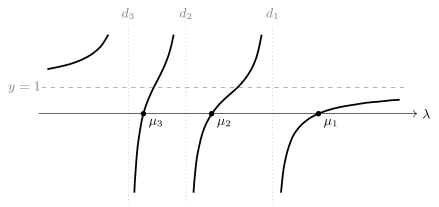
Idea. Part (b) is one line of
Chapter 8 once (a) has cleared the denominators out of
the way. Part (c) is a picture. Each term increases with on any interval
that avoids , so
on each of the
open intervals into which the poles cut the line climbs steadily from
left to right. Just to the left of each pole shoots up to ; just to the
right it starts again from ; and far out in
either direction it settles at . Draw that, and the
roots count themselves. The proof turns the picture into
a count that needs no limits at all: the eigenvalues turn out to
be distinct, there are exactly intervals where a root
can live, and each holds at most one.
The dotted verticals are the poles, at the old
eigenvalues ; the dashed horizontal is , the level approaches at both
ends. On the branch left of every term of the sum
is positive, so the curve stays above and never meets the
axis. Each of the other three branches runs from to or from to , increasing throughout,
so each crosses the axis exactly once. Three branches,
three roots, one strictly inside each gap and one above
the top pole.
Proof. (a) Suppose
for some .
Rearranging, . The matrix
is
diagonal with -th
diagonal entry ,
so the -th
coordinate of the left-hand side is ; the -th coordinate of the
right-hand side is .
Since
and , this
forces , and then . The diagonal entries
are distinct,
so the only diagonal entry of that vanishes
is the -th, and
therefore for some scalar . But then , and gives , so — a
contradiction.
(b) Let . Then is diagonal with nonzero diagonal
entries, hence invertible, with Apply the determinant statement of Corollary 8.3.6 —
itself a
case of Theorem 8.3.2 — to
the invertible matrix , with the column and the row
— that
is, with as its and in place
of its , so
that its is our : The scalar in the second factor is , since for diagonal . So and the product is nonzero. Hence if and only if . Finally
, since negating all rows of a matrix
multiplies its determinant by , by applications of Theorem 7.5.1 (b); so
the two determinants vanish together, and by Theorem 7.10.4 (a)
this happens exactly when is an eigenvalue
of .
(c) Let be one of the open intervals into
which cut the real line, and let
lie in . For each
, the numbers
and
are nonzero and have the same sign, because ; hence Multiplying by and summing over gives . So is strictly
increasing on each such interval, and in
particular has at most one root in each.
Next, every eigenspace of is
one-dimensional. Let . By (a), , so is invertible, and rearranging as in (a)
gives , that is,
So , a space of dimension
. Now write with unitary and diagonal carrying the
eigenvalue list of with
multiplicity (Corollary 12.4.3,
or Corollary 12.5.2
over ). Since
is invertible,
, and is
the number of diagonal entries of equal to . That number is
therefore at most : the eigenvalues of are
distinct, and each is simple.
Now count. Call the eigenvalues . By (b) each is a root of , and by (a) none equals
a , so each lies
in one of the
open intervals. None lies in : there
every
is positive, so every term of the sum is positive and
.
That leaves
intervals, each containing at most one root of , to accommodate distinct roots — so
each of the intervals
contains exactly one of them, and since they are listed
in decreasing order, and . Conversely every root of is an eigenvalue by
(b), so has no
roots besides these . Reading the intervals
in decreasing order gives the displayed chain.
(d) Fix and put , which is defined because
and nonzero because . As
in (b), Therefore This proves the theorem.
Identity
is worth keeping on its own: it says that the
characteristic polynomial of the bumped matrix is the
characteristic polynomial of the original one multiplied
by the secular function. The poles of cancel the roots of the
product exactly, and what survives is a polynomial of
the same degree with its roots shifted one gap to the
right.
Example
(A three-by-three update, found from its secular
equation)
Let Write down and its secular function,
find all three eigenvalues from the secular equation,
and confirm them independently.
Solution. The matrix.
has entry
, so The hypotheses of Theorem 17.5.2 hold:
are distinct, , and no coordinate of vanishes.
The secular function. With ,
The roots. Multiply through by ,
which by
turns into : So the eigenvalues are , , . They sit
where the theorem promised: It is quicker to check the three roots than to
expand the product. At , at , ; at , .
An independent confirmation. Part (d) of the
theorem produces eigenvectors without any further
elimination: is diagonal applied to
. For , and after scaling by . Multiplying out,
. The same recipe gives for and for , and both check
by one matrix–vector product. Finally the trace: , as Corollary 12.1.4
requires.
Warning. Both extra
hypotheses of Theorem 17.5.2 earn
their place, and the sign of reverses the
picture.
A zero coordinate deflates. Take and
, so . Then is an
eigenvector of with eigenvalue , because . So conclusion (a) fails. The secular
function has only two poles and only two
roots, ; the third eigenvalue, , is invisible to it.
The eigenvalues still interlace, , but not strictly.
A repeated deflates too. If
, any
vector in orthogonal to is an
eigenvector of for , for the same
reason.
Negative reverses the
interlacing. For the matrix
is negative semidefinite and every eigenvalue goes
down: applying Theorem 17.5.1 to
and
gives
. Reading the chain of the
theorem in the wrong direction is the standard way to
get this backwards.
The shifts
add up
Interlacing says where each eigenvalue may go. One
number says how far they all go together, and it costs a
line.
Corollary
17.5.3 (Total Eigenvalue Shift)
Let be Hermitian, , , and . Then
Proof. By Theorem 0.9.6 (3)
applied to the matrix and the matrix , Hence , by part (1) of the
same theorem. Both and are
Hermitian, so Corollary 12.1.4
expresses each trace as the sum of the eigenvalues with
multiplicity, and subtracting the two expressions gives
the claim.
So the whole budget for the movement is ,
and for
Theorem 17.5.1 says
how it may be spent: each eigenvalue takes a nonnegative
share, and no share except the top one is large enough
to carry an eigenvalue past its old upper neighbor. In
Example (A bump on a diagonal matrix)
the budget was
split as ; in
Example (A three-by-three update, found from its secular equation)
the budget
was split as .
Exercises
A. Check your
understanding
Exercise
(A1)
- (a) State Theorem 17.5.1,
including the hypothesis on .
- (b) Write down the
secular function of for and
.
- (c) Explain in one
sentence why no
is an eigenvalue of under the hypotheses
of Theorem 17.5.2.
- (d) Determine
whether the following is correct, and justify your
answer: if then
for every .
- (e) A Hermitian
matrix
has eigenvalues
. What
does Corollary 17.5.3 say
about when ?
Solution.
(a) For Hermitian
,
,
and , the
eigenvalues of satisfy
for , together with . The hypothesis is what makes
the perturbation positive semidefinite; without it only
the second family of inequalities survives.
(b) .
(c) If , comparing -th coordinates in forces
because ; then is a multiple of
, and
forces that multiple to be .
(d) Incorrect;
the inequality goes the other way. For the added
matrix is negative semidefinite, and for every . Concretely, , ,
gives and drops from
to .
(e) It says the
four eigenvalues of sum to , that is, more than those of
. Combined with
Theorem 17.5.1, which
caps at
, at , and at , it forces .
B. Practice
Exercise
(B1: A secular equation, end to end)
Let , , and .
- (a) Write down and the secular function
.
- (b) Verify that
, , and are roots of , and explain why these
are all the eigenvalues of .
- (c) Exhibit the
interlacing chain of Theorem 17.5.1 for
this pair.
Solution.
(a) has
entries , so
and .
(b) At : . Over this is .
At :
. At : . The
hypotheses of Theorem 17.5.2 hold —
are distinct, , and every coordinate of is nonzero — so
by part (c) the secular function has exactly three roots
and they are the eigenvalues. We have found three
distinct roots, so there are no others.
(c) , all strict, as part (c) of Theorem 17.5.2
predicts.
Exercise
(B2: Reading the chain backwards)
Let and .
- (a) Compute the
eigenvalues of
and of .
- (b) State which
chain of inequalities Theorem 17.5.1 gives
here, being careful about which matrix plays the role of
.
Solution.
(a) has trace and determinant , so its characteristic
polynomial is and its eigenvalues are and . Also with eigenvalues and .
(b) Put and , so that is the
bumped matrix. The theorem then reads , that is,
. Taking for and instead would
give the reversed chain ,
namely again: the same four numbers, read from the
other side.
Exercise
(B3: The missing eigenvalue)
Let , , and . It is given that two of the eigenvalues of
are and . Find the third without
computing a characteristic polynomial, and then confirm
it from the secular equation.
Solution. By Corollary 17.5.3 the
eigenvalues of sum to
Hence the third eigenvalue is .
For the confirmation,
for each , so
and . The hypotheses of Theorem 17.5.2 hold,
and lies in the
interval
where part (c) puts the third root. As a check on the
other two, and , exactly as the theorem requires.
C. Going deeper
Exercise
(C1: What a zero coordinate does)
Let with the real, let , and let
.
- (a) Prove that if
then is an
eigenvector of with eigenvalue .
- (b) Suppose , the are strictly
decreasing, and exactly one coordinate vanishes. Show that
the remaining
eigenvalues of are the roots of the
function obtained from the secular function by deleting
the -th term.
Hint: restrict to the coordinate subspace spanned by
the with
.
- (c) Illustrate both
parts with , , and .
Solution.
(a) , so .
(b) Let , a subspace of dimension . Every column of
other than the
-th lies in , and because
; hence
. In the
ordered basis of
, the restriction
of to has matrix , where
and is with its -th coordinate removed.
Since and is also
invariant by (a), the eigenvalues of are those of the
restriction to
together with .
Now has
strictly decreasing diagonal entries, , and has no zero
coordinate, so Theorem 17.5.2 applies
to : its eigenvalues are
exactly the roots of its secular function. That function
is the secular function of the original update with the
-th term deleted,
because that term was anyway.
(c) Here , so is an
eigenvector with eigenvalue by (a). By (b)
the other two eigenvalues are the roots of that is, of , i.e. , with roots . So the spectrum is . Directly, whose second row and column confirm the
eigenvalue , and
whose remaining block has trace and determinant .
Exercise
(C2: Only one eigenvalue can escape)
Let be Hermitian, , , and .
- (a) Prove that
at most one eigenvalue of lies
outside the closed interval , and say which one it is and on
which side, according to the sign of .
- (b) Prove that the
escaping eigenvalue moves by at most ,
and show by examples with that it may move by exactly that amount,
and that it may not escape at all.
Solution.
- (a) Suppose first
. By Theorem 17.5.1, , so no eigenvalue of falls
below the interval; and for , , so only
can rise above it. So at most one eigenvalue escapes,
namely the largest, and it escapes upwards.
For ,
the warning above gives
for and
. Hence , and for . So only
can escape, and it escapes downwards.
- (b) Take ; the case
is the
mirror image. By Theorem 17.5.1 every
shift is , and by Corollary 17.5.3 they
sum to .
So each shift, in particular that of , is at most
.
For equality, let , ,
: then
, and moves from
to , by exactly . For no escape, let and
: then
, whose eigenvalues both lie in . The whole budget
went to ,
which Theorem 17.5.1 caps at
.
Exercise
(C3: Bumping along an eigenvector)
Let be Hermitian with an orthonormal basis
of eigenvectors , where .
- (a) Fix and . Prove that
the eigenvalues of , listed with
multiplicity but not necessarily in order, are
together with for .
- (b) Deduce that
has
eigenvalue list . (This is
the deflation step: it removes the top
eigenvalue and leaves the rest untouched, which is what
makes it possible to find eigenvalues one at a
time.)
- (c) Explain why (a)
does not contradict part (c) of Theorem 17.5.2.
Solution.
(a) For , orthonormality
gives , so For , gives . So is a basis of consisting of
eigenvectors of , with the stated
eigenvalues. A basis of eigenvectors exhibits the whole
eigenvalue list with multiplicity.
(b) Take and in
(a).
(c) There is no
contradiction, because the hypothesis of Theorem 17.5.2 that
fails here fails as badly as possible. Writing
everything in the orthonormal eigenbasis, the update
vector is , whose
coordinate vector is : all
but one of its coordinates are zero. Part (a)
is the extreme case of Exercise (C1: What a zero coordinate does)
(a), with
coordinates deflating at once, and only one eigenvalue
is left to move.