Sylvester’s law of inertia says that a real symmetric
form is nothing but a pair of counts, and that any two
forms with the same counts are the same form in
disguise. One pair of counts has a claim on our
attention that none of the others has: the form of
signature is
the one the physical world appears to run on. This
section does the linear algebra of that form. Everything
in it is this chapter’s machinery specialized, and the
payoff is a picture — a cone dividing space into three
regions — together with a classification theorem that is
the hyperbolic twin of a circular one we already
proved.
Fix and
in the
canonical form of Corollary 14.5.2, and there
is only one form to write down.
Definition
14.11.1 (Minkowski Space)
Minkowski space is the real
vector space
equipped with the symmetric bilinear form whose quadratic form is . The first coordinate is the
time coordinate and the remaining three
are the space coordinates. More
generally, for , is with the form
whose matrix in the standard basis is .
In words:
is the dot product of with three of its
four signs reversed. Its matrix in the standard basis
is which is symmetric, so is a symmetric form
(Definition 14.3.1), and it
is diagonal, so
is an orthogonal basis for (Definition 14.4.1). Reading
off the signs, the signature of is and its inertia is
(Definition 14.5.1). The form
is nondegenerate: and for , so a vector paired to zero with everything
has all four coordinates zero (Definition 14.1.4).
Warning. Two sign
conventions are in use, and both are called “the”
Minkowski form. We take , signature
; many
sources take , signature , which is our . The two are not
congruent — congruence preserves the signature (Theorem 14.5.1) — but every
statement below transfers by reversing each inequality
on , because changes sign. The one
thing both conventions agree on is the set , which is why
the picture of this section is convention-free. State
your convention before computing, and never mix the
two.
Timelike,
spacelike, and null
Nothing in this section is a new notion. Section 7
studied the vectors on which a form vanishes, and called
them isotropic; over a nondegenerate
indefinite form has plenty of them, and the ones
belonging to
have names of their own.
The form sorts nonzero vectors into three classes
by the sign of ,
and the middle class — where vanishes — is exactly
the isotropy of Section 7.
Definition
14.11.2 (Timelike, Spacelike, Null)
Let with .
Then
is
- (a)
timelike if ;
- (b)
null, or lightlike, if
;
- (c)
spacelike if .
The set is the
light cone. A timelike is
future-pointing if and
past-pointing if .
The word null is a second name for
something already defined: a null vector is precisely a
nonzero isotropic vector for in the sense of Definition 14.7.1, and the
light cone is the isotropy locus of together with . So “the light
cone” is not new geometry; it is the locus Section 7
already forced us to take seriously, drawn for one
particular form. Timelike and spacelike are then just
names for the two sides that the isotropy locus
separates.
The last clause of the definition is legitimate
because a timelike vector cannot have : if it did, then
. So every timelike vector
is future-pointing or past-pointing, and exactly one of
the two.
Example
(Reading off the three types)
Classify , , ,
and in
, and
decide which of them are isotropic.
Solution. ,
so is
timelike and future-pointing. , so is spacelike.
, so
is null, hence isotropic. Finally , timelike and future-pointing. Only
is isotropic; the other three are anisotropic.
Section 7’s structure theorem applies verbatim. A
nonzero isotropic vector sits in a hyperbolic plane, and
here we can point to one: take and . Then and so the Gram matrix of is
and
is a hyperbolic plane (Definition 14.7.3).
Splitting it off, Theorem 14.7.5 writes with
hyperbolic of signature and anisotropic of
signature ,
that is, negative definite. Only one plane splits off,
because the Witt index of a real form of signature is (Proposition 14.7.7), which
here is .
Quick check. Is there a
plane in on which vanishes
identically?
Solution. No. Suppose
and span such a plane, where and . Then gives and ,
while gives . Hence , which is the
equality case of Theorem 11.1.5, so
is dependent. If then
and ;
otherwise , so and
,
which force and . Either way is
dependent, so no plane exists. Structurally this is the
statement that the Witt index of is (Proposition 14.7.7), since
by Definition 14.7.4 no totally
isotropic subspace has dimension larger than the
index.
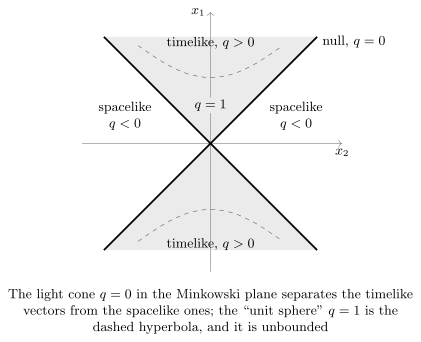
The picture is easiest to draw with one space
coordinate instead of three, in , where the
light cone degenerates to the two lines .
Two features of the picture deserve to be said out
loud. The shaded region is not
connected: the future-pointing and past-pointing
timelike vectors form two separate pieces, and no
continuous path of timelike vectors joins them. That
last claim is worth one line, since it is the only place
in this section where a topological word is used.
Suppose were
a continuous path of timelike vectors from a
future-pointing vector to a past-pointing one. Its first
coordinate is a
continuous real function that is positive at one end and
negative at the other, so by the intermediate value
theorem — an analysis input, quoted and not proved here,
as in Section 6 — it vanishes somewhere along the path.
But forces
, so that point of the path is not
timelike, a contradiction. And the level set , which plays the
role the unit circle plays for the dot product, is
unbounded. Both facts come straight from the mixed
signs, and both are invisible to anyone whose intuition
was trained on positive definite forms.
Warning. Orthogonality for
is not the
perpendicularity you can see. A null vector is
-orthogonal to
itself, and the consequence is that Chapter
11’s decomposition fails. Take . Since , the -orthogonal
complement of is
the hyperplane , which contains . So
is three-dimensional, not four, and . Nothing has gone wrong;
positivity was doing that work in Chapter 11, and it is
gone.
Hyperbolic rotations
Now the isometries. The group attached to is the isometry
group of its matrix (Definition 14.10.1), which
is in
the notation of Definition 14.10.2: the
matrices with
. Its elements are the
Lorentz transformations. We classify
them in dimension , where becomes
The classification of in Theorem 11.7.6
rested on one geometric fact: a unit vector of the
Euclidean plane is
for exactly one . Replace the circle by the hyperbola
and the same proof runs. We need the corresponding
parametrization, and we take it from calculus:
and is a strictly increasing bijection. Those
facts are the only analysis used in this section.
Definition
14.11.3 (Boost)
For ,
the boost of rapidity is
A boost is the hyperbolic analogue of the rotation
of
Chapter 11: same shape, hyperbolic functions in place of
circular ones, and no minus sign in the corner.
Idea. The congruence says
exactly that the two columns of are an orthogonal
basis for
with -values and . So: parametrize the
vectors with ,
which is the hyperbola; then the second column is
forced, because the -orthogonal
complement of a nonisotropic vector is a line, and on
that line only two vectors have . This is Theorem 11.7.6’s
proof with the circle replaced by the hyperbola.
Proof. Write with columns and
.
The entry of
is , so the hypothesis says
The first column. Since is a bijection of
, there is a
unique
with .
Then , so
for a unique sign , unique
because .
The second column. The vector satisfies , and because .
The set is the null
space of the nonzero row vector , hence a line, so
it equals .
Therefore for some , and
gives . Hence
is a
sign, and it is determined by , since
and .
This is the displayed matrix, and expanding,
The four families. For the
matrix is ; for
it is ; for
it is ; and
for it is , each by
multiplying out and using ,
. As
runs over so
does , which
gives the displayed set equality. The families are
disjoint because is the sign
of the entry
and ,
and both are determined by .
The subgroup. By the addition
formulas for
and , So is a group homomorphism ;
it is injective because is, and its image
is a subgroup by Definition 0.10.2.
This proves the theorem.
The four families are sorted by two signs, and each
sign has a reading. The determinant says whether the
space coordinate is reversed, exactly as in . The sign of the entry says whether
the future cone is sent to the future cone: for the image of is , with
positive first coordinate, while sends it to . So
the identity component consists of the boosts alone, and
the other three families are obtained from it by
reversing space, time, or both.
Circular
and hyperbolic, side by side
The comparison is the point of this section, so here
it is in one table. In each column, the isometry group
of the named form on .
| level set |
circle |
hyperbola , two branches |
| canonical element |
|
|
| parameter |
, periodic |
,
unbounded |
| addition law |
|
|
| determinant
part |
|
|
| determinant
part |
reflections |
|
| number of pieces |
|
|
| entries |
all of modulus |
unbounded |
The two canonical forms differ in one place only:
carries
a minus sign that does not, and that
single sign is the difference between and
. Everything else in the table follows from
it. In particular the last row is the unboundedness that
Section 10 recorded when it observed, without proof,
that is
not compact for while is.
The
triangle inequality, reversed
For a timelike the number is positive,
so it has a positive square root, and the analogy with a
norm is irresistible. Write The analogy holds, but with every inequality
upside down. First the tool.
Lemma
14.11.2 (Reversed Cauchy–Schwarz
Inequality)
Let be timelike and both
future-pointing. Then with equality if and only if for some .
Idea. Split each vector as a time
coordinate plus a space part, .
Timelike and future-pointing says . Then , and Theorem 11.1.5
bounds by
— in the helpful direction, since it appears with a
minus sign. What is left is to compare with ,
and squaring both sides turns the difference into a
perfect square.
Proof. Write
and with and , so that and . Timelike gives and , and future-pointing gives
; hence
and , so . By Theorem 11.1.5 in
, Both sides of the inequality to be proved are
now known positive, so it suffices to compare squares.
Expanding, Therefore , and combining
with the previous display gives .
For the equality case, equality forces both steps to
be equalities: and . Suppose first . Then
and , so , and with . Suppose
instead . The equality case of Theorem 11.1.5
makes dependent, so with , and then
forces
. Now
reads , so and ; and because
.
Conversely, if with then and , so equality holds. This proves the
lemma.
Theorem
14.11.3 (Reversed Triangle Inequality)
Let be timelike and both
future-pointing. Then is
timelike and future-pointing, and with equality if and only if is a positive
multiple of .
Proof. By Theorem 14.3.5, . By Lemma 14.11.2, , so where the last step uses on timelike
vectors. The right-hand side is positive, so is
timelike; its first coordinate is a sum of two positive
numbers, so it is future-pointing. Both sides of the
last display are nonnegative, so taking square roots
preserves the inequality and gives . Equality holds
exactly when it holds in Lemma 14.11.2, that is,
exactly when with . This
proves the theorem.
Read as a statement about clocks, the reversed
inequality says that a journey made in two straight legs
accumulates less elapsed time than the single
straight leg between the same endpoints, which is the
algebra behind the twin paradox; whether that algebra
describes the world is a question for physics, and this
book answers only the algebra.
Quick check. Where exactly would
the proof of Theorem 14.11.3 break if
were
future-pointing and
past-pointing?
Solution. At Lemma 14.11.2, whose proof
uses to
get . With
we have
, and
can be negative, so the
chain collapses at its first step. The conclusion
genuinely fails: take and
, both timelike with , whose sum is
and is not
timelike at all.
Exercises
A. Check your
understanding
Exercise
(A1)
- (a) State the sign
convention used in this section, give the matrix of
in the
standard basis, and say what its signature and inertia
are.
- (b) Define timelike,
null, and spacelike, and say which earlier notion the
word “null” renames.
- (c) True or false:
the sum of two spacelike vectors is spacelike. Justify
your answer.
- (d) Write down and , and say which
row of the comparison table each answer sits in.
- (e) True or false:
is
abelian. Justify your answer.
Solution.
(a) The
convention is , so , with signature and inertia (Definition 14.5.1). The
opposite convention uses and has signature
.
(b) For :
timelike means , null means ,
spacelike means (Definition 14.11.2). “Null”
renames “nonzero isotropic vector” (Definition 14.7.1).
(c) False. Take
and , with . Their sum is , with , which is
timelike.
(d) by Theorem 14.11.1 with , and ,
since . The first sits in the “determinant part” row, the second
in the “addition law” row, which is what makes a group
homomorphism.
(e) False. and both lie
in , and
has entry while has entry ; these differ
since .
B. Practice
Exercise
(B1)
Determine which of the following lie in . For each one
that does, give its rapidity and the signs of Theorem 14.11.1. Justify
your answer.
Solution. Write and test
column by column, using , , .
: ; ; . So . Here and , so and
with
, since
and .
: , so
the first column already fails and .
(Indeed , so scales the form
rather than preserving it.)
: first
column as for ;
second column ; and . So , with , , and
; that is, .
Exercise
(B2)
- (a) Classify ,
, and in as timelike,
null, or spacelike.
- (b) The vector is null. Find a
such that is a
basis of a hyperbolic plane, that is, and .
Solution.
(a) , so is null. , so is null. , so is
spacelike.
(b) Try ,
which has for every . Then , so works: . The Gram matrix of is
, so
is a hyperbolic plane (Definition 14.7.3).
Exercise
(B3)
Let and in . Compute , , ,
and , and check Lemma 14.11.2 and Theorem 14.11.3 on this
pair. Is either inequality an equality?
Solution. , so is timelike and
future-pointing with . , so . Next
, and , so as Lemma 14.11.2 requires.
Finally with , so
. Since , we get
, as Theorem 14.11.3 requires.
Neither is an equality, and indeed is not a
multiple of , since .
C. Going deeper
Exercise
(C1)
For
put .
- (a) Prove that
is a bijection, and that is a
positive multiple of read in .
- (b) Hence deduce
that , and say which part of Theorem 14.11.1 does the
work.
Solution.
- (a) Since and , we have , so and maps into . For injectivity
and surjectivity, solve with : the equations and
give , so ,
which is a legitimate value since it is , and then
determines
uniquely because is a bijection. So
each has exactly
one preimage.
In ,
, and .
- (b) By Theorem 14.11.1, .
Comparing entries, and dividing numerator and denominator by
gives . The work is done by the addition law
; the parametrization merely renames
as , and because is a bijection onto
no
information is lost in the renaming.
Exercise
(C2)
- (a) Prove that is the set of all
with , and that this set is unbounded.
- (b) Deduce that no
bound holds for all , and
contrast this with , where
always. Which hypothesis of Chapter 11’s theory is
responsible?
Solution.
(a) If then
. If , the
proof of Theorem 14.11.1 shows for some and sign ; then is the first
column of when
,
and of
when , and both lie in . The set is
unbounded because as .
(b) The first
column of ranges
over an unbounded set by (a), so its entries are
unbounded, and no such exists; this is the
unboundedness Section 10 recorded, obtained here from
the orbit rather than from a one-parameter family. In
the
columns are unit vectors for the Euclidean norm, so
every entry has modulus at most and the group sits
inside a bounded region. The responsible hypothesis is
positive definiteness of the form: it
is what makes a bounded set, namely the unit sphere. Once
one sign is reversed, the level set is a hyperbola and
nothing is bounded.
Exercise
(C3)
The Quick check above showed that has no plane on
which the form vanishes identically. Show that does have one,
by exhibiting two vectors that span it, and reconcile
the two answers with Theorem 14.7.5.
Hint: pair each positive coordinate with a
negative one.
Solution. In the form is
. Put and
. Then the last because every term pairs a zero with
something. The list is
independent, since a relation reads . So
is a totally isotropic plane, and by bilinearity vanishes on all
of it.
The reconciliation: by Definition 14.7.4 the Witt
index bounds the dimension of a totally isotropic
subspace, it counts the hyperbolic planes of Theorem 14.7.5, and over
it equals (Proposition 14.7.7). For
this is
, so
totally isotropic subspaces are lines at most; for it is , so a
totally isotropic plane is exactly what one should
expect, and the two vectors above realize it. What
differs is not the dimension but how evenly the four
signs are split.