Chapter 3 answered one question about a linear system
completely: has a solution exactly when lies in the
column space of
(Theorem 3.1.1). Its
applications section then hit a wall. Traffic flows
cannot be negative, and once the unknowns are required
to satisfy , the column space is the wrong set to
look in. This section finds the right set, which is a
cone, and answers the new question with
the separation theorems of §03: either has
a nonnegative solution, or a single vector certifies that
it has none. That is Farkas’s lemma, and the next two
sections run on it.
One step is harder than it looks. Separation needs a
closed set, and nothing proved so far
says that the relevant cone is closed. Most of the work
goes into that step, and the last part of the section
shows, with an explicit cone, that it can really
fail.
Throughout, the field is . Vectors in
are columns,
is the standard inner
product, and is the
Euclidean norm it induces, the norm that Theorem 18.3.1 uses.
Convergence means , and “closed” is meant in the sequential
sense of Definition 18.1.6: a set
is closed when
every limit of a convergent sequence of points of again lies in . Convergence in this
norm is entrywise convergence, by the elementary
bound
(18.5.1)
The left inequality holds because , and the right one is the triangle
inequality for . Applied
to , with the algebra of limits of Chapter
16’s introduction on the right, it shows that exactly when every entry of
tends to .
Convex
cones
For a vector with real entries we write
when every entry of is , and
when every entry is . The set is the nonnegative orthant.
The relation is an entrywise statement about a
vector, and it has nothing to do with the Loewner order
of
Chapter 13, which is a statement about a matrix.
Here is the question. Let have columns . By Theorem 0.9.3, , so Without the sign condition this set would be
the span of the columns, a subspace. With it, the set is
closed under addition and under multiplication by
nonnegative scalars, but not under
multiplication by . Such sets turn up
whenever quantities cannot be negative, so they get a
name.
A cone is a set you may stretch and add in, but
never reflect.
Definition
18.5.1 (Convex Cone)
Let be a
vector space over . A subset is a
convex cone if is
nonempty and
In words: a convex cone contains every
nonnegative combination of two of its
members, and hence, by induction on the number of terms,
every nonnegative combination of finitely many of its
members. Three special cases unpack the single
condition. Taking shows , so every convex cone contains the
origin. Taking shows that is closed under
multiplication by nonnegative scalars. Taking shows that it
is closed under addition, and conversely a nonempty set
with these two closure properties is a convex cone.
A convex cone is a convex set in the sense of Definition 18.1.1: take
and with . The
converse fails, and the next examples show how.
Examples. Each is checked against
the one condition of the definition.
- The orthant. If and , then every entry of is
a sum of products of nonnegative numbers, so . Hence is a convex
cone.
- A half-space through the origin.
Fix and let . If and , then . So is a convex cone. When
it is one of the two closed
half-spaces bounded by the hyperplane .
- The ice-cream cone. In , write vectors
as
with and , and let . If
and , the triangle inequality and homogeneity of
the norm (Definition 16.1.1) give
. So is a convex cone. In
it is the
round solid cone that gives the family its name.
- Positive semidefinite matrices. In
the real vector space of real symmetric matrices, the
set of is a convex cone. This is part (a) of Exercise (C2: The cone of positive matrices).
Chapter 13 used the phrase there, and this is the
definition it was using.
- Degenerate cases. and are convex cones. More
generally, every subspace is a convex
cone, since it is closed under all linear
combinations and in particular the nonnegative ones. A
subspace is the extreme case of a cone that happens to
be closed under reflection as well.
Nonexamples by minimal change. In
, take the
union of two opposite quadrants, . It is closed under nonnegative scaling,
since . The clause that fails is addition:
and lie in , but their sum does not. Or keep
convexity and lose the scaling: the closed unit disc is
convex, but is not in it.
Or translate the orthant to : it is
convex and closed under addition, but it does not
contain .
Why this definition. The scalars
must be nonnegative. With all real scalars allowed, the
definition becomes the definition of a subspace, and the
sign information that started this section would be
lost. The requirement is a
convention that some authors drop: they call a cone as well. Including the
origin costs nothing here and keeps the statements below
free of exceptions.
Warning. A convex cone need
not be closed. In let It is a convex cone. Let
and . The
first entry of is . If it is positive, the vector lies
in . If it is
zero, then
and ; since
the only member of with first entry is , this forces
and , and
the sum is . But for every , while the limit is not in . Separating a point
from a cone needs the cone to be closed, so closedness
must be proved. This particular cone comes back at the
end of the section as the image of a closed cone.
The cones in the question at the start of this
section are the simplest kind.
Definition
18.5.2 (Finitely Generated Cone)
Let be vectors in a real vector space
. The cone
generated by them is A cone of this form is finitely
generated. For the empty list we set , the value of the empty sum. When
and is the matrix with
columns , this is , and we also write it .
It is a convex cone: a nonnegative combination of two
nonnegative combinations of the is again one,
with coefficients . It is also the
smallest convex cone containing , since any convex cone containing
the
contains all their nonnegative combinations, by the
remark after Definition 18.5.1. The
orthant is . A subspace with basis is ,
since
is or
according to the sign of
. The ice-cream
cone is not finitely generated, a fact
we shall neither need nor prove.
Quick check. Is the same as ? Is a line or a half-line?
Solution. Both cones are the
quadrant . The second list’s cone is the quadrant
because . The first contains
the second, and every generator of the first lies in the
quadrant, which is a convex cone, so the first is
contained in the quadrant too. A redundant generator
changes nothing. The cone of and is the whole
-axis ,
a line: for
use , and
for use
.
The dual
cone
A certificate that has
no nonnegative solution will be a vector that makes a
nonnegative inner product with every column of but a negative one
with .
Every nonnegative combination of the columns then also
has a nonnegative inner product with , so cannot be such a
combination. The set of vectors that pass the
first test deserves a name.
The dual cone of is the set of
directions that make an angle of at most with everything
in .
Definition
18.5.3 (Dual Cone)
Let be a
finite-dimensional real inner product space and let
be
any subset. The dual
cone of
is We write for .
In words: when the linear functional
is nonnegative on the whole of , that is, when lies in the closed
half-space . The inner
product is what places inside rather than in the dual
space of Chapter 5 (Theorem 5.1.1 is the case
).
Warning. is not the dual
space. The star here produces a subset of itself, not a space of
functionals, and it is defined for any subset, not only
for a subspace. For a subspace the dual cone is the
orthogonal complement: if for every , then
applying this to gives as well, so , and the converse is immediate. So for a
subspace we always write , never .
The basic properties take one line each, and they
explain why every dual cone is a good set to separate
from.
Proposition
18.5.1 (Basic Properties of the Dual
Cone)
Let be a
finite-dimensional real inner product space and let
.
- (a) is a closed convex
cone.
- (b) If , then .
- (c) .
- (d) . In , with the matrix of columns
, this is
.
Idea. is the intersection
of the sets , one for
each . Parts (a), (b) and (d) read off this
description (more members of mean more conditions,
and for a cone the generators suffice), and (c) is the
symmetry of the inner product.
Proof.
(a) , so
is nonempty.
If and , then for every
,
using linearity in the second slot, which holds because
the field is .
Finally is an
intersection of closed half-spaces (all of when ),
closed by Proposition 18.1.6 (c)
and (b), since
is a linear functional; if , then , which is
closed.
(b) A vector that
is nonnegative against every member of is in particular
nonnegative against every member of .
(c) If , then
for every , by
the definition of . Since the inner
product is symmetric over , this says for every , which
is .
(d) The
generators lie in the cone, so (b) gives . Conversely, if
for every , then whenever
every .
The matrix form follows because the -th entry of is .
Part (a) holds for every set , including one that is
neither convex nor closed. Part (c) is only an
inclusion, and the question of when it is an equality is
really the question of this section.
Examples.
- The orthant is its own dual. By
(d), .
- A single generator. , a closed half-space when . A
thin cone has a fat dual.
- The degenerate cases. The dual cone
of is
all of , and the
dual cone of is
,
because a
in it must satisfy , that is .
As subspaces, by the warning, we write these as
and .
- A wedge in the plane. For , part (d) gives . This is the wedge between
the directions and , each of which is perpendicular to one edge
of . Exercise (B3: A dual cone and its dual)
finishes this computation.
Finitely
generated cones are closed
Now the key step. We want to separate a point from ,
and §03 separates points only from
closed convex sets. So we must show
that
is closed.
Here is why that is not obvious. Suppose
with every . The obvious move is to take a limit
of the ,
but they need not converge, or even be bounded. If the
columns of are
dependent, then can stay put
while
runs off along the null space. The cure has two parts.
First, throw away the dependence, generator by
generator, which is the “count, then drop a point” move
of Theorem 18.2.2 adapted
to cones. Second, once the columns are independent,
prove that is recovered
from
by a fixed linear map, so that the cannot
escape.
Theorem
18.5.2 (Carathéodory’s Theorem for
Cones)
Let be a real
vector space and let . Every lies in for some set of indices such that the list is
linearly independent. In particular, if
, then
is a
nonnegative combination of at most of the .
Idea. Take a representation of
that uses
as few generators as possible. If those generators were
dependent, a dependence relation could be added to the
representation, with a scalar multiple chosen so that
one coefficient reaches zero and none goes negative.
That removes a generator, which contradicts minimality.
It is the move of Theorem 18.2.2 with a
linear dependence in place of an affine one,
and that difference is why the bound is rather than .
Proof. By Definition 18.5.2, with every . Discarding the
terms with ,
we can write with for every
, for some
. The empty set is allowed, when .
Among all such representations choose one with as small
as possible. We claim that is
linearly independent.
Suppose not. Then there are reals , for , not all zero,
with . Replacing every by if necessary, we may
assume that for at least one . Put a minimum over a nonempty finite set, so it
exists. It is , and it is attained at some . Then Every new coefficient is . If , then . If , then , so . Also .
Discarding the zero coefficients leaves a representation
of with
positive coefficients on a subset of ,
which contradicts the minimality of . Hence
is linearly independent, and .
If , a
linearly independent list in has length at most
by Theorem 1.6.3 (a),
so . This proves the theorem.
The second part is a statement about one cone with
independent generators.
Lemma
18.5.3 (Injective Images of the Orthant Are
Closed)
Let have linearly independent
columns. Then is a
closed subset of .
Idea. Independent columns make
injective, and an injective matrix
has a left inverse with . So if converges,
then converges too, because is a fixed matrix. The
limit is still , and it maps to the limit of the . The left
inverse is what keeps the from running
away, and injectivity is exactly what provides it.
Proof. If , the cone is , which is
closed. Let . Since the columns of are linearly
independent, Corollary 11.4.4
((b)
(c), with ,
where ) shows that is
invertible. Put , so
that .
Let with .
Write with .
Then . By Eq. 18.5.1,
entrywise. Each entry of is a fixed
linear combination of the entries of , so by the
algebra of limits entrywise. Put
.
Each entry of is , and a nonstrict
inequality survives a limit, so . By
the same reasoning with the fixed matrix , we have entrywise. A convergent sequence of
real numbers has only one limit, so .
Hence with ,
that is, . This proves that the
cone is closed.
The two pieces now fit together.
Theorem
18.5.4 (Finitely Generated Cones Are
Closed)
Let . Then is a closed convex cone.
Idea. By Theorem 18.5.2 the cone
is the union of the cones of its independent sublists.
There are finitely many of them, and each is closed by
Lemma 18.5.3. A finite
union of closed sets is closed, by Proposition 18.1.6
(b).
Proof. Write , a convex cone by the remark after
Definition 18.5.2. Let
be the set of
those for which is
linearly independent, and for put . The
empty set is in , and is finite, with at
most
members.
First, . Each , because a nonnegative combination
of some of the is a
nonnegative combination of all of them with the
remaining coefficients zero. And is Theorem 18.5.2.
Next, each
is closed. If , then . Otherwise , where is the matrix whose
columns are the with . Those columns
are linearly independent, so Lemma 18.5.3
applies.
Hence is a
finite union of closed sets, closed by Proposition 18.1.6
(b).
The proof uses no analysis beyond the algebra of
limits of Chapter 16’s introduction, through Eq. 18.5.1 and the
subsequence argument of Proposition 18.1.6 (b).
In particular it never uses compactness, fact (A3) (the
only compactness in the background would be the
equivalence of norms, which fixing the Euclidean norm
avoids); a finitely generated cone other than is
unbounded, so compactness had nothing to offer anyway.
What the proof uses is finite
generation, twice: for finitely many pieces,
and for writing each piece as the image of an orthant
under a matrix with a left inverse. The last part of the
section shows that without it the conclusion can fail.
In Farkas’s lemma below, compactness enters only through
the existence half of Theorem 18.3.1.
Farkas’s
lemma
We can now separate. Theorem 18.3.2 would
give some hyperplane between and the cone,
but for a cone we want one through the
origin, with a normal vector whose sign on the
cone we control. Both come most cleanly from the nearest
point of Theorem 18.3.1.
Lemma
18.5.5 (Separating a Point from a Closed
Cone)
Let be a
finite-dimensional real inner product space, let be a
closed convex cone, and let with . Then
there is with .
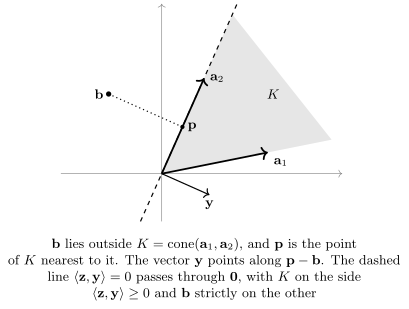
Idea. Let be the point of
nearest to , and use , the vector from back to the
cone. The inequality of Theorem 18.3.1 says that
every point of is
seen from
at an angle of at least from . Because is a cone, we may test
it against
and ,
which shows that the separating hyperplane passes
through the origin.
Proof. is nonempty, closed,
and convex, so by Theorem 18.3.1 (a) there
is a point nearest to , and by part (b)
of the same theorem
(18.5.2)
Put , which is nonzero since and . The
points and lie
in , since is a cone. Substituting
them into Eq. 18.5.2 gives and , so . Now Eq. 18.5.2 reads , that is , for every . So .
Finally, since . This proves the lemma.
With , the lemma becomes the
theorem this section is named after. It is stated for a
matrix, since that is how it will be used.
Theorem
18.5.6 (Farkas’s Lemma)
Let and .
Exactly one of the following has a
solution:
- (F1)
with , ;
- (F2) and , with .
Idea. The two systems cannot both
be solvable, which is one line of algebra: pair
with . That
at least one is solvable is geometry. If (F1) fails,
then lies
outside the cone of the columns, the cone is closed by
Theorem 18.5.4, and Lemma 18.5.5 produces
.
Proof. Not both. Suppose
with ,
and . Then since it is a sum of products of the
nonnegative entries of and . So is impossible.
At least one. Suppose (F1) has no solution.
Let . By Definition 18.5.2, (F1)
says exactly that , so . By Theorem 18.5.4, is a closed convex
cone, so Lemma 18.5.5 gives with
. By Proposition 18.5.1 (d),
means . So solves (F2).
This proves the theorem.
The geometric reading. Either lies in the cone
spanned by the columns of , or there is a
hyperplane through the origin, , with every
column on one side () and strictly on the
other (). The vector is a
certificate of infeasibility: anyone
can check (F2) by multiplying out, and the “not both”
computation then proves that (F1) has no solution.
Example
(Deciding a system both ways)
Let Decide, for and for , which
alternative of Theorem 18.5.6 holds,
and exhibit the solution.
Solution. The columns are ,
, and , all in the closed first quadrant.
So , and in fact the two
are equal, since and are among the
generators.
For we expect (F1). The system , has, for
example, the solution , and also .
Nonnegative solutions need not be unique.
For we expect (F2), since has a
negative first entry. Try :
then and . So is a certificate, and by the “not
both” half of Theorem 18.5.6 the
system , has
no solution. The certificate encodes a one-line
argument: the first equation reads , and its
left side is
whenever .
Linear programming, in the next section, meets
systems of inequalities,
with . Farkas’s lemma handles them after one
standard move: add a slack variable to
turn each inequality into an equation.
Corollary
18.5.7 (Farkas’s Lemma for Inequalities)
Let and .
Exactly one of the following has a solution:
- (i)
with , ;
- (ii) ,
, and , with .
Idea. A slack vector turns the inequalities into
equations with matrix , and in Theorem 18.5.6 the
identity block becomes the extra condition .
Proof. Here
means . So (i) has a solution if and only
if there are and in
with : given , take , and given and , drop . In block form
this reads Apply Theorem 18.5.6 to the
matrix and to . Exactly one of
the system above and the following is solvable: and
. The transpose has the blocks and stacked, so the
first condition says and .
That is (ii).
The dual
of the dual
Farkas’s lemma has a coordinate-free form, which says
that nothing is lost by passing to the dual cone twice,
provided the cone is closed.
Theorem
18.5.8 (The Bidual of a Closed Cone)
Let be a
finite-dimensional real inner product space and let
be a
closed convex cone. Then .
Proof. is Proposition 18.5.1 (c).
Conversely, let . By Lemma 18.5.5 there is
with . That single shows .
Hence , and the two are equal.
For , which is closed by Theorem 18.5.4, the
theorem is Farkas’s lemma. By Proposition 18.5.1 (d),
, so “” says
that every
with has , that is, (F2) has no solution. And “” is (F1).
This is the “dualize” move in its purest form: a
question about a cone (is in it?) is
traded for one about its dual (does every member of the
dual approve of ?), and the trade
is exact when the cone is closed.
When the
cone is not finitely generated
The system “, ” asks whether lies in the
image of the orthant under . Replace the orthant by a closed
convex cone and by a matrix , and ask whether . The
“not both” half of the proof of Theorem 18.5.6 survives
unchanged. The “at least one” half needs to be closed, and
the next example shows that this can fail.
Example
(A closed cone with a nonclosed shadow)
In , with
coordinates , let the set of triples for which the symmetric
matrix is
positive semidefinite (Definition 13.1.1).
Let , so that is
the projection onto the first two coordinates, and write
. Show that is a closed convex
cone, but that the cone of the earlier warning, which is not
closed. Then show that for
neither of the two alternatives
holds:
- (i) for
some ;
- (ii) for every , and , for some .
Solution. is a closed convex
cone. Write for . It is linear in : . So if and , then for all , and
is a convex cone that contains . If
with , then for fixed the number is a
fixed linear combination of the entries of . So it
converges to , and
because a nonstrict inequality survives a limit. Hence
is closed.
Membership. By Theorem 13.1.4 (a)
(e), exactly when the principal minors , , and are all .
The image. . If and is arbitrary, put . Then , , and , so and .
Conversely, if , then , and if then forces . So is exactly the
displayed set. It is not closed:
converges to .
Neither alternative holds for .
Alternative (i) fails because .
For (ii), suppose has for every . Since
for every real ,
we get for all . A nonconstant affine
function of takes
negative values, so . But then , which is not . So (ii) fails
too.
It is worth seeing exactly where the proof of Theorem 18.5.6 breaks.
The vectors lie in , their images converge to
, and the
themselves run off to infinity in the third coordinate.
This is the escape that the left inverse in Lemma 18.5.3 prevented.
There is no nearest point of to : the distance is
, but is not in the
set, so Lemma 18.5.5 has nothing
to start from. What fails is
closedness, which is why the finitely
generated case needed its own theorem.
The dual cone cannot see the difference either: is the closed
half-plane , strictly larger than , as Exercise (C3: The bidual sees only the closure)
shows.
Exercises
A. Check your
understanding
Exercise
(A1)
- (a) Define a convex
cone and the dual cone of a subset of .
- (b) State Farkas’s
lemma, and say in one sentence what the vector in the second
alternative certifies.
- (c) Determine
whether the following is correct, and justify your
answer: every convex cone in is closed.
- (d) Determine
whether the following is correct, and justify your
answer: the union of two convex cones in is a convex
cone.
- (e) In Theorem 18.5.2 the bound
is generators,
while Theorem 18.2.2 allows
points. Which
feature of the proof accounts for the difference?
Solution.
(a) A convex cone
is a nonempty with for all and all real . The dual cone
of is .
(b) For and ,
exactly one of the following is solvable:
with , or with . Such a certifies that
the first system has no solution, since any solution
would give
.
(c) Incorrect.
The cone of the warning in this
section is a convex cone, but
leaves it.
(d) Incorrect.
The two quadrants and are convex cones, and their union contains
and but not their sum
.
(e) For cones the
dependence to be removed is a linear
dependence , and a linearly
independent list in an -dimensional space has
at most members.
For convex hulls it is an affine
dependence (coefficients also summing to ), and an affinely
independent list can have members.
B. Practice
Exercise
(B1: Recognizing cones)
Determine which of the following subsets of or are convex cones.
Justify your answers.
- (a) .
- (b) .
- (c) .
- (d) .
- (e) .
Solution.
(a) A convex
cone. It is nonempty, containing . If ,
, and , then by the triangle inequality for real
numbers (Theorem 0.6.4) It is , a quarter-plane turned by .
(b) A convex
cone. It is a subspace, being the null space of , and every subspace is a convex
cone.
(c) Not a convex
cone: it does not contain , which taking
in the
definition would force into it. It is convex and closed
under addition; what fails is scaling by , for
instance is not in it.
(d) Not a convex
cone. It is convex, but it is not closed under
nonnegative scaling: is in it, and is not,
since .
(e) A convex
cone. Each of the three conditions is a homogeneous
linear inequality , with , , and , so the set is
an intersection of three half-spaces through the origin.
Each is a convex cone by the examples of this section,
and an intersection of convex cones is a convex cone: it
contains ,
and each member cone contains every nonnegative
combination of points of the intersection.
Exercise
(B2: A certificate either way)
Let . For each of and
,
decide which alternative of Theorem 18.5.6 holds,
and exhibit a solution of that alternative.
Solution. The columns are ,
, and .
For , try : the equations and give . So solves ,
and (F1) holds.
For , look for perpendicular to
the “outermost” generator and
nonnegative on the others. The vector gives
and . So (F2) holds, and by Theorem 18.5.6 the
system , has no solution. As a direct check,
adding twice the first equation to the second gives
,
whose left side is for .
Exercise
(B3: A dual cone and its dual)
Let .
- (a) Show that .
- (b) Compute and check that it
equals , as Theorem 18.5.8
predicts.
Solution.
(a) By Proposition 18.5.1 (d),
. Given such a , write : indeed the right side is , and both coefficients are . So .
Conversely, both generators satisfy the two
inequalities, and the set defined by the inequalities is
a convex cone, so it contains the cone they
generate.
(b) Applying Proposition 18.5.1 (d)
to the generators found in (a), . The same decomposition
argument, now with , shows this set
is .
C. Going deeper
Exercise
(C1: Gordan’s alternative)
Let .
- (a) Prove that
exactly one of the following has a solution:
with and ; or
with .
- (b) Deduce that if
the columns of
are , , and , then some
nontrivial nonnegative combination of them is , and find
one.
Hint for (a): scale so that its
entries sum to ,
and apply Theorem 18.5.6 to with an extra row of
ones.
Solution.
- (a) Not
both. If with ,
, and , then . Every term is , and the term for
an index with is . That is a contradiction.
At least one. Suppose the first system has
no solution. If , , and , then
would solve it. So the system has no solution. By Theorem 18.5.6 there is
with and , that is, . Then , so solves the
second system.
- (b) Here . The second system is
impossible: , and its entries sum to
, so they cannot
all be positive. By (a) the first system is solvable.
Indeed gives .
Exercise
(C2: The ice-cream cone is its own dual)
Let , with the inner product on .
- (a) Prove that .
- (b) Prove that .
- (c) Deduce that
is closed.
Hint for (b): test
against the member of .
Solution.
(a) Let . By Theorem 11.1.5,
,
where the last step multiplies the inequalities and . Hence . Fix
: we have shown that its inner product with
every is , so . Hence .
(b) Let .
The point lies in , so If , dividing by
gives . If , test
against instead: . Either way .
(c) By (a) and
(b), , and
every dual cone is closed by Proposition 18.5.1
(a).
Exercise
(C3: The bidual sees only the closure)
Let , the
image cone of Example (A closed cone with a nonclosed shadow).
- (a) Prove that .
- (b) Prove that .
- (c) Explain why this
does not contradict Theorem 18.5.8, and show
that is the
set of all limits of convergent sequences of points of
.
Solution.
(a) If ,
then testing against gives for every real . This forces , as in the
example, and then gives . Conversely, if and , then for every , since on .
(b) By (a), , so by Proposition 18.5.1 (d),
(c) Theorem 18.5.8 assumes
the cone is closed, and is not. Every point of
is such a
limit: if
or , use the constant sequence; if , use , which
tends to .
Conversely, a limit of points of lies
in , because
is closed by
Proposition 18.5.1 (a).
So is
exactly the set of limits of sequences in .