1.1 Vector Spaces
Chapter 0 met several kinds of objects that can be added and scaled: pairs of real numbers, polynomials, matrices. Each time we checked the same handful of rules by hand. This section collects those rules into one definition, the vector space, and proves the first consequences once, so that they hold in every example at the same time.
1.1.1. One set of rules in three places
Start with the plane
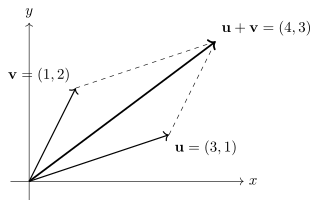
The picture shows one rule at once: going along
Now look at polynomials of degree at most
The same happens for
Arrows, polynomials, and matrices are very different objects, but many arguments about them only use these rules. If we prove a statement from the rules alone, it holds for arrows, polynomials, and matrices at once, and for every other system obeying the rules. So we list the rules once and give the systems that obey them a name.
A vector space is a set whose elements can be added and scaled by numbers from a field, with the usual rules of arithmetic.
1.1.2. The definition
Let
- (VS1)
for all . - (VS2)
for all . - (VS3) There exists
an element
such that for every . - (VS4) For
every
there exists an element such that . - (VS5)
for all and . - (VS6)
for all and . - (VS7)
for all and . - (VS8)
for every , where is the identity element of .
Read the definition clause by clause.
- The two functions. Addition takes
two elements of
and returns an element of . Scalar multiplication takes a number from and an element of and returns an element of . So “the sum stays in the set” and “a multiple stays in the set” are not extra axioms: they are built into the word “function into ”. When we test a candidate, this closure is the first thing to check. - (VS1)–(VS4) concern addition alone.
It is commutative and associative, there is a vector
that changes nothing, and every vector can be undone. These are the axioms (F1)–(F4) of Definition 0.7.1, now for vectors. - (VS5) and (VS6) are the two
distributive laws. In (VS6) the symbol
appears twice with two meanings: on the left it adds scalars in , on the right it adds vectors in . - (VS7) says scaling by
and then by is scaling by the product , computed in . - (VS8) says the scalar
acts as it should. It looks too obvious to state, but we will see below that it cannot be dropped.
Note the order of quantifiers in (VS3):
one vector
Let
A vector space over
We wrote “a zero vector” and “an additive inverse” on purpose. The axioms only say these exist. That there is only one of each is a theorem, proved later in this section.
Warning. Two different
zeros. The scalar
1.1.3. Examples
We start with the families we will use throughout the book. For each, the work is to say what the operations are and why the axioms hold. We check some axioms in full and point out the pattern for the rest.
Let
- (a)
, with entrywise addition and scalar multiplication. - (b)
, with the matrix operations of Definition 0.9.6 and Definition 0.9.7. - (c)
, with the addition of Definition 0.8.2 and . - (d) For a set
, the set of all functions , with the pointwise operations - (e) The set
of all sequences of elements of , with termwise operations.
Solution.
(b) The sum and scalar multiple of
matrices are matrices, so both operations are functions into . The eight axioms are exactly the rules of Theorem 0.9.1, with the zero matrix as and as an additive inverse of .(c) Chapter 0 defines
, the column vectors, and the entrywise operations are the matrix operations. So (a) is the case of (b) with rows and column. The zero vector is .(d) The formulas define functions
and from to , so the operations land in . Two functions are equal when they take the same value at every (Definition 0.4.1), so each axiom is checked one point at a time. For (VS3), let be the zero function, for all . Then for every , by (F3), so . For (VS4), let . Then by (F4), so . For (VS6), let . For every , where the second equality is (F9) together with (F6) in . Hence . The other five axioms reduce in the same way to a field axiom at each point: (VS1) to (F1), (VS2) to (F2), (VS5) to (F9), (VS7) to (F5), and (VS8) to (F7) with (F6).(e) A sequence
is a function , , and the termwise operations are the pointwise ones. So (e) is (d) with .(f) Let
and . Only finitely many are nonzero, and forces , so is again a polynomial. The sum of polynomials is a polynomial by Definition 0.8.2. By Theorem 0.8.1 (parts 1 and 2), addition satisfies (VS1)–(VS4), with the zero polynomial as and as an additive inverse. Since polynomials are equal when their coefficients agree (Definition 0.8.1), (VS5)–(VS8) are checked coefficient by coefficient. For instance, the coefficient of in is , which is the coefficient of in . The others reduce in the same way: (VS5) to (F9), (VS7) to (F5), and (VS8) to (F7) with (F6).
The pattern is worth naming. Whenever the operations
are defined entry by entry,
point by point, or coefficient
by coefficient, each axiom for vectors is a
field axiom applied in each slot. In fact (a), (b), and
(e) are all instances of (d): a column in
A subset of a known space often works just as well, provided the operations do not lead out of it.
The set
The next example applies the same pattern to a set of real numbers, with a smaller field of scalars.
Let
Solution. Let
Closure. We have
Zero and additive inverses. The number
The identities. Scalar multiplication by
We saw in Example (
The same set can carry more than one field of scalars. The next example makes this concrete.
Explain why
Solution.
As sets,
The degenerate case. The set
A final example looks strange, but it satisfies every axiom.
Let
Solution. Closure. For
(VS3). We need
(VS4). For
(VS6). For
(VS8).
The remaining axioms (VS1), (VS2), (VS5), and (VS7)
are Exercise (B3: Finishing the Positive Reals).
So
This example earns its place for one reason. The
words “zero vector” and “addition” describe
roles fixed by the axioms, not the
familiar number
Quick check. Explain why each of
the following, with the usual operations, is a vector
space over
- (a) The set
of twice-differentiable functions with . - (b) The set of
symmetric matrices
, that is, those with .
Solution. Both are subsets of known spaces, so we use the pattern after Example (The Standard Vector Spaces): check closure, the zero vector, and additive inverses; the other six axioms are identities inherited from the big space.
(a)
. If and , then by the sum and constant multiple rules of calculus, and are twice differentiable, with and . So both lie in . The zero function satisfies , so . If , its additive inverse in is , and by Theorem 0.7.1 (e); so it is the function , which lies in by closure under scaling. The identities hold in (Example (The Standard Vector Spaces) (d)), hence in . For instance and lie in .(b) By Theorem 0.9.5,
and when and . The zero matrix is symmetric, and the additive inverse , which Chapter 0 defines as , is symmetric by closure under scaling. The identities hold in , hence for symmetric matrices.
1.1.4. Nonexamples
Each nonexample below is a small change to an example. We say what still works and name the exact clause that fails.
- Change scalar multiplication on
to , keeping the usual addition. Addition is untouched, so (VS1)–(VS4) hold. (VS5) holds: . In the same way (VS6) and (VS7) hold. But , so (VS8) fails. - Change the line
to . Let with the operations of . The points and lie on , but their sum has . So addition is not a function , and is not a vector space with these operations. - Change “degree at most
” to “degree exactly ”. In (Definition 0.8.5), and have degree , but their sum has degree . Again addition leaves the set. There is no zero vector either: the zero polynomial has degree , not . - Change the entries from real to
integer, keeping
as the field. For , addition is fine, but . So scalar multiplication is not a function .
1.1.5. Why these axioms
Each axiom is there for a reason, and a few conventions deserve a comment.
- (VS8) cannot be dropped. The first
nonexample satisfies all other axioms. Without (VS8),
the “scalar multiplication”
for all and would also be allowed, and scaling would carry no information at all. - (VS1) is in fact redundant.
Commutativity of addition follows from the other seven
axioms, by expanding
in two ways (Exercise (C1: Commutativity Comes for Free)). It is kept because the proof is fiddly and nobody wants to repeat it. - Closure is not optional. Two of the
nonexamples fail only because an operation leads out of
the set. That is why the definition asks for
functions into
. - The scalars form a field. We use division by nonzero scalars in the zero product law at the end of the next subsection. The warning after it shows what goes wrong without division.
- The name. “Vector” originally meant an arrow in physics. The word is kept for elements of any vector space, even when they are polynomials or functions.
1.1.6. First consequences of the axioms
The definition says a zero vector and additive
inverses exist, not that they are
unique. Before writing
Throughout, we use one fact about functions without
further comment: if two inputs are equal, the outputs
are equal. So from
The first tool lets us cancel a vector from both sides of an equation.
Let
Proof. Suppose
Let
Proof. By (VS1), the hypothesis
says
Uniqueness uses the standard move from Chapter 0: suppose there are two, and show they are equal.
Let
Proof. Existence is (VS3). Suppose
Let
Proof. Existence is (VS4). Suppose
Since the inverse is unique, it deserves a name.
Let
For example,
Remark. Axioms (VS1)–(VS4) say that
Now to scalars. No axiom mentions
Let
Proof. Let
The same move, with the zero vector in place of the
zero scalar, handles
Let
Proof. Let
To identify a vector as
Let
Proof. Let
Let
Proof. Let
The companion rules
The last result is the one we will use most. In a field, a product of nonzero numbers is nonzero (Theorem 0.7.1 (f)). The same holds for a scalar times a vector.
Let
Idea. The direction
Proof.
Warning. The zero product
law needs division by scalars. Suppose we
allowed integer “scalars” and let
As a first use, here is a fact about sizes. Let
1.1.7. Exercises
A. Check your understanding
- (a) State the eight
axioms of a vector space over a field
, and say which of them involve scalars. - (b) Identify the
zero vector in each of:
; ; ; the space of Example (Positive Reals with Exotic Operations). - (c) True or false: a vector space can have exactly two elements. Justify your answer.
- (d) True or false:
in every vector space,
implies . Justify your answer. - (e) True or false:
if
and , then . Justify your answer.
Solution.
(a) See Definition 1.1.1. The axioms (VS5)–(VS8) involve scalars; (VS1)–(VS4) involve only addition.
(b) The zero matrix of size
; the zero polynomial; the zero function ; the number (Example (Positive Reals with Exotic Operations)).(c) True. Let
. By Example (The Standard Vector Spaces) (a), is a vector space over , and it has exactly two elements.(d) False. In the vector space
over from (c), the vector satisfies . (Over the statement is true: by (VS8) and (VS6), and , so by Theorem 1.1.9.)(e) True. By (VS6) and Theorem 1.1.8,
. Since , Theorem 1.1.9 gives , so .
B. Practice
Determine which of the following are vector spaces. Justify your answer.
- (a)
over , with the usual scalar multiplication but with addition . - (b) The set of upper
triangular matrices in
, over , with the matrix operations. - (c)
, over , with the operations of . - (d)
, over , with the operations of . - (e)
over , with and the usual addition.
Solution.
(a) Not a vector space: (VS3) fails. Suppose
satisfied (VS3). Then would equal , which is impossible since the second entries differ.(b) A vector space. Let
and be upper triangular and . Then and are upper triangular, so the operations land in the set. The zero matrix is upper triangular, and so is . The identities (VS1), (VS2), (VS5)–(VS8) hold for all matrices in by Example (The Standard Vector Spaces) (b), hence for upper triangular ones.(c) A vector space. Let
, , and . By Theorem 0.8.5, . Also is the product of the constant polynomial with , since by the product formula of Definition 0.8.2 that product has coefficients . So . Hence . The zero polynomial has value at , and by closure under scaling. The identities hold in by Example (The Standard Vector Spaces) (c), hence in .(d) Not a vector space: addition leaves the set. The constant polynomial
lies in the set, but , so does not.(e) Not a vector space: scalar multiplication leaves the set. We have
and , but . So the rule is not a function .
Let
- (a)
; - (b)
; - (c)
and .
Hint: to show a vector equals
Solution.
(a) By (VS5), (VS4), and Theorem 1.1.6,
So is an additive inverse of . By Theorem 1.1.4, .(b) By (a) applied with the scalar
, then Theorem 1.1.8, then the remark after Definition 1.1.3,(c) By Definition 1.1.3, (VS5), and (a),
Similarly, since in , (VS6) and Theorem 1.1.8 give .
Let
- (a) Verify (VS1),
(VS2), (VS5), and (VS7). Hence
is a vector space over . - (b) Compute the
vector
. - (c) Find the vector
, and check your answer against Theorem 1.1.8.
Solution.
- (a) Let
and . By the laws of real multiplication and of exponents for positive bases:- (VS1):
. - (VS2):
. - (VS5):
. - (VS7):
.
Together with closure, (VS3), (VS4), (VS6), and (VS8) from Example (Positive Reals with Exotic Operations), all eight axioms hold. Hence
is a vector space over . - (VS1):
(b)
and . So the vector is .(c) By Example (Positive Reals with Exotic Operations), the additive inverse of a vector
is . Since , we get . By Theorem 1.1.8, this should equal , and it does.
C. Going deeper
Let
- (a) Let
and as in (VS4). Put . Show that , and deduce that . - (b) Show that
for every . - (c) Deduce that both
cancellation laws hold:
implies , and implies . - (d) By expanding
in two ways, prove that for all .
Hint: in (a), add an additive inverse of
Solution. Throughout we use only (VS2)–(VS8), and we drop brackets in sums whenever (VS2) allows it.
(a) Since
and by (VS3), By (VS4) choose with . Adding on the right of gives , that is, . By (VS3), . So as well.(b) Let
and as in (VS4). By (a), (VS2), and (VS3),(c) Suppose
, and let be as in (VS4). Adding on the left and using (VS2), . By (a), , so , and (b) gives . Now suppose . Adding on the right and using (VS2), , so , and (VS3) gives .(d) Let
. On the one hand, by (VS6) and (VS8), On the other hand, by (VS5), then (VS6) and (VS8), Hence , grouping by (VS2). Canceling on the left and then on the right, by (c), gives . This proves (VS1).
- (a) Let
be an infinite field and a vector space over . Prove that is an infinite set. - (b) Let
be a prime and . How many elements does the vector space over have? Explain why this does not contradict (a).
Hint: for (a), fix
Solution.
(a) Since
and , there is with . Consider , . Suppose , so . By Exercise (B2: More Rules for Signs) (c), . Since , Theorem 1.1.9 gives , so . Therefore is injective. An injective function from an infinite set has an infinite image, so , which contains the image of , is infinite.(b) An element of
is a list with each chosen freely from the elements of . So has elements. There is no contradiction, because (a) assumes the field is infinite and is finite. The proof of (a) still shows that is injective, so a nonzero space over has at least elements.
Let
- (a) Let
be a vector space over . Prove that , with the same addition and with scalar multiplication restricted to , is a vector space over . - (b) Deduce that
is a vector space over and over . - (c) Explain why
, with its usual addition and multiplication, is not a vector space over .
Solution.
(a) The addition is unchanged, so it is a function
satisfying (VS1)–(VS4). Scalar multiplication restricts to a function , since . The axioms (VS5)–(VS7) are statements about all scalars in , so they hold in particular for all scalars in ; the operations and appearing in them are the same in as in . For (VS8), the identity of is the identity of , and holds in over . Hence is a vector space over .(b)
is a vector space over by Example (The Standard Vector Spaces) (a). The subsets and contain and and are closed under the four operations, so (a) applies to both.(c) The only candidate for scalar multiplication is
, the product in . But it does not land in : and , while . So there is no function given by this rule, and is not a vector space over with these operations.