8.8 Stages of Knowledge: Kripke Models
This section is optional, and nothing outside it
depends on it. Section 8.7 named several classical laws
that have no derivation without
8.8.1. Stages of knowledge
An inquiry passes through stages. At each stage some
atomic statements are known: established, never to be
withdrawn. From a stage, the inquiry may go on in
several ways, to later stages where more is known.
Nobody knows which way it will go. The atomic statements
are the letters of Chapter 4’s formulas (Definition 4.1.1),
its atoms, and the formulas of this section are those
formulas: letters,
A Kripke model consists of:
- a finite non-empty set of stages;
- for each stage
- for each stage
We draw a model as dots for the stages, with an arrow
from a stage to each stage that comes directly after it.
A stage is reachable from
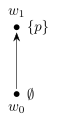
The model
8.8.2. Forcing
What a stage knows about a compound formula is computed from its parts, as a row computes a truth value, except that some connectives look ahead to later stages.
Let
- (K1)
- (K2)
- (K3)
- (K4)
- (K5)
- (K6)
- (K7)
A stage refutes a sequent
In words: a conjunction or a disjunction is
decided at the stage itself, and a disjunction is forced
only when one of its sides is: the inquiry must already
know which. An implication and a negation look ahead. To
force
A model with one stage is a row of a
truth table. With one stage, the stages reachable from
A stage that refutes
Quick check. In a one-stage model
in which
Solution. Yes to both. The only
stage reachable is the stage itself, which does not
force
8.8.3. A first countermodel
In
Solution.
- Hence
- Next,
- So
At
8.8.4. Knowledge persists
Letters stay known by the definition of a Kripke model. The same holds for every formula.
In every Kripke model, if
In words: what a stage forces, every later stage
forces. The proof is a structural induction on
Second readingThe proof of heredity
Proof. We prove, by Theorem 4.3.1,
that every formula
Letters. A letter forced at
Every clause of Definition 4.1.1 is covered, so every formula has the property. This proves the lemma.
Quick check. A stage
Solution.
8.8.5. The rules without RAA are sound for stages
Let
In words: a derivation without
TAUT (Section 4.8) is not among the rules here: it is
licensed by completeness, whose proof uses
The proof is Chapter 4’s proof of Theorem 4.7.2, Steps 1–4, with “every valuation making the context true” replaced by “every stage forcing the context”. Each rule’s case, in one line:
| Rule | Why its case holds at a stage |
|---|---|
| the cited line itself, forced at |
|
| the clause (K3), (K4) or (K7) at |
|
| (K5) or (K6), applied at |
|
| no stage forces |
|
| a later stage |
|
| fails: its box on |
Second readingThe proof, case by case
Proof. Step 1 (reduction to
primitive rules). As in Step 1 of the proof of
Theorem 4.7.2,
a derived rule or cited result derived without
Step 2 (the induction). For
Step 3 (the cases). Premises and
assumptions:
Box rules: if line
So
Step 4 (the last line). The last
line lies in no box (Definition 1.4.2),
so its context
If some stage of some Kripke model refutes
Proof. Suppose it had one. By Theorem 8.8.2
the stage would force
Quick check. Which case of the
proof fails for
Solution.
8.8.6. Two branches
In the model
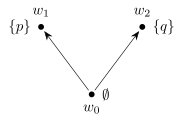
Show that
Solution.
- No stage forces both
- By Corollary 8.8.3,
neither
Classically each is derivable (Section 2.5, and Corollary 4.8.5
for the first, a tautology). The branch is what defeats
them. At
8.8.7. What two or three stages settle
Here is the propositional right column of the table
in Section 8.7, “Which laws survive without RAA”, each
sequent with a stage that refutes it. Two more models
are described in words:
| Sequent (letters |
A refuting stage |
|---|---|
With Corollary 8.8.3,
each row proves that the sequent has no derivation
without
8.8.8. Searching for a countermodel
How were these models found? Here is the search for
- Start with a stage
- It must force
- Check every clause at both stages: this is
In general:
- to refute a disjunction at
- to refute
- keep letters known once known.
The search is a guide, not a decision procedure as stated here.
Remark. Three facts, stated without proof.
- The converse of Theorem 8.8.2
holds: a sequent forced at every stage of every Kripke
model that forces its premises has a derivation without
- From it, by placing a new first stage below two
countermodels, follows the disjunction
property: if
- Kripke models extend to the quantifiers, with a
domain at each stage that may grow. In them
Nothing in this book depends on these facts.
Warning (Not allowed: misreadings of forcing). Each sentence below is wrong; the tag names the clause it misreads.
- “
- “
- “
- “A picture with
8.8.9. Exercises
A. Check your understanding
- (a) In
- (b) Why is a one-stage Kripke model a row of a truth table?
- (c) True or false:
if
- (d) Which rule’s
case fails in the proof of Theorem 8.8.2,
and how does
Solution.
(a) Yes. The only stage reachable from
(b) With one stage, (K5) and (K6) look only at that stage, so the clauses become those of Definition 4.4.2, with “forced” for “true”.
(c) False:
(d)
Decide each in a line, with the clause you use.
- (a)
- (b)
- (c)
- (d)
- (e)
- (f)
- (g) Is this a Kripke
model:
- (h) In
- (i)
- (j)
- (k)
- (l) Can a one-stage
model refute
Solution.
(a) No:
(b) Yes: no stage reachable from
(c) No: neither letter is known at
(d) Yes: the only stage reachable from
(e) No:
(f) Yes. The stages reachable from
(g) No: a letter known at
(h) (K6) needs
(i) Yes (K5). Of the stages reachable from
(j) No:
(k) Yes: the only stage that forces
(l) No. At a single stage forcing is truth, and
B. Practice
Let
- (a) Decide whether
- (b) Which sequents
among
- (c) A
chain is a Kripke model whose stages
can be listed
Solution.
- (a)
(b)
(c) Suppose some stage
Marking scheme. (10 points) - 5:
(a), one per formula, each with its clause. - 2: (b). -
3: (c), the two orders of
Fatal errors (0 for the step): deciding (K5) or (K6)
at
For each claim, either derive it without
- (a)
- (b)
- (c)
- (d)
- (e)
- (f)
- (g)
Solution. The verdict comes first in each part.
- (a)
Derive. Each conjunct is a negation, so
each takes a
- (b)
Derive. A
(c) Break, at
(d) Derive. A
(e) Break, at
(f) Derive. The disjunction is used by cases; the case
- (g)
Break, at
The look-alikes: (a) and (b) are converses, and both
derivable. (c) is (a)’s look-alike with
Marking scheme. (10 points) - 6: the four derivations, 1.5 each. - 3: the three countermodels, 1 each, every clause checked. - 1: one correct remark on a look-alike pair.
A wrong verdict scores 0 for that item. Fatal errors
(0 for that item): a derivation that uses
C. Going deeper
- (a) Derive
- (b) Derive without
- (c) Compare (a), (b) and Exercise (B5: Behind two negations, and one instance) (c) with Theorem 2.5.7, in one sentence.
Solution.
- (a) A
- (b)
Refute, at
- At
- At
- (c) Theorem 2.5.7 compares rules, which act on every statement at once. Instance by instance the three differ: one instance of excluded middle gives Peirce’s law (a) and double-negation elimination (Exercise (B5: Behind two negations, and one instance) (c)) for that letter, while that instance of Peirce’s law does not give the instance of excluded middle back (b).
Marking scheme. (10 points) - 5:
(a). The
Fatal errors (0 for the step): using
Prove that in every Kripke model, for every stage
Solution.
The comparison: Example (Three negations become one)
derives
Marking scheme. (10 points) - 4:
Fatal errors (0 for the step): “not forced, so the negation is forced”; heredity used without being cited.