Sections 5.3 to 6.4 derived a good deal, and some
searches stalled. The converse of Proposition 5.6.2
could not be finished: every attempt ran into a side
condition. The converse of Proposition 5.6.1
stalled in the same way, and so did the search for in Exercise (C2: A witness is not a name, used later).
But a search that fails proves nothing, since a cleverer
derivation might exist. Chapter 4 met the same problem
for the connectives and solved it with meaning: a row of
a truth table that makes the premises true and the
conclusion false rules out every derivation at once (Corollary 4.7.3).
This section builds the meaning of a quantified formula:
a model, a domain of objects with a
meaning for every symbol. A model that makes the
premises true and the conclusion false is a
counter-model, the exact form of the
counter-readings used since Section 5.3, and Section 7.2
uses it to settle the stalled searches.
Why a row
is not enough
Chapter 4’s semantics gave each atom a truth value
and computed the rest. Try it on the stalled sequent of
Proposition 5.6.2’s
converse, Neither side has a main connective among : each is a quantified formula,
and a truth table would have to treat each as one atom.
The sequent would become , refuted by the row , . That
“refutation” is worthless. The same reading refutes
, which is derivable (Proposition 5.5.1).
Treating a quantified formula as an atom throws away
exactly the structure that the quantifier rules use.
So what does make true or false? Section
5.1 read such sentences informally, over a
domain: “for every in the domain there is
an in the domain
with ”. To
decide it we need three things.
- A domain: the objects the variables
range over. Over the sentence may be
true and over a three-element set false.
- A meaning for each symbol. is a predicate symbol,
a name with two slots and no meaning of its own (Section
5.2). Read as
on , the
sentence says “every integer has an integer above it”,
which is true; read as on , it says “every
natural number has a natural number below it”, which is
false at .
- Values for the free variables, if
there are any. The formula is
neither true nor false on until we know which
number is.
The first two together are a
structure; the third is an
assignment. A structure with an
assignment decides every formula, by clauses that read
the quantifiers as Section 5.1 read them. That is all
this section does; Section 7.2 uses the result.
Structures
Situate the notion first. A formula is built from
symbols: constants such as and , function symbols such
as and , predicate symbols such
as , and , each function and
predicate symbol with its number of argument places, its
arity (Section 5.2, Definition 5.2.1
and Definition 5.2.2).
The symbol is
special: it is part of the logic, with rules of its own
(Definition 5.7.1),
and it will always mean the same thing. A structure
gives every other symbol a meaning.
A structure is a non-empty set of objects
together with a meaning for each symbol: an object for
each constant, an operation for each function symbol,
and a relation for each predicate symbol.
Definition
7.1.1 (Structure)
Fix a collection of constants, function symbols and
predicate symbols, each function and predicate symbol
with its arity . A structure (also called a
model) for these symbols consists
of
- (M1) a
non-empty set , the
domain of ;
- (M2) for each
constant , an
element ;
- (M3) for each
function symbol
of arity , a
function , defined at every -tuple of elements of
;
- (M4) for each
predicate symbol
of arity , a set
of -tuples of elements of
.
The symbol is
not interpreted by : in every structure
it means identity, “is the same element
of as”.
In words. (M1) says what the variables range over,
and insists that there is at least one object. (M2) says
which object each name names; two constants may name the
same object. (M3) makes each function symbol an
operation that can be applied to any
objects of the domain and always returns an object of
the domain. (M4) makes each predicate symbol a relation:
is the set
of tuples for which “holds”. A one-place
predicate symbol
becomes a subset , a two-place one a set of ordered
pairs, and so on. Here is the set of -tuples of
elements of ; this
section uses only their everyday meaning.
We usually describe a structure in one line, naming
the domain and the meaning of each symbol, and write
“”
for the structure with domain in which the symbol
means the
usual order. When a symbol has its usual meaning on a
familiar set, we say so and do not write . When the
domain is followed by a list of symbols, a semicolon
separates the domain from the list, as in : each
listed symbol has its usual meaning on that set, and
only the listed symbols belong to the structure. With a
single symbol we may also write a comma, as in .
Examples, simplest first.
- One element. , with . This
is the degenerate structure. Every variable must take
the value , so
“for every element” and “there is an element” both mean
“”. It will
reappear as a test case: a sentence true here and false
in some other structure cannot be derivable (by the
soundness statement in Section 7.2), and some of the
chapter’s non-derivable sequents need at least two
elements to refute.
- Two elements, one relation. , with
: the relation “is the same as”, written out
as a set of pairs. A finite structure can be given
completely by listing.
- The integers with their order. , with . Here the relation is described by a
condition rather than a list.
- Arithmetic. , with the constants and naming zero and one,
the function symbols , and two-place meaning addition,
multiplication and subtraction, the one-place symbols
, and meaning
negation, squaring and absolute value, and , , , the usual order.
Extended by the other familiar symbols with their usual
meanings (numerals, halving, the predicates , division with its
value at a zero denominator fixed arbitrarily as in the
non-example below, and a function symbol for each
sequence or function an example uses), this is the
structure in which the analysis examples of Chapters 5
and 6 have been read all along.
↺Second readingA
non-example, and the repair used for
1/n
Non-example by minimal change. Take the
arithmetic structure and add a one-place function symbol
, meant to be read
as .
This is not a structure: (M3) asks for
a function defined at every element of , and is not defined.
Everything else in the description is fine; exactly
clause (M3) fails, at the single point . There are two repairs.
Shrink the domain to , where is always defined; or
keep and give
any value at
, say .
The second repair is the one this book uses for terms
such as : the
value at is fixed
arbitrarily and is never looked at, because such terms
are used only under a bound (as in
Exercise C3 of Section 7.2), exactly as a sequence was read in Section
5.1 as a function symbol whose values off are never used.
The domain is non-empty because of Proposition 5.5.1;
the subsection “Why domains are non-empty” explains
why.
↺Second readingWhy
total functions, and why identity
- Total functions. Clause (M3) is what makes
every term name an object: the term must have a value,
or the formula , which derives
from nothing, would have no truth value.
- Identity for . The rule replaces
equals by equals everywhere. If a
structure could read as some other relation,
would fail. On ,
read as
“ and have the same parity”
and as “is
positive”: then and
would both hold, while , which derives
from them, fails. With fixed as identity, no
such reading exists.
Warning. A structure must interpret
every symbol that occurs in the
formulas at hand. “Take ” is not yet a structure for : until is given a meaning, the
sentence has no truth value, and the same domain makes
it true with read
as and false
with read as
“” (at
). Always
write the domain and the meaning of
each symbol.
Drawing a
finite structure
A finite structure whose symbols are one- and
two-place predicate symbols can be drawn, as Section 5.1
drew its worlds. Each element is a dot. Beside a dot
stand its name and the one-place predicates it
satisfies. For a two-place relation , an arrow runs from
to for each pair in , and a loop at
records the pair
. Deciding a
sentence in a drawn structure is then reading the
picture, dot by dot.
When the relation is a partial order , arrows crowd the
picture, and a lighter drawing is used. Section 7.4
defines partial orders; here it is enough that is reflexive and
transitive and never holds both ways between two
different elements. The Hasse diagram
of such a structure puts below when and , and draws a line
only for the pairs with nothing strictly between them.
The loops, and the pairs that follow by chaining lines
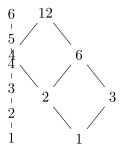
upwards, are understood. In the right picture below,
holds
although no line joins and : the chain , , runs upwards.
A picture is a structure only when it says what every
symbol means: the caption names the domain and each
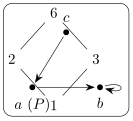
symbol. Figure F draws two structures. Left: , , . Right: , with read as “ divides ”.
Figure F. An arrow diagram (left)
and a Hasse diagram (right).
Quick check. In the left structure
of Figure F, decide and .
Solution. The first is true: every
dot has an arrow out of it (, , ). The second is
false: no dot receives an arrow from all three. The dot
receives none
from , the dot
none from or , and the dot none at all.
Assignments
and the value of a term
A structure names the objects that
constants stand for. Variables are
different: their whole purpose is to range over the
domain, so a structure gives them no fixed value. A
separate object records what they stand for at a given
moment.
Definition
7.1.2 (Assignment)
Let be a
structure with domain . An
assignment in is a function that gives
every variable a value . For an
assignment , a
variable and an
element ,
the assignment is the one that gives the value and every other
variable the value gives it:
In words: an assignment is a choice of value for
every variable at once, and changes
that choice at the one variable , leaving the others
alone. The assignment is what the quantifiers will use:
“for every ” will
mean “for every , with
set to ”. Changes
can be stacked: first sets to and then to . When and are different variables
the order does not matter, since each change touches
only its own variable; when they are the same variable,
the later change wins.
There are always assignments, because is non-empty: pick any
and let
every variable have the value . Like a valuation in
Chapter 4 (Definition 4.4.1),
an assignment fixes infinitely many values, and a
formula will only ever look at finitely many of
them.
With a structure and an assignment, every term names
an element of the domain. Terms are built by the clauses
of Definition 5.2.1,
so the value is defined by recursion on terms, in the
pattern of Theorem 4.3.4.
The value of a term is computed from its
variables and constants upwards, one function symbol at
a time.
For a structure and an assignment
, the
value of a
term is:
- for a variable ;
- for a constant ;
- for a function symbol
of arity .
The third clause is where (M3) is needed: must accept every
tuple the terms might produce.
For example, in the arithmetic structure on , let and . The term
,
which is written in the usual way, has value .
Under it has value , and under it has
value . The term
has value
under every
assignment, since it contains no variable.
Satisfaction
Now the central definition. We want to say when a
structure and an assignment make a formula true.
Formulas are built by the clauses of Definition 5.2.2,
so we define it by recursion, one clause per way of
building a formula, and each clause reads its connective
or quantifier as Chapter 4 and Section 5.1 read it.
A formula is satisfied when the objects its terms
name stand in the relations its predicates name,
combined by the connectives as in a truth table, with
“for every ” and
“there is an ”
ranging over the domain.
Definition
7.1.3 (Satisfaction)
Let be a
structure with domain and an assignment in
. The relation
, read “
satisfies under ”, is defined by
recursion on the formula :
- (S1) if ;
- (S2) if and are the same element of
;
- (S3)
never holds;
- (S4) if does not hold;
- (S5) if both and ;
if at least one of them holds; unless holds and
does not; if both hold or
neither does;
- (S6) if for
every ;
- (S7) if for
at least one .
When does not hold we write . For a list of formulas,
means that for every formula of .
Read it clause by clause. (S1): an atomic formula is
satisfied exactly when the values of its terms form a
tuple in the relation that interprets its predicate
symbol. (S2): an equation is satisfied when both sides
name the same object; this is where “ means identity” enters.
(S3)–(S5) are the half of (V1) and
clauses (V2)–(V6) of Chapter 4’s Definition 4.4.2,
with “is true under ” replaced by “is
satisfied by
under ”: is never satisfied,
flips, needs both, needs one, fails only with a
satisfied hypothesis and an unsatisfied conclusion,
needs agreement. (S6) and (S7) are the new clauses. To
decide , we run through the elements of the domain, set
to and leave every other
variable alone, and ask whether is satisfied each
time. For one success is enough. In symbols, for
(S6) and (S7):
A trace, step by step. Decide in two structures, both with the usual order:
with domain
, and with domain . Let be any
assignment.
In : by
(S6) we must check, for every , that . Fix . By (S7) it is enough
to find one with . Take . Under the terms and have the values and , and , so (S1)
holds. Hence the sentence is satisfied. Notice that the
witness
depends on : (S7)
is checked inside (S6), once for each
.
In : (S6)
asks the same for . At and the witnesses and work. At no has , so (S7) fails for , and
(S6) fails. So ,
and the failure has a name: the element has nothing above
it.
The assignment matters for free
variables. In , with also read as usual,
take the formula , in which is free. Under an
assignment with it is satisfied, since every has (recall that
). Under an assignment with it is not:
gives , which fails. The
same formula in the same structure is satisfied under
one assignment and not under another; it is a property
of , “ is least”, not a
statement.
↺Second readingSatisfaction
is well defined; degenerate cases
Well defined. The clauses define,
for each formula, which pairs satisfy it,
by recursion on the formula: (S1)–(S3) settle the atomic
formulas and ,
and each of (S4)–(S7) settles a compound formula from
its immediate parts. One point needs a word. Clauses
(S6) and (S7) consult the immediate part under
other assignments , not
under . So the
recursion must define satisfaction of each formula under
all assignments at once, and then (S6)
reads off the answer for at every . The
recursion is still on the formula alone, and Theorem 4.3.4,
applied to formulas built by the clauses of Definition 5.2.2,
gives exactly one such relation.
Degenerate cases. In the one-element
structure , every assignment gives every variable the
value , so
and (S6) and (S7) both reduce to “”. So and
are satisfied together or not at all, and every equation
is satisfied.
In any structure, is satisfied, since every is the same element as
itself; and never is.
Satisfaction as a game. Section 5.1
read a sentence whose quantifiers all stand in front as
a game between a challenger, who tries to make it false,
and a defender, who tries to make it true. The clauses
extend that game to every formula, one move per clause.
At (S6) the challenger picks an element
for ; at (S7)
the defender picks. At the
challenger picks the side to be checked, and at the
defender does; is played as ,
and as the two implications joined by . At the players
change roles (S4), since making true is
making
false. At an atomic formula the game ends, and the
defender wins exactly when (S1) or (S2) holds; at the defender never
wins (S3). A sentence is true in exactly when the
defender can answer every challenge and win: read clause
by clause, that is what (S1)–(S7) say. In the trace
above, the defender’s answer to each
challenge is such
a way of winning on ; on the
challenge has
no answer.
Quick check. Play the game for
on and on . Who moves first, and who
wins?
Solution. The defender moves first,
since comes
first: the order of the quantifiers is the order of the
moves. On ,
whatever the
defender names, the challenger answers and wins, so
the sentence is false. On the defender names , and every challenge
has , so the sentence
is true.
Quick check. Is satisfied in , in , and in , each with the usual
product?
Solution. In , no: at , (S7) asks for a
real with , and every
real square is . In , yes: for each , is in the
domain and ; and with is a structure,
since a product of non-negative reals is non-negative
(M3). In , yes:
every complex number has a complex square root (school
algebra of complex numbers: with has the square root ). The sentence is the
same all three times; only the structure changes.
Only the
free variables matter
The example of above showed mattering. In the
first example it did not: the verdict on was reached for “any assignment ”. That is no
accident. A sentence has no free variables (Definition 5.2.4),
and every variable it contains is bound, so every value
gives is
overwritten by (S6) or (S7) before it is looked at. We
prove the general fact, which is the first-order version
of Chapter 4’s Lemma 4.4.1:
satisfaction depends only on the values of the
free variables.
Say that two assignments and agree
on a set of variables if
for every variable in it. We need the free
variables of a formula (Definition 5.2.3),
in the recursive description given after that definition
in Section 5.2: every variable occurring in an atomic
formula is free there; has the free
variables of ; , for a
binary connective , has those of and those of
; and and
have those of other than .
Lemma
7.1.1 (Free Variables Coincidence Lemma)
Let be a
structure and a formula, and
let and be assignments
in that agree
on every free variable of . Then
In words: to decide a formula, only the values of
its free variables matter.
↺Second readingThe
proof: an induction for all assignments at
once
Idea. Structural induction on , as for Lemma 4.4.1,
after a first induction on terms: a term’s value depends
only on the values of its variables. The connective
cases are Chapter 4’s. The quantifier case is the only
new one, and it explains why the property must be stated
for all pairs of assignments: (S6)
compares with , which are new assignments, so the
induction hypothesis must apply to them. They agree at
, since both give
it , and at every
other free variable of , since those are
free in .
Proof. Terms first. We
show: if and
agree on
every variable occurring in a term , then . We use structural induction on
terms (Definition 5.2.1;
the pattern of Theorem 4.3.1).
For a variable ,
the variable
occurs in , so
. For a
constant , both
values are .
For , every variable of occurs in , so
the hypothesis for gives for each ; applying to equal tuples
gives equal values.
Formulas. We apply structural induction to
the property : for all
assignments ,
in that agree on the
free variables of ,
if and only if .
Atomic formulas. Let be , and
let , agree on its
free variables. Every variable occurring in is free in it (Definition 5.2.3),
so and agree on the
variables of each , and by the claim for
terms . The two tuples in (S1)
are equal, so one lies in exactly when the
other does. The case is the same with (S2). For , neither side holds,
by (S3).
Connectives. Assume and , and let , agree on the
free variables of . These include the free variables
of and
those of , so
if and only if , and likewise for . By (S5),
satisfaction of is decided by these two answers
through the same rule for and for , so
holds. The cases , , , and
are the same argument with (S4) and the
other parts of (S5), as in the proof of Lemma 4.4.1.
Universal quantifier. Assume , let be a variable, and let
, agree on the
free variables of . Let . We claim that and
agree on the free variables of . At , both give . A free variable of other than is a free variable of
(Definition 5.2.3),
so . By , applied to
these two assignments, This holds for every , so by (S6) if and only if . This proves .
Existential quantifier. The same argument,
with (S7) in place of (S6): the displayed equivalence
holds for each ,
so there is a
making the left side hold exactly when there is one
making the right side hold.
Every clause of Definition 5.2.2
has been covered, so holds for
every formula . This proves the
lemma.
Quick check. In , does whether
satisfies
depend on ?
Solution. No: is not free in the
formula, so by the lemma only matters. The
formula holds exactly when .
The lemma has a consequence that the rest of the
section uses constantly.
Sentences. If is a sentence, it
has no free variables, so any two
assignments agree on its free variables, and the lemma
says that either holds for every assignment or for none. We then
write , and say that is true
in (or
that is a model
of ), in the
first case, and , is false
in , in
the second. At least one assignment exists because is non-empty, so a
sentence is always exactly one of true and false in
. This is the
precise form of Section 5.1’s informal “true over a
domain”.
Only finitely many values matter. A formula
has finitely many free variables. To decide , it is enough to know on those. So we
describe an assignment by the values that matter (“”), exactly as
Chapter 4 described a valuation by the values of a few
atoms.
Warning. The same sentence can be
true in one structure and false in another, and “true”
without a structure means nothing. is true in and false in , as
traced above. A sentence of predicate logic is like a
formula of Chapter 4 with atoms: it has a truth value
only once the meaning of its symbols has been fixed.
Semantic
entailment
Chapter 4 said that entails when every row that
makes true
makes true (Definition 4.5.3).
The row is now a structure with an assignment.
An argument is valid when every structure, under
every assignment, that satisfies all the premises also
satisfies the conclusion.
Definition
7.1.4 (Semantic Entailment in Predicate
Logic)
Let be a
list of formulas and a formula. We say
semantically entails , and write ,
if for every structure for the symbols
occurring in
and , and
every assignment in , We write when is empty. If
fails, we write ; a structure with an assignment
such that
and is a
counter-model to .
In words: “every structure” means every domain and
every meaning of the symbols, so an entailment holds for
reasons of form and not because of what happens to mean. “Every
assignment” covers every value of the free variables;
when and
are
sentences, the assignment makes no difference, by Lemma 7.1.1.
And a counter-model is the analogue of Chapter 4’s
refuting row: one structure, with one assignment, where
the premises hold and the conclusion does not. The
symbol is
the one of Chapter 4, and the context always shows which
is meant: a sequent of formulas with quantifiers or
predicate symbols is read with this definition.
A structure may interpret symbols that do not occur
in or . The clauses of
Definition 7.1.3
consult only the symbols of the formula at hand, so such
extra meanings change nothing.
First examples of entailment. The argument
Section 5.1 opened with, “every positive real has a
square root; 2 is positive; so 2 has a square root”, is
, derived in Section 5.3.
Truth tables called it invalid, since they saw three
unrelated atoms. It is valid in the new sense: Let satisfy both premises, and let . By (S6) for
the first premise, with , we get . Under
the term has
value , and under
the term has value ; so by (S1), holds if and only if if and only
if , which is the second premise. So by (S5)
, that is, , and by
(S1) again . Chapter 4’s objection to this argument is
gone.
Proving an
entailment by meaning
To show , fix an arbitrary structure and
assignment satisfying , and show that
they satisfy . The first proof
below writes every step with the clause that licenses
it; the second condenses it to what a mathematician
writes.
Example
(A Semantic Proof, Clause by Clause)
Show that .
Solution. Each step ends with the
clause that licenses it.
- Let be a
structure with domain and an assignment with
(Definition 7.1.4).
- There is with
(S7).
- To show , let
; we must
show (S6).
- From item 2, with this : (S6).
- Under the terms , have the values , , so
(S1).
- Take the witness for : under the values are again , , so by item 5 (S1), and so (S7).
- Since was
arbitrary, (S6).
Condensed. Suppose some is -related to everything.
Then for each ,
the element
itself is related to , so each has something related
to it.
Section 5.6 derived the same sequent (Proposition 5.6.2);
this is its meaning. The converse fails, and Section 7.2
draws why.
Quick check. In item 6, why are
and the same
assignment?
Solution. The variables and are different, and each
change touches only its own variable, so the order of
the two changes does not matter (the paragraph after Definition 7.1.2).
Example
(The Drinker Sentence, by Meaning)
Show that : in
every structure, some element has the property that if
it has , everything has .
Solution. Let and be given, with
domain .
Case 1: . Choose any , which exists
because is
non-empty (M1). Under the formula is
satisfied, by (S6), so the implication is satisfied, by
(S5); hence the sentence holds, by (S7).
Case 2: some is not in . Under the
hypothesis
fails (S1), so the implication is satisfied (S5), and
(S7) gives the sentence.
The case split is on a question about the whole
structure, whether , and the witness depends on its answer; this
is why no witness can be named in advance, and why a
derivation needs a detour (Section 6.3 derived it, with
, , in place of , , , Exercise (C1: Some index decides, used later)).
Case 1 is where the non-empty domain is used, as in the
next subsection.
Why domains
are non-empty
Clause (M1) of Definition 7.1.1
demands a non-empty domain. Here is the reason. Proposition 5.5.1
derives in three lines: at
the variable ,
then . The matching entailment holds for our
structures: Let . Since is non-empty, choose
some . By
(S6), , and this is the one element (S7)
asks for, so .
Now suppose empty domains were allowed. In a
structure with , (S6) says is
satisfied, since “for every ” has
nothing to check; and (S7) says is not,
since there is no
at all. So the sequent would be derivable and yet fail
in a structure, and the rules would lead from a true
premise to a false conclusion. (Worse, no assignment
into an empty domain exists, so even the clauses could
not be applied as written.) One of two things had to
give: the rule at a
variable, or empty domains. The book, like most of
mathematics, keeps the rules and makes domains
non-empty.
Nothing is lost. Statements about an empty
set are handled by the bounded
quantifiers of Definition 5.1.1,
inside a non-empty domain. The bounded forms and abbreviate and , and in a structure with domain
in which the
one-place predicate symbol (Section
5.2) is interpreted, by (M4), as the empty subset of
, the first is
true (every hypothesis is false) and the second is false (no
is in ). Vacuous truth
lives in the bound, not in the domain.
Exercises
A. Check your
understanding
Exercise
(A1)
Let ,
, be the
structures with domains , , , each with the usual order.
- (a) For each of the
sentences (i) , (ii) , (iii) and (iv) , say in which of the three structures it is
true, with a witness or a failing element for each
verdict.
- (b) True or false:
if a sentence is true in some structure, it is true in
every structure for its symbols.
- (c) Why must the
domain of a structure be non-empty? Name the derivable
sequent that would otherwise fail.
- (d) In Example (A Semantic Proof, Clause by Clause),
which clause produces the element , and why may the same
serve for every
?
Solution. (a) (i) True in
all three: for each , take , which lies in
the same domain and is larger.
(ii) This says
“there is a least element”. True in , with : no natural number
is below . False
in and
: for any
, the element
has , so (S6) fails
for
under .
(iii) This says
“between any two elements there is a third” (density).
False in
and : at
, there is no integer
strictly between. True in : for in , is rational
and .
(iv) This says
“no element is least”. False in , at . True in and , with .
| (i) |
true |
true |
true |
| (ii) |
true |
false |
false |
| (iii) |
false |
false |
true |
| (iv) |
false |
true |
true |
(b) False. Sentence (ii) is true in and false in
, as the
table shows.
(c) The sequent is , derived in Proposition 5.5.1
by at the variable and . In
an empty domain would be true, with nothing to check, and
false, with no witness; so the rules would lead from a
true premise to a false conclusion. (There would also be
no assignments at all.)
(d) (S7), applied to the premise in item 2.
The element is
fixed before any
is chosen, and item 2 says that is related to
every , by (S6); so item 6 may
use whatever
item 3
picked.
Exercise
(A2: Drill)
Each part takes a line or two. Parts (a)–(d) read a
structure or a clause, (e)–(i) decide a formula in a
given structure, with a witness or a failing element,
(j) and (k) judge, and (l) builds a structure.
- (a) Let and . Is
true in ?
- (b) In the same
structure, is true?
- (c) In , what
is the value of under an assignment with ?
- (d) By Lemma 7.1.1,
the values of which variables can
matter to the truth of in a given structure? Do they all
matter?
- (e) In , is
true?
- (f) In , under an
assignment with , is satisfied? And with ?
- (g) In the left
structure of Figure F, is true?
- (h) Decide in and in the
right structure of Figure F.
- (i) Decide in and in the even integers with .
- (j) Is with the two-place
function symbol
read as subtraction a structure?
- (k) In a structure
with
and , decide and .
- (l) Give a structure
on in
which is false and is true.
Solution.
(a) No: it fails
at .
(b) Yes, at .
(c) .
(d) At most and , its free variables;
not . Not always:
never matters,
since holds
under every assignment, and whether matters depends on the
structure. In it does (true with , false with
); if
is empty
it does not. The lemma gives an upper bound, not the
exact set.
(e) Yes, with
.
(f) Yes, with
. With , no: nothing
in is below
.
(g) Yes: the only
element with is
, and the arrow
enters it;
at and the hypothesis
fails.
(h) True in ; false in the
divisibility structure, at , .
(i) True in , with . False in the even
integers:
would need ,
so , which is
odd.
(j) No: (M3)
fails, since .
(k) Both true:
the first because its hypothesis fails at ; the second because
both sides are true.
(l) : no loops, and each element has an arrow
out.
B. Practice
Exercise
(B1: One sentence, two pictures)
Two structures for the one symbol are drawn below. On
the left, :
the domain , with read as “ divides ”, as a Hasse diagram.
On the right, , with the usual order,
as a vertical chain.
Decide each sentence in each structure, with a
witness or a failing pair:
- (i) ;
- (ii) ;
- (iii) ;
- (iv) .
Which of them tell the two structures apart?
Solution. (i) True in
both: in
each, since
divides every element of and is the least
element of .
(ii) True in both: in , since every
element of
divides ; in .
(iii) False in , at , : neither divides
the other. True in : of two numbers,
one is at most the other.
(iv) True in both: in , and in (or the larger of and ).
Only (iii) separates them.
Marking scheme. (10 points) - 8: 2
for each of (i)–(iv) in both structures, 1 for the
verdicts and 1 for a named witness or failing pair for
every verdict. - 2: naming (iii) as the only separating
sentence. Fatal errors (0 for the part): a verdict on
that reads
as the usual
order of numbers.
Exercise
(B2: A model on three elements)
Give an example of a structure with exactly three
elements in which both are true. Check both sentences. Which
properties must every such structure have?
Solution. Take and
: each element is related to the next
one around a circle. First sentence: for , the
witnesses give pairs in . Second sentence:
none of ,
, is in , so is satisfied
under for each .
The properties every answer must have: the domain has
three elements; every element has
some with ; and
no pair is in , so that is always different
from . Any meeting these
works, for instance or the set of all pairs
with .
Exercise
(B3: Is it a structure?)
For each description, say whether it is a structure
for the symbols named. If not, name the clause of Definition 7.1.1
that fails, and repair it with as small a change as you
can.
- (i) , with a one-place
function symbol
read as for and .
- (ii) , with read as .
- (iii) , with read as the empty
set.
- (iv) , with a constant
naming .
- (v) , with a two-place
predicate symbol
read as .
- (vi) , with a one-place
function symbol
read as .
Solution. (i) Yes: every
element has a value in .
(ii) No: (M3) fails, since .
Repair: .
(iii) No: (M1) fails. Repair: any non-empty
domain.
(iv) No: (M2) fails, since .
Repair: , or
let name an
integer.
(v) Yes: (M4) asks only for a set of pairs,
and nothing requires a relation to hold for every first
element.
(vi) No: (M3) fails, since is not real.
Repair: , or fix for
.
Descriptions (v) and (vi) carry the same information,
and only the function symbol must be total.
Marking scheme. (10 points) - 6: 1
for each verdict. - 2: the clause named at each “no”
(all four right). - 2: repairs that are minimal and
correct. Fatal errors (0 for the part): calling (v) a
non-structure because is undefined for
.
C. Going deeper
Exercise
(C1: Proofs by meaning)
- (a) Prove clause by clause, as in Example (A Semantic Proof, Clause by Clause).
- (b) Prove ,
condensed.
- (c) Prove , condensed,
and say where your proof uses the existential
premise.
Solution. (a) Let . By (S5) it suffices to show
each conjunct. For , let (S6). By (S6) for the premise, ; by (S5), . Since was arbitrary, (S6). Likewise , with the other half of (S5).
(b) If , the left disjunct holds. Otherwise some
is not in
. The
premise at gives
or
, so
, and
holds. Either way the disjunction holds.
(c) Let be the premise’s
witness: if , then .
Suppose holds; then , so holds. The witness
is where the
existential premise is used: the hypothesis is
applied at it.
Marking scheme. (10 points) - 4:
(a), with every step’s clause named, and (S6) used both
to fix and on the
premise. - 3: (b), split on whether (or on a
failing element), with the premise used at that element.
- 3: (c), taking the premise’s witness and applying the
hypothesis at
(in either order). Fatal errors (0 for the part): in
(a), a proof in which is a particular element
(for example a constant’s value, or an element chosen to
lie in )
rather than an arbitrary , so that the closing (S6) step for is
unjustified.
Exercise
(C2: Challenge: only the symbols that occur
matter)
Let and
be structures
with the same domain that give the same
meaning to every symbol occurring in a formula . Prove that for
every assignment ,
if and only if . (This is the claim after Definition 7.1.4
that extra meanings change nothing.)
Solution (Hint 1). Terms first, as
in the proof of Lemma 7.1.1.
Solution (Hint 2). Prove, by
structural induction on , the property:
for every assignment , …; the quantifier
case needs it at .
Solution. Terms. For every
term whose
symbols and
interpret
alike, for every , by structural
induction on . For
a variable , both
values are .
For a constant ,
they are . For , the hypothesis gives equal values
of the , and
applied to equal tuples gives equal values.
Formulas. Let be the
property: for every assignment ,
if and only if , for formulas whose symbols
and interpret alike.
Atomic formulas: the tuples of values are equal by the
claim for terms, and , so (S1) gives the same answer;
equations likewise by (S2); by (S3).
Connectives: (S4) and (S5) combine equal answers into
equal answers. For : the two structures have the same
domain, so ranges
over the same elements in both; for each , at the
assignment gives equal answers, and (S6) gives .
For , the same with (S7). Every clause of Definition 5.2.2
has been covered, so holds for
every formula.
Marking scheme. (10 points) - 2: the
claim for terms, by induction. - 2: the atomic cases,
with (S1) and (S2). - 2: the connective cases. - 3: the
quantifier case, using the property at the changed
assignments and the shared domain. - 1: naming where
“same domain” is used. Fatal errors (0 for the step): an
induction hypothesis stated for one fixed only.