A sentence is true or false in a structure. A formula
with one free variable is different: it is true of some
elements of a structure and false of others, so it picks
out a set. In the formula
is true of and false of the odd numbers, so it picks
out the even numbers, although the structure has no
symbol for “even”. This section asks which sets a
structure’s language can pick out. Its first half writes
formulas for sets: points, intervals, orders, the
primes, a supremum. Its second half, for a second
reading, asks why some sets cannot be picked out at all,
and answers with a map that moves the elements of a
structure without changing anything a formula can
see.
A formula defines the set of elements (or tuples
of elements) that make it true.
Definition
7.5.1 (Definable Set)
Let be a
structure with domain , and a formula whose
free variables are among , all
different. The set defined by in is for any assignment . A set is
definable in if some formula
defines it.
By Lemma 7.1.1
the set does not depend on : the assignments
, for different , agree on , and only
the values of the free variables matter. For the set is a set of
elements, and we write it in set-builder form, .
Set-builder notation, used since school, is exactly
this: the reading of a formula in a structure.
Two remarks on the definition. The structure is part
of the question: the same formula defines different sets
in different structures, and a set is definable
in , never definable
outright. And the formula may use only the symbols of
: to define a
set in we
may write , , connectives and
quantifiers, and nothing else, not even or .
The connectives act on defined sets as the set
operations do. If and define and (with the same free
variable ), then
by (S4) and (S5) the formula
defines ,
defines ,
and
defines , the elements not in . So the definable sets
of a structure are closed under intersection, union and
complement, and a set built from definable sets by these
operations is definable without further work.
Example
(Sets Defined by Formulas)
Each formula is read back in words.
- (a) In , the
formula , “ is a square”, defines
: a real
number is the square of a real number exactly when it is
non-negative.
- (b) In , the formula
, “ added to itself gives
itself”, defines , since forces . The formula , “ is plus something
non-zero”, defines the set of pairs with .
- (c) In , write for the formula
, “multiplying by changes nothing”. It
defines : at
the instance
fails, since
; at
the
instance
fails too, since ; and at every instance holds.
- (d) In , the formula
“ is not
, and whenever
is a product, one
factor is ”,
defines the primes. At the instance fails (, and neither factor is ); at the first conjunct
fails; at a composite with the instance at that , fails; at a prime,
every factorization has a factor .
Each definition builds on the last: and are not symbols of
these structures, yet the language can name them, and
once is defined,
“prime” can be written with it. In (d), is the formula with for and its bound renamed, say , so that the substituted letter is not
captured.
To check that a formula defines a given set, check
two directions, as for any equality of sets: every
element of the set satisfies the formula, and every
element that satisfies the formula is in the set. In (d)
the cases ,
and “ composite” are the
second direction, and “at a prime” is the first. Leave
out a case and a definition can be wrong at one point.
Delete the conjunct from (d): at every factorization has , so the
remaining formula is true of , and it defines the
primes together with . Exactly one element
changed sides.
Quick check. What does
define in ?
In ?
Solution. In , the even
integers. In , all of : every rational is for , which is again
rational. Same formula, two structures, two sets.
is a
projection
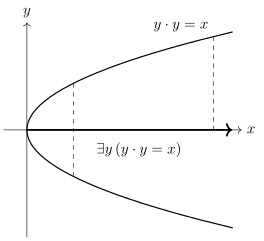
A formula with two free variables defines a set of
pairs, and a set of pairs of reals can be drawn. In
, the
formula defines , a parabola lying on its side. The
formula has the one free variable , and by (S7) it is true
of exactly when
some puts the
point on the
parabola. So it defines the set of first coordinates of
the points of the parabola: its shadow
on the -axis,
.
The dashed segments drop two points, and , and the point
, onto their
shadows and . No point of the
parabola lies above a negative , so no negative number
is in the shadow.
In general, defines the projection
of the set that defines: is in it exactly when
some puts in ’s set, by (S7).
Dually, keeps the whose whole vertical
line lies in ’s set, by (S6).
This is the picture behind every in a definition:
to show a set definable, it is often easiest to describe
a set of pairs and project.
The two readings are tied by negation. By (S4), (S6)
and (S7), is satisfied exactly when
is not, so the set defined by is
the complement of the projection of the complement of
’s set:
remove ’s
set from the plane, take the shadow of what is left, and
keep the points of the axis that are not in that
shadow.
Quick check. In , which
set does define?
Solution. . The least
value of
is , at , so holds for every
exactly when
. In the
picture: the vertical line at lies wholly in the
region
when , and
the line at a positive leaves it near .
A common task in mathematics is to turn a notion
described in words into a formula, and the skill is the
reverse of reading back. The notion must be said using
only the symbols of the structure, and every variable
that is not the defined set’s own must be bound.
In (c) the formula is used inside a
larger formula, as a word is used in a sentence. This is
how definitions accumulate: each defined notion is an
abbreviation, and the full formula is the abbreviation
written out.
Defining a notion goes in three steps. First, say the
notion in words that use only the structure’s symbols:
“upper bound” becomes “every element of is at most ”. Second, write each
auxiliary notion as a formula with its own free
variable, and substitute it where it is used, renaming
bound variables so that nothing is captured. Third,
check both directions on a small case. The commonest
slip is a variable left free. Written without its , the formula
has two free variables and defines a set of
pairs, those with or ; it is not a
property of at
all.
A defined notion can also be given its own symbol, as
“even” and “the supremum of ” are in ordinary
mathematics. Section 5.8 showed (Proposition 5.8.2)
that such a definition is safe: introducing a predicate
symbol by , or a constant for an
element that is proved to
have, proves nothing new about the old symbols.
Definability says which notions can be so introduced in
a given structure: exactly those some formula of its
language defines.
Warning. Greatest is not maximal. A
maximal element has nothing strictly above it; a
greatest element is above everything. In the
divisibility order on ,
is maximal and not greatest. Writing for
“maximal” defines the wrong set: in that order it
defines ,
while the maximal elements are and .
Quick check. In the divisibility
order on , which elements are maximal? Is there a
greatest element?
Solution. and : neither divides any
other element of the set. There is no greatest element:
does not divide
, and does not divide .
Isomorphic
structures (second pass)
This half of the section is for a second reading. It
asks when two structures are the same except for the
names of their elements, and proves that such structures
satisfy the same sentences. From that comes a way to
show that a set is not definable. It
uses functions and bijections in their everyday sense: a
rule that sends each element to one element, and, for a
bijection, one that matches the two domains one to one,
every element of the second domain hit exactly once.
Definition
7.5.2 (Isomorphism of Structures)
Let and
be structures
for the same symbols, with domains and . An
isomorphism is a
bijection such that
- (i) for
each constant ;
- (ii) for each function symbol of arity and all ;
- (iii) if and only if , for each predicate symbol
of arity and all .
An isomorphism is an automorphism of
. and are
isomorphic if an isomorphism exists.
In words:
renames every element, and the renaming carries each
constant to the corresponding constant, each operation
to the corresponding operation, and each relation onto
the corresponding relation, in both directions.
Clause (iii) is needed in both directions. The
identity map , , from with
empty to
with , is a bijection, and it sends every pair in
the first relation into the second, since there are
none. Yet the sentence is false in the first structure and true in
the second. The converse half of (iii) fails at , and with it the
map is not an isomorphism.
Examples. and the even numbers with are isomorphic, by
: every
even number is
for exactly one ,
and if and
only if .
A finite example, with the bijection as a table:
On the left,
has and ; on the right is
, with an arrow from to when . The table is a
bijection, and it sends the three arrows on the left
exactly onto the three on the right. A non-example:
,
from to
itself, preserves in both directions
and is one to one, but it is not onto: nothing is sent
to . So it is not
an automorphism.
Theorem
7.5.1 (Isomorphic Structures Satisfy the Same
Sentences)
Let be an isomorphism. For every formula and every
assignment in
, where gives each variable the value . In
particular, if and only if , for
every sentence .
In words: renaming the elements, consistently,
changes the truth of nothing.
The theorem is most often used backwards: a sentence
true in one structure and false in another shows that
the two are not isomorphic. The
sentence , “every element is a sum of two
equal ones”, is true in (take ) and false in
(at ), so no bijection
carries
addition to addition, although bijections exist
(Sets, Relations, and Cardinality, Chapter 3).
The converse of the theorem fails: two structures can
satisfy the same sentences without being isomorphic, and
the optional Section 7.6 meets such a pair.
The proof is in the fold below.
↺Second readingThe
proof: terms, then formulas
Idea. An induction on terms and
then on formulas, of the kind Section 7.1 gave for Lemma 7.1.1.
Each clause of the definition of isomorphism carries one
kind of atomic formula across; injectivity carries
equations back; and in the quantifier cases, as runs over , its image must run over all of
, which is what
“onto” gives.
Proof. Terms. First, for every term , by induction on . For a variable , both sides are , by the
definition of . For a constant, this is clause (i). For
, clause (ii) and the hypothesis for give
Formulas. Structural induction on , with the claim
stated for all assignments at once, since the
quantifier clauses change the assignment.
Atomic. By (S1), means that the tuple of the values is in
. By clause
(iii) that holds exactly when the tuple of their images
is in , and
by the claim for terms the images are the values :
this is (S1) for . Equations. implies ; the converse holds because is
injective. With the claim for terms,
this is (S2) on both sides. is satisfied on
neither side, by (S3).
Connectives. The answers for and agree on the two
sides by hypothesis, and (S4), (S5) combine them by the
same rule on both sides.
Universal quantifier. holds if and only if for every , by (S6); by the hypothesis, applied to
the assignment , if and only if for every . Now : both give the value and every other
variable the
value .
As runs over
, runs over
all of , because is
onto. So the condition says that for every , which is (S6)
for .
Existential quantifier. The same, with (S7):
some works
on the left exactly when some works on
the right, and every is such an , since is
onto.
For a sentence, Lemma 7.1.1
makes the assignment irrelevant on both sides, which
gives the last sentence of the statement.
Quick check. Why can no sentence in
the symbol
tell
from the even numbers with ?
Solution. Doubling is an
isomorphism between them, so by Theorem 7.5.1
they satisfy the same sentences.
What an
automorphism cannot move (second pass)
An automorphism is a renaming of a structure onto
itself. By the theorem, a formula cannot tell an element
from its image.
Corollary
7.5.2 (Automorphisms Preserve Definable
Sets)
If is an
automorphism of
and
is definable in , then for every , if and only if
.
Proof. Let , with free
variable , define
, and let be an assignment
with .
By Theorem 7.5.1
with ,
if and only if . The first says ; since ,
the second says .
So to show that a set is not
definable, find an automorphism that moves an element of
it to an element outside it.
Example
(Zero Cannot Be Defined from the Order of the
Integers)
In ,
the shift is an automorphism: it is a bijection, with
inverse , and if and only if . It sends to , and . By Corollary 7.5.2,
is not
definable in : no formula in alone singles out
zero among the integers.
Contrast . There is definable, by , “nothing is below ”. The corollary is not
contradicted, since is not an automorphism of : it is not
onto.
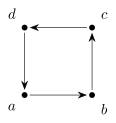
A finite picture: the four-cycle below, with and
the four arrows
.
The rotation , , , is a bijection that sends each arrow to an
arrow and each non-arrow to a non-arrow, so it is an
automorphism. Applied once, twice or three times, it
moves any element to any other, so no single element is
definable.
A minimal change makes one element definable again.
Add the loop
to . Now defines , and the rotation
is no longer an automorphism, since it sends the arrow
to , which is not an
arrow. The method can only use the automorphisms a
structure has; each of the three non-trivial rotations
sends the loop to a loop at , or , so adding one arrow
removed all three.
Warning. An automorphism shows that
a set is not definable; it never shows
that one is. That no automorphism moves a set is not
evidence that a formula defines it. To show a set
definable, write the formula.
Quick check. In the four-cycle,
where does the rotation send the set ? Could be
definable?
Solution. The rotation sends to and to , so it moves to . By
Corollary 7.5.2,
is not
definable. Its complement is not definable either, by the same
rotation.
Exercises
A. Check your
understanding
Exercise
(A1)
- (a) Define “ is
definable in ”.
- (b) Write formulas
defining, in , the even numbers and the set .
- (c) Why does a
formula with two free variables define a set of pairs,
and not a set of elements?
- (d) (Second
pass.) State Theorem 7.5.1.
- (e) (Second
pass; key proof.) Where does the proof of Theorem 7.5.1
use that is onto,
and where that it is injective? What goes wrong for
on
?
- (f) (Second
pass.) Why does show undefinable in
but not
in ?
Solution. (a) Some formula
with free
variable (at
most) defines it: , for any assignment (Definition 7.5.1).
(b) , “ is a sum of two equal
numbers”; , “
added to itself is itself”.
(c) Its truth depends on the values of both
variables (and, by Lemma 7.1.1,
on nothing else), so it is true or false of pairs of
values.
(d) If is an isomorphism, then
if and only if , for every formula and every
assignment in
; in particular
and satisfy the same
sentences.
(e) Onto: in the and cases, so that
runs over all
of as runs over . Injective: in the
equation case, to go from back to . The map is not onto, and the case fails: is satisfied when has the value , and not when has the value , because the
element below
is exactly the
one the map never reaches.
(f) It is an automorphism of and moves
; it is not an
automorphism of (not onto), and in the set is in fact
definable, by .
Exercise
(A2: Drill)
Each part takes a line or two. Parts (a)–(f) belong
to the first half of the section; parts (g)–(l) to the
second half (second pass). They run from reading a
formula, through writing one, to judging maps and using
them.
- (a) What subset of
does define in ?
- (b) Define in .
- (c) Define the pairs
with in
.
- (d) In ,
which set does define? In ?
- (e) Write “ is maximal” and “ is greatest” for a
partial order .
- (f) In , is . What does
define?
- (g) Is an isomorphism
from to
the even integers with ?
- (h) Is an automorphism
of ? Of
?
- (i) Using (h), is
definable
in ?
- (j) Is that
consistent with (b)?
- (k) has and
. Which singletons are definable?
- (l) Are and isomorphic?
Give a sentence that shows it.
Solution.
(a) The multiples
of .
(b) .
(c) ,
“ is plus
something”.
(d) , “nothing is
below ”; , since every
integer has a smaller one.
(e) ; .
(f) , the shadow of
the unit circle on the -axis.
(g) Yes: a
bijection onto the evens, and if and only if
.
(h) Not of : , but . Yes of
: it is a
bijection (its own inverse), and .
(i) No: the
automorphism sends
to .
(j) Yes: sends to , so it does not move
.
(k) , by ,
“something points to ”. Not or : swapping and (and fixing ) is an
automorphism.
(l) No. , “there is a least element”, is true in
and
false in ; isomorphic structures would agree on
it.
B. Practice
Exercise
(B1: Define it by a formula)
Define by a formula, and read each formula back in
words. Parts (i)–(iii) are in ; parts (iv)
and (v) are in , with
a one-place symbol.
- (i) “ divides ”.
- (ii) “ is a square”.
- (iii) “ and have no common divisor
except ”.
- (iv) “ is bounded above”.
- (v) “ has a supremum that is
not in ”.
Solution.
(i) : “ is
times
something”.
(ii) : “ is
something times itself”.
(iii) : “every
common divisor of
and is ”. The consequent is
of Example (Sets Defined by Formulas)
(c), with its bound variable renamed to : written with the bound
of , it would capture the
free . (At every is a common divisor, so
the formula fails, as it should.)
(iv) , with
the
upper-bound formula : “some is at least every
element of ”.
(v) : “some least upper bound of is not in ”.
Marking scheme. (10 points) 2 for
each part: 1 for the formula, 1 for its reading back,
with any auxiliary formula (, ) written out or cited.
Fatal error (0 for the part): a free variable left over
that is not one of the defined set’s.
Exercise
(B2: What does this formula define?)
Describe the set each formula defines.
- (i) in .
- (ii) The same
formula in .
- (iii) in .
- (iv) in .
- (v) in , and in .
Solution.
(i) All of : every real number
has a real cube root.
(ii) The cubes,
.
(iii) : at , for every
; at , the instance
fails.
(iv) All pairs
with . In , always exists,
and it is non-zero exactly when . The same formula
defined in
(Example (Sets Defined by Formulas)
(b)); in , where
a negative is
available, it defines something else.
(v) In , : between and any larger lies . In , all of : take .
Marking scheme. (10 points) 2 for
each part; in (iv), full marks require noticing that
is not . Fatal error (0 for
the part): an answer that ignores the structure, such as
the same set for both structures in (v).
Exercise
(B3: Automorphisms of small structures)
(Second pass.)
- (a) Find every
automorphism of : ,
, the answer given to
Exercise (B1: Construct a relation, or show none exists, used later)
(ii).
- (b) Which singletons
and which two-element subsets of does that leave
possibly definable? Define those that are.
- (c) Is an
automorphism of , with
a constant?
Solution. (a) An
automorphism sends related pairs to related pairs and
unrelated pairs to unrelated pairs. is the only element
related to nothing, so it must go to . is the only element
related to itself and to nothing else, so it must go to
. That leaves
and , which may stay or be
swapped, and both choices preserve . So there are two
automorphisms: the identity, and the swap of and .
(b) and are not definable: the swap moves them.
is defined
by ; by . Among the
two-element sets, is defined by , “
is related to something else”, and by its
negation . The other four,
, , , , are moved by
the swap, so none is definable.
(c) No: it sends the value of the constant to
, and clause (i)
of Definition 7.5.2
asks .
Marking scheme. (10 points) 4 for
(a): both automorphisms, with the argument that and are fixed. 4 for (b):
each definable set with its formula, and each other set
with the automorphism that moves it. 2 for (c). Fatal
error (0 for (b)): claiming a set definable because no
automorphism moving it was found.
C. Going deeper
Exercise
(C1: The definable subsets of )
(Second pass.)
- (a) Prove that the
only subsets of
definable in by a formula with one free variable are
and .
- (b) Show that the
relation “” is definable in .
- (c) Why does (a) not
contradict (b)?
Solution. (a) and are defined by and . Conversely, let
be definable and
non-empty, with , and let . The shift is an automorphism of : it is a
bijection, with inverse , and if and only if
. It sends to , so by Corollary 7.5.2.
Since was
arbitrary, .
(b) , “ is
above with
nothing in between”. In it holds of exactly when and no integer
lies strictly between, that is, : if , an integer
with does
not exist; if , then lies between.
(c) The corollary, and the argument of (a),
concern sets of elements. “” defines a set of pairs, and a shift
moves each pair to another pair of the same
set, so the set of pairs is not moved. What (a) forbids
is a formula singling out some integers and not others;
(b) singles out a relation that every integer has to its
successor.
Marking scheme. (10 points) 5 for
(a): the shift shown to be an automorphism (bijective
and order-preserving), then the corollary applied. 3 for
(b), with both directions checked in . 2 for (c). Fatal
error (0 for (a)): using , which does not preserve .
Exercise
(C2: Challenge: the automorphisms of )
(Second pass.)
- (a) Show that , and for each
rational , are
automorphisms of .
- (b) Deduce that the
only subsets of
definable in by a formula with one free variable are
and .
- (c) Show that is definable in , with
a constant, but
not in .
Solution. (a) Both are
bijections of ,
with inverses and , and both preserve in both directions:
if and
only if ,
if and only if .
(b) The translations alone suffice: given
in a non-empty
definable set and
any ,
the automorphism sends to , so by Corollary 7.5.2.
As in C1, .
(c) In the formula defines it. In
it is
neither
nor , so by (b)
it is not definable.
Marking scheme. (10 points) 3 for
(a), 4 for (b), 3 for (c). Fatal error (0 for (b)): an
argument with alone, which fixes and so cannot move
to anything
else.
R. Review
Exercise
(R1)
Decide whether each sequent is derivable, and justify
your answer.
- (a) .
- (b) .
Solution. (a) Not
derivable. Look for a refuting row, backwards from the
conclusion:
is false only when and . The premise must then be true, so
its hypothesis must be false, which needs . In the
row ,
,
, the
premise is , true, and the conclusion is , false. By Corollary 4.7.3
there is no derivation.
(b) Derivable. The goal is an implication,
so open a box on ;
the premise is waiting for , which a box on produces by repeating
(the
goal-directed and premise-directed steps of the search
method of Section 3.1).
1
2asm, for
3asm, for
4 2
5 3–4
6 1, 5
7 2–6
The row method of (a) could not settle (b): no row
refutes it, and only a derivation (or Theorem 4.8.4)
shows it is derivable.
Exercise
(R2)
Derive without
and
without derived rules that use it. Which rule would you
need to derive itself?
Solution. The goal is a
conjunction, so derive each conjunct. Each is a
negation, so each gets a box,
whose goal is .
The only way to use the premise is to
clash with it, so inside each box we build . In the
first box, from : a box on
clashes with and uses (the
pattern of Proposition 2.1.2).
In the second, from : a box on
simply repeats
. These are
the rules of Chapters 1 and 2 (Definition 2.2.1,
Definition 2.1.1,
Definition 1.4.1).
1
2asm, for
3asm, for
4 3, 2
5 4
6 3–5
7 6, 1
8 2–7
9asm, for
10asm, for
11 9
12 10–11
13 12, 1
14 9–13
15 8, 14
No is used.
To reach
we would need
from and
from , that is,
, which is derived with (Proposition 2.5.1),
or an box
directly (Definition 2.5.1).
The look-alike is Exercise (B1: Three searches)
(b), : there the conjunct needed , while
came by
alone. Here both conjuncts stop at a double negation.
That no derivation of (or of ) from the
premise avoids is true,
but we state it without proof, and nothing depends on
it.
Exercise
(R3)
Derive without .
Solution. The goal is , so open a
flagged box with a fresh name (Definition 5.4.1);
the new goal is . Inside, run the
derivation of R2 (Exercise (R2))
with and
in place of
and . One change: the
premise is now , not , so
each clash first turns
into by at
(Definition 5.5.1).
1
2asm, for
3asm, for
4 3, 2
5 4
6 3–5
7 6
8 7, 1
9 2–8
10asm, for
11asm, for
12 10
13 11–12
14 13
15 14, 1
16 10–15
17 9, 16
18 2–17
The side condition of at
line 18: does
not appear in the premise on line 1, no box is open at
line 18, and
does not appear in the conclusion. The flagged box
immediately contains the box of
line 2, so it is cited from line 2, the first line of
that inner box. Lines 7 and 14 are legal
steps: is . The whole derivation is
R2’s, run inside a flagged box, with an
before each clash.
Exercise
(R4)
Is the sentence true in ? Is it
derivable?
Solution. True in ? No. The
hypothesis is true in : each has above it. The
conclusion is false: a candidate
fails at , since is false. By
(S5) of Definition 7.1.3,
an implication with a true hypothesis and a false
conclusion is false.
Derivable? No. By the soundness statement of
Section
7.2, a derivable sentence is true in every
structure; this one is false in , so no
derivation exists.
Why these tools. A structure settles the
question in two lines, while a derivation search could
only fail, and a failed search proves nothing. A truth
table is the wrong look-alike: it reads the sentence as
with two
atoms, and a refuting row for says nothing
here, since the sentence has the same shape and is derivable (Proposition 5.5.1,
then ). The
soundness statement used here is proved in Section
7.3.