Section 5.5 gave the rule that proves an existential
statement: exhibit a witness, and forget it. This
section gives the rule that uses one,
. It is the last of the four quantifier
rules, and the subtlest, because an existential says
that a witness exists without saying which one it is.
The rule handles this with a box and a fresh name, as
did, but the name now stands for an object
that is not arbitrary, and the side
condition keeps it from being treated as if it were.
With the rule in hand, the section moves an past a , and shows
exactly where the reverse move breaks down.
Using a
witness whose identity is unknown
Chapter 2 proved that if is even then is even (Theorem 2.1.3).
One of the facts it rested on, (E3), says that the
square of an odd integer is odd, and it was shown by
taking “an integer with ” and computing
with it. Chapter 2 noted that naming the of (E3) lay outside its
derivation: it is a quantifier step, whose rule had to
wait. Here is the simplest proof with the same step.
If is
even, then is
even. Since
is even, choose an integer with . Then , so is even.
The hypothesis is . The proof does not know
which integer is;
it does not need to. It gives the unknown witness a
name, uses the one fact it has about it, , and reaches a
conclusion, “
is even”, in which the name no longer appears. The
witness of
the last step is forgotten by , as
in Section 5.5.
Why is this correct? Two tempting shortcuts show what
the proof is careful not to do.
- It does not name the witness by a term that already
means something. From “some integer is even” we may not
conclude “ is
even”: the existential does not say that the witness is
, and, as the
warning “ runs one way only” of Section 5.5 noted, it
cannot be read back as a statement about a named
object.
- It does not let the conclusion mention the name. If
it did, the conclusion would be a statement about , and outside the
argument refers
to nothing; the existential promised only that
some works.
So the name must be new, the argument may use only
what the existential says about it, and the conclusion
must not mention it. Then the argument works for the
witness, whichever integer it is, because it never used
anything else about it.
The rule of
existential elimination
To use “there exists”, give the witness a new
name, assume only what the existential says about it,
and conclude something that does not mention
it.
Definition
5.6.1 (Rules for the Existential
Quantifier)
asm, for
, –
The rule on the left is
(existential elimination). It cites a
line holding
and a flagged box with the name , a variable, whose
first line is the assumption and whose
last line , a line
of that box itself, is ; line and the box must be
available at line
(Definition 1.4.2,
with the flagged boxes of Section 5.4). The new line
repeats . Side condition, at
line : the name
does
not appear
- in ,
- in ,
- in any premise, or
- in any assumption of a box still open at
line .
The rule on the right is ,
recalled from Definition 5.5.1:
is any term free
for in .
The box of is
the flagged box of Section 5.4 with one difference: it
opens with an assumption, , “ is a witness”. The
flagged box of had
no assumption, because “let be arbitrary” assumes
nothing about .
The citation “
, –” names the line of the
existential and the box, as names
its disjunction and its boxes. “Appear” is the word of
Section 5.2: written anywhere in the formula, after a
quantifier symbol included. In a finished derivation the
box’s assumption is printed “asm, for ”;
read it as “choose with …”.
In practice, two habits make every
clause of the side condition hold: name the witness with
a brand-new letter, written nowhere in the derivation so
far, and make sure the box’s last line does not mention
it. Clauses 3–5 below, the side condition, are the
official test, the one a checker runs.
This rule has conditions that matter; read each
one.
- The assumption. The box assumes
: the
formula of the existential, with the new name in place
of . This is
“choose with
”. It is the
only thing the box knows about .
- The last line. The box ends with
, a line of the
box itself, not of a box inside it, as for and
. It is “whatever the witness is, follows”. The new
line then asserts
outside the
box, where is
no longer assumed to be anything.
-
does not appear in . The box
shows that
follows from “
is a witness”; if mentioned , line would make a claim
about a name that, outside the box, is tied to nothing.
The subsection “Three ways to break the rule” below
shows the damage.
-
does not appear in a premise or in an assumption of an
open box. The name must be new to everything we
know at line . If
a premise or an open assumption already said something
about , the
assumption would add
to it a claim that is
the witness, which the existential never made.
-
does not appear in . The existential must not
itself mention the name chosen for its witness. This
clause also makes free for in (Section 5.2: a
variable that does not appear in is free for every
variable there), so the assumption says of
exactly what
says of
.
- “Still open at line ”. The box’s
own assumption is closed
at line , so it is
not among the assumptions checked. This matters: read
inside the box, “an open assumption” would include , which
contains
whenever is free
in , and the
rule could then never be applied in the cases that
matter.
A first witness:
is even
Here is the proof above as a derivation, over , with “ is even” written and the computation as one line justified
“arith” (Section 5.3). The premise is an existential, so
its box opens first, aimed at the goal (left); the goal
is postponed until a line shows its witness (right).
1
2asm, for
4?
5?
1
2asm, for
3arith 2
4?
5?
1
2asm, for
3arith 2
4 3
5 1, 2–4
At line 5,
is not in line 4, not in the existential of line 1,
which is also the only premise, and no box is open. The
derivation and the proof match sentence for
sentence:
| 1 |
“Since is
even, …” |
| box , 2 |
“… choose an integer with .” |
| 3 |
“Then , …” (arith) |
| 4 |
“… so is
even.” (, the witness ) |
| 5 |
(unwritten: the conclusion does not mention , so the box
closes) |
Quick check. Could line 5 have been
, closing the box one line earlier?
Solution. No: that line mentions
the witness ,
which breaks clause 3. Outside the box names nothing; must
forget it first, as line 4 does.
One box instead
of many cases
The long “or” of Section 5.1 shows why the rule has
this shape. Over a domain whose elements are named and , says
, and
(Definition 1.6.1)
would use it by proving the goal twice, once in each
case. The cases look alike, so they can be done once,
with a name that could be either.
1
2
3asm, for
4 2
5 4, 3
6 5
7asm, for
8 2
9 8, 7
10 9
11 1, 3–6, 7–10
1
2
3asm, for
4 2
5 4, 3
6 5
7 1, 3–6
On the left, Section 1.6’s rule over the two named
elements; on the right, the same argument by .
Each case box on the left is the box on the right with
or in place of . Because is fresh, one box
serves for every element, named or not, and for domains
that cannot be listed.
Using an
existential: open the box early
When a resource is , the
premise-directed step of the search method is to open
its box at once, with a fresh name , and to make the
box’s last line the current goal.
Inside the box, the assumption is a new
resource, and the name is a new term for
later steps to use.
Name the witness early: open the box
as soon as the existential is available, and aim it at
the current goal.
Why early? Opening early keeps every resource, since
every line available before the box is available inside
it; and a box aimed at the current goal can always be
closed once the goal is reached, since its name was
chosen fresh. What the early box gives is the witness’s
name, often exactly the term a postponed goal is waiting
for.
↺Second readingWhy
opening early is safe
And a box aimed at the current goal can always be closed
once is
reached: is
chosen, when the box opens, to appear in no premise, in
no open assumption, not in and
not in the current goal . The assumptions
still open at the line that closes the box are the ones
that were open when it opened, so every clause of the
side condition holds there. (One caution: a
inside the box needs a flag that does not appear in the
new assumption; a flag that is fresh at that point has
this property.)
The first result is the derivation that this step
writes almost by itself.
Proposition
5.6.1 (Some Distributes Over And, One
Way)
.
Idea. The premise is an
existential, so open its box first, with a fresh , and aim it at the
goal. Inside, the assumption
splits by , and each half is an instance of one
conjunct of the goal, with the witness . The goal does not
mention , so the
box closes.
1
2asm, for
7?
8?
1
2asm, for
3 2
4?
5 2
6?
7 4, 6
8?
Proof. The following is a
derivation.
1
2asm, for
3 2
4 3
5 2
6 5
7 4, 6
8 1, 2–7
Line 2 is the assumption for . Lines 4 and 6 are with
the witness . At
line 8, does
not appear in line 7, in line 1 (which is also the only
premise), or in any assumption of an open box (none is
open). So line 8 is a correct , and
the derivation has 8 lines.
Notice where the witness went. It was used twice
inside the box, as the witness of two different
existentials, and then forgotten twice. The conclusion
records that something has and something has , and no longer that it
is the same thing.
Quick check. Is ? Run the search, and say where it
stalls.
Solution. The premise splits by
into and . Opening both boxes early gives the
assumptions
and, for the second box, a different
name, : the
second box is opened while the first is open, so appears in an open
assumption and may not be reused. The postponed goal
needs one term with , and the
resources speak of two names, with nothing to say that
they are equal. The search stalls there. It must: over
, with as “even” and as “odd”, the premise
is true and the conclusion, “some integer is both even
and odd”, is false. That is a counter-reading (Section
5.3).
Three ways
to break the rule
Each of clauses 3, 4 and 5 can be seen failing, and
each failure leads from premises that are true, under
the reading given, to a false line. Here is clause 3,
beside a correct use of the same premise; the fold after
it breaks clauses 4 and 5.
The conclusion clause (3). Over , “some number exceeds
” is true. Let the
box end in the line , which
mentions its own witness:
1
2asm, for
3 1, 2–2
4 3
5 4–4
1
2asm, for
3arith 2
4 3
5 1, 2–4
Line 3 breaks clause 3. Every other line is legal: in
particular line 5 is a correct ,
since appears
in no premise and in no open assumption (there is none),
and not in line 5. Over the conclusion says
that every number exceeds , which is false at
. Once the name
leaves its box, it can be generalized over as if it were
arbitrary.
On the right, a correct use of the same premise: the
box ends in , which forgets the witness before the
box closes, and the conclusion is true over .
A small world in which the premise is true and
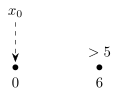
the line that breaks clause 3 is false. The label “” is the one-place
predicate
( is not a dot);
the dashed arrow gives the value . The premise is true
(at ); line 3,
, is
false; so is line 5 (at ).
Quick check. In the clause-3
derivation, line 5 is a correct , yet
it is false in the picture. Which line is to blame, and
why does a correct step not save the derivation?
Solution. Line 3, which closes the
box with a line that mentions its witness.
is safe only when the last line of its box,
here line 4, is true whatever names. Line 4 is
copied from line 3, and both are false when names . So line 5 inherits the
error from line 3; it is not a new one.
↺Second readingClauses
4 and 5, broken
The premise clause (4). Over , with read as “even” and the
variable read
as , both premises
below are true: some number is even, and is not even.
1
2
3asm, for
4 3, 2
5 1, 3–4
Line 5 breaks clause 4: appears in the
premise on line 2. The box assumed that , which the premise
had already described as odd, is the even witness, and
derived a contradiction from that assumption, not from
the premises.
The existential clause (5). Over , with read as “”, the premise
below says that every integer has a smaller one:
true.
1
2 1
3asm, for
4 3
5 2, 3–4
Line 2 is a legal at
the term . Line
5 breaks clause 5: the existential on line 2 is with
, and appears in it. The
assumption on line 3
is : the
box has assumed that the witness smaller than is itself. The
conclusion says that some integer is less than itself,
which is false. The other clauses hold at line 5: is not in , not
in the premise, and no box is open.
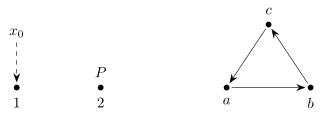
Two small worlds, one per clause: in each, the
premises are true and the line that breaks the clause is
false. Left, clause 4: the dots and , with (“even”) true at only, and naming ; both premises, and
, are
true, and the line is false, as always.
Right, clause 5: three dots, an arrow from to meaning ; the premise
is true, since every dot has an arrow into
it, and the line is false, since there is no
loop.
A fourth illegal pattern, a second witness given a
name that an open assumption already uses, is the error
of the warning “Two witnesses, one name” below.
Warning. The witness is not
arbitrary. The flagged boxes of and
look alike: both introduce a fresh name.
Their names mean opposite things. In a box,
is
any object, and what is proved about it
holds for all. In an box,
is one
particular object, the witness, about which we
know
and nothing else; what is proved about it holds for it
alone. From “some integer is even” nothing follows about
every integer, and the rules agree:
1
2asm, for
3 2
4 3–3
5 1, 2–4
Line 4 is blocked: appears in the
assumption
of the box, which is still open at line 4. That
clause of is what keeps a witness from being
generalized over inside its box; clause 3 of ,
that not appear
in , keeps it
from leaving the box (the derivation for clause 3
above).
Here are three more derivations, each with an Idea
saying why each rule was chosen: two for part (a), one
for each direction, and one for part (b).
Example
(Derivations with existential elimination)
Show that:
- (a) ;
- (b) .
Solution.
- (a) Idea.
The premise is an existential: open its box first.
Inside, the assumption is a
disjunction, and the premise-directed step for (Section 1.6) opens
two cases, each ending in the current goal. In each case
one side of the goal has an instance with the witness
, so and
finish it.
1
2asm, for
9?
10?
1
2asm, for
3asm, for
5?
6asm, for
8?
9 2, 3–5, 6–8
10?
1
2asm, for
3asm, for
4 3
5 4
6asm, for
7 6
8 7
9 2, 3–5, 6–8
10 1, 2–9
Line 9 is (Definition 1.6.1),
and it is the last line of the box
itself. At line 10, is in neither line 9
nor line 1, and no box is open.
Idea. Now the premise is a disjunction: first,
with two cases, each ending in the goal. In each case
the resource is an existential, so its box opens at
once, and inside it and
build the goal.
1
2asm, for
6?
7asm, for
11?
12 1, 2–6, 7–11
1
2asm, for
3asm, for
5?
6 2, 3–5
7asm, for
8asm, for
10?
11 7, 8–10
12 1, 2–6, 7–11
1
2asm, for
3asm, for
4 3
5 4
6 2, 3–5
7asm, for
8asm, for
9 8
10 9
11 7, 8–10
12 1, 2–6, 7–11
At line 6, the open assumption is line 2, which does
not contain ; at
line 11 it is line 7, which does not either. The name
is used in both
cases. That is allowed: when the second box opens, the
first has closed, and the side condition looks only at
the premises, the boxes still open, the existential and
the conclusion. Lines 6 and 11 are lines of the two case
boxes themselves, as
requires.
The two derivations mirror each other:
outside and inside in one, the other way round in the
other. Over a domain, both sides say that some element
has or . Contrast Proposition 5.6.1,
where only one direction holds: passes through
in both
directions and through in one.
- (b) Idea.
The goal is a negation, so the goal-directed step of
Section 2.2 opens a box on
(Definition 2.2.1),
with the goal .
Then the premise opens its box, aimed at . Inside, the witness
is the term at
which to instantiate both universal statements: the
premise gives , and the assumption gives , a clash.
1
2
3asm, for
9?
10 3–9
1
2
3asm, for
4asm, for
8?
9 1, 4–8
10 3–9
1
2
3asm, for
4asm, for
5 2
6 5, 4
7 3
8 7, 6
9 1, 4–8
10 3–9
At line 9, the box of line 3 is still open, so its
assumption is checked: does not appear in
it. Nor is in
, in line 1, or
in line 2. Read over with as “odd” and as “divisible by ”: some integer is odd,
no odd integer is divisible by , so not every integer
is divisible by .
The witness, whichever odd integer it is, is a
counterexample to “every integer is divisible by ”, and the derivation
never needs to know which.
Moving one
quantifier past another
Section 5.1 read and as games, and observed that the first
gives the second: if one works for every , then for every some works, namely the same
one. Here is that observation as a derivation, with the
letters of a two-place predicate. It shows, written out
in full, a pattern that later derivations of the chapter
use again and again and that later exercises leave more
and more of to the reader.
Proposition
5.6.2 (Some-All Gives All-Some)
.
Idea. Three moves, read off the
goal and the premise.
① Fix. The goal is : open a flagged
box with a fresh (Section 5.4); the
new goal is .
② Obtain. That goal is an
existential: postpone it. The premise is an existential:
open its box early, with a fresh , assuming ,
and aim it at the current goal .
Instantiate the assumption at the term the goal
mentions, : this
gives .
③ Choose. That line is an instance
of the postponed goal, with the witness : .
In the Givens/Goal table:
|
|
| + the fresh name (fix:
opens a box) |
: postponed |
| + the witness and
(obtain: opens a box) |
|
| +
( at ) |
✓ by , the
witness
(choose) |
1
5?
6?
1
2asm, for
4?
5 1, 2–4
6?
Before reading on: at the line that closes the
box, check each clause of its side
condition. Where could still
appear?
Proof. The following is a
derivation.
1
2asm, for
3 2
4 3
5 1, 2–4
6 2–5
Line 2 is the assumption for . Line 3 is at
. Line 4 is
with and the witness , which is free for
since has no
quantifier.
Line 5 closes the box,
whose last line, line 4, is a line of the box itself.
Its side condition holds: does not appear in
, nor in the existential of line 1, which is also the only premise;
and the one box still open at line 5, the flagged box of
, has no
assumption.
Line 6 closes the flagged box of by (Definition 5.4.1).
That box immediately contains the box,
so its range starts at line 2 (the convention of Section
5.4), and its last line, line 5, is a line of the box
itself, the instance . The name appears neither in
the premise nor in line 6, and at line 6 no box is open.
This proves the proposition.
The two names played opposite parts. The name is arbitrary: nothing
was assumed about it, and line 6 generalizes over it.
The name is the
witness: line 2 assumed everything the premise says
about it, and line 5 forgets it. The witness works for because it works for
every , which line
2 says. This is the shape of a great many proofs in
analysis, and it has a name.
Fix, obtain, choose: fix the arbitrary objects of
the goal (); obtain witnesses from the hypotheses
( and );
choose the goal’s witness from what is now available
().
Nothing in the proof used that the formula is : the same six
lines derive for any formula , which is the
derivation promised in Section 5.1; the fold checks the
substitutions.
↺Second readingThe
swap for any formula
For any formula and different
variables and
, with different
names and , other than and , that do not appear in
, the same
six lines derive . Line 2 is . Line 3 is ,
which equals ,
since the two substitutions put fresh names in for two
different variables and so do not interfere; so line 4
is with the formula and the
witness . The
fresh names are free for their variables, since neither
appears in ,
and the side conditions are checked as before. With the
letters and exchanged, this is the
derivation of to promised in Section 5.1.
↺Second readingEither
nesting works
Either nesting works. The derivation
opened the flagged box of first and the box
inside it. The other order is just as good.
1
2asm, for
3 2
4 3
5 3–4
6 1, 2–5
At line 5,
appears neither in the premise, nor in the open
assumption (its is a bound variable,
not ), nor in
line 5. At line 6, is not in line 5, not
in line 1, and no box is open. In this order the box
is aimed at the whole goal; in the first, at the goal
left inside the flagged box. Both are the search
method’s “open the box early”: early relative to the
goal that the box must reach.
The converse search stalls at a side
condition. Try . The
goal is an existential: postpone it; it will need a
witness and a
line . The premise is a universal, and to get an
existential out of it we must instantiate it at some
term. The natural routes then meet a side condition.
Here are two of them.
First route: obtain the witness, then try to
generalize. Instantiate at a name , open the box
on the result, and try to prove
inside it by :
1
2 1
3asm, for
4 3
5 4–4
6 5
7 2, 3–6
Line 5 is blocked: appears in the
assumption of the box,
which is still open. The witness was obtained
for , and the assumption
says so. Choosing a different flag, say , does not help: the
goal inside its box would be , and nothing
gives it.
Second route: fix first, obtain inside, and carry
the witness out. Open the flagged box of first, obtain inside it, and try to
close the box with a line about , so that can
then generalize over :
1
2 1
3asm, for
4 2, 3–3
5 2–4
6 5
Line 4 is blocked: appears in . Lines
5 and 6 would be legal on their own; the derivation
fails only because the witness escaped its box at line
4.
The two blocked lines are the two halves of one fact.
The witness is
obtained after
is fixed, so it may depend on ; the conclusion asks
for an chosen
before any , which
may not. This is the dependence that Section 5.1 read
off the order of the quantifiers, now visible as the
order of the boxes. A stalled search is not a proof that
no derivation exists. A counter-reading breaks the
claim: two dots
and , with read as “ differs from ”. Each dot has a dot
that differs from it, so the premise is true; no dot
differs from both dots, itself included, so the
conclusion is false.
↺Second readingRenaming
the bound variable of an existential
Renaming the bound variable of an
existential. Section 5.2 promised that a bound
variable at the front of a formula may be renamed, and
Section 5.4 derived the renaming for (the fold after
Example (Flagged boxes at work)).
Here is the derivation for . Let be a formula and
, variables, with not appearing in . Then Take a fresh name , a variable different
from and that does not appear in
, as in
Section 5.4. Both directions use one fact about
substitution: since does not appear in
, each free
of stands where
had a free
, and nowhere
else, so putting a term in for those ’s gives ; that is,
. (It is a structural induction of
the kind in Section 5.2, one clause at a time.)
1
2asm, for
3 2
4 1, 2–3
1
2asm, for
3 2
4 1, 2–3
In the left derivation, line 3 is with
the formula , the
variable and the
witness : by the
fact, is
line 2. The witness is free for , because the
quantifiers of are those of
, and none
of them is on .
In the right derivation, line 2 is the assumption of the
box for the existential ,
which is ,
that is by the
fact, and line 3 is with
, and the witness , which is free for
since it does not
appear in .
In both, line 4 is a correct :
does not appear
in , so it
is in neither line 1 nor line 3, and no box is open.
So and can each be derived from the other,
as the recipe of Section 5.2 assumed.
Two
witnesses
A proof often obtains several witnesses, one from
each existential hypothesis. Each needs its own box and
its own name.
Example
(The sum of two even integers is even)
Over , with
“ is even” written
, derive
Solution. Idea. Both
premises are existentials: open both boxes early, the
second inside the first, with different
names and . The goal is an
existential: postpone it. Inside both boxes the
resources are and , and arithmetic gives , which shows the witness: the compound
term .
1
2
3asm, for
7?
8?
1
2
3asm, for
4asm, for
6?
7 2, 4–6
8?
1
2
3asm, for
4asm, for
5arith 3, 4
6 5
7 2, 4–6
8 1, 3–7
Line 5 is one line of arithmetic: from and , substituting
and factoring gives . The substitutions
are steps of the rule , which
arrives only in Section 5.7, so here the whole
calculation is one line justified “arith”, citing the
two lines it uses. Line 6 is with
and the witness .
At line 7 the only box still open is the outer one,
whose assumption is line 3; appears neither in
it, nor in the premises on lines 1 and 2 (line 2 is also
the existential cited), nor in line 6. At line 8, appears neither in
line 7, nor in the premises (line 1 is the existential
cited), and no box is open. The derivation has 8 lines.
The written proof is three sentences: Choose with , and with . Then . So
is
even.
Solution. The inner box would then
be flagged with
the assumption , and line 7 would close it by . At
line 7 the outer box is still open, and its assumption
(line 3) contains . That breaks the
clause “ does
not appear in any assumption of a box still open at line
”. In words: the
second witness would be assumed to be the same integer
as the first, so
and would be
forced equal, which the premises never said.
A
contradiction trapped in a box
An box may end in . The contradiction
is found inside the box, about the witness, and leaves
it as , which
mentions no name. The best-known instance is a theorem
of pure logic.
Theorem
5.6.3 (The Barber)
For every two-place predicate symbol ,
Try it first (five minutes): the goal is a
negation.
Idea. The goal is a negation: open
a
box on the existential, aimed at . Its assumption is
an existential: name the witness early, , aiming the box
at the same .
Inside, an attempt that instantiates the universal at
some other term
gets , and nothing
clashes with it; the one term that makes both sides
speak of the same thing is itself. The instance
says that holds exactly when it does not, and a
statement equivalent to its own negation is
contradictory (Lemma 2.4.2).
1asm, for
10?
11?
1asm, for
2asm, for
9?
10 1, 2–9
11?
Proof. The following is a
derivation with no premises.
1asm, for
2asm, for
3 2
4asm, for
5 3, 4
6 4, 5
7 4–6
8 3, 7
9 8, 7
10 1, 2–9
11 1–10
Lines 4–9 are lines 2–7 of the derivation of Lemma 2.4.2
at the statement , with line 3 in place of its assumption.
At line 10, is
not in , not in
the existential of line 1 (its is bound), and there is
no premise; the only open assumption, line 1, does not
contain . This
proves the theorem.
Read as
“ shaves ”: nobody shaves exactly
those who do not shave themselves. The old puzzle of the
barber who does is answered by this theorem: there is no
such barber. Read the domain as consisting of sets and
as : no set has as
its elements exactly the sets that are not elements of
themselves. For sets this is Russell’s theorem, which
Sets, Relations, and Cardinality, Section 1.1
proves as a theorem about sets. Neither reading was used
in the proof, which holds for every ; the “paradox” is
eleven lines of logic, and its conclusion is that
something does not exist.
Quick check. In the proof of Theorem 5.6.3,
lines 3–9 are all about . Why may line 10
close the box?
Solution. Its last line, , does not mention
(clause 3);
appears in no
premise and in no open assumption (line 1’s is bound), and not in
the existential of line 1 (clauses 4 and 5).
How this
rule looks in a mathematical proof
In a written proof, the box
is announced by “choose”, “let be such a point”,
“say ”, “fix
such a ”. The
assumption of the box is the property in the sentence,
and the rest of the paragraph is the inside of the box.
The claim the paragraph ends on, usually the clause
after the final “so”, must not mention the chosen name,
though the computation leading up to it may. If that
claim still mentions the name, the paragraph has not
finished: a later step must reach a claim without the
name before the box can close, often an that
forgets it (as in the example below), or a contradiction
(as in Example (Derivations with existential elimination)
(b)).
↺Second readingA
bounded sequence, rule by rule
Here is an instance from analysis. A sequence is
bounded if there is an with for every
. A proof
says:
Since
is bounded, choose with for all
. Then
for all , so is
bounded.
With the domain , the sequence as a
function symbol ,
and the bound on
written out by Definition 5.1.1,
the proof is this derivation.
1
2asm, for
3asm, for
4 2
5 4, 3
6arith 5
7 3–6
8 3–7
9 8
10 1, 2–9
The sentences match the boxes. “Choose ” opens the box
(line 2). “For all ” in the second sentence is the flagged box
of with its
box (lines 3–7, closed by line 8); the arithmetic is line 6. “So is bounded” is two
steps: with the witness (line 9),
which forgets the bound , and the close of the
box (line 10). The conclusion mentions neither nor , as the side
condition requires.
Warning. Two witnesses, one
name. “Let and be even, say and ” is a common error
in parity proofs. It gives two unknown witnesses the
same name, and the rest of the proof then uses an
equation the premises never gave. For instance it
“proves” that the sum of two even integers is divisible
by :
1
2
3asm, for
4asm, for
5arith 3, 4
6 5
7 2, 4–6
8 1, 3–7
Line 7 is blocked: appears in the
assumption of the outer box, still open at line 7.
With and
, both
premises are true and is not divisible by .
The four
quantifier rules on one card
Example
(Instances of )
|
() |
|
|
|
() |
|
|
|
() |
|
|
Inside each box the last line is reached from the
assumption (in the first by arith, , and ; in
the second by ,
at
and ; in the third by arith from ), and none mentions its name.
Not an instance. From , a
box that opens with : the assumption must be ; assumes the witness stands on the other
side of , which
the existential never said.
Chapters 1 and 2’s thirteen rules are on the card at
the end of Section 3.1. Here are the four quantifier
rules, with their side conditions. Section 5.7 collects
the whole table, and nothing later depends on the last
column.
|
|
free for
in |
“In particular, for , …”; “applying the hypothesis to , …” |
h t (or
specialize h t) |
|
box …
|
in no
premise, in no open assumption, not in |
“Let be
arbitrary. … Since was arbitrary, …” |
intro x |
|
|
free for
in |
“Take .
Then …”; “
will do.” |
use t (or
Exists.intro t h) |
|
, box … |
not in
, not in , in
no premise, in no open assumption |
“Choose with
. Then …”;
“let be such a
point.” |
obtain (or
Exists.elim h) |
↺Second readingChoosing
a name
The phrase “choose” is apt and slightly misleading.
We do not choose the witness, since we cannot see it; we
choose a name for it. A written proof
that says “choose ” promises the reader
that nothing more about will be used than the
property stated, and that will be gone by the end
of the argument.
Warning (Not allowed: ).
- “Close the box on a line that mentions its witness”:
clause 3 (the pair in “Three ways to break the
rule”).
- “Name the witness with a letter that a premise or an
open assumption mentions”: clause 4 (the fold “Clauses 4
and 5, broken”; the warning “Two witnesses, one
name”).
- “Name the witness with a letter that the existential
mentions”: clause 5 (the fold “Clauses 4 and 5,
broken”).
- “Open the box with an assumption other than ”: clause 1
(“Not an instance” in Example (Instances of )).
The decision chart grows by two rows:
|
open a flagged box with a brand-new name ; its last line is
;
close with |
instantiate at the term the goal, or another line,
names () |
|
postpone; use once
a line shows an instance |
open the box
at once, with a brand-new witness name, aimed at the
current goal |
The connective rows are the table of moves in Section
3.1.
The search method: one more step.
With this rule, each of the four quantifier rules has
added a step.
- Premise . Open the box
early, as soon as the existential is available, with a
fresh name and
the assumption ; make its
last line the current goal, which must not mention . Give every new
witness a new name.
In the Givens/Goal table, puts
a witness among the Givens, its name and its assumption
, and
leaves the goal as it was.
Exercises
A. Check your
understanding
Exercise
(A1)
These parts are about the proof of Proposition 5.6.2.
- (a) State as a
schema, with every clause of its side condition.
- (b) The proof opened
the flagged box of first and the box
of inside it.
Could they be opened in the other order? If so, does
every side condition still hold?
- (c) Answer the
Before reading on prompt of the proof: at line
5, where could
still appear, and does it?
- (d) In the two
attempts at the converse, , which
line is blocked in each, and by which clause of which
rule?
- (e) Give the idea of
the proof in two sentences.
Solution. (a) From on
line and a
flagged box with name , from the assumption
on
line to on line , a line of the box
itself, write
on line ,
justified “ ,
–”. Side condition at
line : does not appear in
, in , in
any premise, or in any assumption of a box still open at
line .
(b) Yes, either order works. In the other
order (the fold “Either nesting works” after the proof),
the box encloses the flagged box. At the
line, appears
in no premise, not in the open assumption ,
and not in the conclusion; at the
line, is not in
, not in the premise, and no box is open.
(c) At line 5, the clauses list four places:
, which is line
4, ; the existential of line 1, ; the premise, which is line 1 again; and the
assumptions of boxes open at line 5. The only box open
at line 5 is the flagged box of , which has no
assumption. The name appears in none of
these, so line 5 is correct. It does appear in lines
2–4, inside the box, which the side condition
allows.
(d) In the first attempt, line 5 ( over
) is blocked by
the clause “
appears in no assumption of a box still open”, since the
box’s assumption contains
. In the second,
line 4 () is blocked by the clause “ does not appear in
”, since .
(e) Fix an arbitrary and obtain the
witness of the
premise, for which holds for every , in particular for
. So is a witness for
, and since was arbitrary, follows.
Exercise
(A2: Drill)
Each part takes a line or two. The parts run from a
single step, through a missing line, a justification
column and steps to judge, to short derivations.
“Clause” means a clause of the reading of Definition 5.6.1.
- (a) A line is . Write
the first line of its box,
with the name .
- (b) Line 9 is ,
justified “ 3, 4–8”, and line 4 is the assumption .
What is line 3?
- (c) Justify each
line: 1 , premise; 2 , premise; in a box flagged : 3 ; 4
; 5 ; 6
; 7 ; 8 ; 9
; then, outside the box, 10 .
- (d) An box
for , named , ends in . May
it close with that line?
- (e) The premise is
. May the box
of
be named ?
- (f) Premises , . May
both boxes be named if one is inside the
other?
- (g) May two boxes
share a name if the first has closed before the second
opens?
- (h) Inside an box
with assumption , may
generalize over ?
- (i) Find the illegal
line: 1 , premise; in a box flagged : 2 , assumption; then
3 , 1,
2–2; 4 ,
3.
- (j) Derive .
- (k) Derive .
- (l) Derive .
Solution.
(a) The box
flagged ,
opening with the assumption .
(b) , with any bound letter in place of (one that does not
clash with or
).
(c) 3 assumption,
for ; 4 3; 5
2 (at ); 6 5, 4; 7
3; 8 7, 6; 9 8;
10 1, 3–9.
(d) No, clause 3:
the last line mentions .
(e) No, clause 4:
appears in a
premise.
(f) No, clause 4:
the inner box’s name appears in the open assumption
of the outer
one.
(g) Yes, as in Example (Derivations with existential elimination)
(a), .
(h) No: is in an open
assumption, which the second clause of
forbids; the witness is not arbitrary.
(i) Line 3,
clause 3: its box’s last line mentions . (Line 4 would be
legal; the conclusion is even derivable, with the
inside the box, but this derivation does not derive
it.)
(j) In a box
flagged : 2
, assumption; 3 , 2; 4
,
3; then 5 , 1,
2–4.
(k) In a box
flagged : 3
, assumption;
4 , 2; 5
, 4, 3; 6
,
5; then 7 , 1,
3–6.
(l) In a box
flagged : 2
, assumption; inside it, in a box flagged
: 3 , assumption;
4 , 3; 5
, 4;
then 6 , 2,
3–5; and 7, the same line, 1,
2–6.
B. Practice
Exercise
(B1)
Derive . Read the sequent
over with as “positive” and as “negative”.
Solution. Idea. The
premise opens its box first, with a witness , aimed at the goal.
The goal is postponed; the witness is the natural
candidate, so the new goal inside is , a negation:
a
box on .
Inside, clashes with the first premise at .
1
2
3asm, for
4asm, for
5 3, 4
6 1
7 5, 6
8 4–7
9 8
10 2, 3–9
At line 10,
is not in line 9, not in line 2, not in either premise,
and no box is open. Over : no integer is both
positive and negative, and some integer is positive, so
some integer is not negative. The witness of the
conclusion is the positive witness of the premise.
Exercise
(B2: Fix, obtain, choose, faded)
Here is a derivation of with its last line missing.
1
2
3 1
4asm, for
5 2
6 5
7 6, 4
8 4, 7
9 8
10 3, 4–9
Name the move, then complete it. Then mark
which lines are the “fix”, which the “obtain”, and which
the “choose”.
Solution. The missing line closes
the flagged box of by ; the
move is the “fix” of fix, obtain, choose, completed:
“since was
arbitrary”.
1
2
3 1
4asm, for
5 2
6 5
7 6, 4
8 4, 7
9 8
10 3, 4–9
11 3–10
Line 11 cites the flagged box ; its last
line, line 10, is a line of that box itself and is the
instance for . The name appears in neither
premise and not in line 11, and at line 11 no box is
open. (At line 10, is not in line 9, not
in line 3, not in the premises, and the only open box,
that of , has no
assumption.)
The moves: fix is the flagged box of
(opened before
line 3, closed at line 11); obtain is
line 3 ( at )
and the box of (lines 4–10), with
lines 5–7 using the second premise on the witness;
choose is line 9, with
the witness .
Exercise
(B3)
An integer is
odd when for some integer . Over , derive with one line justified “arith”. Then write
the proof as three sentences of prose.
Solution. Idea. As in Example (The sum of two even integers is even):
open both boxes early, with different names, and
postpone the goal until the arithmetic shows the
witness.
1
2
3asm, for
4asm, for
5arith 3, 4
6 5
7 2, 4–6
8 1, 3–7
Line 5: . Line 6 is with
and the witness . At line 7, is in none of line 6,
line 2, the premises, and the open assumption on line 3;
at line 8, is
in none of line 7, line 1, the premises, and no box is
open.
In prose: Choose integers and with and . Then . Since is an integer, is odd.
Exercise
(B4: Derive or break)
For each claim, derive it with the rules so far, or
break it with a counter-reading.
- (a) .
- (b) .
- (c) .
- (d) .
- (e) .
- (f) .
- (g) .
Solution.
- (a) Derive. Obtain
the witness, and instantiate its universal at the
witness itself.
1
2asm, for
3 2
4 3
5 1, 2–4
(b) Break. The
domain ,
with true of the
pairs and
only. Each
element is related to something, and no element to
itself.
(c) Derive. The
box opens first, aimed at the goal; inside
it, a box.
1
2
3asm, for
4 1
5asm, for
6 4, 5
7 6, 3
8 5–7
9 8
10 2, 3–9
(d) Break. The
domain ,
with true of
nothing and true
of both elements. The first premise holds (no hypothesis
is true), the
second holds since , and no element lacks .
(e) Derive. The
witness of the conclusion is the compound term .
1
2asm, for
3 2
4 1, 2–3
(f) Break. The
domain ,
with sending both
elements to , and
true of only. Some element has
, and no value of
does.
(g) Derive. Two
boxes with different names, the second inside the
first.
1
2
3asm, for
4 1
5 4, 3
6asm, for
7 6
8 7
9 5, 6–8
10 2, 3–9
At line 9 the open assumption does not contain
; at line 10 no
box is open.
The pairs: (c) and (d) are the contrapositive and its
look-alike (denying the antecedent); (e) and (f) are
converses; (a) and (b) differ in the order of the
quantifiers. Worked examples of these types: Proposition 5.6.1
and its Quick check (a counter-reading); Example (Derivations with existential elimination)
(b); Example (The sum of two even integers is even);
the two-dot counter-reading of the converse of Proposition 5.6.2.
Marking scheme. (10 points)
- 1 each: (a), (b), (d), (e), (f), with the derivation
or the counter-reading in full.
- 2: (c), with the box
opened first and aimed at the goal, and obtained
inside it (by a box or
by ).
- 2: (g), with two boxes, different names, closed in
the right order.
- 1: the closing pairing.
Fatal errors (0 for the claim): an box
closed on a line that mentions its witness; a
counter-reading in which a premise is false.
C. Going deeper
Exercise
(C1)
Derive and check the side condition of every and
line. Then give a reading over in which both
premises are true, and say which integer the
derivation’s witness is.
Solution (Hint 1). The shape is the
one of Proposition 5.6.2:
fix, obtain, choose. Which line does symmetry have to
turn round?
Solution (Hint 2). Open a flagged
box for , and
inside it the box
of the first premise, with the assumption .
Solution. Idea. The goal
is : fix
. The new goal
is postponed. The first premise is an
existential: obtain with ,
and instantiate it at the term the goal mentions, : . The goal
needs ,
with first, so
the second premise turns the line round, instantiated at
and in that order (read
off the line to be turned). Then choose the witness
.
1
2
3asm, for
4 3
5 2
6 5
7 6, 4
8 7
9 1, 3–8
10 3–9
Line 9 ():
does not appear
in , nor in the existential of line 1, nor in
either premise; the only box open at line 9 is the
flagged box of ,
which has no assumption. Line 8 is a line of the box
itself.
Line 10 ():
the flagged box immediately contains the box,
so its range starts at line 3. Its last line, line 9, is
a line of the box itself and is . The name appears in neither
premise and not in line 10, and no box is open.
A reading. Over , let mean “”. The
second premise holds since . The first holds with the
witness , and only
with it: for , the instance gives . The conclusion says that every
integer has a partner with product , which is true. The
derivation’s
names the witness of the first premise, so under this
reading it can only be , and the derivation
gives every the
partner ; the
derivation itself never uses which integer it is.
Marking scheme. (10 points) - 2:
opens a flagged box for the goal’s with a fresh
name, and postpones the existential. - 2: opens the
box of the first premise with a
fresh witness, aimed at the current
goal. - 2: instantiates the assumption at and the symmetry
premise at ,
in that order,
and fires it. - 2: with
the witness ,
inside the box. - 1: checks the side conditions of the
and
lines clause by clause. - 1: a reading over in which both
premises hold, with the witness identified (or, if the
reading does not determine it, correctly described as
whichever witness the first premise has). Fatal errors
(0 for the step): an box
closed on a line containing its witness; over
a name in an open assumption; the symmetry premise
instantiated in the wrong order and then used as if it
fired.
Exercise
(C2: Find the error, used later)
Here is a “derivation” of .
1
2asm, for
3 2
4 1, 2–3
5 4
- (a) Is the
conclusion derivable from the premise? Justify your
answer.
- (b) Does this
derivation prove it? If not, name the exact line that
fails, the rule, and the clause of its side condition
that is broken.
- (c) Show that the
illegal step itself is unsound: use the same step to
“derive”, from a premise true over , a sentence false
over .
Solution (Hint 1). For (a), the
conclusion is half of the conclusion of a result proved
in this section.
Solution (Hint 2). For (c), drop
: start from the
premise and take the same illegal step as line
4.
Solution. (a) Yes, the
conclusion is derivable: by Proposition 5.6.1
the premise gives , and gives
.
Directly, moving the
inside the box repairs the derivation:
1
2asm, for
3 2
4 3
5 1, 2–4
At line 5,
is not in line 4, not in line 1, and no box is open.
(b) No. Line 4 fails: it is with
, and
appears in
, which breaks
the clause “
does not appear in ” of Definition 5.6.1.
The witness has escaped its box. Lines 1–3 are correct,
and line 5 would be a correct if
line 4 were a legitimate line. A true conclusion does
not make the argument correct: the conclusion is
derivable, but not by this derivation.
(c) The same step, from
alone:
1
2asm, for
3 1, 2–2
4 3
5 4–4
Line 3 is the illegal step of line 4 above. Line 4
repeats line 3 into a flagged box, and line 5 is a
correct :
appears in no premise, in no open assumption, and not in
line 5. Over
with as “even”,
the premise “some integer is even” is true and the
conclusion “every integer is even” is false. So the step
from to can lead from
truth to falsehood; it is a counterexample to the
step, while the conclusion of the
original sequent has no counterexample at all. (This is
the same failure as the derivation after Definition 5.6.1
that “proves” every natural number exceeds .)
Marking scheme. (10 points) - 2: (a)
says the conclusion is derivable and gives a correct
derivation or cites Proposition 5.6.1
with . - 3: (b) names line 4, the rule , and
the clause “ not
in ”. - 1: (b)
says that the other lines are correct, so the error is
in that one line. - 4: (c) gives a derivation that uses
the same illegal step and is otherwise legal, with a
reading in which the premise is true and the conclusion
false. Fatal errors (0 for the step): answering (a) “no”
because the derivation is wrong; giving a counterexample
to the conclusion of the original sequent (there is
none); blaming line 5.
Exercise
(C3: The diagonal of a list)
Let be sets of natural numbers, one for each
, and let
.
- (a) Over the domain
, read as “”. Follow the
proof of Theorem 5.6.3 in
this reading to show that is none of the sets
.
- (b) Compute for the list , and for the list . In each case, find a
number at which
differs from ,
from and from
.
Solution (Hint). In (a), the
existential of line 1 is “some has ”. What does the
definition of say
about every , when
?
Solution. (a) Suppose
for some
: this is the
existential of line 1, with its witness named (line 2). By the
definition of ,
for every : exactly when
; that
is . At (line 3): exactly when
, which
is impossible (lines 4–9). So no has .
(b) First list: is false, so
for
every , and . differs from at : and (, , ).
Second list:
is a multiple of only for (; for , ), so . contains ; lacks ;
lacks .
In both, and
differ at the
number itself, as
the proof says they must.
Marking scheme. (10 points)
- 2: the assumption set up as the witness of an
existential.
- 2: the universal read
off the definition of .
- 2: the instance at and the
contradiction.
- 2: the first list’s , with the three
differences.
- 2: the second list’s (the case justified), with
the three differences.
Fatal error (0 for (a)): instantiating at some number
other than .