Sections 8.1 and 8.2 matched each rule with the
phrases that carry it. A proof, though, is read and
written whole. This section writes proofs several times,
from a full derivation to the plain prose of a textbook,
names the four levels this gives, fixes exactly which
steps the last level may leave unsaid, and ends with the
use that matters most to a reader working alone: when a
sentence looks doubtful, rewrite it, and only it, as a
skeleton, and look.
One short
proof, four texts
Here is one proof, for every integer : if is odd, then is odd, written
four times, starting from the version a textbook prints
and zooming in.
Plain prose.
Let be odd,
say .
Then , so is odd.
Prose with the rules tagged.
Let be an
integer [], and suppose is odd [];
choose an integer
with
[, fresh ]. Then [algebra], so is odd, with the
witness
[; then
closes, since “
is odd” does not mention ]. Since was arbitrary, every
odd integer has an odd square [, ,
closing].
The skeleton (domain ).
1asm, for
2asm, for
3arith 2
4 3
5 1, 2–4
6 1–5
7 1–6
The full derivation. The skeleton
again, with its line 3 split into two arith lines, each
recording one fact: the square of , then a factor
taken out.
1asm, for
2asm, for
3arith 2
4arith 3
5 4
6 1, 2–5
7 1–6
8 1–7
Four texts, one proof. Each keeps the box of , the assumption that
is odd, the
choice of and the
computation; they differ in how much of the routine work
the reader is trusted to restore.
A derivation, a skeleton and a paragraph are the
same proof; they differ in what the reader is trusted to
restore.
Quick check. In the plain prose,
which words stand for line 2 of the skeleton, and which
skeleton lines have no words at all?
Solution. “Say ” is line 2,
the opening of the box
with the fresh name . Lines 5, 6 and 7, the
closings of the three boxes, have no words. “So is odd” is line 4,
the .
Sections 2.2 and 6.4 already printed proofs twice,
once as a derivation and once as a paragraph. The four
texts you have just read are the four levels of the next
definition.
Definition
8.3.1 (Levels of Proof)
A proof can be written at four
levels.
- Level 0, the full derivation. A
derivation in the sense of Definition 1.4.2,
with the rules of Chapters 1, 2 and 5: every
line is a premise, an assumption, or
one rule applied to available lines. A
derived rule used as one line (Definition 2.3.1),
such as the bounded rules of Proposition 6.1.1,
counts as one rule. Facts about numbers enter as
premises, or as lines justified “arith”, each of which
records one such fact applied to the
lines it cites.
- Level 1, the skeleton. The boxes
and the logical lines only: every assumption, every
flagged name, every line that opens or closes a box,
with the rule that closes it, and every line that such a
closing line cites. Each stretch of mathematics between
them is compressed into one line, justified “arith”, “by
def”, or by a cited result; a stretch of routine logical
steps inside one box is compressed into one line
justified by the names of its rules in order, such as
“, ”.
- Level 2, annotated prose.
Sentences, each tagged in brackets with the rule or
rules it carries, such as [] or
[].
- Level 3, plain prose. Sentences
without tags, in which some steps are left unsaid. Which
steps may be left unsaid is fixed by the convention that
follows, not by the writer.
In words: level 0 hides no logic. Every line other
than an arith line can be checked mechanically against
the schema of its rule, and each arith line records one
fact about numbers that can be checked by hand. Level 1
keeps the logical architecture and lets the arithmetic
run in blocks. Level 2 is level 1 turned into sentences,
with the architecture still labeled. Level 3 removes the
labels and some of the lines, following a fixed
convention.
↺Second readingLevels
already on the page, and a skeleton missing a
box
The levels are already on the page in earlier
chapters. The derivation in Section 6.4 is level 0. The
paragraph after Theorem 2.2.1,
with its tags ,
, ,
, is level 2 for the rules Chapter 2 had;
its quantifier steps carry no tags. The derivation
printed below that paragraph is not quite level 0, and
the reason is instructive: it fixes , and in advance and leaves
out the two quantifier steps, choosing , (and later ) and passing from one
to every , because Chapter 2 had
no rules for them yet. Section 2.2 says so in the
paragraph after the derivation. With Chapter 5’s rules
those steps can be written. The example of the square
root of two below writes the choices of and and the step to every
; the choice of
stays inside the
arithmetic fact of line 15 of its level-0 derivation (in
the fold “Level 0 of the square root of two”), since
evenness is treated there as a single predicate .
A non-example, by one change: take a
level-1 skeleton and delete one of its boxes, say the
box in which a name is chosen, keeping
the lines inside. The result is not a shorter skeleton.
It is a list in which appears from nowhere,
and no reader can tell whether it was chosen, given, or
assumed. A skeleton may compress the work inside a box;
it may not compress the boxes.
Why four levels and not two? Because each serves a
task. Level 0 is for settling a doubt completely:
nothing in it is taken on trust. Level 1 is for planning
a proof and for reading one: it is what you write on
scratch paper before the first sentence (Section 8.5
turns this into a procedure), and what you reconstruct
from a textbook when a proof will not come clear
(Section 8.4). Level 2 is for learning, which is why
this volume uses it. Level 3 is what mathematicians read
and write.
Warning. A skeleton is not
a finished proof. A level-1 text with lines
such as “, arith” is a plan: it says that a
computation goes there, and it can hide a computation
that does not work. For on , a skeleton of “ is uniformly
continuous” with one line “arith” at that point looks
exactly like a correct skeleton for , where
works because ; the claim is false for the first
function (Example (The square function on the real line)),
and only writing out the arithmetic shows where it
fails. Expand every “arith” line before calling the
proof done.
Which steps
may be silent
Section 8.1 stated the principle: a step may go
unsaid when its result is forced by the lines around it;
every choice, assumption and citation is spoken. The
most common cases:
| the closing line of , ,
or (not of , or ):
“since was
arbitrary”, “in either case”, “hence if then ” |
may be |
the box decides it |
| ; ; repeating a line already shown |
may be |
the next sentence shows which part or form was
used |
| at the name in sight; inside a
chain |
may be |
the sentence that uses it forces it |
| opening a box: “let”, “suppose”, “choose …” with a
new name |
never |
it creates a name or an assumption |
| a witness, with what it depends on; a case split,
with why the cases cover everything |
never |
it is a choice |
| a citation of a hypothesis or a result; the clash of
;
the conclusion of or
|
never |
the reader cannot guess what licensed it |
The official list, which the rest of the book checks
written proofs against, is the next definition. The
table gives its most common entries; the definition
gives all of them.
Definition
8.3.2 (Silent Steps)
In level-3 prose the following steps may be
silent, that is, left unwritten:
- when both conjuncts are displayed, and ;
- ;
- ;
- , once the contradiction or the empty case
has been stated;
- the name of (not the
fact it uses);
- the exchange of the two members of a disjunction or
of a conjunction (Example (First derivations with “or”),
Proposition 1.2.1),
made only to match the schema of a rule, with no
citation;
-
with a definition (“that is”, “by definition”, or
nothing);
- at the obvious term;
- whose
implication is a line already in the proof that is
neither a hypothesis of the statement, nor a cited
result, nor an instance of one (for instance, an
instance of the property of a chosen name), when its
antecedent is displayed or has just been assumed;
-
and
inside a chain of equalities or inequalities;
- the phrase “it suffices to show”, when the claim of
the cut is displayed and then used;
- the closing lines of (“hence
if then ”), of
(“since was
arbitrary”), of (“in
either case”) and of (the
conclusion repeated outside the box of the chosen
name).
The following are never silent:
- the openings of , , and , and
of with a fresh name;
- the conclusions of and of
(“hence ”,
“hence ”);
- a or step,
written as an explicit case split or as an explicit
removal of a double negation (Proposition 2.5.1
(b); “ must hold,
since …”), with the flag of Section 8.7 when the step is
genuinely non-constructive;
- the case split of , with
the reason the cases exhaust;
- the clash of : both
members of the clashing pair are named;
- the witness of ,
with what it depends on;
- an instance of at a
term that is not the obvious one;
- every citation, and so every whose
implication is a hypothesis of the statement or a cited
result, or an instance of one;
- both directions of ,
and both halves of an proof;
- the base case and the step of an induction, with the
induction hypothesis stated;
- the announcement of a contrapositive;
- the negated form, after De Morgan (Proposition 2.5.5)
or a quantifier negation (Proposition 6.2.1,
Proposition 6.2.3);
- the claim of a cut;
- a “without loss of generality”, together with the
symmetry that licenses it.
The eighth and ninth items of the first list, for
instance, say this: after “choose such that for every ”, applying that
line to a particular needs no comment.
Silent steps and truth tables.
Section 4.8 named the step that a truth table licenses,
TAUT (Definition 4.8.1).
Section 6.3 let it act on the propositional skeleton of
a first-order line, where every atomic and every
quantified part counts as a letter (Definition 6.3.1,
Proposition 6.3.1).
Most items of the first list are TAUT steps: with
both conjuncts displayed, ,
, , once
the contradiction is stated, , the
exchange of the members of a disjunction or conjunction,
with a definition, and on a
line of the proof. A reader can check each of them by a
truth table on the skeleton. The quantifier and equality
items, at the obvious term and and inside
chains, are not TAUT steps: they are silent because the
sentence that uses them forces them. TAUT never licenses
a first-order law. On the skeleton, and are two different letters,
so passing from one to the other is a derivation with
the quantifier rules, not a TAUT step. From Section 6.3
on, a level-1 line that compresses propositional steps
inside one box may cite TAUT with its lines, in place of
the names of its rules.
Warning. Level 3 is not
level 0 with steps missing at random. A proof
that skips the reason a case split is exhaustive, or
chooses
without saying what it depends on, or uses a lemma
without naming it, is not “written at level 3”: it has a
gap, because those steps are in the never-silent list.
Conversely, a proof that omits “since was
arbitrary” has no gap. When you judge whether a written
proof is complete, judge it against Definition 8.3.2,
not against your sense of what is obvious.
↺Second readingThe
two lists against the principle, with an
example
Read the two lists against the principle. Everything
in the first list is forced. has
one premise and two possible conclusions, and the next
sentence shows which was used. The closing line of a box
is determined by the box. at
the obvious term ,
when is the name
in sight, is forced by the sentence that uses it.
Everything in the second list carries information that
the surrounding lines do not determine. Which name is
chosen, and that it is fresh; which witness, and what it
depends on; which cases, and why they are all the cases;
which result is cited. A reader who meets “Then is even” with no
citation has to guess what licensed it, and a guess is
not a check.
A small example. In “since , in
particular ”, the step from the conjunction “ and ” to its first
conjunct is , and the unwinding of into that
conjunction is
with the definition of an interval. Both may be silent,
and here the writer kept the phrase “in particular”
anyway, which is allowed: the convention says what
may be omitted, never what must be. On
the other side, “suppose ” can never be omitted from the proof of Theorem 2.2.1:
without it, the reader does not know that a box has
opened, and the final “” has no visible source.
Quick check. At level 3, may each
of these be left out: (i) “since was
arbitrary”; (ii) “choose (depending
on )
such that …”; (iii) “by the triangle inequality”?
Solution.
- (i) Yes: it is the
closing of . (ii) No: it is an with
a fresh name, and the dependence of a witness. (iii) No:
it is a citation.
The
irrationality of the square root of two, four times
The first example is the proof of Theorem 2.2.1,
now with every quantifier step written. It uses the fact
that Section 2.2 calls (L): every rational number is
for integers
, with , not both even.
Write for
“ is even”. The
proof uses only two clauses of (L), and in a convenient
form: with
gives , which
avoids division; and “not both even” is .
The clause
is then not needed at all, since would force , and both would be
even. It also uses Theorem 2.1.3,
which we write as the formula . To keep the lines short, write for .
Example
(The irrationality of the square root of two at four
levels)
Write the proof of Theorem 2.2.1,
that no rational number has square , at levels 0, 1, 2 and
3 of Definition 8.3.1,
and match the levels line by line.
Idea. The move this example shows
in full is skeleton first: before any
arithmetic, write the first and the last line of every
box. The goal dictates the outer
box (, “let ”) and the next one (,
“suppose ”,
ending in ).
Inside, (L) instantiated at is an existential, so
its boxes open at once, with fresh names , , and they too end in
. Only then is
there something to compute: the arithmetic fills the
innermost box, and it has a target, the clash with “not
both even”. Sections 8.5 and 8.6 come back to this move
twice, with parts of the proof left blank.
Before reading on: the level-3 proof below has
four sentences. Which lines of the level-1 skeleton does
its second sentence, “By (L), write …”, stand
for?
Solution. Level
3.
Let be
rational, and suppose . By (L), write with integers , , not both even. Then
, so
is even, and
is even by Theorem 2.1.3;
writing
gives ,
so is even by the
same theorem. Thus and are both even, a
contradiction; hence .
Level 2.
Let
[: the box of ], and suppose [assumption for
].
By (L), there are integers and with , not both even;
choose such and
[ at
, then
twice, with fresh names]. Then
[arith], so is
even [arith], and by Theorem 2.1.3
is even [ at
, ].
Writing , we
get , so
is even
[arith], and by the same theorem is even [ at
, ]. So
and are both even [],
while they were chosen not both even: a contradiction
[;
then twice, since mentions neither
nor ]. Hence []. Since
was arbitrary, no
rational number has square [].
Level 1. Level 1 keeps every box,
every assumption and every closing line, and compresses
the work between them into three lines.
1
2asm, for
3asm, for
4 1, 2
5asm, for
6asm, for
7asm, for
8asm, for
9E; arith; lemma 3, 5, 7, 8
10arith; lemma 3, 5, 7, 8, 9
11E, I, E 8, 9, 10
12 6, 7–11
13 4, 5–12
14 3–13
15 2–14
Line 9 takes the first conjunct out of , and
line 11 the second.
The answer to the prompt: “By (L), write with integers
, , not both even” stands
for line 4 ( of
premise 1 at )
and for the openings of the two
boxes, lines 5–8. It also displays the conjunct on its own, so
the inside line 9 that takes it out has nothing
left to say.
↺Second readingLevel
0 of the square root of two
Level 0. Premise 1 is (L) in the
form above, premise 2 is Theorem 2.1.3.
The derivation has 24 lines.
1
2
3asm, for
4asm, for
5 1, 3
6asm, for
7asm, for
8asm, for
9asm, for
10 9
11arith 4, 10
12arith 8, 11
13 2, 6
14 13, 12
15arith 6, 8, 11, 14
16 2, 8
17 16, 15
18 14, 17
19 9
20 18, 19
21 7, 8–20
22 5, 6–21
23 4–22
24 3–23
The three “arith” lines are facts about integers,
each checkable by hand. Line 11: , by lines 10 and 4. Line 12: is times the integer , so it is
even. Line 15: by line 14, for an integer
; then line 11
reads , so is even. The side conditions at the
flagged lines hold: at line 21 the flag is not in , in line 7, in a
premise, or in the assumptions still open (lines 3, 4,
6, 7); at line 22 the flag is not in , in line 5, in a
premise, or in lines 3 and 4; at line 24 the flag is in no premise and
not in line 24.
Level-1 line 9 is level-0 lines 10–14; line 10 is
lines 15–17; line 11 is lines 18–20. Premise 2 is not a
line of level 1; it is cited as “lemma”. Every other
line of level 1 is a line of level 0, renumbered.
At level 0, “By (L), write with integers
, , not both even” stands
for line 5 ( of
premise 1 at )
and for the openings of the two
boxes, lines 6–9. It also displays the conjunct, in the
form , on
its own, so the of
line 10 that extracts it has nothing left to say and can
be silent.
A check at level 0.
Solution. Eight lines. Line 5 is
of premise 1 at the obvious term , the name in sight;
“By (L)” cites premise 1, and the instance is not
written. Lines 10 and 19 are .
Lines 13 and 16 are of
the lemma at the obvious terms and ; the citations “by Theorem 2.1.3”
and “by the same theorem” remain, and they are the lines
14 and 17. Lines 21 and 22 are the closing lines of the
two boxes. Line 24 is the closing line of :
level 3 never says “since was arbitrary”. Every
other line has a phrase: lines 1 and 2, the premises,
are the citations “By (L)” and “by Theorem 2.1.3”;
lines 3, 4, 6–9 the openings; lines 11, 12, 15 the
arithmetic; lines 14, 17 the citations; lines 18 and 20
the clash, “both even, a contradiction”, which names the
pair through “not both even” two sentences earlier; and
line 23, “hence ”, the conclusion of , which
is never silent.
Look at what the four texts share. Every level has
the box of , the
box of the assumption , the choice of and , two uses of the lemma,
and a contradiction followed by “hence ”. That common
part is the proof; the rest is how much of the routine
work each reader is trusted to do. The skeleton is the
place where you can see it most clearly: fifteen lines,
of which only lines 9 and 10 carry the mathematics;
every other line is a decision about logic.
Solution. Four lines. Line 4 is
of premise 1 at the obvious term , the name in sight;
“By (L)” cites premise 1, and the instance is not
written. Lines 12 and 13 are the closing lines of the
two boxes. Line 15 is the closing line of :
level 3 never says “since was arbitrary”. Every
other line has a phrase: line 1 is “By (L)”; lines 2, 3
and 5–8 the openings; lines 9 and 10 the computations
with their citations of Theorem 2.1.3;
line 11 the clash, “both even, a contradiction”; and
line 14, “hence ”, the conclusion of , which
is never silent.
The second example has no arithmetic at all. That
makes it a good test of the levels: what is left when
there is nothing to compress?
Solution. Level 1.
Every line of the full derivation of Example (Uniformly continuous implies continuous)
other than the premise opens or closes a box, or is
cited by a closing line, except one stretch inside the
box of ,
which becomes line 7.
1
2asm, for
3asm, for
4 1, 3
5asm, for
6asm, for
7E, I 2, 5, 6
8 4, 5–7
9 3–8
10 2–9
Level 3.
Let and
.
By uniform continuity, choose (depending
on
only) such that for all with .
In particular for every with ,
so this
works for and
.
Where the dependence of is
recorded. At level 1, in two places: the box of
lies
inside the boxes of and , so
may depend on both; and the line it
comes from, line 4, mentions and not
, so it
does depend only on (Section
6.4). At level 3 it is the parenthesis “(depending on
only)”,
and nothing else: the parenthesis is the whole of the
box structure that survives. Section 8.2’s picture draws
the same record.
↺Second readingLevels
0 and 2 of the same proof
Level 0 is the derivation of Example (Uniformly continuous implies continuous),
copied here with the same line numbers. Line 1 is
uniform continuity (UC), line 11 is continuity at every
point (C).
1
2asm, for
3asm, for
4 1, 3
5asm, for
6asm, for
7 6, 2
8 5, 7
9 4, 5–8
10 3–9
11 2–10
Level 1. Every line of level 0 other
than the premise opens or closes a box, or is cited by a
closing line, except line 7: lines 7 and 8, which
specialize the chosen to the point
and repackage
the result, are the one stretch of work inside a
box.
Level 2.
Let
[] and let []. By
uniform continuity, applied at [],
there is such that implies for all ; choose such a
, which
depends on only [].
Taking [],
every with
has . So this works for and [;
then closes, since “some works” does not
mention the chosen one]. Since and were arbitrary, is continuous at every
point of [
twice].
As in Section 6.4, the prose renames the bound
variables of UC to , , so that can name the fixed
point.
Where the dependence of is
recorded. At level 0, in two places: the box of
lies
inside the boxes of and , so
may depend on both; and the line it
comes from, line 4, mentions and not
, so it
does depend only on (Section
6.4). At level 1 the record is the same, lines 3 to 5
being unchanged. At level 2 it is the clause “which
depends on only”, placed
at the tag, after the at
that
produced it. At level 3 it is the parenthesis
“(depending on only)”, and
nothing else: the parenthesis is the whole of the box
structure that survives.
Here the gap between level 0 and level 1 is one line,
because there is no arithmetic to compress.
From level 1 to level 3, ten lines become three
sentences. What the level-3 text keeps is exactly the
never-silent part of Definition 8.3.2:
the openings of the two
boxes (“let
and ”), the citation and the choice with its fresh
name (“by uniform continuity, choose ”), the dependence
of the witness, and the witness itself (“this works”). The at
, inside line
7, is the obvious instance and becomes “in particular”.
The closing line 8 and the two
closing lines 9 and 10 are silent.
Quick check. In the level-3 text,
which words record that was chosen inside
the box of from a line
that mentions only?
Solution. The parenthesis
“(depending on only)”.
It suffices
to show, as a column
Section 8.2 read “it suffices to show ” as a step that
replaces the goal by and shows on the
spot that
is enough. A proof that makes several such steps in a
row is easiest to plan, and to check, as a
column. The goal goes at the top. Each
row is a claim from which the row above follows, with
the reason beside it. At the bottom is a claim that
needs no reduction: a hypothesis, a fact or a cited
result. Read upwards, the column is the proof.
Example
(Two columns)
- (a) Prove that for
every real . (b)
Let for . Prove that . Plan each
proof as a column of reductions, then write it.
Solution. (a)
|
(the goal) |
|
|
|
a number at least , plus , is positive |
| — |
every square is at least |
(b) Let . For
with
, where
is still to be
chosen:
|
(the goal, for ) |
|
, so |
|
for positive numbers, taking reciprocals reverses
|
|
gives
|
| — |
choose an integer (the school fact of Example (The reciprocals tend to zero));
since , , so ; it depends on |
Each reason is an implication that points
up: the row implies the row above it.
Read from the bottom, (a) is the proof “Since , .” Read the same way, (b) is “Let , and
choose
with . For , .” In (b) the constant is found
at the bottom of the column, last, and written in the
proof’s first sentence, as step 5 of Section 8.5 will
require.
Quick check. In column (b), which
row introduces a constant, and which reason needs ?
Solution. The bottom row introduces
, chosen from the
school fact at , so it
depends on . The
reciprocal row needs : must exist
and be positive for “ gives ”. The bottom row uses it too: must be
defined, and an integer above lies in
because .
Expand to
check
The levels are not only a way to write. They are a
way to check. When a sentence of a level-3 proof leaves
you uneasy, rewrite that stretch, and only that stretch,
at level 1. Either every line of the expansion is legal,
and the doubt is settled, or one line breaks a rule, and
you have found the error and its exact address.
Start with a sentence whose fault is close to the
surface:
Some element of is positive; let be one. Since was arbitrary, every
element of is
positive.
Expand it. “Some element of is positive” is the
line ; “let be one” opens an box
with a fresh name ; “since was arbitrary” needs a
. At level 1, with that line marked:
1
2
3asm, for
4 2
5 3–4
6I? 2–5
Line 6 is what “since was arbitrary” needs,
and no rule gives it. It cannot cite the box 2–5, which
is still open (and is the box
of ); and a new
box flagged , opened inside it,
breaks the side condition of (Definition 5.4.1),
because appears
in the open assumption on line 2. That assumption says
that is
positive, so is
one particular element, not an arbitrary one. Section
8.6 catalogues the error as (N3). For the premise
is true and the conclusion false.
Here is a harder one, which sounds like the level-3
proof of Example (Uniformly continuous implies continuous, at four levels)
run backwards.
Let . For each , continuity at gives some such that
for every with .
Hence, choosing as above for every
, we have whenever and ,
so is uniformly
continuous on .
Expand it. “Let ” opens
a box for . “For each
” opens a
box for .
“Continuity at
gives some ”
is twice and the opening of an box
for . At
level 1, with the line the sentence needs as line 7, its
rule marked with a question mark:
1
2
3
4E twice 1, 3, 2
5
6
7I? 3–6
Line 7 is what the phrase “choosing as above for every
” needs: one that works for
all and , so that can
then produce UC’s inside the box of . But line 7
would be a over , and no such step is
legal here. The box of opened at line 3 is
still open, so
cannot cite it; and a new box with the flag , opened inside the
box of ,
breaks the side condition of (Definition 5.4.1),
because appears
in the open assumptions on lines 3 and 6. The phrase
“for every ” has
generalized over a name on which the chosen depends. This is
the first blocked line of Example (The search from C to UC),
met there in the search; here it was found by expanding
one English sentence. Section 8.6 catalogues the error,
and Example (The square function on the real line)
shows that no repair is possible: for on the conclusion is
false.
The expansion took six lines, and it was enough to
expand the one doubtful stretch. That is the general
pattern: you never need to rewrite a whole proof at
level 0 to check it. Find the sentence you do not trust,
find the boxes open at that sentence, and write the few
lines it stands for.
Exercises
A. Check your
understanding
Exercise
(A1)
Parts (a)–(c) are about Example (Uniformly continuous implies continuous, at four levels),
parts (d) and (e) about Example (The irrationality of the square root of two at four levels).
- (a) Which lines of
the level-1 skeleton does the level-3 sentence “Let
and ” stand
for? Which open a box, which close one, and which are
written at level 3?
- (b) Where is the
dependence of recorded at levels
1 and 3?
- (c) State the idea
of the proof in two sentences.
- (d) At which line of
levels 1, 2 and 3 is the “not both even” clause of (L)
used to reach the contradiction?
- (e) True or false,
with a reason: at level 3, the sentence “hence ” may be left
out of the proof of Theorem 2.2.1,
since the reader has just been told that a contradiction
was reached.
Solution. (a) Lines 2, 3,
9 and 10. Lines 2 and 3 open the flagged boxes of and , with their
bounds
and ; lines 9 and 10 close them by . The
openings are written (“let”); the closings are silent at
level 3 (Definition 8.3.2).
(b) At level 1: the box of sits inside the
boxes of and
, and
line 4, the line it comes from, mentions only. At
level 3: the parenthesis “(depending on only)”.
(c) Uniform continuity at provides one
that serves
all pairs of points of at once, and it
provides it before any point is named. Continuity at a
point asks only
for the pairs whose first point is , so the same works.
(d) Level 1: it is the second conjunct of
on
line 8, used at line 11. Level 2: “while they were
chosen not both even: a contradiction”. Level 3: “Thus
and are both even, a
contradiction”, where the clash refers back to “not both
even” in the sentence that chose and .
(e) False. “Hence ” is the
conclusion of , which Definition 8.3.2
puts among the steps that are never silent. A
contradiction alone does not say which assumption it
refutes; in this proof the boxes of , and of are all open when
it is reached, and the sentence says which box closes
and what it gives.
Exercise
(A2: Drill)
Each part takes a line or two. (a) names a level;
(b)–(f) decide whether a step may be silent at level 3;
(g) and (h) judge a text; (i) and (j) decide whether a
line may be justified TAUT; (k) and (l) work with an “it
suffices to show” column.
- (a) “Let [].
Take []. …”
At which level is this text written?
- (b) At level 3, may
“since was
arbitrary” be left out?
- (c) May “choose
with ” be left out?
- (d) May “by the
triangle inequality” be left out?
- (e) May “in
particular ”, after “since ”, be left out?
- (f) May the split
“ or , and every real
is one or the
other” be left out?
- (g) A skeleton has
the line “, arith”. Is the proof
finished?
- (h) A text says “Let
be rational. Then
is even.” Name
two never-silent steps that are missing.
- (i) From Section 6.3
on, may the level-1 line , citing the line , be justified TAUT?
- (j) May the line
, citing , be justified
TAUT?
- (k) A column for
“, given and ” has the first row “it suffices to show ”.
What is that row’s reason, and what row could come
next?
- (l) In an “it
suffices to show” column, which row is proved outright,
with no further reduction?
Solution.
(a) Level 2:
sentences, each tagged with the rule it
carries.
(b) Yes: it is
the closing of .
(c) No: it is an
with a fresh name.
(d) No: it is a
citation.
(e) Yes: it is
.
(f) No: it is the
split of , with the reason it exhausts.
(g) No: a
skeleton is a plan, and every arith line must be
expanded (the warning “A skeleton is not a finished
proof”).
(h) The choice of
( with
a fresh name, citing (L)): appears from nowhere.
Also missing: the assumption , the opening of
,
and the citation of Theorem 2.1.3
that licenses “ is
even”.
(i) Yes. On the
skeleton (Proposition 6.3.1)
it is , true in every row: it is .
(j) No. On the
skeleton the two lines are different letters, and fails in a
row ( true, false). The step needs
twice and
twice.
(k) (). Next:
“it suffices to show ”, because then by the hypothesis .
(l) The bottom
row. It is a hypothesis, a fact or a cited result; every
other row is reduced to the one below it.
B. Practice
Exercise
(B1: Some-all gives all-some, on the natural
numbers)
Read Proposition 5.6.2
over the domain , with as “”: from , conclude . The premise is true, with the witness . Write the proof at
levels 1, 2 and 3. Your proof must use the premise,
although this instance of the conclusion also has a
one-line proof, with .
Solution. Level 1.
The proof has no arithmetic, so the skeleton is the
level-0 derivation of Proposition 5.6.2
with read
as :
1
2asm, for
3 2
4 3
5 1, 2–4
6 2–5
Level 2.
Let
[]. By hypothesis, some natural number is at
most every natural number; choose such a number , which depends on
nothing, since the hypothesis mentions no [,
fresh]. In
particular [ at
], so some natural
number is at most
[ with witness ; then
closes, since this does not mention ]. Since was arbitrary, every
natural number has a natural number at most it [].
Level 3.
Let .
By hypothesis, choose with for every ; the hypothesis does not mention , so does not depend on
. In particular
, so is a natural number
at most .
The level-3 text renames the bound variable of the
hypothesis to , so
that can name the
fixed number. The witness was chosen inside the
box of , but it
comes from line 1, which mentions no ; so it does not depend
on . The one-line
proof, “, so
take ”, is
with the witness , which
does depend on . Both prove the
conclusion; only the first is an instance of Proposition 5.6.2,
and only the first shows that a single serves every .
Exercise
(B2: Back from prose to a skeleton, with blanks)
Here is a level-3 proof.
Claim. If is an odd integer, then
.
Let be odd,
say with
an integer. Then
, so it suffices to show that is even. If
for an
integer , then
; if , then . Either way for an
integer , and then
.
Work over the domain , with “ is odd” as
and as
. Here is its level-1 skeleton with nine
blanks, labeled (i)–(ix). Name the move, then
complete it, and say where the proof uses the fact
(E1) of Section 2.1, that every integer is even or
odd.
Solution. The move is
skeleton first: every box closes by the rule its opening
asks for: a “choose” by on a
line that does not mention the chosen name, the split by
,
“suppose is odd”
by , “let
” by .
Completion: (i) , by (E1) at
; (ii) 5,
6–8; (iii) 10, 11–13; (iv) 4, 5–9,
10–14; (v) , with fresh; (vi) 15,
16–18; (vii) 1,
2–19; (viii) 1–20;
(ix) 1–21.
(E1) enters at line 4; in the prose it is “if … if ”, whose reason
for covering every case is not written, so the given
proof is slightly short of level 3 there.
Exercise
(B3: A column of reductions)
- (a) Prove that for every real by an “it suffices to
show” column, each row with its reason.
- (b) Turn the column
into a level-3 proof.
- (c) Which reasons in
your column are steps
that level 3 may leave silent?
- (d) A student’s
column has the row “it suffices to show and
”.
Is that row’s reason correct? Can the student
finish?
Solution. (a)
|
(the goal) |
|
, and , so the right side is |
| — |
the triangle inequality, Example (The triangle inequality by cases)
with and
in place of
its and |
(b) “By the triangle inequality, .”
(c) and :
both are links of
a chain, silent at level 3 (Definition 8.3.2).
The citation of the triangle inequality is never
silent.
(d) The reason is correct: if both hold, the
sum is at least ,
so the row implies the goal. But the student cannot
finish. The new row is false at , where ,
although the goal holds there ().
A reduction is legal whenever its arrow points up; it is
useful only when the new row is true.
Marking scheme. (10 points) - 3: (a)
a column whose every row has an upward-pointing reason,
ending in a cited result or a fact (the triangle
inequality, or a case split on the sign of and ). - 3: (b) a
forward level-3 text with the citation written. - 2: (c)
the two links
named as silent, the citation as spoken. - 2: (d) the
reason judged correct, and the row shown false at a
named : it fails
exactly when , for instance at .
A three-case proof (; ; ) written as a column earns (a) and (b) in
full. Fatal errors (0 for the step): a row whose reason
points down (“the goal implies the row”); a case split
that does not exhaust (N8).
C. Going deeper
Exercise
(C1: Arbitrarily close numbers, at two levels)
Consider Proposition 6.2.5:
for real numbers
and , if for every , then
.
- (a) Write its proof
at level 1, as a skeleton in which school facts about
and
are lines
justified “arith”.
- (b) Write it at
level 3.
- (c) Which lines of
your skeleton are silent at level 3? Which instance of
must the level-3 text name, and why?
Solution. (a) The
statement is an implication, so the outer box is ; the
goal is
atomic, and the proof in Section 6.2 opens an box on
.
1asm, for
2asm, for
3arith 2
4 1, 3
5arith
6 4, 5
7 2–6
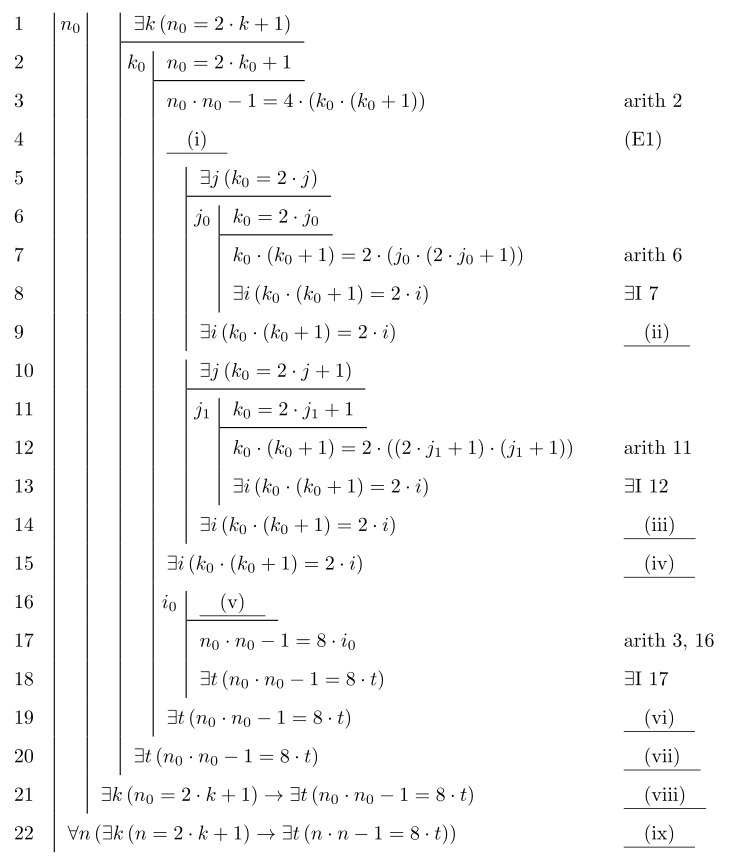
8 1–7
Line 4 is the bounded at
the term , whose bound is
line 3. Line 5 is the school fact that no real number is
less than itself.
(b)
Suppose for every , and
suppose, for a contradiction, that . Then , so
the hypothesis applies with
and gives ; but no real number is less than
itself. Hence .
(c) Only line 8, the closing line of , is
silent: “hence if … then ” is not written. Line 5 is not silent: it is
one member of the clashing pair of the on line
6, and level 3 names it (“no real number is less than
itself”). The instance of line 4 must be named, , because it is not the obvious term: no name
in sight is the obvious candidate for , and the
whole proof turns on choosing this one. Saying only “by
the hypothesis” would leave the reader to find the
instance, and that instance is the idea of the proof.
The
opening, “suppose, for a contradiction, that ”, and its
conclusion, “hence ”, are also never silent.
Marking scheme. (10 points) - 2: (a)
the box on
the hypothesis, and inside it a box opened on . - 2: (a) the box
closed by ( alone
would give only ), with as its last line. -
2: (a) the at , citing a line . - 2:
(b) a level-3 text with the opening of the
contradiction, the instance, the clash and “hence ”, and no tags. - 2:
(c) the silent line identified, and the instance
said to be named because it is not the obvious term. -
Other routes: a box on
followed by
, or a split on or
(arith) whose first case reaches by the same and
clash and then by , while the second gives by arith, earns the
4 points of the first two lines, provided the
line is written explicitly, or the disjunction of the
split is justified (from , or by
trichotomy). In the split, the case assumption is the
line the cites for the third line, and for (b) and
(c) the opening of the box or
of the split stands in for the opening of the
contradiction. Fatal errors (0 for the step): the box
closed by
with the conclusion ; the hypothesis applied at an not known to
be positive.
Exercise
(C2: Exit check: levels)
Let be a
sequence of real numbers with , and let be a real number.
Here is a level-0 derivation that , with the
definition of a limit as in Example (Five definitions, translated)
(a), the hypothesis as premise 2, and two lines of school
arithmetic justified “arith”.
1
2
3asm, for
4arith 2, 3
5 1, 4
6asm, for
7asm, for
8asm, for
9 7, 8
10asm, for
11 9, 10
12arith 2, 11
13 10–12
14 8–13
15 6, 14
16 5, 6–15
17 3–16
Write the proof at level 2 and at level 3. Then say
in one sentence how the case goes.
Solution. Level
2.
Let [].
Since ,
, so
[arith]. Applying the definition of with in
place of [],
choose ,
depending on (and on the
fixed number ),
such that for every [,
fresh]. Let []
with
[assumption for ]. Then
[,
],
so [arith]. So this works for [, ,
with witness ; then
closes]. Since was arbitrary, [].
Level 3.
Let . Since , we have , so by the definition of , applied with
, there is (depending on and ) such that for every . For every , So this
works for , and .
The case . Then for
every , so for every and
every , and any
works, for
instance ; the
hypothesis is not needed.
At level 3, the silent steps are those Definition 8.3.2
allows: the and
of lines 9 and 11 at the obvious (the implication of
line 11 is line 9, an instance of the property of the
chosen , not of
a hypothesis or a result), carried by “for every ”, and the closing
lines 13, 14, 16 and 17. The of
line 5 is not silent, because its
instance is not the obvious one; it is named
(“applied with ”). The witness of line 15 is named
(“this ”), and its
dependence is stated.
Marking scheme. (10 points) - 4:
every never-silent step is present at level 3, one point
each: fixed first ();
the hypothesis applied at ,
with its positivity justified, and chosen from it ();
the witness
produced with its dependence on stated ();
taken
arbitrary (). - 3: the level-2 tags are correct: for
and for
, at
, for
, for
, for
the witness. Deduct one point per wrong or missing tag,
down to 0. - 2: no step silent at level 3 beyond those
Definition 8.3.2
allows, steps already scored in the first line not
counted again; in particular the estimate is written out for an arbitrary
. - 1: the
case handled,
or excluded explicitly with a reason. A level 3 that
writes “for every ” as the single phrase for
together with earns
the point, as in the solution. Fatal errors (0
for the step):
chosen before is fixed;
dividing by
in the case .
Exercise
(C3: Back from prose to a skeleton)
Here is a level-3 proof.
Claim. For every integer , or .
Let be an
integer. If is
even, say ,
then , so
. If
is odd, say , then , so .
Reconstruct its level-1 skeleton. Work over the
domain , with
“ is even” as
, “ is
odd” as and as . Name the rule that closes each box, and
name every step of the skeleton that the prose leaves
unsaid.
Hint: The claim is a disjunction for every . Which disjunct is
reached in each case, and by which rule?
Solution. Write for the goal’s
instance ; in the derivation it is written
out.
1(E1)
2asm, for
3asm, for
4arith 3
5 4
6 5
7 2, 3–6
8asm, for
9asm, for
10arith 9
11 10
12 11
13 8, 9–12
14 1, 2–7, 8–13
15 1–14
Line 1 is (E1) at , cited as in B2’s
line 4. The boxes close by
(lines 7 and 13: does not mention
or ), (line
14) and (line 15). The second case box could reuse
the name , since
the two boxes are siblings; keeps the lines
apart. The arithmetic: (line
4) and (line 10).
The prose leaves unsaid the disjunction (E1) and its
reason for covering every case (as in B2, the proof is
slightly short of level 3 there), the two steps
(silent: each case’s last words, “so ” or “so ”, show
which disjunct was reached), the
closings, the closing and the
closing (silent closings). It writes every opening
(“let”, “if”, “say”), both witnesses ( and ) and both
computations.