Section 8.1 read the connective rules in the
sentences of written proofs. The statements of analysis,
though, are made of “for every” and “there exists”, and
most of the words in an analysis proof carry a
quantifier rule: “let”, “fix”, “choose”, “take”, “will
do”. This section completes the dictionary with the rows
for the quantifiers, equality and unique existence, for
definitions, “the” and double inclusion, and for the
patterns that are not single rules but are written as if
they were: the lemma (“it suffices to show”) and its two
“stronger” cases, induction, and symmetry (“without loss
of generality”). It also makes exact one habit of
analysis prose, the parenthesis “(depending on )”.
Three
sentences, three rules
Section 6.1 derived “if , then ” in sixteen
lines. Written the way a mathematician writes it, the
same argument takes three sentences:
Let . Since and , we may choose (depending on
) such
that for every . Then for every
, .
Here is the derivation of Section 6.1 again, with the
same line numbers. To keep its lines short, write for
and for
.
1
2asm, for
3arith 2
4 1, 3
5asm, for
6asm, for
7asm, for
8 6, 7
9asm, for
10 8, 9
11arith 10
12 9–11
13 7–12
14 5, 13
15 4, 5–14
16 2–15
| “Let .” |
opens the box 2–15; its closing line 16 is not
written |
| “Since and , we may choose …” |
3 and 4, then opens the box 5–14 |
| “Then for every , .” |
7–13 |
| (the paragraph ends) |
14, 15, 16 |
Each sentence opens a box, and the boxes are nested
in the order of the sentences.
- “Let ” opens the bounded box
of lines 2–15 in the derivation above, with the fresh
name .
Its closing line, line 16, is not written: the paragraph
simply ends, and a reader who heard “let” knows that the
box closes there.
- “Choose …” is
two rules. The words “since and ” are
the of line 4, at the term , with its
bound from line 3. The word “choose” opens the box
of lines 5–14, with the fresh name .
- “Then for every ” opens the box
of and the
box of
(lines 7 and 9), and the computation is lines 8, 10 and
11. The words “for every ” also announce the lines that close these
two boxes, 12 and 13.
- The of line 14, which writes “some works” from “this works”, and the closing
line 15 of the box,
are silent. They are the end of the paragraph.
The one word in the paragraph that no rule asks for
is the parenthesis “(depending on )”. It is the
subject of a subsection below. First, the rows.
The
quantifier rows
|
“let ”;
“fix ”; “let be
given”; “since
was arbitrary” |
never the introduction; “since was arbitrary” may be
silent |
|
“in particular, for ”; “applying … with in place of
” |
the instance must be named when it is not the
obvious one |
|
“take ”; “let ; then …”; “… will do” |
never; its dependencies are stated |
|
“choose such
that”; “by hypothesis there is with ”; “let be such a point” |
never; the name must be fresh |
The phrases in the table are mostly the bounded forms
of the rules (Proposition 6.1.1):
“let ” opens
a box whose assumption is , and “choose
such that
…” opens an box
with the two assumptions and “…”. A bound is part of the phrase:
“let ” is one step, not “let ” followed by
“suppose ”.
In analysis, is
the first sentence of every limit proof: “Let .”
is “apply the definition of with ”: the
instance is not the
obvious one, so it is named. is
the line that places a constant, “let ”, written before the
computation that shows it works. is
“choose
(depending on ) such that
…”, in which the name has not been used
before in the proof.
Example
(A constant sequence)
Let be a real
number and let for every . Prove that , and annotate each phrase with its
rule.
Solution. Let [,
opening]. Take [].
Let with
[,
,
opening]. Then where the first equality substitutes [] and the
last step uses , the assumption of the first box. This
proves .
The last sentence stands for three closing lines, all
silent: the and
for
(“for every ”), and the for
(“since
was
arbitrary”). The witness “take ” is placed
before the work that justifies it.
Two things here are degenerate, and both are worth
seeing once. The witness depends on nothing: any
works.
And the assumption is never used. The box is still opened,
because the goal asks for it;
without “let ”, the line “” would
not say which it
is about.
The
dependency parenthesis
In the paragraph that opened this section, was chosen “(depending
on )”.
Section 6.4 read off a derivation the rule behind the
parenthesis:
A constant chosen in a box may depend on the
names of the boxes open around that box, and it does
depend only on the names in the line it comes
from.
In the derivation of Section 6.1, the witness is obtained at line 5
from line 4, which mentions , inside the
box of only. So
may depend on
, and
it does. In the derivation of Example (Uniformly continuous implies continuous),
the witness is obtained
inside the boxes of and , so it
may depend on both; but it comes from a
line that mentions alone, so
it does depend only on , and that
is uniformity.
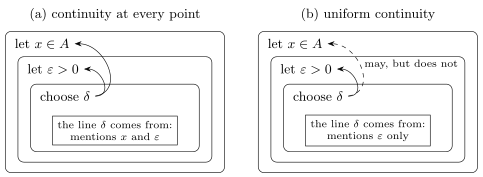
A chosen constant may depend on
the names of the boxes it sits in, and
does depend only on the names in the
line it comes from (the solid arrows).
Numbers show why the arrows matter. Take and . At the
point , the
largest with
for every with
is : about at , and about at . No single serves every
point, so
must depend on the point as well as on : panel (a).
For ,
, so works at every point at once:
depends on
only,
panel (b).
The parenthesis is the prose record of this. “Choose
(depending on
)” says:
the boxes open here are those of (besides the
data of the theorem, such as the sequence), and the line
from which comes
mentions . “Choose
(depending
on and
on )” says that
came from a
line mentioning both, inside both boxes. A witness that
came from a line mentioning neither is a constant, and
the proof may say “(depending on neither)” or simply “a
fixed ”. This
is why proofs in analysis say what each chosen constant
depends on. A missing parenthesis is not a wrong step,
but it hides the one fact a reader most needs in order
to check the quantifier order, and many false proofs in
analysis go wrong exactly there.
Quick check. For and , does
work
at the point ?
At ?
Solution. At , yes, since . At , no: has and .
Example
(The reciprocals tend to zero)
Prove that , for the sequence . Annotate
each phrase with its rule, and state what the chosen
constant depends on.
Solution. The sequence starts at
, so in the
definition of Section 6.1 the numbers and range over the positive
integers . We use one
school fact about the real numbers: for every real
number there is
an integer greater than . (It follows from the
axioms for the real numbers; here we take it as
known.)
Let [,
opening]. It suffices to find with
since then every with has , so [it suffices: the claim () displayed, then
used].
By the school fact, applied to [],
there is an integer greater than ; choose
such an integer
[], which depends on . Since , we
have , so and . From , taking reciprocals
reverses the inequality: , which is (). So this will do [],
and .
Read the proof as a skeleton. The first sentence
opens the box of . The second
is an “it suffices to show”, in the sense of the row
below: it states a simpler claim (), shows on the spot
that () is
enough, and leaves () to be proved. The
next paragraph proves (). It contains two
different quantifier steps that both concern : “choose” is the on
the school fact, which hands over some integer beyond
and
calls it ; “will
do” is the that offers this as the witness the
definition asks for. Between them, the clause “so and ” checks
the bound of the witness, which the bounded
needs as a line.
The constant
depends on only: it came
from the school fact at , inside the
box of .
For instance, has , and is a choice that works; so is any larger
integer.
Quick check. “For every , for all large .” Where is the hidden
, and
between which two quantifiers does it stand?
Solution. “For all large ” is “there is an such that for every
” (Section
6.1): the hidden stands after and before . Written
out, the sentence is , the definition of . Since comes after
, the may depend on .
Equality
and unique existence
| , |
“substituting”; chains “”;
“by (1)” |
yes, inside chains |
|
“there is exactly one”; “existence … uniqueness …”;
“suppose also
…” |
never either half |
In analysis, is at
work in every chain of equalities and inequalities, such
as where each link substitutes equals
for equals and each inequality link applies one fact
about order (Section 5.7). (Here gives
, so
.) The lines
that such
chains rest on are never written. Unique existence (Definition 5.8.1)
has two halves, which Proposition 5.8.1
separates: “ has exactly one real solution: is one, and if
, then
”. The first
clause is existence, by ; the
second is uniqueness, a and
box on a second candidate. Neither half implies the
other, so neither may be silent.
The uniqueness half often stands alone, when
existence is not claimed or is proved elsewhere.
Uniqueness of limits is a case of this kind.
Example
(A sequence has at most one limit)
Let be a
sequence of real numbers with and . Prove that
, and annotate
each phrase with its rule.
Solution. Let [,
opening]. Then , so, applying the definition of with in place of
[], we
may choose (depending on ) such that
for every [,
fresh name ].
Likewise, from , choose (depending on ) such that
for every [,
, fresh name ]. Let . Then , and , so both bounds apply at [ at
, twice, with
],
and where the inequality is the triangle
inequality of Example (The triangle inequality by cases),
with . Since was
arbitrary, for every [,
closing], and Proposition 6.2.5
gives [, citing
it].
Four things in this proof are never silent, and each
is visible. The instance is named
twice, because it is not the obvious instance. The two
witnesses get two names, and : the hypotheses
promise a threshold for and a threshold for
, and nothing says
they are the same number, so calling both would assert an
equality nobody proved (Section 8.6 catalogues the
error). The point is named, since the bounds are
applied at it. And the closing result is cited by
name.
↺Second readingThe
bookkeeping of the two choices
What is silent is the bookkeeping of the two
boxes. The line mentions neither , nor , so the side condition
of lets it leave both boxes, and then the box
of
closes on it. The calculation chain hides its steps, as
the row allows. The proof shows that a sequence has
at most one limit: the uniqueness half
of .
Whether a given sequence has a limit at all is a
separate question, which this proof does not touch.
Definitions, descriptions and sets
Three more phrases do logical work in almost every
chapter of analysis: “we define”, “the”, and “the two
sets are equal”.
| a definition (a definitional extension, Proposition 5.8.2) |
“we define ”; “call perfect if …”;
“write for
…” |
never the definition; its uses (
or
with it) yes |
| “the” (a definite description, Definition 5.8.3) |
“let be the
limit of ”;
“the least element of ”; “” |
never the existence and uniqueness behind “the”:
proved or cited before the name is used |
| double inclusion |
“we show and ”; element chasing: “let ; … so ”; “so ” |
never either inclusion, nor the opening “let ” of each, nor
the appeal to extensionality that turns “the same
elements” into |
“The”, as in “the limit”, names an object. It may be
used only once there is exactly one such object (Section
5.8): for a limit, existence is the hypothesis that
converges,
and uniqueness is Example (A sequence has at most one limit).
Chapter 5 read as . Two inclusions give , by
inside : the two sets have the same elements. Each
inclusion is an element chase: “let
” opens a
bounded box whose last line is . The last step,
from “the same elements” to , is not logic.
Logic gives only the converse, that equal sets have the
same elements (Example (Equal Sets Have the Same Elements)).
The step itself is the axiom of
extensionality, an axiom about sets (Section
5.7), and a proof cites it, as a premise or with the
words “by extensionality”; it is never silent.
↺Second readingWhat
a definition adds
A definition adds a word and proves nothing new about
the old words (Proposition 5.8.2,
Section 5.8). So “we define” writes an abbreviation, and
every later use of it is
or
with the definition.
Example
(Two inclusions)
Let and . Prove that , and tag the steps
that carry the logic.
Solution.
- Let
[assumption
for ]; so , that is, .
- If ,
then
too, and a product of two negative numbers is positive:
.
This clashes with [], so
is
impossible [], and by trichotomy.
- If ,
then both factors are positive and the same clash
follows. So .
- Hence [], and .
- Let
[assumption
for ]; so and []. A product of a non-negative and a
non-positive number is at most , so , that is,
, and
.
- So and : every real has [
inside ]. By extensionality, [,
with the axiom].
The words “that is” unwind the two sets’ definitions
(,
silent at level 3).
Quick check. To prove by
double inclusion, which inclusion is a theorem of
Chapter 2, and which takes one line?
Solution. is Theorem 2.1.3.
is one
line: gives
.
Induction,
lemmas and symmetry
The rows of this table are not rules of the calculus.
Each is a pattern of rules that proofs announce with a
phrase of its own.
| it suffices to show; a lemma (a cut, Lemma 2.3.3) |
“we first show (Claim)”; “it suffices to show”; “we
claim” |
never the claim itself; “it suffices” may be dropped
if the claim is displayed and then used |
| it suffices to prove something stronger |
“it suffices to prove the stronger …”; “in fact more
is true: …” |
never the stronger claim; the step from it to the
goal may be silent when it is one ,
or chain link |
| a stronger hypothesis gives a weaker theorem |
“in particular, for ”; “since every such has , the
result applies” |
the narrowing of the hypothesis, never |
| induction (Axiom 4.2.1,
Theorem 4.2.2) |
“we argue by induction on ”; “base case”; “suppose
the claim holds for ” |
never either the base case or the step; the
induction hypothesis is stated |
| symmetry |
“without loss of generality”; “similarly”; “by
symmetry” |
allowed only when the swap turns the statement and
the hypotheses into themselves, up to identities such as
|
It suffices to show
“It suffices to show ” does two things.
It shows on the spot that gives the goal,
and it leaves to be proved: the
goal is replaced by . As Section 1.3
observed, to show it suffices to show
when is in
hand. A lemma is the same move in the other order: prove
first, then
use it as if it were a premise. (Logicians call both a
cut; Lemma 2.3.3
(b) is the precise statement.) In analysis, “it suffices
to show for ” reduces a limit to one estimate; Example (The reciprocals tend to zero)
made one with the claim ().
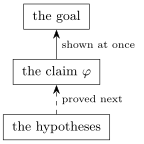
“It suffices to show ”: the solid step
is written on the spot, the dashed one is the rest of
the proof.
Solution. “It suffices to find
with , since then …”. It leaves (), which the next
paragraph proves.
Two cases of the move have names of their own. To
prove it
suffices to prove a stronger from which follows at once: to
show for
,
show ,
and then . And a theorem stays true when its hypothesis
is narrowed: from “if , then
” and
“every
has ”, the chain of Proposition 1.4.1
gives “if , then ”: a stronger hypothesis, a weaker
theorem.
↺Second readingStronger
and weaker, in general
Both moves are instances of one fact about where a
part sits in a formula. Weakening a part in a positive
place, such as the conclusion of an implication, weakens
the whole; weakening a part in a negative place, such as
the hypothesis, strengthens the whole. The second-pass
Section 4.9 states and proves this as Theorem 4.9.5;
nothing on the main line uses it.
Induction
An induction is applied
to Axiom 4.2.1,
whose hypothesis is a conjunction: the base case , and the step
“for every , if then ”. So the step is
a box with a box
inside it, and the phrase “suppose the claim holds for
” opens the inner
box; its assumption is the induction
hypothesis, and it must be stated, because the
step uses it.
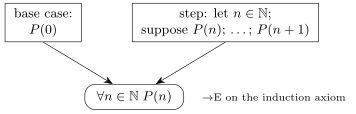
An induction: two inputs to one implication, the
induction axiom (Axiom 4.2.1).
The step is two boxes, the box of and, inside it, the box
of the induction hypothesis .
Without loss of
generality
Symmetry is a case split whose
second box is the first with two letters exchanged.
“Without loss of generality ” writes the first
box and leaves the second to the reader, who must be
able to get it by swapping the letters; that works when
the statement and the hypotheses come back unchanged
under the swap, up to identities such as .
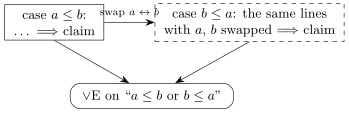
“Without loss of generality ”: the solid case
is written, the dashed one is left to the reader, who
gets it by the swap.
Quick check. May a proof that for all
real , begin “Without loss of
generality ”?
Solution. Yes: swapping and leaves the statement
unchanged, and there are no hypotheses. The case split
is legitimate, though not needed, since .
Example
(An induction, and a legitimate symmetry)
(a) Let be a real number with
.
Prove that for every , and annotate each phrase with its
rule.
(b) Let and be real numbers. Prove
that , with a “without loss of
generality”, and write out the case split it
abbreviates.
Solution. (a) For , let be the statement
“ and
”. We
argue by induction on , using Axiom 4.2.1.
Base case. , and and , so
holds [].
Step. Let [,
opening], and suppose holds, that is,
and
[,
opening: the induction hypothesis]. Then . Since
[] and
, the
product is
positive, so . Since and , multiplying gives , and [], so
.
Hence
holds [].
By induction, holds for every
Axiom 4.2.1.
The base case is the first hypothesis of Axiom 4.2.1,
written as its own paragraph. The step is the second:
“let ” and
“suppose
holds” open its two boxes, and “hence ” is the last
line of the inner one; the closing lines “so , for
every ” are
silent. The induction hypothesis is stated in full, and
each of its halves is taken out by and
used:
twice (for the sign of , and to multiply
by without reversing
it), and
once, at the end. The statement was chosen with care:
the tempting “” fails at whenever , since , and an induction for it would have to start
at .
(b) Without loss of generality, . Then and
,
and since ,
The phrase abbreviates a on
“ or ”, which holds for
all real by
trichotomy. The first box is the paragraph above. The
second box, on , reads: then and
,
and since , . That is the
first box with
and exchanged
throughout, read through three identities: , , and . These say that the
statement is unchanged when and are exchanged, and
there are no hypotheses to check. This is what makes the
swap exact, and so what licenses “without loss of
generality”.
Warning. “Without loss of
generality” needs a statement and hypotheses that are
unchanged by the swap. Here is a false “proof” that
for all real :
“Without loss of generality ; then .”
Exchanging and
turns the claim
into , which is a different claim, so the second
case is not the first one in disguise; and indeed , gives .
Before writing “without loss of generality”, swap the
letters in the statement and the hypotheses, and check
that each comes back unchanged, up to identities such as
.
What the
sentence does not say
Some quantifiers in mathematical English are not
written at all, and some are written where they do not
apply. Four habits of mathematical English cover most of
them.
The hidden universal closure. A
theorem stated as “if is even, then is even” means “for
every integer , if
is even, then
is even”.
Section 5.1 introduced this convention: a letter
that is not introduced anywhere, in the statement of a
theorem, is read with a “for every” in front of the
whole statement. It applies to the statement of a
theorem, lemma or exercise, not to a line inside a
proof: inside a proof every letter has been introduced
by a “let” or a “choose”, and its box tells the reader
which. The proof of such a theorem begins by opening the
hidden box: “let
be an integer”.
“For all large ” hides an
and a
bound, as the Quick check above found. “Eventually”
means the same. The negation of “ for all large ” is “for every there is an for which fails”, usually said
“ fails for
infinitely many ”.
“Any” can mean “every” or “some”,
and only the rest of the sentence decides (Section 5.1).
“Any is
positive” means every element of is positive. “If any
is
positive, then is
non-empty” means: if some element of
is positive. When
“any” appears, rewrite the sentence once with “every”
and once with “some”, and keep the one that was
meant.
Quantifiers at the end of a
sentence. English lets a writer put “for some
” or “for all
” after the
formula they govern, and then the order of two such
phrases is unclear. “ for some for all ”, over , has two readings:
The first is true (for take , since ; for take ). The second is false (whatever is proposed, refutes it). The
remedy is to write the quantifiers of such a statement
in front, in the order in which they
apply. A trailing phrase such as “for every ” is safe only
when it is the last quantifier of the sentence, as in
the definition of .
Warning. Moving “for all ” to the end of a
sentence can change continuity into uniform continuity.
“ whenever ,
for all ”, written
after “for every there is such that”,
does not say whether comes before
(continuity at every point) or after it (uniform
continuity). The two formulas of Section 6.4 differ
exactly there, and Example (The square function on the real line)
shows that the difference is real: on satisfies the first
and not the second. Write the quantifiers in front.
Warning (Not allowed: quantifier steps in
prose). Each sentence below might appear in a
proof, and each is wrong. The tag names the entry of the
catalogue in Section 8.6, or the item of the convention
on silent steps in Section 8.3, that it breaks.
- “Let and choose with for every . This works for every .” The
was chosen inside
the box of one : (N2).
- “Some
has .
Let ; then
.” The
witness of an existential is chosen (“choose
with ”, with
a fresh name). Written with “let”, the second sentence
claims
for every :
(N3).
- “Choose with
for , and with for .” One name for two witnesses: (N4).
- “Let be the
limit of ”, in
a proof that has not shown that converges:
(N14).
- “Let . Then for every , as required”,
where no sentence says what is. The witness of
, with what it depends on, is never silent
(Definition 8.3.2,
Section 8.3).
Exercises
A. Check your
understanding
Exercise
(A1)
Let be a
sequence of real numbers and a real number. Here is
a proof that if and , then for all large . Its sentences are
numbered.
- Suppose and . (2) Then . (3) Choose such that
for every .
(4) Let
with . (5)
Then , so . (6) Hence for every
, that is,
for all
large .
- (a) Name the rule or
rules carried by each sentence.
- (b) Sentence (3) has
no dependency parenthesis. What should it say, and why
does not depend
on ?
- (c) Which instance
of in the proof is not the obvious one?
- (d) Which closing
lines are silent?
Solution. (a) (1) ,
opening: the hypothesis of the theorem is assumed (its
two conjuncts are then available by ). (2)
An arithmetic step from . (3) on
the definition of at ,
with its bound from (2), then ,
opening a box with the fresh name . (4) and
,
opening the boxes of and of . (5) at
and on the
line from (3), giving ;
then the school fact with , and arithmetic. (6) and
, closing (“for every ”), then with
the witness (“for
all large ” is
), and the box
of (3) closes, since the conclusion does not mention
.
(b) “Choose (depending on ) such that …”. is obtained at line
(3), from the definition instantiated at , a term that mentions
(and the
sequence, which is data). The box of is opened only at (4),
after is chosen,
so cannot depend
on .
(c) The instance in (3).
It is the instance the proof is built around: any with
would do, and
leaves the margin .
(d) The closing lines of the box
(3) and of the box
(1), “hence, if and , then …”. Sentence (6) writes the closings of
the boxes of (4) in words, and the
through “that is”.
Exercise
(A2: Drill)
Each part takes a line or two. Most parts ask which
rule a phrase carries, whether it may be silent, or for
a judgment or a sentence.
- (a) “Fix .”
Which rule, and may it be silent?
- (b) “Applying the
hypothesis with in place of
.” Which
rule, and may the term go unnamed?
- (c) “Take .” Which rule, may it be silent,
and what does depend on?
- (d) “By hypothesis
there is with
; choose
such a .” Which
rule, and what does it require of the name?
- (e) In “Let .
Choose such that
… . Let .”,
may depend on
?
- (f) In “Let . Let .
Choose such that …”, may depend on ?
- (g) Write “ for all ” with the
quantifier in front.
- (h) Negate “ for all large
” with no in front of a
quantifier.
- (i) A proof of
“” begins “Without loss of generality .” Is that
legitimate?
- (j) In an induction,
which sentence opens the box of the induction
hypothesis?
- (k) To prove , a proof shows
and
.
Which rules does that pattern use, and how does each
inclusion open?
- (l) A proof begins
“Let be the least
element of ”. What
must already be on the page?
Solution.
(a) Bounded ,
opening; never silent.
(b) at a
term that is not the obvious one; the term must be
named.
(c) ’s
witness, written before the work; never silent; it
depends on .
(d) ,
with a fresh name.
(e) No: the box
of opens after
is
chosen.
(f) It may, since
both boxes are open; whether it does depends on the line
it comes from.
(g) .
(h) For every
there is with .
(i) No: the swap
turns the claim into , a
different claim; each case needs its own line (both are
one line long).
(j) “Suppose
holds”, inside
“Let ”.
(k)
inside , for ; then by and
with the axiom of extensionality, cited. Each inclusion
is a bounded that
opens with “let ” (or “let ”).
(l) That such an
element exists and that there is only one (, a definite
description). Uniqueness is one line, since two least
elements are each at most the other; existence is the
part that needs a reason.
B. Practice
Exercise
(B1: Ambiguous English)
Each sentence has a quantifier phrase at its end.
Write both readings in symbols, with the quantifiers in
front, and decide whether each reading is true for the
function given.
- (a) “ for every real
, for some real
”, for .
- (b) “ for some real
, for every real
.”
- (c) “
implies for all real , for some ”, for .
Solution. (a) , “ is
bounded above”, and . For the first is
false: whatever
is proposed, has . The second is true for every function:
given , take .
(b) and . The first is true: given , take . The second is
false: for any ,
the two values and give and , so not every works.
(c) and
. For the first is
false: it is the uniform continuity condition at , and Example (The square function on the real line)
refutes it with , , for which
and . The second is true for every
function: given
and , if then for any , say ; if , take , so
that is false and the implication holds
vacuously.
In (a) and (c), the reading with in front is the
one a writer means; the other is true of every function,
so it says nothing about . In (b), the intended
reading is . Written with the quantifiers in
front, the sentences say what they mean: “there is such that for every
”, “for every
there is with ”, “there is
such
that for all ,
…”.
Exercise
(B2: An induction, annotated)
Prove that is divisible by for every . Annotate each
phrase of your proof with its rule, and say which
hypothesis of Axiom 4.2.1
each part of the proof establishes.
Solution. For , let be “”, that is,
“there is an integer with ”. We argue
by induction on .
Base case. , so holds, with the
witness
[]. This is hypothesis (i) of Axiom 4.2.1.
Step. Let [,
opening], and suppose holds [,
opening: the induction hypothesis]. By the induction
hypothesis there is an integer with ; choose such
a (depending on
) [,
fresh name ]. Then
where the third equality substitutes []. Since
is an
integer,
holds, with the witness [].
The step is hypothesis (ii) of Axiom 4.2.1:
the on
and the on
.
By induction, for every Axiom 4.2.1.
The box of closes on “”, which does not
mention , as its
side condition requires; its closing line, and those of
the two boxes of the step, are silent.
Exercise
(B3: Six, two and three, used later)
Let and . Prove by double
inclusion. Name each “let”, each “choose” with its fresh
name, and each witness.
Solution.
- Let
[],
and choose with
[,
fresh]. Then
and , so and , with the
witnesses and
[
twice, ]; so .
- Let
[].
Choose with and with [
twice, two fresh names: one name for both would be
(N4)]. Then , so , and
with the
witness
[]; so .
- So every integer has [
inside ], and by extensionality .
The two boxes of close on
“”, which
mentions neither
nor .
Marking scheme. (10 points) - 2:
, with
chosen and both
witnesses written. - 4: : two choices
with distinct names (1); the computation , or another
valid route to an integer with (2); the witness
named (1). - 2: the double-inclusion frame: both
inclusions, each opened by “let ”, and the
conclusion by
extensionality, cited. - 2: the tags: ,
with fresh names, .
Fatal errors (0 for the step): one name for both
witnesses; “ and , so ” asserted without an argument (N9).
C. Going deeper
Exercise
(C1: When “similarly” is honest)
- (a) Prove that for all real and , with a “without loss
of generality”. Then write out the it
abbreviates, and check that its second box is the first
with the letters exchanged.
- (b) Let and be real numbers. A
student proves as follows: “Without loss of
generality .
Then , and .” Explain why “without loss of generality”
is not legitimate here, prove the case the student
skipped, and show by an example that the hypothesis
cannot be
dropped from the statement.
Solution (Hint 1). In (b), exchange
and in the statement and in
the hypothesis, and compare with the original.
Solution (Hint 2). In the case
, , and the
claim becomes .
Solution. (a) Without loss
of generality . Then and , so
.
The phrase abbreviates on
“ or ”, true for all
real by
trichotomy. Box 1, on , is the paragraph above. Box 2, on : then and
,
so . Exchanging and in box 1 gives “; , ; ”, which is box 2 read through , and . These identities say that the
statement is unchanged by the exchange, and there are no
hypotheses, so the swap is exact.
(b) Exchanging and changes both the
hypothesis and the claim: it gives “, and ”,
which is not the original statement. So the case is not the case
in
disguise, and it needs its own argument.
Case . Then , and
multiplying
by gives
.
With the student’s case (: ), this proves the claim in either case. The
hypothesis
is used only in the skipped case. It cannot be dropped:
, has , so
,
while , and
is
false.
Marking scheme. (10 points) - 2: (a)
a correct computation in the case . - 3: (a) the
written out, with its disjunction justified, and the
exchange checked against the statement. - 2: (b) the
reason: the exchange changes the hypothesis and the
claim. - 2: (b) the case proved, using . - 1: (b) a
counterexample without , checked. Fatal errors (0 for the step): in
(b), “the other case is similar” without computing it; a
counterexample that satisfies .
Exercise
(C2: Moving a quantifier changes the meaning)
Give an example of a sentence of analysis, in
English, that begins “for every …”, whose meaning
changes when the phrase “for every ” is moved to the end of
the sentence. Write both readings in symbols and show
that one is true and the other false.
Solution. An example. “For
every real , there is with .” Moved:
“There is with , for every
real .” The
readings are The first is true: given , there is an
integer
(the school fact of Example (The reciprocals tend to zero)),
and gives and . The second is false: whatever is
proposed,
is positive and fails. (It is natural to read the moved
sentence as the second formula, since its “for every
” now comes after
“there is ”;
whichever reading a reader picks, the sentence no longer
says one thing.)
What a different answer must have, so that
it can be checked against this one: - the sentence
contains “for every ” and at least one
existential quantifier (“there is”, “for some”) whose
scope contains a formula mentioning ; - moved to the end,
“for every ” can
be read as coming after the existential quantifier, so
that the witness may no longer depend on ; - both readings are
written in symbols with all quantifiers in front, and
there is a specific interpretation (here with its usual order)
in which one reading is true and the other false, each
claim checked; - the false reading is refuted by naming,
for each candidate witness, a value of that defeats it.
Another correct answer, for on , is “for every , for every there
is
such that whenever ”
(continuity, true); with “for every ” moved to the end, it
becomes the sentence of the warning, whose
uniform-continuity reading Example (The square function on the real line)
refutes.