Chapter 3 ended on a question it could not answer.
Section 3.1 searched for a derivation of ,
and every route came back to the same gap; but a search
that fails proves nothing, since a cleverer derivation
might exist. The row that refutes affirming the
consequent in Section 4.5, and , finds what the search could not:
it makes
true and
false, and the search of Section 4.6 finds such rows
whenever they exist. This section proves the theorem
that turns such a row into a proof that
no derivation exists. It is called
soundness: whatever the rules derive is true in every
row where the premises are true. The proof is the book’s
first long proof about proofs, and it is an induction on
the lines of a derivation.
What must
be proved, and why it is not obvious
↺Second readingIs
the proof circular?
The proof below argues by cases (“if …
if ”) and by contradiction, in the
metalanguage: the very patterns that and
record in the object language. That is not circular. The
theorem is not meant to persuade someone who rejects
reasoning by cases. It is a theorem of ordinary
mathematics about a calculus, and what it rules out is a
mismatch between the rules and the tables, of the kind
the connective in the fold of Section 4.4 has.
Chapters 1 and 2 checked each rule as it arrived.
is safe because two true statements make a true
conjunction (Section 1.2); is safe
because that is what “if … then” asserts (Section 1.3).
Section 1.2 said once that Chapter 4 would prove it for
every rule of Chapters 1 and 2 at once. Why is that more
than collecting the separate checks?
The first attempt at a proof is: go down a
derivation, line by line, and show that each line is
true in every row in which the premises are true. For a
derivation without boxes this works. Each line is a
premise, or comes from earlier lines by a rule, and the
rule turns true lines into a true line. But it fails at
the first box. Here is the derivation of Proposition 2.3.2,
written with atoms:
1
2asm, for
3asm, for
4 1, 3
5 4, 2
6 3–5
7 2–6
Line 3 is , and
the row , makes the premise true and line 3
false. Line 5 is , which is false in
every row. So the lines inside a box
are not true in the rows where the premises are true,
and the first attempt collapses. Yet the derivation is
correct, and its last line is true
in every row making true (Example (An implication and its contrapositive)).
What goes wrong is that a line inside a box is not
claimed on the strength of the premises alone. Line 4
says: if ,
and all hold,
then holds. That
is a true claim about rows. Every line depends on the
premises and on the assumptions of the
boxes around it, and a correct statement about each line
must mention both. Below we give this list a name: the
context of the line.
From now on the lines of a derivation carry
formulas in the sense of Definition 4.1.1,
with atoms . Nothing in the rules changes. Every rule
was stated as a schema, whose letters stand
for arbitrary statements (Definition 1.2.1),
so it applies to formulas as it stands, and Definition 1.4.2
and Definition 1.2.3
read the same with “formula” for “statement”. As Section
4.1 said, a derivation written with Chapter 2’s letters
is a pattern,
and reading its letters as atoms, or as any formulas,
gives a derivation of formulas.
Two conventions for the rest of the section. The
primitive rules are those of Chapters 1
and 2 collected in Section 3.1: , ,
, , , , , , , , ,
and .
The box rules among them are the five
that cite a box: , , , and
.
The other eight, included,
cite only lines; we call them the one-step
rules.
A derivation may also use derived rules such as and . A line
citing one abbreviates a stretch of derivation in rules
proved earlier, with the letters replaced by formulas
(Definition 2.3.1),
and Section 2.3 showed how to write it out: repeat the
cited lines, then paste the derivation of the derived
rule below them. Every chain of derived rules ends in
primitive rules. So whenever , there
is also a derivation of from premises in
that uses
primitive rules only. That is the only
kind of derivation the proof below has to consider.
The context
of a line
Let a derivation have lines . We write
for the
formula on line .
The length of a derivation is its
number of lines. The context of line
is the list of
the premises together with the assumptions of every box
containing line :
the statements the line depends on. We write it . The context of
the last line is just the premises, since by Definition 1.4.2
the last line lies in no box. For lists of formulas
and , we write
when every formula of occurs in .
Exercise C4 of Section 1.4 (Exercise (C4: The assumptions a line depends on, used later))
wrote such lists by hand, as sets of line numbers; its
part (c) observed what Lemma 4.7.1
below proves.
The context of a line is everything that line
depends on: the premises, and every assumption still
open where the line stands.
In the derivation of Proposition 2.3.2
above, the boxes are and , and the
contexts are:
| 1 |
|
none |
|
| 2 |
|
|
|
| 3, 4, 5 |
, , |
,
|
|
| 6 |
|
|
|
| 7 |
|
none |
|
Quick check. In that derivation,
which lines have
in their context?
Solution. Lines 3, 4 and 5, the
lines of the box opened by .
Now look at each line through its context. Line 3 is
one of the formulas in its own context, so every row
making the context true makes line 3 true. Line 4: every
row making
and true makes
true. Line 5: no
row makes ,
, and all true (the first and
third force ), so
the context is unsatisfiable and it entails even (Section 4.5). Line
6: every row making and true makes false. Line 7: its
context is the premise, and we know . So on this derivation, every line satisfies This is the statement that survives the boxes,
and it is the one we shall prove for every line of every
derivation.
Two facts about contexts, read off the scope rule, do
the bookkeeping. The first says that citing an available
line never involves an assumption the citing line does
not have. The second says exactly what the context of a
box’s last line is, when the box is cited by a box
rule.
Lemma
4.7.1 (Contexts in a Derivation)
Let lines ,
and belong to a
derivation, and let denote the
context of line .
- (a) If line is available at line
, then .
- (b) If line is justified by a box
rule citing the box whose first line is and whose last line is
, then the
formulas of are exactly
those of
together with , the assumption
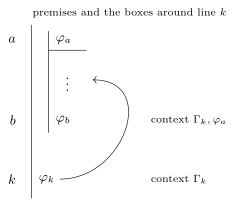
of that box. We write this .
Part (b): the last line of a cited box depends on
everything line
depends on, and on the box’s own assumption. The
arrow is the citation.
Idea. Both parts compare two sets
of boxes, since contexts differ only in the assumptions
of the boxes around a line. For (a), the scope rule says
that the boxes around line are among the boxes
around line . For
(b), the boxes around line should be the cited box
itself and the boxes around line ; the danger is a
further box inside the cited box that also ends on line
, and the box
rules forbid exactly that.
The proof reads both parts off the scope rule; it is
in the fold below.
↺Second readingThe
proof: reading the scope rule
Proof. (a) The premises
belong to every context. Any other formula of is the
assumption of a box containing line . Since line is available at line
, every box
containing line
also contains line , by the scope rule of
Definition 1.4.2.
So that assumption belongs to .
(b) Let be the box from line
to line . Since line cites , the box is available at line
. By the scope
rule, it ends before line , and the boxes
containing are
exactly the boxes containing line .
We find the boxes containing line . Every box containing
line contains
, and so contains
line ; and contains line . Conversely, let be a box containing
line . By Definition 1.4.2,
two boxes are either disjoint or one inside the other;
and share line , so , or contains , or lies inside . The last is
impossible: then line , the last line of , would be a line of a
box inside , and
every box rule requires the last line of its box to be a
line of that box itself, not of a box inside it (Definition 1.4.1,
Definition 2.2.1,
Definition 2.5.1,
Definition 1.6.1,
Definition 2.4.1).
So , or is one of the boxes
containing , which
are the boxes containing line .
Hence the boxes containing line are and the boxes
containing line .
The assumption of
is , so
consists
of the premises, the assumptions of the boxes containing
line , and , which is together with
.
In the derivation of Proposition 2.3.2,
line 6 cites the box by , and
is with the assumption added, as (b) says.
Line 5 cites lines 4 and 2, both available there, and
and are contained in
, as (a)
says.
↺Second readingA
box that ends inside another
Warning. Part (b) needs the box to
be cited by a box rule. Definition 1.4.2
allows a box to end on the same line as a box inside it,
and then its last line has a larger context. In the
derivation below, the box is available
at line 5, but contains , the assumption of the
inner box, as well as . No box rule may cite
: its
last line lies inside the box , not in
itself. (This is why the derivation of Example (Regrouping a disjunction)
needs its line 11.)
Quick check. In the derivation of
Proposition 2.3.2
above, which case of the soundness claim handles line 5?
Which lines’ contexts are involved, and why does
hold?
Solution. Line 5 is , by citing
lines 4 and 2: a one-step rule. Lines 4 and 2 are
available at line 5, so by Lemma 4.7.1
(a), and are contained in . The claim for the earlier lines gives and
. So a valuation making true would make
both and true, which clause
(V2) of Definition 4.4.2
forbids. No valuation makes true, and
holds because there is no row to check.
The
soundness theorem
We can now state the theorem that Chapters 1 and 2
kept pointing to.
Theorem
4.7.2 (Soundness)
Let be a
list of formulas and a formula. If , then
.
Try it first (ten minutes): suppose line is , by
from a box that opens with and ends with
. Suppose you
already know that every row making the context of line
and true makes true. Why is true in
every row making the context of line true? What happens in
the rows where is
false?
Idea. An attempt at the case
runs into two things. First, knowledge about the box’s
last line is knowledge about rows making its
own context true, which contains the
assumption ;
that is why the claim must carry contexts, and why Lemma 4.7.1
(b) is needed. Second, the rows in which is false are not
covered by the box at all, and they need nothing: there
is
true by (V5). The same two moves handle every box rule.
The Step roadmap:
① Prove the stronger claim for every line of a derivation in
primitive rules.
② Use strong induction on (Theorem 4.2.2):
a rule may cite any earlier line, not
only the line just above, so the hypothesis must be
available for all earlier lines at once.
③ Split on how line is justified. A premise
or an assumption belongs to its own context. A one-step
rule: apply the hypothesis to the cited lines, move
their contexts into by Lemma 4.7.1
(a), and use one clause of Definition 4.4.2.
A box rule: apply the hypothesis to each box’s last
line, whose context is plus the box’s
assumption by Lemma 4.7.1
(b), and argue about the rows where that assumption is
true or false.
④ The last line lies in no box, so its context is the
premises, all in ; adding the other
formulas of
keeps the entailment.
Before reading on: in the case of (Claim 3
below), where does the proof use that is exactly when
is , and which
half of that fact does it use?
Proof. Step 1 (reduction to
primitive rules). Suppose . As
shown in the subsection on derivations of formulas,
there is a derivation of whose premises all
belong to
and which uses primitive rules only. Fix one, with lines
; let
be the
formula on line
and its
context.
Step 2 (the induction). For , let be the statement:
if , then . We prove for every by Theorem 4.2.2.
So let ,
and assume for
every . If
or , there is
nothing to prove, so let . Every line and every box that line
cites is
available at line , and so lies before
line (Definition 1.4.2).
Hence the induction hypothesis holds for every line that line cites, and for the last
line of every box it cites.
Let be a
valuation that makes every formula of true. We show
; since is arbitrary, this
proves . By Definition 1.4.2,
line is a
premise, an assumption, or the conclusion of one
primitive rule, and the three claims below treat these
cases.
Step 3 (the cases).
Claim. If line is a premise or an
assumption, then .
Proof of Claim. A premise belongs
to every context. An assumption opens a box, that box
contains line ,
and so its assumption belongs to
. In both
cases is
one of the formulas that makes true.
For the one-step rules we first record what the
hypothesis gives for a cited line. If line cites line , then line is available at line
, so by Lemma 4.7.1
(a). Hence makes
every formula of true, and the
induction hypothesis gives
Claim. If line is justified by a
one-step rule, then .
Proof of Claim. We take the rules
one at a time; in each, the cited lines are true under
by .
. Line
repeats a line
, so ,
and .
. Line is ,
citing lines holding and . Both are true under
, so is
true by (V3).
. Line is , citing a line
holding . That line is true under , so by (V3) both
conjuncts are true, and in particular . The second form,
which writes ,
is the same with the other conjunct, and we skip it.
.
Line is , citing lines
holding and . Both are true
under . By (V5),
an implication with a true hypothesis and a false
conclusion is false; since is true
and is
true, is
true.
. Line is or
,
citing a line holding . That line is
true under , so
both disjunctions are true by (V4).
. Line is , citing lines
holding and
. By
both would
be true under ,
and by (V2) is false
whenever is
true. So no valuation makes every formula of true, and there
is no to
consider: holds because there is no row to
check.
. Line is any formula , citing a line
holding . By
, ,
which (V1) forbids. So again no valuation makes every
formula of
true, and holds.
.
Line is , citing lines
holding and . Both are true
under ; by (V6),
. The second form, which writes from and , is the same with
the sides exchanged, and we skip it.
For the box rules we record what the hypothesis gives
for a cited box. If line cites, by a box rule,
the box from line
to line , then
by Lemma 4.7.1
(b), and the induction hypothesis for line says
Claim. If line is justified by a box
rule, then .
Proof of Claim. Recall that makes every formula of
true.
.
Line is , citing
a box that opens with and ends with
. By , every
valuation making and true makes true. If ,
then by (V5). If ,
then makes and true, so , and
again by (V5).
. Line is , citing a box
that opens with and ends with
. By , every
valuation making and true makes true; since (V1)
makes false
under every valuation, no valuation makes and true. As makes true, it must
make false,
and then by (V2).
. Line
is , citing a box
that opens with and ends with
. By and (V1), as
in the previous case, no valuation makes and true. Suppose
. Then by (V2), so makes and true, which
is impossible. Hence .
. Line is , citing a line holding , a box
that opens with and ends with
, and a box
that opens with and ends with . By , , so by (V4),
or . By for the first
box, every valuation making and true makes true; for the
second, every valuation making and true makes true. If ,
then makes and true, so . If
, the second box gives in
the same way.
.
Line is , citing a box that opens with and ends with
, and one that
opens with and
ends with .
By ,
every valuation making and true makes true, and every
valuation making and true makes true. If ,
the first box gives . If ,
then too, since
would give by the second box. In both cases
, so by (V6).
The three claims cover every way line can be justified, so
holds. By Theorem 4.2.2,
holds for
every :
every line of the
derivation satisfies .
Step 4 (the last line). The last
line of a
derivation lies in no box (Definition 1.4.2),
so its context consists of the
premises alone, and . By the
induction of Steps 2 and 3, .
Every premise belongs to (Definition 1.2.3),
so a valuation making every formula of true makes every
formula of
true, and hence makes true. This proves
.
The proof is long, but each case is one step of the
truth-table reasoning of Section 4.4, placed in the
right context. Every primitive rule has passed. So has
every derived rule, since each abbreviates primitive
ones. The rules never lead from truth to
falsehood, not merely line by line but for every
derivation that can ever be written.
↺Second readingWhy
induction on the position of a line
Why strong induction and the position of a line? A rule may
cite any available line, however far back: line 7 of the
derivation of Proposition 2.3.2
cites the box that begins at line 2. So the hypothesis
is needed for all earlier lines at once. A different
route would induct on the length of the whole
derivation, removing its last line. But the lines above
the last line need not form a derivation, since a box
may still be open there (in the derivation of Proposition 2.3.2,
lines 1–6 end inside the box ), and that
route has to cut boxes open. Carrying the context of
every line avoids the surgery.
Example
(Running the claim on a case split)
Here is a derivation of . List the context of
each line, and check for each , naming the case of the
proof that handles it.
1
2asm, for
3 2
4asm, for
5 4
6 1, 2–3, 4–5
Solution. The boxes are and .
| 1 |
|
premise |
is in
its context |
| 2 |
|
assumption |
is in
its context |
| 3 |
|
citing 2 |
; a row making true makes true |
| 4 |
|
assumption |
is in
its context |
| 5 |
|
citing 4 |
as for line 3, with |
| 6 |
|
citing 1 and both boxes |
see below |
For line 6: by Lemma 4.7.1
(b), and , and the claim for lines 3 and 5
says that rows making and
true, and rows making and
true, make
true. A row making true makes true, so it
makes or true, and one of the
two boxes applies. Line 6 is the last line, and its
context is the premise: so , as soundness
promises.
Every rule,
checked against the tables
|
1.4 (clause (D3)) |
Claim 2 |
none: the line is repeated |
|
| , |
1.2 |
Claim 2 |
(V3) |
|
|
1.3 |
Claim 2 |
(V5) |
|
|
1.4 |
Claim 3 |
(V5) |
“a box from to gives ”; the
box ,
would give ; row , |
|
1.5 |
Claim 2 |
(V4) |
|
|
1.6 |
Claim 3 |
(V4) |
“the two boxes may end in different lines; write the
first box’s”; from , the boxes and would give ; row
,
|
| , |
2.1 |
Claim 2 |
(V2); (V1) |
|
|
2.2 |
Claim 3 |
(V1), (V2) |
“a box from to any line gives
”; the
one-line box
would give ; row |
| ,
|
2.4 |
Claim 3; Claim 2 |
(V6) |
|
|
2.5 |
Claim 3 |
(V1), (V2) |
“a box from to gives ”; from , the box , (by ) would
give ; row |
The thirteen primitive rules, with the case and
clause each uses. Each wrong version changes one
condition, and its case fails there: the row makes the
premises true and the line false.
↺Second readingThe
four wrong derivations, written out
Here are the four derivations the wrong versions
would license, written as patterns with Chapter 2’s
letters; read and
as the atoms
and for the rows of the
table. Each is correct except at its last line, which
only the wrong version allows. Wrong
reverses the implication its box proves; wrong closes
on a line that only the first box reaches; wrong closes
a box that never reached ; wrong opens its
box with
instead of .
1asm, for
2 1
3 1–2
1
2asm, for
3asm, for
4 1, 2–2, 3–3
1
2asm, for
3 2, 1
4 2–3
Refuting
with one row
Soundness is most often used backwards. If the
conclusion can be false while the premises are true, no
derivation can exist.
Corollary
4.7.3 (Refuting Row)
Let be a
list of formulas and a formula. If some
valuation makes every formula of true and false, then .
Proof. Let make every formula of
true and
false. Then
fails (Definition 4.5.3).
If held, Theorem 4.7.2
would give . So does not hold.
Here means that there is no
derivation of
from premises in : not with the
primitive rules, not with any derived rule, not in a
thousand lines. One row has settled a question about
infinitely many derivations.
Quick check. Does the row refute
?
Does the row ?
Solution. The first does not, since
its conclusion is
true. The second does: is T and is F. So , by Corollary 4.7.3.
Chapter 3’s question. Section 3.1
searched for a derivation of
and stalled. The row , makes true (false hypothesis) and false (true
hypothesis, false conclusion). By Corollary 4.7.3,
The letters of Chapter 3 stood for arbitrary
statements, and the search asked for a derivation of the
pattern: one derivation, written with
and , that works whatever
they are. Such a derivation, with and read as the atoms and , would derive ,
which we have just ruled out. So the pattern has no
derivation, and the search was right to fail.
(Particular instances can be derivable: with and the same statement,
takes one line. A refuting row for atoms
speaks about the pattern, as the warning after Lemma 4.5.3
said.)
What soundness certifies. Soundness
turns every break this book has made into a proof that
no derivation exists. Section 1.1 called a form bad when
some choice of statements makes its counterexample set
true (Definition 1.1.3).
For a propositional form, a row making the
counterexample set true is such a choice, and by Corollary 4.7.3
no derivation of the form exists, with any rule of
Chapters 1 and 2. Chapter 1 promised exactly this, in
Section 1.3, for affirming the consequent: the row , of Example (Affirming the consequent is not valid)
makes and
true and false, so So the repair of Argument B that Section 1.4
considered is not merely unjustified: it is impossible.
The same holds for every break in the derive-or-break
items from Section 1.5 on, for each claim of Section 3.2
that the search of Section 4.6 refuted, the four breaks
of Exercise (B3: Derive or break, used later)
among them, and for every refuting row of Sections 4.5
and 4.6. A break by statements about a number certifies
the same: the truth values of those statements form a
row, and since the connectives are truth-functional
(Section 4.4), that row makes the counterexample set
true.
Warning. A refuting row must make
every premise true. For ,
the row , makes the conclusion false, but it
also makes the premise false, so it refutes
nothing; and the sequent is derivable, by one line of
.
A row in which some premise fails is simply not one of
the rows Definition 4.5.3
looks at.
Warning. Soundness goes one way. It
says that derivable sequents are valid; it does not say
that a formula true in the row you happened to check is
derivable. The atom is true under the all-T
valuation, but : the all-F valuation makes it false, so Corollary 4.7.3
(with empty)
applies. Whether every valid sequent is
derivable is a separate question, answered in Section
4.8.
Quick check. Give a row showing
.
Solution. Take , , . The
premise is
true, since is
false. The conclusion has hypothesis , which is true,
and conclusion ,
which is false, so it is false. By Corollary 4.7.3,
no derivation exists. (The rows with true fail: they make
the premise force
true, or make the premise false.)
Satisfiable lists are consistent.
Section 4.5 kept two words apart, and soundness joins
them in one direction. A satisfiable list is consistent (Definition 3.2.1):
if , soundness would give , but
a row making
true makes
false. With Proposition 3.2.2
(b) this is Corollary 4.7.3
once more: a row making the counterexample set true
shows it consistent, and so , as
Exercise B4 of Section 3.2 anticipated. Section 4.8
proves the converse.
Test the
subgoal
Section 3.1’s search works on subgoals: a goal, and
the lines available for it. Soundness gives it a test.
Before chasing a subgoal, look for a row making the
available lines true and the subgoal false. If there is
one, no line standing at this point can hold the
subgoal: its context, the premises and the open
assumptions, is among the available lines, so the row
makes that context true and the subgoal false, while the
proof of Theorem 4.7.2
showed that every line satisfies . This is the move test the
subgoal. Section 3.1 met it without the name
(“Choosing a side of can leave a goal
that does not follow”): from , the goal tempts from
, and the row
,
makes true
and false, so the
search must split first.
Chapter 2 met a harder case. Section 2.5 did not aim
at for the De Morgan direction , because the step from the premise
to either disjunct can be broken. Now such a break is a
proof: the row , makes true and
false, so
, and the row , gives
. Both subgoals fail the test, so a
derivation of Proposition 2.5.5
(d) cannot end with , which
is why Section 2.5 reached for . The test
only refutes. A subgoal that passes it may still be hard
to reach; whether it can be reached at all is Section
4.8’s question.
Quick check. A search for opens a box for , with
the goal . Does
the subgoal pass
the test?
Solution. Yes, trivially. The
available lines , ,
are made true by
no row at all (
and force
), so no row
refutes any subgoal there; and indeed follows by , then
by . An
unsatisfiable context lets every subgoal pass.
Exercises
A. Check your
understanding
Exercise
(A1)
These parts are about the proof of Theorem 4.7.2.
Part (c) uses the derivation of Proposition 2.1.2,
written with atoms:
1
2asm, for
3 2, 1
4 3
5 2–4
- (a) Why does the
proof use strong induction on , rather than ordinary
induction from line to line ?
- (b) In the case,
the induction hypothesis is applied to the last lines
and of the two boxes. What
does it say about each, and which part of Lemma 4.7.1
identifies the contexts?
- (c) List the context
of each of the five lines of the derivation above, and
check for each.
- (d) Suppose a rule
“from and , infer ” were added to
the primitive rules. Which part of the proof would fail?
Give a valuation showing it.
- (e) Where does Step
4 use that the last line of a derivation lies in no
box?
Solution. (a) A rule may
cite any available line, however far back, and the last
line of a box that closed long ago. The hypothesis must
therefore be available for every earlier line, not just
for line . For
example, line 7 of the derivation of Proposition 2.3.2
uses the claim for line 6, and line 6 uses it for line
5; but line 5 uses it for line 2, three lines back.
(b) It says and
. By Lemma 4.7.1
(b), and : every row making and true makes true, and every row
making and
true makes
true. It is
not ,
which is what we are trying to prove.
(c) The box is .
| 1 |
|
premise, in its context |
| 2 |
|
assumption, in its context |
| 3 |
|
no row makes and
true, so it entails |
| 4 |
|
the same unsatisfiable context entails |
| 5 |
|
a row making true makes false, so true |
Line 3 is the case,
line 4 the case, and line 5 the case,
with by Lemma 4.7.1
(b).
(d) Claim 2, the one-step rules: it would
need a new case, and the case is false. From and
nothing follows about . The valuation
with , makes and true and false; with the new
rule, the three-line derivation of from and would have a last line
whose context does not entail it.
(e) It concludes that the context of the
last line is just the premises. Without that, the last
line could depend on an undischarged assumption, and
would say nothing about the rows making
the premises true.
Exercise
(A2: Drill)
The parts run from reading off a refuting row,
through contexts, to testing a subgoal and deciding a
claim.
- (a) Give a refuting
row for .
- (b) Give one for
.
- (c) Does , refute
?
- (d) Is there a
refuting row for ?
- (e) Refute .
- (f) Refute .
- (g) Line 5 of a
derivation lies in the boxes opened at lines 2 and 4,
and line 1 is the only premise. What is ?
- (h) Line is justified by citing
the box 3–6. What is , in terms of
?
- (i) A search for
considers ending with from
. Test the subgoal
.
- (j) The list
is satisfiable: give a row, and say what follows about
.
- (k) Which clause of
Definition 4.4.2
does the case of the proof of Theorem 4.7.2
use?
- (l) Derive or
refute: .
Solution.
(a) , .
(b) , .
(c) No: it makes
the premise false.
(d) No. The only
row making both premises true has true. (The sequent is
derivable, by one line of .)
(e) . With
no premises, every row qualifies.
(f) , , .
(g) .
(h) , by
Lemma 4.7.1
(b).
(i) The row , makes
true and
false: (Corollary 4.7.3),
so the subgoal is dead.
(j) , (or both
F). So the list is consistent: . (It is the list of Exercise (B4: Derive ⊥, or make every member true, used later)
(a) without its third member ; with , Section 3.2 derived
.)
(k)
(V4).
(l) Refute: , , makes the
premise true (false hypothesis) and false, so the
conclusion false; by Corollary 4.7.3
no derivation exists.
B. Practice
Exercise
(B1: Derivable or not)
Determine which of the following are derivable.
Justify your answer.
- (a) .
- (b) .
- (c) .
- (d) .
Solution. (a) Not
derivable. The row , , makes the premise true (its
hypothesis is false) and the conclusion false. By Corollary 4.7.3
there is no derivation.
(b) Not derivable. The row , makes
false,
so
true, and
false. By Corollary 4.7.3
there is no derivation.
(c) Not derivable. The row , , makes
true (both sides false) and true, and false.
(d) Derivable: Example (Choosing a side too early)
in Section 3.1 derives it, with on . So no row can refute
it: by Theorem 4.7.2
it is valid. A search for a refuting row confirms this.
The conclusion is false only if both and are false, that
is,
and ; but then is false and the
premise is false.
The trap is (d). Its conclusion
looks stronger than the premise, since
it seems to decide in advance which disjunct follows
from ; but a
derivation exists, and trying to refute it by a row is
bound to fail.
Exercise
(B2: Ordering the E case)
Here are nine lines. Seven of them, in the right
order, form the case of
the proof of Theorem 4.7.2.
Line is , by citing
line (holding
),
the box from line
to line (opening
with ,
ending with ),
and the box from line to line (opening with , ending with ). Give an admissible
order, and say why each of the other two lines cannot be
used.
(i) By the
induction hypothesis for lines and , which come before line
, and
.
(ii) Hence in
either case; since was arbitrary, .
(iii) Let be a valuation making
every formula of true.
(iv) If ,
then makes every
formula of
true, so .
(v) By Lemma 4.7.1
(a), , so makes every formula of
true; by
the induction hypothesis for line , , so
or .
(vi) By the
induction hypothesis for line , .
(vii) By Lemma 4.7.1
(b), is
with added, and is with added.
(viii) If ,
then makes every
formula of
true, so .
(ix) Line is inside the box, and
the box was cited at line , so the context of line
is ; the induction
hypothesis for line then gives
directly.
Solution. An admissible order:
(iii), (v), (vii), (i), (viii), (iv), (ii).
What each line needs: (v) and (viii), (iv) use the
valuation fixed in (iii); (viii) and (iv) use (vii) and
(i); (ii) uses the case split of (v) and both of (viii)
and (iv). So any order is admissible in which (iii)
comes before (v), (viii), and (iv); (vii) and (i) come
before (viii) and (iv); (v) comes before (ii); and
(viii) and (iv) come before (ii). For instance (vii),
(i), (iii), (v), (iv), (viii), (ii) is also admissible:
(vii) and (i) do not mention , and the two cases may
be taken in either order.
Line (vi) applies the induction hypothesis to line
itself. The
hypothesis of Theorem 4.2.2
covers only the lines ; (vi) assumes what is to be proved.
Line (ix) uses the context of the citing line for the
box’s last line. It is false: line lies inside the box,
whose assumption is part of its
context, so , not . In the
derivation of Example (Running the claim on a case split),
line 3 has context , while line 6 has context , and
could not be read off from line 3 directly.
Exercise
(B3: Derive or refute)
For each claim, give a derivation, or a refuting row
and the result that makes it a proof of
non-derivability.
- (a) .
- (b) .
- (c) .
- (d) .
- (e) .
- (f) .
Solution.
- (a)
Derive.
1
2asm, for
3asm, for
4 1, 3
5 4, 2
6 3–5
7asm, for
8asm, for
9 1, 8
10 9, 7
11 8–10
12 2–6, 7–11
- (b)
Derive.
1
2asm, for
3 2
4 2
5 1, 3
6 4, 5
7 2–6
(c)
Refute. , , : both premises have false
hypotheses, and is . By Corollary 4.7.3,
no derivation exists.
(d)
Derive.
1
2asm, for
3asm, for
4 2, 3
5 4
6asm, for
7 1, 3–5, 6–6
8 2–7
(e)
Refute. : is T, is T, and is F. By Corollary 4.7.3,
no derivation exists.
(f)
Derive, without .
1
2asm, for
3asm, for
4 2
5 3–4
6 5, 1
7 6
8 2–7
- (c) is the converse
of the chain, a way of affirming a conclusion; (e) is a
look-alike of ,
which (a) gives by ;
(f) looks paradoxical and is not: its premise is false
in every row but one, and there is true.
Exercise
(B4: Test the subgoal)
A search for has reached
this stage:
1
2
3asm, for
9
10 3–9
A student plans to reach by deriving first.
- (a) Test that
subgoal.
- (b) Name the
move that works, then complete it.
Solution.
(a) The available
lines are , , , and
the subgoal is .
The row , , makes the three lines true and false. So no line of
the box itself, whose context is , can hold : every line satisfies
, by the proof of Theorem 4.7.2.
The plan is dead. ( may still stand as the
assumption of a case box inside it, whose lines have a
larger context; that is how (b) uses it.)
(b) Use the
premise by its main connective: gives
; split it,
closing the case
by the clash with .
1
2
3asm, for
4 1, 3
5asm, for
6 5, 2
7 6
8asm, for
9 4, 5–7, 8–8
10 3–9
(Proposition 2.3.4
gives line 9 from lines 4 and 2 in one step, as a
derived rule; either is correct.)
C. Going deeper
Exercise
(C1: A safe rule and an unsafe one)
- (a) Add to the
primitive rules a one-step rule : from a line
, infer . Show that Theorem 4.7.2
still holds for derivations that may use .
- (b) Add instead a
one-step rule : from a line
,
infer . Show that soundness fails: name the case
of the proof that breaks, give a derivation using of a sequent
with a refuting row, and give the row.
Solution (Hint 1). The proof of Theorem 4.7.2
treats one rule per case. Adding a rule adds one case to
Claim 2 and changes nothing else.
Solution (Hint 2). For (b), start a
derivation from the premise , and look for a way to
write
first.
Solution. (a) The proof of
Theorem 4.7.2
goes through with one more case in Claim 2. Every other
part is unchanged: Step 1 and Step 4 do not look at the
rules, Lemma 4.7.1
(a) holds for any cited line, and (b) concerns only box
rules, and is not one.
The case . Line
is , citing
a line holding
. By , , so
by (V3), and by (V4). So every line of a
derivation with still
satisfies , and soundness holds.
(b) The new case of Claim 2 fails: from
, (V4) gives only that one disjunct
is true, and (V3) needs both. With , this is a
derivation of :
The row , makes the premise true and the
conclusion false, so , although with . The failure
is at line 3: its context is , and the row makes
and line 2 true
but line 3 false.
Marking scheme. (10 points)
- 2: (a) says that only one case is added, and why the
rest of the proof (Steps 1 and 4, Lemma 4.7.1)
is unaffected.
- 3: (a) the case for , using the
hypothesis for the cited line through Lemma 4.7.1
(a) and the clauses (V3), (V4).
- 2: (b) names the failing case, with the reason (one
true disjunct does not give a true conjunction).
- 3: (b) a correct derivation with and a refuting
row for its sequent.
Fatal errors (0 for the step): a “refuting row” that
makes a premise false; in (a), checking only on atoms
without the context argument.
Exercise
(C2: Exit check: soundness)
Close the section first, and write from
memory.
Write out, in full, the , and
cases of the proof of Theorem 4.7.2:
state the claim being proved for every line, set up the
induction, and prove the three cases, naming the reason
for each step.
Solution. The claim. Fix a
derivation in primitive rules with lines , and write
for the
formula on line
and for
its context (the premises and the assumptions of the
boxes containing line ). We prove for every with , by Theorem 4.2.2
applied to “if , then ” (for it holds
vacuously): fix
with ,
assume for every line , and let be a valuation making
every formula of true. Every line
and box that line
cites lies before line , so the hypothesis
applies to the cited lines and to the last lines of the
cited boxes. We show .
.
Line is , citing
the box from line
(the assumption ) to line (the formula ). By Lemma 4.7.1
(b), . Since , the hypothesis gives . If , then by (V5). If ,
then makes every
formula of true, so , and
by (V5).
. Line is , citing the
box from line
(the assumption ) to line (the formula ). By Lemma 4.7.1
(b) and the hypothesis for line , . Since under every valuation (V1), no
valuation makes all of true.
As makes true, ,
so by (V2).
. Line is , citing line (holding ) and
the boxes from to
( to ) and from to ( to ). Line is available at line
, so by Lemma 4.7.1
(a); makes true, and the
hypothesis for line gives , so
or by (V4). By Lemma 4.7.1
(b), and , and the hypothesis for lines and gives and . If ,
then makes true,
so ; if ,
likewise by the second box.
Conclusion. With the other cases, the
induction gives for every line. The last line
lies in no box, so its context is the premises, which
all belong to ; a valuation
making true
makes the premises true, and so makes the last line
true: .
Marking scheme. (10 points)
- 2: states the claim for every line, with
contexts.
- 2: uses the course-of-values hypothesis on earlier
lines only, and says why the cited lines and boxes are
earlier.
- 2: identifies the context of each box’s last line as
plus the
box’s assumption, citing Lemma 4.7.1
(b) (and (a) for the cited line in E).
- 1 + 1 + 1: the semantic step in each of the three
cases (the rows where the assumption is false for I; no row satisfies
the box’s context for I; the split on which
disjunct is true for E).
- 1: the conclusion for the last line.
A proof that inducts on the length of the derivation
instead, and handles open boxes correctly, earns the
same points step for step. Fatal errors (0 for the
step): applying the hypothesis to line itself; using as the context
of a box’s last line.
Exercise
(C3: A changed table)
Replace (V4) by: exactly when exactly
one of , is . Keep every
other clause and every rule.
- (a) Which cases of
the proof of Theorem 4.7.2
still go through?
- (b) For each rule
whose case fails, give a derivation and a row that is a
counterexample for the new table.
- (c) Is still
derivable? Is it valid for the new table? What does this
show?
Solution.
(a) Every case
except . The rules that do not mention use other clauses,
which are unchanged. The case
needs only that a true disjunction has a true side, and
that still holds: exactly one side is true.
(b) : the
derivation 1 ; 2
, 1. The
row makes true and, for the new
table,
false.
(c) Derivable:
the rules did not change. Not valid for the new table:
the row of (b). So soundness is a fact about the rules
and the tables together; change a
table, and the same rules can lead from truth to
falsehood.
Marking scheme. (10 points)
- 4: (a), with the argument for the
case.
- 4: (b), the derivation and the row, checked.
- 2: (c), both answers and the conclusion.
Fatal errors (0 for the step): in (a), declaring the
case broken without a row that breaks it.
Exercise
(C4: Challenge: ⊥ read as a letter)
Read as an
ordinary letter. A letter valuation
gives or to every atom
and to , computes
, , , by
(V3)–(V6), and sets exactly when
or . Write
when every letter valuation making every formula of
true makes
true.
- (a) Show that every
line of a derivation that uses no and no
, and
cites no derived rule whose own derivation uses them,
satisfies . Give the cases and
,
and say why the others are those of Theorem 4.7.2.
- (b) Deduce that
has
no derivation without and
(and
without derived rules derived with them).
- (c) Derive with and
without , and say why (b) must exclude as
well.
Solution.
- (a) Step 1 of the
proof expands each line citing a derived rule into a
pasted derivation of that rule, which by hypothesis uses
neither nor ; so the
expanded derivation is in the remaining primitive rules
(and a derived rule derived from derived rules of this
kind expands the same way, one layer at a time). Steps
1, 2 and 4 do not look at the clauses, and the cases of
premises, assumptions, and the
rules for ,
, , use only
(V3)–(V6), which are unchanged; they go through word for
word with for
.
:
makes
true, so by
it makes
and
true. Now with
forces , and line is .
: by , every letter
valuation making and true makes true. If ,
then . If ,
then makes and true, so , and
again .
(b) The letter
valuation with and makes the premise true and the
conclusion false. So fails, and by (a) no derivation
of
without and , and
without derived rules derived with them, exists. (Many
derived rules of Chapter 2 use one of the two, Proposition 2.5.1
(b) (with ) and Proposition 2.1.1
(with ) among them; a derivation that avoids the
two only on its face is not covered.)
- (c)
1
2asm, for
3 1
4 2–3
So with the rule
is derivable, and (a) must fail for . It does:
with , every negation is true, so the box
of lines 2–3 satisfies , and yet .
Marking scheme. (10 points)
- 2: the carried-over cases named, with the reason
(Steps 1, 2, 4 and the clauses (V3)–(V6) unchanged), and
Step 1’s restriction to derived rules derived without
and .
- 2: the case.
- 3: the case, both values of .
- 1: (b), the letter valuation and the
conclusion.
- 2: (c), the derivation and the failing case.
Fatal errors (0 for the step): in (b), using the
ordinary valuations, under which holds.
Exercise
(C5: Challenge: two three-valued tables)
A Kleene valuation assigns
one of the values , , to each atom and is
extended by ,
, , , . (This extension differs from the
three-valued valuation of the optional excursion below,
whose gives
the
value at .) For a set of
designated values, say that -entails if every Kleene
valuation giving
every formula of a value in gives a value in .
- (a) For , show that
the case fails:
give a box that is correct for -entailment and a at which
the line that writes
is undesignated.
- (b) For ,
show that the case
fails.
- (c) Is designated
under every in (a)? In
(b)?
Solution.
(a) The one-line
box : -entails . writes
, and at
, .
(b) The premises
, and the conclusion
, at , :
and , but .
(c) In (a), no:
at
. In (b), yes: for each of the three values .
So the first choice of loses excluded middle
and the box rule for ; the second keeps
excluded middle and loses modus ponens.
Marking scheme. (10 points)
- 4: (a), the box, the valuation and the
computation.
- 3: (b), the valuation and the three values.
- 3: (c), both parts, with the computation.
Fatal errors (0 for the step): a “failure” in (a) or
(b) at a valuation that does not designate every
premise.
Optional
excursion: reductio says something new
Optional: nothing later depends on this
excursion. It answers a question Chapter 2
raised.
A three-valued valuation assigns to each atom
one of the values , , , ordered .
Think of as
“true”, as
“false”, and as “not yet
settled”.
An implication gets when its conclusion is
at least as true as its hypothesis, and otherwise the
value of its conclusion; a negation is only on .
Chapter 2 introduced in Section
2.5 because the rules before it stalled on , and
said that Chapter 4 would prove that no derivation of
from avoids . Truth
tables cannot do it. The row method only proves
non-derivability from all the rules,
and with the
sequent is derivable, so no two-valued row refutes it.
The trick is to run the proof of Theorem 4.7.2
with a different notion of truth, one with three values,
under which every rule except still
passes.
A three-valued valuation is extended to all formulas
by recursion (Theorem 4.3.4):
So if , and
otherwise. On the values and alone these are exactly
the tables of Definition 4.4.2,
with for and for . For a list
, let be the least of
the values for in , and if is empty. Write
if for every three-valued valuation
: the conclusion
is at least as true as the weakest premise.
Theorem
4.7.4 (Reductio Is Not Derivable from the Other
Rules) Optional: nothing
later depends on this.
Neither nor has a derivation that uses only the
primitive rules other than (and
derived rules derived from those).
Idea. Repeat the proof of Theorem 4.7.2
with in
place of :
every line of a derivation without satisfies
. Then show that both sequents fail
for , at
. The
one case that breaks is , and that
is the point.
Proof. As in Step 1 of the proof of
Theorem 4.7.2,
a derived rule derived without
abbreviates a pasted derivation in the primitive rules
other than , so it is
enough to consider those. Fix a derivation that uses
only the primitive rules other than , with
lines ,
formulas
and contexts . We show for every with , by Theorem 4.2.2
exactly as in Step 2 of the proof of Theorem 4.7.2,
the cases and
being
vacuous. Fix ,
assume the claim for all earlier lines, and fix a
three-valued valuation ; write . We must
show . Two facts do the bookkeeping. If
line cites line
, then (Lemma 4.7.1
(a)), and the least value over a longer list is at most
the least over a shorter one, so . If line cites a box from line
to line by a box rule, then
(Lemma 4.7.1
(b)), so the hypothesis for line says . Below, , , .
Premises and assumptions: is in , so .
: . :
and , so .
: , and likewise . :
.
:
and . If , then . Otherwise ,
so .
:
and , so
as for
;
the second form is symmetric.
: and . If , then ; if , then and
. So .
: , so .
:
the hypothesis gives . If
, then . Otherwise and ; since , the minimum is not , so it is , and . :
the same argument for each box gives
and , so is at most their
minimum.
: the hypothesis gives . If , then .
If , the
minimum is and is
not , so .
: , and the boxes give and
.
If , then
, so and
. If , then and from the second
box.
This covers every rule used, so for every line, and in particular for
the last line, whose context is the premises. As in Step
4 of the proof of Theorem 4.7.2,
a list containing all the premises has least value at
most theirs, so every sequent
derived without satisfies
.
Now let . Then , since
, and
,
since . So , and
fails. Also , the
value of the empty list, so
fails. Hence neither sequent is derivable without .
The case that was not written is itself.
Its box would give , and we would need . At the
box gives nothing, since
already, while
may be . This is
the three-valued face of the question asked in the Idea
of Theorem 4.7.2:
the two-valued case used
that forces , and with a third value, and can both fail
to be true.
A technique, named. The proof is an
instance of a general technique: to show that a rule
cannot be derived from the others, find a new notion of
“true” under which the other rules are sound and that
rule is not. Here the notion has three values; Exercise
C4 uses two values with read as an ordinary
letter, and Exercise C5 two other three-valued tables.
Each notion is a different semantics. For the two-valued
tables the rules are not only sound but complete, which
is Section 4.8’s theorem.