Section 4.4 gave every formula a value under every
valuation, and collected the values in a truth table.
One formula at a time, though, is not what Chapters 1
and 2 were about. They were about
sequents: premises on the left, a
conclusion on the right, and the claim that the
conclusion can be derived. This section defines the
counterpart of a sequent in terms of truth, :
every valuation that makes the premises true makes the
conclusion true. On the way it names the formulas that
are true in every row, and the pairs of formulas that
are true in the same rows. It then proves two lemmas
about changing a formula, by replacing one part or by
putting formulas in for its atoms, that later sections
use, and ends by sorting the section’s questions by
whether one row or every row settles them, and by
setting
beside .
Tautologies
and contradictions
Some tables of Section 4.4 had a last column made
entirely of : the formula
of Example (The truth table of modus ponens),
and the biconditional of Example (An implication and its contrapositive).
Their truth does not depend on the situation. One table
in Exercise A1 there, that of ,
was all .
These extremes deserve names.
A tautology is true for reasons of form alone:
whatever the atoms mean, it comes out true.
Definition
4.5.1 (Tautology and Contradiction)
A formula is a
tautology if
for every valuation . It is a
contradiction if
for every valuation .
By Lemma 4.4.1,
the value of under a valuation
depends only on the row the valuation gives to the atoms
of . So
is a
tautology exactly when its truth table has in every row,
and a contradiction exactly when it has in every row.
Infinitely many valuations, finitely many rows to
check.
Examples, simplest first.
- and
are
tautologies: in the row both are true, and in the row , has a false
hypothesis and is true.
-
and are contradictions: in each row one of , is false, and the
two sides of the biconditional differ.
- Nonexample. is neither: it is in the row TT
and in
the row TF. Most formulas are like this. Changing one
symbol of the tautology , to get , loses the property: the rows in which the
hypothesis and conclusion differ are no longer excluded
by their being the same atom. A formula that is true in
some rows and false in others, such as , is called
contingent: every formula is a
tautology, a contradiction, or contingent.
↺Second readingFormulas
with no atoms
A formula with no atoms, such as or , has the same
value under every valuation (its table has one row). So
it is either a contradiction, like , or a tautology,
like . This
degenerate case is the only one in which “not a
tautology” forces “a contradiction”.
Lists of formulas need a word too,
because a list of premises can fail to be true together
even when each premise alone can be true.
Definition
4.5.2 (Satisfiable)
A formula is
satisfiable if there
is a valuation with .
A list of formulas , where , is
satisfiable if there
is a valuation that makes
every true. A formula
or list that is not satisfiable is
unsatisfiable.
In words: a formula is satisfiable if some row makes
it true, and a list is satisfiable if some
single row makes all its members true
at once. So a formula is unsatisfiable exactly when it
is a contradiction. The empty list
() is
satisfiable: every valuation makes all of its members
true, since it has none to check.
The list is unsatisfiable, although each of its
members is satisfiable: a row making true makes false.
Satisfiability of a list is about a common row, not
about each formula separately. And the list is satisfiable, by the row with false and , true (the first two
have true conclusions, and the third has conclusion
, which is
true); in fact is
false in every row that makes all three true.
Tautologies and unsatisfiable formulas are two sides
of one coin. For every formula , Indeed, by (V2) of Definition 4.4.2,
exactly when . So
“no valuation makes true” says “no
valuation makes false”, which is
“every valuation makes true”. Sections 4.6
and 4.9 use it to pass between the two kinds of
question.
Warning. “Not a tautology” does not
mean “a contradiction”. The formula is neither: some
rows make it true and some false. To show a formula is
not a tautology, one row making it
false is enough; to show it is a
contradiction, every row must make it false.
Semantic
entailment
Now the counterpart of a sequent. A derivation from
premises to
a conclusion
is a promise that follows from . In terms of
truth, “follows” should mean: no situation makes the
premises true and the conclusion false. We want to
prove, in Sections 4.7 and 4.8, that the rules of
Chapters 1 and 2 derive exactly the sequents that pass
this test; for that we need a precise name for the
test.
An argument is valid when its conclusion is true
in every row in which all its premises are
true.
Definition
4.5.3 (Semantic Entailment)
Let be a list of formulas, where
, and let
be a formula.
We say
semantically entails , and write if every valuation that makes
all of true also makes true. We then also
call the argument from to
valid. We write for , and
when
is empty. If
fails, we write , and a valuation that makes
every formula of true and false is a
refuting valuation, or refuting
row.
Clause by clause. “Every valuation”: the condition is
checked in all situations, not in the actual one; a
valid argument cannot be spoiled by what the atoms
happen to mean. “That makes all of true”: rows in which some premise is
false are ignored, whatever the conclusion does there.
“Also makes
true”: in the remaining rows, the conclusion must hold.
In symbols, for every valuation , And says: there
is a valuation making every premise true and
the conclusion false. One refuting row is enough.
Checking it. By Lemma 4.4.1,
whether a valuation makes the premises and the
conclusion true depends only on its row on the atoms
occurring in
and . So can
be decided by one truth table on those atoms (Definition 4.4.3
allows extra atoms in the list): find the rows in which
every premise is , and look at
the conclusion there.
First examples. Row 1 of Example (The truth table of modus ponens)
is the only row making and
true, and is true
there, so . By Example (An implication and its contrapositive),
and , since the two
columns are equal.
The empty list. When is empty, every
valuation makes “all of ” true, so says that
every valuation makes true: holds
exactly when
is a tautology.
Unsatisfiable premises. If is unsatisfiable,
no valuation makes all of true, so the
condition has no row to check and holds: for
every formula . For example and
.
This is the table’s version of Proposition 2.1.1,
,
and of .
More premises. If , and
is a list
containing every formula of (and perhaps
others), then : a valuation making all of true makes all of
true, and so
makes true.
Adding premises never destroys an entailment. In the
same way, the order of the premises and repetitions
among them do not matter: only which formulas occur in
the list does.
↺Second readingThe
bookkeeping of entailment
Four facts about need nothing but
the definition. Reflexivity:
whenever is
a member of ,
since a row making all of true makes true.
Weakening: adding premises keeps an entailment,
as just shown. Order and repetition:
rearranging ,
or repeating a member, changes nothing. Cut: if
and , then .
Indeed, let a row make every member of true. By the first
entailment it makes true, so it makes
every member of true, and by the second it makes true. Section 2.3
proved weakening and cut for (Lemma 2.3.3)
by pasting derivations, and its weakening, which asks
only that every member of be a member of
, covers
order and repetition; reflexivity for is the derivation
whose only line is the premise . Here each fact
is one line about rows. Section 4.8 sets the two lists
side by side.
A test by satisfiability. Finally, for every
list and
formula , Both sides say that no valuation makes every
formula of
true and
false, because exactly when .
With empty
this is the equivalence between tautologies and
unsatisfiable negations above.
The list is the counterexample
set of the claim (Definition 1.1.3):
an argument is valid exactly when its counterexample set
cannot be made true by any row.
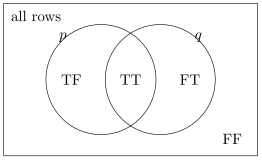
Rows as regions. A table on and has four rows, and they
can be drawn as the four regions of a picture.
Each row of the table on is a region. A
formula marks the rows where it is true: the lens,
both
circles,
everything outside ’s circle. says
that the region where all of is true lies
inside the region of : .
Equivalent formulas mark the same region, a tautology
marks the whole rectangle, and an unsatisfiable list
marks nothing in common.
Quick check. Does hold? Does ?
Solution. The first holds: a row
making
true makes true,
so is
true. The second fails, for instance at , (any ), which makes true and false.
Example
(Affirming the consequent is not valid)
Show that .
Solution. We need one row making
both premises true and the conclusion false. The
conclusion must
be , and
the premise must
be . In
the row , , the premise is , since its
hypothesis is false. So this row makes and true and false: it is a refuting
row.
The pattern is the one of Section 1.3, “from and
, infer ”, which is not an
instance of .
Section 1.1’s Quick check gave the row a face: with
: “ is divisible by ” and : “ is even”, at the premises and are true and is false. It is also
the step that would repair Argument B of Section 1.1:
from “if is even,
then is even”
and “ is even”,
conclude “ is
even”. The conclusion of that instance happens to be
true for every integer , as Argument A proves;
the refuting row shows that the form
does not guarantee it, so the step proves nothing.
Section 4.7 upgrades this row from “not valid” to “not
derivable by any derivation”.
A valid argument with several premises is checked in
the same way, and working backwards from F often settles
it without a table.
Example
(Two cases, two conclusions)
Show that .
Solution. Suppose a valuation makes all three
premises true and the conclusion false; we derive a
contradiction. Since is , both and are (V4). Since
is and is , the
hypothesis is
(V5). In
the same way forces
to be .
But then
is ,
contradicting the first premise. So no refuting
valuation exists, and the entailment holds.
The search replaced a table of rows by four
forced steps. The entailment is the table’s picture of a
proof by cases with : in the
case , the second
premise gives ,
and gives ; in the case , the third gives , and
again.
Changing the grouping of a formula can change what it
entails.
Example
(One grouping entails the other, not conversely)
Decide whether , and whether
.
Solution. The first holds.
Suppose a valuation makes true and false.
The latter forces and false, so and . Then is , and has a
true hypothesis and a false conclusion, so it is , a
contradiction.
The second fails. Take and , with
either value.
Then is , since its
hypothesis is false. But is for the same
reason, so is , which is . These two
rows are refuting rows.
So the two groupings are not interchangeable, which
is why Chapter 1 fixed a convention ( groups to the right)
and why the convention matters.
Warning. is not . The formula is a
formula: it has a value in each row and can be a part of
larger formulas. The statement is
not a formula at all. It is a claim
about two formulas, true or false once
and for all, like . They are related (Exercise B3
below asks you to prove that
holds exactly when is a tautology), but writing , or
inside a formula, mixes the two levels and means
nothing.
Quick check. Is ? Is
?
Solution. The first holds: the list
is
unsatisfiable, so there is no row to check. The second
fails: the row , makes true (false hypothesis) and true, and false. It is the
pattern “denying the hypothesis”, the mirror image of
affirming the consequent.
Semantic
equivalence
Two formulas can be different strings and still say
the same thing in every situation, as and did in
Example (An implication and its contrapositive).
Chapter 2 had a word for formulas that derive each
other, provable equivalence (Definition 2.4.2).
Here is the counterpart in terms of truth.
Two formulas are equivalent when they have the
same truth table.
Definition
4.5.4 (Semantic Equivalence)
Formulas
and are
semantically equivalent, written , if
and .
In words, each entails the other. Equivalently, for
every valuation . Indeed, if and
, then by
; if , then cannot be , since
would make . The converse is plain. By (V6) of
Definition 4.4.2,
“ for every ” says that is true under every , so From “same value under every valuation” it
follows at once that is reflexive,
symmetric, and transitive: ;
if , then ; if and
,
then .
Examples: (the clause (V3) does not
care about the order); (two flips); (both are true under every valuation).
The degenerate case: any two tautologies are equivalent,
and so are any two contradictions. Nonexample:
and
are not
equivalent. One direction holds, , but
the other fails in the row , . Entailment in one direction is not
equivalence. Nor is equivalence identity: and are different
formulas, with different parse trees, and treats
them as different (Section 1.3).
The equivalences used most often are collected below.
They are stated for arbitrary formulas , not
just atoms, since Section 4.9 applies them to compound
formulas.
Proposition
4.5.1 (Standard Equivalences)
For all formulas , and :
- (a) (contrapositive)
;
- (b) (De Morgan)
and ;
- (c) (implication as
a disjunction) ;
- (d) (double
negation) ;
- (e) (biconditional)
;
- (f) (commutativity)
and ;
- (g) (distributivity)
and ;
- (h) (associativity)
and .
Idea. For atoms these are
truth-table checks. For arbitrary formulas the same
tables work, with in the place of atoms: under a fixed
valuation, each of has some value, and both sides are
computed from those values by the clauses (V2)–(V6),
exactly as in a table whose first columns are .
Proof. Fix a valuation , and let , , . Each side of
each equivalence is built from by
connectives, so by (V2)–(V6) of Definition 4.4.2
its value under
is computed from by the clauses of those connectives. The
combination ,
or , is
one row of the tables below, whose first columns list
all 4 (or 8) combinations. In each table the columns of
the two sides of each equivalence agree in every row, as
the reader can check column by column. Hence both sides
have the same value under , and since was arbitrary, they are
equivalent by the paraphrase of Definition 4.5.4.
Parts (a), (b), (c), and (e): The first three formula columns agree, which
gives (a) and (c). The last agrees with the column of
in the table of Definition 4.4.2
( exactly
when ), which
gives (e). This gives (b). For (d): if , then
and ; if , then and ; in both cases .
For (f): clause (V3) makes exactly when , a
condition that does not change when and are swapped, so ; likewise (V4) for .
Parts (g) and (h): In each of the two tables the first two
formula columns agree, and so do the last two. This
proves all parts.
Chapters 1 and 2 derived many of these laws as pairs
of sequents, some directions with derivations that use
or
(Proposition 2.5.5
(d), Proposition 2.5.1,
Proposition 2.5.6)
and others without. That some of them cannot do without
a classical rule, Chapter 2 stated without proof (for De
Morgan (d), for instance); for ,
Section 4.7 proves it in an optional result. The tables
do not see that difference: they see only that the two
sides agree in every row. Section 4.8 shows that every
such agreement can be turned into derivations, with
among the rules.
Long conjunctions and disjunctions.
Associativity lets us stop worrying about grouping. We
write for the
conjunction grouped to the right, , and likewise for
; for it is itself. Then,
for every valuation and every ,
↺Second readingWhy
long conjunctions are evaluated term by
term
For the conjunction, we prove by Axiom 4.2.1
on , started at
, that the first
line holds for every list of formulas. For both sides say
. If it holds for every list of formulas, take a list
of . The
conjunction is , where has terms. By (V3), exactly when
and , and by the hypothesis for ,
exactly when for . Together: exactly when every
. The disjunction is the same with
(V4) and “some”.
The same holds for any grouping. Call a formula built
from , in this order, using alone, a
grouping of the list. For a grouping is
, where is a grouping of
and a grouping of
, for some with . Each part
has fewer terms, so by (V3) and Theorem 4.2.2
on , a grouping is
true under
exactly when every is. Likewise
for with
(V4).
Two consequences follow at once, since the right-hand
sides do not care about order, and by the fold every
grouping has the same right-hand side. Reordering the
terms of a long conjunction, or grouping them
differently, gives an equivalent formula; likewise for
disjunctions. And De Morgan’s laws extend to many terms:
since, for instance, both sides of the first
are true exactly when some is false.
Quick check. Is ? And is ?
Quick check. Which of the three
operations turns into , and what does it keep?
Solution. Substitution of for the atom
, at both
occurrences. It keeps tautologies, so the new formula is
a tautology too. It is not a replacement of a part:
is not
equivalent to .
Equivalent formulas agree in every row. Three other
relations say how two formulas can fail to agree, and
they have old names.
Definition
4.5.5 (Contradictory, Contrary and Subcontrary
Formulas)
Formulas
and are
contradictory if every row makes
exactly one of them true; contrary if
no row makes both true but some row makes both false;
subcontrary if no row makes both false
but some row makes both true.
In words: contradictory formulas are each other’s
negation in value, , since “exactly one true” says
that iff ,
that is, iff . Contrary formulas cannot both hold
but can both fail; subcontrary formulas cannot both fail
but can both hold. A row here is a valuation, or
equally, by Lemma 4.4.1,
a row of a table on the atoms of both formulas.
| , |
contradictory |
each is exactly where
the other is : is only at TF,
the one row where is |
| ,
|
contrary |
both false at , ; both true would need and true |
| , |
subcontrary |
both true at , ; both false would need and false |
Quick check. Classify the pair
, .
Solution. Contradictory. In each
row the two sides of the first agree exactly when the
two sides of the second disagree, since has the other
value from . So
exactly one of the two is true in each row.
Replacing a
part by an equivalent part
In algebra, if , then
may be replaced by inside any expression.
Semantic equivalence behaves in the same way, because
the value of a formula depends only on the values of its
parts. This is what makes chains of equivalences, one
standard equivalence applied deep inside a formula at a
time, a legitimate way of computing.
Recall from Section 4.1 that the subformulas of are the formulas at
the nodes of its parse tree (Definition 4.1.3).
An occurrence of in is a node whose
subtree is a parse tree of ;
replacing that occurrence by means
putting a parse tree of in place of
that subtree, which gives the parse tree of a new
formula .
Lemma
4.5.2 (Replacement)
Let . If is obtained
from a formula
by replacing one occurrence of in by , then .
Idea. Induct on the shape of . Either the
occurrence is all of , and then is and is , equivalent
by hypothesis; or it sits inside one immediate part of
, the other
part is untouched, and the value of is computed from the
values of its parts, one of which has not changed and
one of which has not changed its value.
The proof, by structural induction with exactly that
case split, is in the fold below.
↺Second readingThe
proof of the replacement lemma
Proof. We apply Theorem 4.3.1
to the property : for every
formula
obtained from
by replacing one occurrence of by , and every
valuation , . By the paraphrase of Definition 4.5.4,
says that
each such
is equivalent to .
In every case, the replaced occurrence sits either at
the top node of the tree of or at a node below
it; in the second case the node lies in the subtree of
exactly one immediate part of , since those
subtrees are the parse trees of the immediate parts (Definition 4.1.2).
If the occurrence is the root, then and ,
and because . It remains to treat an occurrence
below the root.
Atoms and . The parse tree
is one node, so there is no node below the root.
Negation. Let and
assume .
An occurrence below the root lies in , so , where is obtained
from by
replacing that occurrence. By , , and (V2) gives .
Binary connectives. Let , with one of , and assume and . If the
occurrence lies in , then , with obtained
from by
the replacement, and by . The clause
of Definition 4.4.2
for computes
from
and ,
and from
and
, by the
same rule, so . An occurrence in is the same with
the roles of the parts exchanged.
This covers every clause of Definition 4.1.1,
so holds
for every ,
which proves the lemma.
Replacing several occurrences, one after another,
keeps equivalence at each step, and is transitive, so
the final formula is equivalent to the first. For
instance, with (b), (d), and then (c) of Proposition 4.5.1,
each applied inside the formula: The first step replaces the subformula by
an equivalent one (De Morgan with , ); the
second replaces by ;
the third replaces the whole formula, by (c) with and .
Section 4.9 computes normal forms this way.
Warning. Replacement needs
equivalence; entailment in one
direction is not enough. We have , but
replacing by
inside gives , and the row , makes true and
false. A
negation reverses the direction of an entailment, so
one-way information cannot pass through it.
The letters ,
of Chapters 1 and
2 stood for arbitrary statements, and Section 4.1 turned
that into a remark about derivations: a derivation
written with letters is a pattern, and putting formulas
in for the letters, uniformly, gives a derivation again.
The truth table of Example (The truth table of modus ponens),
though, was computed for the atoms and . Does it tell us
anything about in place of ? It should: the table
only used the values of and , and a compound formula
also has a value in each row. This subsection makes that
precise.
Let be distinct atoms and formulas. The
substitution of for is the function on formulas defined
by recursion (Theorem 4.3.4):
In words: replaces
every occurrence of each in by , all at once,
and changes nothing else. For a list , we write for the
list . For example, with
putting
for
and for , The
that puts in
for is not
replaced again: the replacements happen simultaneously,
in one pass over the parse tree.
Example
(One row, two valuations)
Let put
for
and for , as above, and let
,
,
.
Compute for . Then define by for every atom , and compute .
Solution. By the display above,
. Under , is and is , so is
; is ; so .
Next, , ,
and , since leaves alone. Under , is and is , so . The
two values agree.
The formula under behaves exactly as
does under
. The lemma below
says that this happens for every formula and every
valuation, and draws the consequences.
Lemma
4.5.3 (Substitution)
Let be
the substitution of for the distinct atoms .
- (a) If , then .
- (b) If , then
.
Idea. Under a valuation , the formula behaves
exactly like
itself under a different valuation : the one that gives
each atom the
value that gives
to . So
every row for is, in
disguise, a row for , and whatever holds
in all rows of
holds in all rows of . The
disguise is proved by induction on the shape of .
Proof. Let be a valuation, and let
be the valuation
with for every atom ; so and
for
every other atom .
Claim.
for every formula .
Proof of Claim. By Theorem 4.3.1.
For an atom ,
is the definition of . For , by (V1). For a negation,
assume ; then , which by (V2) is the flip
of , and so equals . For a binary
connective ,
assume the claim for and ; then is
computed by the clause for from
and , and so equals ,
which the same clause computes from the same two
values.
(a) Let , and let be any valuation. By
the claim, , since is a tautology. So
is
true under every valuation.
(b) Let , and let make every formula of
true. For each in , the claim gives
, so makes every formula of
true. By
, , and by the claim again . This proves .
So a table computed once for atoms settles infinitely
many instances. From we get , and every other instance of excluded
middle. From (Example (The truth table of modus ponens))
we get for all formulas , which is
the table’s version of as a
schema. And from Example (Affirming the consequent is not valid)’s
refuting row we learn only that the pattern is not
valid, not that its instances fail; the lemma runs one
way only, as the next warning says.
Warning. Substitution must be
uniform: every occurrence of is replaced by the
same .
Replacing only the first of the tautology by gives , which is false
in the row , . And the lemma runs one way only. An
instance can be a tautology when the pattern is not:
is not a
tautology, but its instance with put in for is , which is.
So a refuting row for a pattern with atoms shows that
the pattern is not valid, not that
every instance fails.
One row or
every row
Every question of this section is about rows, and
each comes in two halves: one half is settled by a
single row, the other needs them all.
|
satisfiable? |
one row making true |
every row |
no: a yes is one row, so this is the negation of “is
the list
unsatisfiable?” |
| a
tautology? |
every row |
one row making false |
the list |
| ? |
every row (or working backwards from F) |
one refuting row |
the counterexample set |
| ? |
every row |
one row where they differ |
the list , since
exactly when (after Definition 4.5.4) |
|
satisfiable? |
one row |
every row |
no: it is the negation of “is
unsatisfiable?” |
So every question is one question in disguise: is
some list unsatisfiable? A yes needs every row, a no
needs one. Section 4.6 searches the rows of a list
without writing them all down.
Two
questions, side by side
We now have two ways of saying that follows from . They were built
from different materials, and it is worth setting them
next to each other before Sections 4.7 and 4.8 connect
them.
| What it says |
there is a derivation from premises
in to |
every valuation making all of true makes true |
| What it is about |
syntax: lines, rules, boxes |
meaning: truth values |
| How to show it holds |
exhibit one derivation |
check every row (or work backwards from F) |
| How to show it fails |
no method yet: a failed search proves nothing |
exhibit one refuting row |
| Defined in |
Definition 1.2.3
(Section 1.2) |
Definition 4.5.3
(this section) |
Look at the fourth row. To show that something is
not derivable, we would have to survey
infinitely many derivations; to show that something is
not valid, one row suffices. And to
show that something is valid takes a
finite, mechanical check, while showing it derivable may
need an idea. Each column is easy exactly where the
other is hard.
Sections 4.7 and 4.8 prove that the two columns
always give the same answer. Section 4.7 proves
soundness: if , then
; so a refuting row proves that no
derivation exists, which answers the question Chapter 3
ended on. Section 4.8 proves
completeness: if , then
;
so a successful table check guarantees that a derivation
exists, even before anyone has found it.
Exercises
A. Check your
understanding
Exercise
(A1)
- (a) Classify each
formula as a tautology, a contradiction, or satisfiable
but not a tautology: ; ; ; ; .
- (b) For each, decide
whether it holds, and give a refuting row if it does
not: ; ; .
- (c) True or false,
with a reason: if and ,
then is
unsatisfiable.
- (d) True or false,
with a reason: or .
Solution. (a) : a
tautology (if is
, the
conclusion
is ; if
is , the
hypothesis is false). : a contradiction (if
is , so is , and is ). : satisfiable, not a tautology ( in the row TT,
in TF).
: a
contradiction, since is a tautology. : a tautology (if the hypothesis is , then is , so is ).
(b) holds: the only row
making
true has , where is true. fails: the row makes
true and
false. holds: in the row , the
premise has a true hypothesis and a false conclusion,
so it is false; the only row making the premise true has
.
(c) True. If a valuation made all of true, it would
make both and
true,
which (V2) forbids. So no valuation makes all of true.
(d) False. The row , refutes
,
and the row , refutes . Each
disjunct fails in some row where the disjunction holds,
although in every such row one of them holds: must work row by
row with a single conclusion.
Exercise
(A2: Drill)
The parts run from classifying one formula, through
lists and entailments, to pairs of formulas and the
reduction to unsatisfiability.
- (a) Tautology,
contradiction or contingent: ?
- (b) The same for
.
- (c) The same for
.
- (d) Is the list
satisfiable?
- (e) Does ?
- (f) Give a refuting
row for .
- (g) Does ?
- (h) Does ?
- (i) Is ?
- (j) Classify the
pair ,
:
contradictory, contrary, subcontrary, or none.
- (k) Classify the
pair , .
- (l) Which list must
be unsatisfiable for to hold?
Solution.
(a) A tautology.
If is , the left
disjunct is ; if is , the right one
is.
(b) A
contradiction: and true leave false.
(c) Contingent:
at , and
whenever
is .
(d) No: a row
making and
true makes
false.
(e) Yes. The two
are equivalent, by Proposition 4.5.1
(c).
(f) , .
(g) Yes: no row
makes
true.
(h) Yes: in every
row with true,
has a true
conclusion.
(i) Yes: both are
in the
row TF only.
(j)
Contradictory: by Proposition 4.5.1
(b) the second is equivalent to .
(k) Contrary:
never both true, since the first needs false; both false at
.
(l) The
one-formula list .
B. Practice
Exercise
(B1: Valid or not)
Decide whether each entailment holds, by a table or
by working backwards from F. If it holds, also give a
derivation of the corresponding sequent with in place of , using the rules
of Chapters 1 and 2; if it fails, give a refuting
row.
- (a) .
- (b) .
- (c) .
- (d) .
Solution. (a) Holds.
Backwards from F: false means ; true means ; then is , so no row
makes the premises true and the conclusion false. A
derivation, with modus tollens (Proposition 2.3.1)
as a derived rule:
(b) Holds. Backwards from F: false means , ; true means ; then
is , and is , contradicting
the first premise. A derivation, with disjunctive
syllogism (Proposition 2.3.4),
which refutes the left disjunct:
1
2
3asm, for
4 1, 3
5 4, 2
6 3–5
(c) Fails. The row , makes
true (false
hypothesis) and false ( true, false). It is the pattern “denying the
hypothesis” of the Quick check , now in the form of an implication.
(d) Holds. Backwards from F: ; then
true forces
, and
true forces
;
then is
, a
contradiction. A derivation by cases:
1
2
3
4asm, for
5 2, 4
6asm, for
7 3, 6
8 1, 4–5, 6–7
Exercise
(B2: A biconditional as a disjunction)
Show by a truth table that . Which
theorem of this chapter will guarantee, without any
search, that each side can be derived from the
other?
Solution. The columns of and of the disjunction agree
in every row, so the two formulas are equivalent: each
side entails the other. The theorem that turns each
entailment into a derivation is completeness, in Section
4.8: if , then . Once it is proved, it will give
and
its converse, before any derivation has been written;
until then the table shows only that the two sequents
are valid.
Exercise
(B3: Entailment and implication)
Let be a
list of formulas and formulas.
Prove:
- (a) if
and only if ;
- (b) if and only if .
Solution. We prove (b); then (a) is
(b) with
empty, since is then the one-formula list .
Suppose , and let make every formula of
true. If
, then by (V5). If ,
then makes every
formula of the list true, so by
hypothesis, and again . So .
Suppose , and let make every formula of
true. Then makes
every formula of true, so , and .
By (V5), an implication with a true hypothesis is true
only if its conclusion is, so . So
.
Part (b) is the table’s version of (the
direction ) and of (the
direction ).
Exercise
(B4: Contradictory, contrary, subcontrary, or
none)
Classify each pair, and give the rows that show
it.
- (a) , .
- (b) , .
- (c) , .
- (d) , .
- (e) ,
.
- (f) , .
Solution. (a)
Contradictory: the first is only at TF,
where the second is , and the
second is only
there.
(b) Contrary: both true would need and true; both are
false at .
(c) Subcontrary: both true at , ; both
false would need
false and both
and
false.
(d) Subcontrary: both true at TT; is only at TF and
only at FT,
so they are never both false.
(e) Contrary: both true would need and equal (for ) and
unequal (for ); both false at , .
(f) None of the three: both true at , both
false at . (In fact .)
The pair (d) is the surprise: an implication and its
converse can never both fail.
Marking scheme. (6 points)
- 1 per part: the class, with a witness for each of
the two questions (both true? both false?): a row where
it happens, or the reason it cannot.
Fatal error (0 for the part): a class claimed with
one of the two questions unanswered.
C. Going deeper
Exercise
(C1: Substitution with a new connective, the last half
blank, used later)
Extend the formulas by a new binary connective (“not both”,
often called NAND): add to Definition 4.1.1
the clause “if and are formulas, so is
”, and to Definition 4.4.2
the clause
(V7) if ; otherwise .
Assume that structural induction and recursion work
for the extended formulas as before, with one more
clause. A substitution of for is defined by the clauses in the
text, with added. Prove that if is a tautology of
the extended language, so is .
Here is the first half of a proof. Let be a valuation, and let
be the valuation
with for every atom . We show
for every formula of the extended
language, by structural induction. Atoms: is
the definition of .
Name the move, then complete it.
Solution. The move is
induction on the shape of a formula,
now with eight cases: atoms, , , and five binary
connectives. The property is : .
.
, so by (V1).
Negation. Assume . Then , which by (V2) is exactly when
, that is, when ,
that is, when .
The four old binary connectives. Assume
and , and let be one of . Then is
computed by the clause for from the two values
and ; the same clause computes from
the same two values. So they are equal.
The new connective. Assume and . By (V7), is
exactly
when , that is, when
, that is, when .
This covers every clause, so holds for every
formula. Now let be a tautology and
any valuation:
. So is a
tautology.
Only one case is new. The proof of Lemma 4.5.3
never looked at what the clauses say, only that each
computes the value of a compound from the values of its
parts; any connective defined by a table passes.
Marking scheme. (10 points)
- 1: names the move and states the property
for all .
- 1: the
case.
- 2: the
case, from the hypothesis for .
- 2: the old binary cases, using the hypotheses for
both parts.
- 3: the case, with
(V7) and both hypotheses.
- 1: the conclusion for tautologies.
Fatal errors (0 for the step): omitting the case; using
where is meant in the
conclusion.
Exercise
(C2: Is equivalence preserved by substitution?)
Let be a
substitution and suppose . Is
? Prove it, or give a
counterexample. Then suppose that De Morgan’s law (b) of
Proposition 4.5.1
had been checked only for atoms, , by its four-row table. Use your
answer to deduce from this, in one line, that .
Solution. Yes. By the paraphrase of
Definition 4.5.4,
means . By Lemma 4.5.3
(a), , and by the definition of
, . So , that is, . (Alternatively, apply Lemma 4.5.3
(b) to and to .)
For the instance: the substitution of for and for turns the two sides of
into and , so these are equivalent by
the first part. Checking a law for atoms, by one small
table, is therefore enough.
A tempting counterexample fails for a reason worth
seeing. With
putting for
, the
nonequivalent formulas and become the
equivalent and
:
substitution can create equivalences. It cannot destroy
one, which is what the question asks.
Marking scheme. (10 points)
- 3: reduces to a tautology
, or to two entailments,
citing the definition.
- 3: applies Lemma 4.5.3
correctly.
- 2: in the route,
computes from the definition of ; in the entailment
route, applies (b) in both directions.
- 2: the instance, with the substitution named.
Fatal errors (0 for the step): answering “no” by a
pair that is not equivalent before the substitution;
using a nonuniform replacement.
Exercise
(C3: The rows of implication are forced)
Pretend we do not know the table of . Say only that there
is some table: a rule giving a truth value
for each
pair of truth values , with for every valuation and all formulas , . (The other
connectives keep their clauses.) Suppose the two rules
for implication preserve truth in the following
sense.
- (E) For every
valuation and all
formulas : if and ,
then .
- (I) For every list
of formulas
and all formulas : if , then , where is read with the
table for .
Prove that is
the table of (V5): , and for
the other three pairs.
Solution (Hint 1). Each of the four
values of is one
instance of (E) or of (I), with atoms for and and a well-chosen
valuation.
Solution (Hint 2). For
and , try (I) with empty and .
Solution. Let and be distinct atoms.
. Take a valuation
with , . If
were , then and , so (E)
would give , which is false. So .
. Apply (I) with empty and . Its
hypothesis holds. So every valuation makes true. A valuation
with gives , and one with gives
.
. Apply (I) with
the list
, and . holds, so
.
A valuation with , makes true, so .
No step used a value of that had not yet been
found, since the formulas in , and contain no . So the only table of
under which
both rules preserve truth is the table of (V5).
Conditions (E) and (I) are what Section 4.7 proves about
the rules and
;
the exercise shows that nothing but the standard table
could have passed.
Marking scheme. (10 points)
- 3: the row from (E), with a valuation making
true and false, and the argument
by contradiction.
- 3: the rows and
from (I), with the hypothesis of (I) checked, and a
valuation for each value of .
- 3: the row from (I) with a non-empty (or any other
correct instance), hypothesis checked.
- 1: says why the argument is not circular (no in the formulas
used).
Fatal errors (0 for the step): using the standard
table of to
justify a value of ; an instance of (I)
whose hypothesis is not checked.
Exercise
(C4: One question for all)
Prove:
- (a) if
and only if the list is unsatisfiable;
- (b) for a list : is unsatisfiable
if and only if for every formula , if and only if
;
- (c) and are contrary if and
only if and the list is
satisfiable;
- (d) and are contradictory if
and only if .
Solution (Hint 1). Write out what
each side says about rows: “every row …” or “some row
…”. Then compare the two sentences.
Solution. (a) iff
, by the display after Definition 4.5.4,
iff is unsatisfiable, by the
equivalence between tautologies and unsatisfiable
negations, applied to .
(b) Three implications in a cycle. If is unsatisfiable,
then for every , since there is no
row to check. If for every , then in particular
. If , then a row making every member of
true would
make true,
which (V1) forbids; so no row makes true, and is
unsatisfiable.
(c) “No row makes both true” says that every
row making
true makes
false, that is, makes true: .
“Some row makes both false” says that some row makes
and
true: the
list is satisfiable.
(d) “Exactly one is true in every row” says
that for every valuation ,
iff , iff
by (V2). That is for every , which is
by the paraphrase of Definition 4.5.4.
Marking scheme. (10 points)
- 2: (a), naming both facts used.
- 3: (b), the three implications in a cycle.
- 3: (c), both halves.
- 2: (d).
Fatal error (0 for the step): in (b), “, so
is false” (a
list is not true or false; rows make its members true or
false).