Section 7.2 called a structure in which three
sentences are true a model of them. Mathematics works
this way all the time: a list of axioms describes a kind
of structure, and a theorem about that kind is whatever
follows from the axioms. This section makes that
precise, and answers the chapter’s first question: the
axioms of a partial order do not prove that any two
elements are comparable.
The plan has five steps. First, theories and their
models are defined. A gallery follows: equivalence
relations, orders, groups and fields, each written as
axioms, each with a model and a non-model. Then one
theorem is derived from the group axioms, to show what a
theorem of a theory is. Then comes consistency, which a
single model proves. Last comes independence, which two
models prove.
Theories
and their models
Fix the symbols (constants, function and predicate
symbols) that the axioms will use, as in Definition 7.1.1.
A theory is a collection of sentences taken as
axioms; its theorems are what can be derived from
finitely many of them.
Definition
7.4.1 (Theory)
A theory is a set of sentences
in the chosen symbols, called its
axioms; the set may be finite or
infinite. A sentence is
derivable from , written , if for some finite list of axioms of (); such a is a
theorem of .
In words: a derivation is finite, so it uses finitely
many axioms, even when has infinitely many. So
“”
reads Definition 1.2.3
through a finite list, and needs nothing new. The case
says that a
sentence derivable from no premises at all is a theorem
of every theory. At the other end, each axiom is a
theorem of its own theory: the derivation whose only
line is the axiom, as a premise, has it as its last
line. The theorems are everything in between: what the
axioms, used finitely often, force.
A model of a theory is a structure in which every
axiom is true.
Definition
7.4.2 (Model of a Theory)
A structure
for the symbols of is a model
of ,
written , if every axiom of is true in . A sentence is a
semantic consequence of , written , if
is true in
every model of .
The axioms are sentences, so no assignment is needed:
by Lemma 7.1.1
each axiom is true or false in outright. And “every
model of ” is the
theory’s version of “every structure satisfying ” in Definition 7.1.4.
Quick check. Let be the three sentences
of the strict order with no largest element (Section
7.2). Is a model of ? Is the set of positive
rationals with ?
Solution. Not the first: and transitivity hold, but fails at , since nothing is above
it. The second is a model: no rational is below itself,
is transitive,
and for each positive the witness is again positive
and above .
A gallery
of theories
Each theory below is given by its axioms, written as
sentences and named, with a model and a non-model. A
non-model is checked by naming the axiom that fails and
where. The names in parentheses are local to this
chapter, except the field clauses (F1)–(F9), which keep
their series-wide numbering; none of them is one of the
clauses (S1)–(S7) of Definition 7.1.3.
Example
(Axioms, Models and Non-models)
Equivalence relations. One two-place
predicate symbol ,
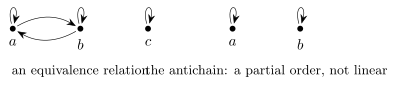
and three axioms: A model: , with relating and both ways and every
element to itself (Figure A, left). Each loop gives
(Refl); the only pairs of different elements are and , which give (Sym);
and every chain of two arrows ends where a loop or one
of these pairs already is, which gives (Trans). In
numbers: “ and
have the same
parity” on . A
non-model: on ,
read as
.
It is reflexive and symmetric, and (Trans) fails at
: and
,
but .
Partial and linear orders. One two-place
symbol . The
axioms (Refl) and (Trans), written with , together with make the theory of a partial
order. Adding gives the theory of a linear
order. A model of the first and not the second:
divisibility on (the right panel of Figure F in Section
7.1), where and
are incomparable,
so (Conn) fails at . A model of both: . Smallest of
all, the antichain with (Figure A, right) is a partial order: the
loops give (Refl), and (Antisym) and (Trans) only ever
meet pairs .
(Conn) fails at .
Strict and dense orders. One two-place
symbol . The
axioms make a strict order; with
a strict linear order; and
with a dense one. A model of all
four: ,
where
lies between . A non-model of (Dense): , at , since no
integer lies strictly between.
Groups. A two-place function symbol and a constant
, with A model: , with read as and as ; the inverse of is . A non-model: , where (Inv)
fails at , since
no natural number added to gives . Commutativity, is not an axiom; the next
example shows why.
Fields. Constants , and two-place function
symbols , , with ten axioms,
the nine (F1)–(F9), numbered as in the field axioms used
throughout this series, and : Models: and , with the usual
operations, and the two-element field,
with domain and the tables (the sum of two equal elements is ; the products are the
usual ones). A non-model: , where (F8) fails at
: no integer has .
Figure A. Left: an equivalence
relation on , whose classes are and . Right: the
antichain on .
The non-models are as instructive as the models: a
non-model with every axiom but one true shows exactly
what that one axiom adds.
Quick check. In the two-element
field, which element is the additive inverse of , and which is the
reciprocal of ?
Why does the field axiom for reciprocals ask nothing of
?
Solution. in both cases: and . The axiom
(F8) reads , and at its hypothesis fails,
so the implication holds by (S5).
The groups part promised a model of the group axioms
in which (Comm) is false. Every group of numbers under
addition or multiplication is commutative, so the model
comes from geometry.
Example
(The Six Symmetries of a Triangle)
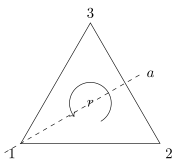
Label the corners of an equilateral triangle , , (Figure T). A
symmetry is a motion that puts the
triangle back on itself, recorded by where it sends each
corner. There are six:
- : nothing
moves;
- : a turn by a
third, ,
, ;
- : a turn by
two thirds, , , ;
- the flips
(fixing , swapping
and ), (fixing ) and (fixing ).
Read
as “first , then
”. For instance
sends
to and then to ; to and then to ; to and then to . It fixes and swaps , , so . Computed
in the same way, the whole table, with row , column and entry , is Take the domain , the table as the meaning
of , and as the meaning of the
constant . Check
the group axioms.
- (Id): the row
and the column
repeat the column and row heads.
- (Inv): each row contains , and in the same place
as its column does. So , and each flip undoes
itself: .
- (Assoc): “first , then , then ” is one sequence of
motions, however it is bracketed. The fold below says
this once more, carefully.
Now and , so (Comm) fails at . So this is a
model of the group axioms in which (Comm) is false.
Two elements would not do: in a group , every product
with is fixed by
(Id), and
commutes with itself, so (Comm) holds.
Figure T. The corners , , ; the turn about the center,
carrying to , to and to ; and the line of the
flip , through
corner and the
midpoint of the opposite side.
↺Second readingWhy
the table is associative without 216
checks
Checking (Assoc) entry by entry would mean
triples ,
each needing four look-ups in the table. There is a
shorter way. A symmetry is a rearrangement of the
corners, and is the rearrangement that applies and then to each corner. Follow
one corner
through : first sends it to where sends the place sent it, and then moves it on. Through
: first moves it, and then
applies
and then . Either way, corner
goes through
, then , then , and lands in the same
place. The two products send every corner to the same
corner, so they are the same symmetry. The table only
records the results, so it is associative because
composing rearrangements is.
Quick check. From the table, what
is ? What
is , bracketed either way?
Solution. . And , while : three turns by a
third bring every corner home.
A theorem
of a theory
A theorem of a theory is derived from finitely many
of its axioms with the rules of Chapters 1, 2 and 5;
nothing else is used. Section 5.4 has already derived
one, in Exercise (B5: Derive or break: properties of a relation, used later)
(c): from (Irrefl) and (Trans), a strict order is
asymmetric. Here is a theorem of the group axioms.
Proposition
7.4.1 (A Group Has Only One Identity)
From (Id), the sentence is derivable: an element that acts as an
identity on every element is .
Proof. The plan: fix and assume that it
acts as an identity; apply that assumption at , and (Id) at . The two give two
values of the one product , and equates
them.
1
2asm, for
3 2
4 3
5 1
6 5
7 6, 4
8 2–7
9 2–8
Line 7 is with
the formula
: line 4 is
, and line 6 says , so the
rule gives . At line 9, appears in no
premise, in no open assumption, and not in line 9.
So in every group the identity is
the only element that acts as one, by the soundness
statement of Section
7.2, without checking any group. In , is the only integer
with and for every ; in the triangle group,
only the row and
the column repeat
the heads. Only (Id) was used. A theorem of a theory
says something about all its models at once; that is
what a theory is for.
Consistency
Section 3.2 called a list of formulas inconsistent
when it derives (Definition 3.2.1).
A theory may be infinite, so its version goes through
finite lists.
Definition
7.4.3 (Inconsistent Theory)
A theory is
inconsistent if , that is,
if for some finite list of
axioms of ;
otherwise is
consistent.
An inconsistent theory derives every sentence, since
turns into
anything. So it says nothing, and consistency is the
least one asks of axioms. Deriving shows inconsistency:
one derivation is enough. Consistency is harder to show
by derivations, since it says that no
derivation from the axioms ends with , and there are
infinitely many derivations to rule out. Section 7.2 met
the same difficulty with non-derivability, and solved it
with a counter-model. A model does the same here: it
rules out every derivation of at once.
Proposition
7.4.2 (A Theory with a Model Is
Consistent)
If some structure is a model of , then is consistent.
Proof. Let , and
suppose for axioms of . By the soundness
statement of Section
7.2 (proved in the optional Section 7.3), . Each is true in
, so
for any assignment , which (S3) forbids.
So no such list exists.
So each model in the gallery proves its theory
consistent. The converse, that every consistent theory
has a model, is also true; it is the completeness
theorem for predicate logic, stated without proof in the
optional Section 7.6. Consistent is a word
about derivations, and has a model
(satisfiable) is one about structures. The two are never
swapped, and where they agree the text says which
theorem makes them agree.
The same reasoning shows that a sentence is
not a theorem. To show , make
the counterexample set true (Definition 1.1.3):
find a model of
in which is
false.
Warning. A model in which is
true shows nothing about .
Comparability, (Conn), is true in , a model of
the partial order axioms, and it is not a theorem of
them, as the next subsection shows.
Quick check. Is the theory consistent?
Solution. No. Open an box
on the first axiom, with witness and assumption ; on
the second gives , and gives
, which
carries out of the box, since is not in , in the first axiom
or in a premise. (Equally, no structure is a model; but
that alone would not show inconsistency without the
completeness theorem.)
Independence
One model with false shows that
is not a
theorem. Two models, one each way, show more.
Proposition
7.4.3 (Independence by Models)
Let be a
theory and a
sentence.
- (a) If some model of
makes false, then .
- (b) If, besides,
some model of
makes true,
then as well; is then
independent of : neither it nor its
negation is a theorem.
Proof.
- (a) If for axioms of , then by the soundness statement of Section
7.2 (proved in the optional Section 7.3). The model
satisfies every , so it
satisfies ,
against the hypothesis. (b) Apply (a) to , which the
second model makes false, by (S4).
Now the chapter’s question. The antichain of Figure A
is a model of the partial order axioms in which (Conn)
is false, and is one in which it is true. So
comparability is independent of the axioms of a partial
order: they neither prove nor refute it. That is why
“linear order” needs (Conn) as an axiom of its own.
The same goes for groups. and the
triangle group are models of the group axioms; (Comm) is
true in the first and false in the second. So
commutativity is independent of the group axioms.
Mathematicians call the groups that satisfy it
abelian, and study the others too.
Finding the two models. The model in which
is true is
usually the one the axioms were written for, such as
or . The model in
which is
false is a counter-model in the sense of Section 7.2,
and it is found by the same backward reading: write down
what
demands, then what each axiom demands, and build the
smallest structure meeting both. For (Conn) the demand
is two incomparable elements, and the axioms of a
partial order then ask only for a loop at each; that is
the antichain.
Independence also tells whether an axiom list has a
spare member: an axiom that follows from the others
could be dropped from the list without changing the
theorems. The three axioms of an equivalence relation
have none.
Example
(Reflexive, Symmetric, Transitive: Each Independent of
the Other Two)
Three structures for one two-place symbol (Figure I). The first
two are the counter-readings (d) and (f) of Exercise (B5: Derive or break: properties of a relation, used later),
now as models, with , in place of , .
- Not reflexive: , .
Symmetric and transitive, since the only pair is ; (Refl) fails at
.
- Not symmetric: , . Reflexive; transitive, since every chain
of two arrows has a loop as one of them; (Sym) fails at
, since is missing.
- Not transitive: , the loops at
, , together with , , , . Reflexive;
symmetric, since the arrows between different elements
come in pairs; (Trans) fails at , since and are in and is not.
By Proposition 7.4.3
(a), no one of the three axioms follows from the other
two.
Figure I. Three relations, each with
exactly two of the three properties of an equivalence
relation.
Warning. A tempting “proof” that a
symmetric and transitive relation is reflexive: “ gives by symmetry, and
the two give by transitivity.” The step from nothing to
is the
error: it needs some related to . In the first structure
above, is related
to nothing, and fails. Section 5.4 broke the claim with this
reading, Exercise (B5: Derive or break: properties of a relation, used later)
(d), and here it is a model of (Sym) and (Trans) in
which (Refl) is false.
Quick check. Show that (Dense) is
independent of the strict linear order axioms.
Solution. is a strict
linear order in which (Dense) holds; is one in
which it fails, at . Apply Proposition 7.4.3.
Exercises
A. Check your
understanding
Exercise
(A1)
- (a) Define a theory,
a model of a theory, and .
- (b) Why does Definition 7.4.3
say “finite list of axioms”?
- (c) In the proof of
Proposition 7.4.3
(a), where is the soundness statement used? Why does a
model in which is true not show
?
- (d) What two models
show
independent of ?
- (e) True or false:
every theory with a finite model is consistent.
Solution. (a) A theory is
a set of sentences, its axioms (Definition 7.4.1).
A model of is a
structure in which every axiom of is true (Definition 7.4.2).
means for some finite list of
axioms of .
(b) A derivation has finitely many lines, so
it uses finitely many premises, and a theory may be
infinite.
(c) To pass from to . A model in which is true is
compatible with and with alike: comparability is true in
and is
not a theorem of the partial order axioms.
(d) A model of in which is false, and one
in which it is true.
(e) True, by Proposition 7.4.2:
a finite model is a model.
Exercise
(A2: Drill)
Each part takes a line or two. The parts run from
reading an axiom, through deciding axioms in a given
structure, to judging claims about theories and building
a model.
- (a) Write “ is symmetric” as a
sentence.
- (b) Which axiom of a
partial order fails in , with read as ?
- (c) In the triangle
table, what are and ?
- (d) Is , a model of the equivalence relation axioms?
Which of the three hold?
- (e) Is , with the group’s read as
multiplication and as , a model of the group
axioms?
- (f) On , which
relations make a model of the strict order axioms? Of
the partial order axioms?
- (g) On with , add
the fewest pairs that make an equivalence
relation.
- (h) Give a model of
the dense strict linear order axioms other than .
- (i) True or false:
if is false
in some structure, then .
- (j) Is the empty
theory consistent?
- (k) Is the theory
with the two axioms and consistent?
- (l) Give a model of
the partial order axioms with three elements in which
exactly one pair of different elements is
comparable.
Solution.
(a) : whenever is related to , is related to .
(b) (Refl): is
false.
(c) and .
(d) No. (Sym)
holds; (Refl) fails, since there are no loops; (Trans)
fails, since
and are in
and is not.
(e) Yes:
multiplication is associative, is an identity, and
each has the
inverse , again
a non-zero rational.
(f) Strict order:
exactly . The loop breaks (Irrefl),
and with no pairs (Trans) has no chain to check. Partial
order: exactly ; with , (Refl) fails
at .
(g) , and .
(h) , or the
rationals strictly between and with .
(i) False: the
structure must be a model of . With and the same sentence,
is false in
every structure with , yet in one line.
(j) Yes: every
structure is a model of it, so Proposition 7.4.2
applies.
(k) No:
twice on the second axiom gives , on
the first gives , and gives
. (Any variable
or constant may be the term.)
(l) , the three loops
and .
B. Practice
Exercise
(B1: Construct a relation, or show none exists, used
later)
On , give a relation that is:
- (i) reflexive and
transitive, but neither symmetric nor
antisymmetric;
- (ii) symmetric and
transitive, not reflexive, with , and each related to
something;
- (iii) irreflexive,
symmetric, transitive and non-empty; or show that no
domain has one.
- (iv) Which of your
answers refutes the “proof” in the last warning of this
section, and at which element?
Solution.
(i) = the four loops
together with , , , . Reflexive: the loops. Transitive: the
chains of two non-loop pairs ( and ) are , giving
; , giving
; , giving
; and , giving
; all in
, and a chain
through a loop gives back its other pair. Not symmetric:
without
. Not
antisymmetric: and with .
(ii) : symmetric and transitive (the
classes
and ), not
reflexive at .
(iii) None, on
any domain. If , symmetry gives , and transitivity
applied to gives , against irreflexivity.
(iv) (ii), at
, which is related
to nothing, so the “proof” has no to start from.
Used later: Section 7.5 comes back to the
relation of (ii).
Marking scheme. (10 points) - 3:
(i), a relation with all four properties checked,
transitivity by listing the chains. - 2: (ii). - 3:
(iii), the argument from an arbitrary pair. - 2: (iv).
Fatal error (0 for (iii)): an argument that assumes
every element is related to something.
Exercise
(B2: A sentence true in one structure and false in the
other)
For each pair, find a sentence true in the first
structure and false in the second, and read it back in
words.
- (a) and .
- (b) and
.
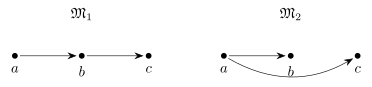
- (c) : , ; and : , (drawn below).
- (d) and , in that
order.
Solution. (a) , “every element has an additive inverse”:
true in , with
; false in
at .
(b) , “every non-zero element has a
reciprocal”: true in , with ; false in at .
(c) , “there is a path of two arrows”: in , , , ; in no arrow leaves
or , so no path of two
arrows exists.
(d) , “some element has arrows to two
different elements”: in , , , ; in each element has at
most one outgoing arrow.
Any other correct sentence earns full marks.
Marking scheme. (10 points) - 2.5
per part: 1 for a sentence true in the first structure
(checked), 1 for false in the second (with the failing
element), 0.5 for the reading back. Fatal error (0 for
the part): a formula with a free variable.
Exercise
(B3: Derive a theorem of a theory)
From the three group axioms, derive : the only element equal to its own square is
the identity. Which axioms did you use? Show by a model
that (Inv) cannot be left out.
Solution. Plan. Fix and assume . Take
an inverse by
, multiply the assumption by on the left, and
regroup: in words, .
1
2
3
4asm, for
5 3
6asm, for
7 6
8 1
9 8
10 9
11 4, 10
12 7, 11
13 7, 12
14 2
15 14
16 15, 13
17 5, 6–16
18 4–17
19 4–18
The four steps,
each with its : line 11 with
the formula
, line 10 being ; line 12 with , line 11 being ; line 13 with , line 12 being ; line 16 with , line 13 being .
At line 17, is
not in , not
in line 5, in no premise and in no open assumption. At
line 19, is in
no premise, in no assumption open outside its box, and
not in line 19.
All three axioms are used. (Inv) cannot be left out:
, with the usual product and read as , satisfies (Assoc),
since multiplication of numbers is associative, and
(Id), since and . But and , so the theorem fails at . By Proposition 7.4.3
(a), it does not follow from (Assoc) and (Id) alone.
Marking scheme. (10 points) - 2: the
plan (fix ,
assume , take an inverse by ). -
3: the chain of equations, with each naming
its . - 2:
the and side
conditions checked: ,
not in , not in , in no premise and in
no open assumption; ,
in no premise,
in no assumption open outside its box, and not in . - 1: the axioms named. - 2: the model
without (Inv), with (Assoc) and (Id) checked and the
theorem failing at . Fatal errors (0 for
the derivation): an step that
replaces a term the line does not contain; using outside its
box.
C. Going deeper
Exercise
(C1: Describe every model)
Describe every model of each sentence, and prove your
description.
- (a) .
- (b) .
- (c) .
- (d) .
Solution. (a) “Any two
elements are equal”: exactly the structures with one
element. If has
, then (S6)
at and meets the equation
with
different values, which (S2) rejects. With one element,
every equation between its values holds. Domains are
non-empty, so “at most one element” is “exactly
one”.
(b) “There are two different elements, and
among any three, two are equal”: exactly the structures
with two elements. The first conjunct gives two
different elements . If a third differed from both,
then at
would make
all three equations false. Conversely, in a two-element
domain the two elements witness the first conjunct, and
any three values repeat one of them.
(c) “Everything is related to everything”:
exactly the structures with , on
any non-empty . By
(S6) twice, every pair must be in , and if every
pair is, the sentence holds.
(d) “Each element is related to exactly one
element”: exactly the structures in which is the graph of a
function from to
, that is, each
has exactly one
with . For
each , (S7) gives
an with , and
the inner
says that any
with is . Conversely, if each
has exactly one
such , that is the witness, and the
inner clause holds by uniqueness.
Marking scheme. (10 points) - 2.5
per part: 1 for the description, 1.5 for both directions
(every model is of this kind; every structure of this
kind is a model). Fatal error (0 for (a)): forgetting
that domains are non-empty, so that “at most one” is
“exactly one”.
Exercise
(C2: The partial order axioms are independent)
Show that each of (Refl), (Antisym) and (Trans), for
, is independent
of the other two.
Solution. For (a) of Proposition 7.4.3,
three structures:
- Not (Refl): , .
Antisymmetric and transitive, vacuously: there is no
pair and no
chain of two arrows. No loops.
- Not (Antisym): , all four
pairs. Reflexive and transitive; and with .
- Not (Trans): , the loops together with and . Reflexive;
antisymmetric, since no two different elements are
related both ways; is missing.
For (b), each axiom is also true in a model of the
other two, for instance in , where all
three hold. So each axiom is independent of the other
two.
Marking scheme. (10 points) - 3 per
axiom: the structure 1, the two other axioms checked 1,
the failing pair 1. - 1: independence cited correctly,
including that each axiom is true in some model of the
other two. Fatal error (0 for the axiom): a structure in
which one of the “other two” fails.
Exercise
(C3: Exit check: a theory checked three ways)
Let be the
theory of a strict linear order with a least element:
(Irrefl), (Trans), (Tri), and
- (a) Show that is consistent.
- (b) Show that
(Dense) is independent of .
- (c) Derive from
that the least
element is unique: , where abbreviates . You may use on the
propositional skeleton.
Solution. (a) is a model:
no number is below itself, is transitive, any
two numbers are equal or one is below the other, and
is a least
element. By Proposition 7.4.2,
is
consistent.
(b) In , (Dense) fails at . The
non-negative rationals with are a model of (no rational is below
itself, is
transitive, any two rationals are equal or one is below
the other, and is
least, since no non-negative rational is below it), in
which (Dense) holds: between lies . By Proposition 7.4.3,
(Dense) is independent of .
(c) Written out, is . The plan: fix , , assume both are
least, instantiate each at the other, and let a TAUT
step combine the two disjunctions with (Irrefl) and
(Trans) at ,
.
1
2
3asm, for
4 3
5 3
6 4
7 5
8 1
9 2
10 9
11 10
12asm, for
13
14 12, 13
15 12–14
16 6, 7, 8, 11, 15
17 3–16
18 3–17
19 3–18
Line 14 is with
the formula
: line 13 is
,
and line 12 says , so the rule gives . The
TAUT step on line 16 reads the skeleton with the letters
for , for , for , for and for . From , , , and
, the letter
follows in every
row: if is false,
then is true;
makes false, so is true; then is true, against . At line 18, is in no premise, no
assumption is open outside its box, and is not in line 18; at
line 19 the same holds for . Only (Irrefl) and
(Trans) were used.
Marking scheme. (10 points) - 2:
(a), a model with every axiom checked. - 3: (b), two
models of (the
axioms checked for the new one), with (Dense) checked in
each. - 4: (c), the derivation: the case closed, by
symmetry of via
and
or
by
into
(1), the instance of (Trans) at , , , reached by three
steps (1), the cases combined, by a TAUT
step whose skeleton is a tautology or by an equivalent
and case analysis (1), the side
conditions (1). - 1: names the axioms used. Fatal error
(0 for (c)): a TAUT step that needs and to be the same
letter (they are not).