Soundness (Theorem 4.7.2)
says that the rules of Chapters 1 and 2 never lead from
true premises to a false conclusion: whatever can be
derived is true in every row where the premises are.
That answers half of the chapter’s question. The other
half is the converse. Could the rules be too
weak, so that some sequent is true in
every row and yet no derivation of it exists? This
section proves that they are not: every truth-table
consequence has a derivation. The proof reads a
derivation off the truth table, one row at a time, and
then glues the rows together with excluded middle.
The
question soundness leaves open
Recall the two relations from Section 4.5. says
that there is a derivation of from premises in
(Definition 1.2.3).
says that every valuation making all of
true makes
true (Definition 4.5.3).
Soundness is the implication Its converse is not automatic. The rules are a
list that people wrote down, and a list can leave
something out. Suppose, as a thought experiment, that we
struck (Definition 2.5.1)
from the list. Every derivation that remains is still a
derivation, so soundness still holds. But the tautology
would
then have no derivation (this is the optional Theorem 4.7.4
of Section 4.7). So a sound list of rules can be too
short. The question is whether our list
is long enough.
Here is a sequent to keep in mind. The formula
is a tautology: if is true then is true, and if
is false then
is true.
Chapter 3 found a derivation of it (Exercise (C2: A disjunction from nothing)),
but only after reaching for , and
nothing in Chapter 3 proved that a derivation would be
there to find. We want a theorem that promises it in
advance, for every tautology and every valid
sequent.
We are going to prove:
If is a
list of formulas and , then .
The plan has two ideas, one per row and one for all
the rows together.
- One row gives one derivation. Fix a
row of the truth table, that is, a valuation . Write each atom as it
stands in that row: if makes true, if makes it false. From
these signed atoms we will derive the formula if is true in the row,
and if it
is false. The derivation climbs the parse tree of , one connective at a
time.
- The rows are glued by excluded
middle. If , the first idea gives from and the signed
atoms of each row. Two rows that differ
only at the atom
have derivations from “” and from
“”.
The rule applied to merges them into one derivation
that no longer mentions . Removing the atoms one
at a time leaves a derivation from alone.
We keep the premises throughout, and we
isolate the two ingredients as lemmas so that each can
be checked on its own. Before either, we need a little
bookkeeping about derivations.
↺Second readingWhere
the route comes from
The first idea is known as Kalmár’s lemma, and gluing
rows by excluded middle is the standard way to finish;
the route is the classical one.
Bookkeeping: adding premises and chaining
derivations
In Chapter 2 we learned to use a proved sequent as a
single line (Definition 2.3.1),
and Section 2.3 proved what that gives, Lemma 2.3.3:
(a) extra premises never hurt; (b) a statement already
derived may be used as a premise; (c) a sequent already
proved may be applied to statements already derived. The
completeness proof uses (a) and (c) dozens of times.
They also made Step 1 of the proof of Theorem 4.7.2
honest: for whole derivations, part (c) is the precise
form of “abbreviates”.
Quick check. Suppose and
. Which part of Lemma 2.3.3,
applied to which proved sequent, gives for
every formula ?
Solution. Part (c) with , , and
,
applied to Proposition 2.1.1,
,
with for
and for .
The rules
prove their own truth tables
Each line of the truth table of a connective says
something like “with true and false, comes
out false”. Read with signs, that line is a sequent:
from and
, conclude
. If every such sequent is derivable,
then the rules know the truth tables. This is the key to
the first idea of the plan. Section 4.4 began by reading
the tables off the rules; the lemma below makes that
reading exact: every line of every table is a derivable
sequent.
Lemma
4.8.1 (The Rules Prove the Truth Tables)
For all formulas and , the following
sequents are derivable, by derivations that do not use
.
- (i) , and .
- (ii) ; ; .
- (iii) ; ; .
- (iv) ; ; .
- (v)
;
;
;
.
Here are the tables of Definition 4.4.2
again, with each row tagged by the sequent of the lemma
that derives it from the signed parts. Where two
sequents fit a row, the tag is the one the proof of the
next lemma uses.
| T |
T |
T |
T |
T |
T |
| T |
F |
F |
T |
F |
F |
| F |
T |
F |
T |
T |
F |
| F |
F |
F |
F |
T |
T |
Beside it: T gives F, tagged
; F gives T, and no
sequent is needed, since the signed part is already the
signed whole;
is always F, tagged .
Each sequent has as premises only the parts
it needs, each as itself or negated. For
instance, is false as soon as is false, whatever
is, and has the single
premise .
This economy will matter: when the proof of the next
lemma uses a row, it needs to know something only about
the parts the row mentions.
Idea. Most of the sequents are
already in the book: rules of Chapter 1, or results of
Chapter 2 with and put in for the
letters. The others are short derivations of the kinds
Chapter 2 practiced: a box that repeats a premise, or a
box that reaches a clash. The only thing to watch is
that no step, and no cited result, uses .
The derivations, with a check that none uses , are in
the fold below.
↺Second readingThe
fifteen derivations
Proof. The table lists, for each
sequent, the rows of the truth table it covers (by Definition 4.4.2)
and where its derivation comes from. The letters of the
Chapter 2 results are replaced by and , as Definition 2.3.1
allows.
|
T, so
F |
|
Example (Two negations from one premise)
(a) |
|
is always
F |
|
printed below |
|
T, T give T |
|
(Definition 1.2.5) |
|
F, anything give F |
|
gives , then Proposition 2.5.5
(c) |
|
anything, F give F |
|
gives , then Proposition 2.5.5
(c) |
|
T, anything give T |
|
(Definition 1.5.1) |
|
anything, T give T |
|
|
|
F, F give F |
|
gives , then Proposition 2.5.5
(b) |
|
F, anything give T |
|
Proposition 2.1.2 |
|
anything, T give T |
|
printed below |
|
T, F give F |
|
printed below |
|
T, T give T |
|
printed below |
|
F, F give T |
|
printed below |
|
T, F give F |
|
printed below |
|
F, T give F |
|
printed below |
In the second column, “F, anything give F” means: if
is F, then
is F whatever the value of .
The seven printed derivations follow. First and (the first is
the derivation of Exercise (B2: An assumption that is not used)
(a), printed again because a proof does not rest on an
exercise): an implication whose conclusion we already
have, and the refutation of an implication by a true
hypothesis with a false conclusion.
1
2asm, for
3 1
4 2–3
1
2
3asm, for
4 3, 1
5 4, 2
6 3–5
Next and
. In
the first, each box repeats the premise it needs; in the
second, each box reaches a clash and closes by .
1
2
3asm, for
4 2
5asm, for
6 1
7 3–4, 5–6
1
2
3asm, for
4 3, 1
5 4
6asm, for
7 6, 2
8 7
9 3–5, 6–8
Then ,
and
. The first
two assume the biconditional and use it in the direction
that clashes with a premise; the last is a box whose
assumption is
already the
that asks for, the degenerate box of Section
2.2.
1
2
3asm, for
4 3, 1
5 4, 2
6 3–5
1
2
3asm, for
4 3, 2
5 4, 1
6 3–5
None of these derivations uses : their
boxes close by , and
.
Nor do the cited results: Proposition 2.1.2
and Example (Two negations from one premise)
come from Sections 2.1 and 2.2, before was
introduced, and Chapter 2 derived De Morgan’s laws (b)
and (c) without it (it says so right after the
derivations of Proposition 2.5.5).
This proves the lemma.
The
connective needs only one sequent. When is false, is true, and
the “sequent” is a one-line derivation;
only the other row, , needs a proof.
Warning. The sequents of Lemma 4.8.1
go from the parts to the whole. Read
backwards they are false. For instance is not derivable in general: the row
,
makes true
and false, so
by Corollary 4.7.3.
A row of a table tells us the value of the whole from
the values of the parts, never the other way round.
Quick check. Which tagged sequent
covers F,
T for ? And for ?
Solution. , . (The row also fits .) For : ,
.
One row,
one derivation
A row of a truth table can be written as a list of
premises: each atom as it stands in the row, itself if
true, negated if false.
We now name the formulas that “write down a row”.
A signed formula is a formula as it stands in one
row: itself if the row makes it true, its negation if
the row makes it false.
For a valuation and a formula , the
signed formula is The superscript is a label naming the
row, not an exponent. In particular, for an atom , the signed
atom
is or . For example, if
and , then , , and . Whatever is, : the signed formula is always the
true one of
and , by
the clause for
in Definition 4.4.2.
The signed atoms describe the row of completely, as far as
go.
The next lemma says they are enough premises to derive
the signed version of any formula built from these
atoms.
Lemma
4.8.2 (One Row of the Truth Table Is
Derivable)
Let be a
formula, let () be atoms among which are
all the atoms of , and let be a valuation. Then
In words: in each row of the truth table of , the value of
can be
derived from the values of its atoms, where “value T” is
written as the formula and “value F” as its
negation.
Idea. Climb the parse tree. At an
atom,
is one of the premises. At a connective, the induction
hypothesis gives the signed parts , , and Lemma 4.8.1
has a sequent from (some of) those signed parts to the
signed whole. So structural induction (Theorem 4.3.1),
with Lemma 2.3.3
(c) to chain, does the whole job. The only care is to
pick, for each pair of values, the row whose premises
are the signs we actually have.
Proof. Fix the atoms and the
valuation , and
write for
the list . We prove, by structural induction (Theorem 4.3.1),
that every formula has the
property
if every atom of is among , then
.
Every atom of an immediate part or of a formula is an
atom of the formula itself, so when satisfies the
“if”, so do its immediate parts, and the induction
hypothesis applies to them.
Atoms. Let be an atom among
,
say .
Then is a member of , and the one-line
derivation whose only line is the premise shows .
The formula . By Definition 4.4.2,
, so . By
of Lemma 4.8.1,
,
and weakening (Lemma 2.3.3
(a)) gives .
Negation. Let , and
assume .
- Case . Then , and
, so . From and
, , chaining (Lemma 2.3.3
(c)) gives .
- Case . Then ,
and , so . The hypothesis is already the
claim.
Conjunction. Let , and assume
and . By Definition 4.4.2,
exactly when .
- Case . Then , , . Chaining and
with ,
, gives .
- Case . Then and .
Chaining with , , gives . The hypothesis for is not used.
- Case , . Then and ,
and chaining with gives .
Implication. Let , and assume
and . By Definition 4.4.2,
exactly when
and .
- Case . Then and .
Chaining with , , gives .
- Case , . Then and . Chaining with
, , gives .
- Case , . Then , and .
Chaining and with , , gives .
Disjunction and biconditional. These go as
for implication. For each pair of values of and , the table in the
proof of Lemma 4.8.1
names a sequent whose premises are among , and whose
conclusion is : for , if ,
if
and , if both are F; for , to
for
the value pairs T T, F F, T F, F T. Chaining the
induction hypotheses for those premises with that
sequent gives .
The atoms and have the property,
and each formation clause preserves it, so by Theorem 4.3.1
every formula has it. This proves the lemma.
Each case used the induction hypothesis only for the
parts named in the premises of its sequent: the
conjunction case with false never looked
at . That is
the economy of Lemma 4.8.1
at work. The disjunction and biconditional cases are
written out in Exercise (C1: The remaining cases).
Here is the lemma run on one formula, with every
chained sequent written as a line.
Example
(Deriving one row)
Let and let .
Find ,
and write the derivation of that the proof of Lemma 4.8.2
produces.
Solution. Compute up the parse
tree: , so , and since , .
So , and the premises are and .
The proof climbs the same tree. At with , it is
the negation case with true: gives . At , the
values are T and F: gives from . At the root, the values are T and F: gives the goal
from and .
Written as a derivation, with each sequent of Lemma 4.8.1
cited as a derived rule:
1
2
3 1
4 3
5 1, 4
The premise is
never cited. It was used only in computing which case
applies: the
case with false needs only ’s sign, not ’s. A derivation need
not use every premise (Definition 1.2.3).
Quick check. Let
and . What sequent does Lemma 4.8.2
provide, and which sequent of Lemma 4.8.1
does the proof use at the root?
Solution. Here ,
so , and the lemma gives . At the root the values are T and F, so the
proof uses , , with and . Its
premise comes from the negation case below it: , by
.
Gluing the
rows: splitting on an atom
Lemma 4.8.2
derives a formula from the signed atoms of
one row. A sequent
mentions no row at all. The signed atoms must be
removed, and the tool for that is excluded middle.
Lemma
4.8.3 (Splitting on an Atom)
Let be a
list of formulas,
an atom and a
formula. If and , then .
Idea. This is proof by cases on
. Proposition 2.5.3
gives
with no premises, and (Definition 1.6.1)
needs a box that reaches from and a box that reaches
from . The two given
derivations are exactly the contents of those boxes,
once their premise (or ) is replaced by
the box’s assumption.
Before reading on: this is the only place in the
completeness proof where a classical rule enters. Where
exactly, and why could the of
Chapter 2 not do the job?
Proof. Let be a derivation of
with premises
in , and
one with premises
in .
Build a list of lines as follows.
- As premises, every premise of or of that is a member of
.
- The line , justified by Proposition 2.5.3
()
with for ; it cites nothing.
- A box that opens with the assumption , followed by the lines
of that are not
premises, with their boxes. A citation of a premise of
that is in now cites the
premise line of step 1; a citation of the premise now cites the
assumption. If the last line of is itself a premise,
the box is shorter: if that premise is , the box is the
assumption alone, which is then its last line; otherwise
the box is the assumption followed by , by , citing the
premise line carrying .
- A second box, built from in the same way,
opening with the assumption .
- The line ,
by , citing line 2 of this list and the two
boxes.
This is a derivation (Definition 1.4.2).
The premises lie in no box and come first, so they are
available everywhere. Inside the first box, the lines of
keep their boxes,
which now sit inside the new box, and they cite the same
lines and boxes as before, or a premise line, or the
assumption, which is available at every line of its own
box. As in the proof of Lemma 2.3.3,
each line is still an instance of its rule. The last
line of the first box is , and it is a line of
that box itself and not of a box inside it: it was the
last line of ,
which lies in no box of (or it is the
assumption itself, or the repetition line). The same
holds for the second box. Both boxes and the line lie in no
box, and neither does the last line, so they are
available at it. Hence the last line is an instance of
,
and the list is a derivation of whose premises are
all in . So
.
Here is its shape, with standing for the
premise lines:
asm, for
asm, for
, –, –
The answer to the prompt: the classical rule enters
at line . Proposition 2.5.3
was derived in Chapter 2 with , and
nothing else in the proof of this lemma is classical.
could not replace it:
produces a negation, and here we need a disjunction with
no premises to split on. Nothing in the proof uses that
is an atom; the
lemma holds for any formula in place of , but atoms are all we
shall split on.
The
completeness theorem
Now the plan of the opening can be carried out.
Theorem
4.8.4 (Completeness)
Let be a
list of formulas and a formula. If , then
.
A list is finite, as in Definition 1.2.3.
That matters: the proof works with the atoms that occur
in and , and it needs them
to be finitely many.
Idea. Step
roadmap. ① List the atoms of and . ②
Claim: for every
valuation , . If makes all of true, then is true in that row,
and Lemma 4.8.2
derives it. If
makes some premise false, the lemma
derives ,
which clashes with the premise . ③ Remove the
signed atoms one at a time, the last first, by Lemma 4.8.3:
an induction on the number of atoms removed. To remove
we need
derivations from both and with the same
other signed atoms: two rows that differ only at . That is why the
Claim must hold for every valuation, not just one.
Let us run the method of the roadmap on the tautology
of the opening.
Example
(The method on a tautology)
Run the roadmap of Theorem 4.8.4
on , and write the derivation it produces,
citing the sequents of Lemma 4.8.1
as derived rules.
Solution. Write for .
The list is
empty and the atoms are , . Every valuation makes true (if the
left side is true; otherwise the right side is), so the
Claim ② always falls in its first case (the row makes
the premises, here none, true), and Lemma 4.8.2
produces four short derivations, one per row:
- : by from , then ;
- : by from , then ;
- and : by from , then .
(In the row , , both and would do; the
proof of Lemma 4.8.2
uses
whenever is
false.) ③ first splits on , twice: once with and once with among the
premises. Then it splits on , once. Three uses
of Lemma 4.8.3
in two rounds. Pasting as in its proof, the last split
is the outermost:
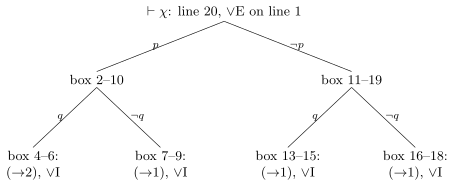
Each leaf is one row of the table; each inner
node is one use of Lemma 4.8.3.
1
2asm, for
3
4asm, for
5 4
6 5
7asm, for
8 7
9 8
10 3, 4–6, 7–9
11asm, for
12
13asm, for
14 11
15 14
16asm, for
17 11
18 17
19 12, 13–15, 16–18
20 1, 2–10, 11–19
The derivation has 20 lines. The one found by search
in Exercise (C2: A disjunction from nothing)
has 13, and splits only once. Here the split on inside the box of (lines 12–19) is
wasted: both of its boxes do the same thing, because in
the rows with
false the value of does not matter. The
proof is a method that always works,
not a recipe for short derivations; to find a short one,
search as in Section 3.1.
Quick check. In the tree, which two
leaves do the same thing, and why?
Solution. The boxes 13–15 and
16–18. Both write by from on line 11,
because in a row with false, is true whatever
is.
Proof. Step 1. The
list is
finite and each formula has finitely many symbols, so
only finitely many atoms occur in or . List them without
repetition as , where .
Step 2.
Claim. For every valuation , .
Proof of Claim. Let be a valuation, and
write for
.
Case 1: for every member of . Since , by
Definition 4.5.3
, so . Every
atom of is
among , so Lemma 4.8.2
gives , and weakening (Lemma 2.3.3
(a)) gives .
Case 2: for some member of . Then .
Every atom of is among , so Lemma 4.8.2
gives , and by weakening . Also , by the one-line derivation whose only
line is the premise . By Proposition 2.1.1,
. Chaining (Lemma 2.3.3
(c)) gives .
Step 3. For each integer with , let be the statement
where for the list of signed atoms is empty. The Claim
is .
Claim. If and holds, then holds.
Proof of Claim. Let be a valuation. Let
be the
valuation that agrees with at every atom except
that , and the one that agrees
with except that
; by Definition 4.4.1,
a valuation may assign any value to each atom, so both
exist. The atoms are different from , so and agree with on them, and for . Also and .
Applying to
and to gives, with standing for the
list , By Lemma 4.8.3,
.
Since was
arbitrary, this is .
Step 2 is .
Applying the Claim with , then , and so on down to , removes the signed
atoms one at a time and reaches . This descent is an
induction on the number of atoms removed; the fold after
the proof writes it out.
Step 4. says that , for
every valuation ;
there is at least one valuation (for instance the one
making every atom true), so . This
proves the theorem.
↺Second readingThe
descent, as an induction
It remains to go down from to , which takes applications of the
Claim. We count the applications made: for , let say “if , then holds”. says that holds, which is Step
2. Suppose
holds, and let . Then , so holds by ; and
satisfies , because . The Claim gives , which is . By Axiom 4.2.1,
holds for
every ,
and is .
If , the
formulas of
and are built
from alone,
and Step 3 does nothing: is the Claim
itself.
Warning. Completeness promises a
derivation, not a short one. For a sequent with atoms, the proof builds
row derivations
and glues them with splittings: with atoms, that is
1024 row derivations and 1023 uses of . The
theorem answers “is there a derivation?”, not “how short
is the shortest?”.
With soundness, completeness closes the circle.
Corollary
4.8.5 (Derivable Means Valid)
For every list of formulas and every formula
, In particular, whether holds
can be decided by checking the rows of a truth
table, where is
the number of atoms occurring in and .
Proof. is Theorem 4.7.2
and is
Theorem 4.8.4.
For the second sentence, let be the
atoms occurring in and . By Lemma 4.4.1,
the values of the members of and of under a valuation
depend only on its values at , so holds
exactly when it holds in each of the rows of the joint
truth table. That is a finite check, and by the first
sentence it decides .
So a question that looks as if it needs a search
through infinitely many possible derivations can be
settled by a finite table. The search for a derivation
may still be the quicker way to a yes,
and one row is the quickest way to a no
(Corollary 4.7.3),
but neither is needed.
Consistent and satisfiable coincide.
Section 4.7 showed that a satisfiable list is
consistent. Completeness gives the converse. If is unsatisfiable,
no row makes
true, so (there is no row to check), and by Theorem 4.8.4:
is
inconsistent. So a finite list is consistent exactly
when it is satisfiable. The word of Section 3.2 and the
word of Section 4.5 pick out the same lists, though one
speaks of derivations and the other of rows; Section
3.2’s task “derive ” and Section 4.6’s
search on a list always give the same answer.
↺Second readingWhy
two definitions of ‘follows’ are enough
Before Chapter 1, “ follows from ” had only an
informal meaning: whatever a careful mathematician
accepts as a valid inference, by any means. That is not
a definition, but two things about it are clear for
propositional forms. If , then
follows
informally: each rule is an inference every
mathematician accepts, and a chain of accepted
inferences is accepted. If follows informally
from by form
alone, then : an inference valid by its form cannot
have a row, which is one way of reading the atoms,
making the premises true and the conclusion false. So
the informal notion is squeezed between and , and completeness
makes the two ends meet: for propositional forms, the
informal notion coincides with both. An argument of this
shape is due to Georg Kreisel.
↺Second readingInfinitely
many premises
We defined only for a list, that is, for finitely
many premises. One may allow an infinite collection
of premises
and say when is derivable from
finitely many members of (a derivation has
finitely many lines, so it can only use finitely many).
The equivalence with still holds for infinite (completeness for
infinitely many premises); together with the finiteness
of derivations it gives the compactness theorem of
propositional logic. The optional Section 4.10 proves
both; nothing in the core depends on them. Our proof
does not reach infinite : Step 1 needs
finitely many atoms.
Two columns
that agree
Section 4.5 set the two meanings of “follows” side by
side. Here is the full table, now that both theorems are
proved: they agree row by row (Corollary 4.8.5
and the paragraph on consistency above).
| follows |
(Definition 1.2.3,
Section 1.2) |
(Definition 4.5.3,
Section 4.5) |
| true by form alone |
a theorem, |
a tautology, (Definition 4.5.1) |
| say the same |
provably equivalent (Definition 2.4.2,
Section 2.4) |
semantically equivalent (Definition 4.5.4) |
| cannot hold together |
inconsistent, (Definition 3.2.1,
Section 3.2) |
unsatisfiable (Definition 4.5.2) |
| shown to hold by |
one derivation |
every row, or a closed search tree (Proposition 4.6.1) |
| shown to fail by |
one refuting row (Corollary 4.7.3) |
one refuting row |
| more premises, cut |
Lemma 2.3.3
(Section 2.3): chaining and cut are why a derived rule
may be cited |
Section 4.5’s structural properties: one line about
rows each |
| tied together by |
soundness, (Theorem 4.7.2) |
completeness, (Theorem 4.8.4) |
Two roads
to every answer
We now have two independent ways to settle any
question “is ?”. One is to search for a
derivation, as in Section 3.1. The other is to
check a table, and Corollary 4.8.5
says the two always agree. Here are two of Chapter 2’s
classical laws settled by the table first.
De Morgan’s law (d). Is ? The four rows: In every row where the premise is T, so is the
conclusion. So , and by Theorem 4.8.4,
.
Peirce’s law. Is ? Work backwards from F (Section 4.4). A
refuting row would need false. Then is true, so is “true
implies false”, which is false. So no row makes the
premise true and the conclusion false: , and by Theorem 4.8.4,
.
Both answers came before anyone found a derivation.
Chapter 2 found both by hand (Proposition 2.5.5
(d), and Proposition 2.5.4,
whose gives the sequent by ), and
the derivations there use .
Completeness explains why a search had to succeed; it
does not say how.
↺Second readingWhat
the proof used
A common alternative route first turns into
a single tautology, , proves completeness for tautologies,
and then unpacks the implications with .
Keeping as
premises, as Step 2 does, costs one extra case (a false
premise) and saves that detour.
Section 4.5 remarked that the tables do not see which
of Chapter 2’s laws needed . Now we
can say why they cannot. A table decides , and
by Corollary 4.8.5
that is the same as derivability with
all the rules, included.
A table has no column recording which rules a derivation
uses. Whether a sequent can be derived without is a
question about a shorter list of rules, and for that
list the completeness theorem is false, as the next
paragraph explains. So no truth-table check can tell the
laws that need from those
that do not.
Which rules did the proof of completeness itself use?
Lemma 2.3.3
only pastes derivations. Lemma 4.8.1
uses no , as its
proof checks. Lemma 4.8.2
and the Claim chain those sequents, together with Proposition 2.1.1,
which Chapter 2 derived before appeared.
The one classical step is the line of Lemma 4.8.3.
So the theorem is really about the full list of rules,
included. Without the list
is sound but not complete, as the optional Theorem 4.7.4
shows for and ; the proof above breaks exactly at the
splitting.
Warning. Completeness does not say
that a tautology has a derivation
without . It says
there is a derivation from the rules of Chapters 1 and
2, all of them. The formula
is a tautology, and every derivation found for it so far
uses
or .
Whether a particular tautology can do without them is a
different question, and a table cannot answer it.
A
truth-table step: TAUT
Completeness has a practical consequence. Any step
from earlier lines to a new one that a truth table
confirms can be filled in by a derivation, so the step
may be written as one line and the filling left to the
theorem.
Definition
4.8.1 (The Step TAUT)
In a derivation of formulas of Definition 4.1.1,
a line may be
justified by TAUT, citing lines () available at it,
if : every row that
makes the cited lines true makes true. For , must be a
tautology.
A TAUT line abbreviates a derivation in the rules of
Chapters 1 and 2: by Corollary 4.8.5,
, and that derivation
is pasted in as a derived rule’s is (Definition 2.3.1;
Lemma 2.3.3
for a line in no box). So TAUT derives nothing new, and
Theorem 4.7.2
holds for derivations that use it. A TAUT line is
checked by a table, not found by a search; its
justification reads “TAUT” with the cited lines.
Convention. TAUT is a license, not a
style. It is used only for a step that a written proof
would pass over without comment, such as a rearrangement
of connectives (“so if , then ”), never to hide the
step an argument is about.
Example
(One line for twelve)
Derive with TAUT, and say what
the step abbreviates.
Solution.
The check: the premise is true only in the row , , since an
implication is false only there, and is true
in that row. Written out with the rules of Chapter 2,
the derivation takes twelve lines (fold below). It is a
step a written proof passes over (“an implication fails
only with a true hypothesis and a false conclusion”), so
the convention allows it.
↺Second readingThe
step written out
An box on
, in which Proposition 2.1.2
(VI) gives ,
clashing with line 1, gives . A box on
, in which an
inner box gives again, gives . Then . The
proof that a TAUT line can always be written out builds
a longer derivation still, by the method of Theorem 4.8.4;
this one was found by search.
1
2asm, for
3VI 2
4 3, 1
5 2–4
6asm, for
7asm, for
8 6
9 7–8
10 9, 1
11 6–10
12 5, 11
Quick check. May line 3 be
justified by TAUT: 1 ; 2 ; 3 , TAUT 1, 2?
Solution. Yes. In a row making
lines 1 and 2 true, either is true, and then is, or is false, and then
is; either way
is
true.
Warning (Not allowed: TAUT). The
first three steps break a clause of Definition 4.8.1,
named in the tag; the fourth is legal and breaks the
convention.
- “, TAUT
1”, with line 1 . The row , makes line 1 true and the new line
false. Clause “every row that makes the cited lines
true”.
- Citing by TAUT a line inside a box that has closed.
Clause “available”: the scope rule of Definition 1.4.2.
- TAUT on a line that is not a formula of Definition 4.1.1,
such as “for every , ”. Clause
“formulas of Definition 4.1.1”.
- “, TAUT
1, 2”, with lines and , in a proof whose point is that
contrapositive step. Convention: legal by the
definition, but it hides the step the argument is about;
write
(Proposition 2.3.1)
or the derivation.
Exercises
A. Check your
understanding
Exercise
(A1)
These questions are about Lemma 4.8.2
and Theorem 4.8.4.
- (a) In the
conjunction case of the proof of Lemma 4.8.2,
suppose and .
Which sequent of Lemma 4.8.1
is used, and which induction hypotheses?
- (b) Where is used in
the proof of Theorem 4.8.4,
including inside the results it cites?
- (c) State the idea
of the proof of Theorem 4.8.4
in two sentences.
- (d) Run Step 2 of
the proof for , and the valuation with , : which
case applies, and which sequent does it prove?
- (e) Step 1 lists the
atoms without repetition. Where in the
proof is that used?
- (f) Which step of
the proof fails if is allowed to be
an infinite collection of formulas, each with its own
atoms?
Solution. (a) , , and only the hypothesis for
, .
The hypothesis for is not needed,
because is false once is.
(b) Only inside Lemma 4.8.3,
at the line : Proposition 2.5.3
was derived with . The
sequents of Lemma 4.8.1
are derived without it, Lemma 2.3.3
only pastes derivations, and Proposition 2.1.1
comes before in Chapter
2.
(c) Each row of the truth table gives a
derivation of the conclusion from the premises and that
row’s signed atoms: by Lemma 4.8.2
if the row makes every premise true, and from a clash
with a false premise otherwise. Two rows that differ at
one atom are merged by excluded middle and proof by
cases, and after all the atoms are merged the signed
atoms are gone.
(d) The valuation makes the premise false, so Case 2
applies with . Lemma 4.8.2
gives (the atom case), the premise gives , and Proposition 2.1.1
gives . The
sequent proved is .
(e) In the Claim of Step 3: and change only the
value at , and
they agree with
on only because those atoms differ from
. If also appeared as some
with , then and
would differ, and the two sequents would
not share the list that Lemma 4.8.3
needs.
(f) Step 1. Infinitely many atoms may occur,
so there is no finite list : the
Claim would need infinitely many signed atoms as
premises, which is not a list, and Step 3’s descent from
has no to start from.
Exercise
(A2: Drill)
The parts run from signed formulas and the steps of
the proof, through consistency and the two columns, to
judging TAUT lines.
- (a) , . Write
, , , .
- (b) , . Which sequent does Lemma 4.8.2
give?
- (c) In (b), which
tagged sequent does the proof use at the root, and where
does its premise come from?
- (d) A sequent has
three atoms. How many row derivations and how many uses
of Lemma 4.8.3
does the method build?
- (e) In the step from
to , which signed
atom disappears?
- (f) , , .
Which case of the Claim of Step 2 applies?
- (g) Is this TAUT
line legal: 2 ; 3 ; 5 ,
TAUT 2, 3?
- (h) Is this one
legal: 1 ; 4
, TAUT
1?
- (i) Is the list
consistent?
- (j) In the table
“Two columns that agree”, what is the twin of “a
theorem”?
- (k) May be
written by TAUT citing no line?
- (l) A list is
satisfiable. What does completeness add to what
soundness already says about it?
Solution.
(a) , , , .
(b) .
(c) with : . The premise comes from
by .
(d) and .
(e) .
(f) Case 2, with
, which
makes
false.
(g) Yes: every
row making
and true
makes
true.
(h) No: the row
,
makes line 1 true and line 4 false.
(i) No. It is
unsatisfiable, so inconsistent (“Consistent and
satisfiable coincide”); directly, on
with in each
box gives .
(j) A
tautology.
(k) Yes: it is a
tautology ().
(l) Nothing about
this list: soundness already makes it consistent.
Completeness speaks of unsatisfiable lists: they are
inconsistent.
B. Practice
Exercise
(B1: Three rows from the primitive rules)
The table in the proof of Lemma 4.8.1
obtains ,
and
from De
Morgan’s laws. Derive directly from the primitive rules, and say
which of your derivations use .
Solution. Each goal is a negation,
so each derivation opens a box on
the unnegated formula and hunts for a clash.
1
2asm, for
3 2
4 3, 1
5 2–4
1
2asm, for
3 2
4 3, 1
5 2–4
For the disjunction, the assumption is used
by with the goal , and each case
clashes with one premise.
1
2
3asm, for
4asm, for
5 4, 1
6asm, for
7 6, 2
8 3, 4–5, 6–7
9 3–8
The three derivations have 5, 5 and 9 lines, and none
uses : every box
closes by or .
Exercise
(B2: The method on modus ponens)
Apply the method of Theorem 4.8.4
to : list the four rows and the case of Step 2
that each falls under, and write the derivation that the
proof produces, citing and the
sequents of Lemma 4.8.1
as single lines. (It is long; that is expected, and the
usual length of an exercise answer does not apply.)
Compare it with the derivation by .
Solution. The atoms are and . The rows:
- ,
:
both premises true, Case 1; is itself a
premise.
- ,
: the
premise is
false, Case 2 with ; Lemma 4.8.2
gives by .
- ,
either value: the
premise is false,
Case 2 with ; the lemma gives (an atom
case).
In Case 2, the clash is
followed by , which is the derivation of Proposition 2.1.1
written out. Splitting on inside each case of a
split on , the
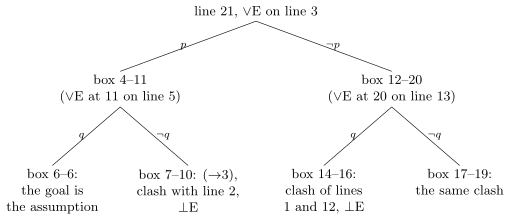
derivation has this shape:
Written out:
1
2
3
4asm, for
5
6asm, for
7asm, for
8 4, 7
9 2, 8
10 9
11 5, 6–6, 7–10
12asm, for
13
14asm, for
15 1, 12
16 15
17asm, for
18 1, 12
19 18
20 13, 14–16, 17–19
21 3, 4–11, 12–20
The box at line 6 has one line: in the row the
goal is the
signed atom itself, so, as in the proof of Lemma 4.8.3,
the box is its assumption alone. The result has 21
lines. The derivation by has 3:
the two premises and by citing
lines 2 and 1. The method is uniform, not short: it does
the same thing for every valid sequent, and pays for
that with a split on every atom.
Exercise
(B3: Table first, then a derivation)
Decide by a truth table whether . If it holds, find a
derivation of by search, where you may cite the sequents of
Lemma 4.8.1
as derived rules. Which rule of your derivation is
classical?
Solution. The table: The premise is true in rows 2 and 3, and so is
the conclusion. So the entailment holds, and by Theorem 4.8.4
a derivation exists.
The search: the goal is a biconditional, so two
boxes, one from to and
one from to . In the second,
the goal is
a negation: a box on , and , give by
,
which clashes with the premise. In the first, the goal
is an atom, the
only premise is a negation, and nothing else applies: we
are stuck, and assume . Then ,
give by ,
which clashes with the premise.
1
2asm, for
3asm, for
4 2, 3
5 4, 1
6 3–5
7asm, for
8asm, for
9 8, 7
10 9, 1
11 8–10
12 2–6, 7–11
The classical rule is the at line 6.
(Pasting in the derivations of the two cited sequents
gives a derivation in the primitive rules of 22 lines.)
Whether some other derivation could avoid is a
question the table cannot answer. In fact none can; we
state that without proof, as Chapter 2 did for similar
sequents, and nothing depends on it.
Exercise
(B4: When TAUT is welcome)
- (a) Derive twice: once with a single TAUT
line, once with primitive rules.
- (b) By the
convention of this section, which is the better proof,
and why?
- (c) In a longer
derivation, line 7 holds and
line 8 holds . Justify line 8 by TAUT, and say why the
convention allows it.
Solution.
- (a) With TAUT, line
3 is justified because a row making both premises true
has false, so
false,
so false. With
primitive rules, a box on
:
1
2
3asm, for
4 1, 3
5 4
6 5, 2
7 3–6
(b) The primitive
one. The TAUT line hides the only idea of the argument,
modus tollens through the conjunction, which is exactly
what the convention forbids.
(c) 8 , TAUT 7. The two
formulas are equivalent (each is false exactly at , ), and the
step is a rearrangement a written proof makes without
comment.
Marking scheme. (10 points)
- 3: (a) the TAUT derivation, with the row check.
- 2: (a) the primitive derivation.
- 3: (b) the primitive one, because the TAUT line
hides the argument’s only idea.
- 2: (c) the TAUT line, with why the convention allows
it.
Exercise
(B5: Consistent or not)
Decide whether each list is consistent. Justify
“consistent” by a row and the result that makes it a
proof; justify “inconsistent” by a derivation of , or by a search and
the result that makes it a proof.
- (a) .
- (b) .
- (c) .
Solution.
- (a) Inconsistent:
1
2
3
4
5 1, 3
6 2, 5
7 6, 4
(b) Inconsistent.
A search closes: gives or ; under the
first, closes both ways; under the second, closes both
ways. So the list is unsatisfiable (Proposition 4.6.1),
hence inconsistent, by Theorem 4.8.4
(“Consistent and satisfiable coincide”).
(c) Consistent.
The row with ,
, all false makes all
three members true (false hypotheses), so the list is
satisfiable, hence consistent (Section 4.7, by Theorem 4.7.2).
Marking scheme. (10 points)
- 3: (a) the verdict (1) and the derivation of (2).
- 4: (b) the verdict (1) and the closed search with
the results that make it a proof (3).
- 3: (c) the verdict (1) and the row with the theorem
it rests on (2).
C. Going deeper
Exercise
(C1: The remaining cases)
Write out in full the disjunction case and the
biconditional case of the proof of Lemma 4.8.2,
in the style of the implication case.
Solution. Throughout, is ,
and the induction hypotheses are
and . “Chaining” is Lemma 2.3.3
(c).
Disjunction, . By Definition 4.4.2,
exactly when .
- Case . Then and .
Chaining with , , gives .
- Case , . Then and . Chaining with
gives
.
- Case . Then , and .
Chaining both hypotheses with , , gives .
Biconditional, . By Definition 4.4.2,
exactly when .
Each case uses both hypotheses.
- Case T, T. ; chain ,
with .
- Case F, F. ; chain ,
with .
- Case T, F. ; chain ,
with .
- Case F, T. ; chain ,
with .
The cases cover all four pairs of values, so in each
the property holds for .
Marking scheme. (10 points)
- 4: the
case: the three value cases, each with the right sequent
of Lemma 4.8.1
and only the hypotheses its premises need.
- 4: the case: the
four value cases, each with the right sequent and both
hypotheses.
- 1: names chaining (Lemma 2.3.3
(c)) as the step that combines the hypotheses with the
sequent.
- 1: says that the cases cover every pair of
values.
Fatal errors (0 for the step): using a sequent whose
premises are not the signed parts , of that
case.
Exercise
(C2: Exit check: completeness)
Close the section first, and write from
memory.
- (a) Prove Lemma 4.8.3:
if and , then .
- (b) Prove Step 3 of
the proof of Theorem 4.8.4
in full: from the Claim of Step 2, for every valuation
, , deduce . State
the statement you prove by induction, and say which
principle of induction you use.
Solution (Hint 1). For (a):
excluded middle and proof by cases. For (b): remove the
signed atoms from the end of the list, one at a
time.
Solution (Hint 2). For (b): let
say “for every
valuation , ”, and show that implies for .
Solution. (a) Let derive from premises in
, and
from premises in
.
Write, as premises, those of and that lie in ; then by (Proposition 2.5.3,
a derived rule with no premises); then a box opening
with containing
the non-premise lines of , in which citations of
the premise now
cite the assumption and citations of premises in cite the premise
lines; then a box opening with , built from in the same way; then
by , citing
the line and the two boxes. (If or ends on a premise, its
box is the assumption alone when that premise is the
assumption’s formula, and otherwise the assumption
followed by by
.)
Every copied line keeps its boxes, now inside the new
box, and cites lines still available to it. The last
line of each box is , as a line of that
box itself, because the last line of or lay in no box. The two
boxes and the line lie
in no box, so they are available at the final line. So
the result is a derivation of from premises in
, and .
(b) For , let be: for every
valuation , . The Claim of Step 2 is .
The step. Let and assume . Let be any valuation, and
let , agree with except that
and . Since the are distinct, both
agree with on
. By for and for , with :
and . By (a), . As
was arbitrary,
holds.
The induction. We use Axiom 4.2.1
on with
the statement :
“if , then
”. is . If holds and , then holds and lies between
and , so the step gives
, which
is . Hence
, which is
: for every
valuation, . Valuations exist, so .
(Inducting downwards on , or on the number of
atoms removed, is the same argument; either earns full
marks.)
Marking scheme. (10 points)
- 3: (a) builds one derivation from the two given ones
with premises in (for instance by
pasting them into the two boxes of a on
, or
by an box on
), with
each premise or
replaced by
an available line, and says why every citation is still
available.
- 1: (a) names the classical step (, Proposition 2.5.3,
or ).
- 3: (b) sets up an induction on the number of atoms
removed (or downward on ) with a statement
quantified over every valuation, and
names the induction principle.
- 2: (b) in the step, applies the hypothesis to
both valuations that differ at , and notes that they
agree with on the
other atoms.
- 1: (b) concludes from .
Fatal errors (0 for the step): splitting on an atom
using the Claim for a single valuation only; an
induction statement that fixes before the induction,
so that the two valuations of the step are not covered
by the hypothesis.
Solution. (a) Derivable.
The goal is an implication: a box on , with the goal ; the premise is
a disjunction, used by inside
the box; in each case with
gives one side,
and gives the goal.
1
2asm, for
3asm, for
4 3, 2
5 4
6asm, for
7 6, 2
8 7
9 1, 3–5, 6–8
10 2–9
(b) Not derivable. In the row , , , the
premise is true ( is F, so is T) and the conclusion is F. By Corollary 4.7.3,
.
(c) Not derivable. In the row , , (the value
of does not
matter), the premise is true because is, and the conclusion
is false because
is. By Corollary 4.7.3,
the sequent fails.
(d) Derivable. Split the premise by , then
use by
:
the case clashes
with and
closes by ; the case gives the goal by .
1
2 1
3 1
4asm, for
5 4, 3
6 5
7asm, for
8 7
9 2, 4–6, 7–8
Neither derivation uses . As the
problem allows, (a) and (d) may instead be justified by
a table (or backwards from F) showing the entailment,
followed by Theorem 4.8.4.
Marking scheme. (10 points; 2.5 per
sequent)
- 1 per sequent: the correct verdict.
- 1.5 per sequent: its justification: a derivation in
which every line is justified and every citation
available, or a table check with Theorem 4.8.4;
or a row that makes every premise true
and the conclusion false, checked, with Corollary 4.7.3
(or Theorem 4.7.2)
cited.
Fatal errors (0 for the sequent’s justification): a
“refuting row” that makes some premise false; a
derivation citing a line that is not available.
Exercise
(C4: Challenge: Strike out ∨I)
Strike from the primitive rules.
- (a) Which sequents
of Lemma 4.8.1
lose the derivations given in its proof (the table of
the fold “The fifteen derivations”), and which step of
the proof of Theorem 4.8.4
also uses , through a result of Chapter 2?
- (b) Read as : a valuation now
makes true exactly when it makes both parts
true; every other clause stays. Show that every
remaining primitive rule is sound for this reading.
- (c) Deduce that
neither nor is derivable without (and
without derived rules derived with it), although both
are valid: the shorter list of rules is sound but not
complete.
Solution.
(a) and are itself;
and
are
derived by and then Proposition 2.5.5
(c). And Lemma 4.8.3
uses Proposition 2.5.3,
whose derivation in Section 2.5 uses twice;
that is Step 3 of the proof, where Lemma 4.8.3
removes the signed atoms.
(b) Only the
cases and of the
proof of Theorem 4.7.2
use the clause for , and is
gone. : if a valuation makes true, it makes
true, hence, in the new reading, both and ; by the first box it
makes true.
Every other case is unchanged.
(c) The valuation
with true and
false makes true and, in the new
reading,
false; every valuation makes false in
the new reading, since and are never both
true. By (b), and Step 1 of the proof of Theorem 4.7.2
(a derived rule derived without
expands, by that step, into a pasted derivation in the
remaining primitive rules), neither sequent has a
derivation without and the
derived rules that use it, such as Proposition 2.5.3.
Both are valid in the ordinary tables.
Marking scheme. (10 points)
- 3: (a), all four sequents and the excluded-middle
step.
- 4: (b), with the case
argued and the other cases said to be unchanged.
- 3: (c), both valuations and the conclusion, with
Step 1’s restriction to derived rules derived without
.
Fatal errors (0 for the step): in (c), using the
ordinary tables.
Exercise
(C5: Challenge: From a closed tree to a
derivation)
Let a search tree (Section 4.6) for have
every branch closed. For a node , the path list
of is the list of
formulas on the path from the root down to , included.
- (a) Prove, by
induction on the number of nodes below , that if every branch
through is
closed, then , where is the path list
of . Treat a
closed leaf and each rule of the table of search rules,
naming the derivable sequents you use.
- (b) Deduce .
- (c) Explain why (a),
(b) and Proposition 4.6.1
give a second proof of Theorem 4.8.4,
and where it uses or .
Solution (Hint 1). A one-way rule:
derive the added formulas from the used one, then chain
(Lemma 2.3.3).
A two-way rule: join the two derivations of .
Solution (Hint 2). For , split
as or
: with the path list of
, from get by .
Solution.
- (a) We use Theorem 4.2.2
on the number of nodes below . Write for the path list
of .
A closed leaf. holds and (one line)
or (the
premise itself): .
An inner node. Its children were added by
the rule of some in . Every branch
through each child is closed, and each child has fewer
nodes below it, so the hypothesis gives (or ) for the
formulas
that each child adds.
One-way rules. It suffices to show for
each added ,
and then chain (Lemma 2.3.3
(c), after weakening). :
. : a box on
, , ;
likewise .
: an box on
, in
which Proposition 2.1.2
gives , then . : a box on
, in which an
inner box gives by and , then
.
: Proposition 2.5.1.
Two-way rules. : on the
line , with the two derivations of pasted into the
boxes as in the proof of Lemma 4.8.3.
: from , by
;
likewise ; then , and
with . : by from the
first child; gives
; cut with
. : from and (by ),
cut gives ; from and (a box on
: by ,
clash), cut gives ; join the two by Lemma 4.8.3,
which holds for any formula in place of the atom (the
remark after its proof). : (a box on
: by
with two two-line boxes, each closed by , then the
clash with ), so by cut with the first child; (an box on
: by ,
each box closing by a clash and , then
the clash with ), so by cut with the second child; join by Lemma 4.8.3.
(b) At the root,
; an box on
holding
that derivation gives (Proposition 3.2.2
(b)).
(c) If , a
search tree for can be continued until every branch is
closed or finished (Proposition 4.6.1
(a)), and it has no open finished branch, since by (c)
of that proposition its row would refute . So
every branch is closed, and (a), (b) give . enters in
the cases , , , , and at the root; in the two
biconditional cases. The derivation follows the tree, so
it is often far shorter than the rows of the first
proof.
Marking scheme. (10 points)
- 1: the closed leaf.
- 2: the four one-way cases.
- 5: the five two-way cases (1 each).
- 1: (b).
- 1: (c), with the classical steps located.
Fatal errors (0 for the step): treating a split by
assuming one side only.
R. Review
Solution. The method of Section 3.1
(Example (Proof by cases, found by the method)
shows it on a proof by cases). The goal is an atom, so no
introduction rule applies; the premise is a
disjunction, so we use it by , with
the goal in both
boxes. The case
is the goal. In the case , nothing gives directly, so we look
for a clash: and
the premise build
by ,
which clashes with , and closes
the impossible case (Example (Manufacturing the other half of a clash)).
1
2
3
4asm, for
5 4, 3
6 5, 2
7 6
8asm, for
9 1, 4–7, 8–8
The second box is its assumption alone, which is
already the goal. No is
used.
Solution. “ only if ” is (Section 1.1, and
Exercise (C1: “Only if” and “unless”, used later)).
“Both odd” is , since an integer is odd exactly when it
is not even. So the sequent is Work backwards from F. A refuting row needs
false, so
, and
the second premise true, so , . In that
row and
are both F, so the first premise is , which is F. So no row makes both
premises true and the conclusion false: the entailment
holds. By Theorem 4.8.4,
the sequent is also derivable. (The eight-row table
gives the same answer; working backwards found the only
candidate row at once.)
Solution. A tautology.
Work backwards from F (Section 4.4). The formula is
false only if is true and is
false. The second needs false and false; the
first needs true
and true,
so with false,
true. But then
is true.
No row makes the formula false, so it is a tautology (Definition 4.5.1).
Derivable without .
Completeness (Theorem 4.8.4)
says it is derivable, but not how, and its proof uses
in
Lemma 4.8.3,
so it does not answer the second question. A search
does: the goal is an implication, so a box on ;
split it by and use by .
1asm, for
2 1
3 1
4asm, for
5 2, 4
6 5
7asm, for
8 7
9 3, 4–6, 7–8
10 1–9
No is used:
the boxes close by and
.
The tools: truth values (Definition 4.4.2)
for the first question, the search of Chapter 3 for the
second. The look-alike tool, completeness, answers only
“derivable with all the rules”.