3.3 From Argument to Derivation
Most searches in Sections 3.1 and 3.2 started from a sequent: its letters, its premises and its conclusion were given. Mathematics starts from a paragraph. Its premises are scattered among words such as “since” and “so”; some of them are not written at all; and its letters must be chosen. This section turns paragraphs into sequents and derives them. Then it goes the other way, and writes a proof beside the derivation it mirrors. A last page collects the sequents that searches keep needing.
3.3.1. One key for the section
Section 1.1, Exercise B5, fixed one key for an
integer
- F1
- F2
- F3
Each fact is true for every integer
A translation is checked by reading it back, letter
by letter, as in Section 1.1: F3 reads back as “if
Quick check. On the key, translate
“
Solution.
3.3.2. Extracting an argument
To turn a paragraph into a sequent, work through five steps.
- Find the conclusion. Words such as so, hence, therefore, thus and it follows that introduce it.
- Find the stated premises. Words such as
since, because, for and
given that introduce them. A supposition
(“suppose …”, “let
- Name the unstated facts. Wherever a step does not follow by a rule from the lines before it, write the fact that would make it follow, as an implication, and check that the fact is true. Supply the weakest fact that closes the gap: a stronger one may prove more than the paragraph claims, or be false. (Compare Section 1.3, Exercise B5 (d), where a missing implication was written and checked.)
- Translate on a key, with Section 1.1’s phrase book.
- Derive the sequent, or break it.
Steps 1–4 are reading. Step 5 is the rest of this book.
Extract the argument of this paragraph and derive it.
Let
be an integer, and suppose that is a prime greater than . Then is odd, since the only even prime is . Nor is a multiple of , because the only prime that is a multiple of is itself. So is neither even nor a multiple of .
Solution. We take the five steps in order.
- The conclusion follows “So”:
- The stated premise is the supposition, “
- The reasons are facts about numbers, but not in a
form a rule can use. “The only even prime is
- The sequent is
- We read the derivation off the goal. It is a
conjunction of two negations: two
In the first picture, the premise is taken apart and
the two conjuncts stand as subgoals. In the second, each
subgoal has its box, with goal
Inside each box, the fact fires once the box’s
assumption is joined to
Lines 4–5 need nothing new, so they are written
before the boxes (Section 3.1). Had the supposition been
kept as a supposition, the claim would be
The argument can also be drawn as a map: each statement a dot, each step an arrow into what it gives. The unstated facts are the dots nobody wrote. The map shows what supports what; it is not a derivation, and it leaves out the boxes.
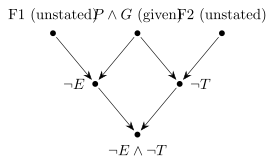
Quick check. Which line of the
derivation in Example (An argument about a prime, extracted)
is the paragraph’s sentence “Then
Solution. Line 10. The paragraph is silent on lines 4–5 and on the box, lines 6–9, that shows it, apart from the reason F1 behind line 8.
Warning (Not allowed: extracting an argument). Each entry names the step of the method it breaks.
- “Writing ‘
- “Reading ‘
- “Supplying ‘every prime is odd’ for the first step”:
the supplied fact must be true, and this one fails at
- “Supplying
- “Translating ‘
3.3.3. Two columns
Now the other direction: a proof is written, and its derivation is wanted. Write the proof in the left column and the derivation in the right, each sentence on the row of the lines it says. A line that no sentence says is a silent step. A sentence that matches no line is a gap in the proof, or a step this book’s rules cannot take.
Let
Proof. Suppose
is even and prime. If were a multiple of , it would be an even multiple of , and no even multiple of is prime; but is prime. So is not a multiple of .
Write the derivation the proof mirrors, in two columns.
Solution. The proof uses one fact,
F3, and the claim is an implication. The sequent is
The two columns finish the derivation.
| The proof | The derivation |
|---|---|
| “Suppose |
2 |
| (silent) | 3 |
| “If |
5 |
| “it would be an even multiple of |
6 |
| “and no even multiple of |
1 |
| “but |
8 |
| “So |
9 |
| (the claim) | 10 |
The finished derivation, read down the right column:
The proof says lines 2 and 5–9, and line 1 only
inside a clause. It is silent on lines 3–4, taking the
conjunction apart, and on line 10, since closing the
outer box is the claim itself. Its “Suppose” is line 2’s
“asm, for
Quick check. If the claim in Example (A proof and its derivation, side by side)
were “if
Solution. F1 replaces F3. The box
of line 5 disappears: the goal
3.3.4. A library of standard sequents
Chapters 1 and 2 and Section 3.2 proved sequents that searches keep needing. Here they are grouped by what they are for: a searcher with a resource or a goal of a given shape looks up its row. Each row is a derived rule (Definition 2.3.1). It is applied to whole available lines, never to a part of a line, and it is cited by the name in its middle column. “The rules in one place” in Section 3.1 lists the primitive rules and most of these derived rules on one card; this page regroups the derived rules, with those of Section 3.2, by use. The last group is different: it holds facts about derivations, which change the task rather than add a line.
| Sequent | In a justification | Proved in |
|---|---|---|
| To use an implication | ||
| Proposition 2.3.1 | ||
| (implication is transitive) | Proposition 1.4.1 | |
| (curry) | Proposition 1.4.2 | |
| (implication as disjunction) | Proposition 2.5.6 (b) | |
| To use a disjunction | ||
| Proposition 2.3.4; Exercise (B1: The other disjunctive syllogism, used later) (a) | ||
| (cases on a hypothesis) | Example (Cases on a hypothesis are two implications); Example (A disjunctive hypothesis splits into two implications) | |
| (constructive dilemma) | Example (Constructive dilemma) | |
| (destructive dilemma) | Exercise (B4: Dilemmas as derived rules, used later) (b) | |
| (modus ponendo tollens) | Exercise (B4: Dilemmas as derived rules, used later) (c) | |
| To use a negation or a clash | ||
| (ex falso) | Proposition 2.1.1 | |
| VI | Proposition 2.1.2 | |
| Proposition 2.5.1 (b) | ||
| Proposition 2.5.5 (a), (d) | ||
| To reach a negation | ||
| Proposition 2.3.2 | ||
| (implies a contradiction) | Example (A statement that implies a contradiction) | |
| Proposition 2.5.5 (b), (c) | ||
| Proposition 2.5.1 (a) | ||
| To reach an implication | ||
| (implication as disjunction) | Proposition 2.5.6 (a) | |
| ( |
Proposition 2.5.2 | |
| To reach a disjunction | ||
| Proposition 2.5.3 | ||
| (refute one side) | Example (Proving a disjunction by refuting one side) | |
| To rearrange | ||
| (and commutes); (or commutes) | Proposition 1.2.1; Example (First derivations with “or”) | |
| (and regroups); (or regroups) | Proposition 1.2.2; Example (Regrouping a disjunction) | |
| (distributivity) | Proposition 1.6.1 | |
| (iff symmetric) | Example (An iff read both ways) | |
| (iff as two implications) | Proposition 2.4.1 | |
| (equivalence cycle) | Proposition 2.4.6 | |
| To change the task (facts about derivations, not lines) | ||
| more premises never hurt; a derived statement may be used as a premise | (weakening, cut) | Lemma 2.3.3 |
| — | Proposition 3.2.2 | |
| an inconsistent list derives every statement | — | Proposition 3.2.1 |
Rows proved in exercises (the second form of
Quick check. Which row would you
look up first? (i) The goal is
Solution.
- (i)
Remark (Looking ahead). We show
that something is derivable by exhibiting a derivation;
how could we ever show that something is not? Chapter 4
gives each statement a truth value and proves that the
rules never lead from true premises to a false
conclusion. Then one choice of truth values, such as
3.3.5. Exercises
A. Check your understanding
- (a) In “Since
- (b) Find the
conclusion: “
- (c) Name the
unstated fact: “
- (d) On the key of
this section, translate “
- (e) In Example (A proof and its derivation, side by side), which sentence of the proof is line 5, and what does line 5’s annotation read?
Solution.
(a) The premise is “
(b) “
(c) Every multiple of
(d)
(e) “If
B. Practice
For each paragraph, find the conclusion, the stated premises and any unstated fact; choose letters; write the sequent; derive it.
- (a) Let
- (b) Let
- (c) Let
Solution.
- (a) Take
Nothing is unstated here except the order convention.
- (b) Take
The tempting wrong supply is “the square of an odd integer is odd”,
- (c) Take
Let
Proof. Suppose
is prime and . If were a multiple of , it would be an even multiple of , and no even multiple of is prime; but is prime. So is not a multiple of .
(a) On the key, “
(b) Write the two-column table.
(c) Which hypothesis does the derivation never cite? What claim does that show, and is it true?
Solution.
- (a) The goal
- (b) The two columns:
The proof The derivation “Suppose 2 (silent) 3 “If 4 “it would be an even multiple of 1 (F3), 5 “but 6 “So 7 (the claim) 8 Line 4 already is
- (c)
Items 1–5: derive each sequent, using a row of the
library where it shortens the derivation, and name the
row; their letters are free, not the key. Items 6–10:
translate on the key, using the facts F1–F3 as premises
where needed, and derive. Items 11–15: derive or break,
as in Example (Two claims, one connective apart).
The facts may be used as premises. A break is an integer
Derive, with the library.
- 1.
- 2.
- 3.
- 4.
- 5.
Translate on the key, then derive.
- 6.
- 7.
- 8.
- 9.
- 10. If
Derive or break.
- 11.
- 12.
- 13.
- 14.
- 15.
Solution. 1.
2.
3. Modus ponendo tollens,
with
Without the library, the goal
The other library route (
4.
5.
6.
7.
8.
9.
The premise
10.
With the library, lines 3–6 shrink to two: 3
11. Breaks. The claim is
12. Derives:
13. Breaks. The claim is
14. Derives:
15. Breaks. The claim is
Items 11 and 12, and items 13 and 14, pair a break
with a derivation on nearby words; item 15 tries to go
back from “not prime” to “even or a multiple of
Let
- (i) This contradicts
- (ii) Suppose
- (iii) Then
- (iv) Adding,
- (v) Hence
- (vi) Suppose, for a
contradiction, that neither
- (vii) Suppose
- (viii) Then
- (a) Put six of these sentences in an order that proves the claim; two do not belong.
- (b) Match each
sentence of your order to a line of the derivation
below, with
Solution.
- (a) (ii), (vi),
(viii), (iv), (i), (v). No other order is admissible:
the supposition (ii) must open first, since the claim is
an implication, the
- (iii) does not
follow:
- (iii) does not
follow:
- (vii) assumes the conclusion, a box opened on the goal (Section 3.1’s warning “Do not assume what you want to prove”).
- (b)
- (ii) is line 2,
“asm, for
- (ii) is line 2,
“asm, for
C. Going deeper
Let
be an integer greater than , and suppose is even or a multiple of . Then is not prime. Indeed, suppose were prime. If is even, is an even prime, and every even prime is at most . If is a multiple of , is a prime multiple of , and every such number is at most . Either way is at most , which is false. So is not prime.
- (a) Name the conclusion, the stated premises, and the facts the paragraph gives as reasons, each on the key.
- (b) Write the sequent.
- (c) Derive it.
- (d) Write the two-column table.
- (e) Is the premise
“
Solution.
(a) The conclusion is
(b)
(c) The goal is a negation: a
- (d) The two columns:
The proof The derivation “Let 1, 2 “Then the goal, line 14 “suppose 5 (asm, for “If 6–8, with 3 “If 9–11, with 4 “Either way 12 “which is false.” 13 “So 14 - (e) It is needed.
Without
Marking scheme. (10 points)
- 2: (a)–(b), the sequent, with F1 and F2 named as the facts given as reasons, in implication form.
- 3: (c), a correct derivation; the model has the
- 2: (d), every sentence placed, the two “suppose”s matched to their annotations.
- 3: (e), “needed”, with a break that makes every member of the new counterexample set true.
Fatal errors (0 for the step):
- (a) Derive
- (b) Let
- (c) Which rules does your derivation use? Compare Lemma 2.4.2.
Solution.
- (a) The premise
gives nothing until one side of the iff is on a line.
The side
The shorter ending 7
(b) Read as an argument, the derivation proves
(c) Only
Marking scheme. (10 points)
- 4: (a), any correct derivation; the model has the
box on
- 3: (b), the conclusion that no statement meets the condition, with the inconsistency.
- 3: (c), the rules of the reader’s own derivation
named correctly, and the point that a derivation using
only
Fatal error (0 for (a)):
R. Review
For real numbers
Solution. Since
Case
Case
In either case the equation holds, which proves it.
Both cases end in the same statement, the goal, as
Let
is neither negative nor greater than . Therefore is not negative, and if is greater than , then .
Solution. The phrase book (Section
1.1) gives “neither … nor” as
Lines 2–5 are half of Proposition 2.5.5
(a), which turns
Is
Solution. The first is derivable,
by the search method of Section 3.1. The goal gives a
box on
The repetition at line 5 puts
The converse breaks: with
Ana and Ben talk about a real number.
Ana. Let
be a real number with . Then is positive. Ben. Why can’t it be negative?
Ana. A negative number is less than its square.
Ben. And zero?
Ana. At zero,
equals . And is less than , because for we would have . Ben. So
. But you never said why when . Ana. Multiply
by , which is positive.
- (a) What is the conclusion, and who states it?
- (b) Turn the dialogue into a derivation.
- (c) Is Ana’s last answer enough?
Solution.
(a) “
(b) With, for instance,
The conclusion
For the derivation:
- (c) Yes:
The method is the extraction of this section (Example (An argument about a prime, extracted)),
run on a dialogue; the rules are Chapter 2’s. The
look-alike,