2.5 Proof by Contradiction and the Classical Rules
Every rule so far either builds a statement or takes
one apart. The rules for negation are no exception:
2.5.1. Two boxes that look alike
Here are two arguments that a mathematician would both call “proof by contradiction”.
The first is the proof of Theorem 2.2.1.
It fixes a rational number
The second is about a real number.
Let
Solution. Suppose, for a
contradiction, that
Look at its shape. The box opens with the assumption
2.5.2. Where the rules so far stop short
The second argument is not a curiosity. Three times already in this chapter a derivation has stopped short in the same way: it reached a negation where the goal was not one.
- Section 2.2 noted that a box opened with
- If you did Exercise C1 of Section 2.3, you met a
second: Exercise (C1: Two premises that cannot both fail, used later)
led from
- Section 2.4 noted, after Example (Negating both sides of an iff),
that its converse,
Try the smallest case,
That no derivation of
2.5.3. Reductio ad absurdum
To prove
This is the rule
As in every schema (Definition 1.2.1),
- The assumption is the exact negation of the
goal. To prove
- The box must reach
- The result is
- The box closes, its assumption is
discharged, and the justification cites the box as a
range
In words: the box is a thought experiment in which
| Rule | The box opens with | The box ends with | After the box |
|---|---|---|---|
The rows differ only in where the
In the Givens/Goal table,
With the convention of Section 2.1, the argument of Example (A number whose square is at most itself) is this derivation.
Warning. The assumption that opens
an
Quick check. A box opens with the
assumption
Solution.
- (i) By
Quick check. In the derivation of
Example (A number whose square is at most itself)
above, which line is the
Solution. Line 6 is the
2.5.4. The move: when stuck, assume the negation of the goal
Chapter 1 and Sections 2.1–2.4 built two lists of
moves. From the goal: its main connective chooses an
introduction rule and so a box or two subgoals. From the
premises: each available line’s main connective chooses
the elimination rule that uses it, and a goal
We are stuck at a gap when the
goal-directed moves give nothing (the goal is a letter,
or a disjunction with neither side in hand) and no
premise-directed move brings the goal closer. Then open
an
When stuck, assume the negation of the goal, and hunt for a clash.
The move is a last resort, not a first one: try every other move first. Four of the derivations under the next heading reach the moment of being stuck, and their Ideas say where.
When
2.5.5. Derivations with the new rule
The stall, resolved. The next result is the one on which we got stuck.
For every statement
- (a)
- (b)
Idea. In (a) the goal
In (b) the goal
Proof.
- (a) This is the
derivation of Example (Two negations from one premise)
(a), which uses the rules of Definition 2.2.1
alone; we repeat it to set it beside (b).
12
- (b) An
Line 3 applies
In both derivations, lines 2 and 3 form a box that
opens with
Second readingEdge cases of reductio
The degenerate case. The smallest
use of
Idea. There is nothing to find: the
premise is the goal. The derivation is here only to show
the rule at its smallest. The box opens with
It is legal and pointless, since line 1 already is the goal. It is the purest case of a pattern that turns up in real proofs: a contradiction box whose assumption does nothing except clash with a line we already had. A warning later in this section, after Example (A number below every positive number), returns to it.
Nonexample by minimal change. Change
only the last line of (a), from
From now on both parts are derived rules in the sense
of Definition 2.3.1.
A line
Contraposition, backwards. Proposition 2.3.2
derives
For all statements
Idea. The goal is an implication,
so the goal-directed move opens a box with
In pictures: the stall at the letter
Proof. The derivation is:
Line 5 may cite line 2 because line 2 lies in a box
that is still open.
So contraposition behaves like double negation: going
from
Excluded middle. Every integer is
even or odd. Every real number is
For every statement
Idea. The goal is a disjunction, so
Section 1.5’s move postpones it: choose a side only when
that side is in hand. But there are no premises, so no
premise-directed move applies, and neither side is worth
aiming at:
In pictures: the
Proof. The derivation is:
The derivation has no premises, so it shows
The assumption of line 1 is used twice, at lines 4
and 7. The first use refutes
Its use is proof by cases on a
statement. To derive
A law with no negation. The last is
a law in which
For all statements
In words: a law with no
Second readingPeirce’s law, derived
Try it first (ten minutes): use the goal-directed and premise-directed moves of the earlier sections on this goal until they stall. At which gap do they stall, and which line, if it were available there, would let you finish?
Idea. The goal is an implication,
so we open a box on
We are stuck, so the new move applies, but where?
Assuming
Proof. The derivation is:
The derivation has no premises, and
The assumption
2.5.6. De Morgan’s laws
The negation of an “and” is an “or” of negations, and
the negation of an “or” is an “and” of negations. For
example, a real number
For all statements
- (a)
- (b)
- (c)
- (d)
Try it first (ten minutes): look for a derivation of (d) with the rules of the earlier sections. Which rule would give its last line, and what would that rule need?
Idea. Parts (a)–(c) yield to their
goals. In (a) the goal is a conjunction of negations:
two
In pictures, for (a): two subgoals; then a box under each.
For (b): the box on
Part (d) resists. Its goal is a disjunction, so the
natural last line is
For (d): the
Proof.
- (a) Two
- (b) One
- (c) The same shape
as (b), with the roles of
- (d)
The derivations of (a), (b), and (c) close every box
by
Laws (a)–(c) conclude negations or a conjunction of
negations, and
Second readingDe Morgan (d) by excluded middle
Excluded middle makes the decision instead. Split on
Quick check. Suppose
Solution. The derivations of (a),
(b), and (c) would still be correct: they use
2.5.7. Implication as a disjunction
In everyday mathematics “if
For all statements
- (a)
- (b)
Idea.
- (a) The premise is a
disjunction, so we use it by cases, each ending in the
current goal
In pictures, for (a): the two cases; then a box on
- (b) The goal is a
disjunction, so we postpone it. The premise is an
implication, which gives
For (b): the split; then
Proof.
- (a)
Line 9 repeats line 7 inside the box of line 8, because
- (b) Cases on
Line 2 is Proposition 2.5.3
used as a derived rule, and the only
The two routes of the section now stand side by side.
2.5.8. One principle in three forms
To say this exactly, we need two rule forms and one
notion.
Over the primitive rules other than
In words:
In the picture, an arrow from X to Y means that X
derives Y over the other primitive rules; going round
the solid cycle, each rule derives the other two. ① is
Proposition 2.5.3
on the solid arrow and Proposition 2.5.1
(b) on the dashed one; ② closes the box by
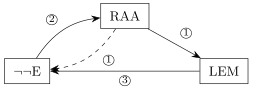
Part ② says that a step of
Line 6 is correct by
So the classical part of our rules is one extra principle, whichever of its three forms we write down.
Second readingPart ③ on the example, and the proof: replacing one rule by another
Part ③ on the example. Part ③
replaces the
The first case is the goal; the second clashes with
line 6 and closes itself. Together, ② and ③ turned the
one
Idea. Replacements can be chained,
so it is enough to go once round a cycle. ①
Before reading on: in the fragment for ③ below,
which rule does line
Proof. ① Suppose a derivation uses
② Suppose a derivation uses
Line
③ Suppose a derivation uses
The first case is a one-line box: it opens with
In each replacement the later lines are renumbered,
and a later citation of the old line
Finally, replacements can be chained.
The base list matters: part ③ uses
Second readingOther books, and a rule we could drop
Remark. Some books call exactly our
Remark.
2.5.9. How reductio looks in a mathematical proof
Here is an argument of a kind that analysis uses constantly; read it one sentence at a time, with the rule of each step in brackets.
Let
Solution. Suppose, for a
contradiction, that
- “Suppose, for a contradiction, that
- “Since
- “Then
- “So the hypothesis applies to it and gives
- “… gives
- “This contradicts
- “Hence
- By the contrapositive (
- By contradiction (
The first proof introduces negations and removes
none; the second removes one, at its
The proof of Theorem 2.2.1
assumes the positive statement
Quick check.
Solution.
- (i)
Second readingRAA is never needed to finish a negation
For one kind of goal the new rule is never needed at
the last step. Suppose the goal is itself a negation
When
Warning. An
Warning. Not every “proof by
contradiction” is
2.5.10. The rule card
Before the card, the new rule on large statements;
each box runs from the assumption shown to
| The box opens with | New line | |
|---|---|---|
The third row is legal; a
Not an instance. A box opens with
Chapter 1’s seven rules are on the card at the end of Section 1.6; here are this chapter’s so far.
| Rule | Shape | You write | Lean |
|---|---|---|---|
| “…, which contradicts …” | exact hn hp (goal
False) |
||
| “This case cannot occur.” “So there is nothing to prove.” | exfalso |
||
| box |
“Suppose |
intro hp (goal False) |
|
| “Since |
mt h hnq |
||
| “We prove the contrapositive: suppose not |
mt |
||
| “ |
h.resolve_left hnp |
||
| box |
“ |
constructor |
|
| “Since |
h.mp hp / h.mpr hq |
||
| box |
“Suppose, for a contradiction, that |
by_contra h |
|
| “It cannot be that |
not_not.mp h |
||
| nothing |
“Either |
by_cases h : P |
The Lean column is for readers who use that proof assistant; nothing later depends on it.
Warning (Not allowed:
- Open the box for
- Write
- Close the box on a
- Write
- To prove
Clause 1 is where the rule bites. Premises
The left box opened with
Quick check. A box opens with
Solution.
Remark (Looking ahead). Chapter 4
proves that
2.5.11. Exercises
A. Check your understanding
- (a) “Suppose
- (b) “Let
- (c) “Assume
- (d) State
- (e) In the
derivation of Proposition 2.5.5
(d), why is a last line
- (f) In the same
derivation, the assumption
- (g) In the instance
of ② on the opening example (in “One principle in three
forms”), which rule justifies the line
Solution.
(a)
(b)
(c) Neither: this is
(d)
(e)
(f) Line 5 cites it, by
(g)
The parts run from one step, through a missing line, a justification column and steps to judge, to short derivations.
(a) A box opens with
(b) Line 1 is
(c) To prove
(d) Let
(e) Line 9 is
(f) Line 6 is
(g) Fill in the justifications (i)–(iv).
123(h) “Suppose
(i) “Suppose
(j) Which of
(k) Find the illegal line, and say why it is illegal.
12(l) A box opens at line 2 with
(m) Derive
(n) Derive
(o) Derive
Solution.
(a)
(b)
(c)
(d)
(e) Line 4 is the assumption
(f) Line 5 is
- (g)
- (i)
- (i)
(h)
(i)
(j)
(k) Line 7: lines 2–5 are not a box (the box opened at line 2 ends at line 6), and
(l) No:
(m) 3
(n) 2
(o) 3
B. Practice
- (a) Derive
- (b) Derive
Hint: in (a) the goal is a negation; in (b) it is a letter.
Solution.
- (a) The goal
All three boxes close by
- (b) The goal
In words: “Suppose, for a contradiction, that
Derive
Solution. The goal is a
biconditional, so by Definition 2.4.1
we need two boxes, one from
Show that
Solution. Open an
The repetition at line 3 is needed because
A search for
Solution. The goal
The assumption on line 3 is cited twice, at lines 5 and 7; the clash on line 9 is between a line built from it and the second premise.
For each claim, derive it with any of the rules of
Chapters 1 and 2, or break it by statements about a real
number
- (a)
- (b)
- (c)
- (d)
- (e)
- (f)
- (g)
- (h)
Solution.
- (a) Derive, with no
classical line. Split on the first premise; in the case
(b) Break. Take
(c) Derive; the classical line is line 2,
Deciding
(d) Break. Take
(e) Derive; the classical line is line 3,
- (f) Derive; the
classical line is line 21,
(g) Break. Take
(h) Derive; the classical line is line 14,
- (a) needs no
classical line, although its goal is a disjunction,
because each case of the premise hands over one side.
(c) and (h) are disjunctions whose sides break on their
own, the place “When
Marking scheme. (16 points) For each
claim: 1 for the verdict; 1 for a derivation every line
of which checks, with the classical line correctly
marked, or for a choice of statements and one value of
- (a) Show that
- (b) Let
- (c) The sentence
“every even integer is greater than
- (d) Show that each
disjunct, as a claim from no premises, breaks. Which
move of this section does a derivation of
Solution.
(a) If
(b) At
(c) The false sentence puts “every” in front of each disjunct separately: (for every
(d)
Marking scheme. (10 points) 3: (a), both cases. 2: (b), the disjunct that holds at each value. 3: (c), the scope of “every” named, with a refuting value for each separated disjunct. 2: (d), the two breaks and the move named. Fatal error (0 for (c)): calling the false sentence an instance of (a).
C. Going deeper
Suppose that, instead of
Given a box that opens with
Solution (Hint 1). Write
Solution (Hint 2). The first case box is a single line.
Solution. Write excluded middle for
Here
A student derives
- (a) Is the sequent
- (b) Does the student’s derivation derive it? Name the first line that fails and the rule or clause it breaks.
- (c) Show that the
illegal step, if it were allowed, would prove too much:
use the same move to “derive”
- (d) Give a correct derivation.
Solution.
(a) Yes: part (d) below gives a derivation. The conclusion is true, and the argument is still wrong.
(b) No. Line 6 fails: it cites line 3, the assumption of the first case box, lines 3–4, which closed before line 5. By the scope rule of Definition 1.4.2, line 3 is not available at line 6. The form of
(c) The same move derives
(d) Keep lines 1–5, and in the case
Line 7 cites line 5, the assumption of the enclosing case box, which is still open: the legal version of what the student wanted.
Derive
Solution. The search. The
goal is a disjunction, so we postpone it; there are no
premises, so no premise-directed move applies; and
neither side is worth aiming at:
Lines 1 and 2 are assumptions, of the
A second correct route first derives
Marking scheme. (10 points)
- 2: an
- 3: an inner box on
- 2:
- 2:
- 1: every citation is available.
The second route earns the same points, step for
step: 2 for the written-out excluded middle opened
correctly (its
- (a) Show that, once
- (b) With neither
- (c) Exercise B3
derived
- (d) Which of the two
paradoxes of Section 2.1 survives in a system with
neither
Solution.
- (a) Replace the old
box by this one. Line
For modus tollens:
123 - (b) A box on
The
(c) No, and no: B3 uses
(d)
Marking scheme. (10 points) 5: (a),
the general replacement (2 for the inner
R. Review
Let
Solution. By (E1),
Case
Case
Both cases reach the goal, so
The method is Chapter 1’s case split (Definition 1.6.1),
used as in Example (The absolute value of a product),
here on the parity of
Call an integer
- (a) Write “
- (b) Show that “
Solution.
(a)
(b) Left to right; the classical line is line 2,
Right to left, with no classical line:
The classical line of these derivations is in the
left-to-right direction, the
Let
Solution.
(i) Follows: Proposition 2.3.2 (
(ii) Breaks at
(iii) Breaks at
(iv) Follows: Proposition 2.5.6, the direction
(v) Follows, with no classical line:
12- (vi) Breaks at
The breaks are of the step with this