8.6 Checking Proofs, and What Is Not Allowed
A reader working alone must judge proofs, including their own, and is the person least able to do it. The remedy is procedural. This section gives two questions to ask of every line and a catalogue of the errors that recur, each tied to the rule of Chapters 1–7 that it breaks, and then checks four short proofs line by line.
8.6.1. Two questions for every line
A proof is correct when every line is licensed: by Definition 1.4.2, each line is a premise (a hypothesis, a proved result or a true school fact), an assumption, or one rule applied to available lines. So checking a proof means asking two questions of every line, with the answers in two columns.
- Is it true? Is the line correct whenever the hypotheses and the assumptions of the open boxes are true?
- Does it follow, and by which rule? From which available lines, and by which rule?
The first column finds where to look; the second decides.
The two questions are different. A line can be true and not follow: a correct fact the proof has not earned. This is the dangerous case, because nothing about the line looks wrong.
| It follows | It does not follow | |
|---|---|---|
| It is true | the normal case: “ |
the dangerous case: Proof B’s last line, “if |
| It is false | the fault is higher up: from the false line “every
real |
“ |
“False” means false in some situation where the hypotheses and the open assumptions are true. When a line follows and is false, some line it rests on, neither a hypothesis nor an open assumption, is false there too, because the rules never lead from true lines to a false one (Theorem 4.7.2); follow it back until the second column fails.
The two columns, as a procedure for one line:
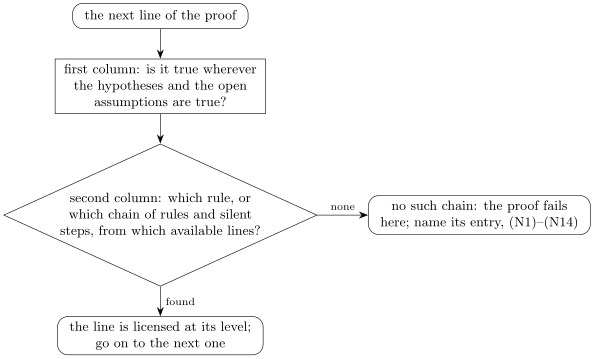
A “no” in the first column marks a line to look at first; only the second column decides. The silent steps are those of Definition 8.3.2.
Second readingTwo notes on the two columns
The same holds for derivations with quantifiers and equality, by the soundness statement for predicate logic in Section 7.2 (“From counter-models to non-derivability”).
(Proof C’s “
Quick check. A proof that
Solution. For an integer
8.6.2. The catalogue
Most wrong proofs fail in one of a few ways, each breaking a particular rule. The entries fall into seven families.
| Family | Entries | Slogan |
|---|---|---|
| “For all” errors | (N1), (N2), (N3) | A “for all” needs one argument about a name that is new and arbitrary. |
| Naming errors | (N4), (N12) | A new choice gets a new name, and two names may name one thing. |
| Implication errors | (N5), (N6) | The box of |
| Case errors | (N7), (N8) | Every case, from a disjunction that covers everything. |
| Scope and citation errors | (N9), (N10) | Cite only what is proved, given, or open around you. |
| Negation errors | (N11) | Negate exactly: an |
| Iteration and existence errors | (N13), (N14) | An “and so on” needs its step; a “the” needs its object. |
Each entry names the error, the rule it breaks and where that rule lives, and a failing instance whose conclusion is marked true or false: a wrong argument can reach either.
- (N1)
Verifying instances and concluding “for
all”. Breaks
- (N2) A
witness that depends on a variable introduced later,
while uniformity is claimed. Breaks the side
conditions of
- (N3)
Treating the name from
- (N4) Reusing
one witness name for two
- (N5) Proving
the converse. Breaks
- (N6)
Affirming the consequent; denying the
antecedent. Breaks Definition 1.4.2
(Section 1.4), being no rule:
- (N7) A
missing case. Breaks
- (N8) Cases
that do not exhaust. Breaks
- (N9) Citing
a line that is not available: the goal itself
(circular reasoning), a result proved later, or a
general “fact” neither proved nor a true school fact (a
false “fact” never qualifies). Breaks Definition 1.4.2:
every line is a premise, an assumption, or a rule
applied to available lines (Section 1.4). Instances: “if
- (N10) Using
an assumption after its box has closed. Breaks
the scope rule of Definition 1.4.2
(Section 1.4). Instance: “Suppose
- (N11) A
wrong negation, in three forms. Each breaks
- (a) An
- (a) An
- (b) A bound negated
instead of a quantifier (Proposition 6.2.3).
Instance: “
- (b) A bound negated
instead of a quantifier (Proposition 6.2.3).
Instance: “
- (c) The negation of
- (c) The negation of
- (N12)
Distinct letters taken for distinct
objects. Two names introduced separately are
treated as naming different objects, though no line says
they differ. Breaks
- (N13) An
“and so on” with nothing behind it. A step is
repeated “and so on”, and its outcome is used for every
stage, but the passage from each stage to the next, or
the reason the process ends, is never proved. Breaks Axiom 4.2.1
(or Theorem 4.2.2):
- (N14) An
object named before it is shown to exist. A
step names an object, with “the …” or “let … be the …”,
and so presupposes that such an object exists (for
“the”, exactly one), though no line states or proves it.
In (N9) the step asserts a fact that is not available;
here the missing premise is never asserted at all,
because it hides inside a name. Breaks
Second readingTrue conclusions behind an ‘and so on’ and a ‘the’
Both new kinds of error can reach a true conclusion.
The words of (N13)’s instance, said of a non-empty set
of natural numbers, reach a true conclusion, but they
leave out why the process ends: a strictly decreasing
list of natural numbers that starts at
An entry diagnoses a step, not the conclusion: a false instance shows the step leading from true premises to a false conclusion, and a true one that a correct conclusion does not excuse it. Some entries name errors met before: (N1) is the first error of Section 5.4’s list, and parts (b) and (c) of (N11) are warnings of Section 6.2.
The catalogue lists steps that can lead from true
lines to a false one. A step can also be valid
but improper. “For all reals
Second readingThe errors under their traditional names
Older books name some of these errors as fallacies:
| Traditional name | Entry |
|---|---|
| hasty generalization | (N1) |
| equivocation: one name for two things | (N4) |
| affirming the consequent; denying the antecedent | (N6) |
| false dichotomy | (N8) |
| begging the question | (N9) |
| a presupposition (“the …”) | (N14) |
Affirming a disjunct is a common error of Section 1.6.
Quick check. Which family, and
which entry, does this belong to: “Some integer
Solution. A “for all” error, (N3):
a name chosen by
Quick check. Which entry does the
sentence “choose
Solution. (N2). Each
Warning. A true conclusion does not make a proof correct. “I know the result is true” answers the first column for the last line and nothing else. Argument B of Section 1.1 has a true conclusion and only true sentences, and it is wrong (Proof B below).
8.6.3. Four proofs, checked
Here are four short proofs as a student might write them; two are correct and two are not.
Claim. For a real number
, if , then .
- Assume
. (2) Then . (3) A product of two real numbers is negative only when one factor is positive and the other negative, so either and , or and . (4) In the first case, . (5) In the second case, and , which is impossible. (6) Hence .
Solution.
| Line | True? | Follows? By which rule? |
|---|---|---|
| (1) | assumption | opens the |
| (2) | yes: |
|
| (3) | yes | |
| (4) | yes, in this case | |
| (5) | the case is impossible | |
| (6) | yes |
Verdict: correct. The disjunction of
line (3) is derived from a stated fact, so the cases
exhaust and (N8) does not apply. Line (5) is the one to
look at twice: “which is impossible” is
Claim. For an integer
, if is even, then is even.
- Suppose
is even. (2) Then for some integer . (3) So . (4) Hence is even. (5) Therefore, if is even, then is even.
Solution.
| Line | True? | Follows? By which rule? |
|---|---|---|
| (1) | assumption | opens a box, with “ |
| (2) | yes, given (1) | the definition of “even”, then |
| (3) | yes | algebra |
| (4) | yes, given (1) | |
| (5) | the statement is true, but … | does not follow: |
Verdict: wrong; line (5) fails; entry
(N5). Every line is true, and lines (1)–(4)
prove the converse.
Claim. For an integer
, the number is not divisible by .
- Suppose
is divisible by , say with an integer. (2) Then , so is even. (3) By Theorem 2.1.3, is even, say with an integer. (4) Then , so , and hence . (5) So is even. (6) But is odd, and no integer is both even and odd; this is a contradiction. (7) Hence is not divisible by .
Solution.
| Line | True? | Follows? By which rule? |
|---|---|---|
| (1) | assumption | opens the |
| (2) | yes, given (1) | algebra, then |
| (3) | yes, given (2) | |
| (4) | yes, given (1) and (3) | algebra: subtract |
| (5) | yes, given (4) | |
| (6) | yes | |
| (7) | yes |
Verdict: correct. The goal is a
negation, and the
Claim. For a real number
: if , then ; and .
- Suppose
. (2) Multiplying both sides by , which is positive, gives . (3) Hence if , then . (4) For the second part, , and by (2), so .
Solution.
| Line | True? | Follows? By which rule? |
|---|---|---|
| (1) | assumption | opens the |
| (2) | yes, given (1) | |
| (3) | yes | |
| (4) | “ |
does not follow: it cites (2), which lies inside the box closed at (3) |
Verdict: wrong; line (4) fails; entry
(N10). The claim is a conjunction, so the
skeleton is
The claim is true. For every real
In Proofs B and D every sentence sounds right, and in Proof B every sentence is true. The errors are in the connections, which the rules govern: “which rule, from which available lines?” catches both.
Remark (Looking ahead). From Sets, Relations, and Cardinality, Chapter 1 on, a warning about one of these errors cites its entry by number, as in “(N3) of the catalogue”.
8.6.4. Exercises
A. Check your understanding
Each line below comes from a proof. Name the catalogue entry of Example (What is not allowed) that it commits, and the rule it breaks.
- (a) “We checked
- (b) “By hypothesis
some
- (c) “To prove that
- (d) “To prove
- (e) “If
- (f) “Every real
Solution. (a) (N1):
(b) (N3):
(c) (N5): the
(d) (N11) (part (a)): the negation of
(e) (N6), affirming the consequent. No rule
licenses it, so it breaks Definition 1.4.2:
(f) (N8): the disjunction is not derived,
and it is false at
Name the entry of Example (What is not allowed) that each line commits, if any, and say whether its conclusion is true.
- (a) “We checked that
- (b) “Let
- (c) “
- (d) “If
- (e) “
- (f) “Suppose
- (g) “The negation of
‘for every
- (h) “To prove ‘if
- (i) “Let
- (j) “
- (k) “Let
- (l) “From ‘
Solution.
(a) (N1); true (
(b) (N2); in general false.
(c) (N4); false (
(d) (N6), denying the antecedent; false (
(e) (N7), a missing case: the odd case is never written. The conclusion is true (
(f) (N10); “
(g) (N11), part (b); false. The stated “negation” holds for every
(h) (N5); the claim is true, but the proof proves the converse.
(i) (N12) (the “since” also cites the unavailable line
(j) (N13); true. The step “if
(k) (N14). The presupposed premise, that such an integer exists, is false, and so is the conclusion that an integer lies strictly between
(l) No entry. No primitive rule writes the step in one line: at level 0 it is
B. Practice
Check each proof in two columns. For a wrong proof, name the first line that fails and its catalogue entry, and say whether the claim is true.
- (i)
Claim. For integers
- (ii)
Claim. For a real number
Solution. (i)
| Line | True? | Follows? By which rule? |
|---|---|---|
| (1) | assumption | opens the |
| (2) | yes, given (1) | |
| (3) | yes | algebra, |
| (4) | yes |
Verdict: correct. In (2) the second witness has a new name, as (N4) of Example (What is not allowed) requires.
(ii)
| Line | True? | Follows? By which rule? |
|---|---|---|
| (1) | assumption | opens the |
| (2) | assumption | opens a box with “ |
| (3) | yes, given (2) | |
| (4) | yes | (3) gives |
| (5) | true, given (1), but … | does not follow: the box assumed
|
Verdict: wrong; line (5) fails, because the
box of line (2) opened with the wrong statement; entry
(N11). The negation of
Find the error in the following proof, name its catalogue entry, and decide whether the claim is true.
Claim. For all real numbers
and , .
- Let
and be real numbers. (2) Either and are both , or they are both . (3) If both are , then , so . (4) If both are , then , so . (5) In either case .
Solution. Line (2) fails. Its
disjunction is not derived, and it is false when
The claim is false: for
Each proof below is correct, or commits one of (N12), (N13), (N14); you are not told how many of each. For a correct proof, name its most delicate step. For a wrong one, name the entry, say whether the claim is true, and give a counterexample to the claim or a repair of the proof.
- (i) Claim:
for all integers
- (ii) Claim:
for all real
- (iii)
Claim: for all integers
- (iv) Claim:
every integer
- (v) Claim:
Solution. (i)
Correct. The delicate step is the
second
(ii) Correct. The delicate
step is the product fact. It gives “
(iii) (N12); the claim is
false:
(iv) (N13); the claim is
true. The “and so on” hides why the splitting
ends: each factor is at least
(v) (N14); the claim is
false:
Look-alikes: (i) and (iii) both use two letters; only (iii) assumes the letters differ.
Marking scheme. (10 points: 2 per
part) - 1: the verdict. - 1: for a correct proof, the
delicate step named; for a wrong one, the entry with a
counterexample (iii, v) or a repair (iv). Fatal errors
(0 for that part): calling (i) an instance of (N12)
because
C. Going deeper
Let
Its level-3 prose begins:
Since
, the number is positive. By the continuity of at , applied with , choose such that for every real with .
The rest is blank. Name the move, then complete
it. Say which skeleton lines your sentences carry,
and what
Solution (Hint 1). What is left is
the box of
Solution (Hint 2). “Let
Solution. The move:
skeleton first: the goal fixes the
Completion.
Let
be a real number with . Then , so, as , , that is, . So this , which depends only on , is as required.
“Let
Marking scheme. (10 points) - 2:
names the move (skeleton first; a hypothesis applied at
a chosen
Here is a proof that
- Suppose
for some rational number . (2) Squaring, . (3) Hence , which is rational, since is. (4) But is irrational, being a product of two irrational numbers. (5) This contradiction shows that is irrational.
Solution (Hint 1). Run the second column on every line.
Solution (Hint 2). For a correct
proof, isolate
Solution. The failing line is
(4). Its first half is true,
A correct proof. Suppose
Marking scheme. (10 points) - 3:
names line (4) as the failing line, and the illegal step
as the unproved general “fact”, entry (N9). - 2: a
counterexample to that step (
Judge each proof. If it is wrong, give the line that fails, its entry in Example (What is not allowed), and a counterexample to the illegal step. If it is correct, name the rule of its most delicate step and check that step.
- (1)
Claim. For every integer
- (2)
Claim. For integers
- (3)
Claim. For every real
- (4)
Claim. For every real
Solution (Hint 1). Run the two-column check on every line, and keep the two questions apart: a true claim can have a wrong proof.
Solution (Hint 2). In (1), ask
which boxes are open when the second
Solution. (1)
Correct. The skeleton is
(2) Wrong; line (2) fails; entry
(N4) of Example (What is not allowed).
The second witness is named
(3) Wrong; line (1) fails; entry
(N8). “Either
(4) Wrong; line (2) fails; entry
(N9); the claim is false. Canceling uses the
“fact” “if
Marking scheme. (10 points: 2.5 per
proof) - For each of (2), (3), (4): the verdict “wrong”
(1); the failing line and its entry, (N4), (N8), (N9)
(1); a counterexample to the illegal step (0.5). - For
(1): the verdict “correct” (1); the delicate step named
as an
R. Review
Two students discuss a claim.
Ana: For every integer
, is even. Ben: Why?
Ana: Take
: . Take : . It always works. Ben: That is two numbers.
Ana: All right.
. If is even, the product has an even factor. If is odd, is even, so again it has an even factor. Either way is even. Ben: You only did positive numbers.
Ana: I never used that
is positive.
- (a) Which entry of Example (What is not allowed) does Ana’s first argument commit?
- (b) Write her second argument as a level-3 proof, and name the rule each sentence carries.
- (c) Is Ben’s last objection right?
- (d) On which fact does the case split rest, and where was it stated?
Solution. (a) (N1) of Example (What is not allowed): two instances, then “always”.
(b) “Let
(c) No. The box of
(d) (E1), “every integer is even or odd”, stated in Section 2.1 as a school fact, before Theorem 2.1.3.