Chapters 1–4 treated an atomic statement as a closed
box, and the statements of analysis keep their whole
content inside the box: “for every there
is an such that
…” lives in the words “for every” and “there is” and in
the letters they govern. This section opens the box: it
introduces predicates, variables, domains and the two
quantifiers
and , and
teaches how to read a quantified
sentence, first in a small picture and then over the
numbers; the rules come one per section, in Sections 5.3
to 5.6.
An argument
the truth table rejects
Here is an argument that nobody would doubt.
Every positive real number has a square root. The
number is
positive. Therefore has a square root.
It is correct in the plainest sense: if the two
premises are true, the conclusion must be. Now try to
check it with the tools of Chapters 1–4. The three
sentences contain no connective at all, so each is
atomic. Give them atoms:
- : “every
positive real number has a square root”;
- : “ is positive”;
- : “ has a square
root”.
The argument has the form . Three
different atoms, and nothing connects them. The
valuation that makes and true and false makes both
premises true and the conclusion false. So by Corollary 4.7.3,
No derivation, with any rule of Chapters 1 and
2, leads from and
to .
↺Second readingWhy
the truth table is not wrong
There is no contradiction here, and it is worth
seeing exactly why. Corollary 4.7.3
is about the form : it
says that no derivation leads from two arbitrary
statements to a third, unrelated one. That is true. Our
argument is correct for a reason that the form cannot
see. The first premise speaks about
every positive real number. The second
says that is
one of the things the first premise
speaks about. The conclusion says of what the first premise
said of all of them. The three statements share parts: a
property (“is positive”), another property (“has a
square root”), an object (), and the word “every”.
Chopped into atoms, the shared parts disappear.
This is the warning of Section 4.4 come true: a truth
table sees only the connectives, and everything inside
an atom is invisible to it. Section 4.4 closed with the
remark that this chapter looks inside atoms. We now do.
The first job is a vocabulary for the parts inside: the
properties, the objects, and the words “every” and
“some”. Section 5.3 then gives the rule that makes the
argument above a derivation, four lines long.
Predicates:
statements with holes
Chapter 1 met the sentence “” and called it
an open sentence (item (e) of Example (Statements and nonstatements)).
It is not a statement, because its truth depends on what
is: it is true
when is and false when is . Put a number in for
and it becomes a
statement.
The argument of the last subsection is built from two
open sentences of this kind: “ is positive” and “ has a square root”.
Each has one hole, marked by . The premise “ is positive” is the
first open sentence with put into the hole; the
conclusion is the second, with put into its hole. The
first premise does something else with the holes, which
we come to in the next subsection. Open sentences are
the missing parts, and they deserve a name.
A predicate is a statement with holes in it;
filling every hole with a name of an object gives a
statement.
A predicate is an open sentence with
one or more marked holes. The number of holes is its
arity: a predicate with one hole is
one-place (or unary), with two holes
two-place (binary), and so on. We write
a predicate as a capital letter followed by its holes in
parentheses:
for “ is
positive”, for
“ has a square
root”, for
“ divides ”. The letters that mark
the holes are variables: , and in
analysis also . A constant is a
name of one particular object: , , , or a letter that has been
given a fixed meaning.
In words: a predicate says something
about objects without saying which
objects. The variables are placeholders, not objects.
“ is positive” is
about whatever will be put in for , and until something
is, it is neither true nor false.
Many predicates of mathematics are written with a
symbol between their two holes rather than a letter in
front: ,
, , . These are
two-place predicates like any other; only the way of
writing them differs. Membership , for a fixed set
, is a one-place
predicate of :
“ is an element of
”. Here a set is
understood informally, as a collection of objects
(usually numbers), and nothing in this section uses more
about a set than
whether a given object is an element of it. For sets
and , means that
every element of
is an element of ;
so
says that is a
set of real numbers.
Objects can also be built from other objects: , , , . The symbols
that build them (,
squaring, , ) are
function symbols, and an expression
such as
names an object as soon as does. A function symbol
may also be a letter, . Here a function
symbol is simply a way of naming one object in terms of
others. Section 5.2 makes all of this exact, under the
name term. For now, a term is any
expression that names an object: a variable, a constant,
or a function symbol applied to terms.
Filling holes is the first way to turn a predicate
into a statement.
- : “ is positive”. A
statement, and true.
- : “ is positive”. A
statement, and false.
- :
“ divides ”. True.
- : “ divides ”. Still open: one hole
is filled and one is not. It is a one-place predicate of
.
- :
“ is
positive”. Still open, in . (It happens to be true
whatever real number is, but that is a fact
about the numbers, and the sentence still has a
hole.)
The last two items show that filling holes is not all
or nothing. A predicate with some holes filled is a
predicate with fewer holes. Only when
every hole is filled, or closed in the
way described next, do we have a statement.
Some letters change their job in this chapter:
|
a whole statement (Chapters 1–2); an atom or any
formula (Chapter 4) |
a predicate symbol |
followed by its holes: , ; a bare is a statement letter
from earlier chapters |
|
atoms of a truth table |
atoms still, only where a truth table reads a
formula (the argument above; review exercises) |
never a variable or a symbol of a first-order
formula in this chapter |
|
one fixed number in an example (“let be a real number”) |
variables: holes of predicates, closed by
quantifiers |
a quantifier in front of them, or a hole still
open |
A property
of natural numbers, as in the principle of induction (Axiom 4.2.1),
was already a one-place predicate in this sense.
Quantifiers
and the domain
There is a second way to turn “ is positive” into a
statement, and the first premise of our argument uses
it. The premise does not put a particular number into
the hole of “ has
a square root”. It says that the open sentence “if is positive, then has a square root” is
true whatever real number is put in.
The word “every” closes the hole without filling it.
Two questions have to be answered before “whatever is
put in” makes sense. What may be put in? And how many of
those things must make the sentence true?
The first question is answered by a domain of
discourse, or domain: the
collection of objects that the variables range over. For
the argument above, the domain is the real numbers,
. In number
theory it is often or (in this book ,
with ). A domain
always has at least one element; an empty collection is
handled by bounded quantifiers, as below.
The second question is answered by the
quantifier.
“For every” promises something of each object in
the domain; “there exists” promises it of at least
one.
Let be
an open sentence in which the variable marks a hole (it may
have other holes too). There are two quantifiers.
- The universal quantifier: , read
“for every , ”, “for all , ”, or “for each
, ”. It is
true when every
element of the domain, put in for , makes true.
- The existential quantifier: , read
“there exists an such that ”, “there is an
with ”, or “for
some , ”. It is
true when at least one
element of the domain, put in for , makes true.
In words: and each close the hole marked , so they remove from the list of holes.
makes one claim about the whole domain at once: no
element is an exception.
claims that there is at least one element for which
holds, and
it does not say which, or how many. “At least one”
includes the case of exactly one and the case of all of
them. The word “some” in mathematics never means “some
but not all”.
With these, the first premise of our argument, over
the domain , is
“for every , if is positive, then has a square root”. The
second premise is and the conclusion
is . Now the
shared parts are visible: occurs in both
premises, in the
first premise and the conclusion, and in the second premise
and the conclusion. The rule of Section 5.3 uses the
first premise with replaced by , giving , and
finishes.
Notice the
inside the quantifier. The premise does not say that
every real number is positive and has a square root; it
says that every real number which is positive has one.
The subsection on bounded quantifiers below explains why
a “for every” restricted to part of the domain always
comes with an implication.
Quantifiers in a
small world
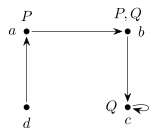
Before the numbers, a picture. A
world here is a few dots, the objects
of the domain, with some dots labeled or (the dots the one-place
predicates hold of) and arrows between dots (the pairs a
two-place predicate holds of: an arrow from
to means ).
Figure W. World W: domain ; holds of ; of ; is the four arrows.
Six readings, each checked dot by dot:
- : true; the witness .
- : false; the counterexample (or ).
- : false at , which has neither
label.
- : true at .
- : true; every dot has an arrow leaving
it (, , , ).
- : false; no dot receives an arrow from
all four (
receives from and
only).
In a finite world every quantifier can be checked dot
by dot. Over or
it cannot, and
the reading needs an argument, as the next subsection
shows.
Quick check. In world W, is true? Is true?
Solution. The first is true: holds of and , and both have an arrow
to ; at and the hypothesis is false, so the
implication holds. The second is true, with the witness
: no arrow ends at
.
A long “and”, a long “or”. When the
dots of a world can be listed, a quantifier is a
connective repeated. In world W, says the
same as , and the same
as . A counterexample to the first is a
false conjunct ();
a witness for the second is a true disjunct (). De Morgan’s law (Proposition 2.5.5),
used three times, then says that “not every dot has
” is “some dot
lacks ”: and . Over the conjunction would
never end, and no formula can write it down; that is why
the quantifiers get rules of their own.
Quick check. In world W, write
as a conjunction of four statements, one
per dot. Which conjunct is false?
Solution. . The first conjunct is false, since has and not . The other three are
true: has both
labels, and and
lack .
The
same sentence over different domains
A quantified sentence is a claim about its domain, so
changing the domain can change its truth value. Two
examples show how.
Take , “every is at least ”.
- Over it is
true: every natural number is at least
.
- Over it is
false: the integer is in the domain, and
is
false.
One element of the domain that makes false is enough
to make false. Such an element is a
counterexample. To show that the
sentence is true over , on the other hand,
we had to say something about every natural number at
once.
Take , “some has square ”.
- Over it is
true: the real number has square . (Its existence is a
school fact here.)
- Over it is
false: that no rational number has
square is exactly
Theorem 2.2.1.
One element that makes true is enough to
make true. Such an element is a
witness. To show that the sentence is
false over , on
the other hand, a theorem about every rational number
was needed, and Chapter 2 proved it by
contradiction.
The two quantifiers are mirror images. For , a single
counterexample refutes and a general argument confirms.
For , a
single witness confirms and a general argument
refutes.
Quick check. Over which of the
domains , , is the sentence
true? Give a witness where it is true, and a reason
where it is false.
Solution. Only satisfies , since
subtracting from
both sides gives . So the sentence is true over and over , with the witness
. It is false over
, which
does not contain :
every has , since . (Over it would be true, again with
the witness .)
Reading a
quantified sentence
Quantified sentences are read from the outside in:
the first quantifier governs everything after it, and
inside it may sit another quantifier, a connective, or a
predicate. Reading aloud slowly, one symbol at a time,
is the most reliable way to understand one. Here are
three, simplest first.
Example
(Reading three sentences)
Read each sentence aloud, say what it claims, and
decide whether it is true over the domain given.
- (a) ,
over .
- (b) , over .
- (c) , over , where is the
one-place predicate “ is prime”.
Solution. (a) “For every
, is at least .” The claim is about
every real number, and it is true: the square of a real
number is never negative (a school fact about signs:
is a
product of two numbers of the same sign, or ).
(b) “There is an such that for every
, .” Unpack from the
outside. The outer quantifier asks for one
natural number .
What must be true of it is the inside, :
every natural number is at least . So the sentence says
that has a
least element. It is true, with the
witness :
every natural number is at least .
(c) The outer symbol is , so the sentence
denies what follows. What follows is :
there is an that
is prime and such that every prime is at most . Such an would be a
largest prime. So the sentence says
“there is no largest prime”. It is true: this is the
ancient theorem that there are infinitely many primes.
Nothing in this book depends on that theorem; here it is
only something to read.
Notice the shape inside (c): , “every prime is at most ”, has an implication
under the .
It speaks about primes only, and the implication is how
a “for every” is restricted to them. The next subsection
makes this a rule of writing.
The sentence in (b) has two quantifiers, and they
come in a definite order: first , then . The order
matters, and the subsection “The order of quantifiers”
below is about it. First, restricted quantifiers.
Bounded
quantifiers
Mathematics rarely says “for every real number”. It
says “for every ”, “for every ”, “there is an
”. The
quantifier ranges over a part of the
domain, described by a condition. There is no new
quantifier for this; the condition is written into the
sentence with a connective. Which connective turns out
to matter.
A “for every” restricted to a condition is an
implication; a “there exists” restricted to a condition
is a conjunction.
Definition
5.1.1 (Bounded Quantifier)
Let be a set,
a variable, and
an open
sentence. The bounded quantifiers are
the abbreviations In the same way, for a term in which does not occur, stands for and for , and likewise
with , , in place of .
In words: “for every in , ” means “for every
whatsoever,
if is in , then
”. “There is
an in with ” means “there is
an that is in
and satisfies ”. The condition
, or , is the
bound. A bounded quantifier is not a
new symbol of the language: it is shorthand, and every
statement about it is a statement about the formula it
stands for.
↺Second readingThe
induction display, read again
The display after Axiom 4.2.1,
in Section 4.2, used as an abbreviation of the words “for
every natural number ”. It was already this
bounded form: stands
for .
Why
under , and
under . Try the
other choices and see what they say. Take the domain
, the set , and the
open sentence .
- “Every element of is greater than ” is false: is not. The correct
form is false too, with the
counterexample , which is in and not greater than
. The wrong form
says that every real
number is in and greater than . It is false as well,
but for a reason that has nothing to do with ’s elements: is not in . Change to and the correct
form becomes true while the wrong one stays false.
- “Some element of is greater than ” is false for . The correct
form is false too: no real number
is both in and
greater than . The
wrong form is true,
with the witness : since , the implication “if then ” has a false
hypothesis and is true (vacuous truth, the phenomenon
behind Proposition 2.1.2).
So a
with inside
claims too much: it says the whole domain lies in . An with inside claims too
little: anything outside is a witness. Neither
says what was meant.
Warning. An existential quantifier
with an implication directly inside, , is almost always a mistranslation. Over
, “some element
of exceeds
” is false, but
is true, because makes the
hypothesis false. When you write and then , check whether you
meant .
Mixing kinds of number. A sentence
of analysis often mixes real numbers and natural
numbers; the convention is to take the larger kind as
the domain and let the smaller kind enter as a bound, as
in , with a sequence read as a function
symbol , .
The empty set. Bounded quantifiers
make sense even when the bound is never satisfied. Let
be the
empty set, the set with no elements, so
that is false for every .
- stands for . For every , the hypothesis is false,
so the implication is true. The sentence is
true, whatever says. For
example, “every element of is greater than
” and “every
element of is less than
” are both
true.
- stands for . No makes the first
conjunct true, so the sentence is
false, whatever says.
Section 2.1 met this phenomenon for implications: a
statement whose hypothesis never holds is true, and says
nothing. A universal statement about the elements of an
empty set is true for the same reason, because there is
nothing to test. This is the reading; Section 5.4
derives the universal half with the rules.
Warning. Existential
import. “Every element of has property ” does
not imply “some element of has property ”. A “for every”
over a bound has no existential import: it does
not say that anything satisfies the bound. It fails when
is empty: “every
element of is greater than
” is true, and
“some element of is greater than
” is false. The
step from “every” to “some” needs an element, and the
bound can remove all of them.
The order
of quantifiers
A sentence with two quantifiers of different kinds
can change its meaning completely when they are swapped.
This is the single most important fact about reading
quantifiers, and the definitions of analysis depend on
it.
Example
(Swapping two quantifiers)
Over the domain , compare Read each aloud, and decide which is true.
Solution. (i) “For every
there is a with ”: every real
number has an additive inverse. It is
true. Given any real , the number satisfies .
(ii) “There is a such that for every
, ”: one single
number is an
inverse of every real number at once. It is
false. Whatever real number is proposed, take ; then . So no
works.
The two sentences have the same letters, the same
quantifiers and the same equation. Only the order
differs. In (i), the may be chosen
after is known, so it may
depend on : the
witness is a
different number for each . In (ii), must be chosen
first, once and for all, and then it
must work for every that comes after.
↺Second readingWhat
makes the pair work
What makes the pair work as an example? Two
properties, and any other pair with the same shape would
do as well. First, for each separately there is a
suitable . Second,
no one is
suitable for all
together, because each serves only one (here, only ).
Quantifiers as a game. Read a
sentence as a game between two players, the challenger,
who tries to make it false, and the defender, who tries
to make it true.
- Each is
a move of the challenger, who picks a value; each is a move of the
defender.
- The moves are made in the order the quantifiers are
written, left to right, and each player sees every move
made so far.
- When every variable has a value, the inside is
checked. The sentence is true exactly when the defender
can win whatever the challenger does.
Here are the two sentences of Example (Swapping two quantifiers),
played.
| first move |
challenger picks , say |
defender picks without knowing , say |
| second move |
defender answers |
challenger answers |
| check |
:
defender wins |
: challenger wins |
| who always wins |
the defender, with |
the challenger, with |
Read the dependency off the order: a variable may
depend on the variables quantified to its left, and only
on them. In (i), is to the right of
, so the choice of
may use . In (ii), is to the left, so it
may not. Sections 5.4 to 5.6 will show this same
dependence as a fact about the boxes of a
derivation.
Quick check. Over the domain , swap the two
quantifiers in “for every there is a prime larger
than ”, that is,
in . Read the result aloud. Is it true?
Solution. The swapped sentence is
: “there is a prime that is larger than
every natural number”. It is false.
Whatever is
proposed, take : then is false, so the inside fails. (The original
sentence is true; it is another form of the theorem that
there are infinitely many primes, which we do not use.)
As in Example (Swapping two quantifiers),
the original lets the prime depend on , and the swapped
sentence demands one prime for all at once.
↺Second readingWhen
swapping is harmless
When swapping is harmless. Two
quantifiers of the same kind may be
swapped. and both say that holds for every
choice of the pair; in the game, the challenger makes
both moves, and the order of the challenger’s own moves
gives nothing away. Likewise and both say that some pair
works. Section 5.4 derives the first swap with the
rules. For quantifiers of different
kinds, one direction is always safe: if one works for every , then for every some works (the same one).
Section 5.6 derives this, to , and Example (Swapping two quantifiers)
shows that the other direction fails.
Words that
hide quantifiers
English marks quantifiers loosely, and mathematical
English has habits that hide them altogether. Two traps
are worth naming now, before they cause trouble.
Warning. The word
“any” can mean “every” or “some”, and
only the sentence around it decides. “Any in is positive” means
every element of
is positive: . “If any in is positive, then is non-empty” means if
some element is positive: . When you meet “any”, rewrite the
sentence with “every” and with “some”, and keep the one
that says what was meant.
Hidden universal quantifiers. A
theorem stated as “if is even, then is even” has no
quantifier word in it, and yet it is not about one
number. It means: for every integer , if is even, then is even. A letter
that is not introduced anywhere, in the statement of a
theorem, is read with a “for every” in front. When
translating, put the hidden quantifier back first.
Keys and
locks
A domain with no numbers in it makes the shapes easy
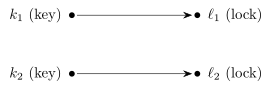
to see: the objects of a building, with : “ is a key”, : “ is a lock”, and :
“ opens ”. The table reads in
either direction;
is a constant, “the front lock”.
| every key opens lock |
|
under |
| some key opens lock |
|
under
|
| no key opens lock |
,
or |
two equally good forms |
| only keys open lock |
|
“only” turns the arrow round |
| every lock has a key that opens it |
|
every … some |
| some key opens every lock |
|
some … every |
Figure K. A building where every
lock has a key that opens it, and no key opens every
lock.
In this building the fifth sentence of the table is
true ( has
, has ) and the sixth is
false ( fails at
, at ). The sixth
implies the fifth, since a master key opens each lock,
so the order “some … every” says more, exactly as in Example (Swapping two quantifiers).
Quick check. Translate “no key
opens every lock”. Is it true in the building of Figure
K?
Solution. , or . It is true in the building of Figure K,
since does not
open and
does not open
.
↺Second readingTwo
slips with an implication inside “there
is”
“Some key opens lock ” is
not :
that formula is true in every building, since the lock
is not a key, so
itself makes the
hypothesis false. It
is the warning after Definition 5.1.1
again.
An implication inside . This is
the warning after Definition 5.1.1
once more, and it comes up in analysis: “there is an
such that, if
, then …” is
not the shape of “for every there
is such
that for every , …”, where the implication sits
under . The implication belongs under a .
What comes
next
We can read quantified sentences, and translate into
them. We cannot yet reason with them. Section 5.2 makes
the language exact, because every rule will put a term
in for a variable; Sections 5.3–5.6 give the four
rules.
Exercises
A. Check your
understanding
Exercise
(A1)
- (a) Read each
sentence aloud, and say over which of the domains , , it is true: (i) ; (ii) ; (iii) ; (iv) ; (v) .
- (b) With domain
, which of the
following translates “some element of is negative”? (i) ; (ii) ; (iii) . For each of the two others, say what it
claims instead.
- (c) What is the
arity of the predicate “”, and how many holes does “” have
left?
- (d) True or false,
with a reason: is true.
Solution. (a) (i) “For
every , is greater than
.” True over all
three domains: adding always gives a larger
number.
(ii) “There is an
with .” The only
solution is .
False over ,
which does not contain ; true over and , with the witness
.
(iii) “For every
there is a smaller than .” False over : for there is no natural
number .
True over and
: given , take .
(iv) “There is an
with .” The only
solution is . False over and , true over with the witness
.
(v) “For every
, is at least
.” True over : if , then ; if
, then . True over : an integer is either
at least , as
before, or at most , and then .
False over : the
counterexample has .
(b) (ii) is the translation (Definition 5.1.1:
under ). (i) is true as
soon as some real number lies outside , since that number
makes the implication vacuously true; so it can be true
when no element of is negative (for , say). (iii)
claims that every real number is in and negative, which is
false whatever is
(take ).
(c) It has three holes, , , , so it is three-place.
Filling with
leaves two holes,
and .
(d) True. It stands for . For every the hypothesis is false,
so the implication is true, even though its conclusion
is false
for every .
Exercise
(A2: Drill)
Answer each part in a line or two. Parts (a)–(d) are
about world W of Figure W, parts (e)–(i) about the
building with , and , and parts
(j)–(l) about numbers.
- (a) In W, is true?
- (b) In W, is true?
- (c) In W, is true?
- (d) In W, write
as a disjunction of four statements, one per dot, and
decide it.
- (e) Translate “every
key opens some lock”.
- (f) Translate “no
lock is a key”.
- (g) Translate “only
keys open locks”.
- (h) Translate “some
lock is opened by every key”.
- (i) Is (h) true in
the building of Figure K?
- (j) Over , translate “every
integer has a larger one”, and say whether it is
true.
- (k) Swap the
quantifiers of (j) and read the result.
- (l) Over , translate with
bounded quantifiers “some positive number is smaller
than every positive number”, and say whether it is
true.
Solution.
(a) Yes: holds of and , and , .
(b) Yes, at .
(c) No: no arrow
ends at .
(d) ; true, by the third disjunct (the
loop at ).
(e) .
(f) , or .
(g) .
(h) .
(i) No: is not opened by
, and not by .
(j) ; true, with .
(k) , “some integer is larger than every
integer”; false: defeats every .
(l) ; false: for any proposed , gives .
B. Practice
Exercise
(B1: Ordered quantifiers)
Determine which of the following sentences are true
over the domain given. Justify your answer: give the
witness a true asks for (as a
function of the earlier variables, if there are any), or
the counterexample that refutes a .
- (a) , over .
- (b) , over .
- (c) , over .
- (d) , over .
Solution. (a) True. Given
any natural number , the natural number
satisfies
. The
witness depends on , which the order
allows.
(b) False. The challenger chooses . Then forces , which is not a
natural number; every natural gives . So for no works. (For and the witnesses and do exist, so the
challenger must choose with care.) (Over the sentence would be
true, with .)
(c) True, with the witness : for every real
, . The
witness is chosen first and does not depend on , as the order
demands.
(d) False, with the counterexample : for every real
, ,
so no has .
Exercise
(B2: Order matters)
Give an example of a two-place predicate on the domain
such that is true and is false. Check both claims.
Solution. Take : “”.
is true. Given any natural
number , the
natural number satisfies .
is false. Whatever natural
number is
proposed, take : then is false. So no is greater than every
.
Any answer must have two properties, and a different
answer can be checked against them.
- Every
has a partner: for each there is at
least one with
.
- No is
a partner of every : for each
there is
at least one with
false.
For example, “” also works: each has the partner , and each fails to be a partner
of . So does
“”: each
is its own
partner, and each
fails to be a partner of . A predicate that does
not work is “”: property 1
holds, but property 2 fails, because is a partner of
every , so is true.
Exercise
(B3: Every and some on three numbers)
Let the domain be , with and as usual, and with
the constants naming its elements.
- (a) Write without quantifiers, as a disjunction of
conjunctions, and decide it.
- (b) Write without quantifiers, as a disjunction, using
De Morgan’s law, and say which disjunct is true.
- (c) Let be the set of elements
of greater than
. Decide and .
- (d) Give an example,
or explain why there is none: a domain and a one-place
predicate for
which is true and is
false.
Solution. (a) The sentence
is It is true, by the first disjunct: is a least element.
(b) is, by De
Morgan’s law (Proposition 2.5.5),
. The third disjunct
is true, since is false: “some element is not below ”, with the witness
.
(c)
is empty. The first is true: for every , the hypothesis is false. The
second is false: no is in .
(d) There is none. A domain has at least one
element (the convention of “Quantifiers and the
domain”), say ; if
is
true, then holds
of , so is a witness and is true.
The emptiness in (c) is the emptiness of a bound, not of
the domain.
Worked examples of these types: the long “and” of
world W; “The empty set” in “Bounded quantifiers”.
Marking scheme. (10 points)
- 3: (a), all nine atoms in the right places and the
verdict with its witness.
- 2: (b), De Morgan applied to a three-term
conjunction and the true disjunct named.
- 2: (c), both verdicts, each with the reason
(hypothesis false; no element).
- 3: (d), “none”, with the argument from a non-empty
domain; 1 of the 3 for an answer that separates the
empty bound of (c) from the domain.
Fatal error (0 for the part): an empty domain offered
as the example in (d).
C. Going deeper
Exercise
(C1: A least element)
Decide whether is true over each of
the domains ,
, and . Give the witness
where it is true, and where it is false show that every
proposed is
defeated by some .
Solution. The sentence says that
the domain has a least element: one
that is at most
every element .
Over :
true, with the witness . Every natural
number satisfies
.
Over :
false. Let
be any integer. The integer satisfies , so fails. No integer
is least.
Over :
true, with the witness . Every satisfies
, by the
definition of the interval.
Over :
false. Let , so . The number satisfies , so and ; hence fails. The defeating depends on the proposed
, which is
allowed, because in the game the challenger chooses
after seeing
.
The last two domains differ by a single point, , and that point is
exactly the least element of . Removing it
leaves a set with no least element, although every
element of
is still at least . Analysis on the
Real Line, Chapter 1 returns to this distinction
between a least element and a greatest lower bound.
Exercise
(C2: The wrong connective)
Take the domain .
- (a) The sentence
“every element of
is positive” is mistranslated as , and “some element of is positive” as . For each mistranslation, give a set for which
it has a different truth value from the English
sentence.
- (b) Show that the
first mistranslation is false for every
set , and the second is true for
every set . What does this say about how
much each one tells us about ?
Solution. (a) Take for the first.
“Every element of is positive” is
true. The mistranslation claims that every real is in and positive; is neither, so it
is false.
Take
for the second. “Some element of is positive” is
false, since its only element is negative. The
mistranslation is true, with the witness : since , the
implication “if , then ” has a false hypothesis and is true.
(b) For the first, let be any
set. The real number does not satisfy , so it does not
satisfy , whatever is. It is a
counterexample to the , so the sentence
is false.
For the second, let be any set, and consider the real
number . The
conclusion
is true, so the implication is
true whether or not . Hence is a witness, whatever is, and the sentence is
true.
So neither mistranslation tells us anything about
at all: the first
is false and the second is true, whichever set is. A sentence whose
truth value does not depend on cannot express a
property of . This
is the precise sense in which the wrong connective
“claims too much” under and “too little”
under .
Marking scheme. (10 points) - 2: a
set for the first mistranslation, with both truth values
checked. - 2: a set for the second mistranslation, with
both truth values checked, and the implication at the
witness justified (its hypothesis is false, or its
conclusion is true). - 3: for the first, for an
arbitrary , a real
number (the same for every , or chosen by cases
covering every )
that fails , with the check. - 3: for the second,
for an arbitrary ,
a witness (the same for every , or chosen by cases
covering every )
at which holds, with a reason that covers every (its conclusion is
true, or a check in every case). Fatal errors (0 for the
step): a witness or counterexample that depends on in (b) without a case
split covering every ; reading as “some element of is positive”.