Chapter 5 opened with a question. Continuity and
uniform continuity differ only in where one quantifier
stands; why does one imply the other in a few lines,
while the converse is false? Section 5.1 gave the
informal answer: a variable may depend on the variables
quantified to its left, and only on them. Exercise (C1: Where the stands)
of Section 6.1 asked for both translations into
formulas, and Section 6.2 negated uniform continuity (Example (Three negations from analysis)
(c)). This section answers the question with the rules.
It derives “uniformly continuous implies continuous” in
full, line by line, with the bounded rules of Proposition 6.1.1.
It then reads off the derivation the one thing this
section adds: which boxes are open where a
constant is chosen, and what that says about
what the constant may depend on. The same reading
locates the exact lines at which the converse breaks
down, and the function shows that the
converse is not merely unproved but false.
Two
definitions that differ in one place
Let be a set
of real numbers and a function defined on
. We work over the
domain , with
a one-place
function symbol, a one-place predicate symbol (Section 5.2),
and the
absolute value. Here the two definitions are only
quantifier patterns, and nothing is
used about except
that is a
term. (A function symbol has a value at every real
number; the values outside are never used, because
is only applied
to variables bounded by , as with sequences in Section 5.1.)
is
uniformly continuous on (UC) when
is
continuous at every point of (C) when
The two formulas have the same matrix and the same
four bounded quantifiers. Only has
moved: in C it stands before , in
UC after it. In the game of Section
5.1, the defender chooses in C after seeing
and , and in UC
after seeing only . So in UC a
single must
serve every point of at once: that is what
uniformly means.
Quick check. Swap the first two
quantifiers of UC, to get . What does the new formula say
about two points of closer than ? Does on satisfy it?
Solution. Now is chosen before
, so it
must work for every at
once. For two points with , this says for every , and
by Proposition 6.2.5,
. So the
formula says: for some , any two
points of closer
than have
the same value. The function on fails it: whatever
is
proposed, the points and are closer than
and have
different values. Yet is uniformly continuous, with .
Swapping and asks far
too much.
The
skeleton first
Hold
fixed, and write for “ works at ”, the formula . Drop the bounds on and for a moment. Then UC
at this
says , one for every point,
and C at this says , a for each point.
The step from the first to the second is Proposition 5.6.2
with other letters:
1
2asm, for
3 2
4 3
5 1, 2–4
6 2–5
Fix a point, obtain the one that works
everywhere, choose it for this point. The converse, from
to , is the swap whose
search stalled in Section 5.6. The rest of this section
puts
and the bounds back and writes out. That costs five
lines: the premise UC itself (line 1), the assumptions
, and
(lines 2, 3 and 5), and the line that closes the box of
(line
10). The skeleton’s line 1 becomes line 4 of the
derivation below (UC at ), its lines
2–5 become lines 6–9, and its line 6 becomes line 11,
which closes the box of .
Quick check. Why may line 5 of the
skeleton close the box of ?
Solution. does not appear
in line 5, , nor in the existential of line
1, which is also the only premise, and the one box still
open, that of ,
has no assumption. Every clause of
holds.
The
derivation
Idea. Run the search method of
Section 6.3. The goal C begins , then
: the goal-directed steps
open two bounded
boxes, “let ” and “let ”,
and write the last two lines. The new goal begins ,
and no witness is in sight, so it is
postponed (Section 5.5). Turn to the
premise UC. It begins , and the term the goal mentions is , whose
bound is on a line: at
(Section 5.3). That gives an
line, and its box
is opened at once, with a witness (Section 5.6),
aiming for the postponed goal as its last line. Inside,
the premise has become “ works for all
”;
instantiate it at the point we have, . Now the postponed
goal has its witness: itself.
Before reading on: which lines does the line
introducing rest on, and
does any of them mention ?
Solution.
1
2asm, for
3asm, for
4 1, 3
5asm, for
6asm, for
7 6, 2
8 5, 7
9 4, 5–8
10 3–9
11 2–10
Every line is tagged with its rule; lines 4, 7 and 8
are the one-line bounded rules, and lines 9, 10 and 11
close bounded boxes. The terms and the side
conditions:
- Line 4: at
, with
its bound on line 3. The term is a
variable that does not appear in line 1, so it is free
for .
- Line 7: at
, with its bound
on line 2, which is available because the box of line 2
is still open.
- Line 8: with
the witness , its bound on
line 5 and the instance on line 7.
- Line 9 (,
flag ):
does not
appear in line 9 (the witness was forgotten at line 8),
in line 4, in the premise, or in the assumptions still
open at line 9, lines 2 and 3.
- Line 10 (,
flag ): does not
appear in the premise, in line 10, or in the assumption
still open at line 10, line 2.
- Line 11 (,
flag ): does not appear in
the premise or in line 11, and no assumption is
open.
The answer to the prompt: line 5 is the assumption of
the box, so it rests on line 4, which rests on
lines 1 and 3. None of the three mentions . The witness was obtained
from the premise at alone,
before played
any part. That is uniformity, read off the lines.
The derivation has 11 lines. Written with the
unbounded rules it has 17, since each of its six bounded
steps (lines 4, 7, 8, 9, 10 and 11) costs one line more
(Section 6.1). The bounded rules keep it at the level at
which a mathematician thinks, and the same argument in
prose is three sentences, each aligned with the lines it
abbreviates:
Let and
[lines 2, 3, 10, 11]. By uniform continuity there is
such
that implies for all ; choose such a
[4, 5, 6,
9]. Applied with , this gives for every with ,
so this
works for and
[7,
8].
The prose renames the bound variables of UC to , so that “” can name the fixed
point; a derivation needs no such care, because
handles bound variables by substitution.
Reading
dependence off the boxes
The derivation shows something the informal proof
leaves unsaid: the exact place where is chosen, and
what surrounds it there.
A constant chosen in a box may depend on the
names of the boxes open around that box, and it does
depend only on the names in the line it comes
from.
Quick check. In the derivation
above, which flagged boxes surround the box of , opened at line
5? What may therefore depend
on, and what does it in fact depend on?
Solution. The boxes of (opened at line 2)
and of (opened at
line 3). So may depend on
and on , as C
allows. In fact it depends only on : it comes
from line 4, which mentions and not
.
Why “may”? Inside the boxes of and , every term
built from and
is
available, so a premise could have been instantiated at
such a term, and a witness obtained from the resulting
line would
depend on both names. The side conditions permit that
here, because the goal C puts inside
both ’s: the
witness is forgotten by
(line 8) before either box closes. Why “does”? Because
everything known about is what its
line says,
and line 4 mentions alone.
↺Second readingChoosing
the delta before the point
So
could have been obtained before entered at all: fix
,
obtain ,
and only then let . That is the order of UC itself. A derivation
in that order nests the boxes as , , (the box of rests on line 4,
so it stays inside the box of ), and it
ends in , which is C with its
first two quantifiers exchanged. C follows by exchanging
them back, as in the swap of Example (Flagged boxes at work)
(c), here with the bounded rules: boxes for and ,
at and then at
, and two
lines. C’s order of choices allows more dependence than
this proof uses.
The limit derivation of Section 6.1 showed the same
thing on a smaller scale: its witness came from a line
obtained at , inside the box of only, and
so it depended on .
The
converse breaks at a side condition
The converse, from C to UC, is the interesting
direction. The search for it fails, and the failure has
an exact address.
Example
(The search from C to UC)
Run the search method on the sequent with premise C
and goal UC, and find where it stops.
Try it first (ten minutes): start the search.
Where does a
come from, and at what moment can you get one?
Idea. The obvious plan copies the
derivation above: fix , obtain
from the
premise, choose it as the witness. It runs into an
obstacle at the second step. In C, stands
behind , so to reach it the premise must first be
instantiated at a point, and the bounded
needs a line . No such line exists until we assume one, in
a box for some .
The
obtained inside that box comes from a line that mentions
, and both side
conditions then hold it in: it cannot leave its own box
while a line about it still mentions it, and cannot be generalized
while a line about still mentions
.
Solution. The goal UC begins , so open a box for . The new
goal is postponed. The premise C begins
,
and no line
is available; the only way to get one is to assume it,
so open a bounded box “let ”. Then the
premise yields a . Here is how far
the search gets, every line legal:
1
2asm, for
3asm, for
4 1, 3
5 4, 2
6asm, for
7asm, for
8 6, 7
9 5, 6–8
10 3–9
11 2–10
The goal inside the box of needs a
that works
for all points: the line , so that at
could
finish. Line 7 says this only for the point . There are two ways
to try to generalize it, and each is stopped by a side
condition.
- Generalize inside the box of . After
line 7, open a new flagged box with the name and the assumption
, repeat
line 7 in it, and close it by with
the conclusion . That line breaks the side condition of
:
appears in assumptions still open there, line 3 and line
7. (With a different name the box is legal, but
line 7 says nothing about , so the box cannot
reach its last line.)
- Leave the box of first, carrying
line 7. Close the box
with line 7 itself as its conclusion, in order to
generalize over
outside it. That line breaks the side condition of : its
conclusion mentions the witness .
The only legal way out of the box of is to forget
, as line 8
does with before line 9 closes the box. Then on
is legal, and
line 10 is what it gives: , with still behind . That is C at again, not
UC, and closing the box of gives line
11, which is C with its first two quantifiers exchanged.
The search has gone round in a circle.
These are the same two blocks that stopped the
converse of Proposition 5.6.2:
a blocked by an open assumption that mentions
its name, and an box
that cannot close on a line mentioning its witness. That
is no coincidence: with the bounds and the matrix
stripped away, C to UC is the swap to .
A failed search proves nothing about all derivations;
a counter-reading does, and the next subsection gives
one: a function for which C is true and UC false.
Section 7.2 explains why that settles the question.
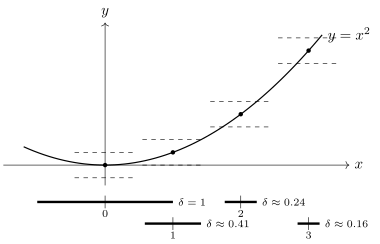
Here is the picture first; the example proves it.
With , the largest that works at
is : at , about at , at , at . It shrinks as grows, and no single
positive
works at every .
Solution. C holds. Let
and . Let
which is positive, since and
. It depends on and
on . Let
with
. By the triangle inequality (Example (The triangle inequality by cases)),
used twice, and since , , so
. Hence where the strict step uses , and
the last step uses . So this works for and .
UC fails. By the negation of uniform
continuity in Example (Three negations from analysis)
(c), with the bounds and dropped because they always hold, we must
show Take . Let be arbitrary, and take and
, which depend on . Then , and, since (so and are both positive),
Since was arbitrary, UC
fails.
The for C
grows smaller as grows, and no
single
serves the whole line. The proof of failure says why:
however small is, far enough out
(at )
the graph is so steep that two points apart have
values more than
apart. Read in the real numbers, with as squaring, the
premise C is true and the conclusion UC is false: a
counter-reading, and by Section 7.2 no derivation of UC
from C exists.
Warning. “Depending on
” is a
claim, and it can be false. When a proof says
“choose
(depending on )”, the
parenthesis records which boxes are open where is chosen, and
which names its formula uses. This is the logical origin
of the book’s rule that every chosen constant says what
it depends on: the dependence is a record of the open
boxes, and a reader can check it. A proof of uniform
continuity must be able to write “depending on ” truthfully.
A “proof” that
is uniformly continuous on that takes “(depending on
)” has a
formula for
that mentions :
the was
chosen inside the box of , so the proof shows
only C, and Example (The square function on the real line)
shows that UC is false.
The proof that UC fails for established, with
numbers, the positive form of the negation from Section
6.2. That form, taken before its last order fact,
refutes UC by logic alone, and a derivation shows how;
one TAUT line (Section 6.3) carries its propositional
core.
Solution.
1
2asm, for
3asm, for
4asm, for
5 2, 3
6asm, for
7asm, for
8 4, 6
9asm, for
10asm, for
11asm, for
12asm, for
13 7, 9
14 13, 11
15 12, 14
16 10, 11–15
17 8, 9–16
18 5, 6–17
19 1, 3–18
20 2–19
Line 15’s propositional skeleton is , so the line replaces
twice, and
,
four lines. The boxes on the witness lines 5, 8 and 10
are opened as soon as those lines exist, the move “name
the witness early” (Section 5.6), which Section 6.3 puts
first. Every closing line’s witness (, , , ) is absent
from , from the
line it
cites, from the premise, and from the assumptions still
open.
Witness
functions
UC says that for every some
works
for all points. A rule that picks such a for each is a
function, : a
witness function for UC. For on , works, since when .
For C the witness may depend on the point too: .
For , Example (The square function on the real line)
gave .
A derivation shows which arguments a witness function
needs. A witness obtained inside the boxes of and may be a function of
both, and one obtained inside the box of alone is a
function of alone. “May
depend” and “does depend” are exactly the two readings
of “Reading dependence off the boxes”. So UC holds when
some witness function for C ignores its point argument,
and the derivation of Example (Uniformly continuous implies continuous)
does the reverse: it turns a for
UC into a for
C, one that ignores .
In the game of Section 5.1, a witness function is a
strategy for the defender: a rule that answers every
challenge, and the defender wins by following it.
A formula of this book cannot say “there is a
function”: its variables range over numbers. A function
symbol can stand for one chosen function, and that is
how Sections 5.1 and 6.1 wrote sequences.
A tempting “proof” of the converse tries to build a
witness function for UC out of one for C, by taking the
smallest of its values.
Example
(A “proof” that continuity gives uniform
continuity)
Find the error in this argument, which claims that
every function continuous at every point of is uniformly continuous
on .
Let . For each , continuity at gives with
whenever and . Let be the smallest of
the numbers . Then , and it
works at every point, so is uniformly
continuous.
Solution.
- The conclusion is false for on (Example (The square function on the real line)),
so some step fails, and it is the third sentence.
- Infinitely many positive numbers need not have a
smallest, and they may come arbitrarily close to . With , the
largest that
works for at
is (the
figure above), which is for , and so smaller than any given positive
number once is
large.
- In the rules: each is the witness
of an box inside the box of , and “the smallest of
them” would be a line about all the witnesses at once.
Using it needs a that works at
every point, the line whose
two routes Example (The search from C to UC)
found blocked by side conditions.
- For finite the proof is right: uses of give
(the subsection “Two witnesses” of
Section 5.6, repeated), and works at every point.
The search stalls at the same side condition that
stopped Example (The search from C to UC);
that is a
counter-reading for the converse is the evidence that no
other route exists (Section 7.2).
Quick check. For which sets does the step “let
be the
smallest of the ” make sense, and
give a positive ?
Solution. For finite non-empty
. Finitely many
positive numbers have a smallest, and it is positive.
For empty , UC
holds outright, since its is
vacuous.
Exercises
A. Check your
understanding
Solution. (a) Line 7 is
the bounded at
the term . It
cites line 6, , and line 2,
, the
bound’s instance. Line 6 is the assumption of the box
that contains line 7, and line 2 is the assumption of
the box of ,
which also contains line 7; both boxes are still open at
line 7. The term is a variable not
appearing in line 6, so it is free for .
(b) At line 7, at the term . Line 6 says that
works for
all pairs of points of , and line 7 uses that
for pairs with first point .
(c) Uniform continuity at supplies one
that works
for all points at once, and it is supplied before any
point is named. Continuity at a point then takes that same
, specialized
to the point .
(d) Line 4 says that some works at
, and
line 8 hands C that witness , whatever it is;
the derivation knows only lines 5 and 6 about it. Here
is such a witness (so is any with ). Reading the derivation with
the witness the exercise names, , the handed to C is
.
It does not depend on . It works: for every
real with ,
Solution.
(a) .
(b) .
(c) Line 9, .
(d) Line 3: 2,
at . Line 4:
3, with witness .
(e) The bounded
, 3–9.
(f) No. That
needs the line , and
that line needs over
while an open
assumption about mentions : the side condition
of .
(g) , since when .
(h) .
(i) .
(j) .
(k) moves to
the right, past . Passing is harmless (two ’s exchange);
passing is the swap that fails.
(l) The witness
function is :
1asm, for
2arith
3 1, 2
4 1–3
B. Practice
Solution. The goal UC begins : open a box for . The new
goal is postponed until a witness is in hand.
The premise begins : open its box
at once, with a witness , aiming for the
postponed goal, which does not mention . Work backwards from
what the boxes for and will need: from we want , and the premise gives when . So is the natural guess, but is allowed and
then is
undefined. Take instead: , and
.
1
2asm, for
3asm, for
4asm, for
5arith 2, 3
6asm, for
7asm, for
8asm, for
9 4, 6
10 9, 7
11arith 2, 3, 8, 10
12 8–11
13 7–12
14 6–13
15 5, 14
16 1, 3–15
17 2–16
Line 11 is arithmetic from lines 2, 3, 8 and 10:
, where the second step uses , and with
gives .
Line 15 is the bounded at
the term , with its bound on line 5. At line 16,
does not appear
in line 16 (the witness term was forgotten at line 15),
in line 1, which is the premise, or in the assumption
still open there. At lines 13, 14 and 17 the
flags , , do not
appear in the premise, in the line itself, or in the
assumptions then open (among lines 2, 3, 4 and 6).
In prose: Let be a constant with for all . Let , and let , which is positive and depends on (and on the
constant , which
is fixed before ), but not on
any point. For with , . So is uniformly continuous
on . The box
of is open
where is
chosen, so
may depend on .
That is harmless: is a constant of the
function, not a point, and its box could as well have
been opened first, outside the box of .
Solution. An admissible order: (v),
(viii), (iii), (vi), (x), (i), (ix), (iv).
- (v) is the
hypothesis of the implication being proved, so it opens
the proof (its box is
the outermost one). After it, other orders are
admissible as long as each sentence comes after what it
uses. (vi) uses the of (iii); (x)
uses the of
(vi) and the of
(viii); then (i), (ix), (iv) follow in that order. So
exactly three orders are admissible: (viii), (iii),
(vi); or (iii), (viii), (vi); or (iii), (vi), (viii),
each preceded by (v) and followed by (x), (i), (ix),
(iv). Only the first matches the derivation of Example (Uniformly continuous implies continuous)
directly. The second and the third fix before ; the third even chooses
before any
point is given, which is possible because uniform
continuity supplies from alone. They
correspond to variants of that derivation in which the
box of (in the
third, also that of ) is opened
outside the box of . Both variants end in
, and C follows by exchanging
the two bounded universal quantifiers (the swap of Example (Flagged boxes at work)
(c), with the bounded rules); sentence (iv), “since
and
were arbitrary”,
covers both steps in prose.
Distractor (ii) introduces as an arbitrary
object, by . But in “continuous at ” the is under : the proof must
produce it, by a choice from the
hypothesis, not receive it from a challenger. A proof
that took
arbitrary would have to show that every works,
which is false in general.
Distractor (vii) chooses and only
afterwards lets
be arbitrary. It looks legitimate, because when (vii) is
read after (viii), is already fixed, and
continuity at
does allow
to depend on . But
the sentence reverses the order of the two steps: a
fitted to
one particular is
followed by “let
be arbitrary”, which claims that the same works for every
. In the rules: if
really was
chosen for this ,
its box assumes a line that mentions , and generalizing over
while that
assumption is open breaks the side condition of , the
first blocked line of Example (The search from C to UC).
If does not
depend on , as
here, then “for this ” is idle and the
sentence should be (vi).
Solution. Let , and
let , which is positive and depends on
only.
Let with . Then, by the inequality given
and because the square root is strictly increasing on
, Since
and were
arbitrary, this works for all
pairs of points; since was
arbitrary, is
uniformly continuous on . The was chosen before
the points: in a derivation of this proof, its line
would lie inside the box of only.
Solution. (a) , which depends on only. Let
with
. By the triangle inequality (Example (The triangle inequality by cases)),
and , so and ; hence .
(b) . For , , so if , then It depends on and on the
bound of the set,
and on no point.
(c) On , has no bound,
so no constant can replace the , and Example (The square function on the real line)
shows that no witness function exists there at all.
Marking scheme. (10 points) - 3:
(a), with proved (for instance
by the triangle inequality twice). - 4: (b): 1 for the
bound , 2 for the chain, 1 for the dependence. - 3:
(c). Fatal error (0 for the step): a “witness” that
mentions or .
C. Going deeper
Solution (Hint 1). The goal asks
for a . Which
hypothesis can produce one, and at which positive number
should it be applied?
Solution (Hint 2). “By the uniform
continuity of ,
applied to ,
choose such that …”
Solution. The move is fix,
obtain, choose: was fixed
(),
obtained from the hypothesis on ( at
, then
); now obtain from the
hypothesis on at
the term the goal needs, ( at
, then ),
and choose that as the witness
().
Completion. Since , the uniform
continuity of ,
applied to ,
gives
such that implies for all ; choose such a . It depends on
, hence on
, and on
no point. Let with . Then , and , so the choice of , applied to and , gives . Since were arbitrary, this
works for
all pairs of points of ; since was
arbitrary, is uniformly continuous on .
Marking scheme. (10 points) - 2:
names the move (fix, obtain, choose), or the rules at
, ,
. - 3: applies the uniform continuity of
at (not at ), using , and chooses
before any
point. - 3: for arbitrary with , gets and then , using . - 2:
concludes with the quantifiers in the order , , points, and says
depends on
only.
Fatal errors (0 for the step): chosen after or depending on ; the uniform continuity
of applied to
points not known to lie in .
Solution (Hint 1). For (b), the two
sets share the point . Two points on opposite
sides of are each
close to .
Solution (Hint 2). For (b), apply
the two hypotheses at and take
.
Solution. (a) On , is constantly , so every works for
every : . The same holds on
, where
is constantly
. On we prove the negation
of uniform continuity (Example (Three negations from analysis)
(c)). Take . Let , and let , ,
. Then , so ; , so
; ; and . So is not uniformly
continuous on .
The gluing fails because the two sets come arbitrarily
close at but have
no point in common: points close to on opposite sides are
each controlled only by their own set, and no common
point links them.
(b) Let . By
the uniform continuity on at , choose
such that for all with ; likewise choose for . Let , which depends on only. Let
with
. There are three cases.
- Case 1: . Then , since .
- Case 2: . The same, with .
- Case 3: one point in each set, say and (the other way
round is the same with the letters exchanged). Then
, so
, and
; hence
. Likewise and , so . By the triangle
inequality (Example (The triangle inequality by cases)),
Every point of
lies in or in
, so the cases
cover all pairs. So is uniformly continuous
on . The common
point is what (a)
lacked: there,
and came
arbitrarily close at but had no point in
common.
Marking scheme. (10 points) - 3: (a)
uniform continuity on and on checked, and the
negation on
proved:
first, then for arbitrary two points
depending on , with all three
conditions checked. - 2: (b) for at some and
for at some with
(the solution
takes ), and , depending on only. - 2:
the cases with both points in one set. - 3: the mixed
case, through the point , with justified and the triangle
inequality cited. Fatal errors (0 for the step): a depending on or ; the mixed case
omitted; in (a), points chosen before .
Solution. (a) The goal is
a : open a
flagged box for . The premise is an
: open its
box at once, with a witness , aiming for the
goal’s instance. Inside, take the conjunction apart,
instantiate at ,
and choose as
the witness:
1
2asm, for
3 2
4 2
5 4
6 3, 5
7 6
8 1, 2–7
9 2–8
- Line 8 (,
flag ): does not appear in
line 8, in line 1 (the premise), or in any assumption
still open at line 8 (there is none: the box of has no assumption).
Line 7, the last line of the box of , is a line of that
box itself and is the formula that line 8 repeats (Definition 5.6.1).
- Line 9 (,
flag ): does not appear in
the premise or in line 9, and no assumption is open.
Line 8, the last line of the box of , is the instance at
of .
The other nesting, with the box of inside the box of
, works too:
at the end of the inner box (its name is in no open
assumption, since the assumption on line 2 does not
mention it), then on a
conclusion without .
(b) Take a domain with two elements , ; let be true of both, and
let mean
“ is ”. The premise is true:
for the
witness has
and , and for the witness works. The
conclusion is false: fails at , and fails it at . The witness in the premise depends on ; the conclusion asks
for one that
serves every .
(Section 7.2 makes this informal reading a structure,
and shows that it proves the converse is not
derivable.)
Marking scheme. (10 points) - 2: a
flagged box with a fresh name for the ,
closed correctly. - 3: an box
with a fresh witness , whose conclusion
does not contain , with the side
condition checked. - 2: ,
at
and with the witness , with the correct
terms. - 3: the two-element reading: domain, meaning of
and , the premise checked
for each and the
conclusion refuted for each . Either nesting of the
two boxes earns full marks. Fatal errors (0 for the
step): on a name that appears in an open
assumption; an
conclusion containing the witness.
R. Review
Solution. The goal is a : open a flagged
box. The premise is instantiated twice, at the flag and
at the compound term , the term the
goal’s instance contains.
1
2 1
3 1
4 2, 3
5 2–4
Line 3 instantiates at , which is free for
. Line 4 is
transitivity, Proposition 5.7.1
(b), written as its one step: the
equation of line 2 rewrites the last of line 3. At line
5, is not in
the premise or in line 5, and no assumption is open. The
method is Section 5.3’s “instantiate at the term you
need”, here a compound term, with the equality of
Section 5.7.
Solution. A list is inconsistent
when is
derivable from it (Definition 3.2.1).
The derivation below uses no : three
boxes give ,
and , and each is used in whichever of its two forms (Definition 2.4.1)
the line needs.
1
2
3
4asm, for
5 1, 4
6asm, for
7 3, 6
8 4, 7
9 6–8
10 2, 9
11 10, 5
12 4–11
13 3, 12
14asm, for
15 2, 14
16 13, 15
17 14–16
18 1, 17
19 18, 12
A TAUT line (Section 4.8) would do it in one step,
since the three formulas have no row that makes them all
true: an odd cycle of “is the negation of” is
impossible.
Solution.
1
2asm, for
3 2
4asm, for
5 4
6 5
7asm, for
8 7
9 8
10 3, 4–6, 7–9
11 1, 2–10
Line 3, justified by TAUT on the skeleton , is the
propositional law Proposition 1.6.1
of Section 1.6; citing it as a derived rule (Definition 2.3.1)
gives the same line. At line 11, is not in line 11 or
in line 1, the premise, and no assumption is open. The
quantifier steps frame the law: this is the
propositional core of Section 6.3.