1.3 Using an Implication: Modus Ponens
Section 1.2 gave the two rules for “and”. This section gives one rule for “implies”: the rule that uses an implication already in hand. Proving one needs a new device, the subject of Section 1.4; using one is what a proof does every time it applies a theorem. The work is to see exactly what the rule allows, and to find chains of implications forwards and backwards.
1.3.1. Four cards
Before the rule, a puzzle about what “if … then” says.
Each of four cards has a whole number on one side and
a color on the other. They lie on a table showing
Solution. For each card, try to break the claim: can its hidden side make a card that is even and not red? (By the promise reading of Section 1.1, that is the only way to break it.)
The card showing
The card showing
The red card. Its color is the conclusion of the implication. If its number is even, the card fits the claim; if its number is odd, the card still fits, since the claim says only what even cards look like and nothing about which cards are red. No hidden number can contradict the claim. Leave it.
The green card. If its number is even, it is an even card that is not red, and the claim is false. This card must be turned.
So the answer is the
Two of the cards show the two ways an implication
meets a case: the
1.3.2. The rule
An implication fires on its hypothesis, and gives its conclusion.
This rule is called
We read it in four bullets.
- Two given lines. One line is an
implication
- Read
- The hypothesis must match exactly.
Line
- The new line is the whole
conclusion. The rule writes
The citation lists the implication first and its
hypothesis second, always: “
Second readingA legal, useless line
The statements
Why this rule. It is what “by Theorem
so-and-so” means. For integers
Every application of a theorem has this shape: check the theorem’s hypotheses, assemble them into exactly the theorem’s hypothesis, and fire.
Quick check. To get “
Solution. The conjunction
Why it is safe. If
Why nothing more. From
Warning. Affirming the consequent
looks like modus ponens and is not. Let
Quick check. Line 1 is
Solution. From line 1 and
The hypothesis can itself be an implication, and then the brackets put it on the left.
Quick check. Line 1 is
Solution.
Remark. At this point an
implication can be used but not
proved. A derivation can write an
implication only by taking it out of a line that already
contains it:
Second readingA rule is not one more premise
Picture a reader who grants both “if
So
1.3.3. Chains of implications
With
Forwards, from the premises. An available
implication (for now, one on an earlier line) whose
hypothesis is also available can fire:
Backwards, from the goal. Suppose the goal
is
The two directions meet in the middle, when a line
reached forwards is a goal reached backwards. In written
mathematics the backward step has a standard phrase, “to
show
In the Givens/Goal table,
Quick check. The premises are
Solution. Two premises have
conclusion
A picture shows the search at a glance. Draw each statement as a dot and each implication as an arrow from its hypothesis to its conclusion. Forwards, follow the arrows out of what you have; backwards, follow the arrows into the goal.
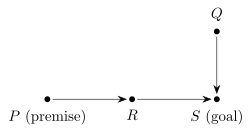
Backwards from
Give a derivation of each sequent.
- (a)
- (b)
- (c)
- (d)
- (e)
Solution.
- (a) Idea.
There is nothing to choose: the premises are an
implication and its hypothesis, and the rule fires once.
123
This is the form of the two short arguments at the start of “The form of an argument” in Section 1.1 (
- (b) Idea,
forwards. The premise
Idea, backwards. The goal
Both searches write the same five lines, the forward one from the top and the backward one from the last line up. Exercise B3 has a case where the backward search is much shorter.
- (c) Idea.
The goal
Line 6 is the first line in this chapter where
- (d) Idea.
This time the goal leads. The goal
Compare (c). There the implication took its two hypotheses one at a time,
- (e) Idea.
Both ends at once. From the goal:
Each derivation in the example is a box-free
derivation (Definition 1.2.2)
with
1.3.4. Checking a line of modus ponens
Finding a chain can take some searching; checking one
never does. For a line justified “
- Are lines
- Is the main connective of line
- Is line
- Is this line exactly
Here is the check run on lines 5 and 6 of (c), and on
a tempting wrong line that might replace them, “
| Line | Cites | Line |
Line is |
|
|---|---|---|---|---|
| 5: |
2, 3 | yes ( |
yes | |
| 6: |
5, 4 | yes ( |
yes | |
| wrong: |
2, 4 | no ( |
no ( |
The wrong line fails twice: it feeds line 2 the wrong
hypothesis and takes out a part of the conclusion. The
main connective settles it: the first
1.3.5. Two chains about numbers
The chains so far were made of letters. Here are two made of facts about numbers, one found forwards and one backwards. In both, the premises are true school facts, and the work is to see which implication fires on what.
- (a) Let
- (b) Let
Solution.
- (a) The
premises. Each implication is a fact about every
integer. If
Idea, forwards. Fire every implication whose hypothesis is in hand. Only the second premise can fire at first, on
Then lines 6–8, written forwards:
123456The finished derivation:
123456Read back, the twelve lines say: if
- (b) The
premises. Each is true for all real
Idea, backwards. Two premises end in the
goal. The last one makes
Then the subgoal read off premise 5:
The finished derivation:
Premise 6 is true and never cited. A true premise can still be a dead end: what decides a backward search is whether the subgoal can be reached, not whether the implication is true.
Quick check. In (b), why is premise 6 never fired?
Solution. Its hypothesis
1.3.6. How this looks in a mathematical proof
Let
- if
- if
A written proof that
Each piece of the sentence is one line.
| Line | Sentence |
|---|---|
| 3 | “Since |
| 4 | “… we have |
| 5 | “… and so |
The sentence never mentions lines 1 and 2: writers
leave a known implication unstated. Each “since
1.3.7. Common errors
The first warning of this section was about the wrong given line: the conclusion in place of the hypothesis. Another common error is a hypothesis that is only partly there.
Warning.
Second readingThe same slip in analysis
This is the commonest slip in analysis: “
A near relative is a hypothesis in the wrong order,
as in the third bullet of the rule’s reading:
Warning. A third error: firing an
arrow that is not the whole line.
1.3.8. The rule card
Before the card, the rule at work on large
statements. Each row is one use of
| The implication | The hypothesis line | New line | ||
|---|---|---|---|---|
Not an instance. From
The card of Section 1.2 grows by one row. Shape shows the given lines, then the new line; You write is the phrase a written proof uses for the rule.
| Rule | Shape | You write | Lean |
|---|---|---|---|
| “We show |
constructor |
||
| “In particular, |
h.1 (and h.2) |
||
| “Since |
exact h hp |
In the Lean column, h is the implication
and hp the proof of its hypothesis;
h hp applies the one to the other, which is
modus ponens.
Warning (Not allowed:
- “
- “
- “
- “
- “
Remark (Looking ahead). Chapter 4
proves more than “affirming the consequent is a bad
form”: no derivation, however long, works for every
choice of
1.3.9. Exercises
A. Check your understanding
- (a) Write the schema
of
- (b) Lines 1 and 2 of
a derivation are
- (c) In Example (Four cards), why is the red card not worth turning?
- (d) True or false,
with a reason: from lines
Solution.
(a) Given lines
(b) Only
(c) The claim is “even
(d) False.
Each part takes a line or two. Lines are numbered as in a derivation. The parts run from one step, through a missing line, a justification column and steps to judge, to short derivations.
- (a) Lines 1
- (b) Lines 1
- (c) Lines 1
- (d) Line 7 is
- (e) Line 5 is
- (f) Justify each
line, the first two being premises: 1
- (g) Lines 1
- (h) Lines 1
- (i) Lines 1
- (j) Lines 1
- (k) Break the form
of “if
- (l) Premises
- (m) Derive
- (n) Derive
- (o) Derive
Solution.
(a)
(b)
(c)
(d)
(e)
(f) Lines 1 and 2 are premises; 3 is
(g) No: the hypothesis of line 1 is
(h) No: the hypothesis must be
(i) No: line 3 is
(j) No: the main connective of line 1 is
(k) Take
(l)
(m) 2
(n) 4
(o) 4
B. Practice
Give a derivation of each sequent. For each, say which step you found first, and whether it came from the goal or from a premise.
- (a)
- (b)
Solution.
- (a) The first step
found was from the goal:
Line 4 is cited twice, by line 5 and by line 7.
- (b) The first step
found was from the goal:
Let
Solution. The hypothesis
In prose: Since
Find a derivation of
Solution. Search backwards. The
goal
It uses premises 1, 2, and 6. The others are never
cited, which is allowed: a derivation need not use every
premise (Definition 1.2.3).
Deleting lines 3–5 and renumbering gives a derivation of
A forward search fires every implication whose
hypothesis is available, relevant or not: from
A search for
Solution. The move is to work
backwards from the goal. The goal
Line 6 writes
In (a)–(c), add one premise, not the
conclusion itself, so that the sequent can be derived
with
- (a)
- (b)
- (c)
- (d)
- (i) “Since
- (i) “Since
Solution.
- (a) Several premises
work. Add
Or add
- (b) Several premises
work. Add
Or add
- (c) Several premises
work: any premise from which, together with
- (d)
- (i) “If
- (i) “If
C. Going deeper
Here is an argument, followed by the derivation its author offers for it.
If
is divisible by , then is even. And is even. So is divisible by .
With
- (a) Name the line
that fails, and say why it is not an instance of the
schema of
- (b) Show that the step can lead from true premises to a false conclusion.
- (c) What new statement about divisibility can be correctly derived from the two premises with the rules so far?
Solution.
(a) Line 3. The schema needs, besides the implication
(b) Try to break the step: this instance already does. The first premise is true, because every multiple of
(c) None. Go down any derivation from these premises line by line, as in Exercise (C4: Challenge: What conjunction cannot do): every line is
Consider the sequent
- (a) Describe a search for a derivation in words, in three parts: what the goal asks for; what the premises give; where the two meet.
- (b) Write the derivation, naming the rule on every line.
Solution (Hint 1). Two premises
have main connective
Solution (Hint 2). The goal splits
into
Solution.
(a) From the goal:
(b) The derivation, with the rule on every line:
Line 4 is cited twice, by line 6 and by line 9.
Marking scheme. (10 points)
- 2: from the goal, splits
- 2: takes
- 3: fires
- 2: the final
- 1: the three-part description names where the searches meet.
Any other correct derivation earns the same points
step for step (its lines may come in another order, as
long as each cites only earlier lines). Fatal errors (0
for the step):