Section 7.1 gave every formula a meaning in a
structure. This section uses it to answer the question
Chapters 5 and 6 left open: when a search for a
derivation stalls, is there no derivation, or only no
derivation found yet? The answer is a
counter-model, a structure with an
assignment in which the premises are true and the
conclusion false (Definition 7.1.4),
together with one statement, soundness for predicate
logic, that turns it into a proof that no derivation
exists.
Three
pictures
Section 5.3 called a reading in which the premises
are true and the conclusion false a counter-reading.
Here are three, drawn as in Section 7.1.
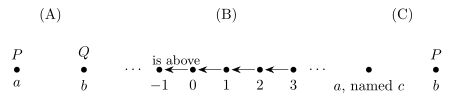
Three counter-readings. (A) holds at and at : is true, with the witnesses and , and is false, since no dot has both labels;
so the converse of Proposition 5.6.1
does not follow (Section 5.6 asked). (B) The integers,
with read
as . Only
the arrows to the next integer down are drawn; is the whole order
, so holds whenever a
chain of arrows leads from to . is true, since every integer has above it, and is false, since an integer above every
integer would be above itself; so the converse of Proposition 5.6.2
does not follow. (C) holds at , and the constant names : is true,
at , and is false (Exercise (C2: A witness is not a name, used later)
asked why no derivation was found).
Each picture is a structure in the sense of Section
7.1: a domain with a meaning for every symbol. The rest
of this section checks such pictures by the clauses,
finds them by a procedure, and shows why one of them
rules out every derivation.
Quick check. Draw two dots that
make true and false.
Solution. Picture (A) again: each
dot has or ; fails at
, and fails at
.
Quick check. In picture (C), which
clauses of Definition 7.1.3
decide , and at which element?
Solution. (S7) asks for some with ; at , (S1) asks whether , and it
is.
Counter-models
A counter-model is found the way a refuting row was
found in Chapter 4, by working backwards from what must
fail. The conclusion must be false, so read off what
that demands; the premises must be true, so read off
what they demand; and then build the smallest structure
meeting both. The worked examples that follow (the swap,
the converses of Proposition 5.6.1
and of the / law, , and ) are sequents whose
derivations stalled or were blocked in earlier
sections.
Example
(The swap of and )
Show that first by a structure on , then by a structure
with two elements.
Solution. Both formulas are
sentences, so by Lemma 7.1.1 we
need only a structure; any assignment will do.
A structure on . Let have domain and , so that says “”. The premise says “every integer has an
integer above it”. To check it by (S6) and (S7): for
each we
need some
with , that is, ; works. The conclusion says “some integer is
above every integer”. By (S7) and (S6) it would need a
with
for
every ; but gives , which is false. So and .
A structure with two elements. Let and , so that says “
is ”. Premise: for
take , and for take ; both pairs are in
.
Conclusion:
fails at ,
since , and fails at . So the premise is true and the conclusion
false.
The pattern is the one Section 5.1 read as a game. In
the premise the witness is chosen
after and may depend on it
(, or
); the
conclusion asks for one that works for every
in advance. A
one-element structure cannot separate the two sentences:
with ,
both are true if and both false otherwise. Two elements
are the least that will do.
The two-element structure is the structure’s idea at
its smallest: each element is related to something, and
nothing is related to everything.
Picture (A), checked by the clauses.
With , , , the premise of the converse of Proposition 5.6.1
holds by (S5) and (S7), with witnesses and , and the conclusion
fails, since and : The same structure refutes the converse of the
/ law of Proposition 6.2.6,
since each element is in or in , and neither set
is all of : Picture (C): with and , holds
with the witness ,
and fails,
since . So . In , with and read as “even” and
“odd”: some integer is even and some integer is odd, but
no integer is both; and every integer is even or odd,
but it is false that every integer is even, and false
that every integer is odd.
The assignment is part of a
counter-model. Section 5.4 showed why may
not generalize over a name in a premise: from one would “derive”
.
Here is a
variable, free in the premise, so a
counter-model needs an assignment as well as a
structure. Let
have domain
with the
set of even integers, and let . Then ,
since is even,
and , since (S6) fails at . So . Under the assignment with the premise
is false, and that assignment refutes nothing; the
counter-model is the structure with
.
Warning. A “counter-model” that
falsifies a premise refutes nothing. For , the
structure , with read as “”, makes the conclusion false, since no
natural number is below every natural number; but it
also makes the premise false, since nothing in is below . It is not a
counter-model, and it proves nothing about the sequent.
As with rows in Chapter 4, check the premises
first.
A model of a list of sentences.
Counter-models are one use of structures; describing a
whole kind of object is another. Consider the three
sentences which say that is a strict
order (never ; and give ) with no largest element.
The structure is a model of all three: no number is
less than itself, the order is transitive, and is a witness
for the third sentence. It is the one the sentences were
written with in mind, but not the only one: in and all three are
true, by the same checks.
↺Second readingFinite
and infinite models
Finite counter-models are convenient because every
clause can be checked by listing. They are not always
available: Exercise C1 below gives a sentence that is
true in every finite structure and false in an infinite
one, and Exercise C2 a sentence with only infinite
models.
These models differ in ways the three sentences
cannot see: has
no least element, and has a third element
between any two. And the one-element structure is not a
model of the three sentences: if the
first sentence fails, and if not, the third fails at
. Exercise C2
shows that no finite structure is a
model of them.
Quick check. Give a counter-model
to . (Think about what makes an implication
with a universal hypothesis true cheaply.)
Solution. Take , , . The
premise is an implication whose hypothesis is false
(it fails at ), so
by (S5) the premise is true. The conclusion fails at
: and , so
is
not satisfied under . (Any structure with and some
element in
but not in
works.)
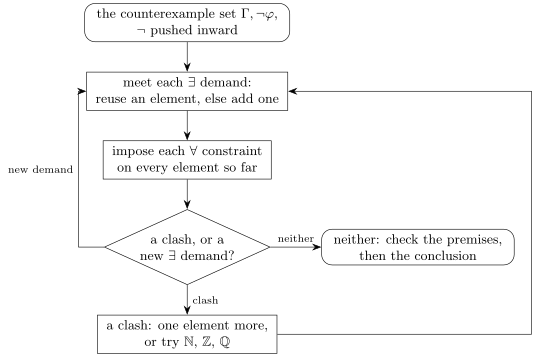
Finding a
counter-model
A counter-model is a structure with an assignment
under which every member of the counterexample
set (Definition 1.1.3)
is true. Section 4.6 searched for a row; here is the
search for a structure, the named move search
for a counter-model.
- Write the counterexample set, and push each inward (Section
6.2), so that every demand is visible as a or an .
- Meet the existential demands first:
each asks for an element; try one already
present, and add a new one only if every present one
clashes.
- Then impose each universal
constraint on every element so far, deciding
the atomic facts it forces.
- Add only forced elements. If a
constraint creates a new existential demand, return to
step 2.
- If every attempt at size clashes, try size ; if each new
element forces another, look for a familiar infinite
structure (,
, ) with that
pattern.
- Check: premises first (the warning
above), then the conclusion, clause by clause.
The search for a counter-model. The procedure
need not stop: Exercise C1 below gives a claim whose
counter-models are all infinite, and Exercise C2 a
sentence whose models are all infinite.
Example
(A Counter-model, Found by the Procedure)
Show that
Solution. Step 1. The
counterexample set, with the negated conclusion pushed
inward:
Step 2. The demand asks for
an element: call it , with .
Step 3. The first member, at , now demands some with .
Step 2 again. Try , already present:
then the third member, at , , forces , a clash. So add , with , and, by the
third member, .
Step 3 again. The constraints at : the first member at
demands nothing,
since is
false; the third member holds for every pair, since the
only related pair is and
lacks . No new
demand: stop adding.
Step 6. Take , , . The first premise holds at
, with the witness
, and at , whose hypothesis is
false. The second holds at . The conclusion fails:
its only candidate pair has .
In numbers: on , read as “ is even” and as “”. Every even
number has the
number
related to it, some number is even, and every number
is odd, so
no pair has
with even.
Quick check. In the example, why
was tried
before adding ?
Solution. Step 2: a demand is met
by an element already present when possible, since every
new element brings new constraints. Here clashed, so was forced.
Small
domains, by expansion
Over a domain with few elements, say , the
clauses can be unwound to the end. By (S6), exactly when is satisfied
under and under ; by
(S7), exactly when is satisfied
under or under ; (S4)
and (S5) treat the connectives as before; and at the
bottom each atomic formula is decided by (S1) as a fact
about elements, such as “the pair is in ”.
The expansion is the record of that
check: is
written as a long over the elements
and as a
long , the long
and of Section 5.1, and
is written
for the fact . Here and are the elements
themselves, not new constants, and no formula is formed:
the expansion is notation for the finite table of (S6)
and (S7) cases, so it is true exactly when the sentence
is, by (S6), (S7) and (S1) alone. After the expansion
only facts like remain, each true or false, and the search
for a counter-model of that size is a search for a row
(Section 4.6).
Example
(Size One Fails, Size Two Works)
Find the least size of a counter-model to
Solution. Size 1, . The first
premise expands to , which is also the conclusion’s expansion.
Whenever the first premise is true, so is the
conclusion: no counter-model.
Size 2, . The conclusion is false exactly when
. The first premise expands to which then forces and . The second
premise expands to four implications, ,
, , , all true with .
So the least size is : two elements, each
related to the other and neither to itself. In numbers:
on , read
as .
Quick check. Expand over .
Solution. : the outer becomes the
, and the inner
the inside each
disjunct.
Each side
condition, broken
Chapter 5 introduced each side condition with a step
that breaks it and a reading in which that step leads
from truth to falsehood; here they are together, each
reading now a counter-model.
| : free
for (5.3) |
from , |
from the renamed premise , |
:
the premise holds; never does |
| : flag in no premise (5.4) |
|
, by |
, “even”, |
| : flag in no open assumption (5.4) |
|
, the boxes nested the
other way |
, |
| : flag not in the conclusion (5.4; 5.5, Exercise (C1: The conclusion clause of for-all-introduction, used later)) |
from , a box flagged ending in gives ,
then by |
from the same box, |
with : the premise holds,
and no number is at least every number ( exceeds ) |
| : free
for (5.5) |
from , |
from the same line,
( at ,
then ) |
, as : no least
integer |
| :
not in
(5.6) |
, through an line
that keeps |
|
: the
premise holds at ,
the conclusion fails at |
| : in
no premise or open assumption (5.6) |
|
|
,
,
|
| :
not in (5.6) |
|
|
three dots, |
| : terms
free for
(5.7) |
|
, after
renaming the premise |
, and both naming |
Each counter-model makes the WRONG sequent’s premises
true and its conclusion false, so, by the statement in
the next subsection, no correct derivation reaches that
conclusion: the side condition is not a fussy extra, it
is what keeps the rule from leading from truth to
falsehood. Each RIGHT step is legal, and its sequent has
no counter-model, with one proviso. The RIGHT
derivations of the rows “flag in no open assumption” and
“ not in ”, taken from
Sections 5.4 and 5.6, use an “arith” line, which records
an arithmetic fact and is not a rule. Those two sequents
hold in every structure in which that fact (, or ) is true, such
as or with the usual
meanings, and not in every structure: read as subtraction on , and fails at . Section 7.3 (optional)
shows the same thing from the other side: each side
condition is used in exactly one case of the soundness
proof.
From
counter-models to non-derivability
A counter-model shows . The stalled searches asked something
else: whether . The bridge is the same as in Chapter
4, where Theorem 4.7.2
turned a refuting row into a proof that no derivation
exists (Corollary 4.7.3).
For predicate logic it reads:
Soundness for predicate logic. If
with the rules of Chapters 1 and 2 and the quantifier
and equality rules of Sections 5.3 to 5.7, then in
the sense of Definition 7.1.4.
Consequently, a counter-model to
shows .
This statement is not proved in this
section. Its proof extends Chapter 4’s to the
new rules, and it is the subject of Section 7.3, which
is optional. The proof is where each side condition of
the quantifier rules is used: the fresh-name conditions
of and , and
“free for” in ,
, and . A reader
who skips Section 7.3 may take the statement on trust,
as the rest of the book does; a reader who reads it will
see why the side conditions are exactly as strict as
they are.
With the statement, the examples above and the three
pictures at the start of this section become
non-derivability results. : the
converse search of Proposition 5.6.2
had to stall, and the two lines where it stalled, the
blocked and the blocked close of the box,
are not a lack of cleverness. Likewise the converse of
Proposition 5.6.1,
the converse of the / law, , and have no derivations.
And the same reasoning is the semantic side of Section
6.4: there, Example (The square function on the real line)
showed that on
is continuous
and not uniformly continuous, so the arithmetic
structure on ,
with read as
squaring, is a counter-model to “continuous entails
uniformly continuous”.
Quick check. Which row of the
side-condition table does picture (C) belong to, if
is “derived” by an box
with witness ?
Solution. None exactly: is a constant, not a
variable, so it cannot be the name of an box
at all. With a variable in its place, the box
would end in , and the
derivation would break the row “ not in ”. Either way,
picture (C) shows that no derivation exists.
Warning. A counter-model proves
non-derivability; it never proves
derivability, and a structure in which a sentence is
true says nothing about whether the sentence is
derivable. is true in , yet it is
not derivable: it is false in . To
show , write a derivation.
What this certifies. Chapters 5 and
6 said, at every stall, that a counter-reading would
settle the question and that Section 7.2 would explain
why. Each of those readings is a structure, and the
statement above turns each into a theorem:
- Section 5.1: the swapped pair of Example (Swapping two quantifiers),
read over :
is true and false, so the first does not derive the
second (5.1’s other refutation is a row, which Corollary 4.7.3
already settled in Chapter 4).
- Section 5.3: the three tiny worlds of the common
errors (capture, a buried quantifier, some occurrences
only), named in the paragraph on counter-readings, and the
breaks of Exercise (B5: Derive or break).
- Section 5.4: and the open-assumption
error; the stalled converse of Exercise (B2: Contraposition under a quantifier, used later),
, by the reading over with “even” and “odd” (the premise
holds because its hypothesis
fails at ; the
conclusion fails at , even and not odd;
Exercise B3 asks for a counter-model with exactly two
elements); and the breaks (b), (d), (f) of Exercise (B5: Derive or break: properties of a relation, used later)
(Section 7.4 makes (d) and (f) models).
- Section 5.5: (picture (C)), the capture in
(no least integer), (Exercise (C1: The conclusion clause of for-all-introduction, used later)),
and the breaks of Exercise (B4: Derive or break).
- Section 5.6: the three counter-worlds of the
clauses, the converse of Proposition 5.6.1
(picture (A)), the swap (picture (B), Example (The swap of and )), and the
breaks of Exercise (B4: Derive or break).
- Section 5.7: the capture in , the
two-dot counter-reading to the converse of Example (Equal Sets Have the Same Elements)
(the subsection “Extensionality” below), and the breaks
of Exercise (B3: Derive or break).
- Section 5.8: the one-element domain with , in which any two
sets without elements are equal and no set without
elements exists (Exercise (B4: The empty set is unique)
(b)).
- Section 6.1: the readings of the translation table,
each separating the wrong formula from the right one. In
rows (c)–(e) the right formula is true and the wrong one
false, so the wrong one is not derivable from the right
one; in rows (a) and (b) it is the other way round, so
the right one is not derivable from the wrong one. Also
the converse in Exercise (C3: Eventually, therefore infinitely often)
(b).
- Section 6.2: the converses of (c) and (d) of Proposition 6.2.6
(6.2 read them over ; picture (A) and the
first Quick check draw them), and the breaks of Exercise (B4: Derive or break).
- Section 6.3: every break of Exercise (B1: Derive or break, twelve claims)
and Exercise (C2: Every M is P, every M is S, so some S is P?)
(a), and the move “test the subgoal by a
counter-reading”.
- Section 6.4: continuity does not give uniform
continuity (Example (The square function on the real line),
as above), and the break in Exercise (C3: Exit check: a quantifier derivation)
(b).
None of them was used as a reason before now; each is
now a proof that no derivation exists.
Three
classes of sentences
Fix the symbols of arithmetic: the constant , the one-place function
symbol , the
two-place function symbols and , and the two-place
predicate symbol . A sentence in these
symbols is
- an instance of a tautology if its
propositional skeleton (Definition 6.3.1)
is a tautology (Definition 4.5.1);
- valid if it is true in every
structure for these symbols ();
- true in if it is
true in the structure , with the successor, .
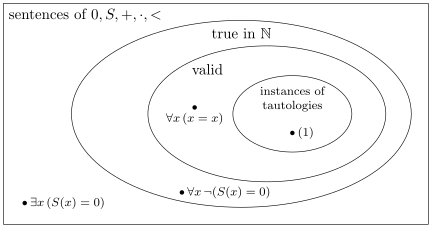
Each class lies inside the next, and neither
inclusion is an equality.
Example
(Three Classes of Sentences)
Place each sentence in the narrowest class it belongs
to.
- (a) .
- (b) .
- (c) .
- (d) .
Solution. (a) An instance
of a tautology: its skeleton is .
(b) Valid, by (S2) and (S6): every element
equals itself. Not an instance of a tautology: its
skeleton is one letter, .
(c) True in : no successor is
. Not valid: in
the structure with , , (and ,
, read in any way),
holds.
(d) False in , so in none of the
three classes.
Why the inclusions hold: a valid sentence is true in
because is one structure; an
instance of a tautology whose different prime formulas
have different letters (every sentence classified here)
is valid because (S3)–(S5) compute a formula’s truth
from the truth of the prime formulas its skeleton’s
letters stand for, exactly as a truth table does (the
first fold below gives the argument); that every
instance is valid, including those where renamed prime
formulas share a letter, is shown in the optional
Section 7.3. The classes meet derivations as follows: an
instance of a tautology is derivable (by , Proposition 6.3.1);
a valid sentence need not be derivable by alone;
and a sentence true in but not valid is
never derivable, by the statement of this section.
The three classes, each inside the next. The
point (1) is ;
the other three points are labeled with their
sentences.
Quick check. Classify .
Solution. Valid: if
holds in a structure, then by (S6) at so does , and (S5)
makes the implication true; if it fails, (S5) makes the
implication true anyway. Not an instance of a tautology:
its skeleton is .
↺Second readingWhy
an instance of a tautology is valid
Let be a
sentence whose skeleton is a tautology and in which
different prime formulas get different letters, and fix
a structure and
an assignment .
Give each letter of the skeleton the truth value, under
and , of the prime
formula it stands for. This is one row of the skeleton’s
truth table. By induction on the skeleton, the
skeleton’s value in that row is exactly when
: at a letter this is how the row was
chosen, and at , , , , the
clauses (S3)–(S5) compute exactly as the clauses
(V1)–(V6) of Definition 4.4.2
do. A tautology has value in every row,
so is
satisfied in every structure under every assignment: it
is valid.
When two different prime formulas share a letter (Definition 6.3.1
gives one letter to prime formulas that differ only by
renaming bound variables), the same argument works,
since the row above is well chosen only if the two
formulas have the same truth value. They do, because
renaming keeps meaning; the optional Section 7.3 proves
this, and nothing in this section relies on it, since
every sentence this section classifies gives different
prime formulas different letters. The argument is about
meaning and does not go through soundness.
↺Second readingA
failed search proves nothing here,
either
A stalled derivation search proves nothing, as
Chapters 5 and 6 said at every stall. A stalled
counter-model search proves nothing either: the
counter-models may all be infinite (Exercise C1), or
simply larger than the sizes tried. Chapter 4’s truth
tables decided every propositional claim in finitely
many rows (Proposition 4.6.1).
For predicate logic, no mechanical procedure decides
derivability: this is a theorem of Church and of Turing
(1936), stated here without proof, and again in the
optional Section 7.6. So the two searches are run side
by side, and the reader’s judgment chooses which to
push.
Extensionality: an axiom, not a law of logic
Write for a
two-place predicate symbol. Section 5.7 derived that
equal sets have the same members, (Example (Equal Sets Have the Same Elements)),
and read its converse, extensionality,
in two dots with holding nowhere. That
reading is a structure: , .
Every is a member
of neither nor
, so and have the same members,
and . By the
statement of this section, extensionality is not
derivable.
So extensionality is a fact about sets, not about
logic: a theory of sets must take it as an axiom
(Section 7.4 says what that means). The counter-model is
not a strange set theory; it is a structure in which
“” is read as a
relation that holds nowhere.
Exercises
A. Check your
understanding
Exercise
(A1)
- (a) Define a
counter-model to .
- (b) State the
soundness statement of this section, and say where it is
proved.
- (c) True or false,
with a reason: if no structure with at most five
elements is a counter-model to ,
then .
- (d) True or false,
with a reason: a structure in which the sentence is true shows
.
- (e) Which step of
the search for a counter-model comes first, and which
kind of demand is met first?
- (f) Give, in one
sentence, the reason that an instance of a tautology
whose different prime formulas have different letters,
such as (a) of Example (Three Classes of Sentences),
is valid.
Solution. (a) A structure
and an
assignment
with and .
(b) If with the rules of Chapters 1, 2
and 5, then ; so a counter-model shows .
It is proved in the optional Section 7.3.
(c) False. The sentence of Exercise (C1: True in every finite model, used later)
has no finite counter-model at all, and it is not
derivable.
(d) False: a structure in which is true says
nothing about derivability (the warning after the
soundness statement). is true in and not derivable.
(e) Writing the counterexample set with
pushed inward
comes first; existential demands are met before
universal constraints are imposed.
(f) The clauses (S3)–(S5) compute truth in a
structure from the truth of the prime formulas behind
the skeleton’s letters exactly as a row does, and a
tautology is true in every row.
Exercise
(A2: Drill)
Each part takes a line or two. (a)–(c) give or judge
a counter-model; (d) judges two infinite ones; (e) and
(f) complete a structure; (g) and (h) expand over ; (i)–(k)
classify a sentence in the symbols , , , , as an instance of a
tautology, valid but not an instance of a tautology, or
true in but not
valid; (l) builds a counter-model.
- (a) Give a
counter-model to .
- (b) Is , a
counter-model to ?
- (c) Give a
counter-model to .
- (d) Is , with read as , a counter-model
to ? And , with read as ?
- (e) , . Choose
so that the
structure is a counter-model to .
- (f) , and . Add
pairs to so
that the structure is a counter-model to .
- (g) Expand over .
- (h) Expand over .
- (i) .
- (j) .
- (k) .
- (l) Give a
counter-model to .
Solution.
(a) , : holds at , and holds at
, so
fails.
(b) No: both
sentences are true there. And no structure is a
counter-model, since domains are non-empty: if every
element has , some
element does.
(c) , ,
:
the premise holds since no element has ; the conclusion fails
at .
(d) Yes, both. In
each has below it, and
nothing is below everything (nothing is below itself).
In each has above it, and
nothing is above everything (nothing is above
itself).
(e) : it
must contain ,
which lacks , and
omit , to break
the conclusion.
(f) Add and nothing else:
needs an arrow
out, would
give an arrow
from every element, and together with would do the same
for .
(g) .
(h) .
(i) An instance
of a tautology: its skeleton is .
(j) Valid, by
(S6) at
and (S5); not an instance of a tautology, since its
skeleton is .
(k) True in , not valid: on , read
as “” (and the other symbols
in any way); then and .
(l) , ,
:
the first premise holds since no element has , the second at , and the conclusion
fails.
B. Practice
Exercise
(B1: Three counter-models, used later)
Give a counter-model for each of the following, and
check each premise and the conclusion against Definition 7.1.3.
- (i) .
- (ii) .
- (iii) . (Here is free in the last
; the
assignment is part of the answer.)
Solution. (i) Take , . The
premise holds by (S7) with . The conclusion fails by (S6) at , since .
(ii) Take , . Premise: at , and are both satisfied,
so
is; at , is not satisfied, so
is,
by (S5). Hence the premise holds by (S6). Conclusion:
holds () and
fails (at ),
so by (S5) the implication fails. In words: whatever has
has , and something has
; that does not
make everything have .
(iii) Take , , and an assignment with . The
hypothesis holds by (S7) with ; its is bound, and the value
is
overwritten. The conclusion has free, with value , so it fails. By (S5) the implication
fails under .
Under an assignment with the
implication holds; so the formula is satisfied under
some assignments and not others, and a counter-model
must name . Now
take and
both to be
. The formula
is satisfied in every structure under
every assignment, since is satisfied at every by (S5) and (S6). So
this structure, with , is a counter-model
to , and by
the soundness statement of this section that sequent is
not derivable. This is why the passage law of Proposition 6.2.7
needs not free in
.
Exercise
(B2: Prove it or break it)
For each claim , either prove it by meaning
(clause by clause or condensed) or give a counter-model,
and state what follows about .
For (a) and (c), if the claim holds, also give a
derivation.
- (a) .
- (b) .
- (c) .
- (d) .
- (e) .
- (f) .
- (g) .
- (h) .
Solution. (a) Holds. If
some were in
, then by the
first premise, against the second; so no is in . A
derivation:
1
2
3asm, for
4 1
5 4, 3
6 2
7 5, 6
8 3–7
9 3–8
So .
(b) Fails. , , : the first premise holds since its
hypothesis is false at , the second holds at
, and the
conclusion fails since . So , by the soundness
statement.
(c) Holds. The premise’s witness has for
every , in
particular for . A derivation:
1
2asm, for
3 2
4 3
5 1, 2–4
(d) Fails. , : each element has an
arrow out, and
has none in. So .
(e) Holds. If is true,
with witness , the
premise at gives
;
if it is false, the conclusion is true by (S5).
(f) Holds. If , then holds,
so
holds by the premise, so .
(g) Fails. , , : every element is in or , , and
.
So .
(h) Holds. Each is in or , and not in ; so it is in
.
A proof by meaning shows ,
not . The derivations of (a) and (c) show
; for (e),
(f) and (h) the matching derivations exist but are not
asked for (each is a short exercise with Chapter 5’s
rules). The pairs (a) and (b), and (g) and (h), are
look-alikes; so are (c) and (d), with opposite prefixes:
an
premise gives a loop, while a premise
does not even give every element an incoming arrow.
Marking scheme. (10 points)
- 8: 1 per part (a)–(h): the correct verdict with its
justification, either a proof by meaning that covers
every premise, or a counter-model with the premises
checked true and the conclusion checked false. A bare
verdict scores 0.
- 1: the two derivations of (a) and (c), checked rule
by rule (both needed).
- 1: stating, at a failing claim, that the
counter-model gives by the soundness
statement.
Fatal errors (0 for that part): a “counter-model”
that falsifies a premise; a proof by meaning offered as
a derivation; a verdict given without a
justification.
Exercise
(B3: The converse from Section 5.4)
Exercise (B2: Contraposition under a quantifier, used later)
derived , and its search for the converse
stalled; this section settled that converse above, in
“What this certifies”, with an infinite structure. Find
a counter-model to with exactly two elements, working backwards
from the conclusion: say which element breaks the
conclusion and how the premise is made true most
cheaply.
Solution. Work backwards. The
conclusion fails when some has and . The
premise is cheapest to make true through a false
hypothesis: make false by putting some element in
. Take , , .
Premise: fails at , since ; so the implication holds by (S5).
Conclusion: at , and , so fails under
,
and (S6) fails. By the soundness statement of this
section, the converse is not derivable, and the stalled
search could not have succeeded.
Exercise
(B4: Each side condition earns its place)
Each derivation below breaks a side condition. For
(a)–(c), name the line that breaks a side condition and
the condition it breaks, give a counter-model to the
sequent of its last line, and, where you can, repair the
derivation so that it reaches a correct conclusion. For
(d), say whether the conclusion is true (follows from
the premise) and whether the derivation proves it.
(a)
1asm, for
2 1
3 2–2
4 1–3
5 1–4
(b)
(c)
1
2
3asm, for
4 2
5 4, 3
6 1, 3–5
(d)
1
2 1
3 2–2
Solution. (a) Line 3:
appears in the
assumption on line 1, which is open at line 3. Line 5 is
a legal : no premise, no open assumption, and is not in the
conclusion. (This is the same-name nesting of Section
5.4’s fold “The same error, as a false sentence”, read
there over with
; here
is left open.)
Counter-model to : , . At
, holds and fails at
. No derivation
reaches this conclusion: the counter-model shows it. A
repair to a correct conclusion drops the inner box and
uses in place of the illegal :
1asm, for
2 1
3 1–2
4 1–3
This is the RIGHT entry of the second row of the
side-condition table, generalized.
(b) Line 2: in the term is not free for , since it would be
captured by . Counter-model: any domain with two elements;
the premise holds, and no element equals both. Repairs:
by from
line 1, with not
in ; or
by at
, then by
.
(c) Line 6: appears in . The last
line has free,
so the counter-model needs an assignment: , , . Both premises hold, and fails. Repair:
forget the witness before the box closes.
1
2
3asm, for
4 2
5 4, 3
6 5
7 1, 3–6
(d) The conclusion is true: it follows from
the premise, and is derived correctly in one line, by from
line 1; so the sequent has no counter-model. The
derivation does not prove it: line 3 breaks “the flag
appears in no premise”, since is in line 1. The
counterexample is to the step, not to
the conclusion: the same step takes to , and
, with read as “even” and
,
makes true
and false (the second row of the
side-condition table).
Marking scheme. (10 points)
- 6: (a)–(c), 1 each for the line with its condition,
and 1 each for a checked counter-model.
- 1: the repairs of (a)–(c), and the remark that (a)’s
original conclusion is unreachable.
- 3: (d): the conclusion judged true, with the
one-line derivation (1); the illegal line and its
condition named (1); a counter-model to the step pattern
rather than to the conclusion (1).
Fatal errors (0 for the step): in (c), a
counter-model with the assignment omitted, although the
last line has a free variable; in (d), a claimed
counter-model to the conclusion.
C. Going deeper
Exercise
(C1: True in every finite model, used later)
Let be a
one-place function symbol, and let be the sentence
“if is
injective, then
is surjective”.
- (a) Prove that is true in every
structure whose domain is finite.
- (b) Give a structure
with an infinite domain in which is false.
- (c) Deduce that
is not
derivable, although no finite structure is a
counter-model.
Solution (Hint 1). For (a), suppose
is
injective on a finite with elements, and count the
elements of its image.
Solution (Hint 2). For (b), look
for an operation on that never repeats a
value but misses a value.
Solution. (a) Let have a finite domain
with elements. If the
hypothesis of is false in , then is true by (S5).
So suppose it is true: by (S6), (S5) and (S2), for all
,
implies ; that
is, takes
different values at different elements. Then the elements of have different values, so
the set of values is a subset of with elements. A subset of
an -element set
with elements is
the whole set (a counting fact from school, proved in
Sets, Relations, and Cardinality, Chapter 3).
So every is
for some
, which is the
conclusion of by (S6), (S7) and
(S2). Hence
is true in .
(b) Take and . The hypothesis holds: gives . The conclusion
fails at :
there is no with , since gives . So is false in .
(c) The structure of (b) is a counter-model
to
(with
empty). By the soundness statement of this section,
is not
derivable. By (a), no finite structure could have shown
this: a search for counter-models that lists finite
structures of size 1, 2, 3, … would never stop.
Marking scheme. (10 points)
- 1: (a) disposes of the case where the hypothesis of
is false, by
the clause for .
- 3: (a) reads the hypothesis as injectivity of and uses
finiteness to get surjectivity, naming the counting
fact.
- 3: (b) a structure with infinite domain, with the
hypothesis checked and the conclusion refuted at a named
element.
- 3: (c) concludes non-derivability through soundness
and says why finite structures could not have done
it.
Fatal errors (0 for the step): in (b), a
“counter-model” in which is not injective;
in (a), an argument that never uses finiteness.
Exercise
(C2: A sentence with no finite model, used later)
Let be the
conjunction of the three sentences of the text saying
that is a
strict order with no largest element: Prove that every model of has an infinite
domain. Where does your proof use that domains are
non-empty?
Solution (Hint 1). Start from one
element and keep climbing with the third conjunct.
Solution (Hint 2). Prove by
induction on that
there are elements of with whenever
.
Solution. Let be a model of , with domain , and write for . We
prove, for every , the statement : there are
elements of
with
whenever . We use Axiom 4.2.1,
applied to the property of , so that the base case is .
Base.
is non-empty (Definition 7.1.1,
(M1)), so there is some , and holds, with no pairs
to check.
This is the one place the proof uses non-emptiness. If
an empty domain were allowed, with “for every ” read as
having nothing to check, all three conjuncts would hold
in it (each begins with ), and it has no
elements at all: the statement “every model is infinite”
would fail.
Step. Suppose are as in
. By the third
conjunct and (S6), (S7), there is with . For
, we have
by
, and then
by
the second conjunct (transitivity). So holds.
Now the elements are all different: if with , then says , which the
first conjunct forbids. So for every , the domain
contains
different elements. A finite set with elements does not
contain
different elements, so is not finite. Since
is a
model of (as
the text checked), has models, and all
of them are infinite.
Marking scheme. (10 points)
- 2: names the non-empty domain as the start of the
construction, and says what fails without it.
- 3: an induction producing, for every , a chain of elements, using the
third conjunct for the step.
- 2: uses transitivity to keep the whole chain
increasing, not only neighbors.
- 3: uses irreflexivity to show the elements are
different, and concludes that is infinite.
A second route: a proof that every non-empty finite
subset of has a
-maximal
element (induction on its size, with irreflexivity in
the base and transitivity in the step), applied to , which is non-empty,
and contradicted by the third conjunct, earns 2 for
using non-empty,
3 for the induction, 2 for transitivity in the step, and
3 for irreflexivity plus the contradiction with the
third conjunct.
Fatal errors (0 for the step): building the chain
without showing its elements are distinct; an “infinite
chain” asserted without an induction or a recursion.
Exercise
(C3: Exit check: formalize, negate, decide)
Work over the domain , with as a
bound as in Section 5.1, and as a term.
- (a) Formalize, with
bounded quantifiers: “for every there
is such that for
every with .”
- (b) Formalize the
sentence obtained from (a) by moving “there is ” to the
front.
- (c) Negate each of
(a) and (b) into positive form: no left in front of a
quantifier or an implication, and written as
.
- (d) Decide which of
(a) and (b) is true in . For the true
sentence give a proof, saying what each chosen number
depends on; for the false one, prove its negation,
giving the witnesses it asks for.
You may use that for every real number there is a
natural number larger than it.
Solution. A remark on the term
. In the
structure , the
symbol must be a
function on all of (Definition 7.1.1,
(M3)); give a
value for every , say . The bound keeps
, so those
values are never used.
(a) .
(b) .
(c) Push inward one
quantifier at a time, keeping each bound (Proposition 6.2.3),
then negate the implication (Proposition 6.2.2):
(d) (a) is true. Let .
Choose a natural number with , by
the fact allowed in the problem; since ,
,
and depends on
. Let
with . Then
, and multiplying by
the positive number gives
. Since was arbitrary, and then
, (a)
holds.
(b) is false; its negation is true.
Let . Take , which
is positive, and , which is in with . Then . Both witnesses depend on , as the order allows. Since was arbitrary, holds, so (b) is
false. In words: no single works for every , because
defeats that .
The two sentences differ only in the order of and
. In (a)
the is chosen
after
and may depend on it; in (b) it must be chosen first,
which is the swap of Example (The swap of and ) in an
analysis setting.
Marking scheme. (10 points)
- 2: both formalizations, with the bounds , ,
attached to the right quantifiers and under the .
- 3: both negations in positive form, with every bound
kept, the quantifier order of each preserved, and under the .
- 2: verdict “true” for (a), with a proof in which
is chosen after
and
said to depend on it.
- 3: verdict “false” for (b), with and given as functions of
and the three
facts , , checked.
Fatal errors (0 for the step): in the negation of
(b),
chosen before (a
single
for all ); a bound
negated instead of the quantifier (, or ).
Exercise
(C4: The least size of a counter-model)
For each claim, find the least size of a
counter-model, and prove by expansion that no smaller
one exists.
- (a) .
- (b) .
- (c) .
Solution (Hint). In each part, the
premises demand witnesses. Count how many of them can
share an element before the conclusion becomes true.
Solution. (a) Least size
3: , , , . The premises hold with the witnesses , , , and no element has two
of the three predicates, so each disjunct of the
conclusion fails. With at most two elements, the three
witnesses for ,
, lie among two elements,
so one element is a witness for two of them, and the
matching disjunct holds. (Over : the premises
expand to , , ; of the three letters chosen, two fall on
the same element.)
(b) Least size 3: , , a three-cycle: every element has an
arrow out, none has a loop, and no two elements have
arrows both ways. Size 1: the first premise expands to
, against
the second. Size 2: the second premise gives , so the first, , forces and , and the
conclusion holds at , .
(c) Least size 2: , , : each
element has exactly one of , , so neither disjunct of
the conclusion holds. Size 1: and
expand to and , which cannot
both hold.
Marking scheme. (10 points)
- 4: (a): the counter-model checked (2); the counting
argument for size 2 (2).
- 4: (b): the counter-model (1); size 1 (1); size 2 by
expansion (2).
- 2: (c).
Fatal errors (0 for the step): a size claim without
the proof that every smaller structure fails.