To prove that a sequence does not
converge, or that a function is not
uniformly continuous, we must use the negation of a
definition, and a negation is only usable once the has been pushed all
the way in. “It is not the case that for every there
is an …” gives a
proof nothing to hold. “There is an such
that for every
there is an
with …” tells it what to find. Section 5.1 read the step
from the first form to the second informally, as the
challenger and the defender changing sides. This section
derives the laws that make it exact, with the rules of
Sections 5.3–5.6. Once they are proved, negating a
definition is mechanical: one law per symbol, from the
outside in. It then shows the laws at work, in an
analysis proof in which a negation and a well-chosen
do the
work, and ends with the laws that move a quantifier
across a connective, and with prenex form, where every
quantifier stands at the front.
Not every,
and some not
Section 5.1 called the two quantifiers mirror images:
a single counterexample refutes a “for every”, and a
single witness confirms a “there exists”. The mirror
suggests four sequents. “Not every satisfies ” should say the
same as “some
fails ”, and
“no satisfies
” the same
as “every fails
”. Three of
the four directions come straight out of the search
method. The fourth does not, and the reason it does not
is worth a close look.
To negate a quantifier, flip it and move the
inside.
In the derivations of this section, means
,
which is by
Definition 5.2.5;
the two readings give the same formula. The fresh name
is always a
variable different from that does not appear in
(or in
, when there is
one); so it does not appear in or
either. The side conditions of and
need this, and it also makes free for in (Section
5.2).
Proposition
6.2.1 (Quantifier Negation)
Let be a
formula and a
variable.
- (a) , by a derivation that
uses ;
- (b) , by a derivation that
does not;
- (c) , both
directions by derivations that do not use .
Try it first (ten minutes): run the search method
of Section 3.1, with the quantifier steps of Sections
5.3–5.6, on (a). Which rule should give the last line,
and what would that rule need from the premise?
Idea. Start with (a), and with the
obstacle. The goal is an , so the search
postpones it until an available line shows an instance
.
None ever does. The premise
is a negation, and a negation is used only by clashing
it with what it negates, . It
says that a counterexample exists and names none, so
has nothing to act on. We are stuck, and the
last step of the method applies: assume , “no fails ”, and hunt for a
clash. The clash will be with the premise, so the new
goal is . Open a flagged box for it, with the
goal . That goal
is again stuck (we know nothing about ), so a second
assumes ; and
now an instance of is on a line,
so produces , which clashes with the outer
assumption.
For (b) and (c) the method runs without getting
stuck. A negated goal opens a box
(Section 2.2); an premise opens an
box early (Section 5.6); a goal opens a
flagged box (Section 5.4). The clash comes in one of two
ways. In (b), and in (c) right to left, the instance
assumed in the box
clashes with the matching instance that
takes from the line. In (c) left
to right, turns the instance into ,
which meets the premise .
Proof. For (a), the derivation:
1
2asm, for
3asm, for
4 3
5 4, 2
6 3–5
7 3–6
8 7, 1
9 2–8
Line 4 is at
the term , which
is free for in
. At
line 7 the side condition of
holds: does not
appear in the premise, in the assumption still open at line 7, or in ,
since it is not
and does not appear in ; and line 6 is
the last line of the flagged box.
For (b):
1
2asm, for
3asm, for
4 2
5 4, 3
6 1, 3–5
7 2–6
At line 6,
does not appear in , in ,
in the premise, or in the assumption still
open there.
For (c), left to right and right to left:
1
2asm, for
3 2
4 3, 1
5 2–4
6 2–5
1
2asm, for
3asm, for
4 1
5 3, 4
6 2, 3–5
7 2–6
In the first, line 5 is the instance of at , as
requires, and
appears neither in the premise nor in ;
no assumption is open at line 6. In the second, the side
condition of at
line 6 is checked as in (b). No line of the derivations
of (b) and (c) is justified by , and the
derivation of (a) uses it twice, at lines 6 and 9. This
proves the proposition.
So “not every” and “some not” are interderivable, and
so are “none” and “every not”. The direction that cost
two
boxes is the one that produces an
existential statement from a negative one. That is not
an accident of our derivation: no derivation of (a)
avoids . This is a
claim about all derivations, which no search can
establish, and we state it without proof (Chapter 4’s
optional Theorem 4.7.4
proves the propositional analogue for ).
Quick check. From the line , may
a derivation write for a constant ? If not, what may it
write, and what does a derivation do next to use it?
Solution. No. says
that some element fails , not that the element
named does: over
, with read as “is even” and
as , is
true and
is false. By (a) the derivation may write . To
use that line it opens an box
with a fresh witness and the assumption
(Section 5.6), and nothing about follows.
The laws as one line. From now on a
derivation may use any law of this section as one line,
citing it, in the way Proposition 6.1.1
allows a bounded rule: the line abbreviates the
derivation printed here, with (and ) replaced by the
formulas at hand and the fresh name chosen so that it
appears nowhere in the larger derivation. Then every
side condition inside the pasted block still holds,
since the block’s premises become lines of the larger
derivation and the name is new to all of them. In a
derivation the justification is a short tag: QN (a) for
Proposition 6.2.1
(a), NIm for Proposition 6.2.2
below, and VI for Proposition 2.1.2.
The
negation of an implication
Every definition with a bounded contains an
implication, , so negating it means
negating an implication. The answer is the one Section
5.1 found for the wrong translation of a bounded : an implication
fails exactly when its hypothesis holds and its
conclusion does not. Chapter 3 met this law only as an
exercise (Exercise (B1: Three searches)
(b)), and a proof in the text may not rest on an
exercise, so we prove it here.
Proposition
6.2.2 (Negated Implication)
For all formulas and , The direction is derived with
, and
the direction without it.
Idea. For the goal is a
conjunction, so asks
for and
separately. The premise is a negation, usable only to
clash with , so in each part we manufacture . For
: open a
box on ; then
follows by , whose
box repeats .
For we are
stuck, since has no known main
connective; so assumes
, and
gives
by
Proposition 2.1.2.
For , the
goal is a negation: assume and
clash with
.
Proof. The two derivations:
1
2asm, for
3VI 2
4 3, 1
5 2–4
6asm, for
7asm, for
8 6
9 7–8
10 9, 1
11 6–10
12 5, 11
1
2asm, for
3 1
4 2, 3
5 1
6 4, 5
7 2–6
Line 3 of the first derivation uses Proposition 2.1.2
as a derived rule (Definition 2.3.1),
and line 8 repeats line 6 into the box, since needs
as a line of
its own box. The only is at line
5.
The derivations use only the rules of Chapters 1 and
2, so the law holds for statements as well as formulas,
and it may be used as a derived rule in the sense of Definition 2.3.1.
Over the real numbers: “if then ” fails for a given exactly when and .
Bounded
quantifiers keep their bounds
Analysis negates bounded quantifiers: , . The two laws so far combine into laws
for them, and the combination has one surprise in it,
which is no surprise once the bound is unfolded:
the bound stays as it is.
Negating a bounded quantifier flips the
quantifier and keeps the bound.
Proposition
6.2.3 (Negating Bounded Quantifiers)
Let be a fixed
set, so that
is a one-place predicate symbol, let be a variable and a formula.
Then
- (a) ,
where is
derived with and without;
- (b) ,
both directions without .
The same holds with replaced by , or by , , , for a term in which does not occur.
So becomes , and never .
Idea. Unfold the bounds (Definition 5.1.1):
(a) is . Push the through the
quantifier by Proposition 6.2.1,
and then through the implication by Proposition 6.2.2;
the second step must happen under the , so it happens
inside an box. The negation lands on , and the bound
comes out
of the implication unnegated. For (b), the derivations
of Proposition 6.2.1
(c) go through with the bounded rules of Proposition 6.1.1
in place of the unbounded ones.
Proof. For (a), and , with the bounds
unfolded:
1
2QN (a) 1
3asm, for
4NIm 3
5 4
6 2, 3–5
1
2asm, for
3NIm 2
4 3
5 1, 2–4
6QN (b) 5
Line 3 on the left is the instance at of , since is not a variable; line
4 is Proposition 6.2.2
with and
for
and . At line 6, does not appear in
the conclusion, in line 2 or in the premise, and no
assumption is open. The right-hand derivation is checked
the same way. The only use of is inside
the two cited laws on the left: in QN (a) and in the
direction of
NIm.
For (b), with the bounded rules:
1
2asm, for
3asm, for
4 2, 3
5 4, 1
6 3–5
7 2–6
1
2asm, for
3asm, for
4asm, for
5 1, 3
6 4, 5
7 2, 3–6
8 2–7
At line 7 on the left, the box’s own assumption has closed, and
is in neither
the premise nor the conclusion; at line 7 on the right,
is not in , in line 2, in the
premise, or in the open assumption on line 2. Neither
derivation uses .
For the bounds and the others, the same four derivations
work with
and in
place of
and ,
choosing not to
appear in ; since
does not occur in
, is
. This
proves the proposition.
Warning. Negate the
quantifier, not the bound. The negation of
“” begins
, not . The wrong form, , is true for
every sequence: works,
since always. So it would “prove” that the constant
sequence
does not converge to .
Negating a
definition, mechanically
With the laws in hand, negating a definition is a
procedure.
Algorithm. Negating a
formula.
- Rewrite
as two implications, by Proposition 2.4.1.
- Push inward, one
symbol at a time, from the outside, citing a law at each
step:
- Stop at atomic formulas. In an
ordered domain, replace by and by ; these are facts
about the order, not laws of logic.
Each step of 1 and 2 replaces a part of the formula
by a part provably equivalent to it. Write that chain
with
between the stages, not . Step 3 is not a
law of logic: make its replacements after the chain,
citing the order fact.
Why may a step act on a part buried inside the
formula? Because a part may be replaced by a part
provably equivalent to it, even under quantifiers that
bind its variables, as long as the equivalence is
derivable for every choice of those variables, that is,
its closure is derivable.
Proposition
6.2.4 (Replacement of Provable
Equivalents)
Let and
be formulas,
and let be the variables free in or in . Suppose that . If is obtained
from a formula
by replacing one occurrence of in by , then , where
are
the variables free in or in . In particular,
.
In words: swap a part for a provably equivalent
part anywhere in a formula, provided the equivalence is
derivable for every choice of its free variables, that
is, its closure is derivable; every law of this section
is.
The proof is an induction on the formula ; its connective
steps are short derivations with the rules of Chapters 1
and 2, its quantifier steps use a flagged box or an
box with a fresh name, and it does not use
truth tables or completeness. It is in the fold below,
followed by a second fold that checks the hypothesis for
the laws of this section.
↺Second readingThe
proof of the replacement rule
Proof. For a formula , write
for its closure: preceded by one
for each
variable free in . The order of
these ’s
does not matter, because the instance of at fresh flags comes by in
that order, and
flagged boxes closed by in
any other order give the ’s in that other
order (this is the derivation of Example (Flagged boxes at work)
(c), with
variables), so “the closure” means the closure in any
one order. The hypothesis is , and the claim is . A derivable formula
may stand as a line of any derivation: paste its
derivation in, with its flags renamed to names new to
the whole derivation, as “The laws as one line”
allows.
We use strong induction (Theorem 4.2.2)
on the number of connectives and quantifier symbols of
: assume the
claim for every formula with fewer such symbols, and
prove it for .
Case 0: the occurrence is itself. Then
is , is , and the claim is
the hypothesis.
Otherwise the occurrence lies in an immediate part of
, which has
fewer symbols; an atomic formula has no part other than
itself.
Case 1: , with the occurrence in , so . The induction hypothesis gives
. Open one flagged box for each
variable of the closure of , nested in the closure’s order,
with fresh flags. Inside, of
the induction hypothesis at the flags, each variable at
its own flag in the closure’s order, gives the instance
of at the flags; every variable of
that closure is free in or , so it has a
flag. The rules of Sections 2.2 and 2.4 give : each direction is a box (Definition 2.2.1)
with inside, and (Definition 2.4.1)
joins them. The flagged boxes then close by , the
innermost first. Each side condition holds: the flag is
fresh, and no assumption is open at the closing
line.
Case 2: , where is , , or , and the
occurrence is in (in , exchange the
parts). As in case 1, with the propositional step , where is the instance of
at the
flags. For each it is a short
derivation with that connective’s rules of Chapters 1
and 2 and on . A variable free in
but not in
is flagged
and never instantiated, which is harmless: the instance
of the induction hypothesis is taken at the flags of its
own variables only.
Case 3: or , with
the occurrence in , so is
or . The induction hypothesis gives
, whose closure may include . Let be the variables
free in or
, so is not among them, flag
them with fresh names , and write for .
Substitution passes and , because is not among ; and all the flags
are fresh, so the simultaneous and the step-by-step
substitutions agree.
- For ,
left to right: assume
and open a flagged box with a fresh . Use at
. Use of
the induction hypothesis at and , each variable at its
own flag in the closure’s order. Then gives ,
and gives . The flag is in no premise,
open assumption or conclusion.
- Right to left is the same, and joins the two directions.
- For : an
box with a fresh witness , inside, closed after .
The flagged boxes of then close by , as
in case 1.
The “in particular”. From , at
each itself (a
variable is free for itself) gives , and gives each direction. No truth table and no
completeness theorem was used.
↺Second readingWhy
the laws of this section meet the
hypothesis
A law of this section is proved for every formula
that meets its condition, so it holds for the instances
at fresh names , and (Definition 2.4.1)
joins the two directions into at the fresh names, and flagged boxes give its
closure, as Proposition 6.2.4
asks. Take one variable at a time, with sides
and of the law, and a
fresh : a
variable other than that appears in neither
nor . The derivation of
is available because each law used
holds for every formula that meets its
condition, in particular for the instances at . The laws this book
applies to parts have conditions of two kinds, and both
survive, for the same reason; the passage laws at the
end of this section have one kind, checked in the fold
after them, and the bounded negation laws the other. A
law of Proposition 6.2.3
with a bound such as asks that its bound variable not occur in the term
; since appears in , is not (as for the passage
laws, in the fold after them). If is , substitution stops at
the quantifier on
and the pair is unchanged; otherwise it passes the
quantifier on ,
and
contains no variable that lacks except , so does not occur in it.
So the instance is again an instance of the same law,
with its condition met.
Renaming a bound variable is a replacement of this
kind: Section 5.4 derived for every formula
in which
does not appear
(the fold after Example (Flagged boxes at work)),
and Section 5.6 did
the same for , so the
convention of Section 5.2, that a renaming may be made
anywhere inside a formula, is now a provable
equivalence. Its closure is derivable, as Proposition 6.2.4
asks: for a variable free in it and a fresh
(as in the fold
above), is
neither nor , and is not , because appears in ,
so does not
appear in , and the
instance is the renaming of to . Two formulas that differ
only by renaming bound variables are joined by a chain
of single renamings, each to a letter absent from the
formula at that step (for and : to , then to , then to ), each applied to a
part by Proposition 6.2.4
and chained by Lemma 2.3.3.
Example
(Three negations from analysis)
Negate each statement into positive form: no in front of a
quantifier, a connective or an inequality. Work over
.
- (a) : .
- (b) is the supremum of
, in the
two-clause form “
is an upper bound of , and for every some
element of
exceeds ”:
- (c) is uniformly continuous
on : .
Solution. (a) Three
quantifiers, then an implication, then an inequality:
The first three steps are Proposition 6.2.3,
the fourth is Proposition 6.2.2.
Last, the order fact turns into : In words: some is
such that, however far out we start, some later term is
at least away from
. Every bound
stayed, and the order of the quantifiers stayed: , then , then .
(b) The outer symbol is . By De Morgan the
negation becomes a disjunction, and each side is negated
on its own: The first step is Proposition 2.5.5,
(d) for and
(c) for ; the
second is Proposition 6.2.3,
(a) on the left and (a) then (b) on the right. Last, the
order facts turn into and into :
In words: fails to be the
supremum when some element of lies above it (it is
not an upper bound), or when some with
is still an upper bound (it is not the least).
(c) Four quantifiers and an implication:
where the first step is four uses of Proposition 6.2.3,
and the second is Proposition 6.2.2.
Last, the order fact turns into : In words: one
defeats every : however small
is,
two points of
closer than
have values at least apart. To
prove that a function is not uniformly
continuous, this is the statement to prove, and it says
exactly what to exhibit: first ; then, for an
arbitrary ,
the two points
and , which may
depend on .
Section 6.4 does this for on .
The same procedure finishes the rewriting promised in
Section 6.1 for “there is no largest prime”. By Proposition 6.2.1
(c), A negated conjunction
is interderivable with : De
Morgan’s law (Proposition 2.5.5
(d)) and Proposition 2.5.6
(a) give one direction, and (b) of the latter with Proposition 2.5.5
(c) the other. Then Proposition 6.2.1
(a) and (b) turn into , and Proposition 6.2.2,
used under , pushes the last in; both steps act
on a part, by Proposition 6.2.4:
The quantifier works like a bounded one, with the bound
.
That bound is not one that Proposition 6.2.3
covers, but the same two steps work for it, and the
bound stays unnegated.
Quick check. Negate “every
non-empty set of reals that is bounded above has a
supremum”, writing for “ is non-empty”, for “ is bounded above” and
for “ has a supremum”, with
the variable
ranging over sets of reals.
Solution. The statement is . By Proposition 6.2.1
(a) and (b) and then Proposition 6.2.2,
its negation is there is a non-empty set of reals, bounded
above, with no supremum. The two conditions are not
negated: they stay as conditions on the counterexample,
just as a bound stays with its quantifier.
Quick check. Negate “ is bounded on ”, , into positive form, and say
it in words.
Solution. : every proposed bound is
beaten somewhere on . The quantifiers flip,
the bound
stays, and the order fact turns
into .
Warning. The negation of an
implication is not an implication. “If , then ” is not
negated by “if , then ”, nor by “if , then ”. For the original is true (its hypothesis fails),
and so is the second candidate, so the candidate cannot
be its negation. The negation is
(Proposition 6.2.2),
and it is false for every real .
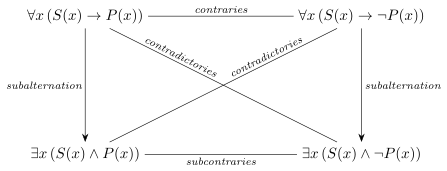
Four forms
and their square
Four sentence shapes come up so often that they have
names. Fix two one-place predicates and .
- A, “every is ”: ;
- E, “no is ”: ;
- I, “some is ”: ;
- O, “some is not ”: .
The diagonals always hold: A and O are each the
negation of the other, and so are E and I. The other
three labels hold only when something is an .
The diagonals, by the laws. A–O is
the two steps of the proof of Proposition 6.2.3
(a), QN and then NIm under , which work for
the bound as
for above.
E–I is the same, followed by Proposition 2.5.1
under (by
Proposition 6.2.4).
Contrary against contradictory. A
and E are contrary: never both true
when something is an , but possibly both
false. The negation of “every element of is positive” is the O
form “some element of is not positive”, not
the E form “every element of is non-positive”.
Example
(The square for multiples of 4 and squares)
Over , let
be “is a multiple
of ” and “is a perfect square”.
Find the truth value of each corner. Then do the same
with read as “is
an odd multiple of ”.
Solution. A, “every multiple of
is a perfect
square”, is false at . E, “no multiple of
is a perfect
square”, is false at . I is true at , and O at . Each diagonal joins a
true corner to a false one.
No number is an odd multiple of . Now A and E are both
true, vacuously, and I and O both false. Contraries both
true, subcontraries both false: this is why the outer
labels need something to be an (existential import,
Section 5.1).
Quick check. Which corner is the
negation of “no multiple of is a perfect square”,
and is that corner true?
Solution. I: “some multiple of
is a perfect
square”. It is true, since . The
negation of E is I, by the diagonal.
How the
laws look in a mathematical proof
Chapter 2 proved, in Example (A number below every positive number),
that a number below every positive number is . Its key step chose
, and the reading after it called “the
hypothesis applies to it” a step about “every”, used as
ordinary reasoning until Chapter 5. The rule is , in
its bounded form (Proposition 6.1.1),
at a term built from the data. Here is the same move
once more, the way it appears in analysis.
Two real numbers that are closer than every
positive number are equal.
Proposition
6.2.5 (Arbitrarily Close Numbers Are
Equal)
Let and be real numbers. If
for every , then
.
Idea. The goal is atomic, so no
introduction rule applies, and the hypothesis is a whose instances
are all inequalities, never an equation. We are stuck,
so suppose .
The hypothesis may be instantiated at any positive term,
so choose the term that makes the numbers collide: , which is positive exactly because .
Proof. Suppose that for every , and
suppose, for a contradiction, that [an box]. Then
, so
,
by the school fact that for every
real . So
the hypothesis applies to the term [bounded
, citing the line ] and
gives . No real number is less than
itself, so this is a contradiction []. Hence
[].
The last step is a genuine : the box
assumed , written , and concluded ; would only have given . The
hypothesis cannot be weakened to “for
some ”:
, , satisfy
and . The facts about used here are
school algebra.
Read the result through the negation laws. Its
contrapositive says: if , then , which by Proposition 6.2.3
is interderivable with , that is, by
the order fact, . The proof did not search for that
: it
named it, , from the data. A proof by contradiction in
analysis is usually this shape. Negate the goal; the
negation hands over an object (here the positive number
); feed
it to a hypothesis that holds for every
object of its kind.
Moving a
quantifier across a connective
Negation is not the only thing that needs moving. A
formula such as has its quantifier buried in a
hypothesis, and proofs often want it outside, or the
reverse. Two groups of laws do this. The
distribution laws move a quantifier
across or
when both
sides mention ;
the passage laws move it across a
connective when one side does not. The laws of this
subsection are proved by the method’s short runs; the
derivations are in a fold, and Section 7.2 returns to
two of the one-way laws.
Proposition
6.2.6 (Distribution of Quantifiers)
For all formulas , and every variable
:
- (a) ;
- (b) ;
- (c) ;
- (d) .
All four are derived without .
The proposition collects laws that are mostly proved
already. Its point is the comparison: goes across and across in both directions,
while
across and
across
go one way
only.
Idea. Three of the four laws were
derived in Sections 5.4 and 5.6 for and ; only the fresh
name’s instances were used there, so formulas can take
their place. For (c), the goal is a and the premise a
disjunction: open the flagged box first, then split on
the premise inside it.
The converses of (c) and (d) are false. Over , every integer is
even or odd, but neither “every integer is even” nor
“every integer is odd” holds; some integer is even and
some integer is odd, but none is both. These are
counter-readings; Section 7.2 draws them as
counter-models.
The passage laws need a condition: the quantified
variable must not be free in the formula that the
quantifier moves away from. Section 5.2 proved the fact
that makes this work: if is not free in , then for
every term . So an
instance of at is ,
with
untouched.
Proposition
6.2.7 (Passage Laws)
Let and
be formulas
and a variable
that is not free in . Then
- (a) ;
- (b) ;
- (c) ;
- (d) ;
- (e) .
Of the ten directions, two are derived here with
:
in (d),
through and the
cited QN (a), and in (e), through
. The
other eight are derived without it.
Read (b) aloud: “everything with has ” says the same as
“if something has , then ”. In (b) and (d) the
quantifier changes from to or back as it
leaves the hypothesis of an implication. That is the
game reading of Section 5.1 once more: a quantifier in a
hypothesis changes sides.
Idea. Each intuitionistic direction
is a short run of the search method. A goal opens a box; a
goal a
flagged box; a premise an box,
early; a premise is instantiated
at , where the
condition on
keeps
unchanged; and the goal waits for
its witness .
The two classical directions get stuck. In (d), the
premise is usable only once is in
hand, and it may not be; so decide it, by . If
holds, then
holds, and holds at every . If not, (a) of Proposition 6.2.1
supplies an
with , and
is vacuously true. In (e), decide : if holds, the premise
supplies a witness; if not, is
vacuously true at every .
↺Second readingThe
derivations of the distribution and passage
laws
Proof. For Proposition 6.2.6:
(a) is Proposition 5.4.1,
(d) is Proposition 5.6.1,
and (b) is part (a) of Example (Derivations with existential elimination),
the derivation of over . Those derivations
are written with and ; they work word for
word with
and in their
place, because they use nothing about and beyond the instances
at the fresh name, which is chosen different from and not appearing in
or .
For (c), the goal is a : open a flagged
box. Inside it the premise is a disjunction, so split on
it; in each case one at
and one reach
the instance of :
1
2asm, for
3 2
4 3
5asm, for
6 5
7 6
8 1, 2–4, 5–7
9 2–8
Line 8 is the instance of at
and the last
line of the flagged box; at line 9, is in neither the
premise nor the conclusion, and no assumption is open.
This proves Proposition 6.2.6.
Proof. In every derivation below,
is a variable
other than that
does not appear in or , and
because is not
free in
(Section 5.2). So the instance at of is ,
and likewise for the other combinations.
(a), and
:
1
2asm, for
3 1
4 3, 2
5 3–4
6 2–5
1
2asm, for
3 1, 2
4 3
5 2–4
6 2–5
At line 5 on the left the assumption is open, and does not appear in
it: this is where the fresh name must avoid .
(b), and
:
1
2asm, for
3asm, for
4 1
5 4, 3
6 2, 3–5
7 2–6
1
2asm, for
3 2
4 1, 3
5 2–4
6 2–5
At line 6 on the left, the conclusion does not mention the
witness : this
is where ’s side condition meets the condition on
.
(c), and
:
1
2asm, for
3 2
4 3
5 2
6 4, 5
7 1, 2–6
1
2 1
3 1
4asm, for
5 4, 3
6 5
7 2, 4–6
(d), :
1
2asm, for
3asm, for
4 2
5 3, 4
6 1, 3–5
7 2–6
(d), ,
with
on :
1
2
3asm, for
4 1, 3
5asm, for
6 4
7 5–6
8 7
9asm, for
10QN (a) 9
11asm, for
12VI 11
13 12
14 10, 11–13
15 2, 3–8, 9–14
Line 8 is at
the term itself:
is , as in
Proposition 5.5.1,
and as there the step is sound because every domain is
non-empty (Section 7.1). At line 14, is in neither the
conclusion nor line 10, nor in the premise or the open
assumption .
(e), and
, the second
with
on :
1
2asm, for
3asm, for
4 3, 2
5 4
6 1, 3–5
7 2–6
1
2
3asm, for
4 1, 3
5asm, for
6asm, for
7 5
8 6–7
9 8
10 4, 5–9
11asm, for
12VI 11
13 12
14 2, 3–10, 11–13
Line 13 is again at
the variable . At
line 10, is in
neither the conclusion nor line 4, , nor
in the premise or the open assumption of line 3. In each
of the eight other derivations, the side conditions are
checked as in Proposition 6.2.1,
and
and
do not occur. This proves Proposition 6.2.7.
Why the condition on . Drop it,
and (b) fails. Take and both to be . Then is true in every domain, while , over with read as “is even” and
read as , says “if some integer
is even, then is
even”, which is false. The derivation of (b), in the fold
above, shows where the condition was used. Without
it, line 4 would be , line 5 would be , and the box
could not close on a line that mentions its witness.
↺Second readingPassage
laws on a part
A passage law of Proposition 6.2.7
asks that its moving variable not be free in ; since appears in , the fresh is not . If is itself, substitution
stops at the quantifier on , and is because is not free in ; the pair is then
the law’s own instance, unchanged. Otherwise
substituting
for passes the
quantifier on
unchanged, and has no free
variable that
lacks except ,
and is not free
in it either. So the pair is again an instance of the
law, with its condition met.
Quick check. A student writes as , citing a passage law. Which
law, and is the condition met?
Solution. Law (e) of Proposition 6.2.7,
applied under (a law may be used on a part under a
quantifier: Proposition 6.2.4,
with the fold “Passage laws on a part” above), with
the formula
, the formula , and as the moving variable.
The condition asks that not be free in , and does not occur in ; so the step is
correct. It is the classical direction of (e), the one
derived with .
↺Second readingTwin
laws
Over a domain with two elements , , a is an “and” and
an is an
“or” (Section 5.5 read over a finite
domain as a long “or”), and each law of this section
becomes a propositional law. Below, abbreviates
, the
instance at ; a
formula in
which is not free
is the same at
and at .
In each pair the direction that needs is the
same: QN (a) and De Morgan (d). A twin is a reading, not
a proof: a domain may be infinite, and the laws were
derived for every domain.
A formula is in prenex form when all
its quantifiers stand at the front, as a
prefix, before a part with no
quantifier, the matrix.
Example
(Bringing a formula into prenex form)
Bring into prenex form.
Solution.
- The first step is passage law (b), with the formula , in
which is not
free.
- The second is law (e) under , by Proposition 6.2.4,
with the
formula , in
which is not
free. Its hypothesis is checked in the fold “Passage
laws on a part”.
Going down, the second step uses the classical
direction of (e).
Alternation. Count the changes
between and
along the
prefix: the example has one, ,
and “” has
two, . Each change is one more
round of the game of Section 5.1: a challenger move
answered by a defender move. A prefix with more
alternations takes more rounds to win, and checking it
by examples gets harder: no finite table of values
settles a sentence over .
Quick check. How many alternations
have the prefixes of “uniformly continuous on ” and “continuous at
every point of ”
(Section 6.1, Exercise (C1: Where the stands))?
Solution. Two each: and . The count is the
same, and the order differs. Section 6.4 is about that
difference.
Exercises
A. Check your
understanding
Exercise
(A1)
These parts are about the derivation of Proposition 6.2.1
(a).
- (a) Which lines are
justified by , and what
does each of the two boxes assume and conclude?
- (b) Why can the
derivation not reach by one
directly from the premise?
- (c) Line 4 is an
at .
Why is its conclusion not the conclusion of the
derivation, although the two formulas are the same?
- (d) Run the
derivation with the formula , over
. Write lines 1
and 9 in words. Does any line name the number ? What more would
be needed to reach ?
- (e) True or false,
with a reason: is a correct
way to write the negation of .
Solution. (a) Lines 6 and
9. The inner box (lines 3–5) assumes ,
reaches , and
line 6 concludes . The outer
box (lines 2–8) assumes , reaches , and line 9
concludes .
(b)
needs a line holding an instance . The
premise is not such an instance (its main
symbol is
followed by ), and no rule
takes it apart except , which
needs . The premise says a counterexample
exists without naming one.
(c) Line 4 lies inside three boxes: the box
opened at line 2, and the flagged box of and the inner box,
both opened at line 3. It depends on the assumptions on
lines 2 and 3, so it is not available at the end. It is
used only to clash with line 2. The conclusion on line 9
is reached by closing the outer box with .
(d) Line 1: “not every real number has a
square different from ”. Line 9: “some real
number does not have a square different from ”, that is, . No line names : the only witness
on any line is the fresh name , inside boxes that
closed, and line 9 comes from , not from
. To reach , open an box
on line 9 with the assumption , apply
(the formula is ) to get , and
close with .
(e) False. By Proposition 6.2.3
the negation is : the bound
stays. The wrong form can be true together with the
statement it claims to negate. Over , take to be : then
is true, and is true as well, with
the witness . A statement and its negation are never both
true.
Exercise
(A2: Drill)
Each part takes a line or two. In (a)–(h), negate the
statement into positive form (in (g), choose the
negation); the last four parts use the square, the
reading over two elements, prenex form and a law under a
quantifier.
- (a) .
- (b) .
- (c) , over .
- (d) “If is even, then is even”, for one
integer .
- (e) .
- (f) .
- (g) Which is the
negation of : (i) ; (ii) ; (iii) ?
- (h) “ is bounded below”:
.
- (i) Over , with “is a multiple of ” and “is odd”, which corner
of the square is the negation of “some multiple of is not odd”, and is it
true?
- (j) Over , write and without
quantifiers, and give truth values that make the second
true and the first false.
- (k) Name the passage
law, and give a prenex form of ,
where is not free
in .
- (l) Is this step
correct: from to , “contrapositive under ”?
Solution.
(a) .
(b) , equivalently .
(c) : the bound stays, and the order fact turns
into .
(d) “ is even and is not even” (Proposition 6.2.2).
(e) , by the order fact for .
(f) .
(g) (i): flip
each quantifier, keep each bound.
(h) , by the order fact for .
(i) A, “every
multiple of is
odd”, by the diagonal. It is false: is a multiple of and even.
(j) and . Take and true, and false.
(k) Law (b):
.
(l) No. The
contrapositive is . Over , with “is a multiple of ” and “is even”, the premise
is true and the line is false at .
B. Practice
Exercise
(B1: Four negations)
Negate each definition into positive form, citing the
law used at each step. Work over , with a sequence and
a function.
- (a) is bounded: .
- (b) is increasing on : .
- (c) :
.
- (d) is a Cauchy
sequence: .
Solution. (a) By Proposition 6.2.1
(c) (the
has no bound), then Proposition 6.2.3
(a) under : and the order fact turns
into : Every real number is exceeded by the size of
some term.
(b) Two uses of Proposition 6.2.3,
then Proposition 6.2.2
and the order fact: Two points of , in increasing order,
whose values are in decreasing order.
(c) Proposition 6.2.3
twice, Proposition 6.2.1
(a) and (b) for the unbounded , Proposition 6.2.2,
and the order fact: The hypothesis is not negated: it
moves, unchanged, into a conjunction.
(d) Proposition 6.2.3
four times, Proposition 6.2.2,
the order fact: For some ,
however far out we start, two later terms are at least
apart.
Exercise
(B2: Two passage laws in one derivation)
Derive without . Then name
the two laws of Proposition 6.2.7
that the sequent combines, and say how.
Solution. The goal is , then , then : open two flagged
boxes and a box, in
the goal’s order. Inside, the premise is an implication
whose hypothesis comes from the assumption by .
1
2asm, for
3 2
4 1, 3
5 4
6 2–5
7 2–6
8 2–7
At line 7,
is not in the premise or in line 7, and no assumption is
open (the box of line 2 has closed). At line 8 the same
holds for . No
is
used.
The sequent combines (b) and (a) of Proposition 6.2.7.
Law (b), with the formula and the formula (in
which is not
free), turns the premise into . Then law (a), applied
under (a
provable equivalence may be used under a quantifier, by
Proposition 6.2.4)
with the
formula , the formula and as the moving variable
( is not free in
), turns
into .
Exercise
(B3: Choosing from the
data)
Let and be real numbers with
for every . Prove
that , by
the method of Proposition 6.2.5:
suppose not, and choose an built from
the data that makes the numbers collide. Then explain
why the choice does not work.
Solution. Suppose
for every , and suppose, for a contradiction, that (the negation of
). Let . Then , since
and . Since ,
, and .
The hypothesis applies to this and gives
so , a contradiction. Hence .
The choice , copied from the text, gives ,
that is, . When this is true (for : ), so there is no
contradiction. The square shrinks a number only when it
is at most , and
the with is what puts there.
Exercise
(B4: Derive or break)
Derive each claim with the rules and laws so far, or
break it by a reading over that makes every
member of its counterexample set true.
- (a) .
- (b) .
- (c) .
- (d) .
- (e) .
- (f) .
Solution.
- (a) Derive. The goal
is a biconditional, so closes two boxes (Definition 2.4.1);
in each, the goal is a , so a flagged
box.
1
2asm, for
3 1
4 2
5 3, 4
6 3–5
7asm, for
8 1
9 7
10 8, 9
11 8–10
12 2–6, 7–11
At line 6,
is in neither the premise, the open assumption on line
2, nor ; line 11 is checked the same way for .
(b) Breaks. Under
the reading with
“is even” and “is
odd”, every member of the counterexample set is true.
Both and are false, so the premise is true; at
, “ is even if and only if
is odd” is false,
so the negated conclusion is true.
(c) Derive. Turn
the premise into a by QN (c), then
open a flagged box for the goal.
1
2QN (c) 1
3 2
4asm, for
5asm, for
6 4, 5
7 6, 3
8 5–7
9 4–8
10 3–9
At line 10,
is in neither the premise nor the conclusion, and no
assumption is open.
(d) Breaks. Under
the reading with
“is even” and “is
positive”, every member of the counterexample set is
true. Some integer is even () and some integer is
positive (), so
the premise is true; “every even integer is positive”
fails at , so the
negated conclusion is true.
(e) Derive.
Decide by ; in the
second case QN (a) supplies a witness that fails , and the premise gives
it .
1
2
3asm, for
4 3
5asm, for
6QN (a) 5
7asm, for
8 1
9 8, 7
10 9
11 6, 7–10
12 11
13 2, 3–4, 5–12
At line 11,
is not in line 11, in line 6, in the premise or in the
open assumption on line 5.
(f) Breaks. Under
the reading with
“is even” and
“”, every
member of the counterexample set is true. Some integer
is , so and the
premise are true; “every integer is even or equal to
” fails at , so the negated
conclusion is true.
(g) and (b), and
(e) and (f), are converse pairs; (d) asks for more than
its premise gives. The breaks are counter-readings
(Section 7.2).
Marking scheme. (10 points)
- 6: one for each correct verdict.
- 2: the derivations of (a), (c) and (e), with the
side condition checked at every closing line of a
flagged or box.
- 2: the three readings, each with the truth values of
the premise and of the conclusion justified.
Fatal errors (0 for the part): a “break” whose
reading leaves the premise false; a derivation that
closes an box on a line that mentions its witness.
Exercise
(B5: Find the error)
Here is a “derivation” of .
1
2
3 1
4 3
5 2
6 5, 4
7 6
Is the conclusion derivable? Does this derivation
prove it? Find the line that fails, break the step that
line takes, and repair the derivation.
Solution. The conclusion is
derivable, and this derivation does not prove it. Line 3
fails: is not a one-line step. It opens a box whose
witness is a fresh variable, never a constant (a
constant has a fixed meaning), and the box must close on
a line that does not mention the witness; here no box is
opened. Nothing licenses passing from “something has
and ” to “ has them”.
The step from to breaks
over , with
“is even”, “is positive” and read as : the premise is true
( is both), and
the line is false, since is not positive.
The repair opens an
box:
1
2
3asm, for
4 3
5 2
6 5, 4
7 6
8 1, 3–7
At line 8,
is not in line 8, in line 1 or in a premise, and no
other assumption is open.
Marking scheme. (10 points)
- 2: “derivable, but not proved by this
derivation”.
- 3: line 3, and the rule it breaks:
needs a box with a fresh witness.
- 2: a reading that breaks the step, with both truth
values.
- 3: a repaired derivation, with the side condition of
checked.
Fatal error (0 for the step): naming line 7 ( is
legal there).
C. Going deeper
Exercise
(C1: Two prenex forms)
A formula is in prenex form when all
its quantifiers stand at the front, before a part with
no quantifier. Using the laws of Proposition 6.2.7,
bring into prenex form in two ways,
ending with and with . Justify each step, and say which
directions of the laws are classical.
Solution (Hint 1). The formula is
an implication with a quantifier on each side. Law (d)
moves the quantifier out of the hypothesis, and law (e)
moves it out of the conclusion.
Solution (Hint 2). For the first
route, start with law (d), taking to be the whole
conclusion .
Solution. First route: out first. Law (d)
of Proposition 6.2.7,
with the
formula and
the formula
,
in which is not
free: Then law (e) under , with the formula , the formula , and as the moving variable
( is not free in
): . A
provable equivalence may be used under a quantifier (Proposition 6.2.4),
so
Second route: out first. Law
(e), with the
formula , the formula , and as the moving variable
( is not free in
):
Then law (d) under , with the formula and the formula ( is not free in ):
Classical steps. Going from the given
formula towards the prenex form, every step of both
routes uses the direction of (d) or of (e):
the direction from the implication to the . These are
exactly the two directions that Proposition 6.2.7
derives with . The way
back uses only the intuitionistic directions.
Marking scheme. (10 points) - 3:
first route, with law (d) then law (e), each with , and the moving
variable named, and the “not free” condition checked. -
3: second route, likewise with (e) then (d). - 2: says
why a law may be applied under or (an equivalence
used under a quantifier, by an box
closed with ). -
2: identifies the directions of (d)
and (e) as the classical ones, used in every step
towards prenex form. Fatal errors (0 for the step):
moving
out of the hypothesis as (it becomes
);
applying a passage law when the moving variable is free
in .
Exercise
(C2: Exit check: negations)
- (a) A sequence of
functions
converges to
uniformly on when where is a term in the
two variables and
. Negate this into
positive form, citing the laws.
- (b) Using the
negation of uniform continuity in Example (Three negations from analysis)
(c), prove that is not uniformly continuous on . Give the
witnesses that the negation asks for, each as a function
of what is chosen before it, and check every
condition.
Solution (Hint 1). For (b), the
negation asks for one first. Near
, the graph of
is steep: two
points close together have values far apart.
Solution (Hint 2). Take and let
be
arbitrary. You must now find ,
depending on , with
and .
Solution. (a) Proposition 6.2.3
four times, then Proposition 6.2.2
and the order fact: In words: for some ,
however far out we start, some later is at least away from
at some point of
. The point may
change with .
(b) By Example (Three negations from analysis)
(c), we must prove Take , which is positive. Let be
arbitrary, and let , so and
; then
take
and , which depend on . Check:
- : .
- , since .
- , since .
Since was arbitrary, the negation of uniform
continuity holds, so is not uniformly
continuous on .
Marking scheme. (10 points) - 3: (a)
the negation, with every bound kept, in place of , and the quantifiers
in the order . - 2: (b) the witness , stated
before is
given. - 2: for an arbitrary , points
and given as functions of
. - 3: the
three checks: ; ; . A different correct choice earns
full marks (for instance , ); the scheme rewards the order of the
choices and the checks. Fatal errors (0 for the step):
chosen
depending on ; points chosen
before is
given, or not depending on it where they must; a bound
negated instead of the quantifier (, ).
Exercise
(C3: “There exists” from “for every”)
Suppose
were not a symbol of the language, and
abbreviated .
- (a) Show that is
then a derived step: from , with free for in , derive .
- (b) Show that is
one too: if , where is a variable other
than that appears
neither in ,
nor in , nor in
, then .
- (c) Which of (a) and
(b) uses a classical rule ( or )?
Solution (Hint 1). In (a) the goal
is a negation: open a
box.
Solution (Hint 2). In (b) nothing
in the premises can be taken apart; aim the clash at the
premise .
Solution. (a) Five
lines:
1
2asm, for
3 2
4 1, 3
5 2–4
Line 3 is at
, which is free
for in because it is
free for in .
(b) From the premises and :
- assume , for ;
- open a flagged box , and in it assume
, for
;
- paste the given derivation of , whose premises
are
available. Its own flags are first renamed to names that
appear nowhere else, as “The laws as one line” requires,
so that the open assumption cannot spoil its
side conditions;
- write by
with , and
by ; close the flagged box with
by . Here is in no premise, not
in the open assumption and not in ;
- write by
with the premise , and by .
(c) (b) uses one: at its
last line (or , in a
proof by cases); (a) uses neither. (Whether (b) could
avoid a classical rule altogether is not asked.)
Marking scheme. (10 points)
- 3: (a).
- 2: (b)’s classical step (, or with a
case split) and flagged box, in the right nesting.
- 3: the side condition of the
line, including the renaming of the pasted flags.
- 2: (c).
Fatal errors (0 for the step): on
while is still
open; instantiating by .