5.3 Using “For Every”: Instantiation
Section 5.2 made the language exact and defined the
operation
5.3.1. Applying a statement about everything
Every application of a general fact to a particular case is one step of logic, and so far that step has been taken on trust. Three earlier places took it.
- Section 1.3 used the theorem “if an integer is
divisible by
- In Example (A number below every positive number)
(Section 2.5) the hypothesis was “
- Section 5.1 opened with the argument “every positive
real has a square root;
The same step happens in each: a statement about
every object is applied to
one object, named by a term. In the
language of Section 5.2, the first premise of the
square-root argument is
5.3.2. The rule
A universal statement may be applied to any term: remove the quantifier and put the term in for the variable.
Here
In words: if a line says that
- Schema: the block above: one cited line, no box.
- Reading: drop the
- Example: from
Read the definition clause by clause; exercises cite the clauses by number.
- The cited line’s main symbol is
- Any term: a constant, a variable
(
- Every free occurrence, by the same
term: the new line is
- Free for
- Line
When the universal statement has a bound,
Quick check. Line 1 is
Solution. The first two, at the
terms
Second readingA quantifier that binds nothing
If
One line, many uses. The cited line stays where it is, available as before. A derivation may instantiate the same universal line as often as it likes, at different terms or the same one. Worked derivation (d) below uses one premise twice.
Why this rule. It says no more than the word
“every”. If every object in the domain satisfies
Why “free for”. The instance must say about
Quick check. Line 1 of a derivation
is
Solution. The only free occurrence
of
A long “and”, taken apart. In world
W of Section 5.1,
5.3.3. Four derivations
The worked derivations below use
Give a derivation of each sequent.
- (a)
- (b)
- (c)
- (d)
Solution.
- (a) Idea.
The goal
Line 3 is
- (b) Idea.
The premise has two quantifiers, and
Line 2 is
- (c) Idea.
Work backwards from the goal
A reader who matches the goal
- (d) Idea,
forwards. The premise
Idea, backwards. The goal
Line 5 cites line 1 again: a universal line can be
instantiated as often as needed. Its term
An arithmetic reading: over
In each derivation, the Idea chose the term of every
5.3.4. Checking a line of instantiation
Choosing the term can take thought; checking a line
never does. For a line justified “
- Is line
- Is the main symbol of line
- Is this line
- Is
Run on line 5 of (d): line 1 is available, since no
box contains it; its main symbol is
5.3.5. How this rule looks in a mathematical proof
Let
Since
for every real , applying this to gives , that is, .
The first half of the sentence is one
| Line | Sentence |
|---|---|
| 1 | “Since |
| 2 | “… applying this to |
| 3 | “… that is, |
A line justified “arith” records a fact of school
arithmetic or algebra, used on the lines it cites; here
the fact is that
Second readingWhat an arith line stands for
Written out in full, an arith line is a universally
quantified arithmetic statement, here
Section 5.4 will turn this three-line derivation into
a proof of
5.3.6. Common errors
Three mistakes are worth seeing written out, each with a reading in which the premise is true and the offending line false.
Capture. The premise
Line 2 says that some number differs from itself,
which is false. The step breaks the side condition: the
free occurrence of
Warning.
A buried quantifier. From the line
Replacing only some occurrences.
Over
Each error has a reading, a small one, in which the premise is true and the faulty line false.
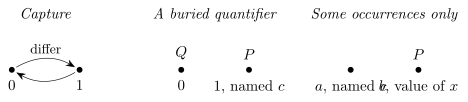
Three tiny worlds. In each, the premise is true
and the faulty line false. Capture:
Quick check. Which numbered clause
of
Solution. Capture breaks clause 4
(
5.3.7. A stall
Try the sequent
So with
Counter-readings. Each error above was shown wrong by a reading, a domain with a meaning for every symbol and a value for each free variable, in which the premises are true and the line is false. Call such a reading a counter-reading: it makes the whole counterexample set of the claim (Section 1.1), its premises and the negation of its line, true at once. A counter-reading shows that a step is unsafe. It is also how this book shows that a sequent has no derivation at all: a search that stalls proves nothing, since a cleverer derivation might exist. Sections 7.1 and 7.2 make readings exact and state that a counter-reading rules out every derivation. Until then, when this chapter says that something does not follow, it gives a counter-reading, and it never treats a stalled search as a proof.
5.3.8. The rule card
| the instance |
||
|---|---|---|
In each row every free
Not an instance. From
Quick check. Line 1 is
Solution. No, clause 3: every free
Chapters 1 and 2’s thirteen rules are on the card at the end of Section 3.1; here are this chapter’s so far.
| Rule | Shape | Side condition | You write | Lean |
|---|---|---|---|---|
| “In particular, for |
h t (or
specialize h t) |
Written mathematics has many forms of the phrase: “in
particular, for h is the universal
statement and t the term; applying
h to t gives the instance,
just as applying an implication to a proof of its
hypothesis gave its conclusion in Section 1.3. In Lean a
universal statement behaves like a function that takes a
term and returns a proof of the instance.
Warning (Not allowed:
- From
- From
- From
- From
5.3.9. The search method: one more step
The search method of Section 3.1 had a goal-directed step and a premise-directed step for each connective. Instantiation adds a premise-directed step.
- A resource
In the Givens/Goal table,
Instantiating is always safe, in the sense of Section 3.1: the new line is added and nothing is lost, since the universal line stays available. What can go wrong is only that the derivation fills with instances nobody needs, as a forward search filled with useless lines in Section 1.3.
5.3.10. Exercises
A. Check your understanding
(a) Write the schema of
(b) For each pair, decide whether line 2 follows from line 1 by one application of
- (i) Line 1:
- (i) Line 1:
- (ii) Line 1:
- (ii) Line 1:
- (iii) Line 1:
- (iii) Line 1:
- (iv) Line 1:
- (iv) Line 1:
(c) True or false, with a reason: from
(d) Why does
Solution.
(a) From line
- (b)
- (i) Not legal: the
term
- (i) Not legal: the
term
(ii) Not legal: only the first
(iii) Not legal: the main symbol of line 1 is
(iv) Legal: it is
(v) False. The main symbol is
(vi) Every term names an element of the domain: once the symbols are interpreted, a constant names one, and a compound term names the value of a function at elements. And the domain is never empty (Section 5.1). So “every element satisfies
Each part takes a line or two. The parts run from single steps, through a missing premise, a justification column and a judgement on one step, to whole derivations.
- (a) Line 1 is
- (b) Line 1 is
- (c) Line 1 is
- (d) Line 4 is
- (e) Justify each
line after the premises: 1
- (f) Line 1 is
- (g) Line 1 is
- (h) Line 1 is
- (i) Same line: is
- (j) Derive
- (k) Derive
- (l) Derive
Solution.
(a)
(b)
(c)
(d) Any two of
(e) 3
(f) No, clause 1: its main connective is
(g) No, clause 3: every free
(h) No, clause 4:
(i) Yes:
(j) 2
(k) 3
(l) 2
B. Practice
Give a derivation of
Solution. The goal
Read
Solution. The goal is a
conjunction, so its last line is
The premise is instantiated twice, along two
different paths: once at
Let
Solution. The goal is a conjunction
of two instances of the premise, at the compound terms
Lines 1–4 are the first derivation. For the second
goal only line 3 is needed:
A search for
Solution. The move is
instantiate at the term you need: the goal
names
For each claim, either derive it with the rules of
Chapters 1–2 and
- (a)
- (b)
- (c)
- (d)
- (e)
- (f)
- (g)
- (h)
Solution.
- (a) Derive.
Instantiate at
(b) Break. The domain
(c) Derive. Two instances of the one premise, at
(d) Break. The domain
(e) Break. The domain
(f) Derive. The instance at
(g) Break. The domain
(h) Derive, in one step: the only quantifier inside is on
- (e) and (f) are
look-alikes: the premise about
Marking scheme. (10 points) - 1 for
each of the eight verdicts with its derivation or
counter-reading. A counter-reading must give the domain,
every symbol’s meaning and the value of
C. Going deeper
A relation
Solution (Hint 1). The goal
Solution (Hint 2). The match gives
Solution. The search. The
goal
The terms. Lines 7 and 9 put
The hypothesis “related to something” is needed. In a
symmetric and transitive relation an element related to
nothing need not be related to itself: on
Marking scheme. (10 points) - 2:
identifies transitivity as the source of the goal and
instantiates it with
- (a) Show that
- (b) The reverse
step, from a line
Solution.
- (a)
12
Clause 1: the main symbol of line 1 is
- (b) Read
Marking scheme. (10 points) - 6: (a)
the derivation, with each of the five numbered clauses
checked (main symbol