Chapter 5 added one step to the search method in each
rule section, and Section 6.2 added laws. This section
puts the steps into one method, puts in order the moves
that do most of the work with quantifiers and names a
third, admits the propositional step TAUT into
derivations with quantifiers, and runs the four kinds of
task of Section 3.2 again. The new difficulty is names:
which term to instantiate at, when to open a box for a
witness, and which names a line may mention when a box
closes.
The search
method, extended
Section 3.1 put the moves for the connectives in
order. Each of Sections 5.3–5.7 added a step. Here is
the method with all of them.
Algorithm. Searching for a
derivation of in predicate logic.
- Set up. Write the premises at the top and
at the
bottom, with one gap between. Translate any definition
in words into a formula first, as in Example (Five definitions, translated).
- Goal-directed step. Take the
current goal’s main symbol and set up its introduction
rule:
- , , , : as in
Section 3.1;
- : open a flagged box with
a fresh name ;
the new goal, the box’s last line, is (Section
5.4). For , the box opens with the assumption ;
- :
postpone, as in Section 3.1;
- : postpone; work on the
premises until an available line shows a term with , then use
(Section 5.5). For , the line is needed
too.
Repeat while the goal is , , , , or .
- Premise-directed step. Take the
main symbol of a resource and apply its elimination
rule:
- , , , , and the
derived rules: as in Section 3.1;
- : open the box
early, as soon as the line is
available, with a fresh witness , and make its last
line the current goal, which must not mention (Section 5.6). An
early box lets the witness serve the goals that come
later;
- : do not instantiate blindly; instantiate
at the term that the goal, or another resource, mentions
(Section 5.3). For , the line is needed
too;
- an equation : use with a
chosen so
that one substitution turns an available line into the
goal, turning the equation round first if needed
(Section 5.7).
- Clash. As in Section 3.1: for the
goal , find or
manufacture a pair , ; an impossible
case closes itself by .
- Stuck. As in Section 3.1: on the
current goal, or on a
well-chosen statement.
When no gap is left, number the lines and check the
derivation as Definition 1.4.2,
extended in Section 5.4, says: every citation is
available, and every side condition holds ( free for at and
, bounded or not; and free for at ; a fresh
name at each line that closes a flagged box).
Two of the new steps deserve a word on their place in
the order. The goal step for is safe in the
same way as the goal steps for and (Section 3.1): if
is
derivable at all, then so is for a fresh
, by one more
; so opening the box loses nothing. The goal
step for is
unsafe in the same way as the one for : a witness chosen
too early may be the wrong one, as in Example (Derivations with existential introduction),
where “take ”
stalled. That is why is postponed and
the boxes of the premises are opened early: the
witnesses they supply are often the terms the postponed
goal is waiting for, as was in the limit
derivation of Section 6.1.
Three moves
for quantifiers
Most first-order searches turn on three moves. The
first two carry the names Chapter 5 gave them; what is
new here is their order, which the method above already
follows.
Name the witness early (Section
5.6). When an line is among the
resources, open its box at once, with a fresh witness,
and make the box’s last line the current goal. The
witness costs nothing to name, and it is often the very
term that a
line or the goal is waiting for.
Instantiate at the term you need
(Section 5.3), and so not before that term is known. A
line can be
instantiated at any term at all, which is exactly why
instantiating it before the goal or a witness names the
term is a blind choice. Wait for the witnesses, then
instantiate at them.
The propositional core. Once the
boxes are open and the lines are
instantiated, what is left is often a step that holds
for propositional reasons alone. The subsection “The
propositional core” below names this move and gives it a
one-line step.
Two pairs of steps recur:
followed by , which
applies a general law at one point, and
followed, inside its box, by with
a term built from the names in hand.
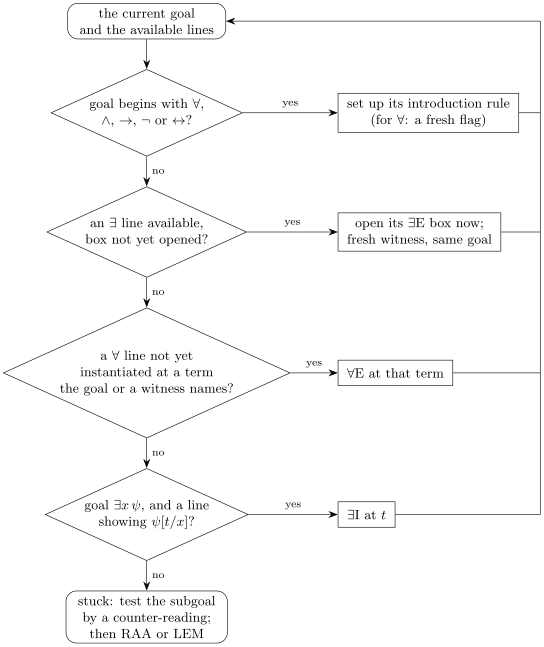
The next move, read off the goal and the lines in
hand:
The last edge reads “no”, not “impossible”: the chart
is a guide to the next move, and it makes no claim that
every derivable sequent is found by following it. It
leaves out the premise-directed connective steps, the
clash and the propositional core (TAUT, below); for
those, follow the method above.
Example
(A search that waits for its witnesses)
Show that .
Idea. The goal is an : postpone it.
Premise 3 is an : open its box
now, with witness (left). Premise 1 is
a , and
is now the term
it needs: then gives
an line.
Open that box at once, with witness (right). Premise 2
needs two terms, and both are in hand: , then . The postponed goal
gets its witness, .
In the left snapshot the gap’s goal is still : an
box keeps the goal it was opened for, and
its assumption, line 4, says “” and nothing more.
In the right snapshot the same goal has moved one box
further in, and line 7 is now the only line that asserts
of particular
terms.
1
2
3
4asm, for
12?
13?
1
2
3
4asm, for
5 1
6 5, 4
7asm, for
11?
12?
13?
Solution.
1
2
3
4asm, for
5 1
6 5, 4
7asm, for
8 2
9 8
10 9, 7
11 10
12 6, 7–11
13 3, 4–12
At line 12,
is not in line 12, in line 6, in the premises, or in the
open assumption on line 4. At line 13, is not in line 13, in
line 3, or in the premises, and no assumption is
open.
Read over ,
with as “”, as “” and as “ is odd”: every positive
integer has a ; every number of the form is odd; some
integer is positive; so some integer is odd.
Compare a search that starts with premise 1, before
any witness is named. It must instantiate at some term,
a variable or a constant that nothing mentions, say
; the line then waits for , which no premise
gives. The box of premise 3 supplies the term that makes
premise 1 usable.
Quick check. Why is line 8 an
instance at ,
and not at some other term?
Solution. Line 7, the only line
that asserts of
particular terms, mentions and . Premise 2 is useful
only at the terms that line names. This is the move
“instantiate at the term you need”: the terms were known
only once the witnesses were named.
Steps that
are right for propositional reasons
Inside the boxes of a first-order derivation, many
steps are propositional: ,
,
a contrapositive, a case split. Section 4.8 let a
propositional derivation take such steps in one line, as
TAUT. With quantifiers the step must not look inside a
quantifier, and the next definition says exactly what it
may look at.
Definition
6.3.1 (Propositional Skeleton)
Call a first-order formula prime if
it is atomic and not , or begins with a
quantifier, bounded or not. Assign to each prime formula
a propositional atom, the same atom to
two prime formulas exactly when one can be turned into
the other by finitely many renamings of bound variables
(Section 5.2), in either direction; this is an
equivalence relation, so the assignment is well defined.
The propositional skeleton of a
formula is
defined by recursion: ;
is
the atom of for
a prime formula ; ; and
for each of ,
, , . The
formulas of one list take their skeletons from one
assignment.
The skeleton keeps the connectives outside every
quantifier and hides everything else; this is not the
skeleton of a derivation that Section 3.1 reads off the
goal, and wherever the two could be confused, the book
says “propositional skeleton” for this one. For example,
since and differ only by renaming and so share
the atom .
Why only renaming? The formulas and are provably
equivalent (Proposition 6.2.6
(a)), yet the first is prime and the second is a
conjunction of two prime formulas. If provable
equivalence were allowed to merge atoms, the skeleton
would depend on what has been derived, and a TAUT line
could hide a quantifier step inside a table. Renaming is
different: whether two formulas differ only by renaming
bound variables can be seen by comparing them symbol by
symbol, so anyone can compute the skeleton without a
derivation. And is kept as itself,
not given an atom, so that is a tautology
and a cited line entails every
skeleton, as says it should; an atom would have neither
property.
Proposition
6.3.1 (Tautological Steps on the
Skeleton)
Let be a
list of first-order formulas and a formula, with
skeletons taken from one assignment. If the skeletons of
semantically
entail (Definition 4.5.3),
then . If no two different prime formulas
occurring outside all quantifiers in and share an atom, the
derivation uses only the rules of Chapters 1 and 2.
In words: a step that is right for propositional
reasons alone is derivable, with the quantified parts
carried along untouched.
The proof takes the propositional derivation that
completeness provides and puts the prime formulas back
in place of their atoms; it is in the fold below.
↺Second readingThe
proof: completeness on the skeleton, then
substitution
Proof. Step 1: no two different
prime formulas outside all quantifiers share an
atom. By Corollary 4.8.5
(completeness, Section 4.8) there is a derivation of with the rules of Chapters 1
and 2; its lines are propositional formulas. Replace, in
every line of ,
each atom of ,
by the prime formula of , to which it was
assigned, and any other atom by . This is the
substitution of formulas for atoms that Definition 2.3.1
makes for letters, and that Lemma 4.5.3
makes for meaning. Every rule of Chapters 1 and 2 is a
schema in formulas, and the replacement commutes with
each connective and leaves alone. So each line
keeps its rule and its citations, and each box keeps its
extent and its assumption; this holds for , and as for
the others. has
no flagged box, so no side condition about names arises.
Each premise
becomes , and
the last line becomes . So the result is a
first-order derivation of (Definition 1.4.2,
as Section 5.4 extended it), and it uses only the rules
of Chapters 1 and 2. This is the second sentence of the
statement.
Step 2: the general case. Choose one prime
formula for each atom, and let be with every prime
formula occurring outside all quantifiers (the
occurrences the skeleton sees) replaced by the chosen
one of its atom. Prime formulas with one atom differ
only by renaming. A renaming is a provable equivalence
whose closure is derivable (the renaming sentence after
Proposition 6.2.4),
so Proposition 6.2.4,
applied one occurrence and one renaming step at a time
(through a letter new to the formula where needed), with
the steps chained by Lemma 2.3.3
(c), gives for each formula of the list, and
. The formulas and have the same
skeletons as
and , and in
them no two different prime formulas outside all
quantifiers share an atom, so Step 1 gives .
Now Lemma 2.3.3
(Section 2.3) chains for each , then ,
then . Each pasted block’s flags are first
renamed to names new to the whole derivation, as “The
laws as one line” (Section 6.2) argues. Then no flag of
a pasted block occurs in a premise or an open assumption
of the derivation it is pasted into, so every and
side condition of the block still holds, and
Lemma 2.3.3
(c) holds for these first-order derivations by the same
pasting. So .
TAUT on the skeleton. From now on, a
line of a derivation may be justified , citing
available lines, when their skeletons semantically
entail its skeleton (Definition 4.5.3),
all from one assignment; with no cited lines, when its
skeleton is a tautology. This is Definition 4.8.1
of Section 4.8, applied to skeletons. By Proposition 6.3.1
the line abbreviates a block of primitive steps, pasted
in with any flags renamed to names new to the whole
derivation, as “The laws as one line” (Section 6.2)
allows. As in Section 4.8, use TAUT only for a step a
written proof would leave unsaid.
These are TAUT steps:
- from and to ,
since ;
- from and to : modus tollens on the skeleton, .
These are not:
- from to : the two prime formulas do not differ by
renaming, so the skeletons are and , and . The step
is derivable, by Example (Flagged boxes at work)
(c), and that derivation looks inside the
quantifiers;
- from to : the skeletons are
and ; this is ;
- : the
skeleton is one atom, not a tautology; this is .
Quick check. Which are TAUT steps?
(a) From to . (b) From to . (c) From to
.
Solution.
- (a) Yes: . (b) No: the skeletons are two different
atoms; the step is Proposition 6.2.6
(a), which looks inside . (c) No: the
skeletons are and ;
the step is QN (a) of Section 6.2, which needs the
quantifier rules and .
Warning (Not allowed: TAUT).
- From to .
Looks inside a quantifier; needs a flagged
box.
- From to . An instance,
not an entailment of skeletons; needs .
- From to
.
Needs .
- From and
to . The skeleton is
,
which fails; needs .
- Citing a line inside a box that has closed. Not
available, whatever the table says (Definition 1.4.2).
The
propositional core
Many first-order derivations have the same shape.
Open the boxes the goal asks for, instantiate every
line at the
names in play, then finish with a step that is
propositional. The quantifiers frame the derivation, and
its core is a truth-table fact.
Example
(A propositional core inside a flagged box)
Show that .
Solution.
1
2
3 1
4 2
5 3, 4
6 3–5
The skeleton of line 5’s step is . At line 6, is not in a premise
or in line 6, and no assumption is open.
Read over ,
with as “”, as “” and as “”. The first
premise says “if , then or ”, true since gives ; the second says that no integer squares to
. Both premises
are true under this reading, and so is the conclusion,
which says that every integer greater than is positive. The
quantifier part of the derivation is two instantiations
and one generalization, and its core is
propositional.
The order of the steps is the point. TAUT could not
have been applied to the premises themselves: their
skeletons are two atoms and , and the goal’s is a
third, , and . Only
after the flagged box is open and both premises are
instantiated at its flag do the lines show the
connectives that the table needs. So the move reads:
boxes first, instances at the flag second, and the table
last.
Quick check. Write out what line 5
abbreviates, with the rules of Chapters 1 and 2.
Solution. Lines 5–13 below replace
the one TAUT line:
1
2
3 1
4 2
5asm, for
6 3, 5
7asm, for
8 7, 4
9 8
10asm, for
11 10
12 6, 7–9, 10–11
13 5–12
14 3–13
That is nine lines in place of one. A written proof
would say “so , since ”.
Four kinds
of task, with quantifiers
Section 3.2 sorted propositional problems into four
kinds, and the kind decides how the search begins. The
same four come back. A theorem has no
premises; an equivalence
needs two derivations; inconsistency of
a list is a derivation of from it (Section
3.2’s definition reads the same for first-order
formulas, now with all the rules); and derive or
break withholds the verdict. A claim is broken
by a counter-reading, which makes every member of its
counterexample set true (Section 7.2).
Example
(One pair of predicates, four tasks)
- (a)
Theorem. Show that .
- (b)
Equivalence. Show that .
- (c)
Inconsistency. Show that the list is
inconsistent.
- (d) Derive or
break. Decide and its converse.
Solution. (a) With no
premises the search starts from the goal alone: an box,
then the
goal waits for a line that shows an instance.
1asm, for
2 1
3 2
4 3
5 1–4
Line 2 instantiates at the variable itself, and line 4 uses
at ,
as in Proposition 5.5.1.
Any term would have done as the witness, since line 1
holds at every term; the variable is simply the term at
hand, and no constant has to be invented.
(b) The E form of Section 6.2 says the same
with its two predicates exchanged: “no is ” is “no is ”. An equivalence is two
searches, and here the second is the first with the
letters exchanged, so one search does the work of both.
Each direction opens a flagged box, instantiates at its
flag, takes one TAUT step and generalizes:
1
2 1
3 2
4 2–3
1
2 1
3 2
4 2–3
The skeletons are and the same with
and exchanged.
(c) An A form and its O form (Section 6.2).
The goal is ,
so the clash step of the method applies, but no pair
, is in sight
among the premises: the clash lives at a witness. The
premise
opens its box at once, the premise is
instantiated at the witness, and the clash is
propositional:
1
2
3asm, for
4 1
5 3, 4
6 2, 3–5
Line 5’s skeleton is .
(d) With the verdict withheld, spend a
minute on each side before committing. For the first
claim, a reading that makes the premise true and the
conclusion false would need every to be a , every element to be a
, and some element
not a , which
cannot happen; so try to derive it. For the converse, a
false hypothesis makes the premise true cheaply, which
suggests a break.
The first claim derives. Lines 3–6 are Example (Flagged boxes at work)
(b), run inside the box of line 2:
1
2asm, for
3 2
4 1
5 4, 3
6 3–5
7 2–6
At line 6,
is not in the premise, in line 6, or in the open
assumption on line 2.
The converse breaks. Over , read as “even” and as “positive”. “Every
integer is even” is false, so the premise “if every
integer is even, then every integer is positive” is
true; the conclusion “every even integer is positive” is
false at .
Test the subgoal by a
counter-reading. Section 4.7 tested a
propositional subgoal by a refuting row before chasing
it. The first-order form of the move is the same. When a
search produces a subgoal, look for a reading that makes
the available lines true and the subgoal false before
you chase it. If you find one, the subgoal is the wrong
one: Section 7.2 states that such a reading rules out
every derivation of it from those lines. Return to the
step that produced it, and choose differently there:
another term for a , a box opened earlier, or a different case
split. A reading takes a minute to find, and it can save
the search a long chase.
Quick check. A search for the limit
derivation of Section 6.1 instantiates the premise at
instead of , and
reaches the subgoal with available. Find a sequence and
numbers that make every available line true and the
subgoal false.
Solution. Take ; for every except ; and
. The
premise holds, since the sequence is eventually constant
at . Every term is
within
of , so the
instance of the premise at and the box
line
hold;
holds; and . But . The subgoal is the wrong one; go back to the
choice of term.
Quick check. Which task is , and how long is its
derivation with TAUT?
Solution. Inconsistency. Three
lines below the premise:
1
2asm, for
3 2
4 1, 2–3
A library
of first-order sequents
Here is what the book has proved about quantifiers,
grouped by use; a search that needs one of these can
copy its derivation, with formulas in place of letters,
rather than rediscover it.
The laws of Section 6.2 may already be used as one
line, by “The laws as one line”; the other rows are
patterns to copy. Either way, a row is used by matching
its shape and then checking its conditions: the passage
laws need the moved variable not free in the other side,
a renaming needs a letter new to the formula, and an
instance of a row’s letters must be free for the
variables it replaces.
Exercises
A. Check your
understanding
Exercise
(A1)
- (a) What is the
propositional skeleton of ? Is it a
tautology?
- (b) What is the
propositional skeleton of ? Can
a TAUT step derive from this
formula?
- (c) Which are TAUT
steps? (i) From and to . (ii)
From and to . (iii) From
to .
- (d) In Example (A search that waits for its witnesses),
why is the box on premise 3 opened before premise 1 is
used?
- (e) A
counter-reading makes the premises of a claim true and
its conclusion false. What may you say now, and what
will Section 7.2 add?
Solution. (a) :
and differ only by renaming, so they share
. It is not a
tautology: true
and false make it
false.
(b) . The two prime formulas are not
renamings of each other ( against
),
so they get different atoms, and is true
in a row: no.
is derivable all the same, by an box
on the first conjunct, a TAUT step inside it to ,
, and a clash with the second conjunct.
(c) (i) Yes: . (ii) No: ; it is
at ,
then . (iii)
Yes: .
(d) Premise 1 is a whose useful term
is not yet known, and the box supplies it, . These are the moves
“name the witness early” and “instantiate at the term
you need”, in that order.
(e) Now: the claim breaks, and a search for
it is abandoned. Section 7.2 states that such a claim
has no derivation.
B. Practice
Exercise
(B1: Derive or break, twelve claims)
Derive each claim, with TAUT allowed, or break it by
a reading over
that makes every member of its counterexample set true.
The groups say which move to try first; they do not say
which claims hold. Claims 1–3: name the witness early.
Claims 4 and 5: instantiate at the term you need. Claims
6–8: the propositional core. Claims 9–12: move a
quantifier, or derive .
- .
- .
- .
- .
- .
- .
- .
- .
- .
- .
- .
- .
Solution. 1. Derive. The
box of the witness opens first; inside it, premise 2 is
instantiated at , and the postponed
goal takes the compound witness .
1
2
3asm, for
4 2
5 3, 4
6 5
7 1, 3–6
Line 5’s skeleton is . At line 7,
is not in line
7, in line 1, or in a premise.
2. Breaks. Read as “”. The
premise is true, since ; the conclusion fails at , since for every
.
3. Derive.
1
2
3asm, for
4 2
5 4, 3
6 5
7 6
8 6–7
9 1, 3–8
At line 8,
is not in a premise, in the open assumption on line 3,
or in line 8. At line 9, is not in line 9, in
line 1, or in a premise.
4. Derive. The term premise 1 needs is , and premise 2
names it.
1
2
3 2
4 1
5 4
6 5, 3
7 3–6
Line 5 instantiates at , which is free for
. At line 7, is not in a premise
or in line 7, and no assumption is open.
5. Breaks. Read as and as . Every , so the
premise is true; no , so the conclusion is false.
6. Derive.
1
2
3 1
4 2
5 3, 4
6 3–5
Line 5’s skeleton is .
7. Derive.
1
2
3 1
4 2
5 3, 4
6 3–5
Line 5’s skeleton is .
8. Breaks. Read as “even” and as “odd”. Every integer
is even or odd; not every integer is even; and is not odd, so “every
integer is odd” is false.
9. Derive.
1
2asm, for
3asm, for
4 1
5 4, 3
6 5
7 2, 3–6
8 2–7
At line 7,
is not in line 7, in line 2, in the premise, or in an
open assumption (line 2’s box is still open, and line 2
does not mention ).
10. Breaks. Read as “” and as “”. The
premise holds, since the only with has . In the
conclusion, is true and is false, since ; so the
implication is false.
11. Derive. Premise 2 is instantiated twice,
at and at , the two terms that
premise 1 at
mentions.
1
2
3 1
4 2
5 2
6 3, 4, 5
Line 6’s skeleton is : no
row makes all three true.
12. Breaks. Read as . Every integer has a
larger one, and excludes . Both premises are true, and is true, so the
whole counterexample set is true: the list is not shown
inconsistent.
Seven claims derive and five break. Four breaks sit
beside a derivable look-alike: 5 beside 4, 8 beside 7,
10 beside 9, and 12 beside 11. Claim 2 weakens the
premise of the derivable of Example (Derivations with existential introduction)
(c). Every break is a counter-reading (Section 7.2).
Marking scheme. (10 points) - 4: the
twelve verdicts, point for each
correct one, rounded down. - 3: the seven derivations,
each with every closing side condition checked and every
TAUT line’s skeleton named. - 3: the five readings, each
with every premise and the conclusion evaluated. Fatal
errors (0 for the claim): a TAUT line that looks inside
a quantifier; a “break” with a premise false.
Exercise
(B2: Two witnesses in a row)
The premises are 1 , 2 and 3 ; the goal is . Here is a partial
derivation:
1
2
3
6asm, for
16?
17?
Name the move, then complete it.
Solution. The move is “name the
witness early”, twice, with each line instantiated
only at the terms in hand: (premise 3) first, then
the witness .
1
2
3
4 1
5 4, 3
6asm, for
7 2
8 7
9 8, 6
10 1
11 10, 9
12asm, for
13 6, 12
14 13
15 14
16 11, 12–15
17 5, 6–16
Lines 4 and 7 instantiate at , and lines 8 and 10 at
; line 15 is
at ,
which is free for . At line 16, is not in line 16, in
line 11, in the premises, or in the open assumption on
line 6. At line 17, is not in line 17, in
line 5, or in the premises.
Marking scheme. (10 points) - 2:
names the move. - 3: opens the two boxes as soon as
their lines
exist. - 3: the
lines at , , and , the terms read off
the lines in hand. - 2: the two side conditions. Fatal
error (0 for the step): on
line 15 before line 14, so that the witness appears in the box’s
last line.
Exercise
(B3: How much TAUT saves)
- (a) Derive twice: once without TAUT, once with
exactly one TAUT line. Count the lines.
- (b) Is the step from
to a TAUT step?
Solution. (a) With TAUT,
six lines (left); without it, ten (right):
1
2
3 1
4 2
5 3, 4
6 3–5
1
2
3 1
4 2
5asm, for
6 3, 5
7 4, 6
8 5, 7
9 5–8
10 3–9
Line 5 on the left has the skeleton .
(b) No: the two formulas are prime and not
renamings of each other, so their skeletons are two
different atoms. The step is derivable by instantiating,
one TAUT line () and generalizing,
the pattern of Example (One pair of predicates, four tasks)
(b).
Marking scheme. (10 points) - 3: the
TAUT derivation, with the skeleton named. - 4: the
derivation without TAUT. - 1: the count. - 2: (b), with
the reason. Fatal error (0 for the step): a TAUT line
citing the
lines directly to reach .
C. Going deeper
Exercise
(C1: Some index decides, used later)
Let say
“” for a
sequence ,
over a domain of indices.
- (a) Derive , with on .
- (b) Derive it again
in two lines, from one TAUT line and one law of Section
6.2.
- (c) Say in two
sentences which index the sentence promises, and why the
derivations of (a) and (b) name none.
Solution (Hint 1). For (a): in the
case , which law of Section 6.2 turns the
negated
into an ?
Solution (Hint 2). For (b): the
formula has the skeleton . Which passage
law moves the out of the hypothesis of an implication,
turning it into ?
Solution. (a)
1
2asm, for
3asm, for
4 2
5 3–4
6 5
7asm, for
8QN (a) 7
9asm, for
10VI 9
11 10
12 8, 9–11
13 1, 2–6, 7–12
Line 6 is at
the variable
itself, as in the proof of passage law (d); as there,
the step is sound because every domain is non-empty
(Section 7.1). Line 11 is at
. At line 12,
is not in line
12, in line 8, or in the open assumption on line 7.
(b)
1
2passage (d) 1
The two prime formulas of line 1 differ only by
renaming, so the skeleton is , a tautology.
Line 2 is Proposition 6.2.7
(d), the direction , used as one line
(“The laws as one line”), with the formula and the formula , in
which is not
free.
(c) If every term is positive, any index
will do; if not, an index with does, since
then the implication is vacuously true. The derivation
splits on which case holds without deciding it ( in (a),
the classical direction of (d) in (b)), so it never
names the index.
Marking scheme. (10 points) - 4:
(a), with the split,
both cases closed, with the side condition of every line
that closes a flagged box checked. - 3: (b), with the
TAUT line justified by renaming, and law (d) with its
condition checked. - 3: (c). Fatal errors (0 for the
step): giving and different atoms and then claiming the
TAUT line anyway; at
after its box
has closed.
Exercise
(C2: Every M is P, every M is S, so some S is P?)
- (a) Break by a reading over .
- (b) Add the premise
and derive the conclusion.
- (c) Which line of
(b) needs the new premise, and what does Section 5.1’s
existential import have to do with it?
Solution. (a) Breaks. Read
as “ is an even prime
greater than ”,
which is true of no ; as “ is odd”; and as “ is even”. Both premises
are vacuously true, since their hypothesis is false for every
, and “some even
number is odd” is false (Section 7.2).
(b)
1
2
3
4asm, for
5 1
6 2
7 4, 5, 6
8 7
9 3, 4–8
Line 7’s skeleton is . At line 9,
is not in line
9, in line 3, or in a premise.
(c) Line 7: its TAUT needs , line 4, which
only the box of premise 3 supplies. Without it,
could still be applied at some term, but no line would
say that term is
and . A “for
every” claims no instance, so the old reading of “every
is ” as also saying that
there are s is not
the book’s reading. With that reading the inference was
valid; without it, the premise must be added.
Marking scheme. (10 points) - 3:
(a), with all three truth values justified. - 4: (b). -
3: (c). Fatal error (0 for the step): a “break” whose
is true of some
number.