1.1  Statements, Arguments and How to Break One

When is an argument a proof? This section says what the sentences of a proof are, how they are built from smaller ones, and how to test the form of an argument by trying to break it.

1.1.1. Two arguments about squares

Recall that an integer n is even when n=2k for some integer k, and odd when n=2k+1 for some integer k. Here is a fact about integers.

For every integer n, if n2 is even, then n is even.

Read the following two arguments for it. Each is written in the style of a textbook proof, and each claim in each of them is true.

Argument A. Suppose n is odd, say n=2k+1 for an integer k. Then n2=4k2+4k+1=2(2k2+2k)+1, so n2 is odd, and therefore n2 is not even. So an odd n never has an even square. Since every integer is even or odd, an integer with an even square must be even.

Argument B. Suppose n is even, say n=2k for an integer k. Then n2=4k2=2(2k2), and 2k2 is an integer, so n2 is even. Hence if n2 is even, then n is even.

Argument A is a correct proof. Argument B is not, although none of its claims is false. It starts from “n is even” and arrives at “n2 is even”. That is a perfectly good proof of a different statement: “if n is even, then n2 is even”. The claim asks for the journey in the opposite direction, from the square back to the number, and the last sentence of B announces a conclusion that the argument never reached.

Seeing this is easy once it is pointed out. Saying in general what went wrong is harder, and that is what this chapter and the next are for. To name the error we need to know what the rules of proof are, and before that, what they act on. So we start with the smallest pieces: the sentences a proof is made of.

1.1.2. Statements

A proof is written in sentences, but not every sentence can appear in one. “Is 91 prime?” asserts nothing, so it cannot serve as a premise or a conclusion; neither can “Let us now turn to the case n=0.” The sentences a proof asserts are the ones that make a claim. A proof also has steps of another kind, such as “Suppose n is odd”, which assert nothing but set up a temporary hypothesis; their rules come in Section 1.4.

A statement is a sentence that is either true or false.

Definition 1.1.1 (Statement)

A statement is a declarative sentence that is either true or false, and not both.

In words: a statement makes a claim, and the claim is either correct or incorrect. The definition asks that one of the two is the case. It does not ask that we know which one. A statement whose truth nobody has settled is still a statement.

Example (Statements and nonstatements)

Decide which of the following are statements.

  • (a) 7 is a prime number.
  • (b) 0.999>1.
  • (c) There are infinitely many primes p for which p+2 is also prime.
  • (d) Is 211−1 prime?
  • (e) x>2.
  • (f) 3>2.

Solution.

  • (a) This is a statement, and it is true.

  • (b) This is a statement, and it is false. A false sentence is as much a statement as a true one.

  • (c) This is a statement. It is the twin prime conjecture, and at the time of writing nobody knows whether it is true. It is certainly true or false, which is all the definition asks.

  • (d) This is a question, so it is not a statement. The sentence “211−1 is prime” is a statement, and a false one, since 211−1=2047=23⋅89.

  • (e) This is not a statement. Whether it is true depends on what x is: it is true when x=3 and false when x=0, and as written nothing says which. Such a sentence is called an open sentence.

  • (f) This is the sentence of (e) with x replaced by 3, and it is a true statement.

Items (e) and (f) differ by one symbol, and the difference is the whole point. The open sentence x>2 becomes a statement in two ways. We can put a number in for x, as in (f). Or we can say which x we mean in some other way, as in “for every real number x, x>2” (a false statement) or “for some real number x, x>2” (a true one). The words “for every” and “for some” are the quantifiers.

Remark. Convention: a fixed but arbitrary number. When an example says “let x be a real number” and then talks about x, the letter names one number, fixed for the whole example, that we are not told. Every sentence about x is then a statement, true or false according to which number x is: with x=3, “x>2” is true; with x=0, it is false; and the example does not know which x it has. So an argument about x may use only what holds whatever x is, and an argument that never peeks at x works for x=3, for x=0, and for every other number at once.

Quick check. Let x be a real number. Is “x>2 or x≤2” a statement? Is it true?

Solution. Yes: by the convention it is a claim about one fixed number x. And it is true whatever x is, since every real number is either greater than 2 or at most 2.

Second readingStatements or propositions?

Remark. The book reserves the words “proposition” and “theorem” for proved results, so it calls the sentences of logic statements. Other books call them propositions, which is where the name propositional logic, for what this chapter and the next study, comes from.

1.1.3. The connectives

Most statements in mathematics are built from smaller ones. “0<x and x<1” is built from “0<x” and “x<1” with the word “and”. “If n2 is even, then n is even” is built from two statements with “if … then”. The words that do the building are the connectives. A statement built from smaller statements by a connective is compound; one that is not is atomic. For this chapter, “x>0” is atomic: it has an inner structure, a number and an order, but no connective joins parts of it.

We write P, Q, R, S for statements whose inner structure we are ignoring. They stand for arbitrary statements, atomic or compound. There are five connectives. In the last column, x is a real number, and every example is true whatever x is.

Symbol Name Read Example
P∧Q conjunction P and Q x2≥0 and x2+1>0
P∨Q disjunction P or Q x≥0 or x<0
P→Q implication if P, then Q if x>1, then x2>1
P↔Q biconditional P if and only if Q x2=0 if and only if x=0
¬P negation not P not x2<0, that is, x2≥0

To the five connectives we add one statement with no parts at all, written ⊥ and read “contradiction”. It stands for a statement that is false however things stand: 0=1 will do. A proof that reaches ⊥ has shown that the situation it was working in cannot occur. That is the heart of proof by contradiction, and the rules for ⊥ come with those for “not”.

In P→Q, the statement P is the hypothesis (or antecedent) and Q the conclusion (or consequent). “If and only if” is often shortened to iff.

Several English words become ∧: “but”, “although”, and “while” all assert both parts, and add a tone of contrast that logic ignores. “2 is prime but not odd” is a conjunction. So is “neither … nor”, in disguise: “9 is neither even nor prime” asserts that 9 is not even and that 9 is not prime, which is ¬P∧¬Q with P: “9 is even” and Q: “9 is prime”.

Chained inequalities are conjunctions in disguise too. 0<x<1 abbreviates (0<x)∧(x<1), and a≤b≤c abbreviates (a≤b)∧(b≤c). The symbol ≤ itself hides a disjunction: a≤b means (a<b)∨(a=b). And a≠b is the negation ¬(a=b). All three facts are used often in the sections that follow.

In theorem statements the book writes ⇒ and ⟺, as mathematicians usually do, and in running prose it says “implies” and “if and only if”. The arrows → and ↔ are kept for statements written in logical symbols, as in this section, whether built from letters like P→Q or from formulas like (x>1)→(x2>1), and for the formal derivations that start in the next. Nothing but typography separates the two pairs.

Warning. In everyday English, “or” is often exclusive: “soup or salad” on a menu means one but not both. In mathematics, P∨Q is inclusive: it is true when P is true, when Q is true, and when both are. For a real number x, “x≥0 or x≤0” is true whatever x is; at x=0 both parts are true, and that does not spoil it. An exclusive “or” must be said in full: “P or Q, but not both”, which is (P∨Q)∧¬(P∧Q).

Warning. The word “if” means different things in a theorem and in a definition. In a theorem, “if P, then Q” is one direction only: “if n is divisible by 4, then n is even” is true, and its converse is false at n=2. In a definition, “a number is even if it is twice an integer” is meant as “if and only if”: a number that is not twice an integer is not called even.

1.1.4. When is an implication broken?

Read P→Q as a promise: whenever P holds, Q holds too. A promise is broken only when its condition is met and the promised thing fails.

An implication is broken only when its hypothesis holds and its conclusion fails.

Take the table’s example, “if x>1, then x2>1”. Its two parts can be true or false in four combinations:

Informal: a reading of “if”, not yet a rule of proof.
P: x>1 Q: x2>1 the promise a value of x
true true kept x=3
true false broken none: this is why the promise holds for every x
false true not broken: it says nothing x=−3
false false not broken: it says nothing x=0

(No value lands in the second row: if x>1, then x2>x>1.) This answers the question “what if P is false?”: then P→Q is not broken, so it counts as true. To show P→Q false, exhibit one case with P true and Q false.

Quick check. Which of x=3, x=−3, x=1 breaks “if x2>4, then x>2”?

Solution. Only x=−3: 9>4 holds and −3>2 fails. At x=3 both parts hold; at x=1 the hypothesis fails, so nothing is promised.

1.1.5. “Only if”, “necessary” and “sufficient”

English has many ways of saying P→Q: “P implies Q”, “Q if P”, “Q whenever P”, “P only if Q”, “P is sufficient for Q”, and “Q is necessary for P”. To sort out the last three, ask of each sentence: when is it broken? Let x be a real number, with P: “x>2” and Q: “x2>4”.

  • “x>2 only if x2>4” says that x>2 never happens without x2>4. It is broken exactly when x>2 and x2≤4, which is exactly when P→Q is broken. So “P only if Q” is P→Q. It is true here: if x>2, then x2>2x>4.
  • The reverse, “x2>4 only if x>2”, is Q→P, broken by x=−3 (the Quick check above).
  • “x2>4 is necessary for x>2” says that there is no x>2 without x2>4: again P→Q. “x>2 is sufficient for x2>4” says that x>2 is enough to guarantee x2>4: P→Q once more.
English broken when symbols
P only if Q P true, Q false P→Q
Q if P P true, Q false P→Q
Q is necessary for P P true, Q false P→Q
P is sufficient for Q P true, Q false P→Q

“If” and “only if” put the same two statements in opposite directions: “Q if P” is P→Q, while “Q only if P” is Q→P. Confusing them is Argument B’s mistake.

1.1.6. Translating a sentence

Translating into symbols is a skill of its own, best learned slowly, in three steps. Find the atomic statements, the smallest pieces that make a claim, and give each a letter. Find the connectives, whatever English words carry them. Then decide how the pieces group.

Take “if 12 is divisible by 3 and by 4, then 12 is divisible by 6”. The atomic statements are P: “12 is divisible by 3”, Q: “12 is divisible by 4” and R: “12 is divisible by 6”. English lets “12 is divisible by” be said once and shared; logic writes each piece in full. The words “if … then” carry →, and “and” carries ∧. The hypothesis is everything between “if” and “then”, so the statement is (P∧Q)→R, not P∧(Q→R). The second reading would claim P outright, and the English sentence claims nothing outright: it only says what follows from what.

A second example shows a connective hidden inside a word. Let x be a real number, and read “x is non-zero, and if x is positive, then so is x3”. With Z: “x=0”, P: “x>0” and C: “x3>0”, “non-zero” is ¬Z, and the whole sentence is ¬Z∧(P→C). Letters that recall their statements, as here, often help; a letter is only a name.

In both examples the English word order is a poor guide to the grouping. When in doubt, ask of each connective: which two statements does it join?

1.1.7. A phrase book

Many English phrases carry a connective in disguise. The table collects the common ones; in each row, ask the question of “Only if”: when is the sentence broken? In the examples, n is an integer and x is a real number.

English paraphrase symbols example
P provided Q if Q, then P Q→P x2>4 provided x>2
P whenever Q if Q, then P Q→P n2 is even whenever n is even
P but Q P and Q P∧Q 2 is prime but even
neither P nor Q not P, and not Q ¬P∧¬Q 9 is neither even nor prime
not both P and Q not (P and Q) ¬(P∧Q) 9 is not both odd and prime
exactly one of P, Q P or Q, and not both (P∨Q)∧¬(P∧Q) exactly one of x>0, x<1
at least two of P, Q, R some two of them hold ((P∧Q)∨(P∧R))∨(Q∧R) at least two of: n even, n>0, n a multiple of 3

“Unless” is Exercise C1.

“Neither … nor” and “not both” differ by one word and say different things. At n=3, “n is neither even nor prime” is false, since 3 is prime, while “n is not both even and prime” is true. In the “exactly one” row, at x=2 exactly one part holds (2>0, and 2<1 fails); at x=12 both hold, so “exactly one” fails. In the last row, n=6 satisfies all three parts, and n=−3 only one: it is a multiple of 3, but odd and negative.

Quick check. Let n be an integer, with E: “n is even” and P: “n is prime”. Translate “exactly one of: n is even, n is prime”, and decide it at n=2, n=9 and n=7.

Solution. (E∨P)∧¬(E∧P). It is false at 2, where both parts hold; false at 9, where neither does; and true at 7, which is prime and not even.

Not every “and” joins two statements. Some sentences with “and” in them make one claim about several things together.

  • “4 and 9 are coprime.” Not: “4 is coprime ∧ 9 is coprime”. Coprime is a relation between two numbers (their only common positive divisor is 1), so the sentence is one atomic statement about a pair. Contrast “4 and 9 are squares”, which is a conjunction.
  • “The points A, B, C are collinear.” Not: a conjunction of three statements about single points. Collinearity is one statement about all three points at once.
  • “1.414 is an approximate root of x2−2=0.” Not: “1.414 is approximate ∧ 1.414 is a root”. It is not a root, since 1.4142=1.999396. “Approximate” changes the meaning of “root”, and nothing here is a conjunction.

By contrast, “12 is a positive even number” is the conjunction of “12>0” and “12 is even”.

Remark. Everyday readings. Four kinds of word mean something different in mathematics from what they mean in conversation, and the everyday reading translates wrongly.

  • “Or” is inclusive: the first warning of “The connectives” above.
  • In a definition, “if” is read more strongly, as “if and only if”: the second warning there.
  • “Some” never says “not all”. “Some solutions of x2=x are non-negative” is true, although every solution (0 and 1) is non-negative.
  • A word without a sharp boundary makes no statement. “x is large” is not a statement until a bound is fixed, as in “x>106”.

1.1.8. Reading a statement: precedence and the main connective

Connectives can be combined without limit, and a string of symbols is only useful if it can be read in one way. Consider ¬P∧Q. Does it deny P and then assert Q, or does it deny the whole of P∧Q? These are different claims. With P: “n is even” and Q: “n>0”, the first says that n is odd and positive, while the second says only that n is not a positive even number, which n=−4 satisfies.

Parentheses settle every such question, and a few conventions let us drop the ones that would only add clutter.

  • (1) ¬ binds most tightly: it applies to the smallest complete statement that follows it. So ¬P∧Q means (¬P)∧Q, and to deny P∧Q we write ¬(P∧Q).
  • (2) ∧ and ∨ bind more tightly than → and ↔. So P∧Q→R means (P∧Q)→R.

In a mixture of ∧ and ∨, or of → and ↔, the parentheses are always written.

Remark. When parentheses in a chain of arrows are dropped, they group to the right: P→Q→R means P→(Q→R). This chapter always writes them.

In this chapter we parse by eye.

The conventions only decide where parentheses may be dropped. The next definition names the one piece of information that reading a statement is for.

Definition 1.1.2 (Main Connective)

The main connective of a compound statement is the connective applied last when the statement is built up from its parts. An atomic statement has no main connective.

The main connective is found by undoing the construction from the outside. Take ¬(P∧Q)→R. By convention (1), the ¬ applies only to the parenthesized P∧Q. That leaves a single connective outside the parentheses, the →, joining ¬(P∧Q) on its left and R on its right. So the last step joined ¬(P∧Q) and R with →, and → is the main connective. Its hypothesis ¬(P∧Q) has main connective ¬, applied to P∧Q, whose main connective is ∧. The construction can be drawn as a tree, with the main connective at the root and the letters at the leaves.
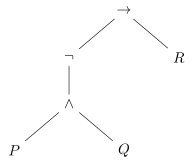
Diagram. Labels: to, P, Q, R

Reading the tree from the top: the statement is an implication; its hypothesis is a negation; what is negated is a conjunction. Reading from the bottom retraces how the statement was built. A one-symbol change moves the root: in ¬(P∧Q→R) the parentheses make the whole implication the thing denied, and the main connective is ¬.

The main connective is not grammar for its own sake. It is the first thing to find when a proof has to be written, because it decides how the proof begins. To prove “if 0<x<1, then x2<x”, whose main connective is →, a proof starts “Suppose 0<x<1.” To prove “x2+1>0 and x2+1≠0”, whose main connective is ∧, a proof has two parts, one for each side. Section 1.2 gives this habit a name, and each later section adds to it.

Quick check. Find the main connective of each statement.

  • (a) ¬P∨Q
  • (b) ¬(P∨Q)
  • (c) (P→Q)∧(Q→P)

Solution.

  • (a) ∨: by convention (1) the ¬ applies only to P, so the statement is the disjunction of ¬P and Q.

  • (b) ¬: the parentheses make the whole disjunction the thing denied.

  • (c) ∧: each parenthesized implication is complete, and the last step joins them with “and”.

1.1.9. The form of an argument

Here are two short arguments, one about integers and one about real numbers.

If n is odd, then n2 is odd. And n is odd. So n2 is odd.

If x>2, then x2>4. And x>2. So x2>4.

They are about different things, and yet they are the same argument. Write P for “n is odd” and Q for “n2 is odd” in the first, and P for “x>2” and Q for “x2>4” in the second. Both then read: from P→Q and P, conclude Q. What makes the step correct has nothing to do with odd numbers or squares. It depends only on the shape of the premises, on the fact that one of them is an implication and the other is its hypothesis. That shape is the argument’s form, and the part of the argument that lives in the letters is its content.

Logic studies the forms of arguments, not their content.

Separating the two has a payoff. Once a form has been shown to be correct, every argument of that form is correct, whatever its content; we check the form once and use it forever. An argument form is written with its premises above a line and its conclusion below it: P→QPQ In running text the same form is written “from P→Q and P, conclude Q”.

1.1.10. Try to break it

Breaking a form means making several statements true at once, and the list of them deserves a name.

Definition 1.1.3 (Counterexample Set)

The counterexample set of an argument form is the list of its premises together with the negation of its conclusion. A counterexample to the form is an argument of that form whose premises are all true and whose conclusion is false, that is, a choice of statements for the letters that makes every member of the counterexample set true. A form is bad if it has a counterexample, and good if no choice of statements can break it.

For “from P→Q and Q, conclude P” the counterexample set is P→Q, Q, ¬P.

To test a form, try to break it: put statements in for the letters that make every premise true and the conclusion false.

One counterexample settles that the form is bad. Failing to find one settles nothing yet: showing that a form is good takes a reason that covers every choice of statements at once.

Quick check. Write the form of each argument, and try to break it.

  • (i) If n is divisible by 4, then n is even. And n is even. So n is divisible by 4.
  • (ii) If x>0 and y>0, then xy>0. And x>0 and y>0. So xy>0.

Solution.

  • (i) With P: “n is divisible by 4” and Q: “n is even”, the form is “from P→Q and Q, conclude P”: the second premise is the conclusion of the implication, not its hypothesis. And n=2 breaks it. The first premise is true for every integer, since a multiple of 4 is 4k=2(2k); the second is true, since 2 is even; yet 2 is not divisible by 4. The form is bad.

  • (ii) With P the compound statement “x>0 and y>0” (a letter may stand for one) and Q: “xy>0”, the form is “from P→Q and P, conclude Q”. It cannot be broken. By the promise table, P→Q is false only when P is true and Q false; so when P→Q and P are both true, Q is true. The form is good.

Where to look first. Make the conclusion false first: that fixes some letters, and the premises must then be made true around it. With statements about numbers, try 0, 1, −1, 2 and 12 before anything clever; most bad forms about numbers break at one of them. Take the form “from P→Q and Q→R, conclude R→P”. Its conclusion is false only with R true and P false. Take P: “x>2”, Q: “x>1” and R: “x>0”; both premises then hold for every real x. At x=12, R is true and P is false, so the whole counterexample set P→Q, Q→R, ¬(R→P) is true, and the form is bad.

Quick check. Write the counterexample set of “from P→Q, conclude Q”, and make all of it true with statements about a real number x.

Solution. The counterexample set is P→Q, ¬Q. Take P: “x>1” and Q: “x>0”. The first member holds for every real x, since a number greater than 1 is greater than 0. At x=−1 the second holds too, since −1>0 is false. So both are true at once, and the form is bad.

Argument B, tried. B’s reasoning shows “if n is even, then n2 is even”, and its last sentence concludes the converse, “if n2 is even, then n is even”. That step has the form “from P→Q, conclude Q→P”, and it breaks: take P: “n is divisible by 4” and Q: “n is even”. The premise is true for every integer, and the conclusion fails at n=2. B’s tempting repair, “from P→Q and Q, conclude P”, is the form of (i), which n=2 just broke. With B’s own content no integer breaks the repair, since every integer with an even square is even (the fact B set out to prove); but the form breaks. A true conclusion reached by a bad form is still not proved.

Second readingA bad form refutes a step, not its conclusion

Breaking the last step of Argument B shows that the step proves nothing. It does not show that “if n2 is even, then n is even” is false, and Argument A proves that it is true. A bad form may even have instances whose premises always give the conclusion. The form “from P, conclude Q” is bad: any true P with a false Q breaks it. Yet in its instance “x>2; so x>1” no number breaks the step, since every real number greater than 2 is greater than 1. The guarantee there comes from a fact about numbers, not from the form. Logic certifies only forms; the content of a step may still be checked by other means.

Second readingValid, or only convincing?

Many true cases are evidence, not a proof. The number n2+n+41 is prime for n=0, 1, 2, and so on all the way to n=39: forty cases without a failure. At n=40 it is 1600+40+41=1681=412. An argument from many checked cases can be strong, but it is not of a good form: its premises can all be true while its conclusion is false. Logic books call a good form valid, and logic studies only form. That is why this book asks of every step not “is it convincing?” but “could this form be broken?”

A list of checked cases says something about the cases checked, and perhaps about most cases; a proof says something about every case. A scientist who reasons “if the hypothesis is right, we shall observe this; we observe it; so the hypothesis is right” uses the bad form of Quick check (i), “from P→Q and Q, conclude P” (Section 1.3 names it affirming the consequent). The reasoning is a sensible guide to what to test next, and it is not a proof. Some books call an argument of a good form with true premises sound; this book keeps that word for a property of rules.

1.1.11. Good form, false sentences

Argument B has true claims and a bad form. The opposite happens too:

If 6 is even, then 6 is prime. And 6 is even. So 6 is prime.

Its form, “from P→Q and P, conclude Q”, is good (Quick check (ii) above), and its conclusion is false. The fault is the first premise, false since 6 is even and not prime. Form and truth are separate questions; all four combinations occur.

every claim true some claim false
form good “If 3 is odd, then 9 is odd. 3 is odd. So 9 is odd.” the argument about 6 above
form bad Argument B, by its last step “from P→Q, conclude Q→P” “If 2 is divisible by 4, then 2 is even. 2 is even. So 2 is divisible by 4.”

The top left is the odd-square argument at n=3; the bottom right is the Quick check’s (i) at n=2. Argument A is not placed. One bad step puts an argument in the bottom row, which is how B got there, but the top row needs every step shown good. A’s steps argue from a supposition (“Suppose n is odd …”) and use “some” (an integer k with n=2k+1), and a form written as premises above a line cannot yet express either. Section 1.4 gives the rules for a supposition, and Chapter 5 those for “some”.

A good form guarantees only that true premises give a true conclusion.

1.1.12. Two ways to attack an argument

An argument can be attacked in two ways, and the two are independent. Attack a premise: show that it is false, as with the argument about 6 above. Attack a step: show that its form is bad by breaking it, as with Argument B. A false premise says nothing about the steps, and a broken step says nothing about the premises. A defended argument needs both: good forms, and premises the reader accepts.

To doubt an argument, doubt a premise or break a step.

The two attacks, in the order a checker makes them:
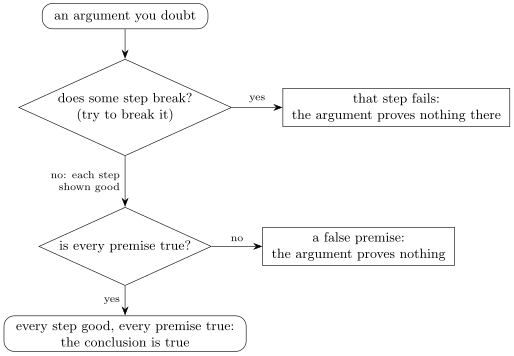
Diagram. Labels: no: each step\shown good, no, an argument you doubt, does some step break?\\(try to break it), that step fails:\the argument proves nothing there, is every premise true?, a false premise:\the argument proves nothing, every step good, every premise true:\the conclusion is true

Failing to break a step is not the “no” answer: the arrow down from the first question needs every step shown good, by a reason that covers every choice of statements.

1.1.13. Each connective, two rules

We now come to the idea that organizes this chapter and the next. Think about what a mathematician does with the word “and”. There are exactly two things to do with it.

  • To prove a statement of the form P∧Q, prove P and prove Q.
  • To use a statement of the form P∧Q that is already known, take either half.

Nobody needs to be taught these two moves. They are also, and this is the point, all there is to know about “and” for the purpose of writing proofs. Every other fact about ∧, such as that P∧Q and Q∧P say the same thing, follows from the two moves, as Section 1.2 shows. The first move is called the introduction rule for ∧, written ∧I, because it is how a ∧ gets into a proof. The second is the elimination rule, ∧E, because it is how a ∧ is taken apart.

The table below is an informal preview. Section 1.2 states these two rules exactly, as patterns of lines.

Rule What it allows You write
∧I from P and Q, conclude P∧Q “We have shown x>0 and x<1. Hence 0<x<1.”
∧E from P∧Q, conclude P; also Q “Since 0<x<1, in particular x>0.”

Every connective works the same way. Each comes with introduction rules, saying how to prove a statement with that main connective, and elimination rules, saying what a statement with that main connective lets us conclude. The rules for ∧ come in Section 1.2, those for → in Sections 1.3 and 1.4, and those for ∨ in Sections 1.5 and 1.6. The rules for ¬, ⊥, and ↔, and one more rule for proof by contradiction, which stands apart from the others, come after these. Two slogans summarize the plan.

Each connective comes with a way to prove it and a way to use it.

A proof is a chain in which every line is a premise, an assumption, or one application of a rule.

The second slogan is what makes a proof possible to check. Finding a proof may need an idea. Checking one needs none: go through it line by line and ask of each line which rule produced it and whether that rule was applied to lines that really are there. A reader who has lost the thread of a long argument can always fall back on that question, and it is the question to ask of Argument B.

Section 1.4 names exactly what B did wrong; the test try to break it has already shown, at n=2 in its Quick check (i), that B’s tempting repair, “from P→Q and Q, conclude P”, is a bad form.

1.1.14. What comes next

Section 1.2 shows what a derivation is, with the rules for “and”. Each later section adds one rule. Two questions guide every search: what does the goal’s main connective ask for, and what does an available line’s main connective let me do?

Remark (Looking ahead). Chapter 5 gives “for every” its rules and explains why an argument about a fixed but arbitrary x proves a statement about every x.

1.1.15. Exercises

A. Check your understanding

Exercise (A1)
  • (a) State the definition of a statement. Is “10100+1 is prime” a statement? For a real number x, is “x2−1=0” a statement? Is “02−1=0”?
  • (b) Let n be an integer, with P: “n is even” and Q: “n is prime”. Write “n is prime but not even” in symbols.
  • (c) Find the main connective of P∧Q→¬R, and write the statement with all its parentheses.
  • (d) True or false, with a reason: if P and Q are both true, then P∨Q is false.
  • (e) Let x and y be real numbers. Write the form of “x>0 and y>0; so y>0 and x>0” with premises above a line, saying what each letter stands for.
  • (f) Which of ∧, ∨, → is the main connective of (P∨Q)∧(Q→R)? Using the preview table of “Each connective, two rules”, say what a proof of this statement must do, and name the rule that Section 1.2 will state for it.

Solution.

  • (a) A statement is a declarative sentence that is either true or false, and not both (Definition 1.1.1). Yes: 10100+1 is a definite integer, so it either is prime or is not. The definition does not ask us to know which. With x fixed, by the convention of the box in “Statements”, “x2−1=0” is a statement about that one number: true if x is 1 or −1, false otherwise. Without the convention it would be an open sentence. The sentence “02−1=0” is a statement outright, and it is false, since 02−1=−1.

  • (b) Q∧¬P. The word “but” is a conjunction.

  • (c) Convention (2) groups P∧Q before → acts, and convention (1) lets ¬ take only R. So the statement is (P∧Q)→(¬R), and its main connective is → (Definition 1.1.2).

  • (d) False. The mathematical “or” is inclusive, so P∨Q is true when both parts are true.

  • (e) With P: “x>0” and Q: “y>0”, the premise is P∧Q and the conclusion is Q∧P: P∧QQ∧P Section 1.2 derives it.

  • (f) ∧: each parenthesized part is complete, and the last step joins them with “and”. So a proof of it has two parts: it proves P∨Q, and it proves Q→R. The rule that puts the two parts together is ∧I. This is the first question of “What comes next”, asked before any rule has been stated exactly: the goal’s main connective decides the last step.

Exercise (A2: Drill)

Answer each part in a line or two.

  • (a) What is the main connective of ¬P∧Q→R?
  • (b) What is the main connective of P∨Q→R∧S? Write the statement with all its parentheses.
  • (c) What is the main connective of ¬(P→Q)∧R?
  • (d) Let x be a real number, with P: “x>0” and Q: “x2>x”. Translate “x is positive but x2 is not greater than x”.
  • (e) Let n be an integer, with O: “n is odd”, S: “n2 is odd” and C: “n3 is odd”. Translate “if n is odd, then n2 and n3 are odd”.
  • (f) Let x be a real number, with P: “x≥2” and Q: “x≤3”. Write “exactly one of x≥2, x≤3” in symbols, and decide it at x=52 and at x=4.
  • (g) Is “if x>1, then x2>1” broken at x=−2?
  • (h) Is “if x2>1, then x>1” broken at x=−2?
  • (i) Let n be an integer. Write “n is prime only if n is odd” as an implication, and break it.
  • (j) Try to break the form “from P∨Q and P, conclude ¬Q”.
  • (k) The argument “If 7 is even, then 72 is even. 7 is even. So 72 is even.” has a false conclusion. Is its form bad?
  • (l) Take the good form “from P→Q and P, conclude Q”. (i) Give an instance, with statements about numbers, whose conclusion is true although a premise is false. (ii) Can both premises of an instance be false at once?
  • (m) Give an example, or explain why there is none: an argument of a good form whose premises are all true and whose conclusion is false.
  • (n) The form “from P→Q and Q→R, conclude R→P” was broken under “Where to look first”. Give an argument of this form about one integer whose premises and conclusion are all true, and say whether it proves its conclusion.
  • (o) Write the counterexample set of “from P→Q and P∨R, conclude Q”, and make every member true with statements about a real number x.

Solution.

  • (a) →. The statement is ((¬P)∧Q)→R.

  • (b) →. With all its parentheses it is (P∨Q)→(R∧S).

  • (c) ∧. The parentheses keep ¬ on P→Q, and the last step joins ¬(P→Q) and R.

  • (d) P∧¬Q. “But” is a conjunction.

  • (e) O→(S∧C).

  • (f) (P∨Q)∧¬(P∧Q). It is false at 52, where both parts hold, and true at 4, where only P holds (4≤3 fails).

  • (g) No. The hypothesis −2>1 is false, so nothing is promised.

  • (h) Yes. The hypothesis 4>1 holds and the conclusion −2>1 fails.

  • (i) With P: “n is prime” and O: “n is odd”, it is P→O. The integer n=2 breaks it: 2 is prime and not odd.

  • (j) Let x be a real number, with P: “x≥0” and Q: “x≤0”, and take x=0. Both premises are true (the “or” is inclusive), and ¬Q is false. The form is bad.

  • (k) No. Its form is “from P→Q and P, conclude Q”, which is good. The premise “7 is even” is false, and a form is bad only when some argument of that form has all its premises true and its conclusion false.

  • (l)
    • (i) “If 2>3, then 3 is odd. 2>3. So 3 is odd.” The second premise is false; the first is true, since its hypothesis fails and nothing is promised; and the conclusion is true. A false premise does not make the conclusion false. (ii) No. When P is false, P→Q is not broken, so it is true; at most one premise of an instance is false.
  • (m) There is none. Such an argument would be a counterexample to its form, and a good form has none.

  • (n) “If 8 is divisible by 4, then 8 is even. If 8 is even, then 8>0. So, if 8>0, then 8 is divisible by 4.” Every sentence is true, since 8=4⋅2, and the argument proves nothing: its form is bad. The truth of the conclusion is a fact about 8, not a gift of the form. With 6 in place of 8 the premises stay true and the conclusion fails: 6>0, and 4 does not divide 6.

  • (o) The counterexample set is P→Q, P∨R, ¬Q. Take P: “x>5”, Q: “x>3”, R: “x<0”, and x=−2. The first member holds for every x; P∨R holds since −2<0; and ¬Q holds since −2>3 is false.

B. Practice

Exercise (B1: Translating analysis)

Translate each sentence into symbols, using the atomic statements given. You do not need to know what the words mean; only the grammar matters.

  • (a) “f is continuous at a but not differentiable there”, with C: “f is continuous at a” and D: “f is differentiable at a”.
  • (b) “If the sequence (an) converges, it is bounded”, with V: “(an) converges” and B: “(an) is bounded”.
  • (c) “x is rational or irrational”, with R: “x is rational”. (A real number is irrational when it is not rational.)
  • (d) “The set F is closed if and only if its complement is open”, with K: “F is closed” and U: “the complement of F is open”.

Solution.

  • (a) C∧¬D. “But” asserts both parts, and “not differentiable there” is the negation of D.

  • (b) V→B. The pronoun “it” refers to (an), so the conclusion is the statement B.

  • (c) R∨¬R. “Irrational” means “not rational”, so the second part is ¬R, not a new atomic statement.

  • (d) K↔U.

Exercise (B2: Parsing)

For each statement, insert all the parentheses that the conventions allow us to omit, and name the main connective.

  • (a) ¬P→Q
  • (b) P∨¬Q↔¬R
  • (c) ¬¬P∧(Q→R)

Then let x and y be real numbers, with P: “x>0”, Q: “y>0” and R: “xy>0”. Write P∧Q→R as an English sentence, and say whether it is true whatever the numbers x and y are.

Solution.

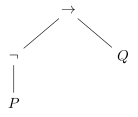
  • (a) (¬P)→Q, main connective →. As a tree:
    Diagram. Labels: to, P, Q
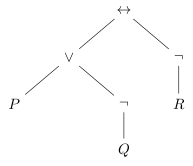
  • (b) (P∨(¬Q))↔(¬R), main connective ↔. Each ¬ applies to the single letter after it, and ∨ binds more tightly than ↔. As a tree:
    Diagram. Labels: P, Q, R
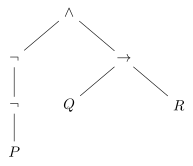
  • (c) (¬(¬P))∧(Q→R), main connective ∧. The first ¬ applies to the statement ¬P, which is the smallest complete statement following it. As a tree:
Diagram. Labels: P, to, Q, R

The statement P∧Q→R is (P∧Q)→R: “if x>0 and y>0, then xy>0”. It is true for all real x and y, since the product of two positive numbers is positive.

Exercise (B3: Necessary and sufficient, used later)

Let x be a real number.

  • (a) Write “x>1 is sufficient for x2>1” and “x>1 is necessary for x2>1” as implications.
  • (b) Decide which of the two is true for every real x, and give a value of x that makes the other false.
  • (c) Find a condition on x, written with ∨, that is both necessary and sufficient for x2>1. You may use that x2>1 exactly when |x|>1, where |x| is x if x≥0 and −x if x<0.

Solution.

  • (a) “P is sufficient for Q” means that P is enough to guarantee Q, that is, P→Q. “P is necessary for Q” means that Q cannot hold without P, that is, Q→P. So the two sentences are (x>1)→(x2>1) and (x2>1)→(x>1).

  • (b) The first is true for every x: if x>1, then x>0, so x2=x⋅x>1⋅x=x>1, where multiplying x>1 by the positive number x keeps the inequality. The second is false for x=−2: then x2=4>1, but x<1.

  • (c) (x>1)∨(x<−1). It is sufficient: if x>1, then |x|=x>1, and if x<−1, then |x|=−x>1; either way x2>1. It is necessary: if x2>1, then |x|>1, and |x| is x or −x, so x>1 or −x>1, the latter meaning x<−1.

Exercise (B4: Break it or explain why not)

For each form, either find statements about a real number x that make every premise true and the conclusion false, or explain, by checking every case, why no choice of statements can (use the meaning of each connective; for →, the table of “When is an implication broken?”).

  • (a) From P→Q and ¬P, conclude ¬Q.
  • (b) From P→Q and Q→R, conclude P→R.
  • (c) From P∨Q, conclude P.
  • (d) From P∧Q, conclude P∨Q.

Solution.

  • (a) Bad. Take P: “x>2” and Q: “x2>4”, and x=−3. The premise P→Q holds for every x, as the “only if” passage of this section showed. The premise ¬P is true, since −3>2 is false. And Q is true, since 9>4, so the conclusion ¬Q is false.

  • (b) It cannot be broken. To make the conclusion P→R false we need P true and R false. Now look at Q. If Q is true, then Q→R has a true hypothesis and a false conclusion, so it is broken. If Q is false, then P→Q has a true hypothesis and a false conclusion, so it is broken. Either way some premise is false.

  • (c) Bad. Take P: “x>0” and Q: “x≤0”, and x=−1. The premise P∨Q is true, since −1≤0, and the conclusion −1>0 is false.

  • (d) It cannot be broken. If P∧Q is true, then P is true, so P∨Q is true.

In (b) and (d), “cannot be broken” is shown by reasoning about every case at once, not by failing to find a counterexample: a search that comes up empty settles nothing.

Exercise (B5: One key, sixteen sentences, used later)

Let n be an integer. Use only the letters E: “n is even”, P: “n is prime”, T: “n is a multiple of 3” and G: “n>10”. Translate sentences 1–14 into symbols. Then translate 15 and 16 into English, and find an n that makes 16 false.

  • 1. n is even and greater than 10.
  • 2. n is odd.
  • 3. n is an even prime.
  • 4. If n is prime and greater than 10, then n is odd.
  • 5. n is a multiple of 3 but not prime.
  • 6. n is neither even nor a multiple of 3.
  • 7. n is not both even and a multiple of 3.
  • 8. n is prime only if n is odd or at most 10.
  • 9. n is even whenever it is a multiple of 3 greater than 10.
  • 10. Provided n>10, being even is sufficient for n not to be prime.
  • 11. n>10 is necessary for n to be an even multiple of 3.
  • 12. Exactly one of “n is even”, “n is prime” holds.
  • 13. At least two of “n is even”, “n is prime”, “n is a multiple of 3” hold.
  • 14. n is odd, but if it is greater than 10, it is not a multiple of 3.
  • 15. ¬G→(E∨T).
  • 16. (P∧¬E)→G.

Solution.

  1. E∧G.
  2. ¬E: an integer is odd exactly when it is not even.
  3. E∧P.
  4. (P∧G)→¬E.
  5. T∧¬P. “But” is a conjunction.
  6. ¬E∧¬T.
  7. ¬(E∧T). Compare 6: one word apart, and different claims (at n=2, 6 is false and 7 is true).
  8. P→(¬E∨¬G). “At most 10” is “not greater than 10”, and “P only if Q” is P→Q.
  9. (T∧G)→E. “P whenever Q” is Q→P.
  10. G→(E→¬P). The statement (G∧E)→¬P says the same; Section 1.4 derives each from the other.
  11. (E∧T)→G. “Q is necessary for P” is P→Q.
  12. (E∨P)∧¬(E∧P).
  13. ((E∧P)∨(E∧T))∨(P∧T).
  14. ¬E∧(G→¬T).
  15. “If n is at most 10, then n is even or a multiple of 3.”
  16. “If n is an odd prime, then n>10”, or “every odd prime is greater than 10”. It is false at n=3: 3 is odd and prime, and not greater than 10.

A translation is checked by reading it back, letter by letter, into English. Read 16 back and the reading “odd prime” falls out of P∧¬E.

Exercise (B6: Same form?)

Here is an argument.

  • (T) If 12 is divisible by 6, then 12 is even. If 12 is divisible by 6, then 12 is divisible by 3. So, if 12 is even, then 12 is divisible by 3.

Which of (a)–(d) have the same form as (T)? For one that does, break the form. Is the conclusion of (T) true, and does (T) prove it?

  • (a) Let x be a real number. If x>2, then x2>4. If x>2, then x>1. So, if x2>4, then x>1.
  • (b) Let Δ be a triangle. If Δ is equilateral, then Δ is isosceles. If Δ is equilateral, then each angle of Δ is 60∘. So, if Δ is isosceles, then each angle of Δ is 60∘.
  • (c) Let n be an integer. If n is divisible by 6, then n is even. If n is even, then n2 is even. So, if n is divisible by 6, then n2 is even.
  • (d) Let x be a real number. If x>3, then x>2. If x>3, then x>1. So, if x>3, then x>2 and x>1.

Solution.

  • (T) has the form “from P→Q and P→R, conclude Q→R”, with P: “12 is divisible by 6”, Q: “12 is even”, R: “12 is divisible by 3”. The two premises share their hypothesis, and the conclusion joins their two conclusions.
  • (a) and (b) have this form. In (a), P is “x>2”, Q is “x2>4” and R is “x>1”; in (b), P is “Δ is equilateral”, Q is “Δ is isosceles” and R is “each angle of Δ is 60∘”.

  • (b) has the form “from P→Q and Q→R, conclude P→R”: the second premise starts where the first ends. That is the form of B4(b), which cannot be broken.

  • (c) has the form “from P→Q and P→R, conclude P→(Q∧R)”. It is the look-alike: the same premises as (T), and a different conclusion. It cannot be broken either. To make its conclusion false, P must be true and Q∧R false, so Q or R is false; then P→Q or P→R has a true hypothesis and a false conclusion, and a premise is false. Section 1.4 derives the forms of (c) and (d).

Breaking the form of (T). Let n be an integer, with P: “n is divisible by 6”, Q: “n is even” and R: “n is divisible by 3”. Both premises hold for every integer, since 6k=2⋅3k=3⋅2k. At n=2 the conclusion Q→R is broken: 2 is even and not divisible by 3. So the counterexample set P→Q, P→R, ¬(Q→R) is true at n=2, and the form is bad. Argument (a) breaks with its own content, at x=−3: both premises hold for every x, and (−3)2=9>4 while −3>1 fails.

(T) itself. Its conclusion is true, since 12=3⋅4, so an even 12 is divisible by 3. But (T) does not prove it: its form is bad, and the truth of the conclusion comes from a fact about 12, not from the premises.

C. Going deeper

Exercise (C1: “Only if” and “unless”, used later)

Let P and Q be statements.

  • (a) Explain why “P only if Q” means P→Q, and not Q→P. (Ask: which situation would make “P only if Q” false?)
  • (b) Explain why “P unless Q” means ¬Q→P.
  • (c) Let x be a real number. Decide whether each sentence is true for every real x. Justify your answer, giving a value of x that makes it false where there is one.
    • “x2=4 if x=2.”
    • “x2=4 only if x=2.”
    • “x2>0 unless x=0.”

Solution.

  • (a) “P only if Q” says that P does not happen without Q. It is broken exactly when P holds and Q fails. That is also exactly when P→Q is broken: an implication promises Q whenever P, and the promise fails only when P holds without Q. So the two say the same thing. By contrast, Q→P is broken when Q holds and P fails, a different situation. For example, “a number is divisible by 4 only if it is even” is true, while “a number is even only if it is divisible by 4” is false (take 2).

  • (b) “P unless Q” says that P holds in every situation except possibly those where Q holds. So once we know that Q fails, we may conclude P, which is ¬Q→P. For instance, “the equation ax=1 has a solution unless a=0” says: if a≠0, then ax=1 has a solution.

  • (c) The first sentence is (x=2)→(x2=4). It is true for every x: when x=2, x2=4, and when x≠2 it promises nothing.

The second is (x2=4)→(x=2), the same two parts in the opposite direction. It is false for x=−2, where x2=4 but x≠2.

The third is ¬(x=0)→(x2>0), by (b). It is true for every x: a non-zero real number is positive or negative, and in both cases its square is positive.

The first two sentences differ by one word, and they are implications in opposite directions. Confusing them is exactly the mistake of Argument B at the start of this section.