Section 8.1 made real functions into objects with a
domain and a graph, and combined them. This section asks
how a function treats the order of : does a larger input
give a larger output? We give the property its
definition, a method for proving it, and rules for
building monotone functions from others. Then we prove
the main result: a strictly monotone function is a
bijection onto its image, and its inverse is monotone in
the same direction. That gives the -th root as a function,
for every real input when is odd.
Increasing
and decreasing functions
Ask a reader whether is decreasing, and the answer is
usually yes. On it is not: , but ,
so a larger input gave a larger output. The function
decreases on and on , and the jump across spoils the union. So
“decreasing” is never a property of a formula alone. It
is a property of a function on a set,
and the definition must name the set.
A small case first. On the set , the function
takes
the values .
Each larger input gives a larger output, so the function
keeps the order there. On the set it does not:
, but
.
A function is increasing on a set when moving
right inside the set never moves its value
down.
Definition
8.2.1 (Monotone Function)
Let be a real function (Definition 8.1.1)
and let . The function is
- increasing on if,
for all , implies ;
- strictly increasing on if, for all
, implies ;
- decreasing on if, for all
, implies ;
- strictly decreasing on if, for all
, implies .
It is monotone on if it is
increasing on or
decreasing on ,
and strictly monotone on if it is
strictly increasing or strictly decreasing on . Without “on ”, the set is the whole
domain . In
symbols, “increasing on ” is
In words: we pick two points of , name the smaller one
, and ask that the
values come in the same order ( or ) or in the reverse
order ( or ). Since means or , an increasing
function also satisfies , and a
decreasing one satisfies . A strictly
monotone function satisfies the same non-strict forms;
the strict inequality fails at .
Negating quantifier by quantifier (Logic and Proof, Proposition 6.2.1),
“ is
not increasing on ” is so a failure is shown by two
witnesses, as and were for above.
The identity on
is strictly increasing, and so is . Sets
and Functions used the same word, and proved there
that
is strictly increasing (Sets and Functions, Example (Maps from calculus)
(a)). It also proved that every strictly increasing map
between subsets of is injective (Sets and Functions, Proposition 2.2.3).
We use both facts without proving them again.
↺Second readingThe
two definitions agree; sets with one
point
Sets and Functions called a map between
subsets of
strictly increasing when implies . Our
is strictly increasing on exactly when its
restriction (Sets and Functions, Definition 2.3.1)
is strictly increasing in that sense: both say the same
thing about the same pairs of points of . The codomain plays no
part.
Sets with one point: on a set with at most one point
there is no pair , so every function is strictly increasing and
strictly decreasing on , vacuously.
Monotonicity says something only about pairs.
Warning. Monotone on two sets does
not give monotone on their union. The function is strictly
decreasing on and on , yet not decreasing on , by
the witnesses found at the start of this section. A proof
that splits into
pieces must also compare a point of one piece with a
point of the other.
Quick check. Is a constant function
on increasing?
Is decreasing
on ? Is the indicator (Sets and Functions, Definition 2.3.2)
increasing on ?
For each “yes”, say whether “strictly” holds too.
Solution. A constant is increasing,
since
satisfies ; it
is decreasing too, and strictly neither: and the values
are equal. The function is not decreasing on
: and . The indicator is increasing: for , if its value at
is , then and its
value at is too. It is not strictly
increasing: with both values .
To prove
strictly increasing on , we fix in and must show . The
hypothesis is about the difference , which is positive.
So the natural plan is to make appear as a factor
of , and
then to sign what is left.
Example
(Method: factor out y − x)
How it goes. “Let with .” Write by algebra on the formula for . Since , the sign of
is the
sign of :
show
for strictly increasing, for
increasing, and or
for the decreasing kinds (Number Systems: From to , Proposition 2.4.3
(c), (d)). Differences of powers factor by Lemma 1.1.8:
Quotients are brought over a common
denominator first.
When to use it. is given by a formula
built from , and , and the claim is that
is monotone on a
set.
Common mistakes. One mistake is to
conclude “strictly” from : a positive number times a non-negative
one may be .
Another is to use a sign of that holds on part of
only. In that
case, split
first, and also compare a point of one piece with a
point of another.
| ,
; the
formula for |
|
|
|
|
:
what is left to show |
For a quotient, the obvious argument fails.
Example
(A quotient of two increasing functions)
Let , . Prove that is strictly
increasing.
Idea (Scratch work). The naive
attempt. “The numerator increases with
, so the quotient
does.” The denominator increases too, and a quotient of
two increasing positive things can do anything: is constant. So the
naive attempt proves nothing.
Factor out . For , bring the difference over the common
denominator , which is positive. The numerator is So .
|
|
|
|
| ,
|
done: a quotient of positive elements is
positive |
Solution. Let
with . Then
and
, so
the denominators are non-zero. Over the common
denominator, The numerator is positive since . The
denominator is positive, since a product of positive
elements is positive, (O4). Its reciprocal is positive
too. Hence , and
is strictly increasing.
When the formula changes at , the domain splits
there into two pieces, and a point of one piece must
also be compared with a point of the other.
Example
(The squashing function)
Let , . Prove that is strictly
increasing on ,
and find its image.
Idea. The absolute value has one
formula for
and another for , so the factoring works on each half
separately. Two points in the same half are handled by
the method; for one point in each half, the signs of the
values decide at once, since has the sign of
.
Solution. Since ,
is defined
on and has the sign of
. Let .
Case . Here at
, and
Case . Here ,
and since and .
Case . Then .
By trichotomy the three cases cover every pair , so is strictly
increasing.
Its image is . Every value satisfies . Every is a value,
at , which is for and for . That is the
surjectivity proved in Sets and Functions by
solving backwards (Sets and Functions, Example (Solving backwards, proving forwards)).
Building
monotone functions from others
The method handles one formula at a time. Most
functions are built from simpler ones by the operations
of Definition 8.1.2,
and monotonicity passes through some of them.
A small case first. On , and are
strictly increasing. For we have and , and adding the two inequalities gives
(Number Systems: From to , Proposition 2.4.3
(b)). So is strictly increasing, with no factoring
at all. Rule (a) below says this for any two
functions.
Proposition
8.2.1 (Rules for Monotone Functions)
Let and .
- (a) If and are increasing on , so is ; it is strictly
increasing if or
is.
- (b) If is increasing on and , then is increasing on , strictly if is and ; and is decreasing on , strictly if is strictly
increasing.
- (c) If and are increasing on and , for every
, then is increasing on .
- (d) If is increasing on and for every
, then is decreasing on
, strictly if
is strictly
increasing.
- (e) Let , , and with . If
is monotone on
and on , then is monotone on
. It is increasing
if both are increasing or both decreasing, and
decreasing if one is increasing and the other
decreasing. It is strictly so if both are strictly
monotone.
Idea. Each part fixes in , writes down what the
hypotheses say about the values at and , and applies one rule
for inequalities in an ordered field to them.
Proof. In each part let with .
(a) and . Adding the
two inequalities gives , strictly if one of the
two is strict.
(b) If , is constant. Let . If ,
multiplying by keeps the inequality: . If
, then
. So
,
strictly if . Finally, negating reverses an inequality:
gives
,
strictly if .
(c) and
. Inequalities between non-negative numbers
may be multiplied, so .
(d) .
Taking reciprocals of positive numbers reverses the
inequality, so . The same holds with : if , then
.
(e) The composite
is defined on ,
since (Definition 8.1.2).
Let and be increasing. Then
with
both in . Since
is increasing on
, it also
satisfies for , so . If
both are strict, and then . The
other three cases are the same argument with the
inequality reversed at each decreasing function: two
reversals restore the order, one reverses it.
Warning. The sign condition in (c)
cannot be dropped. The identity is increasing
on , but its
product with itself, , is not: and .
Quick check. On , the
functions and are increasing and non-negative. Is
increasing on , and by which rule?
Solution. Yes, by (c): both factors
are increasing on , and both are there. The second
factor is increasing because is, by Lemma 1.5.1
(a) with .
Adding the constant keeps it increasing, by
rule (a) with a constant function.
Strict
monotonicity reflects the order
A strictly increasing function carries to . For the
inverse we need the way back: from to . Because on is a total order, the
way back is free.
Proposition
8.2.2 (Strictly Monotone Functions Reflect the
Order)
Let , , and .
- (a) If is strictly increasing
on , then , and .
- (b) If is strictly decreasing
on , then , and .
Idea. The directions are the
definition. For the way back, suppose the conclusion
fails; totality turns “not ” into , and the forward direction then contradicts
the hypothesis.
Proof.
- (a) The direction
of
the first equivalence is Definition 8.2.1.
For
of the second: if , then and , or and ; in both cases .
of
the first: let , and suppose fails. Since is a total order with
strict part
(Number Systems: From to , Proposition 4.1.2
(a)), . By
of
the second equivalence, . With this gives by
antisymmetry, against . So .
of
the second: let , and suppose fails. By totality, ; and , since would give . So , and then , against
. So
.
- (b) If in , then , so , since
negating reverses inequalities. Thus is strictly increasing
on . By the same
rule, , and likewise for . Apply (a) to .
Taking
and
together, the second equivalence gives again: injectivity, which Sets and
Functions proved directly (Sets and Functions, Proposition 2.2.3).
What is new is the direction , and it
rests on totality alone.
Solution. The directions . From “not
” totality
gives ,
hence , against . In a partial order, “not ” would allow
and to be incomparable, and
the argument would stop.
The converse of Sets and Functions, Proposition 2.2.3
is false: an injective function need not be
monotone.
Example
(Injective but not monotone)
Let swap
and : , , and for every other
. Show that is injective but
monotone on no set containing , and . Then do the same for
on and
the set .
Solution. The swap.
Checking the three cases of the definition, for every
, so is its own two-sided
inverse and is bijective (Sets and Functions, Theorem 2.4.4).
It is not increasing: and . It is not decreasing: and .
The reciprocal. If , then , taking
reciprocals. It is not increasing: and . It is not
decreasing: and , the witnesses found at the start
of this section.
The inverse
of a strictly monotone function
By Sets and Functions, Theorem 2.4.4,
a function has an inverse exactly when it is a
bijection. A strictly increasing is
injective, but usually not surjective onto : of Example (The squashing function)
misses . Cutting
the codomain down to the image repairs that, and the
inverse then inherits the order.
A small case first. Let on . Its
image is , and each value comes from exactly one
input. So going back is a function from to : it sends
, , . It is again
strictly increasing. Its graph is the graph of
with each pair swapped.
Theorem
8.2.3 (Inverse of a Strictly Monotone
Function)
Let and let be strictly increasing.
Then:
- (a) , with codomain , is a bijection
; write
for its inverse;
- (b) is strictly
increasing;
- (c) .
The same holds with “strictly decreasing” in place of
“strictly increasing”, in the hypothesis and in (b).
Try it first (ten minutes): take in . Why should ?
Idea. The direct attempt applies
to , but nothing is
known about
yet; that is what we are proving. So name the two
preimages, and . Now ,
and the question is about alone: does force
? That is
the direction of Proposition 8.2.2.
Part (a) needs no new idea: is chosen so that
every point is reached, and strict monotonicity gives
injectivity. Part (c) tests membership of a pair, as in
Example (Method: reading a graph as a set of pairs),
with each pair swapped to .
Before reading on: where is the totality of used?
Proof.
(a) For , by the
definition of the image, so is a function . It is
surjective, since every is for some . It is injective
by Sets and Functions, Proposition 2.2.3.
So it is a bijection, and by Sets and Functions, Theorem 2.4.4
it has a two-sided inverse .
(b) Let with , and let and
, points of . Since , . By Proposition 8.2.2
(a), , that
is, .
(c) Let . If , then and , and ;
so . Conversely, if , then and , and , since ;
so . This proves the
theorem for strictly increasing .
↺Second readingThe
decreasing case
Let be
strictly decreasing. Part (a) is proved word for word as
above, since Sets and Functions, Proposition 2.2.3
covers decreasing maps too. Part (c) used only and .
For (b), let in
and , . Then ,
and Proposition 8.2.2
(b), applied to the pair , gives , that is, .
So is
strictly decreasing.
Where is totality used? In part (b), inside Proposition 8.2.2,
where “not ” became . The injectivity cited in (a) rests on it
too: Sets and Functions, Proposition 2.2.3
is proved by trichotomy. Each hypothesis has a job.
Without “strictly”, (a) fails: a constant on is increasing and
not injective. Without cutting the codomain to , (a) fails as well:
has no inverse, because nothing goes back
from .
Part (c) says that the graph of is the graph of
reflected in the
line , the
inverse relation that Sets and Functions
defined (Sets and Functions, Definition 1.4.3).
To draw an inverse, draw and swap the axes.
Solution. Writing
shows that takes
exactly the values in : as runs over , runs over , and so does
. Solving
gives on . Check: with
, and , so . By Theorem 8.2.3,
is strictly
increasing.
Chapter 1 proved directly that roots keep order (Lemma 1.5.2
(d)). The theorem gives a second proof, with the root as
an inverse function, and the new part is that roots
extend to negative numbers when the exponent is odd.
Example
(Roots as inverse functions)
Let
with , and
let , . Show that the function on
is
strictly increasing, and that for odd every real number has
exactly one real -th root.
Solution. On . By Lemma 1.5.1
(a), is
strictly increasing on . Its image is : a power of a
non-negative number is non-negative (, and for by Lemma 1.5.1
(a) with ),
and every
is for (Lemma 1.5.1
(b)). By Theorem 8.2.3,
applied to the restriction of to , the inverse
is strictly increasing, and it sends
to the unique
with , which is .
Odd on
. Let with . Then for every real , by the power laws and
. Let
. If , then by Lemma 1.5.1
(a). If ,
then , so . Negating reverses
this inequality, so . If , then , since a power of a
positive number is positive (Lemma 1.5.1
(a) with ). So
is strictly
increasing on .
Its image is :
is , and
is . By Theorem 8.2.3,
is a bijection
with a
strictly increasing inverse. Its value at is the
one real with ; we write it
, for
every real when
is odd. By the
formula for the image, for , and so for every real .
For even
the second half fails: , so is not injective on
, and for
every , so is not a value. So
for
is defined
only for odd .
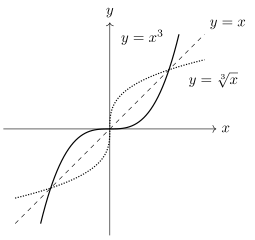
The graphs of (solid) and of its inverse
(dotted) on ,
mirror images in the dashed line , as Theorem 8.2.3 (c)
says.
A strictly increasing function on all of need not have an
interval as its image.
Example
(A strictly increasing function with a jump)
Let , for and for . Show that is strictly increasing,
find its image, and describe .
Solution. Let . If , then .
If , then
. If , then . So is strictly
increasing.
The image is : values at are the negative
numbers, and values at are the numbers . In particular
is not a value,
though it lies between the values and ; the image is
not an interval. By Theorem 8.2.3,
, for and for
, is
strictly increasing.
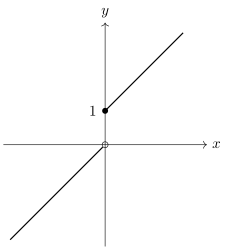
The graph of : the line up to the open
point , then
the line
from the closed point . The values between and are skipped.
Exercises
A. Check your
understanding
Exercise
(A1)
These parts are about the proof of Theorem 8.2.3.
- (a) Run the proof
for on
: find
and , and say what
, are in part (b) of the
theorem for ,
.
- (b) Which cited
result gives the injectivity in part (a) of the
theorem?
- (c) Give the idea of
the proof of part (b) of the theorem in two
sentences.
Solution.
(a) is strictly increasing
on by Lemma 1.5.1
(a). If , then ; and every is with ,
since would give . So , and is on
. For : , , and
gives .
(b) Sets and Functions, Proposition 2.2.3.
(c) Name the
preimages , , so that becomes , a
statement about .
Strict monotonicity reflects the order, by totality of
, so .
Exercise
(A2)
Classify each function as strictly increasing,
strictly decreasing, or neither, with a reason.
- (a) on .
- (b) on .
- (c) on .
- (d) on .
Solution.
(a) Neither:
but ,
so not increasing; and , so not decreasing.
(b) Strictly
increasing, by Lemma 1.5.1
(a) with .
(c) Strictly
decreasing. The function is strictly
increasing on ,
by Sets and Functions, Example (Maps from calculus)
(a). Passing to
reverses it, by Proposition 8.2.1
(b).
(d) Strictly
decreasing: for , , the method with .
B. Practice
Exercise
(B1)
Prove that is strictly increasing on and strictly
decreasing on .
Solution. Let . Over the
common denominator , So , and its sign is the sign of . If , then
(Number Systems: From to , Proposition 2.4.3
(c)), so
and .
If , then , so and .
Exercise
(B2: Prove or disprove)
Prove each true statement and refute each false one
with a counterexample.
- (a) The composite of
two strictly decreasing functions is strictly
increasing.
- (b) If is
strictly increasing and for all , then is strictly
decreasing.
- (c) The sum of a
strictly increasing and a strictly decreasing function
on is
monotone.
- (d) The function
is strictly increasing on .
Solution.
(a) True: Proposition 8.2.1
(e), both strictly decreasing.
(b) True: Proposition 8.2.1
(d).
(c) False. Take
, strictly
increasing (Sets and Functions, Example (Maps from calculus)
(a)), and ,
strictly decreasing. The sum has , , : it goes up and
then down, so it is neither increasing (, ) nor
decreasing (, ).
(d) False. Let
. The
method gives and at , the bracket is . Indeed and , so and . Repair: on the statement
is true, since gives , and , so the bracket is .
Exercise
(B3)
Let , . Prove that is strictly increasing,
find its image, and write down . Is increasing?
C. Going deeper
Exercise
(C1: Find the error)
Here is an argument that is
strictly increasing on .
- (i) Let .
- (ii) By the method
of Example (Method: factor out y − x),
.
- (iii) Since and , we get .
- (iv) Also , so .
Is the conclusion true? Does the argument prove it?
Name the line that fails, if any, and repair it.
Solution. The conclusion is true,
but the argument does not prove it. Line (iv) fails:
(iii) gives only that the bracket is , and a positive
number times a non-negative one is only . A counterexample
to the step: . This is the first mistake Example (Method: factor out y − x)
warns against: strictness concluded from .
Repair. Line (i) gives more than (iii) uses:
, so
(Lemma 1.5.1
(a)), while and . Hence , the bracket is , and (iv)
holds.
Exercise
(C2, used later)
Let be increasing, with for every
. Prove
that .
Then show that “increasing” cannot be dropped.
Solution (Hint 1). Fix , and split by the sign
of .
Solution (Hint 2). Suppose , and apply
to both
sides.
Solution. Let . By trichotomy,
, or .
If ,
then, being
increasing, , against . If , then , that is, , against . So for every , and by Sets and Functions, Proposition 2.1.1.
Without “increasing” the claim fails: satisfies
for every
, and it is not
the identity, since it sends to .
What a complete answer needs. (10
points) - 2: fixes an arbitrary and compares with (the three cases of
trichotomy, or the two of totality). - 3: in one case
(, or
),
applies the monotonicity of to the inequality
between and and uses to reach a
contradiction or, by antisymmetry, . - 2: handles
the other case, or says that it is symmetric with the
reason. - 1: concludes from equality at every point. - 2:
gives a function with , , and
checks both properties.
Slips that lose the step. Applying
to a strict
inequality and keeping it strict, when is only increasing.
Assuming is
injective or continuous without proof.