Part II of this volume (Chapters 4–7) ended with
polynomials as formal objects and with what their values
can and cannot do. Part III (Chapters 8–10) turns to
functions of a real variable, the objects that analysis
adds, composes, inverts and bounds. This section fixes
what a real function is, how two of them combine, how a
graph moves when the formula changes, and how a function
splits into an even and an odd part. Everything is
proved from Sets and Functions, the complete
ordered field
and the polynomials of Chapters 6 and 7; no limit
appears.
Let . What is ?
The tempting answer cancels: , so . But the formula
asks us to
divide by at
, and no field
rule allows that. Another reader says is undefined. Both
readers have a function in mind, and they have different
ones. In Sets and Functions, a function is
given by a graph, in which every input of its domain has
exactly one value, together with a
codomain (Sets and Functions, Definition 2.1.1).
A formula supplies the values but not the domain. Until
the domain is named, the question has no answer.
Here is a small case. Take the inputs and send
each input to its square. The values are , and , and the function is
recorded by the three pairs , , . With the inputs
and the
same rule, the pairs are and : a different
function.
A real function is a set of inputs together with
one real value for each of them. The inputs are
part of the function, and every input gets exactly one
real number.
The graph is exactly the relation in the definition of a
function (Sets and Functions, Definition 2.1.1),
since each element of is the pair . The codomain
of a real function is always . So the test for
equal functions in Sets and Functions (Sets and Functions, Proposition 2.1.1)
reads: two real functions are equal if and only
if they have the same domain and the same value at every
point of it. With , the function of the
opening question is on , and
is not an
input.
Example
(First Real Functions)
Each of the following is a real function; check that
each input has exactly one value.
- (a) A constant on , and the identity
on
.
- (b) The absolute
value on (Number Systems: From to , Definition 4.1.1).
- (c) on .
- (d) on
.
- (e) A restriction
(Sets and Functions, Definition 2.3.1),
for instance on .
- (f) An indicator
for (Sets and Functions, Definition 2.3.2),
with codomain
in place of .
- (g) The function
equal to on and to on .
Solution. (a), (b) One formula,
defined everywhere; is given by two
cases that cover and do not overlap.
(c) exists
exactly when . (d) For , is the unique
with . It exists
because is a
complete ordered field. (e) A restriction keeps the old
values on the smaller domain. (f) Enlarging the codomain
changes no value. (g) The two pieces are disjoint and
cover , so they
glue to one function, as in Sets and Functions, Example (Piecewise definitions are gluings).
The figure shows, from left to right, the graphs of
, , and ; an
open dot marks a point that is not on the graph.
Which subsets of the plane are graphs? Reading the
definition of a function (Sets and Functions, Definition 2.1.1)
as a statement about vertical lines answers this.
Take . The set is a graph over : above and above it has one point each.
The set is not, since it has two points above
. Nor is , since it has a point above , and .
Proposition
8.1.1 (Vertical Line Test)
Let and . Then is the graph of a real
function on if
and only if
- (i) for every there is
exactly one with , and
- (ii) every has .
Proof. Let for . Then (i) is the condition in the
definition of a function. And (ii) holds because every
element of is a
pair with
.
Conversely, (ii) gives . With (i), the pair
is then a function . Each has by the
definition of the value, and each with lies in by the same definition,
so .
In words: the vertical line through meets exactly once when , and not at all
when .
Warning. No natural
domain. The function on is
the restriction of the identity of to ; it
is not the identity, because the domains differ. And not
every curve is a graph: the circle contains and . Every point must lie above , by (ii), so . But then there
are two points above , and (i) fails at , whatever is.
Quick check. Is each set a graph,
and over which ?
(1) ; (2) ; (3) .
Solution.
- Yes, over .
(2) No: and
both lie in
it. Every point lies above , by (ii), so , and there are
two points above ,
so (i) fails. (3) Yes, over : every
element has , and for the only with is . It is the graph
of .
Combining
real functions
Two real functions with different domains can still
be added; the sum lives where both are defined.
Composition needs more care, because needs to be an input of
.
Here is a small case. Let on and
on
. Their sum makes
sense where both do, on ; at it is .
The composite needs and , so it is defined on
too. At it is
.
Definition
8.1.2 (Operations on Real Functions)
Let and be real functions and . On define, for
each , and , likewise ; here is if and otherwise, and is if and otherwise. On define ,
and ; and on . The
quotient , , has
domain . The composite
, , has
domain
For instance, on . Fix . If , then , so . If , then , so the maximum is .
This composite is the composite of Sets and
Functions (Sets and Functions, Definition 2.1.2),
applied to a restriction of . Write for its domain. Every
value of lies
in , so may be regarded as a
function ,
and after it is a
composite in that sense, with values . Composition
stays associative. The functions and
have the same domain and the same values , so they are
equal. This is associativity of composition (Sets and Functions, Proposition 2.1.3)
for the restricted maps.
↺Second readingThe
two domains of a triple composite
Let as well. The domain of is
the set of in the
domain of
with , that is, .
The domain of is , so the domain of is
the set of with in it, which is the
same set. On it both sides take the value , and Sets and Functions, Proposition 2.1.1
gives equality.
The domain of a composite can be empty. The square
root after has domain , because gives :
the composite is the empty function of Sets and Functions, Proposition 2.1.2,
legal and useless.
Quick check. What is the domain of
? Of
the composite of after ?
Solution. . The composite has domain
.
Polynomial
and rational functions
Chapter 6 defined, for a polynomial , its
polynomial function on (Definition 6.4.1).
In this chapter the letter usually names a real
number, so we write this function as ; the
polynomial has the identity as its function.
For a first instance, the polynomial restricted to
has
the values ,
, ; and is
defined at every real number except , with value at .
Definition
8.1.3 (Polynomial Function, Rational
Function)
Let . A polynomial function on is the
restriction to of
the polynomial function of some . For with
, the
rational function is on
.
Chapters 6 and 7 proved what these functions need.
Since is a
field, the following three facts hold here.
- Operations match. The polynomial
function of
is the sum of those of and , and likewise for . This is Proposition 6.4.4
(b), and restricting to keeps it.
- The function determines the polynomial on an
infinite set. Let be infinite, with for every
. Then . To see this, put
. An infinite set contains distinct points, as
shown inside the proof of Theorem 7.4.2.
Choosing
distinct points of , part (a) of that
theorem gives . So on an interval with more than one point,
the degree and leading
coefficient of a polynomial function are well
defined.
- Few roots. A non-zero has at most roots (Theorem 7.4.1),
so a rational function is defined at every real number
except at most of them.
On a finite set the second fact fails: on , the
polynomials and
have the same
function.
Quick check. Is on a polynomial
function? Are the rational function and the
polynomial function on
the same function?
Solution. Yes: on , , so it is the
restriction of the identity, the function of the
polynomial . No:
their domains are and , although they agree
at every point of .
Moving a
graph
Replacing
by moves a
graph; the question is which way. Guessing from the sign
gets it wrong half the time. A graph is a set of pairs,
so the safe way is to test membership of a pair.
Example
(Method: reading a graph as a set of pairs)
How it goes. To prove that is
moved by a bijection ,
fix and prove by unwinding “” into “ and ”. Since is a bijection, the
right side says exactly that .
When to use it. Shifts, reflections
and stretches of graphs; symmetry of a graph; the graph
of an inverse function in the next section.
Common mistakes. The usual mistake
is to move the graph the wrong way. The formula for
contains , while the picture
moves by .
For a set and , write ; for , write , and , as in Sets and Functions, Example (Reflections, scalings and sums as images).
A small case first. Let on , with
graph . The function
has domain . Its values are , and . So its
graph is , which is : the graph moved one to the right and two
up.
Idea (Scratch work). We plan (a).
Write on .
| ; on |
|
| : , |
and
|
A naive guess first: “ has a minus sign, so the graph moves left
by ”. Test it at
,
, . The vertex of
is
where , at
: the graph
moved right. The table shows why. The
move is , and the formula evaluates at the first coordinate
of . The only gap left is , which holds by the definition of .
Proof.
(a) Let be the function in (a)
and . By the definition of , if and only
if . So
if and only if and , that
is, . Two pairs are equal
exactly when their coordinates are equal. So
holds exactly when , and the last condition says
. This proves
(a).
(b) is on the graph if
and only if and , that is, .
(c) if and only if and , that is, .
(d) Since : if and only if ; and is on the graph of if and
only if
and ,
that is, .
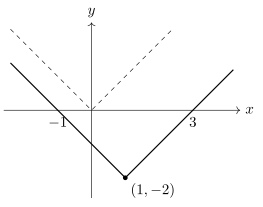
The figure shows (dashed) and
on
: by (a) with
, , the vertex moves
from to
, and the
zeros are at and
.
Quick check. Which function on
has graph ?
Solution. By (a) with and , it is
on . Its vertex is .
Even and
odd functions
Two symmetries of a graph are common enough to have
names. A set is symmetric if for every ; then .
For example, take . On the
function takes
the values : the value at equals the value at
. The function
takes the
values : the value at is minus the value at
.
Definition
8.1.4 (Even and Odd Functions)
Let be symmetric and . Then
is
even if for
every , and odd if for
every .
By Proposition 8.1.2
(b), is even
exactly when its graph equals its reflection in the
-axis. Indeed,
both and have
domain , so
they are equal exactly when their graphs are.
The odd case uses the method of reading a graph as a
set of pairs (Example (Method: reading a graph as a set of pairs)),
with , which is its own inverse. For , the
pair lies on the graph if and only if and . If is odd, this says and , so the graph is
unchanged by .
Conversely, let the graph be unchanged by . Then for the point lies on it,
so .
Some examples:
- , and the constants
on are
even;
- and on , and on , are
odd;
- on is neither, since its
value at is neither its value
at nor ;
- the zero function is both.
An odd with
has , so .
Every function on a symmetric set splits into an even
and an odd part, and only one way. For example, take
on . The terms and do not change when
is replaced by
, and changes sign. So is the even function
plus the
odd function .
Proposition
8.1.3 (Even and Odd Parts)
Let be symmetric and . There
is exactly one pair of functions
with even, odd and , namely
Proof. Existence.
Replacing by
swaps and , so and ; and .
Uniqueness. Let with even and odd, and put . As a difference of even functions is even, and as a
difference of odd functions it is odd. So ,
hence .
Since ,
for every
. Thus and .
For a polynomial function on , the even part keeps
the even powers, since for even
and for odd . For ,
the formulas give the even part and the odd part
, as found
above.
Exercises
A. Check your
understanding
Exercise
(A1)
Is each set a graph of a real function, and if so
over which ?
- (a) .
- (b) .
- (c) .
- (d) .
Solution. We use Proposition 8.1.1.
(a) No: and
lie in the
set, so by
(ii). There are two points above , so (i) fails. (b)
Yes, over : it
is . (c) No: and lie in it, so
by (ii),
and then there are two points above , so (i) fails, whatever
is. (d) Yes, over
: no pair has first coordinate , since , and
for the
only with is . It is the graph of
.
Exercise
(A2: Is this legal? Is it useful?)
Let
on and on .
- (a) Find the domains
of and
. Are the
two composites equal?
- (b) Is the composite
of after the
constant function
on legal? Is it
useful?
Solution.
(a) By Definition 8.1.2,
has
domain and has domain
. They
are not equal: the domains differ, and the values differ
too, since while .
(b) Legal: its
domain is , so it
is the empty function (Sets and Functions, Proposition 2.1.2).
It is useless: it has no values.
B. Practice
Exercise
(B1)
Let . Prove that and .
Solution. Both sides have domain
; fix . If , then by Number Systems: From to , Definition 4.1.1,
so the right sides are and . If , then
, and the right sides are and , again the max and
the min. The values agree at every , so the functions are
equal.
Exercise
(B2)
Obtain the graph of on from that of by Proposition 8.1.2,
and find its vertex and its zeros.
Solution. By (d) with , has graph : stretch
vertically by . By
(a) with ,
, applied to
, the
function has that graph moved right by and down by . The vertex goes to and then to . The zeros solve
, so or .
Exercise
(B3)
Find the even and odd parts of on . Why is removed from ?
Solution. For , the formulas of
Proposition 8.1.3
give The formula makes sense at . But even and odd
functions need a symmetric domain: with removed, must go too.
Exercise
(B4: Prove or disprove)
Prove each true statement and refute each false one
with a counterexample.
- (a) The product of
two odd functions on a symmetric is even.
- (b) A function on a
symmetric that is
both even and odd is the zero function.
- (c) The composite of
two odd functions is odd.
- (d) The sum of an
even and an odd function on is never even.
Solution.
(a) True: .
(b) True: , so
, as in
the uniqueness part of Proposition 8.1.3.
(c) True: .
(d) False: is even, the zero
function is odd, and their sum is even.
C. Going deeper
Exercise
(C1: Additive functions, used later)
Let satisfy for all , and let
.
Prove:
- (a) , and is odd;
- (b) for every
and ;
- (c) for every .
Solution (Hint 1). Choose and so that the equation
speaks about
alone.
Solution (Hint 2). For (c), write
with , , and
compute in
two ways.
Solution.
(a) With , , so . With , ,
so .
(b) For we use
induction (Logic and Proof, Axiom 4.2.1).
For ,
by (a). If , then . For , , and by (a),
.
(c) Let with and . By
(b), applied twice, . Dividing by
gives .
What a complete answer needs. (10
points) - 2: obtains and oddness from suitable substitutions. - 3:
proves (b) for by induction, with the step from the
equation. - 2: extends (b) to negative by oddness. - 3:
computes two
ways and divides by . Slips that lose the step: using for
rational before
proving it; assuming is a polynomial or
monotone.
![Diagram. Labels: |x| on mathbb R, 1/x on mathbb R setminus \0\, sqrt x on [0, infty ), mathbf 1_[0,infty ) on mathbb R](../tikz/6bbad1d3cae8a211c037a90a21f48c9aa94acf4c.svg)