Chapter 1 gave every non-negative real number its
-th roots (Lemma 1.5.1).
It gave every positive real number its rational powers
(Definition 1.5.2),
so a power with a rational exponent such as
already has a meaning. A power such as does not, and
no root will give it one. This section borrows three
facts about a single function, the exponential, and
derives everything else from them: the logarithm, real
powers and their laws, and how fast the exponential
grows. Its main theorem shows that two of the three
facts already determine the function completely.
Powers that
roots cannot reach
A power
with is a
power of an -th
root, . The
exponent is
not of the form , because is irrational, as
Section 8.3 showed from Number Systems: From to , Theorem 3.3.1.
So is
not a root of anything we know.
The naive answer, “the limit of as rational approach ”, needs limits of
functions, which this volume does not have. Our route
goes through one function, the exponential, and one
rule, . Constructing the exponential needs
power series, so we borrow it: three facts, and
everything else is proved.
What this
volume borrows about the exponential
The exponential should turn sums into products, and
near it should
look like .
Integration, Series, and Function Spaces,
Chapter 7 constructs it as a power series and proves the
facts below. Its is a complete ordered
field, so by Number Systems: From to , Theorem 6.3.1
it is our , up
to the one order-preserving field isomorphism, and the
function carries over along it.
Axiom
8.5.1 (What This Volume Borrows about the
Exponential)
There is a function with the following
properties. They are assumed here and proved in
Integration, Series, and Function Spaces,
Chapter 7.
- (E1) for all .
- (E2)
for every .
- (E3) For
every with there is with .
In words: the addition rule (E1)
turns addition of arguments into multiplication of
values. The tangent-line bound (E2)
puts the graph of on or above the line
. The
value property (E3) says that every
positive real number is a value of .
Chapter 3 borrowed cosine and sine in the same way
(Axiom 3.5.2).
Nothing in Sections 8.1–8.4, and nothing earlier in this
section, uses these three facts. From here on we use
these three facts about and no
others, and each proof that uses one names it.
The addition rule and the tangent-line bound carry most
of the weight. The value property is what makes the
logarithm defined on all of .
Neither of the first two facts follows from the
other. The constant function satisfies the addition
rule, since , but not the tangent-line bound: at it would need . The function
satisfies the tangent-line bound with equality, but not
the addition rule: at it gives , while .
Warning. The three facts say
nothing about continuity or derivatives. That is continuous, and
equal to its own derivative, is true. But it is not
among the three facts, and no proof in this volume may
quote it. Nor is a notation yet. Until
real powers are defined and shown to agree with , we write , never .
First
consequences
Negative integer exponents appear as soon as we
divide. For a real and , the power is the integer power of Chapter 1 (Definition 1.5.1).
By Proposition 1.5.3
(d), . We also write for .
The first proposition collects what the addition rule
and the tangent-line bound say at once.
Proposition
8.5.2 (First Consequences of the Addition Rule
and the Tangent-Line Bound)
- (a) .
- (b) and for
every .
- (c) is strictly
increasing on .
- (d) for
every
with .
- (e) for
every and
every .
Idea. Part (a) is the addition rule
at , with
the tangent-line bound to rule out . Part (b)
writes as a
square, . Part (c)
factors a difference, as in Example (Method: factor out y − x),
but with a product. The addition rule factors as , and the tangent-line bound shows that the
bracket is positive. Part (d) is the tangent-line bound
at , turned
upside down.
Proof.
(a) By the
addition rule, , so . By the tangent-line bound, , so
. A
product that is zero with one factor non-zero has its
other factor zero, so .
(b) By the
addition rule and (a), . Hence , and
because inverses are unique. The same holds at , so . By the
addition rule, , which is because it is the
square of a non-zero number.
(c) Let . By the addition
rule, , so The first inequality is the tangent-line bound
at ,
multiplied by from (b). The last step holds because a
product of two positive numbers is positive, (O4): here
and
.
(d) Let . By the
tangent-line bound at , . Both numbers are positive, so taking
reciprocals reverses the inequality: .
And by (b) applied to .
(e) For we induct on
. For , by (a). If ,
then by the addition rule For , (b) and the case just proved give
.
The value property (E3) appears nowhere in this
proof. So every part of Proposition 8.5.2
holds for any function that satisfies
the addition rule and the tangent-line bound. The main
theorem below depends on that.
Quick check. Which of the three
borrowed facts does each of the following use: ; is strictly
increasing; the inverse of is defined at every
point of ?
Solution. uses the
addition rule (E1) and the tangent-line bound (E2), by
the proof of (a). Strict increase uses the same two
facts, through (b) and (c). The inverse being defined on
all of
needs every positive number to be a value, which is the
value property (E3). That the inverse is a function at
all is (c), so the first two facts enter too.
Squeeze,
then close the gap by Archimedes
The main theorem computes as a supremum. To
show , Sets and Functions, Definition 5.3.5
asks that be an
upper bound and that no smaller number be one. The
second half often comes from members of approaching at a known rate.
A small case first. Let be the set of the
numbers for
,
and let .
Every member of
is at most . The
member with index
is , so the
members come within of . Given any , a large
has , and
then . So no is an upper
bound, and . The method below does the same with any
constant in place
of in .
Example
(Method: squeeze, then close the gap by
Archimedes)
How it goes. To prove for a set
:
- show that every satisfies ;
- find a constant , fixed before is chosen, and
an such that for every integer some satisfies ;
- given , put . By Number Systems: From to , Proposition 4.2.3
there is with
for all . For we
get .
So no is an upper bound, and is the least upper
bound.
When to use it. A supremum has been
guessed, and the members of come with an index
and an error
estimate of the form .
Common mistakes.
- The “constant” is allowed to depend on
. With , the estimate says
nothing about small gaps.
- The constant is , which leaves undefined. If
the estimate seems to come with , enlarge : a lower bound stays true when
grows.
| every
has ; for
some
has , with
fixed in
advance |
no is an upper bound of |
| ;
; for
|
some
with :
take , |
The real numbers form a complete ordered field (Number Systems: From to , Theorem 5.5.2).
Every complete ordered field is Archimedean (Number Systems: From to , Theorem 6.1.2),
so the Archimedean property, which the last step of the
method uses, holds in .
Two facts
determine the exponential
For a fixed ,
the numbers are built from by arithmetic alone. At
and they are
, and
. The theorem says that these numbers
squeeze from
below, and that their supremum is .
Theorem
8.5.3 (The Exponential Is Determined by Its
Addition Rule and Tangent-Line Bound)
Let ,
and let Then
is non-empty and bounded above, and .
Consequently, if is any function satisfying the
addition rule (E1) and the tangent-line bound (E2) with
in place of , then .
Idea (Scratch work). We want two
bounds on : above by , and below by
minus
something of size .
Upper. The tangent-line bound at gives .
Raising both sides to the -th power gives , and by
Proposition 8.5.2
(e). But raising an inequality to a power is allowed
only between non-negative numbers (Lemma 1.5.1
(a)). At ,
, the base
is
negative. So we ask for , which makes .
Lower. Part (d) of the same proposition at
gives , valid when , so . To compare this with , multiply and
divide by : The middle factor is close to : Bernoulli’s inequality
gives . That is the we need.
| the addition rule and the tangent-line bound; Proposition 8.5.2;
|
and , not depending on |
| ; |
: Bernoulli |
Then Example (Method: squeeze, then close the gap by Archimedes)
finishes, with . The keeps at .
Before reading on: why must exceed ? Find every place
it is used.
Proof. Fix . By the
Archimedean property there is with
,
so . Let with . Then
,
so
and
(Number Systems: From to , Proposition 4.1.3
(d)).
Upper bound. By the tangent-line bound at
, . Raising to the -th power keeps an
inequality between non-negative numbers, so . And by Proposition 8.5.2
(e). So is
an upper bound of , and exists.
Lower estimate. Since , Proposition 8.5.2
(d) gives . Both sides are positive, so raising to
the -th power,
with part (e) on the left, gives Splitting the power of a product, . Here , since . Multiply the display by this positive
number, and then apply Bernoulli’s inequality (Sets and Functions, Theorem 3.3.7)
to ,
using :
Conclusion. Put . It depends on only, and by Proposition 8.5.2
(b). For every integer the member of satisfies . By
Example (Method: squeeze, then close the gap by Archimedes),
.
Uniqueness. Let satisfy the addition
rule (E1) and the tangent-line bound (E2), with in place of . The proof of Proposition 8.5.2
used only these two facts and field and order rules, so
its conclusions hold for . The argument above
used only those conclusions, the tangent-line bound, and
facts about . So
for every . Two functions with the same domain,
codomain and values are equal, so .
The set
never mentions , so the theorem is a
formula: is
pinned between computable numbers, as the next
definition shows at . And the three borrowed facts describe a
function that the first two already determine.
The number
e
Definition
8.5.1 (Euler’s Number)
.
By the proof of Theorem 8.5.3 at
, for every
integer ,
At
this reads , so . Exercise B1 below squeezes harder.
Now we can say more about what fails without the
tangent-line bound, beyond the constant function . The function
satisfies the addition rule, since . It also has the value
property, since gives . It is not : by Proposition 8.5.2
(e), and because . So, by Theorem 8.5.3, it
must fail the tangent-line bound. It does, at : , as . Without the tangent-line bound, the
addition rule and the value property leave the speed of
the function free.
The
logarithm
By Proposition 8.5.2
(b) and (c),
is a strictly increasing map from into . By the value
property, every point of is a value. So is a bijection.
The logarithm undoes the exponential.
Definition
8.5.2 (The Logarithm)
The logarithm is the inverse of the bijection : for ,
is the unique with .
In words: the existence of is the value property.
Its uniqueness holds because a strictly increasing map
is injective (Sets and Functions, Proposition 2.2.3).
So
for every
and for every . By Theorem 8.2.3,
is strictly
increasing, and its graph is the graph of with the coordinates
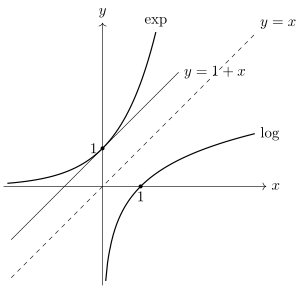
swapped, that is, reflected in the line . We write and never .
The picture shows above the line , touching it at
, and as its mirror image
in , through
. It
illustrates; no proof below reads anything off it.
Quick check. What are and ?
Solution. , since
undoes . And
by Proposition 8.5.2
(b), so .
Each rule for comes from a rule
for : apply
to both sides
and use that
is injective.
Proposition
8.5.4 (Rules for the Logarithm)
Let
with .
- (a) and .
- (b) and .
- (c) , and each inequality is an equality only at
.
Idea. For (a) and (b), compute
of each side.
For (c), the tangent-line bound at gives , and at
it
gives the other half. Strictness needs for
, which the
three facts do not state. We get it by writing as a square, , valid while .
Proof.
(a) We have by Proposition 8.5.2
(a), and
by the definition of . So and , by the
definition of .
(b) By the
addition rule, , so
by the definition of . Then by (a).
(c) First, for
every .
Case . Then , and by
the tangent-line bound. Squaring keeps an inequality
between non-negative numbers, so by the addition rule
the last step because . Case
.
Then by Proposition 8.5.2
(b).
Now the tangent-line bound at gives , that is, . By the strict inequality just
proved, it is strict when , that is,
when . By
(b), . The tangent-line bound at gives , that
is, , again strict when . At all three numbers
are .
Part (c) gives numbers: ,
for example.
Real
powers
A real power is the exponential of a multiple of
a logarithm.
For example, the rule below sets and . The second
should be , the
cube root of , and
we will check that it is.
Definition
8.5.3 (Real Powers)
Let .
- If ,
then .
- If and
, then
.
No other pair is given a value by this definition; in
particular there are no real powers of
a negative base.
In words: to raise to the power , take the logarithm,
multiply by , and
exponentiate. By Definition 8.5.2,
for . This is the definition with applied to both
sides, not a theorem.
The symbol
was already in use for (Sets and Functions, Definition 3.3.2),
and Chapter 1 gave and . The next
proposition shows that the new definition agrees with
both wherever they overlap, so no symbol now has two
meanings.
↺Second readingBase
zero and negative bases
Base zero. For
both definitions give . For , the definition of real powers says nothing.
The symbol
keeps the value
that Sets and Functions, Definition 3.3.2
gives it as a natural-number power. For , would have to be
, so
it is left undefined.
Negative bases. is defined only
for , so
the formula cannot start. One could set ,
but the rule would then break. With and it would give
, not . The real cube root of
a negative number is a separate object, of Example (Roots as inverse functions),
and it keeps its own symbol.
Solution. No: base is covered only for
. The
symbol keeps
its natural-number value from Sets and Functions, Definition 3.3.2,
which this definition does not touch. Yes: , since by Proposition 8.5.4
(b).
Proposition
8.5.5 (Real Powers Agree with Roots and Integer
Powers)
Let
with .
- (a) For and , the
real power
is ,
the rational power of Definition 1.5.2,
where is the
integer power of Chapter 1.
- (b) In particular,
for , the real
power is the
integer power
(for , the
power of Sets and Functions, Definition 3.3.2).
- (c) for every
.
Idea. Show that is a non-negative
number whose -th
power is ; the
uniqueness of roots makes it . Then take
the -th power.
Proof.
(a) By the
definition of real powers, , and
by Proposition 8.5.2
(b). By part (e) of the same proposition, with the
integer , So and . By the uniqueness in Lemma 1.5.1
(b), . By part (e) again, now with in place of
and the integer
, and part (e) states with the integer
powers of Definition 1.5.1
when .
(b) At , is the unique
with , which is itself. So (a) gives
.
(c) By Proposition 8.5.4
(a), .
From now on
and are the
same thing, and we use whichever reads better.
Solution. Yes. By (a) with , , , the unique non-negative real number whose
square is . Since
and , that number is
.
The laws of exponents now come in one line each,
because each is a law of or of in disguise. For
whole-number exponents they are school rules: , and . The proposition says that they hold
for every real exponent.
Proposition
8.5.6 (Laws of Real Powers)
Let with .
- (a) and
.
- (b) .
- (c) .
- (d) .
- (e) As a function of
on : is strictly
increasing if , strictly decreasing if , and constant
if .
- (f) As a function of
on : is strictly
increasing if and strictly decreasing if .
Idea. Write each power as of a product and use
the addition rule, the log rules, and the monotonicity
of and .
Proof.
(a) by the addition rule. Also by Proposition 8.5.2
(b).
(b) by (d), and
, so .
(c) , by Proposition 8.5.4
(b) and the addition rule.
(d) This is Proposition 8.5.2
(b).
(e) If , then ,
since is
strictly increasing. So is strictly increasing,
because multiplying by a positive number keeps order.
Composing with the strictly increasing gives a strictly
increasing function (Proposition 8.2.1
(e)). If ,
then ,
and is strictly decreasing, because multiplying
by a negative number reverses order. The composite is
strictly decreasing by the same rule. If , .
(f) Let . Then
.
If , then
, and keeps the order. If
, the order
is reversed and keeps the reversed
order.
Quick check. Is ? Is
?
Solution. Yes to both. Since , we have , because squares of non-negative
numbers keep order. The map is strictly
increasing by Proposition 8.5.6
(e), so . For the second, by Proposition 8.5.5
(a). So , by Proposition 8.5.6
(b). Since , , so and .
The
exponential outruns every power
How fast does grow? The tangent-line bound gives only , which a
linear function matches. Raising the tangent-line bound
to a power, as in the proof of Theorem 8.5.3, does
much better.
A small case first. Split into two halves. By
the addition rule, , and the tangent-line bound gives
, so
. The
tangent-line bound at alone gives only . Splitting
into more pieces does better still.
Proposition
8.5.7 (The Exponential Beats Every
Power)
- (a) For every and every , . Hence, for every , for all
.
- (b) For every and every , .
Hence, for every , for all .
Idea. For (a), split into equal parts and
apply the tangent-line bound to each: . Dropping the loses a little, and
gives a strict inequality. For (b), apply not at
but at , which is much
smaller.
Proof.
(a) Let , , . By the tangent-line bound, . Raising to the power keeps a strict
inequality between non-negative numbers, so by Proposition 8.5.2
(e), If and , then , and , so the right side exceeds
.
(b) Let and . By the
definition of real powers, . So, by Proposition 8.5.4
(c) at , Now let and
, and take . Here by Proposition 8.5.5
(a). Since and , we get , because squares of non-negative
numbers keep order. So and . Hence .
The thresholds are explicit:
once , and once . They are far from the best, and
need not be good. They need to exist, depending on , or only, never
on .
Exercises
A. Check your
understanding
Exercise
(A1)
These questions are about the proof of Theorem 8.5.3.
- (a) Which of the
addition rule (E1), the tangent-line bound (E2) and the
value property (E3) does the proof use, including
through Proposition 8.5.2?
- (b) Where does
Bernoulli’s inequality enter, and at which real number
is it applied?
- (c) Write out the
two bounds on
that the proof gives at , .
- (d) Take and . Which step of the
upper-bound argument fails? Is its conclusion
still true for this pair?
Solution.
(a) Only the
addition rule (E1) and the tangent-line bound (E2). The
proof of Proposition 8.5.2
uses these two and field and order rules. The proof of
the theorem adds the tangent-line bound at . The value property
(E3) is not used, which is why the uniqueness sentence
asks only for the first two.
(b) In the lower
estimate, to bound below by . It is applied
at , which
is because
.
(c) .
(d) Here ,
and . The step “raise to
the -th power”
fails: Lemma 1.5.1
(a) needs a non-negative smaller side. The conclusion
fails too: , while , because .
The inequality is strict by the first step of the proof of
Proposition 8.5.4
(c).
Exercise
(A2)
True or false? Give a reason or a counterexample.
- (a) for
every .
- (b) for all .
- (c) Definition 8.5.3
defines .
- (d)
for all
and .
Solution.
(a) True, by the
addition rule (E1) with , or by Proposition 8.5.2
(e) with .
(b) False. At
the left
side is and
the right side is . But ,
since is
strictly increasing.
(c) False: the
base is
negative, and Definition 8.5.3
gives no real powers of a negative base. The real number
is the odd root of Example (Roots as inverse functions),
a different symbol.
(d) False. With
, , , : the left side is
,
the right side (values by Proposition 8.5.5
(b)).
B. Practice
Exercise
(B1)
Prove that .
Hint: one value of in the bounds after Definition 8.5.1
does both.
Solution. Take . The lower bound
gives because .
The upper bound gives because . Hence .
Smaller is not
enough: at the upper bound is , , , , all above
.
Exercise
(B2: Prove or disprove)
Prove each true statement and give a counterexample
to each false one.
- (a)
for every .
- (b) for every
.
- (c) If , then
for
every .
- (d) There is a
polynomial function on (Definition 8.1.3)
with
for every .
Solution.
(a)
True. Let and with and . By the binomial theorem in the commutative
ring (Theorem 1.2.3),
is a
sum of non-negative terms. Among them are , and . Dropping the others, where the first inequality is the upper-bound
half of Theorem 8.5.3.
Suppose . Then , since at we have . The display
gives for every integer with . By Number Systems: From to , Proposition 4.2.3
there is
with and
, a contradiction. So .
(b)
True. By Proposition 8.5.4
(b), (a) and (c), .
(c)
False. Take , , : . The statement holds for (Proposition 8.5.6
(f), with equality at ) and reverses for .
(d)
False. Suppose for all . Put and . For we have for . So the triangle
inequality gives . By Proposition 8.5.7
(a) with , any
, which is , has , a contradiction.
Exercise
(B3: Put the proof in order)
Here are lines of the lower estimate in the proof of
Theorem 8.5.3,
shuffled, with two lines that do not belong. Write an
order of the correct lines that makes a proof, and say
why each distractor fails.
- (i) Fix and an integer
.
- (ii) Then and .
- (iii) By Proposition 8.5.2
(d), , so .
- (iv) .
- (v) So .
- (vi) Bernoulli’s
inequality at gives .
- (vii) Hence .
- (viii) (D1) By the
tangent-line bound, , so .
- (ix) (D2)
Bernoulli’s inequality at gives .
Solution. Each line may come only
after the lines it uses. Line (ii) uses (i). Line (iii)
uses (ii), since it needs and positive
sides. Line (iv) uses (ii), since it divides by . Line (v)
uses (iii) and (iv). Line (vi) uses only (i), since it
needs . Line (vii) uses (v) and (vi). Every
order respecting these constraints is accepted.
One is (i), (ii), (iii), (iv), (v), (vi), (vii); another
is (i), (vi), (ii), (iv), (iii), (v), (vii).
(D1) bounds the wrong thing: the goal is a lower
bound by , and is not one. Its “so” is also unjustified:
is Bernoulli’s inequality, not a consequence
of . (D2) has the wrong sign: Bernoulli’s
inequality at gives . The claimed bound is false,
since for
the left side is and the right side .
C. Going deeper
Exercise
(C1: Find the error)
Here is a proof that is strictly
increasing: “Let . By the addition rule, , and by the tangent-line bound, . So .” Is the conclusion true? Does the
argument prove it? Name the line that fails, and show
that it fails with numbers.
Solution. The conclusion is true:
it is Proposition 8.5.2
(c). The argument does not prove it. The first equality
is false: the addition rule (E1) gives the
quotient , not the difference. At , : ,
while , and . The correct line is . After it, the tangent-line
bound gives , and multiplying by
finishes.
Exercise
(C2: Chapter check: the logarithm is slower than every
root)
- (a) Prove that for
every there is such that for every .
- (b) Let . Prove
that for every there is such that for every .
Solution (Hint 1). For (a), compare
with a root
of smaller than
, using Proposition 8.5.7
(b).
Solution (Hint 2). For (b), put
. What is in terms of ?
Solution.
(a) Let and
; it
depends on only. Let
, and put
. By Proposition 8.5.7
(b) with ,
. By
Proposition 8.5.5
(a), , so and . Hence ,
because fourth powers of non-negative numbers keep
order. So and . Finally , by the addition law for real
powers and Proposition 8.5.5
(a). Hence .
(b) Let and
put . Let , the threshold of (a) for
, and ; both
depend on and only. Let and . The map is strictly increasing on by Proposition 8.5.6
(f). So , by part (b) of the
same proposition and Proposition 8.5.5
(b). By (a) applied to and , . Here , by Proposition 8.5.5
(a) and the law . By the definition of real powers, , so
What a complete answer needs (10
points)
- 3: a bound with , with the result or log rule it comes
from named.
- 3: an explicit depending on only, and a
check that
gives .
- 2: passes from to the bound in (b), for example by the
substitution with the monotonicity of cited,
or directly by Proposition 8.5.7
(b) with and
.
- 2: the quantifiers in the order , then , then every .
A route through Proposition 8.5.7
(a) (put ) earns the same points step for step.
Slips that lose the step (0 for the
step): chosen
depending on ; any
use of derivatives, l’Hôpital’s rule or limits of
functions.