The later volumes will define continuity, limits of
functions and the integral, and each definition will be
tested on functions that resist being drawn. This
section collects those functions in one place. For each
we prove what can be proved with the tools of this
chapter: the order, the floor, suprema and finite
counting. What needs a limit we only ask, and the
questions go into a table at the end.
Irrationals
between any two reals
Most of the functions below treat rational and
irrational points differently, so we need both kinds in
every interval. The rationals are dense (Number Systems: From to , Theorem 4.2.5).
The irrationals are dense too. Number Systems
left this as an exercise (Number Systems: From to , Exercise (C2)),
and we prove it here. A real number is
irrational if it is not in .
Lemma
8.6.1 (Irrationals Are Dense)
For all with there is an irrational with .
The argument for irrationality works for every
rational : is
irrational.
Quick check. Why does the proof
shift by ,
and not by ?
Solution. For rational , the number is rational, so
the shift would land on a rational. The proof needs a
shift that turns every rational into an irrational, and
an irrational shift does that.
The
Dirichlet function
The simplest function that no pencil can draw is the
indicator of the rationals.
Proposition
8.6.2 (Properties of the Dirichlet
Function)
- (a) A real is a period of
(Definition 8.4.3)
if and only if .
- (b) For all , and
, both attained, and .
- (c) For all , is neither increasing
nor decreasing on .
Proof.
(a) Let , . Since is closed under sums
and negatives, if and only if , so for every
. Let . Then and , so is not a
period.
(b) Every value
of is or . The interval contains a
rational, where
is (Number Systems: From to , Theorem 4.2.5).
It also contains an irrational, where is (Lemma 8.6.1). An
upper bound of that is itself a value is its supremum, so
is attained; likewise .
Since is bounded
on the non-empty set , Proposition 8.3.4
gives .
(c) By Lemma 8.6.1 there
is an irrational . The rationals are dense, so there are
rationals and . Then and , so is not increasing on
. Also with ,
so it is not decreasing.
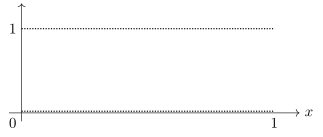
The Dirichlet function on : the rational
points sit on the upper dotted line, the irrational
points on the lower one, and every stretch of either
line contains points of both kinds.
Multiplying by . Let on
: on and off . Then
for every , so
near the values
of are small.
Away from they
are not. Let and . If , an irrational with
(Lemma 8.6.1) gives
. If , a rational with gives by the triangle inequality (Number Systems: From to , Proposition 4.1.3
(e)). So every interval around , however short,
holds points where differs from by at least .
Thomae’s
function
The Dirichlet function gives every rational the same
value. Thomae’s function gives a rational a value that
shrinks with its denominator. For example, it gives
the value , both and the value , and the value . At an irrational
point it is .
Definition
8.6.2 (Thomae’s Function)
For ,
let with
, and
; the
pair is
unique (Proposition 2.2.6
(a)). Thomae’s function is
Since
and ,
; likewise
for every
. On , , since
.
Warning. The denominator is read
after cancelling: ,
not . Without
lowest terms, “
at ” is not a
function at all, since would get the two values and .
Quick check. Compute , , and .
Solution.
- .
- ,
since
and .
- ,
since .
- , since is irrational. Indeed, if ,
then . But is irrational, as shown in Section 8.3.
Large values of are rare. On , the points with
have
denominator ,
or . They are , , , and : only five.
Proposition
8.6.3 (Thomae’s Function Has Few Large
Values)
- (a) is a period of .
- (b) For all real
and every
,
the set is
finite.
- (c) For all , the interval
contains
points with and points with .
Idea. A large value needs a small
denominator: forces .
There are finitely many such , and for each only finitely many
multiples of
lie in . The
same point appears under several (), so we take a
union of finite sets rather than add up counts.
Proof.
(a) For , also , and
both values are .
Let in
lowest terms. Then . A positive common divisor of and divides . It
divides as well,
so it is a common divisor of and and is at most their
greatest common divisor ; hence it
equals . So and
.
(b) Let and
(Definition 8.4.1).
For let . Let . Then , so ; write in lowest terms. From we
get , so by Proposition 8.4.1
(g). From and we get . Hence ,
and by Proposition 8.4.1
(g). So
with .
(If , no qualifies and .)
Each is
finite. If , then .
Otherwise let and . The map ,
, is onto by the definition of , and injective
because . So
has elements (Sets and Functions, Definition 4.1.2).
A finite union of finite sets is finite. Let
and be finite sets. Then
is the
union of the disjoint sets and . The second
is finite, as a subset of . So is finite by Sets and Functions, Proposition 4.1.5.
Induction on the number of sets gives
finite.
Hence , a
subset of a finite set, is finite by Sets and Functions, Proposition 4.1.6.
- (c) The interval
contains a
rational, where (Number Systems: From to , Theorem 4.2.5).
It also contains an irrational, where (Lemma 8.6.1).
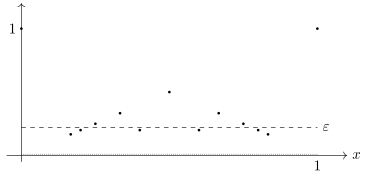
Thomae’s function on , drawn for the
denominators : the dot over has height , and the irrational
points lie on the dotted axis. Only finitely many dots
rise above the dashed level .
More
strange functions
An involution. A function with is an
involution. Exercise C2 of Section 8.2
(Exercise (C2, used later))
showed that an increasing involution of is the identity. Here
is how far that fails without “increasing”.
Example
(An Involution That Is Monotone Nowhere)
Let , for and for . Show that ,
that is a
bijection, and that is monotone on no
interval
with .
Solution. For , . For
, also
, so
. So is
its own two-sided inverse, and it is a bijection by Sets and Functions, Theorem 2.4.4.
Let . By
Number Systems: From to , Theorem 4.2.5,
used twice, there are rationals in , and , so is not decreasing
there. By Lemma 8.6.1, used
twice, there are irrationals in , and , so is not increasing
there.
The map was already a non-identity involution; is one that agrees with
the identity on a dense set.
A jump. The function of Example (A strictly increasing function with a jump),
for and for , is strictly
increasing on ,
yet its image skips the whole interval .
A staircase. The floor function
makes a step function out of a straight line.
Example
(A Staircase Along the Diagonal)
Let , and for . Describe
on for
.
Solution. For we have
, so by Proposition 8.4.1
(g), and is
defined. For , The first equivalence is the definition of the
floor. The second takes reciprocals of positive numbers,
which reverses inequalities (Number Systems: From to , Proposition 3.2.2).
So on : a step
at height whose
right end lies on the line .
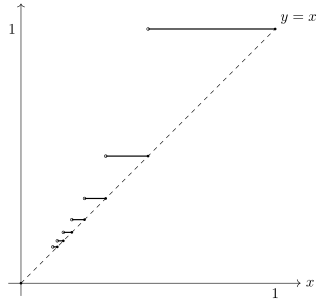
The staircase and the line (dashed), drawn for
: each step
starts just above the line and ends on it.
Proposition
8.6.4 (The Staircase Hugs the Diagonal)
- (a) is increasing on .
- (b) takes infinitely many
values.
- (c) For , .
(At the left
side is and so is
the right, so the strict inequality fails there.)
Proof.
(a) Let .
Taking reciprocals reverses the inequality, so (Number Systems: From to , Proposition 3.2.2).
Then by Proposition 8.4.1
(c). Both are at least , so taking reciprocals
again gives . For
, .
(b) For , (Proposition 8.4.1
(a)). Suppose
took finitely many values. The set consists of some of them, so it
would be finite (Sets and Functions, Proposition 4.1.6).
It is non-empty, so it would have a minimum (Sets and Functions, Proposition 3.3.8).
But
and .
(c) Let and . By the solution of Example (A Staircase Along the Diagonal),
, so , and The middle inequality is , true for
. The last
holds because gives (Lemma 1.5.1
(a) with exponent ).
So near , agrees with up to an error below
, although
is constant on
each step.
Solution. No. A step function with
a partition into
open pieces takes at most values: one on each piece and one at each
of the
partition points. By Proposition 8.6.4
(b), takes
infinitely many values.
A zigzag. Replace the floor by the
distance to the nearest integer, and the steps become
tents.
Example
(A Zigzag That Never Settles)
Let , and for (Definition 8.4.2).
Describe on for
.
Solution. For in that interval, , and
for this is Proposition 8.4.2
(a) with , and at both sides are . So at both ends, at , where
, and
in between climbs
from to and falls back. Each
interval carries one full tent, and the tents crowd
toward .
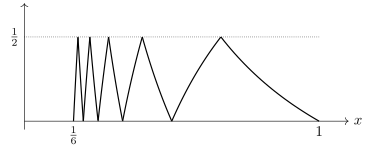
The zigzag
on : five
tents, each rising from to and back, narrower as
they approach .
Proposition
8.6.5 (The Zigzag Takes Every Value Near
0)
- (a) For every and every
there is with .
- (b) For every , .
Proof.
(a) Let and . By Number Systems: From to , Proposition 4.2.3
there is with . Put
. Since , we have (Number Systems: From to , Proposition 3.2.2).
Since has period (Proposition 8.4.2
(c)), induction on gives . Finally , as , so by Proposition 8.4.2
(a), , because .
(b) For both sides are
. For , by Proposition 8.4.2
(b).
So on every interval the zigzag sweeps through all of , while is pressed between
and
.
Two functions on a closed interval.
The last two are defined at every point of and still
misbehave.
Example
(Unbounded on a Closed Interval)
Let , and for . Show that is not bounded above on
(Definition 8.3.1).
Solution. Let , and put and . Then . So
no is an upper
bound of .
Example
(A Supremum Never Reached)
Let , for and . Show that and
that it is not attained.
Solution. Every value is at most
: it is or it is . For , put
; then . By Proposition 8.3.2,
. Every value is in fact
strictly below , so the supremum is not
attained.
Both and are defined everywhere
on the closed bounded interval . The table below
asks which further hypothesis would rule out both
behaviors.
The
table
Example
(A Table of Strange Functions)
Each row names a function, recalls its definition,
lists what has been proved about it, and asks what the
later volumes will answer.
| (Definition 8.6.1) |
on , off |
periods exactly the non-zero rationals; on every
interval sup , inf
, monotone
nowhere |
continuous at any point? integrable on ? |
|
on , off |
at most
in size; near each , points where it differs from its value at
by at least |
continuous exactly where? |
| (Definition 8.6.2) |
at in lowest terms,
off |
period ;
finitely many points of where ; positive and zero points in every
interval |
continuous exactly where? integrable on ? |
| (Example (An Involution That Is Monotone Nowhere)) |
on , off |
; a bijection; monotone on no interval |
continuous at any point? |
| (Example (A strictly increasing function with a jump)) |
for , for |
strictly increasing; image skips |
which property forces the image of an interval to be
an interval? |
| (Example (A Staircase Along the Diagonal)) |
on , at |
increasing; infinitely many values;
for |
continuous at ? differentiable at
? integrable? |
| , (Example (A Zigzag That Never Settles)) |
for , at |
takes every
value of
on every ; |
continuous at
? continuous at
? differentiable
there? |
| (Example (Unbounded on a Closed Interval)) |
on , at |
not bounded above on |
which hypothesis on a function on forces it to be
bounded? |
| (Example (A Supremum Never Reached)) |
on , at |
sup , not
attained |
which hypothesis forces the sup to be attained? |
Exercises
A. Check your
understanding
Exercise
(A1)
Find the supremum and infimum of on and of on . Which of them are
attained, and where?
Solution. For on : supremum , infimum , both attained (Proposition 8.6.2
(b)), for example at and at the irrational
(irrational by the Quick check after Definition 8.6.2,
and gives , and it is positive).
For on : every value is at
most , since , and , ; so the
supremum is ,
attained at and
. Every value is
at least , and
;
so the infimum is , attained at every
irrational point of .
Exercise
(A2)
Let .
- (a) Is bounded on ?
- (b) Is monotone on ?
Solution.
(a) Yes: for .
(b) No. The
points lie in : squaring, , and squaring is strictly
increasing on (Lemma 1.5.1
(a)). The values are , , . The first pair shows is not increasing on
, the second
that it is not decreasing.
B. Practice
Exercise
(B1)
Find all with .
Solution. forces rational, in lowest terms
with and
.
Listing and keeping the pairs with : Seven points; is not new, since it
is , with value
.
Exercise
(B2: Prove or disprove)
- (a) for every .
- (b) The restriction
of to is increasing.
- (c) Every bijection
is
monotone on some interval with .
- (d) for every
.
Solution.
(a) True. If
and were both
rational, so would be their difference , which is
irrational, as shown in Section 8.3. So at most one of
the two values is .
(b) True. On
, is the identity, and
gives
.
(c) False. is a bijection that is
monotone on no such interval (Example (An Involution That Is Monotone Nowhere)).
(d) True. This is
Proposition 8.6.3
(a).
Exercise
(B3)
Compute ,
and check the inequality of Proposition 8.6.4
(c) at .
Solution. and , so . Then , and
. Indeed .
C. Going deeper
Exercise
(C1: Additive and increasing)
Let satisfy for all , and let be increasing. Prove
that for
every ,
where .
Solution (Hint 1). Exercise C1 of
Section 8.1 gives
on . Trap between rationals.
Solution (Hint 2). Suppose and for some
. Where can a
rational sit so
that monotonicity and collide?
Solution. By Exercise (C1: Additive functions, used later)
(a) and (c), and for every . Since is increasing and , .
Fix .
Case . Suppose . Then , and Number Systems: From to , Theorem 4.2.5
gives
with . Then , although and is increasing, so : a
contradiction. Suppose . Then , and a
rational with
gives , against . So .
Case . Take rationals (Number Systems: From to , Theorem 4.2.5,
in and
). Then
, so .
Without “increasing”, additivity alone does not force
in
general. But an additive function that is not of this
form cannot be written down without the axiom of choice.
This series builds no such function, and it does not
prove that none can be written down without choice.
What a complete answer needs. (10
points) - 2: obtains on
and , each
with its reason. - 4: for , refutes with a
rational between
and , using
monotonicity in the right direction. - 2: the symmetric
case .
- 2: the case . Another correct route earns the same points:
a two-sided squeeze with rationals closer
than , then
Archimedes (2 for on
and , 4 for
,
4 for closing the gap). Slips that lose the step:
dividing by
without ;
assuming
continuous or taking a limit of rationals.
Exercise
(C2)
Let and
let be increasing. Prove that is bounded and attains
its supremum and its infimum on . Why does Example (A Supremum Never Reached)
not contradict this?
Solution. For , , so
because is
increasing. So is
bounded, is an
upper bound of that is itself a value, hence is
attained; likewise .
The function
is not increasing on : but . Its supremum fails to be
attained exactly because the value at the right end
drops.
R. Review
Exercise
(R1)
Let , and suppose its polynomial function
satisfies for every . Prove that is a constant
polynomial.
Solution. Let and
. Evaluation respects differences (Proposition 6.4.4
(b)), so . By induction on , : , and
.
Suppose ,
of degree . Then
are
distinct
roots of , against
Theorem 7.4.1,
which allows at most . So , and is constant.
Exercise
(R2)
Prove that the strictly increasing bijections form a
subgroup of the group of all bijections under
composition. Do the strictly decreasing bijections form
one?
Solution. The bijections of form a group under
(Example (Groups)
(c)). Let be the
set of strictly increasing bijections. We use Theorem 5.2.1.
,
since . Let . Since
is strictly increasing and onto, Theorem 8.2.3 (b)
gives that is strictly increasing. It
is a bijection by Sets and Functions, Theorem 2.4.4.
Then
is strictly increasing by Proposition 8.2.1
(e). It is bijective by Sets and Functions, Theorem 2.2.1
(c). So , and
is a subgroup.
The strictly decreasing bijections do not form a
subgroup. A subgroup contains the identity, and is not strictly
decreasing (, ). They are not even closed under
composition: composed with itself is .
Exercise
(R3)
Let ,
and let and for . Prove that .
Exercise
(R4)
Is there a polynomial whose polynomial function is on
?
Solution. No. Suppose there were.
Then , since
. Let . The polynomials and both have degree at
most and agree at
the distinct
points , where . By Theorem 7.4.2
(a), . Then
, a contradiction.
The tool is that a polynomial is fixed by finitely
many values. Two look-alikes fail. Comparing growth
gives nothing: grows like a
polynomial of degree . “Since is even, has only even powers”
needs the same identity principle to compare with , and then still
needs an argument.