Logic and Proof, Chapter 4 described the
natural numbers as what we reach from by adding , again and again, and
nothing else; induction (Logic and Proof, Axiom 4.2.1)
was the precise form of “nothing else”. In this chapter
every object is a set, so we need a set to play and an operation on
sets to play “add ”. This section chooses
both, adds the one axiom that lets the repetition be
completed into a set, and proves induction as a theorem
about the set it produces.
Going one
step further
The empty set is the only set we can name without
first having another one, so it will be . For “add one” we want
an operation that, started from , keeps
producing new sets, never returning to one already met.
Putting a set inside itself as an element does that, as
we shall see.
The successor of a set adds the set itself as an
element.
Definition
1.3.1 (Successor of a set)
For every set , the
successor of is the set
In words: the elements of are the
elements of ,
together with
itself. So, for every set , The set exists and
is unique: is
the set of
Pairing (Z3), and comes from Union
(Z4), both by Proposition 1.1.2
(b), (c). Two facts are visible at once. First, for
every . Second,
: the successor keeps every old
element and adds
itself, which is a new element whenever . The next
section proves for every natural number .
The letter is an upright . Sets,
Relations, and Cardinality, Chapter 1 used an
italic for a set
in Sets, Relations, and Cardinality, Proposition 1.2.2,
and we are about to use that proposition with this
operation as its step; the two letters never stand for
the same thing.
Start from and apply
repeatedly.
Example
(The first natural numbers as sets)
Define Write each of as a set of the earlier numerals, and
then using only and braces.
Check that are four different sets.
Solution. Each step adds the
previous set as a new element: Written with and braces
only, already
needs eight pairs of braces and eight copies of , which is why
the numerals are worth having.
The four sets differ, by Extensionality (Z1): two
sets are equal only if they have the same elements, so
it is enough to find an element of one that is not an
element of the other. The set has no elements, while
, and all have the element
; so differs from each of
them. Next,
and , but
: the
only element of is , and . So differs from and from . Finally , but : the elements
of are and , and differs from both, as
just shown. So .
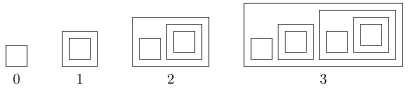
Each number is the set of the numbers before it:
,
and
because nothing comes before . The picture draws a
set as a box and its elements as the boxes directly
inside it.
The box for
holds three boxes, which are copies of the boxes for
, and . In general a natural
number will turn
out to be the set of the natural numbers less than , so that for . That is a theorem, proved later in this
chapter once the order on the natural numbers is
defined. For now the pattern is only something we have
seen in the first five cases.
From here to the end of the chapter, the numerals
name these sets. They are not real numbers; where the
chapter compares the two pictures, it says so.
Other choices of “add one” are possible. The rule
also starts a list of different sets, . With an axiom of
infinity stated for that rule, it too would give a set
satisfying Peano’s axioms, but not by the proofs of the
next section. What it loses is the pattern above: under
it, the set playing has one element, not
three, and it does not contain the sets playing and . The next section’s
proofs rest on that pattern, and one of its results
fails outright: under the set playing is , which
is the pair of Definition 1.2.1,
while the next section shows that no pair is a natural
number in our sense. The choice makes the
order of the numbers into membership, which the chapter
uses repeatedly.
Warning. The successor is defined
for every set, not only for numerals,
and its result need not look like a number. For , the successor is . It does not contain , while every numeral
after computed
above does. A statement about that holds
for the numerals may fail for other sets; this is why
the results below are stated for elements of one
particular set.
Inductive
sets and the axiom of infinity
We want a set whose elements are exactly . The dots
are the problem: Pairing and Union make each numeral,
one at a time, and no axiom so far collects them all.
The way out is to describe the property such a set must
have, ask for a set with that property, and then cut it
down to size.
An inductive set contains and never runs out of
successors.
Definition
1.3.2 (Inductive set)
A set is
inductive if and,
for every , also .
In words: the first clause gives the set a starting
point, and the second says it is closed
under the successor, so that applying never leads
out of it. In symbols, with bounded quantifiers,
The word “inductive” has another use in the analysis
volume of this series, for subsets of the real numbers
that contain the number and are closed under
.
The shape is the same, but here the starting point is
the set ,
the step is , and there is
no ambient set of real numbers.
An inductive set contains all the numerals: by the
first clause, then by the second, then , and so
on, one application of the second clause per numeral. So
an inductive set cannot be finite in any naive sense,
and nothing we have so far produces one.
Non-examples by minimal change come cheaply. The set
contains
and the successors of , and ; only the last
successor is missing, since : the set has the element , and none of does ( has no elements, and
the elements of ,
and are among , each different
from by Example (The first natural numbers as sets)).
And , if we had it, would be closed under
but
would miss the starting point. Both clauses do work.
Quick check. Is inductive?
Is ?
Solution. Neither. contains
, but
is not an element of : its only
element is , and because . So the closure clause fails at .
contains and the
successors of and
, but is not
among : the
set has the
element , and none
of does
( has no elements,
the only element of is , and the elements of
are and , both different from
by Example (The first natural numbers as sets)).
So the closure clause fails at .
Axioms (Z1)–(Z6) of Axiom 1.1.1
produce each numeral separately, never all of them at
once. That they cannot do better, that is, that no
inductive set can be shown to exist from (Z1)–(Z6), is a
theorem of set theory proper; we state it without proof,
and nothing in this book depends on it. So the existence
of an inductive set has to be assumed.
Axiom
1.3.1 (Axiom of Infinity)
(Z7) There is an inductive set.
Everything else the chapter builds, the natural
numbers and their arithmetic included, comes from the
inductive set of (Z7) by the six axioms of Axiom 1.1.1.
The axiom provides some inductive
set and says nothing else about it. It may contain sets
other than . We cannot simply call it “the set of
natural numbers”; we have to carve that set out of
it.
The least
inductive set
An inductive set contains the numerals, and perhaps
more. To remove anything extra, keep only what lies in
every inductive set: whatever a set
must contain merely by being inductive.
The natural numbers are what every inductive set
is forced to contain.
There is one obstacle. Separation (Z6) can only cut a
set out of a set already given, so we need an ambient
set for the natural numbers; and the smallest-closed-set
construction of Sets, Relations, and
Cardinality, Chapter 1 (Sets, Relations, and Cardinality, Proposition 1.2.2)
intersects a set of subsets, but the inductive sets are
not handed to us as the elements of any set. So we fix
one inductive set
and look only at the inductive subsets of , which do form a set,
by Power set and Separation; the theorem below shows
that the choice of does not matter.
Definition
1.3.3 (The set of natural numbers)
Fix an inductive set , which exists by (Z7).
Define The elements of are the
natural numbers.
In words: a natural number is an element of the fixed
inductive set
that survives every attempt to shrink to a smaller inductive
set.
The set
exists by Separation (Z6), with ambient set , once the condition is
a property in the sense of (Z6): a formula of Logic
and Proof, Chapter 5’s first-order language with
and (Logic and Proof, Definition 5.2.2),
with as a
parameter. The condition is “for every , if and is inductive, then
”, and,
since
abbreviates as in (Z5) (Sets, Relations, and Cardinality, Definition 1.1.2),
the only part not yet written in that language is “ is inductive”. Written
out with no abbreviations it is The first line says that has an element with no
elements, which is , because is the only set
with no elements (Proposition 1.1.2
(a)). The second says that for each some element
of has exactly the
elements of , which is by
(Z1).
Here is what “least” means, and why the choice of
is harmless.
Theorem
1.3.2 (The Least Inductive Set)
- (a) is inductive.
- (b) for
every inductive set , whether or not .
- (c) is the only set
with properties (a) and (b). In particular, does not depend on
the inductive set
fixed in Definition 1.3.3.
Idea. Part (a) is Sets,
Relations, and Cardinality, Chapter 1’s smallest
closed set, with
as the ambient set, as the starting
element and as the step:
the closed subsets of are exactly its
inductive subsets, and is their
intersection. For (b), an inductive need not lie inside
, so we cut it
down to , which does; then the definition of applies. Part (c)
is two inclusions, each an instance of (b).
Proof. (a) Apply Sets, Relations, and Cardinality, Proposition 1.2.2
with ,
the single starting element , which lies in
because is inductive, and the
single step , which turns elements of into elements of for the same reason. A
subset is closed in the sense of that proposition
exactly when and for every , that is, when is inductive. So the
set of closed subsets is a set by Power set (Z5) and Separation (Z6);
it is non-empty, since . Its intersection , formed
inside as in Proposition 1.1.2
(c), is , which is . By Sets, Relations, and Cardinality, Proposition 1.2.2,
is
closed; that is, is inductive.
(b) Let be an inductive set.
The set exists by (Z6) (Proposition 1.1.2
(c)), and . It is inductive:
by (a) and because
is inductive; and
if , then
by (a) and because is inductive. So is an
inductive subset of , and by Definition 1.3.3
every element of lies in it. Hence
.
(c) Let be a set that is
inductive and is contained in every inductive set. Then
,
because is
inductive by (a); and by (b), because is inductive. So by Sets, Relations, and Cardinality, Proposition 1.1.1.
Now let be
another inductive set, and let be the set
that Definition 1.3.3
produces from . The proofs of (a)
and (b) used nothing about except that it is
inductive, so they apply to as well:
is
inductive and is contained in every inductive set. By
what we just proved, .
This proves the theorem.
So is
the least inductive set: it is
inductive, and it lies inside every inductive set. From
now on we forget .
The numerals of Example (The first natural numbers as sets)
are natural numbers, since is inductive and
contains each of them by the argument given after Definition 1.3.2.
Warning. “An inductive set is the
set of natural numbers” is false in
general. Theorem 1.3.2
gives for an inductive , and nothing more. The
set-theory volume of this series, using the axiom of
Replacement (not part of this chapter), builds the
inductive set ; it
contains
itself as an element, and the next section shows that
. Axiom (Z7) does not say that its is not a set of this
kind. What distinguishes among inductive
sets is “least”, and every argument about natural
numbers must go through , not through an
arbitrary inductive set.
Induction
on the natural numbers
Leastness has an immediate consequence. To show that
every natural number belongs to some set , it is enough to show
that is
inductive, since then .
Theorem
1.3.3 (Induction on )
- (a) (Set form.) Let
.
If , and
for every ,
then .
- (b) (Property form.)
Let be a
property, that is, a formula of the first-order language
with and , possibly with other
variables as parameters. If holds and,
for every , implies , then
holds
for every .
Proof. (a) The hypotheses
say that is
inductive. By Theorem 1.3.2
(b), . With , Sets, Relations, and Cardinality, Proposition 1.1.1
gives .
(b) Let , a set by
(Z6). Then ,
because by Theorem 1.3.2
(a) and holds.
Let . Then
and
, so by
hypothesis, and
because is
inductive; hence . By
(a), ,
which says that holds for every
.
Compare part (b) with the principle of induction, Logic and Proof, Axiom 4.2.1.
Read with in
place of , and
with
in place of ,
the two statements are the same; and once addition is
defined, later in this chapter, will be . The
difference lies in their status. In Logic and
Proof, Chapter 4, induction was an axiom, a basic
property of
taken on trust. Here it is a theorem,
proved from the seven axioms (Z1)–(Z7) about sets, and
the proof is three lines long because all the work went
into the definition of : the natural
numbers were defined as what every inductive set
contains, and induction says exactly that.
The proof of (b) is the model for the inductions in
the rest of this chapter.
Show the set is inductive. To prove
for every
, form
and show that it has as an element and is
closed under .
Here is the move once, on a statement about the shape
of natural numbers: every is , or is , or has as an element.
Let , a set by (Z6). Then by the first
alternative. Let ; there are three cases. If , then , which
satisfies the second alternative. If , then , which has as an element. If , then . In every case ,
since also because is inductive (Theorem 1.3.2
(a)). By Theorem 1.3.3
(a), .
Two features of this small proof recur. The property
carried along is a disjunction, because “” alone is false
at and , and an induction
can only carry a property that holds at the start. And
the step is a case split along the disjunction, with one
case for each alternative; dropping a case would be the
error (N7) of Logic and Proof, Example (What is not allowed).
Quick check. In the proof just
given, which case of the step produces the first natural
number that satisfies the third alternative “”, and which
number is it?
Solution. The case . It produces , which has as an element. Neither
nor has as an element ( has no elements, and
the only element of is ), so is the first. From then
on the third case passes “” to , because
.
The next section uses the move five times in a row,
to show that
satisfies Peano’s axioms.
Exercises
A. Check your
understanding
Exercise
(A1)
- (a) List the
elements of and
of as sets of
numerals.
- (b) Is ? Is ?
- (c) True or false,
with a reason: every inductive set has
as an element.
- (d) Write “ is not inductive” in
symbols, with the negation moved inward until it stands
only in front of a membership statement.
Solution.
(a) and , by Example (The first natural numbers as sets).
(b) Both are
true. The elements of are and , and both are elements
of ;
so
(Sets, Relations, and Cardinality, Definition 1.1.2).
And is itself one
of the listed elements of , so . A set can be
both an element and a subset of another set; for
numerals this will turn out to be the rule, not an
accident.
(c) True. Let
be inductive.
Then by the first clause of Definition 1.3.2,
and the second clause applied five times gives , each
being the successor of the one before.
(d) “ is inductive” is . Its negation is
which by De Morgan’s law Logic and Proof, Proposition 2.5.5
(d) and (c) is equivalent to ,
and by Logic and Proof, Proposition 6.2.3
(a), the bounded form of Logic and Proof, Proposition 6.2.1,
to In words: lacks the starting
point, or some element of has its successor
outside .
B. Practice
Exercise
(B1: Intersections and differences)
Let and be inductive sets.
Prove that
is inductive. Is inductive? Justify your answer,
and say which clause of the definition holds and which
fails.
Solution. The set exists by (Z6)
(Proposition 1.1.2
(c)). It contains , since and . If , then
because is
inductive and , and
likewise; so . Hence is
inductive.
The set is not
inductive: it does not contain , so the first
clause fails. The second clause holds: if , then , and
because ; so . This is a non-example by minimal
change: removing one element breaks exactly one
clause.
Exercise
(B2: Zero or a successor)
Prove that every is or is for some
, by
showing that the set is inductive.
Solution. The set exists by (Z6), and
.
It contains by the first alternative. Let . Then , so
because is
inductive (Theorem 1.3.2
(a)), and satisfies
the second alternative with .
So . By Theorem 1.3.3
(a), ,
which is the claim.
The step never used the hypothesis that satisfies one of the
alternatives, only that . That is legitimate: the step’s
conclusion was reached outright, and induction still
does the work of saying that every natural number is
reached from by
successors.
C. Going deeper
Exercise
(C1: Two steps back)
- (a) Prove that every
is
, or is , or is
for some .
- (b) Let be an arbitrary
inductive set. Running the argument of (a) on , what does it prove about the
elements of , and
what does it not prove?
Solution.
(a) Let a set by (Z6). Then by the first
alternative. Let ; we show , in
three cases along the disjunction. If , then , the
second alternative. If , then , the third
alternative with . If with , then , the
third alternative with in place of
, and
because is
inductive. In each case ,
so . By Theorem 1.3.3
(a), .
(b) Call the set
. The same three
cases show that
has as an element
and is closed under , so is inductive; by Theorem 1.3.2
(b), . That says only that every natural
number is , or
for some ,
which is weaker than (a), whose lies in . It does not say
that every element of is , or
for some .
The set form of induction concludes only because
was given; for the most we get is , and the elements of outside , if any, are not
reached. Induction proves statements about , not about
arbitrary inductive sets.