Chapter 1 built the natural numbers as the set , with its , , and , and proved the laws
of arithmetic, the order and well-ordering from the
axioms for sets. From this chapter on,
means that set (Corollary 1.7.3
and the citing rule of Section 1.7). In the equation has no
solution: for every by Proposition 1.6.3
(a), while
by the same result, as with . So would give , hence , which Theorem 1.6.1
(a) rules out. This section builds a larger set , out of alone, with the one
tool of Sets, Relations, and Cardinality,
Section 2.5: the quotient of a set by an equivalence
relation.
What we use
about the natural numbers
Every fact about in this section and
the next is one of the following results of Chapter 1,
and each is cited where a proof uses it. The defining
equation
and the evaluation of numeral sums and comparisons such
as and
rest on Definition 1.5.1
and Theorem 1.6.1
and are not cited each time.
- Defining equations (Definition 1.5.1):
, and , and the numerals ,
, , …, with .
- Laws of arithmetic (Theorem 1.5.3):
and are commutative and
associative,
distributes over ,
and ,
,
.
- Cancellation (Proposition 1.6.3
(b), (f)): gives ; and with gives .
- Order (Theorem 1.6.1
(a)): is a
strict total order, so for all exactly
one of , ,
holds, and
is transitive
and irreflexive.
- Order and addition (Proposition 1.6.3
(a)): if
and only if for some ; and if and only if for some . Adding preserves (Proposition 1.6.3
(c)).
- Small facts and well-ordering:
(Theorem 1.6.1
(d)); no
satisfies (Theorem 1.6.1
(b)); every non-empty subset of has a least element
(Theorem 1.6.2).
That is the whole list for now. Nothing about the
integers or the rationals of school enters a proof: from
here on they are the sets this chapter builds, and their
familiar properties become theorems.
A naive
attempt
The school picture of an integer is “a natural number
with a sign”: ,
, . It is tempting to take
that literally and let an integer be a pair with a sign (read
as “plus” and
as “minus”) and a
size . Two
things go wrong at once.
First, zero gets two names, and : a “plus zero” and
a “minus zero”. Either both stay, and every theorem must
treat them as the same, or one is banned, and every
definition must check that it never produces the banned
one.
Second, addition needs cases. Adding and should give when and when , where is the subtraction
of Proposition 1.6.3
(a), defined on
only when .
There are four sign patterns for a sum, and two of them
split again by the order of the sizes. A proof that
addition is associative would split by the signs of all
three terms and then by the order of their sizes, and
every case would subtract in in its own
direction.
The trouble in both is the same: the definition
performs a subtraction that can only do one way
round. The construction below never performs it. It
records the subtraction as a pair, and lets an
equivalence relation decide when two recorded
subtractions should count as equal.
Pairs that
record a difference
Think of a pair as a note saying “ minus ”, to be computed later
or never. The note is legitimate even though is not a natural
number. Many notes say the same thing: , and all describe
“two less than nothing”, which school calls .
When do two notes and describe the same thing? School would write
, and
then add to
both sides to get . That last equation is the one we keep,
because it uses only addition, which has for all inputs.
The computation with minus signs is a
heuristic, borrowed from school to find
the definition; the definition does not depend on
it.
An integer is a difference you have not computed
yet.
Definition
2.1.1 (The Integers)
For , let The set of integers is the
quotient set of Sets, Relations, and Cardinality, Definition 2.5.4,
and an integer is an element of . The class of the
pair is
written :
In words: two pairs are related when their
cross sums agree, the first coordinate
of each added to the second coordinate of the other. The
relation is a subset of , described
by a property (Sets, Relations, and Cardinality, Definition 1.3.3,
Sets, Relations, and Cardinality, Definition 1.3.2).
An integer is one whole class: the set of all pairs that
record the same difference. The notation is the class
notation of Sets, Relations, and Cardinality, Definition 2.5.2
with ; no
new bracket is introduced.
Well-definedness. Sets, Relations, and Cardinality, Definition 2.5.4
is stated for an equivalence relation.
Until is shown
to be one, the definition of is a plan, not a
definition. The next proposition supplies the missing
check, and it is placed directly after the definition
for that reason.
An integer is a set of pairs. It is
not a natural number with a sign, and it is not a pair.
Sets, Relations, and Cardinality, Chapter 1
adopted the convention that a pair is not a number
(after Sets, Relations, and Cardinality, Definition 1.3.1),
and on that
became a theorem, Proposition 1.4.3.
The same care is needed here: is the set , and the school is what those pairs
have in common. The construction takes “what they have
in common” to be the set of them.
Idea. Reflexivity and symmetry are
rearrangements of one equation, by commutativity.
Transitivity has two hypotheses, and , and a goal
in
which and do not appear. In
school one would subtract them. In we add the two
equations, so that appears on both sides, and then remove it by
cancellation.
Before reading on: which line uses cancellation
in , and why is
it more direct than subtracting ?
Proof. We check (Eq1)–(Eq3) of Sets, Relations, and Cardinality, Definition 2.5.1.
Let .
(Eq1) by commutativity (Theorem 1.5.3
(b)), so .
(Eq2) Suppose , that is, . By commutativity, , and says .
(Eq3) Suppose and , that is, Adding the two equations gives . By associativity and commutativity (Theorem 1.5.3
(b), (c)), the left side is and the
right side is , so By cancellation (Proposition 1.6.3
(b)) with , . That is .
This proves that is an equivalence
relation.
The answer to the prompt is the last line of (Eq3).
It is tempting to “subtract from both sides” at
the end. In the
difference of
Proposition 1.6.3
(a) exists only when . Here it does exist, since and by the same result and
commutativity, but only after that check; and reading
off uses the uniqueness in (a), which
is itself proved by cancellation. Cancellation removes
directly, and
it holds for all ,
with no size check.
So is now defined, and by Sets, Relations, and Cardinality, Theorem 2.5.1
its elements partition : every pair lies in exactly one
integer, and if and only if .
Pictures of
classes
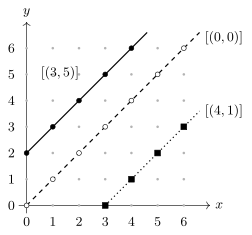
The quarter plane is a grid of lattice points, and the
classes are easy to see in it.
Example
(Three classes, listed and drawn)
List the elements with of each of the classes , and , and describe
each class as a set of lattice points.
Solution. The class . A pair
lies in it
when .
This holds if and only if . Indeed, if , then by associativity (Theorem 1.5.3
(c)). Conversely, , so gives , and cancellation (Proposition 1.6.3
(b)) gives . So and the elements with are , , , , .
The class . Here the condition is , that is,
, since (Definition 1.5.1
(a)). So , the diagonal, and the
elements with are , , , , .
The class . The condition holds if
and only if , by the same two steps as for . So . Its elements with are and only: (Theorem 1.5.3
(b)) gives
(Proposition 1.6.3
(a)); with , is or , since no natural
number lies strictly between and (Theorem 1.6.1
(b)); and then or , so is or by cancellation (Proposition 1.6.3
(b)).
Each of these three classes is the set of lattice
points on one diagonal line or of the quarter
plane, starting on an axis and running up and to the
right.
The picture shows the three classes as three
diagonals:
solid with filled dots, dashed with open dots, dotted with
squares. Every pair lies in exactly one class (Sets, Relations, and Cardinality, Theorem 2.5.1),
so no two of these diagonals share a lattice point;
after the normal form below we see that every class is a
diagonal of this kind, so every lattice point lies on
exactly one of them. The class is the
degenerate case: it is the integer zero, and it is the
only class whose line passes through the origin.
A non-example by minimal change.
Replace the sums in the definition by products: on , let
mean . This
is still reflexive () and symmetric ( gives ), both by
commutativity of (Theorem 1.5.3
(f)). It is not transitive: since , and . The clause that fails is
(Eq3), and the line of the proof above that has no
counterpart is cancellation. Additive cancellation holds
for every ;
multiplicative cancellation (Proposition 1.6.3
(f)) needs ,
and the pair
supplies a middle factor that is . When Section 2.4
builds fractions with this product relation, it excludes
zero second coordinates for exactly this reason.
Why this
definition
Why cross sums. “” cannot be
the definition, because is defined in only when . The cross-sum
equation says the same thing whenever both differences
exist, and it makes sense for every two pairs.
Why whole classes. Each class has a
simplest pair, one with a coordinate , as the next
proposition shows. One could define as the set of these
simplest pairs instead. But then the sum of and would have to be
brought back to a simplest pair, , by a subtraction
in in the right
direction: the case analysis of the naive attempt
returns. With classes, any representatives may be
combined, and the equivalence relation absorbs the
bookkeeping. The price is the check of the next section:
a definition through representatives must not depend on
which ones were used.
The degenerate class and the name.
The class of
is the diagonal; it will be the zero of . The word “integer”
is Latin for “whole” or “untouched”, a number not broken
into fractions; Section 2.4 builds those.
The first result about the new set says that each
class has exactly one simplest name.
Idea. The three cases are the three
cases of trichotomy for and , and Proposition 1.6.3
(a) turns each inequality into an equation with a
non-zero . In each
case one line of arithmetic shows that is related to the
simplest pair. For “exactly one pair”, two simplest
pairs of the same form are handled by (b), so we prove
(b) first. Two of opposite forms, and with , would need
, which
the order forbids.
Proof. (b) Suppose . By
Sets, Relations, and Cardinality, Theorem 2.5.1
(b), , that is, . Since (Definition 1.5.1
(a)) and
(Theorem 1.5.3
(a)), .
Likewise gives , so .
(a), the three cases. Let . By Theorem 1.6.1
(a), exactly one of , ,
holds. By
Proposition 1.6.3
(a), holds
if and only if for some , and if and only if for some . So exactly one of the three listed
conditions holds. In each case the stated equality of
classes follows from Sets, Relations, and Cardinality, Theorem 2.5.1
(b), once the two pairs are shown to be related:
- if ,
then (Definition 1.5.1
(a)), so ;
- if , then
, so
;
- if ,
then (Definition 1.5.1
(a)), so .
In particular every class contains a pair of the form
or .
(a), only one such pair. Let be a class containing
two such pairs
and . Since
both lie in ,
by Sets, Relations, and Cardinality, Theorem 2.5.1
(b). If
and , then by (b), so ; likewise if both have the form . This covers
every case in which one of the pairs is , since has both forms.
There remains and with and . Then says . Since , Proposition 1.6.3
(a) gives ;
and since
(Theorem 1.5.3
(a)) with ,
it also gives . By transitivity , which Theorem 1.6.1
(a) rules out. So this case cannot occur, and the pair
is unique.
So every integer has a normal form:
it is for
a unique ,
or for a
unique
with . In
the picture, every class is a diagonal: means
, that
is, , and
means , that is, (Definition 1.5.1
(a)), so The normal form is where the class’s diagonal
meets an axis. The next section reads as the natural
number and as its negative;
this is how the description of Sets, Relations, and
Cardinality, Section 2.1, “an integer is a natural
number or the negative of one”, becomes a theorem about
the constructed .
Warning. A property of a class must
not be read off one representative.
“The integer is small when ” sounds like a property of integers and
is not one: , the first pair has , and the
second has .
The class is “small” or not according to the name we
happened to use. The property “ is positive when
” looks the
same and happens to be safe: if and , then . That needs a proof, and Section 2.3
gives it before it calls any integer positive.
Quick check. Is ? Is
?
Solution. Yes: the cross sums are
and
. No:
the cross sums are and , and . In school terms, and both record
“five less”, while records “five more”. The normal forms
agree:
and , so
, while , a different class by Proposition 2.1.2
(a).
The set
exists, and each element has a simplest name. It has no
arithmetic yet. The next section defines the sum and
product of two integers by formulas on representatives,
and the warning above is the question it must answer for
each formula.
Exercises
A. Check your
understanding
Exercise
(A1)
- (a) State the
relation and
the set of Definition 2.1.1
in symbols.
- (b) Which pairs with
a coordinate equal to lie in ?
- (c) Why does the
proof of Proposition 2.1.1
cancel rather
than subtract it?
- (d) True or false,
with a reason: .
Solution.
(a) For : ; and .
(b) Only . A pair in the class would
need (Theorem 1.5.3
(a)); but by Proposition 1.6.3
(a) (with Theorem 1.5.3
(b) to write ), and , so would give , and then , which Theorem 1.6.1
(a) excludes. A pair needs , that is, , so by cancellation (Proposition 1.6.3
(b)). This agrees with Proposition 2.1.2
(a): , so
, and the class has exactly one pair with a
coordinate .
(c) Subtraction
in is defined
only when the number subtracted is at most the other (Proposition 1.6.3
(a)). Here is
at most both sides, so subtracting would be possible,
but only after that check, and reading off the
differences uses the uniqueness in (a), which is itself
proved by cancellation. Cancellation (Proposition 1.6.3
(b)) holds for every with no check, so the proof uses it
directly.
(d) True.
because , so the classes are equal by Sets, Relations, and Cardinality, Theorem 2.5.1
(b). Both are the zero class .
B. Practice
Exercise
(B1: Three look-alike relations)
On , determine which of the following relations
are equivalence relations. For each one, decide which of
(Eq1)–(Eq3) hold. Justify your answer.
- (a)
if and only if .
- (b)
if and only if .
- (c)
if and only if .
Solution.
(a)
Symmetric, but neither reflexive nor
transitive. Symmetric: gives by
commutativity (Theorem 1.5.3
(b)). Not reflexive: would need , that is,
, which is
false. Not transitive: since , and
since ; transitivity would give ,
which we just saw is false. Notice that
every pair is related to something,
since by commutativity. A symmetric relation in
which every element is related to something still need
not be reflexive: “ related to , so related to , so related to ” uses transitivity, and
that is what fails here.
(b) An
equivalence relation. (Eq1) . (Eq2)
gives , by commutativity. (Eq3) Suppose and . Adding,
and rearranging by Theorem 1.5.3
(b), (c), and cancellation (Proposition 1.6.3
(b)) gives . In school terms the pair records , and the relation
says .
(c)
Reflexive and transitive, not
symmetric. (Eq1) , since the two sides are equal.
(Eq3) First, for , and give : by Proposition 1.6.3
(a), and
for some
, so
by Theorem 1.5.3
(b), (c), and (a) again gives . Now let
and
.
Adding and rearranging, If , then by Proposition 1.6.3
(c), contradicting the display by trichotomy (Theorem 1.6.1
(a)). So , by trichotomy again. Not symmetric:
since , that is, ; but would need , that is,
, which is
false since (Theorem 1.6.1
(d)).
Exercise
(B2: A class in set-builder form)
Let . Describe the class by a set-builder
expression, in the two cases and . Hence describe
and .
Solution. Case . Write with (Proposition 1.6.3
(a)). We claim A pair lies in when , that is, by Theorem 1.5.3
(c), (b). By cancellation (Proposition 1.6.3
(b)) this holds if and only if ; the converse
direction is substitution. So the elements of the class
are exactly the pairs , .
Case . Write (Proposition 1.6.3
(a)). In the same way, means ,
which by rearranging and canceling holds if and only if
. So .
The two descriptions agree when (then ), as they must. For
the examples, , so , and .
C. Going deeper
Exercise
(C1: Exit check: the relation that builds )
Let be the
relation of Definition 2.1.1
on .
- (a) Prove that is an equivalence
relation.
- (b) Prove that if
and , then .
- (c) Say in one
sentence what (b) means for a rule that adds two
integers by adding representatives coordinatewise.
Name the property of behind each step.
Solution.
(a) This is Proposition 2.1.1;
here is the proof once more. Reflexive: by
commutativity. Symmetric: if , then by
commutativity. Transitive: let and . Adding the
two equations and rearranging by associativity and
commutativity gives , and cancellation
of (Proposition 1.6.3
(b)) gives .
(b) The
hypotheses are and . Adding them, By associativity and commutativity (Theorem 1.5.3
(b), (c)), the left side is and the right side is . So which is the cross-sum equation for .
(c) The class of
does
not depend on which representatives of and were used, so
“add representatives coordinatewise, then take the
class” is well defined: it assigns
exactly one integer to each pair of integers.
Marking scheme. (10 points)
- 2: reflexive and symmetric, each citing
commutativity of
in .
- 3: transitivity: combines the two hypotheses into
one equation with a common summand on both sides (by
adding them, or by substituting one into the other) and
removes that summand by cancellation in
, named as
such.
- 2: in (b), combines the two hypotheses (by adding
them, or by substituting both into a rearranged
sum).
- 2: in (b), rearranges by associativity and
commutativity to the cross-sum equation for the two
sums.
- 1: (c) concludes that the coordinatewise sum is well
defined on classes.
A proof of (b) that changes one argument at a time
(first to
with fixed,
then the other) and joins the two by transitivity earns
the four points of (b) if each step is justified. Fatal
errors (0 for the step): subtracting in (for instance
“subtract from
both sides”) without showing that the difference exists;
proving only reflexivity and symmetry and calling the
relation an equivalence relation.