The previous section built and proved
induction on it (Theorem 1.3.3).
Sets, Relations, and Cardinality, Chapter 2
used two further facts about the natural numbers without
a second thought:
is not of the form , and forces . For the sets of this chapter neither is
automatic, and the obvious argument for the second
fails, as we shall see. This section proves both for
natural numbers, using one property of their membership
structure; it then names the list of properties we have
reached, Peano’s axioms, and shows that each of its last
three items, (P3), (P4) and (P5), does a job that the
other two cannot do.
Transitive
sets
We want to prove: if and , then . The tempting move
is to cancel, reading as “the same thing was
added to both”. But union does not cancel: , and . What does give is membership. Since
, either or ; and likewise or . So the one bad
case is and
at once,
two sets each inside the other.
For the numerals, membership only ever points to
earlier numerals, and the elements of an element are
earlier still. In , the element has the elements and , and both are again
elements of . This
is the property we name.
A transitive set contains the elements of its
elements.
Definition
1.4.1 (Transitive set)
A set is
transitive if every
element of is a
subset of : for
every ,
.
In words: unpacking (Sets, Relations, and Cardinality, Definition 1.1.2),
is transitive
when, for all sets and , Membership passes through in two steps: whatever
is an element of an element of is already an element
of . The name
comes from this display, which has the shape of the
transitivity of a relation (Sets, Relations, and Cardinality, Definition 2.4.1)
with as the
relation and
fixed at the end.
Examples, simplest first.
- is
transitive, vacuously: it has no element at which the condition
could fail. This degenerate case is the base of every
induction below.
- is
transitive: its only element is , and .
-
is transitive: , , and .
A non-example by minimal change: remove from . The set is not
transitive, because its element has the
element , and
( differs from
and from , Example (The first natural numbers as sets)).
Deleting one element broke the property at exactly one
place.
If is
transitive, then gives , so and together give . So the bad case above reduces to a set
that is an element of itself. The lemma below rules that
out for natural numbers, and with it the bad case.
Lemma
1.4.1 (Natural Numbers Are Transitive
Sets)
- (a) Every is a
transitive set.
- (b) is a transitive
set: every element of a natural number is a natural
number.
- (c) for every
.
- (d) Every with is for some
.
- (e) for every with .
Idea. Each part is one use of the
move of the previous section, show the set is
inductive, in its property form Theorem 1.3.3
(b). The base is always , where the claim is empty or
immediate. The steps of (a)–(c) start from “ means
or ” and treat the two
cases. Part (c) is the only one that uses an earlier
part: it argues by contradiction inside the step, and
transitivity (a) is what turns a membership one level
down into the forbidden . In (d) and (e) the statement is false at
, so the property
carried is a disjunction “ or …”. Before reading on: in the proof
of (c), why does give
?
Proof. Each part is proved by Theorem 1.3.3
(b), with the property named at its start.
(a) Let be “ is transitive”. holds because has no
elements. Let be transitive, and let . If
, then because
is transitive,
and ; so . If , then . In both cases , so is
transitive.
(b) Let be “”.
holds because
. Let with . The elements of are the elements of , which lie in by hypothesis, and
itself, which
lies in by
the choice of . So
. Hence for every , which says
that is
transitive.
(c) Let be “”. holds because has no
elements. Let with , and suppose . Then or
.
- If , then , because is transitive by (a);
and , so .
- If , then .
Both cases contradict . So , by (Logic and Proof, Definition 2.2.1).
(d) Let be “, or for
some ”.
holds by the
first alternative. For every , holds by
the second alternative, with . So holds for every
, and
for the
second alternative is the claim.
(e) Let be “ or ”. holds by the first
alternative. Let with . If , then ,
which has as an
element. If , then . Either way , so
holds. So
holds for every , and for the second alternative is the claim. This
proves the lemma.
The step of (d) never used . As with the
predecessor in Sets, Relations, and
Cardinality, Chapter 2 (Sets, Relations, and Cardinality, Example (An induction that ignores its hypothesis)),
the step’s conclusion was reached outright, and
induction is still what guarantees that and the successors are
all there is. Part (b) says that the natural numbers are
built only from natural numbers: unwrapping a natural
number never leads outside . Part (c) is the
fact the bad case needed.
Peano’s
axioms for the natural numbers
Here is the list. Its five items are traditionally
called Peano’s axioms; for they are
theorems.
Theorem
1.4.2 (Peano’s Axioms Hold in )
- (P1) .
- (P2) For every , .
- (P3) For every , .
- (P4) For all , if , then .
- (P5) Every with
and for
every is
equal to .
Moreover, is a set, and
with codomain it is a function
, which is injective and does not take
the value .
Idea. (P1), (P2) and (P5) are the
previous section restated: is inductive, and
induction holds. (P3) is one line, since and
nothing is an element of . (P4) is the
argument of the opening of this section: leaves only the case and to exclude, and
transitivity with excludes it.
Proof. (P1) and (P2) say that is inductive,
which is Theorem 1.3.2
(a). (P5) is Theorem 1.3.3
(a).
(P3) Let . Then . If , then
by (Logic and Proof, Definition 5.7.1),
which is impossible, since has no elements. So , by
(Logic and Proof, Definition 2.2.1).
(P4) Let with . Since , we have or ; likewise, since
, we have or . Suppose . Then and . Since is transitive (Lemma 1.4.1
(a)) and ,
we get ; so , that is, . This contradicts
Lemma 1.4.1
(c). Hence ,
by
(Logic and Proof, Definition 2.5.1).
For the function: let , a set by Separation (Z6) inside the product
of Proposition 1.2.2;
the pairs lie in that product by (P2). We
check the two clauses of Sets, Relations, and Cardinality, Definition 1.4.1.
(Fn1): for , . (Fn2): if and , then
and for some ; by
Theorem 1.2.1,
, and
then . So is a function , whose
value at is . It is
injective by (P4) (Sets, Relations, and Cardinality, Definition 1.4.3),
and is not a
value by (P3). This proves the theorem.
The function and the operation
on all sets share a letter, and
they agree wherever both are defined. Only the first is
a set. The operation has no graph: a set containing the
pair for
every set would give, after two
unions, a set containing every set, which Sets, Relations, and Cardinality, Theorem 1.1.4
forbids.
One more consequence is used constantly. By Lemma 1.4.1
(d), every with is for some
, and
by (P4) this is
unique: if , then . So every
non-zero natural number has exactly one predecessor, and
has none, by
(P3).
Quick check. Is the function surjective? Is ?
Solution. No to both. is not
surjective: , and by (P3) no has . (Every
other natural number is a value, by Lemma 1.4.1
(d).)
If , then would be a natural
number with , which Lemma 1.4.1
(c) rules out. So . In particular is a set that is
not a natural number, although all its elements are.
Peano
systems
Sets, Relations, and Cardinality, Chapter 2
worked with a set of real numbers, and
this chapter with a set of sets. Both come
with a starting element and a step. The last section of
the chapter asks whether they are “the same”, and to ask
it we need to say what any such structure must satisfy.
The answer is the list just proved, with , and replaced by
letters.
A Peano system is a set with a start and a step,
where the step is one-to-one, never returns to the
start, and reaches everything.
Definition
1.4.2 (Peano system)
A Peano system consists of a
set , an element
, and a
function , such that:
- (P3)
for every ;
- (P4) is
injective;
- (P5) every subset with and for every
is equal to
.
In words: (P1) and (P2) are built into the data,
since and
maps into . (P3) says the step
never leads back to the start. (P4) says two different
elements never step to the same element. (P5) is
induction for : a
subset that contains the start and is closed under the
step is everything, so every element of is reached from by steps. We write
and not
, so that
the letter never suggests . The notation lists the three
pieces of data; it is not a set built from them (if one
object is wanted, take the pair of Definition 1.2.1).
The first example is the one we have, and the second
shows that the elements need not be numbers.
- is a Peano system, by Theorem 1.4.2:
is a function, and (P3)–(P5) are those
of the theorem.
- Tagged numbers. Let , a set by Proposition 1.2.2,
let , and let . Every element of
is for exactly one
(Theorem 1.2.1),
so is well
defined, and its graph is a set by (Z6) inside . (P3): would give by Theorem 1.2.1,
against (P3) for . (P4): gives , so by (P4) for . (P5): let contain
and be closed
under . The set
has as an element and is
closed under , so by Theorem 1.3.3
(a), and .
Here is not , and no element
of is a natural
number, as we shall see at the end of the section.
Why these three clauses and no others? Each one does
work that the other two cannot do: for each clause there
is a structure satisfying the other two and failing
it.
Example
(Each axiom is needed)
Show that each of the following structures , with ,
satisfies two of (P3), (P4), (P5) and fails the
third.
- (i) , , .
- (ii) ,
,
,
.
- (iii) (The
natural numbers beside a two-sided chain.)
, whose elements are the pairs with and ;
;
and for .
Solution.
(i) Fails
(P3): . (P4) holds: has one element, so two
inputs with equal outputs are equal. (P5) holds: a
subset of
containing is
.
(ii)
Fails (P4): with . (P3) holds: both
values are . (P5) holds: if has as an element and is
closed under ,
then , so .
(iii) First,
is a function
. Each
element of is
for exactly
one
and one , by
Theorem 1.2.1.
For , the
first coordinate is or with (Lemma 1.4.1
(d)); never both, by (P3) for ; and the is unique, by (P4) for
. So exactly
one line of the definition applies to each element, and
it names one value. The values lie in , since . The graph is a set by (Z6) inside .
To check (P3) and (P4), sort the values by their
second coordinates, which are , and , three different sets
(Example (The first natural numbers as sets)):
(P3) holds. A value equal to would have
second coordinate , so it would be with
,
against (P3) for .
(P4) holds. Suppose . The two
values have the same second coordinate, so they come
from the same row of the display. In the first row,
gives by Theorem 1.2.1
and (P4) for . In the third row,
gives , so . In the second row, because ; so
either both values are of the form , and
as
before, or both are , and both inputs are . In every case
.
(P5) fails. Let , a subset of (Proposition 1.2.2).
It contains , and it is closed under , since . But is not in , because its second
coordinate is not
. So .
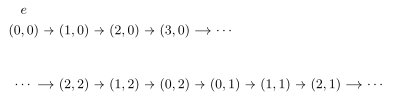
The picture shows (iii), with an arrow from each
element to its image under .
The top row is a copy of , starting at . The bottom row is a
chain running forever in both directions: read as “” and as “”, and adds one everywhere,
with ,
playing ,
stepping to ,
playing . Every
element has exactly one arrow out and at most one arrow
in, which is (P4); only has no arrow in, which
is (P3). What fails is that the bottom row cannot be
reached from .
Induction, (P5), is the clause that says “nothing
else”.
So (P3) and (P4) alone cannot prevent extra elements:
in (iii) the whole bottom row is extra. That is why the
definition of needed “least”,
and why induction is part of the list.
Pairs are
not natural numbers
Sets, Relations, and Cardinality, Chapter 1
adopted a working convention, stated after Sets, Relations, and Cardinality, Definition 1.3.1:
a pair is not a number. In that chapter numbers were
given and pairs were postulated, and the convention said
they were different kinds of object. Now both are sets:
a pair is the set of Definition 1.2.1,
and a natural number is an element of . For natural
numbers the convention becomes a theorem.
Proposition
1.4.3 (No Pair Is a Natural Number)
For all sets
and , the pair
is not an
element of .
Idea. Every natural number other
than has as an element,
by Lemma 1.4.1
(e). A pair is not , and it does
not have
as an element, because both of its elements contain
.
Proof. Let be sets, and suppose
(Definition 1.2.1).
The pair has the element , so .
By Lemma 1.4.1
(e), , so or . Both are impossible, since and , while
has no
elements. This contradiction shows .
So, for instance, the tagged numbers in the second
example of a Peano system above are never natural
numbers, and Sets, Relations, and Cardinality,
Chapter 1’s answer that because “a pair is not a
number” is borne out by Proposition 1.4.3
once the numbers ,
, are read as elements of
, as the
later chapters of this volume read (Section 1.7). The
same statement for -tuples with needs a
definition of -tuples, which comes
later in this chapter, together with the order on .
Warning. The encoding produces true
statements that sound absurd. Since and , so “” is true of the pair , although is not in the open
interval of
real numbers, and “” is false of the pair. Such
a statement is a fact about how pairs were encoded as
sets, not about pairs: with Wiener’s encoding , met in Section 1.2 (Exercise (C3: Wiener’s encoding)),
the pair of and
is , which
does not have as
an element. A proof about pairs should use only their
characteristic property, Theorem 1.2.1.
The places in this section that look inside a pair (the
remark after Theorem 1.4.2
that the operation has no graph, the closing remark
of the tagged-numbers example that is not
, Proposition 1.4.3,
and this warning) are about the encoding itself.
With Peano’s axioms in hand, the next section proves
the recursion theorem on and uses it to
define addition and multiplication.
Exercises
A. Check your
understanding
Exercise
(A1)
- (a) For each of the
three structures in Example (Each axiom is needed),
which of (P3), (P4), (P5) fails?
- (b) In the proof of
(P4) in Theorem 1.4.2,
where is Lemma 1.4.1
(a) used, and where is (c)?
- (c) Is
inductive? Justify your answer.
- (d) Is a
transitive set? Is it an element of ?
Solution.
- (a)
(b) Part (a) is
used to pass from to : is a
natural number, hence a transitive set. Part (c) is used
at the end: the argument reaches , and (c) says
, which
gives the contradiction.
(c) No. The set
has as an element
and is closed under on its
elements from , but itself
is not an element of . First, : , while (the
Quick check after Theorem 1.4.2).
Second, : otherwise because is transitive (Lemma 1.4.1
(b)), and would give . So the
closure clause fails at the element .
(d) It is
transitive: is a subset of every set; is a subset,
since is listed;
is a subset,
since is listed.
It is not an element of : by Lemma 1.4.1
(b), every element of a natural number is a natural
number, and
is not one. Indeed , and if with , then , so , and since ; this contradicts Lemma 1.4.1
(d). So being transitive does not make a set a natural
number.
B. Practice
Exercise
(B1: Put the proof in order)
Let . The following lines contain a proof
that if , then , shuffled,
together with two lines that do not belong. Write the
seven correct lines in an order that makes a proof, say
which other orders are also admissible, and say why each
of the other two lines fails.
(i) So , that
is, .
(ii) Suppose
.
(iii) We have
, so by canceling on both
sides.
(iv) Since , we have or .
(v) Suppose ; then and .
(vi) This
contradicts (Lemma 1.4.1
(c)); so .
(vii) From and we get , since is
antisymmetric.
(viii) Since
is transitive (Lemma 1.4.1
(a)) and ,
we have .
(ix) Since , we have or .
Solution. An admissible order is
(ii), (ix), (iv), (v), (viii), (i), (vi):
Suppose . Since , we have or . Since , we have or . Suppose ; then and . Since is transitive and , we have . So , that
is, . This
contradicts ; so .
The only other admissible order exchanges (ix) and
(iv), which use only (ii) and not each other. Everything
else is forced: (v) needs both (ix) and (iv) to reduce
each disjunction to its first alternative; (viii) needs
the of (v);
(i) needs the of (v) and the inclusion of (viii); (vi)
closes the box opened
by (v), whose assumption is , the negation of
the goal (Logic and Proof, Definition 2.5.1).
The distractor (iii) cancels where no cancellation
law exists. For sets in general, does not give : with . For natural numbers the conclusion happens to be true,
but that is the statement being proved, not a reason for
it.
The distractor (vii) cites a “fact” that is not
available. No result so far says that and cannot both hold,
and for natural numbers that is exactly what lines
(viii), (i) and (vi) establish. Citing it is the
circular step (N9) of Logic and Proof, Example (What is not allowed):
the line uses, as a reason, what the proof is there to
show.
Solution. (P3): for , by (P3) of Theorem 1.4.2,
applied to .
(P4): if , then , so by (P4) of Theorem 1.4.2,
and then by
(P4) again. (Equivalently: is a composite of two
injections, so it is injective by Sets, Relations, and Cardinality, Theorem 1.4.4
(a).)
(P5) fails. Let . It contains
, since . It is closed
under : let ; then , and
, because
would give by
(P4), against (P3). But , since and . So a subset of with as an element and
closed under need
not be all of . The step skips , and starting from
it reaches only
the “even” numbers.
C. Going deeper
Exercise
(C1: A Peano system with a different start)
Give an example of a Peano system with and
. Check
every clause of Definition 1.4.2.
Solution. Any correct answer has: a
set ; an element with ; a function , so that
every value lies in ; and the three clauses
(P3), (P4), (P5) for these data.
Take , , and for .
- The data. , since and . For ,
by (P2) and by (P3) of Theorem 1.4.2,
so . The graph is a set by (Z6)
inside .
(Fn1) holds, since is in the graph for each ; (Fn2) holds as
in the proof of Theorem 1.4.2,
by Theorem 1.2.1.
So
is a function (Sets, Relations, and Cardinality, Definition 1.4.1).
- (P3). If for some , then , so by (P4) for ; but .
- (P4). If with , then by (P4) for .
- (P5). Let with and for
every . The
set is inductive: ; ; and for , . By Theorem 1.3.3
(a), . Every lies in and is not , so . Hence .
Other answers can be checked against the four
properties at the start. For instance, , , also works, by the same argument
with added
in (P5).
Exercise
(C2: Closed subsets of the chain)
Let be
the structure (iii) of Example (Each axiom is needed).
Call
good if and for every .
- (a) Show that every
good set contains .
- (b) Show that each
of the following sets is good, where :
- (c) Show that a good
set that contains contains .
Solution (Hint 1). For (a), apply
induction to the set of with . For (c), the arrows of the bottom row
point toward : from the
step goes to .
Solution (Hint 2). For (c), prove
by induction on the property: “for every good , if , then ”.
Solution.
(a) Let be good, and let . Then , because ; and if , then , so . By Theorem 1.3.3
(a), , so
.
(b) All four sets
contain . Closure is checked element by element,
using the definition of .
- : .
- :
maps into .
- : elements
of are handled
as before. If with , then , and ; so .
- : elements
of as before;
. Every lies
in , since
by (P2) of Theorem 1.4.2
and is
transitive (Lemma 1.4.1
(b)); so . For with : if , then ; if with
(Lemma 1.4.1
(d)), then , and , so
because is
transitive (Lemma 1.4.1
(a)); hence .
- (c) We prove by Theorem 1.3.3
(b) the property : “for every good
, if , then ”.
Base. Let be good with . Then .
The set has as an element and is
closed under , since ; so it is by Theorem 1.3.3
(a), and . With (a) and ,
this gives .
Step. Let with , and let be good with .
Then , so by . Now , because means or
.
Both parts lie in , so , which is .
So the good sets include , the sets (whose part in the
bottom row starts at and runs to the right), the sets (whose part in the
bottom row starts at ), and . Read on the two-sided
chain, these are the empty part, the rays starting at
some point, and the whole chain. That they are
all the good sets is also true, but the
proof needs a least element of a non-empty set of
natural numbers, which comes later in this chapter with
the order on . Part (c) already
shows that a good set containing every contains every
, hence all of
. Every good set
other than is a
witness to the failure of (P5).