Chapter 1 made relations into sets: a relation on a
set is a subset
, and means (Definition 1.3.3).
It named the properties that make a relation an order or
an equivalence and left them to this chapter. Equality,
, inclusion
,
divisibility ,
and “leaves the same remainder on division by ” are all relations, and
they behave alike in some ways and differently in
others. This section names four properties that sort
them, proves the ones that divisibility has, and
collects witnesses for every failure. Sections 2.5 and
2.6 then study the two combinations that matter
most.
Four
properties
Start from equality. Every equals itself; if , then ; and if and , then . The relation on keeps the first and
third of these and loses the second, but it has a
substitute:
and
together force . Each of these is a property a relation may
or may not have.
Each property is one rule for what the relation
must contain, given what it already contains.
Definition
2.4.1 (Properties of a Relation)
Let be a set
and a relation on
. Then is
- reflexive on if for
every :
- symmetric if implies
,
for all :
- antisymmetric if and together
imply , for
all :
- transitive if and together
imply , for all :
In words: reflexive says every element is related to
itself. Symmetric says the relation can be read
backwards: whenever it relates to , it also relates to . Antisymmetric says it
can be read both ways only between an element and
itself. Transitive says two steps can always be replaced
by one.
Three of the four are implications, so a relation has
them unless some related pair (or triple) makes the
conclusion false: for symmetry and transitivity a pair
is missing from ,
and for antisymmetry two different elements are related
both ways. Negating with Logic and Proof, Proposition 6.2.3
and Logic and Proof, Proposition 6.2.2
turns each failure into a witness:
So “not symmetric” is shown by
one pair related in one direction only,
and “not transitive” by one triple. A single witness
settles a failure; a success needs an argument for all
elements.
Reading a relation as a picture.
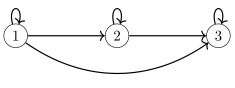
Draw the elements of as points and an arrow
from to whenever . The
relation on
is
:
Reflexive means a loop at every point. Symmetric
means every arrow has a return arrow. Antisymmetric
means no two different points are
joined in both directions. Transitive means every path
of two arrows has a direct arrow from its start to its
end. In the picture there are loops everywhere, no
return arrows, and the two-arrow path has its
shortcut ;
so on is reflexive,
antisymmetric and transitive, and not symmetric, with
witness the pair . A path may also return to its start: .
Transitivity then demands the loop at . That case is the
source of the warning below.
Why “reflexive on ”. The other
three properties mention elements only when they are
related, so they depend on the set alone. Reflexivity
depends on too.
The relation is reflexive on , and the same set
of pairs, viewed as a relation on , is not
reflexive on , with witness . That is why the
definition names the set.
Divisibility
Divisibility shows that the same rule can give an
antisymmetric relation on one set and not on a larger
one, because the larger set brings in more pairs: on contains both and , which on does not. Recall Definition 2.2.1:
for integers ,
means
for some
.
Proposition
2.4.1 (Divisibility on the Natural
Numbers)
The relation is reflexive,
antisymmetric and transitive on . On it is reflexive and
transitive, and not antisymmetric.
Idea. Reflexivity and transitivity
are one line each from Definition 2.2.1.
For antisymmetry, and give . If , this forces , and for positive integers
that means . On
the multipliers are positive, so ; on they may both be
.
Proof. Reflexive. For
every integer ,
, so
.
Transitive. Let and , say and with . Then , and by Proposition 2.1.2
(a), so .
These two arguments work for all integers, so on
and on .
Antisymmetric on . Let with and , say and with .
Case 1: or . If , then ; if , then . Either way .
Case 2: and . By Lemma 2.1.1
(a), and
, so both
are positive. Since and , we have (if , then ); likewise . By Proposition 2.1.2
(b), , so and . Now , and , so . If , then
multiplying by gives , contradicting . So , hence , and .
Not antisymmetric on . and
, so and , but .
The failure on is a non-example by
minimal change: enlarging the set from to keeps reflexivity and
transitivity, and antisymmetry fails exactly because an
integer and its negative divide each other. Two facts
about
will matter in Section 2.6: every divides , since , and divides every , since . In the
divisibility relation, sits above everything
and below
everything.
A table of
examples
Here are eight relations checked against the four
properties. Each “no” comes with its witness, which is
how a failure is proved; each “yes” is a one-line
argument given after the table.
Example
(Eight relations, four properties)
Decide which of the four properties each relation
has: , and on ; on for a set
with at least one
element; on
and on ; “” on ; and the empty
relation
on a set with at
least one element.
Solution.
| on |
yes |
yes |
yes |
yes |
| on |
yes |
no: |
yes |
yes |
| on |
no: |
no: |
yes |
yes |
| on
|
yes |
no: |
yes |
yes |
| on |
yes |
no: |
yes |
yes |
| on |
yes |
no: |
no: |
yes |
|
on |
yes |
yes |
no: |
yes |
| on
|
no: any |
yes |
yes |
yes |
The witnesses. and not ; and not ; not . , since the empty set is a subset of
every set (Section 1.1, after Proposition 1.1.3),
and , since has an element and
has none.
, and : would give , and no
integer lies there (Proposition 2.1.2
(c)). The pair is from Proposition 2.4.1.
For :
and
are
integers, and . For : no has .
The “yes” entries. Equality is reflexive by (Logic and Proof, Definition 5.7.1),
symmetric and transitive by Logic and Proof, Proposition 5.7.1,
and antisymmetric because its conclusion is one of its
hypotheses. For
and ,
antisymmetry and transitivity are order facts about
, and is reflexive because
gives ; for , antisymmetry holds
vacuously, since and never hold
together. For , reflexivity is
immediate from Definition 1.1.2,
transitivity is Proposition 1.1.2,
and antisymmetry is Proposition 1.1.1.
For , see Proposition 2.4.1.
For :
;
;
and ; these are integers by Proposition 2.1.2
(a). The empty relation is symmetric, antisymmetric and
transitive vacuously: each property is an implication
whose hypothesis requires a pair in .
Three degenerate cases are worth a sentence each,
because each shows a property holding for a reason other
than the one we expect.
- The empty relation on a non-empty
has every
property except reflexivity, all vacuously. It is the
standard witness that the three implication properties
do not imply reflexivity.
- The full relation relates
everything to everything. It is reflexive, symmetric and
transitive; it is antisymmetric only if has at most one
element.
- If , then , and on it is : with only one element, it is
symmetric. The non-emptiness of in the table is what
the witness needs.
Quick check. On the set of
integers , let
mean “ and have a common prime
factor”, that is, some prime divides both. Which of
the four properties does have?
Solution. Reflexive: every integer
has a prime
factor (Theorem 2.2.5),
and divides and . Symmetric: the
condition “
and ” does
not depend on the order of and . Not antisymmetric:
and
(both divisible by ), and . Not transitive:
(common factor )
and
(common factor ),
but and have no common prime
factor, since a prime dividing is a positive divisor
of that is at
least , hence is
(the example
after Definition 2.2.2),
and :
would give
,
and no integer lies there (Proposition 2.1.2
(c)). Sharing a factor with a middle element does not
pass along, because the shared factor may change.
Warning. A false theorem:
“symmetric and transitive imply reflexive.” The
“proof”: let , and take with ; by
symmetry , and by transitivity . The
conclusion is false: the empty relation on is symmetric and
transitive (vacuously) and not reflexive, with witness
. The illegal
step, “take with
”,
is an (Logic and Proof, Definition 5.6.1)
on , which was never derived and need
not be true: (N9) of Logic and Proof, Example (What is not allowed)
(Exercise C2 gives the correct version).
Two combinations of the properties organize the rest
of the chapter. A relation that is reflexive, symmetric
and transitive behaves like equality; Section 2.5 calls
it an equivalence relation and shows
that it cuts into
classes. A relation that is reflexive, antisymmetric and
transitive behaves like ; Section 2.6 calls it
a partial order; inclusion on and
divisibility on
are examples that are not comparisons of sizes.
Exercises
A. Check your
understanding
Exercise
(A1)
- (a) State in symbols
what it means for a relation on to be antisymmetric,
and write its negation in symbols.
- (b) True or false,
with a witness: every antisymmetric relation fails to be
symmetric.
- (c) Which of the
four properties does the relation “” have
on ?
- (d) Let with . How many
relations on are
reflexive on ?
Solution.
(a) . Its negation, by Logic and Proof, Proposition 6.2.3
and Logic and Proof, Proposition 6.2.2:
.
(b) False.
Equality on any set is antisymmetric and symmetric. So
is the empty relation (vacuously).
(c) Reflexive:
. Symmetric: . Not antisymmetric: both
ways and .
Not transitive: and , but .
“Close to” does not pass along a chain, because small
differences add up.
(d) Four. A
reflexive relation must contain and . The other two
pairs of ,
and , may
each be in or out, independently, which gives relations:
together with one of , , , .
B. Practice
Exercise
(B1: Five relations)
For each relation, determine which of the four
properties it has. Justify your answer, with a witness
for each failure.
- (a) On :
if and only if .
- (b) On : if and
only if .
- (c) On the set of functions
: if and
only if for every .
- (d) On : if and
only if .
- (e) On : if and
only if .
Solution.
(a) Reflexive:
.
Symmetric: gives . Transitive: from and , adding
gives , and canceling gives . Not
antisymmetric: both ways, and . (The
pairs and
are related
exactly when ; Number Systems: From to , Chapter 2
builds from the
classes of this relation.)
(b) Reflexive,
symmetric and transitive, because “” is equality of
the values and
, and equality
has those three properties. Not antisymmetric: and .
(c) Reflexive:
.
Transitive: at each . Antisymmetric: if
and
,
then
for every , and
by Proposition 1.4.1
(same domain and codomain). Not symmetric: the constant
functions and
satisfy and not
. In
addition, two functions need not be comparable: for
and the
constant , neither
(fails at )
nor
(fails at ).
(d) Symmetric:
.
Transitive: if and , then , and (since , as ), so . Not
reflexive: , so is not related to
itself. Not antisymmetric: and (both products are ), and . This is the
planted case: is
symmetric and transitive, yet not reflexive on , exactly at the one
element related to nothing. On it is
reflexive. Compare the warning before these
exercises.
(e) Not
reflexive: . Not symmetric: and not (). Not transitive:
and
,
and not . Antisymmetric, vacuously: and would
give and
,
which is impossible, so no pair satisfies the
hypothesis.
Exercise
(B2: Example generation)
Give an example of a relation on that is
reflexive and transitive, but neither symmetric nor
antisymmetric. Check each property. Then list the
properties that every correct answer must have.
Solution. One answer: Reflexive: the three loops are in . Not symmetric: and not
.
Not antisymmetric: , and . Transitive: we check every two-step path
with and (a step along a loop changes nothing). They
are ,
,
and
, and
their shortcuts , , ,
are all in .
Element has no
arrow out except its loop, so no other path exists.
Every correct answer must: - contain the three pairs
, , ; - contain two
different elements related both ways
(to fail antisymmetry); - contain a pair related
one way only (to fail symmetry); -
contain the shortcut of every two-arrow path.
The second and fourth items together force more: if
,
and
,
transitivity puts in. First, there is only one
two-way pair: two of them, say and , give and by
transitivity, so
is the full relation, which is symmetric. Call the
two-way pair and the third element . Every arrow between
and is two-way, so a
one-way arrow must have at one end, and one
such arrow is never enough: transitivity relates to the other element of
the pair too, in the same direction. For example, fails transitivity, since
and not . If , then gives , and neither nor can hold,
since that would make a second two-way pair; so both
arrows point out of . Likewise forces
,
and both arrows point into . Conversely, each of
these six relations is a correct answer. Those with
above the pair
are the answer above with the elements renamed. Those
with below are
obtained from them by reversing every arrow, which keeps
the loops, the two-way pair and the one-way arrows, and
keeps transitivity: a path of the reversed relation is the
reverse of a path , and the reverse of its shortcut is . So carries
exactly six correct answers: one for each choice of the
two-way pair (three choices) and of whether the third
element lies above the pair or below it (two choices);
the answer above has above the pair .
Exercise
(B3: Intersections and unions)
Let and be transitive relations
on a set . Prove
that is
transitive. Show by an example on that need not be
transitive.
Solution. Let with and
. Then , so because is transitive; likewise
. Hence
.
For the union, let and . Each is transitive, vacuously: in
a two-step path
would need a pair starting at , and there is none; in
one would need a
pair ending at .
But contains and and not , so it is not
transitive. The intersection keeps both relations’
shortcuts; the union creates paths that neither relation
contains, so neither supplies their shortcuts.
C. Going deeper
Exercise
(C1: Properties as equations between sets)
Let be a
relation on , let
be its
inverse relation (Definition 1.3.3),
and let be the diagonal.
- (a) Prove that is symmetric if and
only if ,
and that is
antisymmetric if and only if .
- (b) Deduce that a
relation that is both symmetric and antisymmetric
satisfies . Is every subset of both symmetric
and antisymmetric?
Solution. Recall that if and
only if .
- (a)
Symmetric. Let be symmetric. If , then , that is,
;
so . If , then , so by symmetry;
so . By Proposition 1.1.1,
. If and , then
,
so .
Antisymmetric. A pair lies in exactly
when and , and it lies in exactly when
(by the
characteristic property of pairs, Definition 1.3.1).
So “” says: for all , if and , then
. That is
antisymmetry, word for word.
- (b) If is symmetric and
antisymmetric, then by (a), . Conversely, every is
symmetric (each of its pairs is , which is its own
reverse) and antisymmetric ( already
forces ). So
the relations with both properties are exactly the
subsets of the diagonal; equality, itself, is the
largest of them, and the
smallest.
Exercise
(C2: What symmetry and transitivity do give)
Let be a
symmetric and transitive relation on , and let be its domain.
Prove that and that , as a relation on , is reflexive on , symmetric and
transitive.
Solution. . Let . Then , with witness . By symmetry , so , with witness
. Hence .
Reflexive on . Let . By the
definition of
there is
with ; fix one (an ,
legitimate now, because is exactly the statement ). By symmetry , and by transitivity, from and , .
Symmetric and transitive on . These are
implications about related elements, and every related
pair lies in ; so they hold on because they hold on
.
This is the correct version of the false theorem in
the warning: its argument proves reflexivity exactly on
the set of elements for which “take with ” is
available. Elements outside are related to nothing,
and there reflexivity fails. In the language of Section
2.5, is an
equivalence relation on .
Marking scheme. (10 points) - 2:
shows , using symmetry to put the second coordinate
in . - 4: for
reflexivity on ,
obtains with
from , and says why this step is now
legitimate. - 2: applies symmetry and then transitivity,
in that order, to get . - 2: explains why symmetry and
transitivity restrict to . Fatal errors (0 for
the step): taking
with for an arbitrary rather than (the error of the
warning); applying transitivity to and .