The previous section ended with a puzzle. The
rationals and the reals obey the same rules of
arithmetic and the same rules of order (Definition 1.1.1),
yet has a
zero in one (as Theorem 1.6.1
will prove) and not in the other. The difference lies in
how sets of numbers behave: in , a set can press
against a point that is not there. This section builds
the vocabulary to say that precisely. Everything happens
in an arbitrary ordered field , because we need to
compare
with , and
the definitions must not already take a side.
A largest
element that is not there
Ask for the largest element of the open interval
in . There is none.
Whatever you propose, the midpoint lies
strictly between
and by Theorem 1.1.2
(h), so it belongs to and beats . The same happens, less
visibly, for the set of positive rationals whose square
is less than ;
Case 1 of the proof at the end of this section is the
reason, and Exercise (C1: The two sides of the gap)
writes it out.
And yet both sets are heading somewhere. The interval
is pressed
against : nothing
in it reaches ,
and nothing smaller than stays above it.
“Largest element” is the wrong notion, because it
demands that the target belong to the set. What survives
is the smallest number that sits above the whole set. To
define it we first need words for “sits above”.
Upper and
lower bounds
Definition
1.2.1 (Upper and Lower Bounds)
Let be an
ordered field and . An element is an
upper bound of if for
every . An element is a lower bound of if for
every .
In symbols, is
an upper bound of
when The bound is an element of , and nothing requires
it to belong to .
For the interval in ,
the numbers ,
, and are all upper
bounds, and and
are lower
bounds. Upper bounds are never unique: if is one, so is every
, by
transitivity. A minimal change gives a nonexample: is
not an upper bound of , because and
. One element above is enough to spoil it.
Negating the definition quantifier by quantifier (the
negation rules are the subject of Logic and
Proof, Chapter 6), where we have used trichotomy to rewrite “not
” as “”.
The empty set is the degenerate case, and it will
matter. Every is an upper bound
of : the
condition “
for every ” has no instances to check, so it
holds vacuously. Instance by instance it is the
implication “if , then ”, whose hypothesis is false, and Logic and Proof, Proposition 2.1.2
derives an implication from the negation of its
hypothesis. Likewise every element of is a lower bound of
.
Definition
1.2.2 (Bounded Sets)
Let be an
ordered field and . The set is bounded
above if it has at least one
upper bound, bounded below if it has at
least one lower bound, and bounded if
it is both bounded above and bounded below.
In symbols, is
bounded above when The order of the quantifiers carries the
meaning. One is chosen first and
must then work for every . Swap them, to “”, and the statement becomes empty of
content: every set satisfies it, since each can take .
Examples in :
the interval
is bounded; the empty set is bounded (by anything); the
interval is bounded below by but
not bounded above. To see the last
claim, negate the definition: we must show that for
every
there is with . Given , the element works, where is the
larger of and
(maxima are
defined in general just below): it is at least , so it lies in
, and it
exceeds by (O3).
The witness
depends on , as
the order allows.
Whether is
bounded above in looks like the same
kind of question, but it is not. The answer, “no”, is
the Archimedean property, and it is proved later in this
chapter from the axiom of the next section. It cannot be
proved from the ordered-field axioms alone.
Maximum and
minimum
Definition
1.2.3 (Maximum and Minimum)
Let be an
ordered field and . An element is a
maximum (or greatest element) of if
and is an upper bound of
. It is a
minimum (or least element) of if
and is a lower bound of
.
A set has at most one maximum. If and are both maxima,
then and
is an upper
bound, so ; by the same argument with the roles
swapped, ; and trichotomy forces . So when it
exists we may write , and likewise .
Examples: the set has maximum , since is in the set and
,
,
. The interval has maximum . The minimal change
from to
keeps every
upper bound but removes the only candidate: has
no maximum, as the opening subsection
showed. The empty set has no maximum, since it has no
elements at all.
The
supremum
Here is the notion that survives where “maximum”
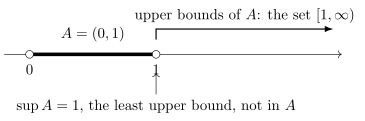
fails. Look again at . Its upper bounds form the set , and
that set has a least element, namely
. The number we
want is the least element of the set of upper
bounds.
The supremum is the upper bound that cannot be
lowered.
Definition
1.2.4 (Supremum)
Let be an
ordered field and . An element is a
supremum (or least upper
bound) of in if
- (S1) is an upper bound of
, and
- (S2) for
every upper bound of .
In symbols, is
a supremum of in
when
In words: (S1) says that sits above the whole
set. (S2) says that no upper bound sits below ; every upper bound is
at least . So
is an upper bound
(S1), and it is the least one (S2). The words “in ” matter: must be an element of
, and the upper
bounds in (S2)
range over . The
same set of rationals can have a supremum when viewed in
one field and none when viewed in another, and that is
precisely the phenomenon this chapter is about.
Before we write “the supremum”, we must know
there cannot be two.
Theorem
1.2.1 (Uniqueness of the Supremum)
Let be an
ordered field and . If and are both suprema
of in , then .
Proof. By (S1) for , the element is an upper bound
of . So (S2) for
gives . Swapping
the roles of and
gives . By
trichotomy, .
The proof is the standard uniqueness move: suppose
there are two, use the first property of one against the
second property of the other, and then swap. From now
on, when has a
supremum in , we
call it the supremum and write . Existence is a
different matter, and nothing so far guarantees it. It
can fail in three ways: the set may have no upper bound
at all, like above; it may have no elements; or it
may press against a gap in the field. The rest of this
section shows the last two.
The mirror-image notion comes with its own
definition, since we use it as often.
Definition
1.2.5 (Infimum)
Let be an
ordered field and . An element is an
infimum (or greatest lower
bound) of in if
- (I1) is a lower bound of
, and
- (I2) for
every lower bound of .
The proof of Theorem 1.2.1,
with every inequality reversed, shows that a set has at
most one infimum, written . The names are
Latin: supremum is “the highest”,
infimum “the lowest”.
Example
(A finite set, and a half-open interval)
Find the supremum of and of in .
Solution. For : the element is an upper
bound, as checked above, so (S1) holds. For (S2), let
be any upper
bound of . Since
, the
definition of upper bound gives . So .
For : the same
two lines work with in place of . It bounds from above by the
definition of that interval, and it is least because
, so every
upper bound
satisfies .
So .
The argument used only that the candidate is a
maximum. It shows that a maximum, when it
exists, is the supremum (Exercise (B1: Maxima are suprema)).
Every nonempty finite set has a maximum, by an induction
on the number of elements of the kind practiced in
Sets, Relations, and Cardinality, Chapter 2, so
for finite sets the supremum is nothing new.
Example
(The supremum need not belong to the set)
Show that in ,
although .
Solution. (S1): every satisfies
, so is an upper bound.
(S2): let be
an upper bound of ; we show . Suppose instead that . Since , we
have ,
so . By Theorem 1.1.2
(h), the midpoint satisfies . Then
, so , and . This contradicts being an upper bound.
Hence , by
trichotomy.
So is the
supremum. It is not a maximum, since . Nothing
in the argument used anything beyond the ordered-field
axioms; the same proof shows that has supremum in .
Example
(A supremum we cannot yet prove)
Let in , where is the set of positive integers (taken
informally for now; later in this chapter, once the
natural numbers are defined inside , it becomes a defined
subset of ).
Show that is an
upper bound of
and that has no
maximum.
Solution. Each is
positive, so by Theorem 1.1.2
(f), and hence by Theorem 1.1.2
(a). So is an
upper bound, and . No element is a maximum either: , because by Theorem 1.1.2
(f), so every element is beaten by the next one.
It is true that , but (S2) is harder than it looks. It says
that no is
an upper bound, that is, for every some exceeds . That requires for
some . The
existence of such an says, in effect, that
the natural numbers are not bounded above, and that does
not follow from the ordered-field axioms. We prove it
later in this chapter, from the axiom of the next
section, and prove right after it.
The degenerate case is the empty set. By the
vacuous-truth remark above, every element of is an upper bound of
. If were a supremum, then
would be an
upper bound too, and (S2) would give , that is,
,
contradicting . So the empty set has no
supremum, although it is bounded above. This is
why the axiom of the next section has to say
“nonempty”.
A nonexample by minimal change shows why both clauses
are needed. Keep . The number satisfies (S1) but
fails (S2): the upper bound lies below it. The
number
satisfies (S2), since every upper bound is at least
, but
it fails (S1). Drop (S1) from the definition and every
number below ,
such as or
, would qualify.
Drop (S2) and every upper bound would. Only the two
clauses together pin down a single number.
Warning. The supremum is
not the maximum. The supremum of a set need not
belong to the set: . The two notions agree
exactly when the supremum lies in the set (Exercise (B1: Maxima are suprema)).
A proof that writes “let ” has assumed something false in
general; the section on working with the supremum
contains a proof that fails for exactly this reason.
Warning. A bounded set need
not have a maximum. The interval is bounded, and it
has no greatest element. “Bounded” promises upper
bounds, which live outside the set; it promises nothing
about the elements themselves.
Quick check. Let . Find and in ,
if they exist. Do the same for and .
Solution. For odd the element is . For even
it is , by
Theorem 1.1.2
(f). So is
an upper bound, and it is attained at . Hence , and by
the argument of Example (A finite set, and a half-open interval)
(a maximum is the supremum), .
Similarly, every element is at least : even-indexed ones are
positive, and odd-indexed ones are because
. The
value is
attained at .
So . Although is infinite, both
extremes are attained, at its first two elements.
A bounded
set of rationals with no rational supremum
We now prove what the opening section promised: in
, a nonempty set
that is bounded above can fail to have a supremum. This
is the gap in ,
expressed in the language of this section.
Theorem
1.2.2 (No Rational Supremum for the Rationals
Below the Square Root of Two)
Let . Then is nonempty and bounded
above in , but
has no supremum
in .
Idea. Suppose a rational were the supremum. By
Logic and Proof, Theorem 2.2.1,
, so or , and each case
is a disaster.
If ,
then is too
small: there is room to step right to a rational whose square is
still below , and
then
beats . To find
, work backwards
from the goal . Expanding, . The is awkward, so bound
it by something simpler: if ,
then , and
. The room available is . Asking to use only
half of it, , gives . We then owe a check of the condition that we assumed
along the way.
If ,
then is too big:
step left to ,
still an upper bound, and then was not the least one.
Now , and the right side equals
exactly when
.
In both cases
depends only on ,
and it is rational because is. Before reading
on: where does the proof use that is rational, and where
does it use Logic and Proof, Theorem 2.2.1?
Proof. Since and , we have
, so is nonempty. The
rational number
is an upper bound: if some had , then by Theorem 1.1.2
(g), contradicting , so by trichotomy.
Suppose, for a contradiction, that is a supremum
of in . Since , (S1) gives ; in particular
, and by Theorem 1.1.2
(g). By Logic and Proof, Theorem 2.2.1,
, so by
trichotomy either or .
Case 1: . Let Then , and because and . Moreover , since (as ) and (as ). Hence , and multiplying
by gives
.
Therefore where the last inequality holds because . So is a positive
rational with square less than , that is, . But , so is not an upper bound
of , contradicting
(S1).
Case 2: . Let Then and . Also , and We claim that is an upper bound of . Indeed, if some had , then, as
, Theorem 1.1.2
(g) would give , contradicting . So is a rational upper
bound of with
,
contradicting (S2).
Both cases are impossible. Hence has no supremum in
. This proves
the theorem.
Rationality of
was used in exactly two places: to make , and so , rational, which
is what membership in and “upper bound in
” require; and
to rule out
by Logic and Proof, Theorem 2.2.1.
The logical shape is the same as in the irrationality of
: assume the
object exists, reach a contradiction, conclude that it
does not.
To see the constants at work, start from the rational
upper bound , whose square exceeds . Case 2 gives and the
smaller upper bound , with . Starting
instead from , Case 1 gives , and because
. Each step can be repeated forever from
either side, and no rational number is ever reached at
which both processes stop.
This is the gap in in its final form.
The next section adds to the ordered-field axioms the
single statement that such gaps do not occur in . Later in the
chapter, the same two-case argument, with now a real number
supplied by that axiom, proves that exists.
Exercises
A. Check your
understanding
Exercise
(A1)
In (a)–(d), give the supremum, infimum, maximum, and
minimum of the set in , or say that it does
not exist. Justify each answer in a line or two. Parts
(e) and (f) are about the proof of Theorem 1.2.2.
- (a) .
- (b) .
- (c) .
- (d) .
- (e) Run Case 2 of
the proof on the rational upper bound :
compute and , and check that
.
- (f) Replace by throughout the
statement and the proof. Which single step of the proof
can no longer be justified, and what possibility does it
leave open?
Solution.
(a) and
:
both are elements of the set, and comparing with the
three elements shows they are an upper and a lower
bound. A maximum is the supremum and a minimum is the
infimum (Exercise (B1: Maxima are suprema)).
(b) , since
belongs to the
set and is a lower bound. and there is no
maximum: is an
upper bound not in the set, and the midpoint argument of
Example (The supremum need not belong to the set)
shows that no is an upper bound (if is an upper
bound, then and is in the set and exceeds ).
(c) The set is
: by Theorem 1.1.2
(g) applied to and , and Proposition 1.1.3
(b),
holds if and only if , which by Proposition 1.1.3
(d) means . So and .
(d) None of the
four exists. Every real number is an upper and a lower
bound of ,
so there is no least upper bound and no greatest lower
bound (as shown in the text), and has no elements
to be a maximum or minimum.
(e) Here , so Then , as the
proof’s display predicts; directly, . So is a
smaller rational upper bound, and the step can be
repeated from it.
(f) The step “by
Logic and Proof, Theorem 2.2.1,
”. Over
nothing rules
out , so
after Cases 1 and 2 the possibility remains, and no
contradiction is reached. Every other step is algebra
valid in any ordered field, included. This is
exactly the opening that the existence proof for , later in this
chapter, walks through.
B. Practice
Exercise
(B1: Maxima are suprema)
Let be an
ordered field and .
- (a) Prove that if
has a maximum
, then is the supremum of
.
- (b) Prove that if
has a supremum
and , then is the maximum of .
- (c) State and prove
the corresponding facts for minimum and infimum.
Solution.
(a) By Definition 1.2.3,
is an upper bound
of , which is
(S1). For (S2), let be any upper bound of
. Since , the definition
of upper bound gives . Hence
is a supremum of ,
and by Theorem 1.2.1 it
is the supremum.
(b) By (S1),
is an upper bound
of , and by hypothesis.
That is exactly Definition 1.2.3.
(c) If has a minimum , then ; and if exists and belongs
to , it is the
minimum. The proofs are those of (a) and (b) with every
inequality reversed: is a lower bound (I1),
and any lower bound satisfies because (I2).
Exercise
(B2: Negating the definitions)
Let be an
ordered field and .
- (a) Write in symbols
the statement “ is
not an upper bound of ”.
- (b) Write in symbols
the statement “ is
not a supremum of ”, as a disjunction of
two statements.
- (c) Use (b) to show
directly that is
not the supremum of in ,
by exhibiting a witness.
Solution.
(a) .
(b) Negating the
conjunction (S1) and (S2) gives: (S1) fails or (S2)
fails. So “ is not
a supremum of ” is
The second disjunct says: some upper bound
lies strictly below .
(c) The first
disjunct fails for , since every element of is below . The second holds with
the witness :
it is an upper bound of , and . Hence
is not the supremum.
Exercise
(B3: A supremum that is approached but not
attained)
Let . Prove that and that has no maximum.
Solution. For , the denominator
is positive,
and ;
multiplying by (Theorem 1.1.2
(c) and (f)) gives .
So is an upper
bound (S1), and .
For (S2), let
be an upper bound of , and suppose . Since , we have . Let , which is positive because and . Then so , and dividing by gives .
This element of
exceeds the upper bound , a contradiction. Hence
for every
upper bound , and
.
Finally, has no
maximum: by Exercise (B1: Maxima are suprema)
(a), a maximum would be the supremum , but .
(The choice of
comes from solving
backwards: it is equivalent to , that is,
, and adding gives a strict
margin.)
C. Going deeper
Exercise
(C1: The two sides of the gap)
- (a) Give a set that is
bounded above and has a supremum in that does not belong
to .
- (b) Let , and let be the set of
rational upper bounds of . Prove that .
- (c) Deduce that
every positive rational number lies in exactly one of
and , that has no largest element,
and that has no
smallest element.
Hint: the two cases in the proof of Theorem 1.2.2
each produce a new rational from an old one.
Solution.
(a) . The argument of Example (The supremum need not belong to the set)
works in the ordered field , because the midpoint
of two rationals is rational; it shows in , and .
(b) () Let . Since , we get . By Logic and Proof, Theorem 2.2.1,
. If , then , and Case 1 of
the proof of Theorem 1.2.2,
applied to
(which used only , , and ), produces with , contradicting . Hence . () Let with and . If some had , then by Theorem 1.1.2
(g), contradicting . So is
an upper bound of , and .
(c) Let with . By Logic and Proof, Theorem 2.2.1,
, so by
trichotomy exactly one of and holds, that
is, lies in
exactly one of
and , by (b). If
had a largest
element , Case 1
of the proof (with , valid since when is largest, as ) would give a
larger element . If
had a smallest element , Case 2 of the proof
(with , which
needs only , , and ) would give , smaller. So the positive rationals split
into a lower piece with no top and an upper piece with
no bottom. Nothing rational sits between the two pieces;
that missing point is the gap.
Exercise
(C2: The least element of the upper bounds)
Let be an
ordered field, , and let be the set of all
upper bounds of
in .
- (a) Prove that is a supremum of if and only if is the minimum of . (This explains the
name “least upper bound”.)
- (b) Prove that if
, then .
- (c) Describe and , and use (a) to
decide whether and have suprema.
Solution.
(a) () If is a supremum, then
by (S1),
and for
every by
(S2). So is an
element of and
a lower bound of , which is Definition 1.2.3’s
definition of minimum. () If , then , which is
(S1), and
for every , which is (S2).
(b) Let . For every
we have
, so . Hence .
(c) , since
every element is an upper bound of the empty set
vacuously; and
has no minimum, because for every . So has no
supremum. , since for any the element exceeds ; and has no minimum.
So has no
supremum either. The two degenerate cases fail for
opposite reasons: too many upper bounds, and
none.