When we first met suprema, Theorem 1.2.2
showed that the set of positive rationals whose square
is less than has
no supremum in .
In the axiom
gives that set a supremum. This section finds out what
the supremum is: a positive number whose square is
exactly . The same
template produces every root . With roots in
hand, and with the Archimedean property of the previous
section, we then answer a question about arrangement:
the rationals and the irrationals are both spread
through every interval of the line, however short.
Constructing a point as a supremum
Logic and Proof, Chapter 2 showed that no
rational number squares to (Logic and Proof, Theorem 2.2.1).
Nothing so far says that any real number does. The
ordered-field axioms cannot say it, since satisfies them all.
So if a square root of exists in , the least upper
bound axiom must produce it.
Theorem
1.6.1 (The Square Root of Two Exists)
There is exactly one real number with .
Try it first (ten minutes): the axiom is the only
statement we have that produces a real number. To which
set would you apply it, and what would you then have to
show?
Idea. The obvious attempts do not
get started. There is no formula for in terms of
rationals, and the decimals of
the chapter’s introduction would need a limit, which we
do not have yet. The only statement that produces a real
number is Axiom 1.3.1, so
will have
to be a supremum, and Theorem 1.2.2
suggests which one. Collect the positive reals whose
square is below
into a set . The
candidate is . The plan has three steps: ① check that is nonempty and bounded
above, so the axiom supplies ; ② rule out ; ③ rule out
.
Trichotomy then leaves .
Each case is ruled out by nudging . If , there is
still room below ,
so a slightly larger number is still in . That is impossible for
an upper bound. If , a slightly smaller number still has square
above , and is
therefore still an upper bound. That is impossible for
the least upper bound.
The nudges are the ones found in Theorem 1.2.2,
where they were derived backwards from the goal. To
recall the first: we want . If , then , so . Letting use half of the room gives ,
and we must then check . For the second nudge, ,
and the right side is exactly when . None
of this used rationality. What is new is only that now exists.
Before reading on: which line of the proof uses
the axiom, and what would that line say over ?
Proof. Let . By Example (A set of reals that must have a supremum),
is nonempty (it
contains ) and
bounded above by ,
so by Axiom 1.3.1 its
supremum exists, and . In particular and . Throughout we
use Theorem 1.1.2
(g): for , if and only if .
Case 1: . Let which depends only on . Then , because and . Also , because
and
. Hence
, and
multiplying by gives . Therefore where the last inequality holds because . Also . Hence . But , which
contradicts (S1), that is an upper bound of
. So Case 1 is
impossible.
Case 2: . Let which is defined and positive because and . Then , and We claim that is an upper bound of . Let and suppose . Since , we get
, contradicting . Hence for every
. Then (S2)
gives ,
which is false since . So Case 2 is impossible.
By trichotomy, . For uniqueness, let with . If , then , and if
, then
; both
contradict . Hence . This proves the theorem.
We write for this number.
By Logic and Proof, Theorem 2.2.1
it is not rational, so : irrational numbers exist.
Compare this proof with the one of Theorem 1.2.2.
The two computations with are the same, word for
word: they are ordered-field algebra, and for a rational
both values of
are rational.
What changed is a single line. In there was no to start from: the
argument showed that no rational number can be the
supremum, since its square cannot be less than , more than , or equal to . In the axiom supplies
, and the very
same argument now shows that its square can only be
.
The proof is an instance of a move this book uses
again and again.
To construct a point: collect the points where
“things are still fine” into a set, take its supremum,
and rule out each way the supremum could fail to be the
point you want.
Here “things are still fine” meant . The exercises
of this section and of the last section of the chapter
ask you to run the move yourself, with less and less of
the proof given. In Chapter 6 the Intermediate Value
Theorem is proved the same way: the point where a
continuous function crosses zero is the supremum of the
points where it is still negative. In Chapter 4 the
Heine–Borel theorem takes the supremum of the points
for which is still covered
by finitely many of the given open sets.
Roots of
every order
The template does not care that the exponent is or that the number is
. Only the choice
of needs new
work.
Theorem
1.6.2 (Existence of Roots)
Let and
.
There is exactly one real number with .
We write this number , or . For the only real with is (a product of
positive numbers is positive), so we also set ;
every then
has exactly one nonnegative -th root.
Idea. Take and , as before, and rule out and . The new
difficulty is the estimate. For we expanded and bounded
by . For general , expanding is messy. We
work backwards from what we need instead.
We need . A difference of -th powers factors:
With and , the first factor is , which we control. The
second factor is a sum of terms, each at most
. That
still depends on ,
and we cannot solve for while is on both sides. So we
bound it by something a little bigger: if , each term is at
most .
This gives The point is that depends only on and , and not on . Now it suffices to
have , and does it, with a factor to make the
inequality strict. We needed along the way,
so we cap at
.
For the
same factorization gives , so
the same , and the
same , serve both
cases.
Proof. We first prove a power
estimate.
Claim. Let and . Then
: the
map
is strictly increasing on . Consequently
for
every integer , where . Moreover
Proof of Claim. Powers are defined
by recursion (Sets, Relations, and Cardinality,
Chapter 2): and , so that ; here only is needed.
We first show by induction on . For this is the
hypothesis. If , then ,
and where the first step multiplies by (Theorem 1.1.2
(c), or equality if ) and the second multiplies by . This proves the
first statement, and the second follows, since for both sides are
.
For the estimate, write . Multiplying out, since every other term appears once in each
sum and cancels. Each term of satisfies , by the second statement
with ,
multiplied by ; and the term with equals . Hence
. Multiplying by gives the
claim.
Let .
is
nonempty. Let . Then and
. Since
,
multiplying by
repeatedly gives (by induction on ). Hence , and
.
is bounded
above by . If , then , so (again by induction on ), and . So
.
By Axiom 1.3.1,
exists, and . Let which depends only on and . Suppose , and let Then .
Case 1: . Apply the claim with , , and . Since , the
claim with gives (both sides are
when ). Therefore so . Hence , although . This contradicts that is an upper bound of
.
Case 2: . First, . Indeed by the claim with (both sides are
when ), so Apply the claim with , , and : so . Now is an upper bound of : if had , the claim
would give , contradicting . But , which
contradicts that
is the least upper bound.
Both cases are impossible, so by trichotomy. If
also and
, then , since or would give by the claim.
This proves the theorem.
For and
the constant
is ,
slightly larger than the that the direct expansion gave. The general
proof pays for its generality with a cruder bound. We
never needed a good bound, only one that does not depend
on .
Example
(Locating a cube root)
Show that .
Solution. By Theorem 1.6.2,
exists and . Exact arithmetic
gives The claim in the proof of Theorem 1.6.2
says that is strictly increasing on . If , then ;
and if ,
then . Both contradict , so .
The integer
part of a real number
Before asking where the rationals are, we need to
locate every real number between two consecutive
integers. This sounds like school arithmetic, and it is.
But its proof uses both the Archimedean property and
well-ordering, and in it fails for the
element (Exercise (C1: Exit check: the Archimedean property, and a circular proof)).
Lemma
1.6.3 (Integer Part)
For every there is exactly one integer with .
This integer is the integer part or
floor of , written . For instance
and
.
Idea. Picture the integers as marks
spaced apart. The
Archimedean property puts a mark to the right of , and a mark to the left
of . Among the
marks to the right, well-ordering picks out the first
one; the mark just before it is . Well-ordering
is a statement about subsets of , so we shift the
marks so that they start at .
Proof. Existence. Let
. By Theorem 1.5.1,
there is
with , and
there is
with .
Hence the set is nonempty. By well-ordering (Sets,
Relations, and Cardinality, Chapter 2), has a least element
. Let ,
an integer because differences of integers are integers
(the remark on
in the previous section). Then ,
since . It
remains to show . First, by the choice of , so and . Hence (Example (Every nonzero natural number is at least 1)),
so
(again from that remark), and because
it is smaller than the least element of . So , that
is, .
Uniqueness. Suppose and are integers with
and , and suppose . Then is a positive
integer, hence a nonzero natural number (the remark on
in the previous
section), so by Example (Every nonzero natural number is at least 1);
that is, . Hence , a contradiction. By
symmetry is impossible too, so .
The
rationals are dense
We know now that irrational numbers exist. How are
they arranged among the rationals? Could there be a
whole interval with no rational number in it? No: every
interval, however short, contains a rational.
Theorem
1.6.4 (Density of the Rationals)
Let
with .
There is
with .
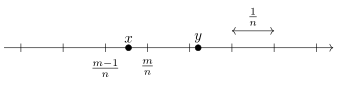
Idea. Think of a ruler whose marks
are the fractions , spaced apart. If the spacing
is smaller than the gap , the ruler cannot jump over the interval
: the first
mark to the right of is at most one step
past , and so it
lands before .
The plan: ① choose with , by the
Archimedean property; ② let be the first mark
strictly to the right of , that is, ; ③
check that .
Proof. Let . Then , so by Corollary 1.5.2
there is with ; the depends on and , through . By Lemma 1.6.3, let
, an integer, since sums of integers are
integers (the remark on in the previous
section). Then . Therefore where the last inequality uses , which is
multiplied by . Dividing by gives . Since and , is rational. This proves the
theorem.
Example
(Running the proof)
Follow the proof of Theorem 1.6.4 to
find a rational number between and .
Solution. Step ①: the
spacing. We need , that is, . By Theorem 1.1.2
(g), applied to the positive numbers and , this
holds exactly when . For , and , so
works. (For
, , so is the least that works, but any
would
do.)
Step ②: the first mark past . We need . Since
, Theorem 1.1.2
(g) gives , so
and .
Step ③: the answer. The proof guarantees
. Directly: gives the left
inequality, and gives the right one.
The irrationals are just as widely spread. The trick
is to shift the rationals by .
Corollary
1.6.5
Let
with .
There is an irrational number with .
Proof. Since , Theorem 1.6.4
gives
with . Let .
Then . If
were rational, then would be a difference of rationals,
hence rational, contradicting Logic and Proof, Theorem 2.2.1.
So is
irrational.
This is why the existence of came first in
this section: the proof of Corollary 1.6.5
needs one irrational number to shift by, and Theorem 1.6.1
supplies it.
Quick check. Name a rational number
between
and , and an
irrational number between and . Justify
both.
Solution. Rational: . Its square is
,
so by Theorem 1.1.2
(g), and .
Irrational: . Since ,
we get . If were rational, then
would be rational, contradicting Logic and Proof, Theorem 2.2.1.
Warning. “Dense” does not mean
“next to each other”. There is no smallest positive
rational number and no “next rational after ”: if is rational,
then is a
smaller positive rational. The same holds for
irrationals: if is irrational, so is , and it is smaller.
Between any two distinct rationals there are infinitely
many more, and between any two distinct reals there are
rationals and irrationals alike.
Density is what makes decimals, and more generally
rational approximation, possible. Every real number can
be pinned down by rationals from below as closely as we
like (Exercise (B1: Every real number is a supremum of rationals)).
In Metric and Topological Spaces the word
dense becomes a notion in any metric
space: a set that meets every ball. The rationals in the
real line are the model example.
Exercises
A. Check your
understanding
Exercise
(A1)
True or false? Give a reason or a counterexample for
each.
- (a) There is a least
positive irrational number.
- (b) Between any two
distinct rational numbers there is an irrational
number.
- (c) Between any two
distinct irrational numbers there is a rational
number.
- (d) Every nonempty
set of rationals that is bounded above has a supremum in
, and that
supremum is rational.
- (e) In the proof of
Theorem 1.6.2,
the constant
depends on .
- (f) Run Case 1 of
the proof of Theorem 1.6.1
with the value in place of (so ): compute , and check that . Which
property of a supremum does this show lacks?
Solution.
(a) False. If
is
irrational, then is positive, smaller
than , and
irrational (if
were rational, so would be ).
(b) True, by Corollary 1.6.5
applied to the two rationals.
(c) True, by Theorem 1.6.4
applied to the two irrationals.
(d) False. The
set is nonempty and
bounded above by ,
so it has a supremum by Axiom 1.3.1. If
were rational, it
would be a rational upper bound of that is at most every
real upper bound, and in particular at most every
rational one. So
would be a supremum of in , contradicting Theorem 1.2.2.
(In fact .)
(e) False.
depends only on
and . It has to be
independent of ,
because is then
chosen in terms of .
(f) Here and
, so and .
Then and the proof’s bound gives the same: . So and
: the number is not an upper
bound of , so it
fails (S1). This is no contradiction, because nothing
said that
was the supremum. In the proof the same computation
contradicts (S1) for .
B. Practice
Exercise
(B1: Every real number is a supremum of
rationals)
Let .
Prove that .
Solution. Let . By Theorem 1.6.4
applied to , there is a rational in , so is nonempty. By
definition every element of is less than , so is an upper bound of
.
Let . By Theorem 1.6.4
applied to , there is with . Then and .
By Theorem 1.4.1,
.
Exercise
(B2: The square root of three, finished)
Here is the start of a proof that there is exactly
one real
with .
Let . Then , and if , then ; so
is nonempty and
bounded above by .
By Axiom 1.3.1,
exists, and .
Case . Let . Then . Since and , we have
, so
, and
. Hence , and contradicts
(S1).
Case .
Name the move, then complete it. Give an
explicit for the
second case and check that it works; then finish the
proof, including uniqueness.
Solution. The move is
construct a point as a supremum: the
points where “things are still fine” () form , the axiom supplies
, and
each way could
fail (,
) is
ruled out. The given text rules out the first; the
missing step rules out the second, against (S2) this
time.
Case . Let , which is defined and
positive because and . Then and If some had , then, as , Theorem 1.1.2
(g) would give , which is impossible for . So is an upper bound
of , and (S2)
gives ,
which is false since .
Both cases are impossible, so by trichotomy.
For uniqueness, let with . If or , then Theorem 1.1.2
(g) gives or , contradicting . Hence
.
Exercise
(B3: The cube root of five)
Prove that there is exactly one real with . Hence show that
.
Solution. By Theorem 1.6.2
with and
, there is
exactly one with .
Exact arithmetic gives and
. By the claim in the proof of Theorem 1.6.2,
is
strictly increasing on . If , then ; if , then . Both contradict , so .
C. Going deeper
Exercise
(C1: Exit check: the square root of two, in both
fields)
- (a) Prove that there
is a real number with .
- (b) Prove that the
set has no supremum in .
- (c) Both proofs use
the same two values of . Explain in two or
three sentences why the same computation yields an
existence theorem in and a nonexistence
theorem in .
Solution.
(a) This is Theorem 1.6.1.
Let ; it contains and is bounded above by
, so exists
by Axiom 1.3.1, and
. If , then satisfies , so and , and exceeds the
upper bound :
impossible. If , then satisfies and ; every then satisfies
, since
would
give . So
is an
upper bound, contradicting (S2). By trichotomy .
(b) Let , and suppose is a supremum
of in , that is, a rational
upper bound of
that is at most every rational upper bound. As , . By Logic and Proof, Theorem 2.2.1,
.
If ,
let . This is rational, and the
computation of (a) gives . So and , contradicting that is an upper bound.
If ,
let . Then is rational and positive, with
. As in (a), every satisfies , so is a rational upper
bound of smaller
than ,
contradicting the choice of .
Both cases are impossible, so has no supremum in
.
- (c) The computation
shows, in any ordered field, that a supremum of the set
cannot have square less than or greater than . In the axiom guarantees
that a supremum exists, so its square must be : existence. In no element has square
(Logic and Proof, Theorem 2.2.1),
so no case is left, and no supremum can exist. For
rational the
values of are
rational, which is why the argument stays inside .
Marking scheme. (10 points) - 1: (a)
defines , checks
that it is nonempty and bounded above, and takes from Axiom 1.3.1. -
2: (a) rules out with an explicit , verifying
including any side condition such as , and contradicts
(S1). - 2: (a) rules out with an explicit , verifying and that
is an upper
bound, and contradicts (S2). - 1: (b) supposes a
rational supremum
and excludes by Logic and Proof, Theorem 2.2.1.
- 2: (b) in each case checks that the new number is
rational and derives the contradiction
with “upper bound in ” or “least among
rational upper bounds”. - 2: (c) says that the
computation excludes and in any ordered field, that in the axiom supplies
so remains, and that
in nothing
remains. Fatal errors (0 for the step): using to define or ; asserting or without
the computation; an that depends on an
element of rather
than on alone. A
proof with a different (for instance in Case 1, using ) earns full
marks if its bound is verified.
Exercise
(C2: Dyadic rationals)
A dyadic rational is a number of the
form with
and . Prove that
between any two real numbers there is a
dyadic rational.
Hint: compare with .
Solution. First, for every
, by
induction (Logic and Proof, Axiom 4.2.1;
Logic and Proof, Exercise (B1)
even gives ): , and if , then , since .
Let . By
Corollary 1.5.2
there is with ; the depends on . Then . By Lemma 1.6.3, let
. Then , and using . Dividing by gives .
The proof is that of Theorem 1.6.4
with the ruler of step replaced by one of
step . Only
the choice of step size changed; any family of steps
that can be made smaller than every would
do.
Exercise
(C3: Find the faulty line)
A student proves Theorem 1.6.4 as
follows. Let .
- (1) Let . By Theorem 1.5.1
some natural number exceeds , so is nonempty.
- (2) By
well-ordering,
has a least element .
- (3) By Corollary 1.5.2,
choose with .
- (4) Since is rational and
smaller than the least element of , it is not in . So , and hence
.
- (5) Therefore and .
Is the statement the student is proving true? Does
the argument prove it? Find the line that fails and say
why. Show that for the set has no least element.
Then repair the proof by changing so that the faulty line
becomes correct.
Solution. The statement is true: it
is Theorem 1.6.4.
So there is no counterexample to the conclusion, and the
only question is whether the argument proves it. It does
not.
Line (2) fails. Well-ordering says that a nonempty
subset of has a
least element. The set is a set of rationals,
not of natural numbers, and it need not have a least
element. For ,
is the set of
positive rationals; if , then and . So no element of is least. Lines (3)–(5)
are correct once a least element is available.
Repair. Fix first, as in line (3),
and replace by a
set of integers: . By Lemma 1.6.3, its
least element is : indeed , while . Now line
(4) holds with : since , we get .
This is the proof of Theorem 1.6.4.
The point is that the step is fixed first, so
the candidates
form a copy of the integers, where “least” makes
sense.