Section 1.4 solved with real square roots alone. Polar form
turns the general equation into a question
about lengths and angles: by De Moivre’s formula (Theorem 1.5.5),
raising to the -th
power raises the modulus to the -th power and multiplies
the argument by .
The angle part is a linear equation for a real number,
with the ambiguity of Proposition 1.5.4
attached. The length part is the real equation with , and before
anything else we must know that it has exactly one
positive solution. This section proves that, solves
, counts the
solutions, studies the case , and ends with a
look ahead at polynomial equations in general.
Real n-th
roots
For ,
Number Systems: From to , Chapter 6 built
the square root by the move construct a point as
a supremum (Number Systems: From to , Proposition 6.1.4),
and an exercise there ran the same move for cube roots
(Number Systems: From to , Exercise (B2: Cube roots)).
For a general exponent the move is the same; only the
estimate for needs a new tool, and Lemma 1.1.4
supplies it. Here is written , and powers in are those of Proposition 1.1.3
with , the
same recursion as Number Systems: From to , Definition 4.2.1
(b).
Lemma
1.6.1 (Real n-th Roots)
Let
with .
Idea. Part (a) is the factorization
: both factors are
positive. For (b), let be the supremum of the
set of
non-negative with
, and rule
out and
.
If ,
we want
with . Working backwards: for , the same
factorization writes as times a sum of terms, each at most
. So
, and it is enough that this be
at most half the room . That gives .
If ,
we want
with still, which makes a smaller upper
bound. Now , and it is enough that
this equal the excess . That gives .
Proof. Three facts are used
throughout: a power of a non-negative real number is
non-negative and a power of a positive one is positive
(induction on the exponent with Number Systems: From to , Proposition 2.3.5
(c)); if then for every , while if then (induction: , and Number Systems: From to , Proposition 2.3.5
(c) or equality); and if and , then
(Number Systems: From to , Proposition 2.3.5
(c) twice, or equality).
(a) By Lemma 1.1.4 in the
commutative ring , Every term of the sum is , and the term with
is , since
. So
the sum is . Also . Hence (Number Systems: From to , Proposition 2.3.5
(c)).
(b)
Uniqueness. If and , say , then by (a); so at most one non-negative has .
Existence. If , then works, since . Let , and let Put . Since , , so . Put .
If , then
, so
and ;
hence is an upper
bound of . Since
is a complete
ordered field (Number Systems: From to , Theorem 5.6.3,
Number Systems: From to , Definition 5.6.1),
has a supremum;
let . Then .
Case . Let It depends only on , and , and , since and .
By Lemma 1.1.4, Since , each term satisfies , by (a) (or
equality), the third fact, and Proposition 1.1.3
(a). A sum of
terms, each at most , is at most . Hence
So , and , against being an upper bound of
.
Case . Let which depends only on , and , and is positive. Since
, we have
, so ; thus . By
Lemma 1.1.4 and
the same bound, with , each of the terms of is at most , so that is, . Now let . If , then (a) gives ,
against . So
, and
is an upper
bound of smaller
than , against
being the
least upper bound.
Both cases are impossible, so by trichotomy,
and works.
For , the
number
is non-negative and squares to , so it is , by the
uniqueness in Number Systems: From to , Proposition 6.1.4.
The constants were found backwards in the Idea and
placed first in the proof, and each depends on , and only. Completeness was
used once, to produce . For the root is
positive, since . For instance and ,
since and
, and both are non-negative.
The symbol is used only
for non-negative real ; the next theorem shows
why it could not mean “the” -th root of a complex
number.
Solving the
equation z to the n equals c
Now the main result. Every non-zero complex number
has exactly
different -th
roots, and polar form lists them.
Theorem
1.6.2 (n-th Roots of a Complex Number)
Let
with , and
let with
. Let be a
polar form of (Proposition 1.5.4),
and for
put
- (a) For : if and only if
for some
.
- (b) For : if and only if
(Sets, Relations, and Cardinality, Definition 2.2.1).
- (c) The map , , is a
bijection. So has
exactly -th roots (Sets, Relations, and Cardinality, Definition 3.1.2).
In particular every non-zero complex number has an
-th root, and
every has
one in .
Idea. Write the unknown in polar
form, . De Moivre turns into , and the uniqueness half of polar
form splits that into a real equation for the length,
, and an
equation for the angle, . The first has one solution, . The
second has the solutions , one for each integer . Different can give the same
point, and they do exactly when the angles differ by a
whole number of turns, that is, when . So the
that matter are
the remainders .
Before reading on: where is the uniqueness half
of the polar form used, and where the uniqueness of the
real -th
root?
Proof. Here by
Proposition 1.5.4
(a), so exists by Lemma 1.6.1
(b).
- (a) Let . If , then (Number Systems: From to , Proposition 2.3.2
(b)), and is no
, since every
has modulus
. So let , and fix a polar form (Proposition 1.5.4
(a)). By Theorem 1.5.5,
, a polar form with . By Proposition 1.5.4
(b), Since , the uniqueness in Lemma 1.6.1 (b)
gives . And
holds for a given exactly when .
If
, then and
for some , so .
If
, use the
polar form , of
in the equivalence above. Both conditions on the right
hold, so .
(b) The numbers
and are given in polar
form with the same modulus. By Proposition 1.5.4
(b), if
and only if that is, if and only if
for some .
Multiplying by , and back, this
says , an
equation between integers. So if and only if
.
(c) By (a), each
is a solution,
so the map is into the set of solutions.
Injective: let . Then . If
, then
by
(b), and since and , Number Systems: From to , Proposition 3.1.1
(e) gives , a contradiction. So .
Surjective: let . By (a), for some . Division with remainder (Number Systems: From to , Theorem 3.1.2
(a)) gives with and . Then , so by (b). Hence the map is a bijection.
Composing it with the bijection , , shows that the set of solutions has elements (Sets, Relations, and Cardinality, Definition 3.1.2).
Finally, is
an -th root of
. If , then and , since
and ; so every has modulus and lies in .
The answer to the prompt: the uniqueness half of the
polar form, Proposition 1.5.4
(b), turns the one complex equation into the two real
conditions, and is used again in (b) to decide when two
of the
coincide. The uniqueness of the real root forces the
modulus, . The ambiguity in the angle is
what produces
roots instead of one.
Warning. Dividing the angle
equation by too
early loses roots. From , , one might write ,
“so and
”. But
only gives (Proposition 1.5.4
(b)), and the angles and give two more cube
roots of . Only
the remainders of
matter, but all of them do.
Roots of
unity
The most important case is .
Example
(Roots of Unity)
Let be
an integer. Find all with , and draw them for .
Solution. Apply Theorem 1.6.2 with
(Theorem 1.5.3
(b)): ,
, and
.
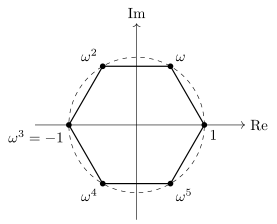
The solutions are Put . By Theorem 1.5.5,
for . By Theorem 1.6.2 (c),
there are exactly
solutions, the -th roots of
unity. They lie on , at the arguments
, equally
spaced around the circle: multiplying by turns each one
into the next (Theorem 1.5.3
(a)), and back into
(Theorem 1.6.2
(b)). For
they are the corners of a regular polygon with corners, one of them at
; for they are and
(Example (Special Angles)
(i)); for
only .
For , (Example (Special Angles)
(iii)), and . Hence , and . The
six roots are
The six roots sum to : since , we have
, so the roots cancel in the opposite
pairs , ,
. In the picture, the hexagon is
symmetric about its center . In general the sum is
Proposition 1.6.3
below.
We write for the set of -th roots of unity. It
is a subset of ,
since each element is some (Theorem 1.6.2
(a)). It contains , and it is closed under
products, since for (Proposition 1.1.3
(c)). It is closed under inverses, since gives ,
a product of elements of (for , ). Chapter 3
treats , like
, as an example
of a group.
The roots of unity also describe the roots of any
: the root
of Theorem 1.6.2
satisfies for , by Theorem 1.5.3 (a)
and Theorem 1.5.5,
since . So by Theorem 1.6.2 (c)
the -th roots of
are : one of them times the -th roots of unity.
The six roots canceled in pairs. The same pairing
works for every even , since (Theorem 1.5.5, Example (Special Angles)
(i)) gives ; but for odd there are no opposite
pairs: if and
were both
-th roots of
unity, then . A different argument is
needed. It is Lemma 1.1.4 once
more.
Proposition
1.6.3 (Sums of Roots of Unity)
Let
with , and
let .
- (a) For : if and only
if . In
particular .
- (b) .
- (c) For ,
Idea. Put .
The sum in (c) is , and Lemma 1.1.4
multiplies it by to give . If we may cancel, and the sum is ; if it is . Part (a) decides which
case occurs.
Comparing real and imaginary parts in (b), with (Theorem 1.5.5),
gives two real identities that are awkward to prove any
other way: for , Part (c) says more: the sum of the -th powers of the roots
of unity detects whether divides .
Quick check. Write the three cube
roots of unity in the form .
Solution. By Example (Roots of Unity)
with , they
are , , with (Theorem 1.5.5, and
the square computed for above). Since and , (Proposition 1.5.1
(a)). So the cube roots of unity are and . Without angles: , and Corollary 1.4.2
applied to , with a square root of , gives .
Polynomial
equations, and a look ahead
An -th root of
solves , a polynomial
equation of degree with only two non-zero
coefficients. The general question is whether every
equation has a solution in . Here the left side
is a polynomial expression , a
finite sum; Chapter 4 makes polynomials objects in their
own right. We built so that one such
equation, , has a solution, and Section 1.4 solved every
equation of degree . It turns out that
nothing more ever needs to be added.
One companion fact needs no heavy machinery: when the
coefficients are real, the solutions that are not real
come in conjugate pairs.
Proposition
1.6.4 (Real Coefficients and Conjugate
Roots)
Let ,
let , and let . Then Hence, if for some , then also .
Proof. First, for every , by Logic and Proof, Axiom 4.2.1
on : , since is real (Proposition 1.2.1);
and if , then , by Theorem 1.2.2 (b).
Next, since is real (Proposition 1.2.1),
so , again by Theorem 1.2.2 (b).
Finally, the conjugate of a finite sum is the sum of the
conjugates, by induction on the number of terms along
the recursion for finite sums, with Theorem 1.2.2 (a)
in the step. This proves the identity. If , then
.
A solution
that is not real gives a second
solution: , since with has , and . For example, has the solution , since ; so it also has the
solution .
Chapter 5 uses this to factor real polynomials into real
factors of degree
and .
Exercises
A. Check your
understanding
Exercise
(A1)
- (a) Find all with .
- (b) In the proof of
Theorem 1.6.2,
where is the uniqueness half of Proposition 1.5.4
used?
- (c) In the same
proof, why is the modulus of a solution forced to
be ?
- (d) True or false:
has exactly
three solutions in , and exactly one of
them is real. Justify your answer.
- (e) State the idea
of the proof of Theorem 1.6.2 in
two sentences.
Solution.
(a) By Example (Roots of Unity)
with , the
solutions are for , where
(Example (Special Angles)
(ii)): , , , .
(b) Twice. In
(a), to turn into the two
conditions and . In (b), to decide when
.
(c) Because and , and Lemma 1.6.1 (b)
says that is the
only non-negative real number with
-th power .
(d) True. By Theorem 1.6.2 (c)
there are exactly three. By the Check above they are
and ; the last two have imaginary part , so only is real.
(e) Polar form
and De Moivre split into a real equation for the modulus, which
has exactly one positive solution, and an equation for
the argument, which is solved up to the ambiguity . That ambiguity,
divided by ,
produces
different roots, one for each remainder modulo .
B. Practice
Exercise
(B1)
Find all with , in the form .
Solution. By Example (Special Angles)
(ii) and Theorem 1.5.3 (b),
, so is a
polar form, with and . Also . By Theorem 1.6.2, the
solutions are for , with arguments , and : by Example (Special Angles)
(i), (ii), (iv) and Theorem 1.5.3.
Check: , and , so .
Exercise
(B2)
Find all with , in the form , and check one of them directly.
Solution. A polar form is (Example (Special Angles)
(i)), and , since and . By Theorem 1.6.2, the
solutions are for . First,
(Example (Special Angles)
(v)). Next, , so (Theorem 1.5.3 (a),
Example (Special Angles)
(ii)). Hence that is, with all four choices of signs. Check:
, so
.
Exercise
(B3)
Let and
. Show that , that is closed under
multiplication, that for the inverse of is , and that
.
C. Going deeper
Exercise
(C1: Exit check: n-th roots)
Let and
with
, and let
be a polar form. Prove parts (a)
and (b) of Theorem 1.6.2: the
solutions of are exactly the numbers , , and if and only if . Cite the
polar form, De Moivre’s formula and the real -th root where you use
them.
Solution. Here (Proposition 1.5.4
(a)). The number
is not a solution, since , and is no , since (Lemma 1.6.1 (b)).
For , fix a
polar form with (Proposition 1.5.4
(a)); then (Theorem 1.5.5), a
polar form with , and by the uniqueness of polar form (Proposition 1.5.4
(b)), if and only if and . The first condition is , by
existence and uniqueness of the real -th root (Lemma 1.6.1 (b));
the second is for some . So implies ; conversely,
applied to the polar form , of , the equivalence gives . For (b), and are given in polar
form with the same modulus, so the same uniqueness gives
if and
only if , if and only if for some , that is, .
Marking scheme. (10 points) - 1:
rules out ,
with the reason . - 2: writes (and ) in polar form and
applies De Moivre’s formula to get . -
3: splits
into and
, citing the uniqueness of polar form,
and states both directions (every is a solution, every
solution is some ). - 1: , with
both existence and uniqueness of the real -th root cited (the
point is lost if either is assumed without citation). -
3: (b), , both directions. Fatal errors (0
for the step): concluding , or
,
from (dropping ); writing for a complex
. Second route:
find one root
and show that if and only if , then solve
by polar
form. The same points apply, with the 3 points of the
third line awarded for the roots of unity, and (b)
replaced by the distinctness of and the periodicity .
Exercise
(C2: Find the error)
Here is an argument.
Claim. For , the -th roots of unity sum
to .
- Let and .
(2) Then , since . (3) So
.
(4) Since is
an -th root of
unity, , so . (5) Hence , and .
Is the claim true? Does the argument prove it? If
not, name the first line that fails, say what is wrong
with it, give a counterexample to the step, and repair
the argument.
Solution. The claim is true: it is
Proposition 1.6.3
(b).
The argument does not prove it. Lines (1)–(3) are
correct: by Example (Roots of Unity),
and (3) is (2) rearranged. Line (5) is correct
given (4), since has no zero divisors.
Line (4) fails. “, so ” cites a general “fact”, that an -th root of unity is not
, which is false:
this is the error (N9) of Logic and Proof, Example (What is not allowed).
Counterexample to the step: itself satisfies , and . Being an -th root of unity gives
no information that separates from ; the information is in
the particular choice with .
Repair. If , then by Proposition 1.5.4
(b), so for
some ,
that is, and
. Since
, Number Systems: From to , Proposition 3.1.1
(e) gives ,
a contradiction. So , and lines (5) and the conclusion stand.
(This repair uses (T1)–(T3) of Axiom 1.5.2,
through Proposition 1.5.4
(b), and no value of the cosine.)
R. Review
Exercise
(R1)
Let satisfy and for all , , and for
every .
- (a) Prove that
either for every , or for every .
- (b) Show that
conjugation satisfies all the hypotheses on .
Solution.
(a) Since maps into , it restricts to a
map , , which preserves sums and
products and sends to . Since is a complete ordered
field (Number Systems: From to , Theorem 5.6.3),
Number Systems: From to , Theorem 6.3.4
gives : for every
real . In
particular , so So , and
or
(no
zero divisors in ; or Proposition 1.4.1
(b)). For with , If , then for every ; if , then
for every .
(b) Conjugation
preserves sums and products by Theorem 1.2.2 (a),
(b), and for every real (Proposition 1.2.1),
so in particular and real numbers go to real numbers.
The comparison with Number Systems: From to , Chapter 6 (Number Systems: From to , Theorem 6.3.4)
is the point:
has only the identity, while has exactly two such
maps. In the
order can be read off from the field operations (the
non-negative numbers are exactly the squares, Number Systems: From to , Proposition 6.1.4),
and a map preserving and must preserve it.
In there is no
order (Proposition 1.4.3),
and nothing written with , and real numbers
alone tells from
.
Exercise
(R2)
Let .
Show that is a well-defined bijection
, and that for all .
Solution. Write , the roots of in Theorem 1.6.2
(with ,
, as in
Example (Roots of Unity)).
The classes of Number Systems: From to , Definition 3.4.2
are congruence classes: if and only if . By Theorem 1.6.2 (b),
if and
only if .
Reading this equivalence from left to right, does
not depend on the representative of the class, so is well defined;
reading it from right to left, is injective. Each
lies in by Theorem 1.6.2 (a),
and every element of is some , again by (a); so
is surjective.
Finally, , and by Theorem 1.5.3 (a),
As a check on the count, both sets have elements (Number Systems: From to , Theorem 3.4.3
(b) and Theorem 1.6.2
(c)). In the language of Chapter 3, is an isomorphism from
the additive structure of to the
multiplicative structure of .
Exercise
(R3)
Let be an
ordered field and .
- (a) Prove that by comparing the squares of the two
sides.
- (b) The proof of the
same inequality by “trapping” between and , and adding the
traps for and
, works in every
ordered field. Which step of it cannot be carried out
for complex ,
and what replaces it in the complex triangle
inequality?
Solution.
(a) Both sides
are non-negative. By Number Systems: From to , Proposition 4.1.3
(b), , , and . Hence since (Number Systems: From to , Proposition 4.1.3
(c)). So . If , then Number Systems: From to , Proposition 2.3.5
(g), applied to these non-negative elements, would give
; so .
(b) The trapping
proof (Number Systems: From to , Proposition 4.1.3
(e), proved from (c)) uses : it compares itself with real
numbers. For a complex that is not real such a
comparison means nothing, since no order on is compatible with
its arithmetic (Proposition 1.4.3).
The squaring proof of (a) is the one that survives: in
the complex triangle inequality (Theorem 1.3.2) the
cross term
is bounded by a comparison between real
numbers, (Lemma 1.3.1),
which replaces here.
Exercise
(R4)
Find all with .
Solution. The tool: take
moduli first. If , then (Theorem 1.2.2
(d)), so and or .
If ,
then (Theorem 1.2.2
(e)), and is
a solution.
If ,
multiply by :
(Theorem 1.2.2
(c)). So is a
cube root of unity: or (the Check above).
Conversely, each cube root of unity lies in (Exercise B3), so
(Proposition 1.5.1
(a)), and because . So each is a solution.
The solutions are , , and .
Why the look-alike tools are worse.
Comparing real and imaginary parts, with , gives and , which can be
solved, but only with a case split by hand ( or ). “Divide
by
” silently loses
the solution .
Polar form works, but it is not needed: the moduli
settle , and
the cube roots of unity can be found without angles, as
in the Check.